#BringBack: Bring back the thousands, bring back the hundreds, bring back the one


January 14 will mark the ninth month since more than 300 schoolgirls were abducted from Chibok. At that time, women organized #BringBackOurGirls to break the national and global silence that covered the atrocity. Those women are still organizing, still mobilizing, still demanding action and accountability. Meanwhile, from the national as well as the global community, the silence has intensified. The Chibok women of #BringBackOurGirls warned, from the outset, that failing to act meant the violence, terror and horror would escalate and expand. This week, their prophecies came to horrible fruition.

Over the past week, Boko Haram is reported to have attacked and razed 16 villages. Baga has been emptied. Many were killed. Others fled to Chad. Many of those who fled drowned in their attempts to cross Lake Chad. Amnesty reports this as “Boko Haram’s deadliest act” thus far. According to survivors, women, children, elders and the disabled were the principal targets. They were hunted as they fled. Now, the landscape is littered with their dead bodies, burnt homes and abandoned villages. The bodies pile up, too many to bury.

Over the weekend, in Maiduguri, the capital of Borno state, a girl, some say she was ten years old, walked into a busy market. A bomb, strapped to her waist, exploded, killing many, wounding many more. The girl was torn into two halves.

Some say using a child so young is a new phase. It’s not. The schoolgirls of Chibok are the girl-child of Maiduguri. The line is direct. The women of #BringBackOurGirls said so, nine months ago, and no one listened. Will anyone listen now?

Bring back the hundreds; bring back the thousands; bring back the one. #BringBack #BringBackOurGirls #BringBackChibok #BringBackBaga #BringBackMaduguri #BringBackOurGirls #BringBackOurGirls #BringBack


(Photo Credit: Premium Times)
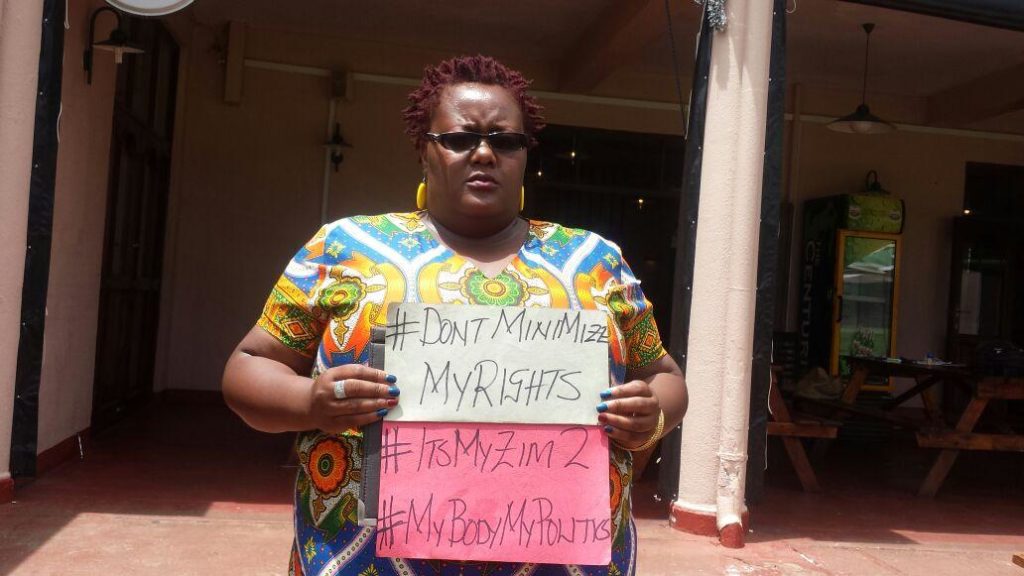
In Zimbabwe, women say #DontMinimizeMyRights!

On December 12, in Harare, a group of men attacked a woman. They were `punishing’ her for wearing a short or mini skirt. The woman was walking past the taxi rank when a man beckoned her over. She refused to answer. He called her a prostitute and then called his friends, and together they attacked her. Another man intervened to stop the men, and was threatened off. Finally, the woman paid a commuter omnibus crew two dollars and got away. The assault was captured on video, which went viral.

Women immediately organized. #DontMinimizeMyRights began to appear on social media, placards, and in the air. The full message began to circulate: #DontMinimizeMyRights. Our Cities. Our Streets. Our Dignity. Our Rights. Our Ubuntu. Hunhu Hwedu. Respect for all. Women organized a protest march, not the first one to take on violence against women that occurs within the fog of `preserving traditional culture.’ In the streets, courtrooms, police station, legislative bodies, schools, crèches, kitchens and beyond and in between, women spoke out.

Harare West MP Jessie Majome explained, “This is a fundamental women’s rights issue. It violates all known basic freedoms, freedom of movement and expression; it undermines everything and even the right to the protection of the law and the right to equality.” Tendai Garwe agreed, “For the women of Zimbabwe, this is an opportunity for us to be heard and to realise that we are coming for the rights that have been side lined for too long. This is not just about a mini-skirt issue because if you can control what l wear what else are you controlling? What power do you have over me? We are very interested in this case because we are pushing an agenda for the amplification of voice and the rights of women.” Women Coalition board member Ms Nyaradzo Mashayamombe added, “It might appear as an act directed at one woman, but its effect is to damage our children psychologically, dehumanise women and present us as a lawless nation. As women of Zimbabwe, we will not stand by and watch women being harassed and humiliated.” SAfAIDS communications director Tariro Makanga warned, “Enough is enough. This is our last time to talk as women. Now we want action!”

Jessie Majome added, “There is no public transportation system and this leaves commuters, especially defenceless women prone to such violent attacks. The government must come up with measures to address the current crisis as well as create employment to ensure that these people who have turned to touting for a living have decent jobs. We need an effective transport system that is convenient and reliable.”

Assaults on women that use clothing as a pretext, whether they come from the government, as in Uganda, or from men on the street, as recently in Kenya, are never an assault on one woman and never occur spontaneously. They attack women’s mobility, presence and power. They attack any hint of intervention into patriarchy. They work to deflect critical energy and attention on failings of the State and society. Violence against women occurs in a climate as well as an instant. That climate is not exclusive to Zimbabwe nor to Africa. In 2012, India, Kyrgyzstan, Indonesia, South Korea, Mexico, Nepal, France, and the United States engaged in State policing of women’s fashion. In New York, for example, transgender women, and especially transgender women of color, were routinely stopped, for the crime of cross-dressing.

And the women always fight back and organize. In South Africa, Namibia, Malawi, Kenya, Uganda, and Zimbabwe, women have forcefully rejected the violence and the excuses for the violence. They have thrown out the alibis of the State and have managed to throw out the State on occasion. Women don’t forget. For Tafadzwa Choto, a prominent Zimbabwean activist, two events politicized her. The first occurred in 1993: “A woman at the University of Zimbabwe was stripped of her skirt. It was said to be a miniskirt and was publicly ripped off her. I was disgusted.” The second was in 1995: “In Harare, in the city center, … three civilians were shot by the police, while the police were chasing after some thieves who had stolen a manual typewriter. Three civilians were shot dead and for what?”

#SavetheMiniskirt. #StripMeNot. #MyDressMyChoice. #DontMinimizeMyRights.

#DontMinimizeMyRights. Our Cities. Our Streets. Our Dignity. Our Rights. Our Ubuntu. Hunhu Hwedu. Respect for all.

(Photo Credit: Afrika Kontakt)

To those who turned their backs on Akaila Gurley: Shame

Akaila Gurley searches for her father


On November 20, Akai Gurley was walking with his girlfriend in a dark stairwell in `the projects’ in New York. An officer came upon them, fired and killed Akai Gurley. Gurley was unarmed. Gurley was Black. Gurley was 28 years old. Gurley was a father. His daughter, Akaila Gurley, is two years old.

The local district attorney is impaneling a grand jury to `investigate the matter.’ Many in New York have protested Akai Gurley’s killing and it context. Their placards read: “Once again in sorrow”, “Not one more”, “Don’t shoot”, “We are human.” Some ask questions: “How long will they kill our sons and daughters while we stand aside and look?” Others simply call for the names: “AKAI GURLEY”.

Akaila Gurley is often at the head of the protests. Akaila Gurley is two years old. Every one of the lethal bullets this year, and in for decades past, has not hit only its victim. Each bullet struck a daughter, a mother, a partner, a community. Whatever the grand jury finds, whatever the newspapers report or the scholars later on unravel, this much is clear right now. Akaila Gurley’s is two years old, and her father is dead.

Akai Gurley was not killed simply by a single officer, and that bullet was no “unfortunate accident”. Akai Gurley was killed those who have agreed that parts of a city are `real estate’ rather than residents, that some must `tragically’ die so that others might prosper. What is the lesson for Akaila Gurley and for the children of her community? The slaughter of the innocents never involves only the innocents slaughtered. The slaughter of the innocents attacks the dreams and aspirations of generations of innocents, no child left innocent behind. To those, uniformed and not, who turned their backs on Akaila Gurely, one word: shame.


(Photo Credit: Nicole Bengiveno / The New York Times)

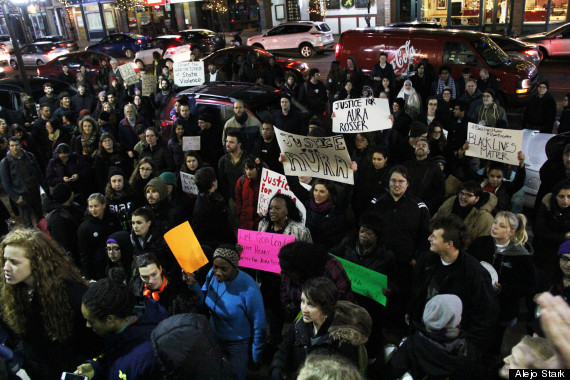
Aura Rosser, Kyera Singleton, Shae Ward, Shirley Beckley: Black women’s lives matter

A year ago, Aura Rosser moved from Detroit to Ann Arbor to start a new life, and by many accounts, she was succeeding. On November 9, however, she and her partner were fighting. Her partner called the police. Two police officers arrived. One of them shot and killed Aura Rosser, who apparently held a knife in her hand. Then the police department went silent. The ACLU and the Ann Arbor Independent filed Freedom of Information Act applications. Students and townspeople organized. The officers were named. The Ann Arbor City Council voted to equip police with body and car cameras. The lack of cameras did not kill Aura Rosser. A man with a gun killed Aura Rosser.

Students, led by Kyera Singleton, have mobilized communities across Ann Arbor and beyond. Singleton explained, “It’s really important that we break the silence about who’s a victim of police violence. We can’t be silent when it happens to a woman and then go out and march when it happens to a man. … These national movements often take place around the bodies of men, and then black women may get erased.”

Aura Rosser’s sister, Shae Ward, agrees. She knew Aura Rosser and doubts that she would have actually attacked anyone, much less someone with a gun. Who was Aura Rosser? According to Shae Ward, “She was very artistic. She was deeply into painting with oils and acrylics. She’s a culture-type of gal. She was a really sweet girl. Wild. Outgoing. Articulate.” She was also the mother of three children.

Now, communities are trying to raise money for the funeral and for the children. Many are asking where the State is in all this. They argue that the State, in this instance Ann Arbor, killed a young Black woman, and the very least it could do is to bear the expenses of her funeral. Ann Arbor has opted to purchase cameras for police bodies and cars.

Shirley Beckley, 71 years old, went to the City Council and demanded a different kind of payment. Respect. Dignity. She asked for three minutes of silence. This request actually confused the City Council, but finally, after the Mayor laughed, they allowed for three minutes, three whole minutes, of silence.

Black women’s lives matter. Cameras will not stop the State assault on Black women’s lives. They will only record and document the assaults. In the same way that prisons have not reduced crime, because they never were intended to, cameras will not reduce State violence against Black women, people, or communities. Only a fundamental change in policing practices and cultures will begin to do that, and that change begins with this: Black women’s lives matter.


(Photo Credit: Huffington Post / Alejo Stark)

In Burkina Faso, the women continue to push for justice and transformation

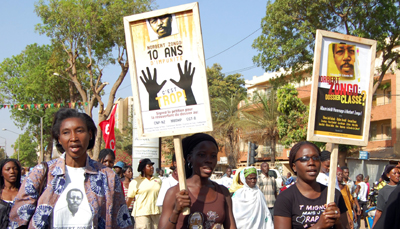
In October, women carrying spatulas took to the streets of Ouagadougou, and sparked an uprising that finally overthrew Blaise Compaoré. With spatulas and brooms, they pushed open doors and windows that had been long closed. Thomas Sankara’s widow, Mariam Sankara, called for a real investigation into the circumstances of her husband’s death. Joséphine Ouédraogo, a minister in Sankara’s government, was appointed Minister of Justice. This week, Ouédraogo announced that she will re-open the investigation into the murder of Norbert Zongo, a prominent journalist who was killed in 1998. Genevieve Zongo, his widow, has been pushing for an investigation for the past sixteen years. Now, at last, as a result of women’s organizing, that investigation will take place.

In December 13, the anniversary of Norbert Zongo’s murder, Genevieve Zongo told the thousands of demonstrators who had gathered to demand justice, “I demand that that the perpetrators be arrested and judged for the full extent of their crimes.” Burkinabé women never stopped demanding justice, for their loved ones, for themselves, for the strangers who had been imprisoned, tortured, murdered.

As a militant feminist, trade unionist, and journalist, Genevieve Zongo never gave up on the struggle for justice. First, she tried the Burkinabé courts. Then, in 2008, she launched the Ten Years campaign, and went international. In 2011, Zongo took her case to the African Court on Human and Peoples’ Rights, in Arusha, Tanzania. On March 28, 2014, the Court “concluded that the Respondent State, Burkina Faso, failed in its obligation to take measures, other than legislative, to ensure that the rights of the Applicants for their cause to be heard by competent national Courts are respected. The Respondent State … failed to act with due diligence in seeking, trying and judging the assassins of Norbert Zongo and his companions. Hence, Burkina Faso simultaneously violated Article 1 of the Charter by failing to take appropriate legal measures to guarantee the respect of the rights of the Applicants pursuant to Article 7 of the Charter.” The Campaoré administration did nothing in response.

But that’s all changed now, thanks to the persistence of women, the road to justice and democracy is being built. Some of the women – like Mariam Sankara, Joséphine Ouédraogo, and Genevieve Zongo – are well known. Others are not. But the women’s message across Burkina Faso is clear. The years of impunity are over. Women with spatulas and brooms and elbows and voices and dreams and aspirations and demands are pushing for more. Thanks to these women, a new day is dawning, and hopefully not only in Burkina Faso.

(Photo Credit: AFP)

Joséphine Ouédraogo’s long slow burn to democracy

Joséphine Ouédraogo

For some, it’s the end of the year, and so a time for reflection and celebration. 2014 has been a year of brave, inspiring young feminists. It has also been a year in which women, young and old and in between, have pushed out long-standing rulers and sparked the process of State transformation. In Burkina Faso, women sparked a revolution with their presence in the streets and their raised spatulas. Joséphine Ouédraogo was there, as she has been for decades.

A number of commentators have identified Burkina Faso as a bright spot for the year, even though they seldom, if ever, recognize women’s role in that brightness:

For protesters in Burkina Faso who have known only one ruler for the last 27 years, 2014 was a very good year. The peaceful overthrow of Blaise Compaoré at the end of October was a victory for democracy.”

Large segments of society were demanding the benefits of genuine representation. Democracy could not be reduced to a facade while old authoritarian networks remained. It was a striking warning to other African autocrats who might be tempted to stay in power indefinitely.”

Over the course of a couple of days in late October, an awe-inspiring display of people power in Burkina Faso forced President Blaise Compaore to scuttle into exile, his tail firmly between his legs. It was a humiliating exit for the man who had ruled Burkina Faso since 1987 … This was a magnificent example that power is not immutable; that people can be in control of their own destinies.”

Call it Spring, call it harmattan, women’s protests led to mass protests led to hope and the promise of democracy. Inside Burkina Faso and around the world, people spoke once again of Thomas Sankara, the President of Burkina from 1983 to 1987, when he was assassinated. In particular, people were reminded of Sankara’s commitment to women’s emancipation. He wrote and spoke of women’s liberation often: “The revolution and women’s liberation go together. We do not talk of women’s emancipation as an act of charity or because of a surge of human compassion. It is a basic necessity for the triumph of the revolution. Women hold up the other half of the sky.” More to the point, Sankara acted. His government outlawed female genital mutilation, forced marriages and polygamy; encouraged women to work outside the home; encouraged girls and women to stay in school, even if pregnant; promoted the distribution of contraceptives. Finally, he appointed many women to high governmental positions. Joséphine Ouédraogo was one of those women.

During the Sankara years, Ouédraogo was Minister of Family Development and Solidarity. Every attempt to transform women’s status and place in Burkina Faso came out of and was implemented by Ouédraogo’s office, including State support for the Women’s Strike of 1984.

When Sankara was overthrown and murdered, Ouédraogo went into exile. She worked as a consultant on development and gender. She continued to work as a sociologist, researching areas that others overlooked, such as the role of women heads of households in rural Burkina Faso. In 1997, Ouédraogo became Director of Gender and Development at the United Nations Economic Commission for Africa, followed by a stint as Secretary General of Enda-Third World, based in Dakar. In both positions, she spoke forcefully and directly of the central position of women in any program to improve the world or any of its parts.

And now, Joséphine Ouédraogo is back in Burkina Faso, and back in the government. She is a self-described militant feminist and militant anti-globalization activist, and she is now the Minister of Justice of Burkina Faso. From 1987 to the present, Joséphine Ouédraogo never forgot the revolution she had helped start, and she never tired of working to create the new spaces for militant democratic practice and for women’s emancipation. As she has known all along, the two need each other. And today, Joséphine Ouédraogo’s long slow burn has been a key part of the Burkinabé women’s spark that set off a revolution.

(Photo Credit: Ouaga.com)

Texas built a special hell for immigrant women and children

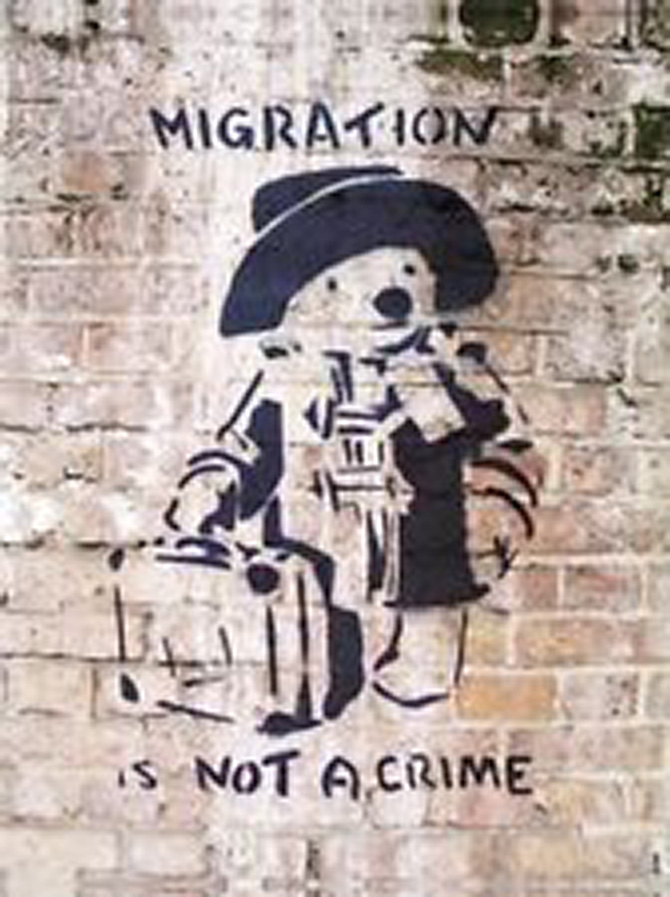
Today, December 18, 2014, is International Migrants Day. On December 18, 1990, the United Nations General Assembly adopted the International Convention on the Protection of the Rights of All Migrant Workers and Members of Their Families. What better way to honor that convention than to build the biggest, baddest prison for migrant women and children? Welcome to Texas, welcome to the United States of America, welcome to hell.

Here’s how the United States builds hell. First, constitute migrants and immigrants as a threat. Include asylum seekers and refugees in this. Then, quickly translate threat into criminal element. Then build the prisons, et voilà! Hell! Homeland Security keeps building prisons for immigrants and migrants. It builds “family detention centers” for women and children. It then outsources the job to a limited number of mega companies. They keep failing at the job and then keep getting new contracts. The prisons keep “running into difficulties”, ranging from lack of health care and education and recreational facilities to overcrowding to sexual exploitation and violence by the staff.

Early this week, Homeland Security Secretary Jeh Johnson toured a site in Dilley, Texas, that `promises’ to be the largest “family residential center” in the country. By end of May, it will hold 2400 “family members,” overwhelmingly women and children, overwhelmingly from Central America. Meanwhile, earlier in December, after some debate and resistance, Karnes County agreed to expand its “family residence” from under 600 to close to 1200 beds. Forcing children and women to live behind razor wire is a growth industry in south Texas this year. Homeland Security sees dropping children into cages as “a deterrent.”

Here’s a typical story from Karnes: “Ana and Victor are from El Salvador, and along with their mother, Alta Gracias, and their 2-year-old brother, Martín, they have been held at the Karnes detention facility for over two months … As the years passed and her children grew up, Alta worried about raising her children in an environment rife with extreme poverty and violence … She was afraid her daughter’s pretty face and her son’s rambunctious spirit would get them into trouble. So she did what any good parent would do: look for a brighter future for her children. Because her husband was already in the United States, it seemed like the best option, despite the hazardous journey.”

Here’s another typical story from Karnes: “This fall, Zadia and her son Jose came to the United States to escape years of physical abuse by her common-law husband. With the help of members of their church, Zadia and Jose fled Honduras. But rather than find refuge, they have been locked up for the last seven weeks in Karnes City, Texas, at one of the federal government’s new detention centers for migrant families.”

The typical is actually worse. The American Civil Liberties Union, the Mexican American Legal Defense and Education Fund and others have written letters, filed complaints, and sued the Federal government because of the conditions at Karnes. MALDEF has documented numerous cases of sexual abuse, extortion and harassment of women. The ACLU cites numerous women, who fled domestic violence at home, only to be locked behind bars in Texas.

None of this is new. It repeats the violence against women that marked T. Don Hutto Residential Center, five years ago also in Texas, and the Eloy Detention Center in Arizona and the Artesia “Family Residential Center” in New Mexico. Everyone of them a colossal snake pit of sexual violence, extortion, harassment of women and children. Everyone of them a death-in-life sentence for hundreds and thousands of children and their mothers. Each time the violence is “discovered”, the “residents” are shipped like so much cargo to the next killing field.

Honor International Migrants Day by celebrating the miracle of freedom, freedom of movement, association, life, choice and love. Celebrate the miracle of being truly human. Close the prisons. Tear down the walls. Beat the guns into plowshares and the barbed wire and batons into pruning hooks. Welcome the migrants with open arms. Welcome the stranger as yourself.

(Image Credit: Migration Museum)

No crime, no trial, indefinite detention: Happy birthday Glory Anawa

Suffer little children, and forbid them not, to come unto me: for of such is the kingdom of heaven.” We have traveled far, and quickly, from such notions of childhood, tenderness, and caring. Instead, we now have prison camouflaged as `detention’, and hell powder puffed as “indefinite detention.” Indefinite detention is not indefinite. It’s eternal damnation, and we, not the children, are the damned.

Glory Anawa fled Cameroon after a threat of Female Genital Mutilation. She sought refuge. Now she sits in a Canadian immigration detention center with little to no hope of seeing anything like freedom ever again.

Anawa’s story is long and complicated, and yet quite simple. At the age of 23 and pregnant, Glory Anawa was sent to Yarl’s Wood, where she remained until she was 8 months and 2 weeks pregnant. Then she was released … for a matter of weeks, after which it was back to Yarl’s Wood for the young mother and her 6-week-old daughter, Tracy. From there, things went downhill, as they had for other mothers and daughters in Yarl’s Wood. Finally, Glory Anawa and daughter Tracy were released.

In February 2013, Glory Anawa, pregnant, sought refuge in Canada. She was immediately taken into custody. In August 2013, Glory gave birth to her son, Alpha Ochigbo. Since birth, Alpha, a Canadian citizen, has been with his mother in prison. The authorities have tried to deport Glory, but Cameroon won’t provide papers. So, Glory Anawa is stuck, because Canada does not have a limit on how long it can detain immigrants, migrants, asylum seekers, or refugees. Glory is not stuck. She has been firmly planted by Canada into a new rung of hell, that of the women who seek asylum, refuge, or help. Welcome to the neoliberal world order.

I don’t even have words to express how I feel. It makes me speechless. I’ve been robbed of my life,” says Glory Anawa. Suffering beyond expression followed by silence followed by a total and global theft that results in death-in-life. Around the world, this is the formula for those who seek asylum, generally, and for women in particular. Canada adds the twist of indefinite detention. Glory Anawa is one of 145 migrants in Canada who are under indefinite detention. Why? Why hold anyone indefinitely? Why hold those who have committed no crime indefinitely? Why hold those who have never been tried indefinitely?

Today, December 15, 2014, is Glory Anawa’s 29th birthday. She should not be condemned to indefinite anything. No one should. And we should not be condemned for eternity for the crime of looking the other way. Tear down more than the walls. Tear down the processes, tear down the consciousness that allows us to think it’s right to condemn women, children, men, all who seek haven from a life of pain and suffering.


(Photo Credit: TheMainlander.com)

In Kenya, the women say, “NON-NEGOTIABLE: my body my womb my rights”

In Nairobi this week, five women wearing t-shirts walked into court. On the back, the t-shirts read: “NON-NEGOTIABLE: my body my womb my rights.” On the front, the t-shirts read, “END FORCED AND COERCED STERILIZATION OF WOMEN LIVING WITH HIV”

The five women, all HIV positive, are suing the Kenyan government, two maternity hospitals, and two international ngo’s for engaging in forced and coerced sterilization. They join women living with HIV in Namibia who recently won a similar case, and who had an identical rallying cry. They join the women of Chhattisgarh and across India who have survived the `sterilization camps.’ They refuse to join the women who died in those camps, though they honor them. They have joined the women prisoners across California who this year finally won the end to forced sterilization of women prisoners in that state. They join women, poor and minority, in North Carolina who finally are receiving some sort of compensation for their mistreatment, to put it gently, in forced sterilization campaigns. They join women living with disabilities in Belgium who resist coerced sterilization. They join women in Peru who eighteen years after the cessation of formal forced sterilization programs still struggle for justice. They join the Aboriginal and Indigenous women and girls across the Americas and Australia who still wait for an accounting of forced sterilization program. They join these women, all of them shouting, “NON-NEGOTIABLE: my body, my women, my rights.”

One of the women, Teresia Otieno, explained, “I went in for an operation to give birth to my first child. By the time I was leaving the operation the doctor told me I had been sterilized.” According to Benta Agola, another one of the women, the medical staff misinformed her every step of the way, and then proceeded onto the sterilization: “I wasn’t involved in decisions.” One woman reports she was threatened with a cut off of baby formula milk if she didn’t go through with the tubal ligation: “The nurse said I could not continue giving birth in the future as giving birth would compromise my immunity and as a result I would die. I eventually gave in but after the procedure I have always had pain in my abdomen especially during the cold season and also cannot undertake heavy chores.” One of the women discovered she had undergone tubal ligation four years after the procedure.

The women are represented by lawyers from KELIN, a nongovernmental organization that advocates for the rights of those living with HIV, and activists from the African Gender and Media Initiative, or GEM. Two years ago, GEM released a report, Robbed of Choice: Forced and Coerced Sterilization Experiences of Women Living with HIV in Kenya. The report documented the forced sterilization of 40 women living with HIV, or WLHIV: “In many cultures including the African, motherhood is at the core of femininity and status in society. The narratives documented here illustrate how WLHIV who have undergone nonconsensual sterilization are no longer considered, women, in their respective communities as these sterilizations are permanent and irreversible in most cases. We hope that this publication will commit the government of Kenya to act by putting in place appropriate measures to prevent and respond to forced and coerced sterilization and ultimately stop torture of WLHIV in healthcare facilities.”

These five women in Kenya are part of a global movement of women challenging the global program of forced sterilization of women. It’s past time to end it. Codify and pay just compensation to survivors of forced sterilization. Establish serious global structures to enforce informed consent. Listen to the women: NON-NEGOTIABLE: my body my womb my rights!


(Photo Credit: http://news.bbcimg.co.uk)

Women are the unexplained unexplained of the global wage gap

Last week, the International Labour Organization published Global Wage Report 2014/5. The largely report confirms what many already know and live. First and last, wages matter: “Wages are a major source of household income in both developed economies and emerging and developing economies.” Second, wages in so-called developed economies have been fairly flat, while wages in so-called emerging and developing economies are moving at a better pace. In fact, global wage growth, such as it is, has been driven almost exclusively by the emerging and developing economies. For example, if China is taken out of the mix, the global wage growth is cut in half. But the real growth, globally and regionally and locally, is in inequality. There’s big money in the production of every widening wage gaps. And here’s where women come in:

“In almost all countries studied there are wage gaps between men and women as well as between national and migrant workers…These wage gaps can be divided into an `explained’ part, which is accounted for by observed human capital and labour market characteristics, and an `unexplained’ part, which captures wage discrimination and includes characteristics (e.g. having children) that should in principle have no effect on wages. The report shows that if this unexplained wage penalty was eliminated, the mean gender wage gap would actually reverse in Brazil, Lithuania, the Russian Federation, Slovenia and Sweden, where the labour market characteristics of the disadvantaged groups should result in higher wages. It would also nearly disappear in about half the countries in the sample of developed economies.”

There’s a gender wage gap, and it’s growing; a motherhood wage gap, and it’s growing; an immigrant wage gap, and it’s growing and for the immigrant mother worker’s wages, there’s a special place. The new world order has a new triple burden for women, a trifecta of gaps that women carry not on their shoulders but in their bodies. The ILO calls these burdens unexplained gender wage penalties. Women are being punished and fined for being women, and the penalty fines are getting steeper by the day.

So, what is to be done? For the ILO, the way forward is fairly straightforward. Raise the minimum wage. Promote job creation. Promote equal pay for work of equal value: “provide for the right to equal remuneration for work of equal value and effective access to justice to claim this right…Equal pay between men and women needs to be promoted through strong policies to promote gender equality, including combating gender-based stereotypes about women’s roles and aspirations, strengthening policies on maternity and paternity as well as parental leave, and advocacy for better sharing of family responsibilities.”

In 2002, then Secretary of Defense Donald Rumsfeld responded to a question concerning Iraqi weapons of mass destruction and Iraq’s ostensible support for terrorist organizations: “Reports that say that something hasn’t happened are always interesting to me, because as we know, there are known knowns; there are things we know we know. We also know there are known unknowns; that is to say we know there are some things we do not know. But there are also unknown unknowns — the ones we don’t know we don’t know.”

Twelve years later, there are explained parts of wage gaps, and there are unexplained parts of wage gaps, and then there are the unexplained unexplained parts of wage gaps, and those are the ones who live at the juncture of the explained and the unexplained, the ones we do know: women. Rumsfeld’s gone, but the war continues, the global war on women.


(Image credit: Ilo.org)