Danielle Hicks-Best: “I’ve given up on justice”

Danielle Hicks-Best today

In 2008, when Danielle Hicks-Best was eleven years old, she was raped … twice. She reported the rape to the District of Columbia Police Department. As happens so often, the police did not do nothing. They arrested the eleven-year-old Black girl, Danielle, for filing a false report. There was medical evidence of sexual violence, and it didn’t matter. The police focused on the girl in front of them rather than the men who had committed the violence. The same thing had happened to Lara McLeod, in nearby Prince William County, who explained, “People say rape is serious and you should report it, but look what happened to me: I reported my rape and they told me it never happened.” Danielle Hicks-Best is even more succinct, “I’ve given up on justice. I’m at the point where I no longer hope for anything to come out of this case.”

And that’s the point. The reports suggest that the State “failed” Danielle Hicks-Best. There was no failure in Washington, DC, or in Virginia or in all the other places, around the world, where this story is continuously repeated.

The State, got exactly what it wanted, what it pushes strenuously to get: a woman living with trauma, agony and pain who has learned to silently absorb injustice directed at her as a woman. Ask Veronica Best, Danielle’s mother: “After 11, she lost the rest of her childhood.” There was no failure, because no one cared enough to begin an investigation.

The police now say the arrest and subsequent treatment of Danielle Hicks-Best was “tragic.” While searingly painful and horrible, the actual event was too common by far to qualify as tragedy. Turning rape survivors into liars is part of a program of mass criminalization and hyper-incarceration, and the younger the survivor the more brutal and intense the State violence against them. In a country where girls go to jail for status offenses and boys … will be boys and so are left free, this is no surprise. Girls and women are convicted of the crime of having survived and of having given testimony. For girls and women, speaking is crime. It’s the price of citizenship in the new democracies.

Remember that as you read or ponder the stories of Danielle Hicks-Best or of Lara McLeod. The State got what it wanted. It’s time for us to get the State we want.


(Photo Credit: Washington Post / Sarah L. Voisin)

Christiane Taubira: “Parfois résister c’est rester, parfois résister c’est partir”

Christiane Taubira

Christiane Taubira, France’s Minister of Justice, resigned today. As she explained, “Sometimes staying is resisting, sometimes leaving is resisting”. We’ll have something on Christiane Taubira in the next couple days. For the last four years, Brigitte Marti has written regularly, at Women In and Beyond the Global, about Christiane Taubira’s struggles to reform the French penal system, to restore justice to so-called criminal justice, all the while combating racist sexist attacks on her and her policies. Christiane Taubira may be leaving the government, but she is not leaving the struggle for women’s rights, immigrants’ rights, workers’ rights, prisoners’ rights, gay rights, minority rights and more, all in the context of a vision of a realizable just world. A just world is possible!

Christiane Taubira explains prison

Here’s a partial list of Brigitte Marti’s pieces that, from June 2012 to last year, profiled Taubira’s varied engagements and interventions:

Resistances, les femmes, le pouvoir et l’élection (June 18, 2012)

From Paris to Baltimore, our prisons are full but empty of sense (November 21, 2012)

In France, mandatory minimum sentences kill (June 27, 2013)

Scandal in France! Prison as a last resort! (August 19, 2013)

Evolution of a scandal in France (August 29, 2013)

Must punishment mean prison? Why are you asking? (September 21, 2013)

These racist attacks assault the heart of the Republic (November 13, 2013)

It is the responsibility of the State to defend reproductive rights and health (November 21, 2013)

French prison guards strike for global incarceration and dehumanization (May 13, 2014)

The false case against Christiane Taubira (May 24, 2014)

Can Christiane Taubira move France from repressive to restorative justice? (June 2, 2014)

France’s twisted road to restorative justice (July 22, 2014)

From Paris to Washington, all women need easy access to real help in times of crisis (August 29, 2014)

In France, isolation is not the answer to anything! (July 22, 2015)


(Photo Credit: Women In and Beyond the Global)

Remember Marikana


(Photo Credit: Dave Mann / The Con)

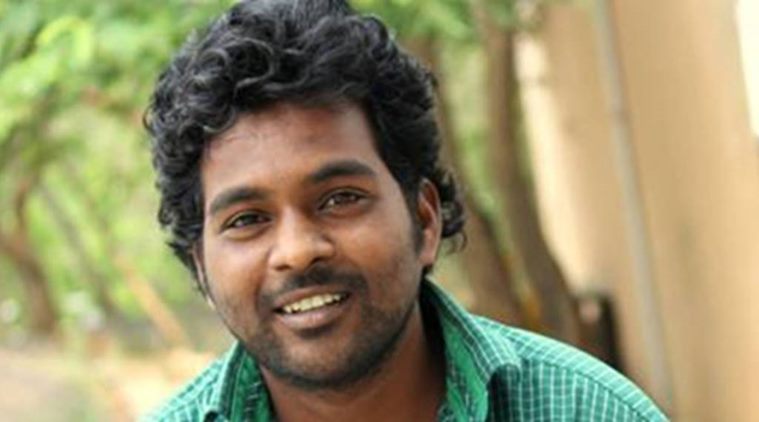
Rohith Vemula: The rot of caste privilege and the price of a Dalit scholar’s life

Rohith Vemula

Rohith Vemula was the leader of a Dalit student organization, Ambedkar Student Association at the University of Hyderabad. He was a bright student on a scholarship in a prestigious PhD program, interested in science studies. His coursework complete, he had just received approval for his research proposal. His dream was to become a science writer like Carl Sagan.

Because of a complaint by the rival, right-wing student association ABVP’s leader N. Susheel Kumar, that he had been assaulted by Rohith and his friends, Rohith had become the target of three different investigations by local neighborhood police and the university. Starting in September 2015, the Union Minister for Human Resources Office had written three letters to the university pressuring them to take action against Rohith and four other ASA members. One faculty member asked, why these investigations about a minor student-student altercation were so drawn out: why was it not settled swiftly? After all, the doctor who examined the claim to assault by the ABVP student said he had one small bruise on his body and did not show any signs of assault.

The altercation was politicized from the start. The ABVP is allied to the RSS, an extremist Hindu nationalist organization popular with upper-caste Hindu communities, whose political arm is the BJP (the political party currently in power in India). India’s largest student union, the ABVP has in recent years been known for disrupting campus dialogue on Kashmir (Pune), secularism, and, at Rohith’s campus, the ASA’s screening of a film on Hindu-Muslim riots in Muzaffarnagar in north India. The scuffle involved both ABVP and ASA students when the latter had demanded an apology for the disruption. Only five ASA students were singled out and suspended in August 2015 by the university.

Subject to three institutional investigations, suspended from the university for seven months while these were ongoing, Rohith’s situation kept worsening. His scholarship was withheld for these seven months, a terrible financial hardship for him and his poor family, which earlier subsided largely on his mother’s daily wage labor of sewing and tailoring. Following three letters from the Ministry of Human Resource Development urging action against these five students, on 16 December 2015, these student-activists were expelled from their dorm, and barred from entering administrative buildings and shared spaces on campus, such as the library. This institutionalized discriminatory treatment in the very educational institution that is supposed to enshrine equal and democratic rights, was part of his long experience of discrimination, “in studies, in streets, in politics, and in dying and living.” As he wrote in his suicide note, “Never was a man treated as a mind. As a glorious thing made of star dust.”

Denied dignity and human rights, Rohith and the four other expelled students launched a 14-day sleep-in strike to protest their treatment. On the fourth day of this strike, Rohith died, gently asserting, in what Manash Bhattacharjee notes is the clarity of a suicide note, “Do not shed tears for me. I am happy dead than alive.”

Following the suicide and related media protests across India, the suspension of the other four Dalit students was reversed. Only proving Rohith’s suggestion, that his birth as a Dalit drove the harassment he faced; though not just that, but also the fact that he spoke up as a Dalit subject, as an activist, and he exercised his constitutional rights of free speech, because he thought he lived in a democracy. But he spoke up in a political climate that has become increasingly inhospitable to dissident voices, be they Muslim, Dalit, secularist, or feminist. His treatment violated the equality promised in our constitution, and his young life was lost needlessly, as Ananya Vajpeyi writes, “to our eternal shame.”

Rohith’s mother has rejected the state’s offered payment of INR 8,00,000 (US$ 11,838) as compensation for Rohith’s death. Given the withholding of the stipends that would have paid for food and living expenses, and driving him to suicide, this seems like a cruel joke. She demands that the politicians and officials involved be held accountable and responsible for driving him to this.

Rohit Venkatramakrishnan has written that Rohith’s death indicts us all. When death or the risk of death seems happier than life to a young student in Hyderabad, or Syria, or a young Buddhist monk in Tibet, we are looking at a deeply traumatic, and multi-layered historical experience of persistent cruelty, violence, dispossession, and dehumanization. Rohith’s death is an indictment not only of the society, but also of the state and its Delhi ministries, that failed to protect the dignity and human rights of some of India’s most vulnerable citizens. In 2016, this points to a crisis in caste relations, minority experience, and inequality in India that needs to be addressed now, by all of us.


(Photo Credit: The Indian Express)

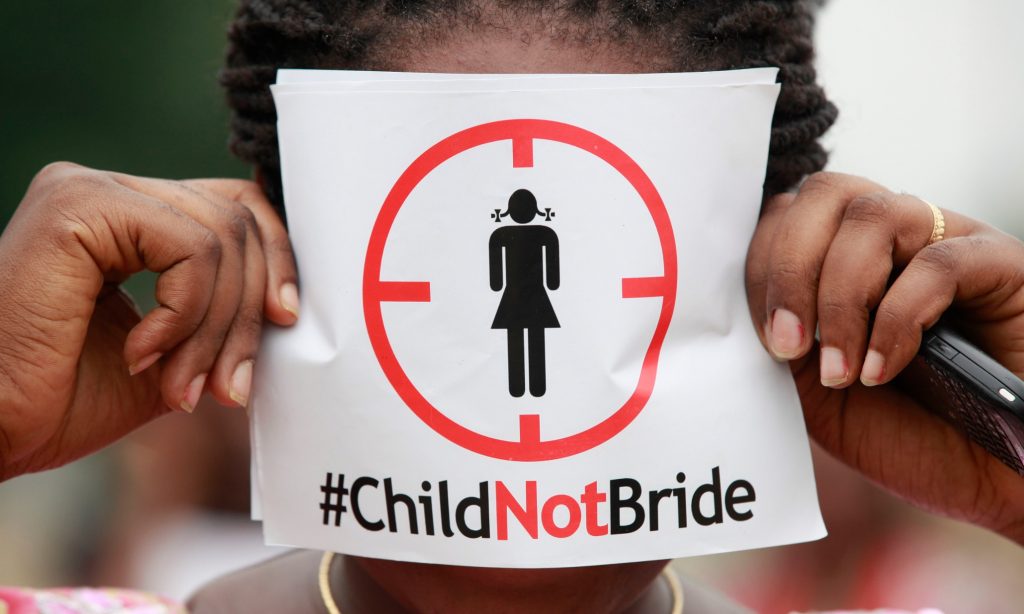
In Zimbabwe, the Constitutional Court supports girls who say NO! to child marriage


On Wednesday, Zimbabwe’s Constitutional Court banned child marriages, outlawing the marriage of children below the age of 18. In November 2014, Loveness Mudzuru and Ruvimbo Tsopodzi filed a suit in Zimbabwe in which they charged that the situation of “child brides” violated girls’ constitutional rights. They named Justice Minister Emmerson Mnangagwa, Ministry of Women’s Affairs, Gender and Community and the Attorney General’s Office as respondents responsible for implementation of the Customary Marriages Act, which allows for girls to be married at 16.

Age prohibitions are like speed limits. There’s the letter of the law and then there’s the car on the road. Ruvimbo Tsopodzi was married off at 15: “I’ve faced so many challenges. My husband beat me. I wanted to stay in school but he refused. It was very, very terrible. I want to take this action to make a difference. There are a lot of children getting married.” Tsopodzi is the mother of one child.

Loveness Mudzuru was married off at 16. By the time she was 18, she had given birth to two children: “Young girls who marry early and often in poor families are then forced to produce young children in a sea of poverty and the cycle begins again. My life is really tough. Raising a child when you are a child yourself is hard. I should be going to school.”

The Constitutional Court decision has been described as revolutionary. Tendai Biti, who represented Mudzuru and Tsopodzi, said, “It’s an amazing judgment. The court has passed a revolutionary judgment for women, girls and children. The court should be congratulated for that,” said Biti, who is also opposition PDP leader. I am very pleased to be part of this great history. Parliament should have done this 36 years ago. It has taken a bold decision by a bold court. Marriages before 18 years are no longer possible. This is a revolutionary ruling since the birth of the Constitutional Court in 2013.”

The Zimbabwe Lawyers for Human Rights, ZLRH, agreed and cautioned, “Although the ruling is a victory and the fact that the primitive practice of child marriages has been recognised and outlawed, ZLHR feels that a lot needs to be done in implementing it and educating Zimbabweans about the legal position so that everyone is aware of this position.”

Veritas, a local NGO who, along with Real Open Opportunities for Transformation Support, ROOTS, initiated the Child Marriage case, commented, “The Constitutional Court this morning delivered its long-awaited ruling on child marriage.  The application to outlaw child marriage succeeded.  This is a great day for gender equality, women’s rights and children’s rights and the fight against poverty … This progressive decision is a mark that the Zimbabwe Constitutional Court is building up a body of constitutional jurisprudence which will also be quoted in other jurisdictions and should assist the Africa-wide campaign against child marriage. Congratulations to the lawyer Tendai Biti who argued the case extremely well before the Bench of the Constitutional Court on January 14th 2015. Well done to the applicants Loveness Mudzuru and Ruvimbo Tsopodzi for having the courage to describe their experiences of child marriage in affidavits for the court.”

Well done, indeed! As Zimbabwean women’s organizations know, more than courage is needed. Action is needed. This court case is only one part of the campaign for women’s equality and emancipation, in Zimbabwe and beyond. In the same month that Loveness Mudzuru and Ruvimbo Tsopodzi filed their suit, the young women’s movement Katswe Sistahood began a parallel campaign, “Give us books, not husbands.” They’re still organizing; that struggle continues. Girls, not brides. Books, not husbands. They should be going to school. Another world is necessary.

(Photo Credit: Oyibos)

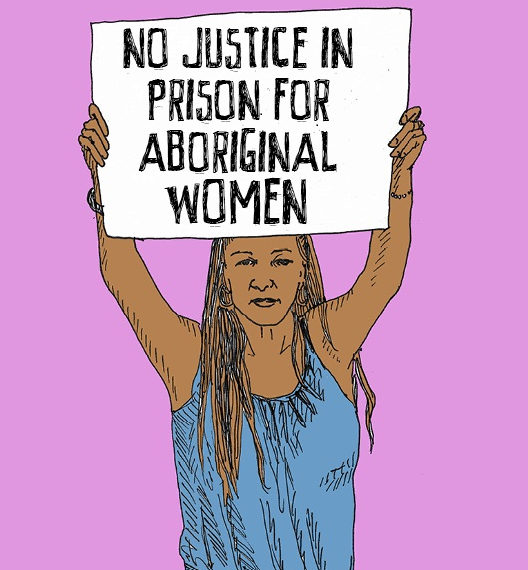
Canada must stop sending Aboriginal women to prison!

Canada is addicted to the incarceration of Aboriginal peoples, and in particular Aboriginal women. According to a recent report by Howard Sapers, the Correctional Investigator of Canada, for the first time ever, more than 25% of inmates in Canadian federal prisons are Aboriginal: “In federal corrections, 25.4 per cent of the incarcerated population are now of aboriginal ancestry.” Sapers describes the number as “quite shocking.” No one is shocked. None of this is new.

Nationally, 3723 of the 14624 prisoners are Aboriginal, but that doesn’t tell the real picture. In the Prairie provinces, 48.62% of prisoners are Aboriginal, and in the Pacific provinces, 31.09% of prisoners are Aboriginal.

For women, the situation is predictably worse. Of 683 women prisoners, 248 are Aboriginal. Over 36% of women prisoners are Aboriginal.

None of this is new. The State need to cage Aboriginal women is longstanding and publically acknowledged. Study after study, book after book has said as much. The State has tinkered with criminal codes, settled with individual prisoners, given lip service to the ongoing ravages of colonialism. All the while, the State continues to disappear Aboriginal women and girls into prisons where they are routinely tortured.

The line of incarceration of Aboriginal people, from 1996 to 2016, is one of almost unbroken ascendance. Thirty years ago, Aboriginal people comprised 10% of Canada’s Federal prisoners. Then the numbers began rising and never stopped: 1996-1997,14.6%; 1997-1998,15.7%; 1998-1999, 16.9%; 1999-2000, 17%; 2000-2001, 17%; 2001-2002, 17.6%; 2002-2003, 18.3%; 2003-2004, 18.5%; 2004-2005, 18.2%; 2005-2006, 18.7%; 2006-2007, 19.6%; 2007-2008, 19.6%; 2008-2009, 19.7%; 2009-2010, 20.6%; 2010-2011,21.5%; 2011-2012, 22%: 2012-2013, 23%; 2013-2014, 22.8%; 2014-2015, 24.4%; 2015-16, 25.4%.

Year by year by year, the State has stolen Aboriginal women’s lives. Aboriginal women are “over-represented” in Federal prisons as they are in maximum security and in solitary confinement. Aboriginal women are the citizens of over-representative democracy. It’s time, it’s way past time, to end the carnage. Canada must stop sending Aboriginal women to prison!


(Image Credit: Flat Out)

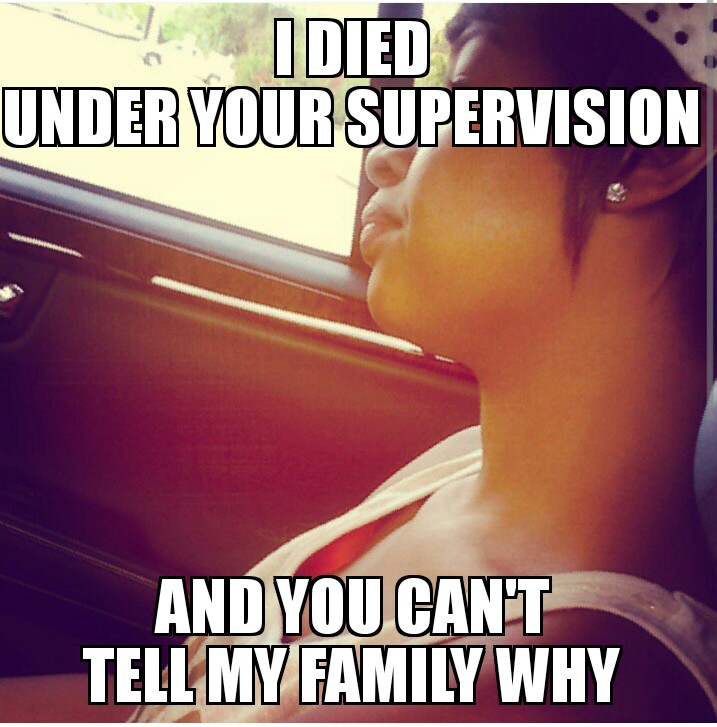
Why did Gynnya McMillen die under Kentucky’s supervision?

Last week, a sixteen-year-old girl named Gynnya McMillen died in her cell at a juvenile detention center in Elizabethtown, KY. Her family wants answers, and the State of Kentucky remains silent.

An initial autopsy shows no “outward signs” or bruising, and no conclusive cause of death. The State says more information will be available in a few weeks. Gynnya was there for only one day.

The State declares as a matter-of-fact: the autopsy results will take weeks. Do not ask anything else until then. Meanwhile, time drags on for Gynnya McMillen’s family, who struggle with the trauma of losing Gynnya and the lack of even the most basic information surrounding her death.

It is unclear exactly why Gynnya McMillen was in custody at the Lincoln Village Youth Development and Regional Juvenile Detention Center. A police department spokesperson said she was the “perpetrator” in a domestic dispute with her parents. It is unclear what circumstances led up to her death in that facility.

What is clear is that Gynnya McMillen spent time years before in a center for kids in crisis. Gynnya needed help then, and she needed help when the Kentucky Department of Corrections put her in its custody last week. Now, Gynnya McMillen is dead.

A spokesperson for the Kentucky Department of Corrections wants you to know that Gynnya McMillen is the first juvenile death in a Kentucky juvenile center since 1999. Lincoln Village’s website boasts the opportunities it provides for its children inmates, including “continuous supervision.”

Under the “continuous supervision” of Kentucky and all its opportunities, Gynnya McMillen died in a day.

Her name was Gynnya McMillen. She joins the list of women and girls, many Black, who wind up dead under “care” of the State. Her family deserves answers. We all deserve answers.

For updates and to get involved, follow Justice for Gynnya McMillen.

(Photo Credit: Facebook / Justice for Gynnya McMillen)

Shonda Walter, a 36-year-old Black woman on Pennsylvania’s death row

Shonda Walter, 2005

Shonda Walter is one of two women who currently sits on Pennsylvania’s death row. Pennsylvania has two women’s prisons, Muncy and Cambridge Springs. Muncy is both maximum security and the intake prison for all women prisoners in Pennsylvania. Muncy also houses Pennsylvania’s death row for women. Every woman prisoner in Pennsylvania first comes to Muncy, where her `security level’ is assigned, based on an assessment of criminal record, medical, mental health, and substance abuse. Lower security prisoners are sent to Cambridge Springs; the rest stay at Muncy. The question of how Shonda Walter’s ended up on death row may be the final nail in the coffin of the death penalty in the United States. Shonda Walter’s story hinges on the State-allotted destiny for young, low and no-income, Black women.

Shonda Walter was tried and convicted for murder. At the time of the murder, Shonda Walter was in her early 20s. At her first trial, Shonda Walter’s lawyers were a hot mess. They freely conceded her guilt to the jury, and they never presented her, or the jury, with any options or explanations. In her appeal, the judge described her attorney as “unintelligible.” The Pennsylvania appeals court found that Shonda Walter had indeed had terrible representation, and then went on to uphold the conviction and sentence.

Shonda Walter is a 36-year-old Black woman, and that is where the Constitution ends.

Shonda Walter has new attorneys who have filed a brief with the Supreme Court. Her attorneys argue that the ordinariness, the typicality, of Shonda Walter’s case, or pre-ordained fate, means the death penalty is unconstitutional. The adjudication of death sentences is capricious, arbitrary, and bears more than a `taint of racism.’

In an amicus brief, a group of social scientists zeroed in on Pennsylvania’s racist patterns: “Social science researchers have … turned their attention to Pennsylvania. One study on the role of race in capital charging and sentencing found that African Americans in Philadelphia receive the death penalty at a substantially higher rate than defendants of other races prosecuted for similar murders.”

Further, across the country. African Americans are systematically removed from capital offense juries. In Pennsylvania, “prosecutors struck on average 51% of the black jurors they had the opportunity to strike, compared to only 26% of comparable non-black jurors.”

As Shonda Walter’s attorneys’ conclusion suggests, none of this is new: “There is a palpable inevitability to the demise of the death penalty in this country. Whether it be now or in the future, the cast of its last libretto will be a familiar one: an innocent victim senselessly murdered, a psychologically damaged defendant, a lawyer with at least one foot on the disfavored side of Strickland’s Maginot line. And, as here, the case will have progressed through a system overshadowed by interminable delays, arbitrary and discriminatory application, and the now inescapable conclusion that too often we err in a way no court can mitigate.”

Too often we err in a way no court can mitigate. Another world must be possible.


(Photo Credit: The Marshall Project / Bill Crowell / The Express / AP)

Nebraska built a special hell for children: solitary confinement

Last week, the ACLU of Nebraska issued a report on the use of solitary confinement in juvenile centers in Nebraska: “On any given day in Nebraska, juvenile justice facilities routinely subject kids in their care to solitary confinement … For children, who are still developing and more vulnerable to irreparable harm, the risks of solitary are magnified – protracted isolation and solitary confinement can be permanently damaging, especially for those with mental illness. It is time to scrutinize the use of solitary confinement on children. Nebraska should strictly limit and uniformly regulate isolation practices.” This report builds on year after year of reports on the epidemic of juvenile solitary confinement across the country.

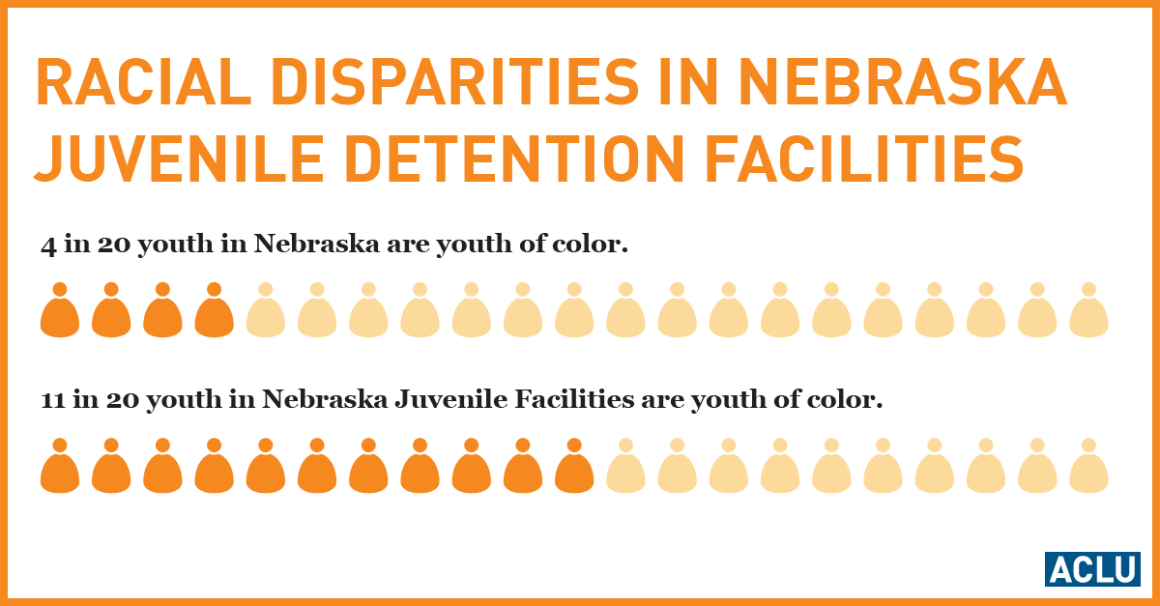
As the county sinks, so sinks Nebraska. Actually, Nebraska is leading the race to the bottom, since the state boasts the third highest per capita number of youth in juvenile facilities. Furthermore, 55% of the juvenile “residents” are youth of color, while only 20% of Nebraska’s youth are youth of color.

Children across the state are sent into solitary for days, weeks, and sometimes months. Often the “reason” for extended solitary confinement is a minor infraction. Often it’s the child’s “attitude.” Who puts a child into isolation for 90 days for having too many books? In Nebraska, quite a few would … and do.

Nebraska has nine juvenile detention centers. Two are run by the Department of Health and Human Services; two are run by the Department of Corrections; and five are county facilities. While all have problems, the real crisis is in the Department of Corrections centers and the county facilities. Two of the county facilities don’t even keep records of how long children are kept in solitary; another has no policy governing the use of solitary confinement. It’s not sufficiently important.

What is consistent is inconsistency. From one center to another, a child can be isolated from 90 days to no more than 5. In the two Department of Corrections facilities, where children have been adjudicated as adults, the rule is “The total number of days that an inmate may be placed on restriction, for each convicted offense, shall not exceed 90 calendar days.”

The report highlights the story of Lisa, who was 14 when she was thrown into solitary: “The room had mesh over the window so you couldn’t look outside. It was an empty room with a cement floor, just plain white walls. There was no mat, nothing in there with you, the room was totally stripped bare. When they closed the steel door, I’d hold onto the door jamb, trying to make it impossible for them to shut me in. Ironically (because I was in solitary for self harm), I survived my time alone by just falling back on hurting myself. I’d bite my own cheeks and tongue, banging my head on the wall. Being locked down alone just reinforced the unhealthy beliefs I already had so I heard `You’re a freak, you don’t belong in the world and you don’t belong around other people.’ What are the facilities trying to accomplish? If it is to manage somebody’s behavior so they don’t harm themselves or someone else, it doesn’t work–it just creates more isolation, anger and separation and hopelessness. We need to be cognizant of how many traumatic and difficult, violating experiences these youths have already had. Solitary just re-traumatizes them. Much of what was done to me was out of ignorance, not evil, but I want people to recognize that we can change things for the better.’”

There is no “ignorance”. The widespread torture of children in juvenile centers across Nebraska is public policy. No one is surprised that a state that leads the country in incarceration of children, and in particular of children of color, leads the country in torture of children once they’re `in the system.’ The answer? Close the prisons; take their money and put it in health care, education, recreation, culture, and everything that sustains life, creativity and wellbeing. Another world is necessary.


(Infograph Credit: ACLU of Nebraska)

England built a special hell for children, Medway Secure Training Centre

In England, children are being sent into “secure training centres” where they are brutalized by staff. On Monday, the BBC aired an undercover report concerning Medway Secure Training Centre. The program showed children, girls and boys, aged 12 to 17, physically and verbally abused by staff, morning, noon, and night. The program also showed staff conspiring to conceal their misdeeds. While dismaying and heart wrenching, none of this is new or shocking. Physical, verbal and mental abuse amounting to torture is the norm in juvenile centers, and it’s not merely the actions of one or two staff members. Violence against children is State policy.

Frances Crook, Chief Executive of the Howard League for Penal Reform, responded to the BBC documentary: “Watching this programme made me cry. The deliberate cruelty against children was one of the most upsetting things I have seen in this country. Shocking also was the institutionalised fraud being perpetrated to cover up that abuse.”

Many have noted that Medway is managed by G4S. While certainly the contract with G4S should be rescinded and the money repaid, it’s not only Medway that is “rotten to the core.” It’s the entire institution of State and social responsibility for children. Behind institutionalized fraud lies institutional violence against children, and that, again, is State public policy. Whatever the reason that children end up in cages called “secure training centres”, the bottom line is that the State has decided they are to blame for everything that happens to them from here on out. That’s why deaths of children in custody, such as those of Adam Rickwood, 14 years old, and Gareth Myatt, 15 years old, in 2004, produce investigations and commissions of inquiry and then absolutely no change.

The United Kingdom has three kinds of institutions for “juvenile offenders”: secure children’s homes; secure training centres; and young offender institutions. Secure children’s homes actually look after the children’s welfare and well-being. They cost more than the “training” centers. In the past decade, the number of secure children’s homes has been cut, while the budgets for “training” centers has ballooned. This didn’t just happen. The State chose to send children into the night and fog of secure training, where it was widely known that “force”, call it violence, is used more often and more energetically. When children become training, what else can you expect?

So, what happens now? Some have said, “Enough is enough. We don’t need further reviews or vague promises that lessons will be learned.” Others have begun to describe a “collective shame”: “Far too often it’s children who have been abused and neglected from infancy – many of whom have mental health problems and learning difficulties, and are in need our protection – who end up incarcerated and written off. Worse still, many will experience violence and mistreatment while in prison, as recent reports of abuse by staff at G4S-run Medway secure training centre in Kent show. And Medway, exposed by Panorama, which led shadow home secretary Andy Burnham to call for G4S to be stripped of its youth prisons contract, is far from an isolated case.”

Where there is no collectivity, there is no collective shame. Where there is no memory, there is never enough. The commissions will not produce more secure children’s homes. They will rename secure training centers, relocate them, paint the walls a pastel `soothing’ color, and continue to torture children. England built a special hell for children, and Medway Secure Training Centre is not its name. It’s name is England.


(Photo Credit: BBC / PA)