The low spark of high-heeled African women farmers

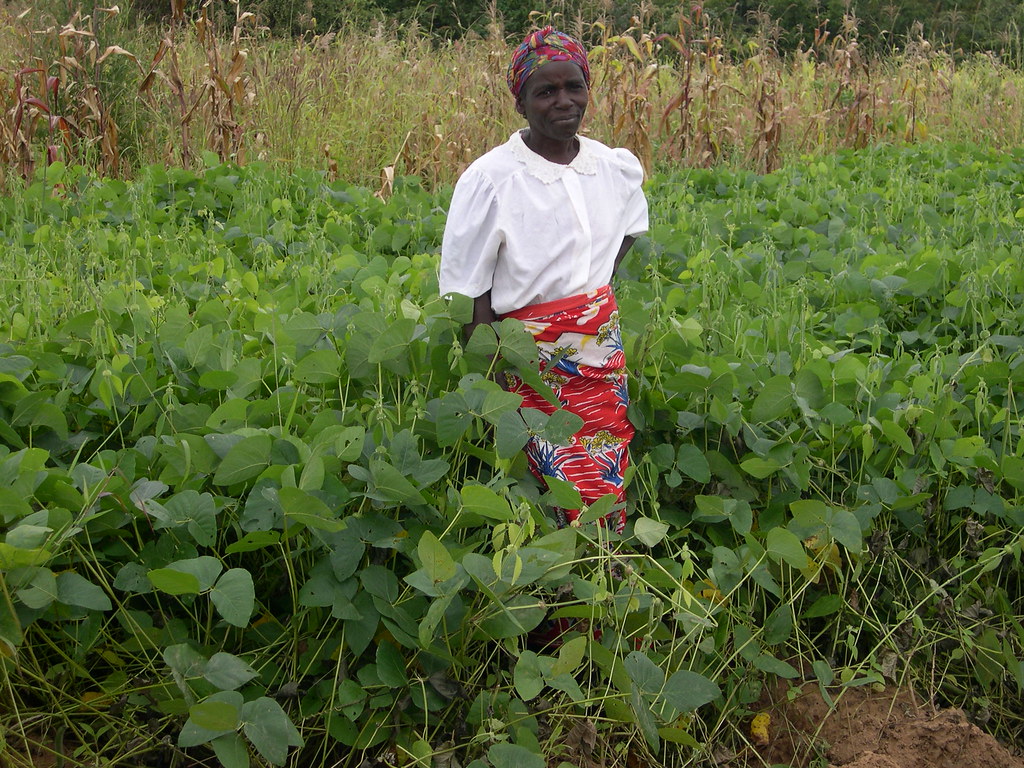
Esnai Ngwira in mucuna field

The planet of slums is fed, clothed and sheltered by continents, and oceans, of farms, many of them small farms. Many small hold farmers are women. This is the case in China. By focusing on women farmers, China, with 10% of the world’s arable land, now feeds 20% of the world’s population.

And now, according to reports, China is turning to Africa, not in a land grab but rather in skills sharing and capacity building. China “seeks to show its trading partners in Africa that feeding their populations is only possible when women are empowered.” China is pushing for land rights for women farmers and for investing in women farmers. A key problem, however, is “the low skill base of Africa’s farmers, who are mainly women”.

What?

The clause concerning “low skills” is slipped in at the end of an article, but it’s actually a bombshell. The reason “Africa” is hungry is that its women are “low skilled”?

This would come as a surprise to those, such as Andrew Mushita and Carol B. Campbell, who have argued, “Most often, women are the keepers of the seeds, tucked away among the beams in the thatched roof, protected from pests by smoke from cooking fire. Others are stored in tins in another location. Villagers volunteer labour to build storage buildings for seed banks, protecting the treasure within the public trust.”

For centuries, and more, women farmers have tended to the seeds, nurtured biodiversity, sustained communities, developed new, and successful, medical treatments, and more.

Esnai Ngwira, a 57-year-old farmer in Ekwendeni, northern Malawi, would be surprised to hear she has a low skills base. Ngwira has been working with a program that builds social ecology in sustainable ways. Rather than using fertilizer, for example, Ngwira uses crop residue. She gets a better maize harvest, helps the soil, helps the earth. Esnai Ngwira is considered “a star innovator.”

Marie Johansson and Victoria Mulunga, of the Creative Entrepreneur Solutions (CES) in northern Namibia, would also be surprised. They, and the other women in their group, are fusing farming practices, gender-responsive environmentalism, and women’s market practices into a sustainable agricultural political economy. They haven’t done that by relying on a “low skill base.”

Likewise, in Kenya, Joyce Odari, an elderly subsistence farmer, was once arrested by forest guards for having cut down trees in a public preserve. She turned her imprisonment into a women’s sustainable agro-forestry operation, that now involves over 200 women in her region.

There are other stories, other women, other names. In the Gambia, women farmers are using simple store-powered dehydrators and dryers to preserve mangoes, which, as dried fruit, they sell to local schools. The mango is a key source of Vitamin A, and its season is short. By drying and distributing them the women farmers are combating blindness, providing extra nutrition in their own homes, and securing extra income.

The stories are everywhere because the women farmers, everywhere across the African continent, are doing what they do. Storing. Sharing. Experiment. Farming. Sustaining. Experimenting some more. Sharing some more.

The first problem for women farmers, on the African continent as elsewhere, is access. Access to land, access to market. Access to resources, access to decent and equal pay. Access to education and then more education. The second problem is security. Land tenure security, market access security. The third problem is autonomy. Global systems of exchange have no respect for the local “customs”, much less the biodiversity that women farmers have created over centuries through open and principled sharing.

“The low skill base of Africa’s farmers, who are mainly women” pretends to focus on women as it obscures the actual lives that women, in this instance women farmers, lead. Not women farmers’ low skill but women farmers’ access to real power haunts a world teetering on the brink of famine. That’s our world.


(Photo Credit: Flickr.com / soilsandfood)


Apartheid haunts domestic work

In Los Angeles County, there is one bus route, the 305, that directly links the low- and no-income residents of the southern suburbs to the wealthy homeowners of the West Side. Millions rely on the 305. Millions of employers, millions of workers. The 305 only exists because of decades-long struggles by people of color, in the streets, in the courts, in the corridors of power, in the living rooms and kitchens of neighbors and family. And after all that struggle, there’s one line. And that line is about to be closed.

It’s called an efficiency. Close the one line that actually serves low-income workers of color, and replace it with `a hub’. How’s that worked for the airline industry? Not so well, but that makes little to no difference. After all, what’s a few more unpaid, and costly, hours in transit in the daily lives of workers of color? It is estimated that the hub system will double the length of commutes and triple the price. Los Angeles doesn’t allow for free transfers from one line to another. It’s called efficiency.

Who are these workers? Janitors, nannies, maids. Women of color, women of color, women of color. Women of color with names. Guadalupe Lopez. Ana Hernandez. Marina Tejada. Silvia Conjura.

Every day hordes of `colored’ and Black women board the buses, and travel for hours, to tend to the needs, desires, idiosyncrasies, and mess of wealthy, more-often-than-not White individuals, families, households, neighborhoods, communities. Every day, women workers of color pay more and get less. Every day their debt increases. Every day their own families, households, neighborhoods, communities suffer the irretrievable lose of time. Every day.

And every day, the State figures out a new way, through efficiencies, of seizing yet another dollar, yet another hour, from the pocket, purses, bodies, and days and nights of these women of color. If this sounds familiar, it should. It was the logic of `public’ transport under the apartheid regimes in South Africa.

For coloured and African women workers, the State made transportation impossible and necessary, unaffordable … and required. It was a clear weapon in the war of some against the many. To this day, the country still struggles with the apartheid geography of impossible and unaffordable transport. As one writer noted yesterday, commenting on the death of his own nanny, Florence Mbuli, “You can now easily replace the word `Bantustan’ with `township’ or `informal settlement’”.

Yes, we can.

Across South Africa, women workers organize daily on the trains that take them to work. They organize domestic affairs, they organize political interventions, as women workers, as women of color. In Los Angeles County, the same is true. Women workers, every day on the bus, are organizing, organizing information, organizing domestic affairs, organizing political interventions.

Florence Mbuli lived to see the apartheid regime end. She lived to see her children grow up into “very successful people”. But the trains remain, the buses remain, the collective taxis remain, because the distances between home and work, the distances created by an apartheid logic of efficiency, remain. In fact, in many places, most notably the Cape Town metropolitan area, the distances have grown greater since 1994.

Today, Florence Mbuli rides with Guadalupe Lopez, Ana Hernandez, Marina Tejada and Silvia Conjura. Together they measure the time, the cost, the distances. Together they organize. The State can claim to reconcile individuals, even communities, but it can’t reconcile space. It can’t reconcile distances. From Watts to Westwood, from Khayelitsha and Mitchells Plain to Claremont and Rondebosch, and beyond, apartheid haunts domestic work.


(Photo Credit: Monica Almeida / The New York Times)

Women prisoners. What do they want? Justice. When do they want it? Now.

Alabama is one of the epicenters of imprisonment in the United States. The government calculates rate of incarceration as the number of prisoners sentenced to more than 1 year per 100,000 U.S. residents. The national rate of incarceration is 502. Alabama’s is 650. The national rate of incarceration of women is 67. Alabama’s is 95. Where the national rate of incarceration women dropped by a little over 1% in the last year, in Alabama, it rose by 9%.

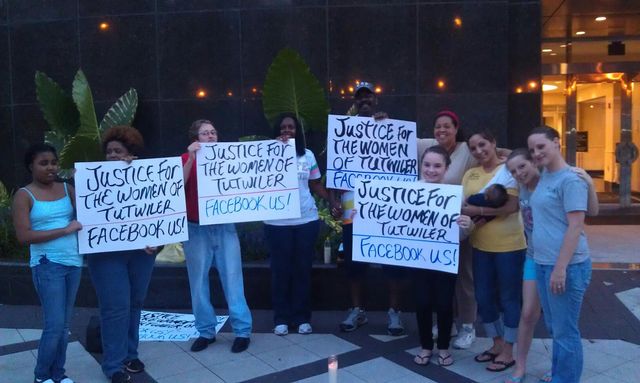
Alabama has one prison for women, the Julia Tutwiler Prison for Women, located in Wetumpka, Alabama. The prison was built in 1942, and designed to hold at the very most 370 women. In 2002, it held over 1,000 women prisoners. That’s when the prisoners sued the state, in what became the Laube v. Campbell case. The women won, District Court Judge Myron Thompson declared the prison “a time bomb ready to explode facility-wide at any unexpected moment”. Judge Thompson found the overcrowding to be in violation of the U.S. Constitution.

So, what did the State do? It started shipping women out of State, particularly to the South Louisiana Correctional Center, in Basile, Louisiana. Where Alabama’s rate of incarceration is 650, Louisiana’s is 881, the highest in the country. Where Alabama’s rate of incarceration of women is 95, Louisiana’s is 113, second only to that of Oklahoma. But hey, at least they’re not `overcrowded’.

Women would be moved three and four times, without prior notification, in the middle of the night, and without any apparent concern for their situation. Pregnant women were moved, women in rehab programs and educational programs were moved, women in medical treatment programs were moved. The South Louisiana Correctional Center is a for-profit, run by LCS Correction Services. The women who were moved found lots of correction and little to no service. For those in programs, such as educational or treatment programs, time in Basile was time lost, and thus time added on to their prison stay. None of that mattered. What mattered was `reducing the prison population’. What mattered was accounting. The prisoners were numbers, not people, not humans, not women. Just numbers.

That shell game didn’t work, and so now Alabama is experimenting with something called Supervised Reentry Program, which, it is hoped, will reduce the number of women prisoners in Alabama in a more reasonable and sensible way. Basically, the program takes `good prisoners’, and especially those who are in for non-violent offenses, and puts them in supervised residential programs, offers training and counseling, and tries to create a pathway for `reentry’.

If the State had consulted with the women right away, they would have come up, right away, with a more reasonable and sensible program.

Erline Bibbs was one of the women in the Laube v Campbell class. She then became a founding member of the Longtimers/Insiders. The Longtimers/Insiders were women prisoners from Tutwiler who had been shipped to Basile. With the help of the Southern Center for Human Rights, they studied and learned. In Bibbs’ words, the women learned “to organize and … how to make a difference in the right way.”

The women prisoners of Alabama want to see women helped rather than locked up. For themselves, and for other women prisoners, they want to be in the processes of decision-making concerning their own lives. For example, they want to face their victims. They want “the opportunity to present to the parole board in a face-to-face hearing our real selves and how we have changed through the years. We believe our obligations are with the victims’ families, not professional victims’ groups or politicians who use victims for their own gain.”

The women’s class action suit against Alabama charged the State with indifference. These women are the difference. They are the ones to tell the stories of their lives. They must be the authors and the judges of `prison reform’.

What do the women prisoners of Alabama want? Justice. When do they want it? Now.

(Photo Credit: Justice for the Women of Tutwiler / Facebook)

Who will write a requiem for Josefa Rauluni?

Once upon a time a man named Josefa Rauluni left the island nation of Fiji for Australia, where he applied for asylum, or “protection”. He was turned down. He was taken to Villawood Detention Centre, a private facility run by Serco. He continually appealed the decision. He continually appealed to the State for asylum, for protection. He maintained he feared for his life if he returned to Fiji. The State responded with a deportation notice. The State told Josefa Rauluni that he would be deported on September 20, 2010.

The night of September 19, Josefa Raulini sent two faxes to the Ministerial Intervention Unit at the Department of Immigration and Citizenship. They read, ”If you want to send me to Fiji, then send my dead body”. The State did nothing.

And so, on the morning of September 20, 2010, Josefa Raulini informed the guards, “I’m not going, if anyone goes near me, I will jump“. The guards did nothing. They did not try to reason with him. They did not try to calm him down. Finally, they tried to use force. As they moved in, Josefa Raulini jumped from a first floor balcony railing. He dove, head first, hit the ground, and died.

And the State did nothing to stop him.

It turns out the State could only do nothing because the Villawood staff has no suicide prevention training. Imagine a prison for asylum seekers whose applications have been rejected and who are awaiting imminent deportation.

Now imagine no one with suicide prevention training. The State `forgot’.

Today is the second day of an inquest into Josefa Rauluni’s death. It is the first of three such inquests into Villawood `suicides’. Josefa Rauluni did not commit suicide. He was pushed. Not by a physical hand but rather by a State whose efficiencies include the absence of mental health care providers in a place designed to drive its residents suicidal and mad.

“”If you want to send me to Fiji, then send my dead body”.

Who will write a requiem for Josefa Raulini and for all the imprisoned asylum seekers  who have perished in State custody? Who will write a requiem for the terrible years?

Fifty years ago, in 1961, the Russian poet Anna Akhmatova concluded writing “Requiem”, an account of “the terrible years of the Yezhov terror”, 1935 – 1940, during which she spent seventeen months, every day, waiting in a line outside the Leningrad prison, waiting for someone who would never return.

The poem begins:

“No foreign sky protected me,
no stranger’s wing shielded my face.
I stand as witness to the common lot,
survivor of that time, that place.”

Who will stand for the time and place, who will give witness to the life and death, of Josefa Raulini? Will we have to wait thirty years, and more, for the foreign sky that offers haven rather than death? Until then, Josefa Raulini haunts the contemporary prison-State.

(Photo Credit: http://www.matavuvale.com)

The Big Box Store

Betty Dukes

When my partner and I were on our honeymoon, in upstate New York, we were craving a set of playing cards. We drove around this big “small town” and saw a familiar sign: “Wal-Mart.”  Unperturbed, my partner drove right into the parking lot.  I told him in no uncertain terms that I wasn’t going in and he wasn’t either.  He started laughing, but it died in his throat when he saw the scowl on my face.

In 2005, I assisted a law school professor on a paper she was writing on the issues of employment-based sex discrimination. My task was to read through hundreds of declarations by women who either worked or work at Wal-Mart as part of a class action suit against the world’s largest private sector employer and summarize each declaration.  These women not only had the courage and conviction to come forward, but many did at the expense of being chastised by their community.

Monday’s Supreme Court ruling in Wal-Mart v. Dukes essentially destroys class actions against corporate America.  As a result, the most marginalized sector of the labor force – working-class to poor women-will suffer the most.

In rural and small town America, Wal-Mart is one of the biggest, if not only, sustainable employer. While reading the declarations, I learned of single moms who sustained a family of four.  Many of these women looked at Wal-Mart as a place to grow, to become educated, and create a better life for their family.  They thought the story of Sam Walton, an up-by-his-bootstraps narrative revered by Wal-Mart as the archetype of the American dream, would apply to them.  But theirs was a dream deferred, as they watched their male cohorts, who often worked the same amount of hours, obtain higher pay and quicker promotions.

With the Supreme Court’s decision, the last vestiges of that dream may have vanished. True, the Court did not decide the substantive issue of whether Wal-Mart discriminated on the basis of gender. But by preventing women from forming a class, they eviscerated the only effective tool in confronting a corporation whose revenues dwarf the GDP of many small countries. Now, each individual class member will have to come forward and sue Wal-Mart (an unlikely scenario), or the 1.6 million women will need to create smaller classes based on commonality other than gender.  In the latter scenario, it is almost certain that this class too will be challenged, and challenged again, until the class is so small, making it not worth the money and effort.

Sadly, Monday’s decision follows a long history of rejecting gender as a potential class against corporations. Decisions like Wal-Mart urges us to think of how we cannot rely on the legal system to recognize bias in corporate structures. The power is up to the consumers, advocates, journalists, activists, artists to make Wal-Mart, and other corporations listen to their constituents.  So, we found playing cards in a locally run business a few blocks from the glowing Wal-Mart sign.

(Photo Credit 1: New York Times / Reuters/ Larry Downing) (Photo Credit 2: BusinessWomen)

A Better Half: Young Feminists Can Rewrite Half the Sky


In many ways, Half the Sky has occupied much of the consciousness of what can loosely be defined as the newest “generation” of Western feminists. It is assigned routinely in college classrooms. While it has stimulated students in the U.S. to think about women’s issues at a global level, it does so at the expense of feminisms that have, over the past few decades, attempted to recognize and correct abuses of privilege by Westerners conducted in the name of “third world women”.

Looking at the bestseller from the vantage point of a young feminist, one passage captures much of what is problematic about Half the Sky. Discussing ways that readers could get involved, the authors warn, “American feminism must become less parochial, so that it is every bit as concerned with sex slavery in Asia as with Title IX in Illinois… Likewise, Americans of faith should try as hard to save the lives of African women as the lives of unborn fetuses.”

Somehow discussing the obstacles faced by women globally without any mention of colonialism, past or present, Kristof and WuDunn systematically dichotomize the West and “the rest” through such passages.

First, the passage reduces American feminism to an issue that barely begins to shed light on various forms of oppression in many women’s lives today – forms of oppression that are gendered, and also defined by race, class, able-bodiedness, and so forth.

Second, the passage relieves the reader of undertaking any immediate action by creating distance between her (and her apparently post-feminist American existence) and the issues at hand.

Third, Kristof and WuDunn fail to emphasize the importance of Westerners acting as facilitators or supporters of actions led by women at the grassroots themselves. By stepping in, and effectively stepping on local women, to create their own initiatives, the chance for cross-border solidarity is destroyed. This dichotomy reprises the historical legacies of colonial calls to action revolving around purportedly irreconcilable differences between “civilizer” and “uncivilized.”

The passage also argues for a space in global feminism for people who believe that the lives of unborn fetuses are equivalent to those of African women.  According to the Guttmacher Institute, out of the 5.6 million abortions carried out in Africa in 2003, only 100,000 were performed under safe conditions, a direct result of the fact that 92% of female-bodied people of childbearing age in Africa live in countries that have restrictive abortion laws. The World Health Organization estimates that 1 in 7 maternal deaths in Africa are caused by unsafe abortions. Including anti-choice politics in a book that spends two full chapters on the gravity of maternal mortality seems contradictory, given the statistics. More to the point, it stymies any productive discussion on the struggle for control over women’s bodies and bodily agency as part of all issues examined in Half the Sky.

Throughout Half the Sky, Kristof and WuDunn refuse to acknowledge any relationships among capitalism, colonial and postcolonial globalized economies, and gendered inequality. For example, at one point they argue, “The factories prefer young women, perhaps because they’re more docile and perhaps because their small fingers are more nimble for assembly or sewing. So the rise of manufacturing has generally raised the opportunities and the status of women. The implication is that instead of denouncing sweatshops, we in the west should be encouraging manufacturing in poor countries, particularly in Africa and the Muslim world.”

Half the Sky argues that sexism is to be found only in far-removed places, that the noble effort of combating sexism in these far-removed places is available to everyone and requires no critical self-analysis or questioning of one’s understanding of women as they exist in their own locality or politics, and that by replacing one kind of oppression with one that benefits industrialized countries, sexism has somehow been defeated.

This cannot become the dominant narrative for young feminists.

And yet it is.

Half the Sky has succeeded in garnering attention towards women’s issues, but its strategies are limiting and ultimately dangerous. How do we retain the momentum and critically, and politically, address the problems?

There must be a way to gain support for feminism that doesn’t rely on easily “marketable” ideas. For now, Half the Sky is the platform we have. We must surround it with other conversations, discussions that press global feminist activists to take responsibility for our actions, including our mistakes. That would be a first step.


Domestic workers declare war on the War on Women


Last week, domestic workers declared war on the War on Women.

The current domestic laborers’ market has been forged in the most recent phase of globalization – understood, too briefly, as the political economy of globalized production serving a global market – that began in the 1970s. The last four decades have been marked by the rise of global cities, and mega-slums. Already, more than half the world population is urban. Soon, very soon, more than half the world population will live in slums. A planet of slums beckons.

Cities are the place, and slums are the face of urban poverty in the new millennium. And that face is a woman’s face “Women bear the brunt of problems associated with slum life.”

Global cities produce mega-slums and slum cities. Meanwhile, global cities’ 25-hour-a-day, 8-day-a-week so-called service economies require large numbers of easily available, and replaceable, and cheap domestic workers who make sure the beds are made; the food prepared and tasty; the children and the elders cared for; the houses swept; and the structures of household, community, regional, national and global patriarchy solidified and intensified. Political economists tell us that the new economies produced social workers, workers in the information sector whose work is more than and different from the binary of boss and worker. Tell that to the maids and nannies, childcare and eldercare providers (as well as the hotel and office cleaners, and sex workers) across the globe who every day, and every night, make sure everything is neat, tidy and available. It’s a world economy in which women, especially women of color, are forced to care.

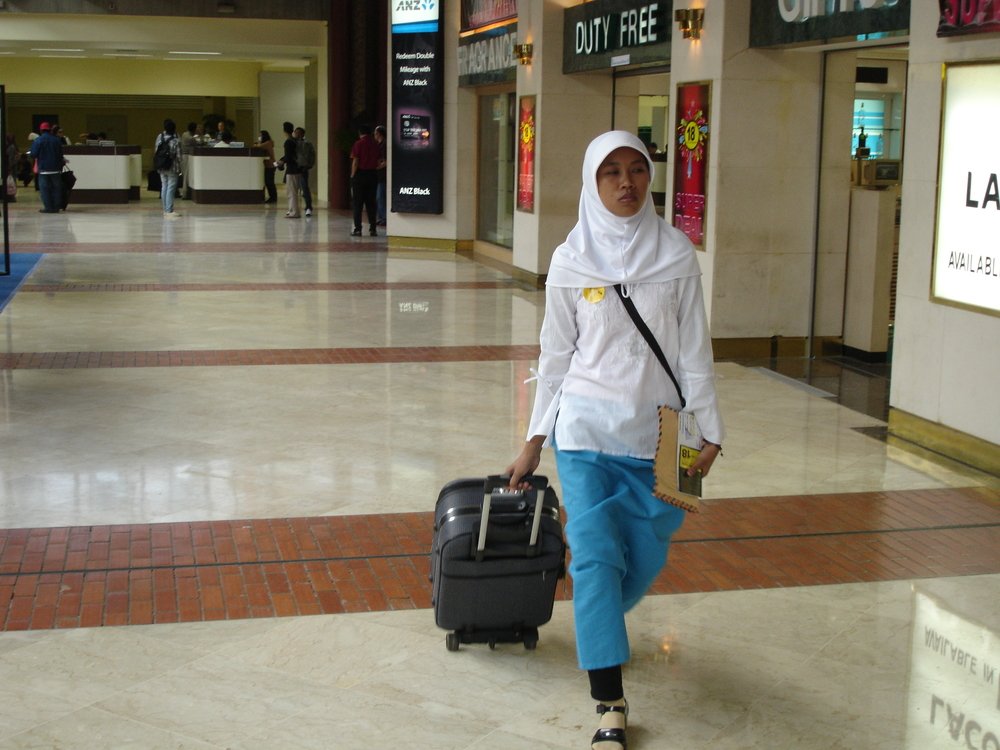
In order to meet this demand, nation-States, the Philippines most notably, have turned themselves inside out and, presto, turned into mega-brokerage houses for mass migrations of domestic workers. Global cities demanded, and created, transnational domestic labor, which became one of the fastest growing, and largest, labor sectors of the world economy.

Women workers built the global economy, which came to rely, violently, on women workers. The feminization of the new industrial workforce produced the feminization of migration, which in turn produced the feminization of survival, and all of it, the whole system, sits heavily, and precariously, on the shoulders and in the arms of domestic workers.

That is one reason that the ILO Convention Concerning Decent Work for Domestic Workers, passed last week, is called a landmark treaty, a milestone. Here is a key section from that document:

“Considering that domestic work continues to be undervalued and invisible and is mainly carried out by women and girls, many of whom are migrants or members of disadvantaged communities and who are particularly vulnerable to discrimination in respect of conditions of employment and of work, and to other abuses of human rights, and

Considering also that in developing countries with historically scarce opportunities for formal employment, domestic workers constitute a significant proportion of the national workforce and remain among the most marginalized …

Recognizing the special conditions under which domestic work is carried out that make it desirable to supplement the general standards with standards specific to domestic workers so as to enable them to enjoy their rights fully.”

Women and girls are “the special conditions under which domestic work is carried out.”

“Special conditions”.

At the beginning of the twentieth century, W.E.B Du Bois famously noted “the problem of the Twentieth Century is the problem of the color line.” For Du Bois the color line came down to a simple, and impossible, question: “How does it feel to be a problem?” Today, the problem of the Twenty First Century continues to be the problem of the color line, and the question now is, “How does it feel to be a special condition?”

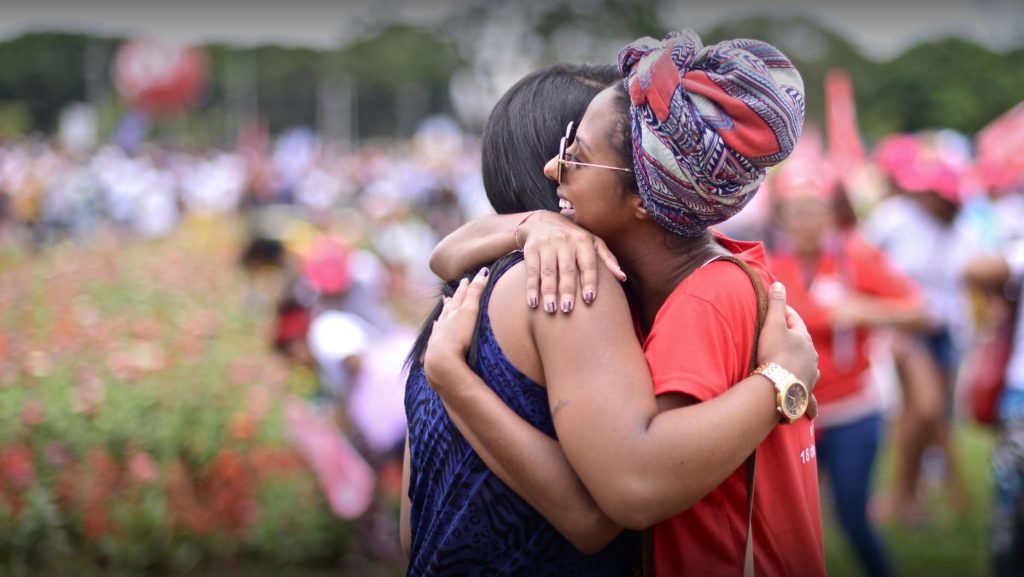
Domestic workers around the world, and in our neighborhoods, recognize that question as part of a global War on Women, and they have had enough. Domestic workers refuse to be ghosts in the machinery of “special conditions.” They have declared war on the War on Women. Step up, step up, it’s not too late to enlist.

(Photo Credit: David Swanson / IRIN / The New Humanitarian)

Women and girl refugees haunt the world

Refugee statistics from the UNHCR

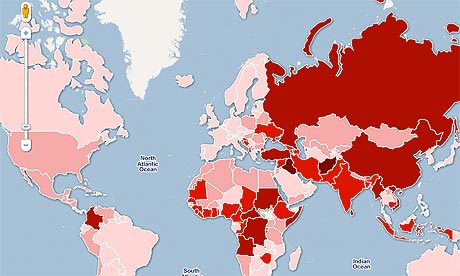
Today, June 20, 2011, is World Refugee Day. To honor this, the United Nations Refugee Agency released a report, UNHCR Global Trends 2010: 60 Years and Still Counting. According to the report, there are no 43.7million refugees and internally displaced persons. That’s the highest number in 15 years. 27.5 million people are internally displaced persons, the highest number in a decade. Globally, fewer than 200,000 refugees voluntarily returned home, the lowest number in twenty years.

Children make up more than 50% of the global displaced population. 55% of stateless people are children. 55% of returnees are children. 48% of Internally Displaced Persons are children. 44% of refugees are children. 31% of asylum seekers are children.  55% of “others of concern” are children. If children are the future, what is the present?

Women and girls? “Women and girls represented, on average, 49 per cent of persons of concern to UNHCR. They constituted 47 per cent of refugees, and half of all IDPs and returnees (former refugees).”

On July 28, 1951, the United Nations adopted the United Nations Convention Relating to the Status of Refugees. In 2000, the United Nations adopted June 20 as World Refugee Day. It chose that day so as to coincide with Africa Refugee Day, June 20. Starting in 2001, June 20 has been `celebrated’ as World Refugee Day.

From 2001 to 2011, ten years is too many. From 1951 to 2011, sixty years is too many too many. Last week, in a nationally broadcast public forum, Dan Pfeiffer, White House Director of Communications, was asked, directly and repeatedly, “Is there a war on women?” He equivocated and obfuscated and generally avoided the question. The question can’t be avoided. Is there a war on women? Yes, there is a war on women. Part of that war is the production of huge populations of refugee and internally displaced women and girls. Stakeholders must be called to account. When asked the question, answer directly. Yes, there is a war on women. Yes, sixty years is too many too many. But hey … who’s counting?

(Photo Credit: The Guardian)

Women haunt the War on Drugs

Yesterday, June 17, 2011, Dan Pfeiffer, White House Director of Communications, was asked, directly and repeatedly, “Is there a war on women?”

Of course, he did not answer, but his non-answer is all the answer one needs.

Especially when one considers that yesterday, June 17, 2011, marked the fortieth anniversary of the War on Drugs. But that was yesterday.

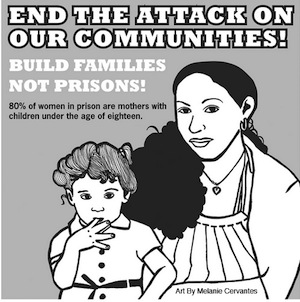
Today is June 18, 2011, and so begins the forty-first year of the campaign against women, called the War on Drugs. As part of the forty years of the war on drugs, women have become the fastest growing prison population, nationally, globally, and probably in your neighborhood. The forty-year long and ongoing `spike’ was no accident and was altogether predictable, and was predicted. There have been calls this week to end the global War on Drugs and the national War on Drugs, but few of those calls have noted that the War on Drugs has been an explicit frontline in the war on women.

The mass incarceration that is the War on Drugs, and its outsourcing and privatization, are one part of the larger War on Women. Women of color suffer higher rates of incarceration, for often minor offenses. All women suffer lack of women’s health services in prison. Women in some states are still being shackled in childbirth. Women are dying of thoroughly treatable illnesses. More than half of female inmates report having been sexually or physically abused prior to imprisonment. The vast majority of women prisoners are living with mental illnesses, and there’s no one to care for them. Women suffer isolation from family and community more often than men. The post prison conditionalities practically assure women will return to prison.

The War on Drugs has targeted women, and women have driven the campaigns against the War on Drugs and the larger War on Women.

But, as the soldiers sing at the very end of Bertolt Brecht’s play, Mother Courage and Her Children: A Chronicle of the Thirty Years’ War, thirty years of war in never enough:

“The war moves on but will not quit.
And though it last three generations,
We shall get nothing out of it.
Starvation, filth and cold enslave us.
The army robs us of our pay.
But God may come down and save us:
His holy war won’t end today.”

Today, June 18, 2011, by Brecht’s generational calculation, the fifth generation of the War on Drugs front in the War on Women moves forward and moves deeper inward. Is there a War on Women? Yes, yes there is.


(Photo Credit: Getty Images) (Art Credit: Melanie Cervantes)

Saheli Women, New Delhi: After the fire update and appeal


Saheli is a women’s “collective” in New Delhi that started out as a crisis intervention center thirty years ago.  It was a time when the women’s movement had been mobilized by many national events that brought women’s vulnerability to the fore.  One of these was the forced sterilization campaign that Mrs. Gandhi’s government had imposed during the Emergency in the mid-1970s.

I came to know the women of Saheli through their opposition to all forms of coercive contraception directed especially against poor vulnerable women. In 1997 they were co-plaintiffs in a public interest lawsuit filed in the Supreme Court against the promotion of quinacrine sterilization, introduced by two American men who worked with local doctors to sterilize women without their consent.  [It was an off-label use of the drug (made into pellets for insertion in the uterus) that the FDA had not approved.  In the US the men were associated with the anti-immigration lobby].

Saheli Women have challenged laws and policies, demonstrated against all forms of injustice, and supported sister organizations in the women’s movement.  They are “autonomous” which in the context of the Indian women’s movement generally implies that they are not aligned with a political party.  They do not take funds from NGO’s, funders, donors or any institutional source.  They do accept support from individuals.  Consequently, I wanted to bring their appeal to the readers and supporters of Women In and Beyond the Global. Saheli Women would appreciate a note of support even if you do not send a check. To me they have always epitomized feminist solidarity and strength.  Thanks for reading this note and their appeal below.  And do go to www.saheliwomen.org for their stories and accounts in their own words.


———-

From: Saheli Women <saheliwomen@gmail.com>

Dear friends,

As you know, on 13th May 2011, a raging fire gutted many shops and along with that, our Saheli office. The devastation has been incredible, with much of our documents and other material collected over 30 years gone.

Many of you have been with us through these trying times  ̶ to keep our spirits up, to help clear the remains and to celebrate the spirit of ‘moving on’ on Saturday the 28th! Thanks so much for a fabulous evening, and for those of you who weren’t there, here’s a picture of what some called our “hip new york bar’ look!

But seriously speaking, the damage to the structure has been severe, and the Public Works Department says it will take them about 4 months to do their bit. In the meantime we taken temporary measures so we can begin to use the office in some form… so we actually have bricked up some sections and got ourselves a door with a lock to secure the place as ours!And we are now getting our first cabinet and bookshelf from friends.

But there is still a lot to be done: Civil works, re-furnishing the place, cataloguing and reprinting documents, scanning and uploading them, etc. Many of you have made specific offers and we will be sorting through our mails to get back to you for that…

Other help:

Physical work: For those of you who can help with sorting documents etc, we plan an intense spell again this coming week – so do call Vani @ 9891128911 to tie up. Once this work is done, we should be able to ask you all to dive into your archives for documents/reports etc we can’t trace at all…

Donations: Many thanks to all of you who have already made invaluable contributions, but we’re still quite short of our needs, so would be great if those of you who would like to donate, do it now, so that we can stop worrying at least on that one account.

Cheques: All cheques [personal ones only, of course] need to be in the name of ‘Saheli Women’s Resource Centre’ and sent with a letter/email stating they are meant for “rebuilding Saheli” along with your address and phone number/email to:

Saheli Women’s Resource Centre
C/o Ms Satnam Kaur
P-9/B, Ground Floor
Jangpura Extension
Near Eros Cinema
New Delhi 110014
Ph: 9899212066
saheliwomen@gmail.com

Bank Transfers: If this is easier, drop us a line and we’ll send you the details.

Cash donations, of course, you can give to any Saheli you know or meet…

All donations to Saheli are exempt under 80G, and yes, and new receipt books have been our first ‘print’ job, so expect them in the mail!

Thank you once again for your continued support, love and solidarity and hope to see you soon under the flyover.

All of us in Saheli
www.saheliwomen.org

Saheli Women’s Resource Centre
Above Unit 105-108
Defence Colony Flyover Market
New Delhi 100 024