The specter of forced sterilization haunts California, Peru and beyond

This week, two events returned to center stage the forced sterilization of largely poor women of disenfranchised ethnic minorities. In Peru, former President Alberto Fujimori and three of his Ministers of Health – Marino Costa Bauer, Eduardo Yong, and Alejandro Aguinaga – were told they are being investigated and will face charges for the forced sterilization of five women during his time in office. Also this week, in California, state legislators are debating a bill that would establish a “eugenics sterilization compensation program.” From Lima to Sacramento and beyond, once more, the monster women refuse to stay silently buried underground.

Alberto Fujimori was President of Peru from 1990 to 2000. In 1996 Fujimori modified the so-called General Population Law, incorporating “voluntary” sterilization an acceptable contraceptive method. In 1996, the Reproductive Health and Family Planning Programme was launched. From 1996 to 2000, over 300,000 women were sterilized. The overwhelming majority were poor and indigenous. The overwhelming majority never consented to the procedure. Many didn’t even know it was occurring. Over 2000 cases have been lodged against the sterilizations. As many as 18 women died because of the sterilization procedures. In 2014, Fujimori was cleared of any wrongdoing concerning forced sterilizations. In 2009, Fujimori was convicted to 25 years in prison for human rights abuses. Late last year, at the age of 79, Fujimori was released from prison, because of ill health. This week, he was informed that he would be facing charges concerning forced sterilization.

For fifteen years, Peruvian women have struggled and pushed for this moment. For example, year in and year out, the women’s rights organization DEMUS, Estudio para la Defensa de los Derechos de la Mujer, has documented cases of forced sterilization and called on the government to act. In response to the announcement of forthcoming charges, DEMUS issued a statement, calling the decision “a milestone in the struggle against impunity, one that highlights the national policy of forced sterilization against thousands of Quechua-speaking, peasant, indigenous and native women living in extreme poverty, which perpetrated grave violations of human rights. With their courage and persistence, the 2166 women who, 15 years ago, filed a complaint, today, with this case going into judicial investigation, finally take a step forward towards their right to justice.”

In California, the state legislature is considering a step forward as well. In 1909 California passed laws allowing for forced sterilization. California was one of 32 states that gave allowed for coerced sterilization of those `unfit’ to reproduce. In 1979, California officially banned forced sterilization, but in its prisons, forced sterilization, especially of women, continued until 2010. From 2006 to 2010, 144 women prisoners were sterilized “without proper authorization”. In 2014, California formally banned forced and coerced sterilization of women prisoners … again. By 1979, California forcibly sterilized over 20,000 people.  The Latinx population was targeted. Prior to 1926, Latinos were targeted. From 1926 to 1979, Latinas bore the brunt of the eugenics sterilization program. Latina women and girls were at a 59% greater risk of sterilization than non-Latina women and girls. Needless and necessary to say, the Latina woman and girls were also overwhelmingly poor.

In early April, California State Senator Nancy Skinner introduced SB-1190 Eugenics Sterilization Compensation Program, which would offer compensation to living survivors of California’s sterilization decades. It is estimated that the Compensation Program would involve around 800 survivors, many of whom to this day do not know that they were sterilized. In establishing a compensation program, California would join Virginia and North Carolina.

Finally, “the bill would require the State Department of State Hospitals and the State Department of Developmental Services, in consultation with stakeholders, to establish markers or plaques at designated sites that acknowledge the compulsory sterilization of thousands of people. The bill would also require the board, in consultation with stakeholders, to develop a traveling historical exhibit and other educational opportunities about eugenics laws that existed in the State of California between 1909 and 1979 and the far-reaching impact they had on California residents.”

In both Peru and California, reports of judicial investigation in one and legislative action in the other are woven through mountains of haunting, heartrending accounts of survivors, family members, friends. For decades, these stories have been shrouded and buried in layers of State and public silence. Thanks to women who refused to be stopped, who struggled with courage and persistence, the days of enforced silence about forced sterilization are nearing an end. The time for acknowledgement, reparations, and education is now.

 

(Photo Credit: El Pais / Reuters) (Image Credit: Journalists Resource / Rachael Romero)

France contracts the epidemic of “tough on immigration” laws

Some issues come back to the scene of “democratic” states at the time of neoliberal battles. In this time of globalization, there is a disparity of sanctions between movements of vulture capital and movements of people, themselves often victims of the economics of globalization.  While no one of late has offered a bill against vulture venture capital, in France, the Minister of the Interior Gérard Collomb has offered Parliament a new bill on asylum and immigration, nicknamed the law of shame.  Fitting into the European Union eagerness to crack down on the rights of people in exile, the bill aims to cut down the appeal time for asylum seekers as well as increase the time in immigration detention center. With an eye to society-market language, the bill promises “controlled immigration, effective asylum rights, and successful integration”.

While the Minister of the Interior claims the bill is balanced, NGOs involved in immigration services, such as la Cimade, warn of the danger of increasing levels of dehumanization with a law that treats everyone reaching France with suspicion. The Minister responds, repeatedly, that France cannot receive all the misery of the world. Remember the Geneva Convention? The Geneva Convention defines rights for refugees, not rights for countries to get rid of refugees.  This “controlled immigration”  bill has already passed the first chamber.

The bill doubles the maximum number of days spent in detention center from 45 to 90 days. Ostensibly, that gives the authorities more time to find solutions other than allowing the person in exile to stay in France, in other words, reaching an agreement with the refugee’s original country about the possibility for return.

According to Mireille Delmas-Marty, French law scholar and professor, before the end of the 1970s there was no separate notion of immigration, and no detention center existed for administrative detention, but, over time, the confusion between immigration, being illegal and delinquency has changed with changes in the law. In 1980 the “Bonnet Bill” marked the beginning of the criminalization of immigration. The bill allowed 7 days of administrative detention under specific conditions. France’s Supreme Court ruled that was too long and censured the bill. In 2018, 90 days is described as a reasonable length of time behind bars for non-criminal people. “Administrative” incarceration for people who are accused of nothing other than traveling without documentation should be challenged in the context of a record number of incarcerations in French prisons with 70,367 behind bars, 21 000 awaiting trial, and 120% occupation rate.

French civil society has resisted the principle of administrative detention on immigration issues. Recently, parents, students and teachers united to demand and obtain the liberation of the father of two high school students from Kosovo who was placed in administrative detention for his immigration status. Such acts of resistance have occurred repeatedly.

Collomb’s bill accelerates asylum procedures so people will have to apply for asylum within 90 days instead of the current 120 days. If their application is denied, they will have 15 days instead of 30 to appeal. The asylum process is already extremely difficult to maneuver for most people in need. Many NGOs, such as the Primo Levy Center, describe the process as too fast and shallow to be fair. Right now, judges and employees of the court of appeal for refugees and the immigration lawyers’ guild are on strike, denouncing the impossibility of treating everyone given the lack of resources.

The bill contained some progressive elements such as a better protection for women victim of sexual mutilations, stateless people, reunification with their family for minors traveling alone, and removing countries denying rights to homosexuals from the list of safe countries.  But the debate in Parliament revealed a larger resistance as the positive sections didn’t make up for the overall lack of protection for the dignity of people in exile. Many MPs from the majority opposed the bill and denounced the absence of necessary altruism and benevolence. With the bill, France is neither a land of integration nor of hospitality. Christiane Taubira remarked that the bill catered to a certain sector of French voters rather than taking into account the human reality of the migrations of our time.

Can numbers change the suspicious side of the law of shame on immigration? At a recent conference on migration, refugees, and exile, French historian Patrick Boucheron argued that more statistics are necessary to understand the human reality of today’s migrations. The world is made of 244 million migrants, with 100 million forced to migrate, 21 million refugees under the status of the Geneva Convention, and 3 million migrating to developed countries. The 10 countries that receive over 50 % of people migrating make up 2 % of the world’s GDP. Boucheron explained that in a time of capitalist crisis accompanied by environmental crisis, hospitality becomes a key political question.

What will transform the vision and understanding of people who are migrating from the perspective of the people who migrated before them?  President Emmanuel Macron’s nickname is Jupiter, a mythological god that reigned over other gods. Jupiter was also the god of hospitality. We should remind the young President of France of that. How can people and the government transform distrust into trust?  What will make a politics of hospitality possible?


(Photo Credit 1, 2: La Cimade)

What happened to Teresa Gratton? Just another woman lost in Canada’s immigrant detention


On October 23, 50-year-old Teresa Michelle Gratton wrote a letter to her husband Herb Gratton, her partner of 32 years, “PLEASE GET ME OUT OF HERE I DON’T BELONG HERE!! HELP ME! HELP ME! PLEASE!!!!!! … I don’t see how they can continue to keep me locked up like a criminal. I have no charges. I had already paid my time for my crime. I’ll leave Canada if that’s what it comes to, but let me out until that’s what’s desided (sic) if it comes to that.” A week later, on October 30, Teresa Gratton – beloved mother, grandmother, wife, life partner, permanent resident of Canada – was “found in medical distress”. Herb Gratton received a phone call, “Your wife died.” That was all that was said. To this day, the family does not know, and demands to know, what happened to their loved one. What happened to Teresa Gratton? The State murdered her. Canada murdered her. The global system of `immigrant detention’ her. To the extent that the system of immigrant detention continues, we all had a hand in murdering Teresa Gratton.

Everything about Teresa Gratton’s story is familiar, the entire spectacular of State indignity, brutality, and silence, with the family’s anguish as backdrop and soundtrack.

Herb Gratton, 58 years old, was born in Canada. When he was 13, he and his mother moved to Nashville, Tennessee. In 1985, he met Teresa. He says for him it was love at first sight. They dated, the moved in together, they started a family. They have three sons, Matthew, now 30 years old; Stan, 27; and Jacob, 24. Matthew and Stan are married with children. After 18 years together, Herb and Teresa were formally married, in 2003. Not long after, they moved to Canada. Herb, Matthew, Stan, Jacob, and all their children, are Canadian citizens. Teresa Gratton had been a legal permanent resident in Canada since 2011.

In 2004, Herb Gratton suffered a back injury. The couple’s financial situation deteriorated. Teresa Gratton worked off and on as a house cleaner. Teresa Gratton lived with fibromyalgia and osteoarthritis, which resulted in chronic pain, and anxiety and depression. She relied on hydromorphone, an opioid, which she obtained legally.

Teresa Gratton had a series of minor run ins with the criminal justice system. At the advice of her attorney, she pled out. That resulted in Teresa Gratton suddenly ending up in the immigrant detention system. Despite all evidence to the contrary, she was deemed a flight risk, and so was moved from was transferred from the Elgin-Middlesex Detention Centre in London, where her family lives, to the maximum security wing of Vanier Centre for Women, nearly 100 miles away. Herb Gratton doesn’t have a car. No one informed Herbert Gratton of the move. He had no idea where his wife was until she called him from Vanier.

Teresa Gratton was transferred on October 1 or 2. On October 30, she was dead. In the interim, she wrote daily letters to her husband, describing the torturous conditions in maximum security. A former resident recalls Vanier: “You go in wanting to kill yourself and the conditions just make you want to kill yourself more.” A former immigrant detainee of Vanier describes it as “terrible. There is nothing there…. Prisoners can only go outside twice a week for fresh air, for like 5 minutes… that’s it. We didn’t see sun, we didn’t see sky.”

Why was Teresa Gratton sent to Vanier Centre for Women? To die. Since 2000, at least 17 people have died in Canada’s immigrant detention system. In 2013, Lucia Vega Jimenez was found hanging from a shower stall in the `immigration holding center’ at the Vancouver airport. Reporters, friends, advocates asked many questions. Silence. Lucia Vega Jimenez’ case was a cause celebre, and yet here we are, four years later, and Teresa Gratton is dead, and her family, to this day, awaits information, something more than, “Your wife is dead.” Something more than silence. Something to answer their loved one, Teresa Gratton, crying, screaming in agony, “PLEASE GET ME OUT OF HERE I DON’T BELONG HERE!! HELP ME! HELP ME! PLEASE!!!!!!” PLEASE!!!!!!


(Photo Credit: Anne-Marie Jackson / Toronto Star) (Video Credit: YouTube / Toronto Star)


In Thailand, seven women said NO! to gold mining contamination and intimidation … and won!

Wiron Rujichaiwat, Lamplern Ruangrit, Mon Khunna, Pornthip Hongchai, Ranong Kongsaen, Bunraeng Srithong and Suphat Khunna

Yesterday, in Thailand, a court ruled that seven rural women activists – Wiron Rujichaiwat, Lamplern Ruangrit, Mon Khunna, Pornthip Hongchai, Ranong Kongsaen, Bunraeng Srithong and Suphat Khunna – are innocent of accusations of having organized an illegal assembly and of having coerced individuals to act against their will. Those charges stemmed from a meeting in November 2016, but the story goes back much further and radiates far beyond the Loei Province, in northern Thailand. It’s another story of local women, in this case local rural women organizing, organizing, organizing, no matter the odds, no matter the enormity of the opposition … organizing, organizing, organizing … and winning!

The Tongkah Harbour Public Company Limited has been around since 1906. In 1907, the company started offshore tin mining. Today, the company is involved in all sorts of mineral mining and in real estate. In 1991, the Tongkah Harbour Public Company founded Tungkum Limited, with the express purpose of mining gold in Loei Province, in northeastern Thailand. Loei Province is one of the most sparsely populated areas of Thailand, an area described as idyllic. In 2003, the Thai Ministry of Industry gave Tungkum the green light, and mining began.

What followed was an altogether familiar tale of mining and environmental contamination and devastation. What had been a hard life became an impossible life and then death-in-life, another instance of necropolitical economic development. Thanks to leaks from the mines, rarely controlled, rarely admitted to by the company, rarely investigated by the State, local water and soil started showing high levels of arsenic, manganese, chromium, cyanide, mercury and cadmium. None of this was unexpected. These are by-products of gold mining and, if improperly contained, they will poison the surrounding communities of people and the environments in which they dwell.

Local communities formed Khon Rak Ban Kerd, People Love their Hometown, KRBK. From the beginning, Wiron Rujichaiwat, Lamplern Ruangrit, Mon Khunna, Pornthip Hongchai, Ranong Kongsaen, Bunraeng Srithong, Suphat Khunna, Mae Rot and other women have been the central driving force for the organizing effort. They have withstood armed attacks, lawsuits, public defamation, and all forms of available intimidation. They have responded with rallies, blockades, petitions, and organizing. In November 2016, Wiron Rujichaiwat, Lamplern Ruangrit, Mon Khunna, Pornthip Hongchai, Ranong Kongsaen, Bunraeng Srithong, Suphat Khunna were invited to a meeting to discuss their views. When they arrived, with their friends, they were accused of blocking access to the meeting place and of unlawful assembly. This week, the court decided that, instead, the seven women had “innocently expressed their opinions, which is within their basic rights under the system of democracy.”

Their lawyer, Teerapun Phankeeree, said the women “are likely to continue to oppose the mining operations … The community not only wanted the company to stop operating, they wanted the company and government agencies to restore the environment, as well.” One of the activists, Pornthip Hongchai, explained, “There is still contamination within our six villages surrounding the mine. No officials or any department have come to seriously fix or address the problem yet. Villagers know that the water is contaminated and we have to be careful and look after ourselves. We still have to buy water to drink and cook with. We’ve been buying water since 2009 when there was a public health announcement.” As Mae Rot explained, “We have nowhere else to go. This is our land and we have been here for a hundred years. We have a right to live peacefully. We can’t eat the food we grow, we can’t drink the water. All we can do is keep fighting for justice. We pray to our ancestors in the mountains for help. Recently the miners drilled but found nothing. Maybe our ancestors are listening.” Maybe the ancestors are listening, and maybe the world as well. In Thailand, seven rural women said NO! to gold mining contamination and intimidation, said NO! to some of the most powerful men and organizations in the world, said YES to democracy … and won!

(Photo Credit: The Nation) (Video Credit: YouTube / CIEE Khon Kaen)

Maryland takes great strides for the reproductive rights of women inmates!

In early April, the Maryland General Assembly approved two new bills that will greatly affect the healthcare of women inmates. Maryland becomes the first state to require a written reproductive healthcare and services policy for pregnant inmates and detainees. Lawmakers in Maryland approved measures requiring correctional facilities to have free menstrual hygiene products available upon request. The House and Senate both unanimously passed the hygiene product bill. Last summer, the Federal Bureau of Prisons declared that all federal prisons must give women free access to menstrual products. Women make up less than 7% of those housed in federal prisons, and so it is imperative to also push these bills at a state level.

The second bill disallowed the use of shackling of pregnant inmates throughout pregnancy and during labor, except in individualized cases when determined necessary by the medical professional responsible for the care of the inmate. Shackling pregnant women is inhumane and unnecessary. This bill also mandates that information on abortion access, adoption, kinship adoption and foster-care be made available to all pregnant inmates, along with new updates to prenatal care and miscarriage care procedures. This bill will be put into effect in October of this year.

The momentum for women’s rights in Maryland continues with the passing of the Rape Survivor Family Protection Act that enables pregnant rape victims to terminate parental rights of their rapist. Advocates in Maryland have been pushing for this bill to pass for over a decade. Currently, 45 states and Washington, D.C. have laws in place that allow the victim to limit or terminate the parental rights of their rapists.

Both the bill disallowing the shackling of pregnant inmates and the Rape Survivor Family Protection Act have been long advocated for in Maryland, so why are these bills finally being pushed through now? Maryland is now at an almost 35% ratio of women in state legislature positions, pushing it into the top 10 for representative gender equality in state legislatures in the country. Maryland also has a growing number of women led advocacy groups that are driven to get women’s rights bills signed into law.

When asked how these long desired bills were finally able to be pushed through, Brittany Oliver, the Founder and Director of  Not Without Black Women, said, “Those were important bills for women’s rights. We worked with a variety of organizations on these bills, including Reproductive Justice Inside. I think what we did was merge policy and organizing to finally get these bills passed. “

When asked what’s coming for women’s rights in Maryland during the next legislative session, Ms. Oliver replied, “This session just ended, so while we don’t yet have an official agenda for next session, one thing we are looking to advocate on is a bill making it illegal for police to have sexual relations with inmates.”

After this successful session, advocates in Maryland have nine months to prepare for the next legislative session. Along with women’s issues, they plan to push forward with economic issues including The Fight For $15, which would raise the minimum wage in Maryland, and a Gender Equity Bill, which would prohibit employers from asking job applicants about their previous salary in hopes to close the gender and race pay gap. The struggle continues!


(Photo Credit: The Washington Post / Andre Chung)

New York votes to remove guns from domestic abusers: Will they also disarm the police?

Praising New York’s reaction to the rising concerns of gun violence in the country, Governor Andrew Cuomo announced he will sign into law legislation that would amend state law that passed after the Sandy Hook killings that previously prohibited domestic abusers from owning pistols and revolvers, but only applied to some selected misdemeanors.

Governor Cuomo said, “New York is once again leading the way to prevent gun violence, and with common sense reform, break the inextricable link between gun violence and domestic violence. Half of the women who are murdered in this country are murdered by an intimate partner.” Firearms had been used in 35 domestic killings in 2016 in New York State.

The law, which is being changed slightly to align with federal law, passed 41-19 in the Senate and 85-32 in the state Assembly. When enacted, it can prevent someone from getting or renewing a license for a gun if the person is the subject of an arrest warrant for alleged crimes.

While a step in the right direction, the law raises a question: if you’re going to disarm domestic abusers, will you disarm the police officers that make up a significant portion of the perpetrators of domestic abuse?

In an information sheet by the National Center for Women and Policing, two studies have illustrated the staggering violence in police families, with the survivors often unable to rely on the precise institution that should protect them from such abuse: “At least 40 percent of police officer families experience domestic violence, in contrast to 10 percent of families in the general population.” A third study done with older and more experienced officers found a 24 percent rate; meaning that domestic violence is two to four times more common among police families.

Reports against police families are handled informally, usually without an official report, investigation, or even a check of the victim’s safety, often in direct contradiction to legislative mandates and departmental policies regarding the appropriate response to domestic violence crimes. Often police officers who are found guilty face no consequences for their actions.

If we’re discussing taking guns away from abusers, police officers who are violent to their families should be disarmed just like any other abuser that will be disarmed in New York, not to mention prosecuted and immediately terminated from their position, as an article in The Atlantic noted, “If there’s any job that domestic abuse should disqualify a person from holding, isn’t it the one job that gives you a lethal weapon, trains you to stalk people without their noticing, and relies on your and discretion to protect the abused against domestic abusers?”

In any conversation surrounding gun violence and domestic abuse, the police need to be held accountable for the violence they perpetrate, not just out on the streets, but in their homes and against the ones they supposedly love.

Now is the time to discuss and act about disarming the police.


(Photo Credit: For A World Without Police)

Why did the English government murder Nancy Motsamai?

Nancy and Fusi Motsamai

On March 12, 35-year-old South African Nancy Motsamai died. Actually, she was killed by the English government. Why did the English government hate this woman so?  According to her husband, Fusi Motsamai, “Nancy was the kind of person who would light up the room with her smile. She loved helping others and volunteered to help at the church with different youth programmes. She believed in justice and used to get cross when injustice happened to others and no one was held accountable for it.” Rest in peace and power Nancy Motsamai. Hamba kahle.

The story is short, brutal and all too familiar. The couple had worked in the United Kingdom for over a decade. When they tried to renew their visa, they ran into unspecified difficulties. As a result, they had to report regularly to Eaton House, a Home Office center in west London. On March 7, they showed up for a regular check-in and were told they were to be deported to South Africa that day. While at Eaton House, Nancy Motsamai said she felt unwell. At Heathrow, Nancy Motsamai collapsed. An immigration officer accused her of faking illness. According to Fusi Motsamai, “He told Nancy that he would handcuff her hands and feet and make her walk to the plane like a penguin, and that he would put her onto the plane even if he had to carry her.” He would make her walk to the plane like a penguin.

Fusi and Nancy Motsamai were detained, separately, for a night. A nurse said Nancy Motsamai was too sick to be detained. The nurse was overruled. The next day, Fusi and Nancy Motsamai were released. Nancy Motsamai collapsed. Five days later, March 12, Nancy Motsamai died … of a pulmonary embolism. Then, the English government failed, or refused, to return Nancy Motsamai’s passport to her husband, which meant she could not be transported to South Africa for burial. Despite numerous requests from the family, the so-called Home Office never returned Nancy Motsamai’s passport. Instead, the country’s high commission provided a special travel document, and so, only on April 5, Nancy Motsamai returned to South Africa.

Meanwhile, on March 30, 18 days after her death, the Home Office did manage to text a warming to … Nancy Motsamai, informing her of dire consequences if she did not show up for an April 5th appointment. Fusi Motsamai explained, “I am still so angry inside about what the Home Office did … I just hope that my going public about this might stop the Home Office from treating others in this way.”

The Home Office responds, “Our thoughts and condolences are with Mrs Motsamai’s family at this difficult time. We take our responsibilities towards detainees’ health and welfare seriously. When there are claims that the highest standards have not been met these will be investigated thoroughly.”

Will a “thorough investigation” bring Nancy Motsamai back? Did it bring Angolan asylum seeker Jimmy Mubenga? Did it bring Jamaican Christine Case? No, and now the children just can’t stop crying.  Home Office, keep your thoughts and condolences to yourself. Nancy Motsamai would light up the room. Your “responsibility” blots out the sun.


(Photo Credit: The Guardian / Teri Pengilley)

Adila Chowan’s victory over racist sexism affects women “not just in South Africa but internationally as well”

Adila Chowan

Last week, the North Gauteng High Court of South Africa handed down a decision in Adila Chowan vs. Mark Lamberti & Co. Adila Chowan sued her former employers – Associated Motor Holdings and Imperial Holdings – and her boss, Mark Lamberti, for economic loss, suffered through wrongful and intentional acts, and for injuries to her reputation and her sense of self-worth, or dignity. Adila Chowan, an Indian Muslim woman, claimed that she was bypassed for promotions, for which she was eminently qualified, in favor of white male candidates. When pressed for reasons, Mark Lamberti told Adila Chowan that she was “a female, employment equity, technically competent, they would like to keep her but if she wants to go she must go, others have left this management and done better outside the company, and that she required three to four years to develop her leadership skills.” In court, Adila Chowan explained, “Because I pride myself on the fact that I am a qualified professional chartered accountant. I had built my career. I had been a CFO. And in Mark Lamberti’s eyes I was being narrowed down because of my colour and being female.” The court agreed with Adila Chowan and found in her favor.

The Court found that Adila Chowan had struggled in a toxic work environment in which white males could reduce her, repeatedly and with impunity, to the status of racialized sexualized object. At the same time, the Court found that, when Adila Chowan filed a grievance, the process was corrupted by the involvement of precisely the supervisor she was accusing. From the smallest detail to the largest structure, everything was wrong.

In his decision, Judge Pieter Meyer noted, “The present matter, in my view, is a classroom example of an appropriate case where delictual liability should be imposed. There are ample public-policy reasons in favour of imposing liability. The constitutional rights to equality and against unfair discrimination are compelling normative considerations. There is a great public interest in ensuring that the existence of systemic discrimination and inequalities in respect of race and gender be eradicated. As blatant and patent as discrimination was in the days of apartheid, so subtle and latent does it also manifests itself today. The protection afforded to an employee, such as Ms Chowan, by the PDA [Protected Disclosures Act] against occupational detriments by her employer on account of having made a protected disclosure that was ‘likely’ to show unfair racial and gender discrimination, is one of the measures taken by the legislature to eradicate the existence of systemic discrimination and inequalities. If employers are too easily insulated from claims for harms, such as the occupational detriments to which Ms Chowan was subjected to on account of having made a protected disclosure to her employer, they would have little incentive to conduct themselves in a way that complies with the provisions of s 3 of the PDA.”

“As blatant and patent as discrimination was in the days of apartheid, so subtle and latent does it also manifests itself today.”

That “subtle and latent” discrimination doesn’t end with Court. Read the articles following the Court decision, and, with rare exception, the focus is on Mark Lamberti and whatever will he do now. One article has a photo of Adila Chowan. All the others picture Mark Lamberti. Adila Chowan has noted that Lamberti apologized to the media, never to her. In reflecting on the case, Adila Chowan said, “For me, I was trying to come out there and tell women that you can make a difference, and you can be heard and can stand up for yourself … Remember, being an Indian Muslim woman, you are seen as marginalised and [you are] basically invisible behind the scarf … This is not just in South Africa but internationally as well, where you see a differentiation between [the attitudes towards] men and women.”

Adila Chowan has waged a mighty struggle at the crossroads of racism and sexism, and she has won, and yet, somehow, even now, she must struggle, again, to have her name and her story told. Adila Chowan is the story. This is Adila Chowan’s story. Remember that.

(Photo Credit: Mail & Guardian)

What happened to Marilyn Lucille Palmer? Just another jail suicide in Michigan

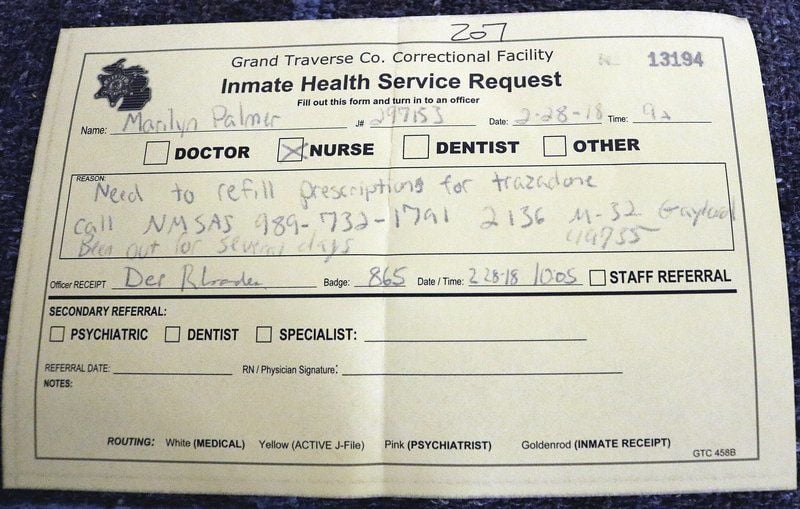
What happened to 36-year-old Marilyn Lucille Palmer? On February 28, 2018, Marilyn Lucille Palmer, mother of a 13-year-old son, was “found” hanging in her jail cell shower, in the Grand Traverse County jail, in Traverse City, Michigan. According to the Sheriff’s Office, “She was unresponsive and not breathing.” Since then, the Sheriff has maintained that the jail could use some help and funds, but basically everything is ok. Everything is decidedly not ok, not in the Traverse County Jail nor in jails across the United States.

On January 12, Marilyn Lucille Palmer pled guilty to one count of identity theft. She was sentenced to three months. She was to be released in May. The day before she died, she was denied a request for an early release. There is no early release possible for three-month sentences. Marilyn Lucille Palmer told her cell mates that she was distraught about missing Easter with her family and missing her son’s thirteenth birthday. Additionally, Marilyn Lucille Palmer used Trazadone, an anti-anxiety medication. A little over a week before her death, Marilyn Lucille Palmer filled out a health service request: “I think I’m having detox symptoms because I have really restless legs and my anxiety is through the roof.” On February 28, Marilyn Lucille Palmer filled out yet another health request: “Need to refill prescription for Trazadone … Been out for several days.” Hours later, in response to cell mates’ “panicked screams”, Marilyn Lucille Palmer was found “unresponsive and not breathing.”

What happened to Marilyn Lucille Palmer? She was dumped in a local, and nationwide, hole of systemic unresponsiveness … to women, to people of color, to those living with mental health needs, to those living with any health needs, to people.

In 2003, Amy Lynn Ford was sent to the Traverse County jail. Amy Lynn Ford was a recovering alcoholic who lived with epilepsy. She took Dilantin to control the seizures, but on the day she was booked, Amy Lynn Ford had not taken her Dilantin, because she had been drinking alcohol. She reported all of this to the intake official who noted the fact and then ignored it. Amy Lynn Ford was never given Dilantin. She was placed in an upper bunk, where she suffered a seizure, fell to the floor, and was seriously injured. She sued the jail, successfully, and, in 2007, was awarded $214,000. Judges and jury found that the County “exhibited deliberate indifference to and was the proximate cause of Ford’s injuries.”

Amy Lynn Ford was injured due to deliberate indifference. On July 22, 2017, Alan Halloway was “found” unresponsive and not breathing in the same Traverse County jail. Apparently, Halloway, who also hanged himself, was found for some three hours. The Halloway family is suing the County and jail. Their attorney, who has offered to represent the Palmer family as well, said, “Everybody wants to know what led up to this and how this was possible again. The whole place is dysfunctional from the top down. … We’ve been dealing with these problems for years and this all just needs to come to an end. How many more mentally ill people are going to kill themselves in that jail?”

In 2014, the National Institute of Corrections issued a report on the Traverse County jail. They found the jail ill equipped for “special populations”. They found the cells worsened the health of those living with mental illness. They estimated that around 80% of inmates were living with mental illness; they found that suicide attempts had become a common occurrence. What’s the word for an institution that exhibits deliberate indifference and in which suicide attempts have become the new normal? Jail.

In 2015, more people committed suicide in U.S. jails than over the preceding decade. In its most recent report, the Bureau of Justice Statistics notes, “In 2014, there were 1,053 deaths in local jails, an 8% increase from 2013 … Suicides, the leading cause of death, increased 13% between 2013 and 2014, from 328 to 372 … The suicide rate increased 8% between 2013 and 2014 to 50 suicides per 100,000 local jail inmates. Males accounted for the majority (900 deaths) of jail inmate deaths in 2014, but the number of female deaths (152) increased 22% between 2013 and 2014.”

What happened to Marilyn Lucille Palmer, in 2018? She went to jail. She needed and asked for help; none came. She killed herself. She was found unresponsive. She went to jail.


(Photo Credit: Traverse City Record Eagle)

In (the) front (of the crowd)

In (the) front (of the crowd)

In the front of the crowd
she was
when #FeesMustFall
hit our campuses
notes a Durban student

not in the margins
was she
says a civil rights leader
out the US way

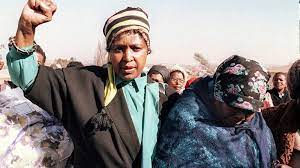
Winnie Madikizela-Mandela
labelled Mother of the Nation
by the everyday
(though apartheid denied her
mothering her own children)

a terrorist in the state’s eyes
and those who benefitted
from the collusions of apartheid

(tortured jailed banished
she kept the flame of freedom
alive during the dark days)

In the front of the crowd
uninvited a unionist jokes
she would just arrive

a journalist says people
have forgotten the past
and have no idea how
apartheid brutalized her

(and the post-traumatic
stress she and everyone
suffered and simply
carried on)

In the front of the crowd
not a spare rib
not an appendage
a person in her own

Winnie Madikizela-Mandela

Not yet Uhuru

(Photo Credit 1: Mail & Guardian) (Photo Credit 2: Wikimedia)