In an age of exile … this is not your home

In Cape Town, the Zeitz Museum of Contemporary Art Africa is currently showing an exhibition entitled A Protea Is Not a Flower, which considers the works of Gerard Sekoto, Bessie Head and Don Mattera, apartheid-era artists who struggled with various modes of exile. Zeitz describes the exhibit as follows: “A Protea Is Not a Flower is a multigenerational conversation between South African artists and writers whose lives and works contend with the complexity of the exilic experience …. The exhibition explores the spectrum of personal and political expression, navigating themes of exile, identity, and memory.” Exactly what is the vehicle, engine or pilot that “navigates” exile?

Exile is not estrangement. Exile is, as it was from its inception, banishment, and although “self-imposed exile” is a common enough phrase, in fact exile is never self-imposed: “No one leaves home unless home is the mouth of a shark.” Despite phrases like “government in exile”, there is no return from exile. Exile is and always has meant banishment. The ancient Roman lawmakers understood this. For them, exile was an “alternative” to capital punishment, or, at least, that’s how it’s understood today. Actually, exile wasn’t alternative, it was synonymous. Exile came with an administrative decree, interdictio aquae et ignis, “interdiction of water and fire”. This decree declared that anyone who ran into an exile within the borders of the country was encouraged to kill him or her. That is not an alternative to capital punishment. No water, no shelter, no warmth, no hope. Exile today has the same design and intent as exile in the past, death-in-life.

The categories of exile are numerous, perhaps infinite, and growing. Refugees. Forced migrants. Internally displaced. Those fleeing persecution, conflict, violence, or human rights violations; “those fleeing” are those forced to flee. Forced to flee climate change, weather-related disasters, and other “natural disasters”, such as wildfires, earthquakes, tsunamis, and the list goes on. Some are forced to flee epidemics. Others are forced to flee mass displacement caused by “development”. No one is fleeing, everyone is forced to flee.

This isn’t “just about” where you live, it concerns where you are, where you are yourself. Millions are counted as unable to return home. In an age of “self-deportation” and “self-eviction”, in order to avoid greater harm today and in the future, millions more who can’t return are uncounted, by the agencies, the State, the media. They are all in exile.

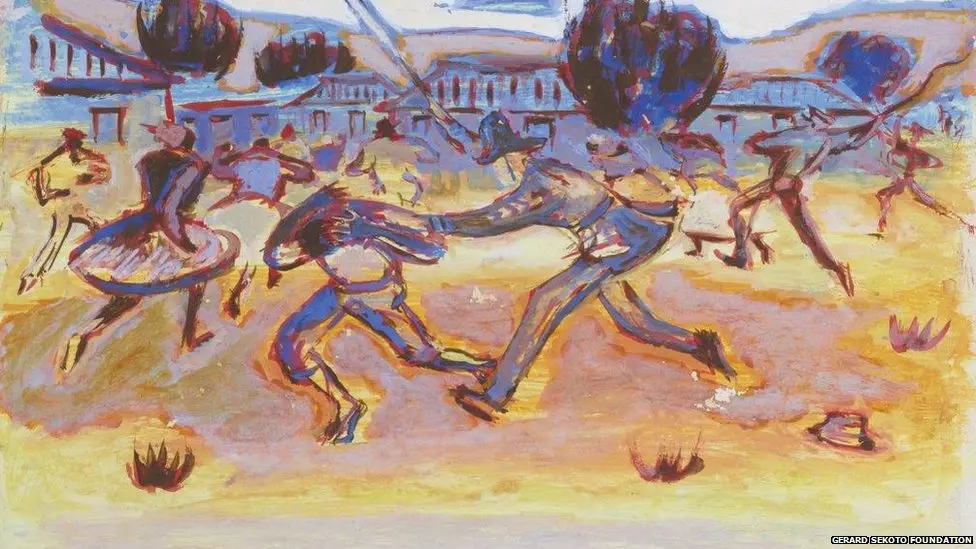
Gerard Sekoto was born in 1913 in what was then the Eastern Transvaal, in what is now Mpumalanga. From an early age, he studied to be an artist. He spent his early adulthood as a teacher and then devoted himself fully to the visual arts. In 1938, at the age of 25, he left for Johannesburg. In 1947, an accomplished artist, he fled South Africa, never to return. He lived and worked and came to renown in Paris, where he died in 1993. He never returned … because he couldn’t. South Africa, though in his soul and bones, was not his.

In 1942, the American poet Karl Shapiro, in the midst of World War II, wrote “Travelogue for Exiles”. The poem is three stanzas; the third reads:

Look and remember. Look upon this land,
Far, far across the factories and the grass.
Surely, there, surely they will let you pass.
Speak then and ask the forest and the loam.
What do you hear? What does the land command?
The earth is taken: this is not your home.

The earth is taken: this is not your home …


(By Dan Moshenberg)

(Image Credit: Gerard Sekoto. “The Sharpeville Massacre” / BBC / Gerard Sekoto Foundation)
France contracts the epidemic of “tough on immigration” laws

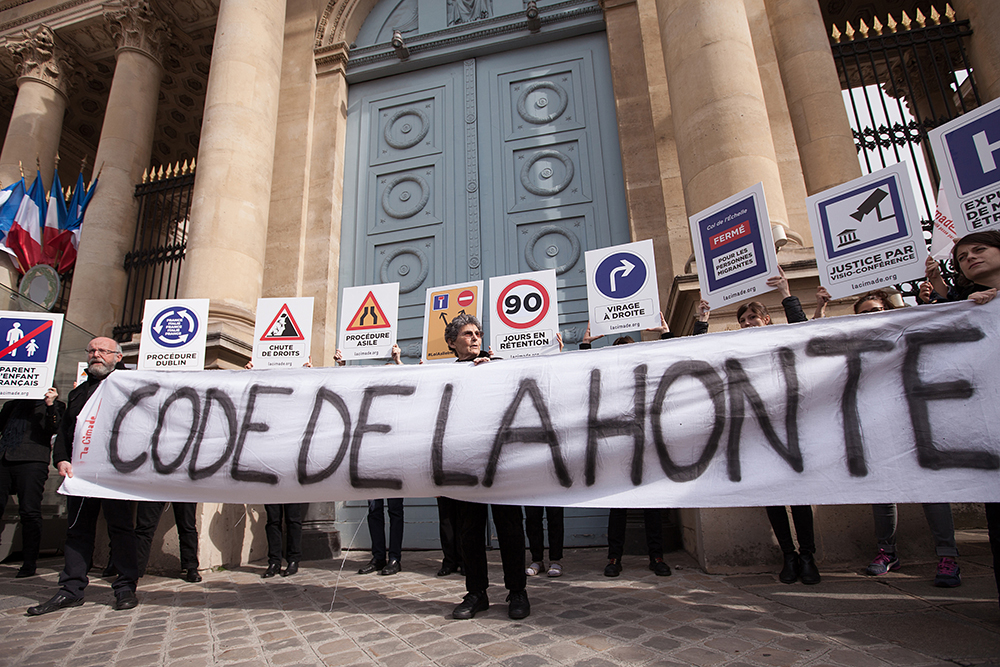
Some issues come back to the scene of “democratic” states at the time of neoliberal battles. In this time of globalization, there is a disparity of sanctions between movements of vulture capital and movements of people, themselves often victims of the economics of globalization.  While no one of late has offered a bill against vulture venture capital, in France, the Minister of the Interior Gérard Collomb has offered Parliament a new bill on asylum and immigration, nicknamed the law of shame.  Fitting into the European Union eagerness to crack down on the rights of people in exile, the bill aims to cut down the appeal time for asylum seekers as well as increase the time in immigration detention center. With an eye to society-market language, the bill promises “controlled immigration, effective asylum rights, and successful integration”.

While the Minister of the Interior claims the bill is balanced, NGOs involved in immigration services, such as la Cimade, warn of the danger of increasing levels of dehumanization with a law that treats everyone reaching France with suspicion. The Minister responds, repeatedly, that France cannot receive all the misery of the world. Remember the Geneva Convention? The Geneva Convention defines rights for refugees, not rights for countries to get rid of refugees.  This “controlled immigration”  bill has already passed the first chamber.

The bill doubles the maximum number of days spent in detention center from 45 to 90 days. Ostensibly, that gives the authorities more time to find solutions other than allowing the person in exile to stay in France, in other words, reaching an agreement with the refugee’s original country about the possibility for return.

According to Mireille Delmas-Marty, French law scholar and professor, before the end of the 1970s there was no separate notion of immigration, and no detention center existed for administrative detention, but, over time, the confusion between immigration, being illegal and delinquency has changed with changes in the law. In 1980 the “Bonnet Bill” marked the beginning of the criminalization of immigration. The bill allowed 7 days of administrative detention under specific conditions. France’s Supreme Court ruled that was too long and censured the bill. In 2018, 90 days is described as a reasonable length of time behind bars for non-criminal people. “Administrative” incarceration for people who are accused of nothing other than traveling without documentation should be challenged in the context of a record number of incarcerations in French prisons with 70,367 behind bars, 21 000 awaiting trial, and 120% occupation rate.

French civil society has resisted the principle of administrative detention on immigration issues. Recently, parents, students and teachers united to demand and obtain the liberation of the father of two high school students from Kosovo who was placed in administrative detention for his immigration status. Such acts of resistance have occurred repeatedly.

Collomb’s bill accelerates asylum procedures so people will have to apply for asylum within 90 days instead of the current 120 days. If their application is denied, they will have 15 days instead of 30 to appeal. The asylum process is already extremely difficult to maneuver for most people in need. Many NGOs, such as the Primo Levy Center, describe the process as too fast and shallow to be fair. Right now, judges and employees of the court of appeal for refugees and the immigration lawyers’ guild are on strike, denouncing the impossibility of treating everyone given the lack of resources.

The bill contained some progressive elements such as a better protection for women victim of sexual mutilations, stateless people, reunification with their family for minors traveling alone, and removing countries denying rights to homosexuals from the list of safe countries.  But the debate in Parliament revealed a larger resistance as the positive sections didn’t make up for the overall lack of protection for the dignity of people in exile. Many MPs from the majority opposed the bill and denounced the absence of necessary altruism and benevolence. With the bill, France is neither a land of integration nor of hospitality. Christiane Taubira remarked that the bill catered to a certain sector of French voters rather than taking into account the human reality of the migrations of our time.

Can numbers change the suspicious side of the law of shame on immigration? At a recent conference on migration, refugees, and exile, French historian Patrick Boucheron argued that more statistics are necessary to understand the human reality of today’s migrations. The world is made of 244 million migrants, with 100 million forced to migrate, 21 million refugees under the status of the Geneva Convention, and 3 million migrating to developed countries. The 10 countries that receive over 50 % of people migrating make up 2 % of the world’s GDP. Boucheron explained that in a time of capitalist crisis accompanied by environmental crisis, hospitality becomes a key political question.

What will transform the vision and understanding of people who are migrating from the perspective of the people who migrated before them?  President Emmanuel Macron’s nickname is Jupiter, a mythological god that reigned over other gods. Jupiter was also the god of hospitality. We should remind the young President of France of that. How can people and the government transform distrust into trust?  What will make a politics of hospitality possible?


(Photo Credit 1, 2: La Cimade)