The picture we paint (over)

The picture we paint

The picture we paint (over)

The picture we paint (over)
that which we differ with
civilized as we are right
here in Africa down South

The picture we paint (over)
did liberation before education
beget us a begging bowl nation

(drawers of water and hewers
of wood Verwoerd-style as
apartheid so cruelly intended)

The picture we paint (over)
a nation-state of book-burners
disrupters of (school) learning
(we harm African nationals too)

(call back the not-too-distant past
of Nazi Germany, Stalin’s Russia
not to mention Pinochet’s Chile
and other US-sponsored despots)

Nearby there is a demand
to stone a human being to death
in these bigoted post-1994 times

The picture we paint (over)
all things being equal before
for all the world to see
all but own ourselves

“Zuma painting’s an attempt at satire, says Brett Murray (Cape Times, May 22 2012); whilst his work is defaced (ETV 7pm E-News), and a group faithfully calls for him to be done in (SAFM 11pm news) – all in one evening’s sitting


(Photo Credit: iol.co.za)

You are not alone (Metrorail style)

You are not alone (Metrorail style)

You are not alone
between your place
and the next in life
in the middle of

You are not alone
at the mercy of
the public transport system
between Metro stations
Ndabeni and Maitland

You are not alone
in hearing no apology
for any inconvenience
this may have caused
(and no journalist is in sight)

You are not alone
commuters evacuate
braving the quick drop
from carriage to ground
(many do a cancer-stick first)

You are not alone
me now Bellville-bound
in another cattle-truck
a Book Launch out UWC-way

(“Feminist Popular Education
in Transnational Debates”
trying to change the world)

You are not alone
a differently-accented traveller
now at the raw end of
Metro’s Protection Services
checking commuters’ tickets

What might scholar-activists
and adult and popular educators
reflect on life Metrorail-style
“in the grand narratives of revolutions”

You are not alone
or are you

(I wend my by now weary way to the university campus, courtesy of what is politely called a “public transport system”, 5 May 2012. A journey of Lifelong Learning, I suppose!)

(Photo Credit: YouTube)

Let’s hope France does not vote for US-style prisons

As France goes to the polls in May, I think of women in prison in France and those in the United States, and I shudder. Consider the following.

These are the rules applied to pregnant women in prison in France, and they are clear:

No restriction of rights and access to Public Health Care during pregnancy.

Women are automatically covered by the health care system, mothers with babies under 18 months of age may receive maternal subsidy in prison the same as any woman in the “free world.”

No surveillance during delivery or at any stay at the public hospital where women who are incarcerated have to go for their regular visits and delivery.

The stay after delivery is the same as for any other, that is to say a minimum of 4 days and for as long as the doctor judges they have to stay.

Mother can be sent to a special section of the prison and keep their infant if they want to. The child is not incarcerated, and so receives all regular subsidies from the state, without restriction, and the mother manages the money, if she so chooses.

The hospital director may ask for surveillance outside the room, if deemed  necessary.

Those are the rules, and they’re a far sight better than those in the United States. Nevertheless, we cannot ignore the distances, in France, between conditions as they for women in prison are and the claims made in official documents. Life for pregnant women in prison is difficult and not often talked about.

In France, for instance, there are 64 000 people incarcerated and 2500 are women. Women in prison often complain that because they are so few, their conditions are not taken seriously. There are political women prisoners, the majority of whom are Basque activists. Women may have private visits with their spouses, so it is possible, within the rules, for a woman prisoner to become pregnant.

Take the much-publicized story of Véronique Le Gall.

Véronique Le Gall was in jail for having killed and stored her newborn baby in a freezer. That was most likely a case of post-partum depression. At any rate, while in prison, she became pregnant. The authorities didn’t know and so only at the last instance was she sent to the hospital to give birth.

The point of the story of Véronique Le Gall is that it’s not unusual. It’s not unusual for women prisoners in France to become pregnant. There are several, formally sanctioned ways to get pregnant in prison. If a couple is incarcerated in the same institution, they have access to an internal visiting room. Women prisoners may be released on weekends. Finally, women can meet their family for 6 to 72 hours in a unité de vie familiale, or family life unit, which are small private apartments.

From one perspective, the standards in prisons in France are much better than those in the United States, but that’s not saying much.

What remains an issue is the prison environment in which a no-exception rule reigns. Pregnant women are trapped in this no-exception rules situation. Their parental right is not going to be compromised but their parenting is. Women prisoners in France can become parents, but they can’t be parents. They can’t act as parents, because they can’t make autonomous decisions about their children.

The last few years has seen both an improvement and a degradation of detention conditions. Recently, both the Controleur General des Lieux de Privation de Liberté, Jean Marie Delarue, and the European Committee for the Prevention of Torture and Inhuman or Degrading Treatment or Punishment have identified disturbing, new elements: increased use of force, lack of training among wardens, increased use of solitary confinement, inadequate food provided by outsourced provisioners, slow psychiatric response to needed attention, and increased use of hand cuffs, especially for male prisoners. In France, doctors oppose the use of any restraints on medical grounds.

The International Observatory of Prisons sent a letter to both President Nicolas Sarkozy and to his main election contender Francois Holland. Neither said much. Hollande declared that French prisons should remain in conformity with principles of dignity. His chargé d’affaires explained that they wanted to render prison “useful” and work to decrease the rate of repeat offenses. As for Nicolas Sarkozy, he announced that he wanted to add 24 000 beds to the 56 000 already in place, and to rework the sentencing reduction program in place as a kind of zero tolerance program. He calls this “reinforcing the authority of justice”.

Prisons reflect as they participate in the evolution of the political economy of a society. That has certainly been the case in France. Let’s hope that the May 6th election marks a positive turn that keeps France’s prisons distant from those of the United States.


(Photo Credit: Robin des Lois)

In the capital of the greatest incarcerating country in the world


On March 28, Ruth Wilson Gilmore gave the annual Yulee Endowed Lecture, hosted by the Women’s Studies Program at the George Washington University. Her talk opened with a slide showing an NAACP billboard that said, against the Statue of Liberty as background,

Welcome to America home to
5% of the world’s people &
25% of the world’s prisoners.

This is the same America that is home to 5% of the world’s population and produces 27.8% of the world’s greenhouse gases from fossil fuel, according to the National Environment Trust.

Pollution and incarceration reveal a dreadful, man-made reality. For both prison and pollution, the United States tries to change its image rather than face up to the reality. The United States is the primary source of world pollution and of prison practices. A prison binge has been built on the disregard of women, of people of color, of the poor. High levels of pollution have been built on absurd consumerism passed off as a social good. Meanwhile, for many, these add up to a cruel reality.

United States administration after administration has produced more laws to incarcerate more people and more “Acts” to cover up the high level of emission of Green House gases and other pollutants. Images of poor people, especially of women of color, abusing the welfare became as visible as the images of the destruction of the “Commons” became invisible. What one hand giveth, the other taketh away.

In her lecture, Ruth Wilson Gilmore talked about the reality of incarceration.  Her book, The Golden Gulag Prisons, Surplus, Crisis, and Opposition in Globalizing California, started as a community project: a research for Mothers ROC (Mothers Reclaiming Our Children) in California, women who know too well the reality of and reasons for incarceration. They needed “a non-lawyer activist with research skills, access to university libraries, and a big vocabulary, to help them.” Gilmore fit the bill perfectly.

In her book, Gilmore relocates the two laws that sent the Mothers’ children to prison—the Street Terrorism Enforcement and Prevention Act and the “three strikes and you’re out” law—into their historical political economic context. Ruthie, as everyone calls her, presented on the particular history of capitalism in the United States, the story of opportunity fertilized with inequality and racism. Her lecture was called “What Would Harriet Do? Unfinished Liberation or the Dangers of Innocence”.

Harriet is Harriet Tubman.

Harriet Tubman’s story exemplifies the root of the social and racial American construction. For Gilmore, Tubman was a designer and a political artist. Tubman’s story of unwavering determination to bring slaves of the south to freedom speaks directly to today’s “zero tolerance.” As the false stories told of African and African-derived people helped to justify the slavery of thousands of women, men and children of African descent, so today’s false story of “zero tolerance” attacks African Americans. 65 million people are currently banned from employment because of previous convictions, and those people live in the communities that most need steady employment.

The following day Ruth Wilson Gilmore continued the conversation in Dan Moshenberg’s Seminar, “Women In and Beyond the Global Prison.”

Again, the discussion focused on the construction of images, from the witch-hunt that put women back in the “domus,” to the “Reaganomic” image of the welfare-queen that re-segregated poor and working African American women, thereby legitimating the re-appropriation of power and global capital. Welfare-queen became pathology. To unpack that pathology, we must learn to study “the genealogy of the phrase,” and thereby reinforce the importance of historical consciousness.

Gilmore brings to light the reality of the political economic project that requires mass incarceration. That project is genocidal, and that project of mass incarceration speaks directly to the situation of health care and reproductive rights in the United States.

Slavoj Žižek recently argued, “one of the strategies of totalitarian regimes is to have legal regulations (criminal laws) so severe that, if taken literally, everyone is guilty of something. But then their full enforcement is withdrawn… At the same time the regime wields the permanent threat of disciplining its subjects.”

I am not saying that we live in a true totalitarian regime. That is not the question. The question is whether we understand that these ‘all-guilty’ laws work to control and subjugate certain sections of the population, such as the African Americans, Native Americans, immigrants, and also women. Of course, women intersect with the other “guilty” populations. In many states, laws limiting women’s reproductive rights are blossoming, and punishment and incarceration await the women who try to secure or wield their rights. At the same time, the story of Trayvon Martin’s assassination fits this framework of being eternally guilty. His corpse was tested for drugs and alcohol. His shooter never had to be tested and is still alive and free.

There are many other stories that show that the current rule of law is an active political-economic tool. Ben Saperstein and May Young, two activists from North Carolina, attended the seminar with Gilmore and Moshenberg. They were there to learn and exchange ideas for their own struggle. They are involved with the Greensboro Legal Fund, which works to bring to light the fate of members of a Latino organization that has been wrongfully accused of racketeering, and has been incarcerated for political reasons.

The exchanges among activists and scholars from North Carolina, Washington, New York and beyond showed the importance of research working with activism. In this time of neoliberal surge, as Žižek remarked, “what unites us is the same struggle”. In this struggle, Ruth Wilson Gilmore’s inspirational work reminds us of the importance of excellent scholarship as a means of resistance.

(Image Credit: NAACP)

What are “moral crimes”? For Afghan women …

According to Human Rights Watch, for incarcerated Afghan “immoral criminal” women, moral crimes can take many shapes, including “falling in love and eloping with the lover”, “running away from an abusing husband”, “being kidnapped”, “getting lost”, “being raped”. What do all these variations share? You might think it’s the woman “victim”. You’d be wrong. For Afghans, the real victim is the woman’s family, and family means “the men of the family”.

Who then is the “typical” Afghan woman? She is the namoos, the honor and dignity of a man.  This is her identity: the woman is the “other” to the man’s “self”. This dependence and otherness makes the Afghan woman oppressed and the object of man’s control over her body – her behavior, the way she walks, talks, what she wears, where she goes – because she must protect the man’s dignity and honor. His dignity and honor are embodied in her vulnerable body. A woman’s body is entrusted with the “dignity and honor” of a man. That is all there is to her being.

If the “dignity” is comprised, the woman’s body can be summarily disposed of. The woman does not even have to be at fault for this to happen. Any violations of dignity can make a woman’s body disposable. There are numerous routes to honor killing.  An Afghan woman is likely to be killed by her male family members after she is thought to have compromise the “dignity and honor” of the male family members by any misconduct. Misconduct includes having been raped.

Through socialization processes at the family and community level, women internalize their “other” identity. The family produces children or youth as disciplinary subjects: “Not only the parental gaze and it’s internalization by children within the family, but also the effects of the multiple gazes originating outside the “parent-child cell” help in producing women as disciplinary subjects. Family members constantly monitor each other. For instance, like the prisoner who takes on the roles of both watcher and watched, a daughter must assume parental scrutiny even in her unobserved or private actions. Women are actively involved in the process. Their identity is tied up in observing the rules and regulations imposed on them, rules and regulations they have internalized as their own.

An Afghan woman will act upon these internalized norms and values.  She will watch her body and her acts.  If any rule is violated, she might punish herself.  There are many instances of Afghan women who committed suicide, which can accurately be termed “honor suicide”, after being raped, to restore the honor and dignity of the family.

But what happens in those rare cases where a woman runs away rather than commit suicide? What happens when a woman who has been raped chooses to live and tell the police? The police put her in jail. If the case makes it to court, the judge sentences her to years in prison for adultery and running away. Finally, President Karzai, under pressure, might “pardon the immoral criminal so that she can marry her rapist. She will not be welcomed at her “father’s” home and she will have nowhere else to go. Either she restores the honor of the family and marries the rapist, or just she kills herself … if she hasn’t already been killed.

“Running away” is mostly associated with love, and “love” in Afghan culture is mostly an immoral word, for boy and girls. In many cases, when families have found out about a relationship, they marry their son or daughter to someone else as soon as they can, to end it.

Girls grow up being taught that men can not be trusted. Therefore, it is expected for a girl to keep herself hidden and safe until marriage. If a girl or young woman decides to run away, she knows that something is going to happen to her. If she is already on the run, she has accepted the consequences. The woman is blamed for whatever happens to her. This belief is widely shared, even among academics and students of the law. Once, in the midst of a hot debate on women’s rights, a classmate stood up and said, “I can do anything to a girl who `breaks the chains’ and steps over the line.” Many in the class, including the professor, seemed to agree, including most of the girls.

This mentality is everywhere, among ordinary people, and among academics, law students, lawyers and judges. What is taught in law school? One professor would teach us, “What goes on in a household is none of anyone else’s business. If a woman is battered or violated, nothing can be done until she goes to the police herself. If she doesn’t have any problem with it, no one can do anything”. Another would teach, “When you bring a woman to your house to `get married’, you are not just going to put her in a glass box and sit and watch.” Then he would laugh, and the class would join in. Another lecturer would teach: “ An adultery case is impossible to prove, unless four male witnesses, who were present at the scene, testify to it’s having occurred.” In other words, the women, who is the “immoral raped criminal,” has to ask the rapists and their witness accomplices to testify to having raped her.

There is no “moral crime”. “Moral crime” is the culture. For Afghan women “moral crime” is another red line drawn around them, a line that makes sure that no woman ever steps out of bounds.

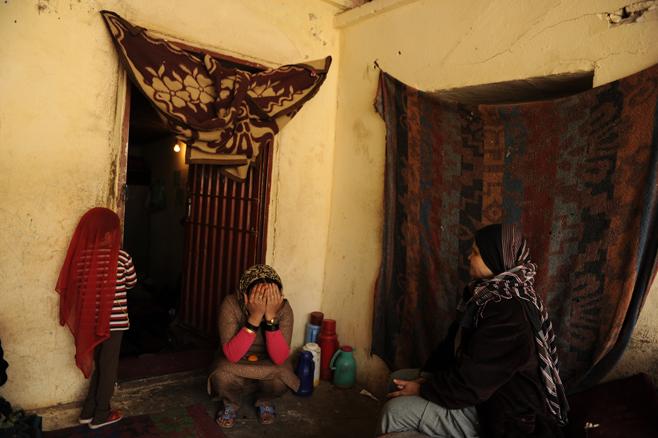
(Photo Credit: Farzana Wahidy / Human Rights Watch)

Remember and recognize Alem Dechasa-Desisa and her sisters

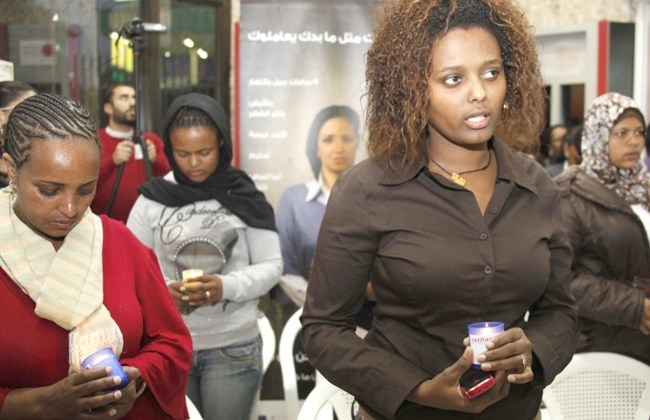
Ethiopian women hold a mass in memory of Alem Dechasa in Beirut, March 21, 2012

March 30 is International Domestic Workers’ Day. Around the world domestic workers, overwhelmingly women, work to clean households, cook, mend, care for children, for elders, for the sick, for those with disabilities. Around the world, domestic workers, millions upon millions of women and girls, travel to or wake up in other peoples’ homes and take care of their employers’ emotional well-being. Around the world, domestic workers organize and struggle with denial of payment, denial of social security, unpaid extended workdays, mistreatment, exploitation, abuse. So, when Ai-Jen Poo, of the National Domestic Workers Alliance, wishes her sisters happy international domestic workers’ day, the wish is as aspirational as it is of the present moment. It’s as hopeful as it is courageous.

Alem Dechasa-Desisa’s life story demonstrates that all too well. On March 8, a video started circulating. The video showed a young Ethiopian woman, presumed to be a domestic worker, pleading for help outside the Ethiopian Embassy in Beirut, Lebanon. A car pulls out. Men jump out, attack the young woman, kick her, knock her to the ground, and worse, and then force her into the car and disappear. All this was caught on video and then shown on Lebanese television news.

Later it was reported that the young woman was indeed an Ethiopian domestic worker, Alem Dechasa-Desisa, 33 years old. She was from Addis. She was the mother of two children. She arrived in Beirut in December 2011, less than three months earlier.

Dechasa-Desisa was suffering. According to her employer, she was suffering a nervous breakdown. Many in Lebanon doubt that was the case. Her employer dumped her at the Embassy, who did nothing. Worse, the Embassy told the employer to take Dechasa-Desisa to a mental health hospital. Take her anywhere. Take her away.

When the police found the young Ethiopian woman, they took her to the immigrant detention center, with the intention of deporting her. She cried so much she was taken … to a mental health hospital. Two days later, she was dead, by hanging. Suicide. Structural homicide. Alem Dechasa-Desisa was dead.

The video shocked Lebanon. The video shocked Ethiopia as well. The death of Alem Dechasa-Desisa disturbed Europe as well, and received some mention in the United States. But what exactly is the shock, the scandal?

The abuse of domestic workers is systemic. The abuse of transnational, migrant workers is, if possible, even more systemic. This new form of a very old situation is intensified by nationalism, racism, sexism. It is also intensified by the structurally induced greater vulnerability of the transnational migrant domestic worker. More often than not, she is a live-in worker. Her `home’ is her employer’s home. Live-in for a transnational migrant worker means more than being on-call 24 hours a day, although that would be bad enough. It means the worker is homeless. If she’s kicked out … there’s no place to go. If she leaves, there’s no place to go. Her very being on the street becomes a criminal act.

All domestic workers struggle with exploitation and abuse. All domestic worker struggle with the absence of any real possible response to exploitation and abuse, other than personal resistance. They know that no State will aid them. Quite to the contrary.

For transnational domestic workers, it’s worse.

The vulnerability of the transnational domestic worker is intensified by the reliance of the home country on the money earned and sent home by the workers who have traveled to richer countries. The home countries also rely, heavily, on the absence of those workers, the reducing of pressures to employ them. The home country needs its workers in other countries and it needs them `to behave’.

The Ethiopian Embassy responded to Alem Dechasa-Desisa’s pleas. It closed its doors.

Alem Dechasa-Desisa’s story is the story of young women on the move, around the world. Hers is the story of modern labor, young women workers struggling to make a living. Without strong unions, women domestic workers are left to their own devices. Without strong unions, women domestic workers’ stories only come to the surface when someone is abused in public and caught on video. Without strong unions, women domestic workers’ lives are defined, by the public, by `suicide.’

Women domestic workers define their own lives differently. Hard work. Advancement. Struggle. Shared laughter and tears.

Yesterday, Friday, March 30, 2012, was International Domestic Workers’ Day. Remember and recognize Alem Dechasa-Desisa and her sisters. Honor them as builders, as the women who have built the everyday lives of the entire planet, and support their organizing efforts. Happy International Domestic Workers’ World!

(Photo Credit: Daily Star)

Feminism and Love: We Shift

“The act of ‘falling in love’ can serve as a ‘conduit’ or impetus for the action necessary to challenge oppression.”
-Chela Sandoval, paraphrasd by Maythee Rojas

As borders are not separated from all of us who construct them, the cracks in the borders do not merely take off a weight so that we can breathe more easily. When we see each other in new ways, we, too, shift: our convictions are tested, our lived experiences are re-interpreted, and we are confronted by the fear and promise of transformation.

To talk about the borders is to talk about fear. To talk about responsibility or liberation or love is to talk about fear. Even in the supremely brave act of love, we fear that every word can be misinterpreted, every action misguided, every relationship threatened by the realities of our bordered lives.

Thus, we must respond to this fear in “the language of lovers [,which] can puncture through the everyday narratives that tie us to social time and space.” We can write the borders in the language of our own stories. We can challenge the borders out of responsibility to and love for one another. And we, ourselves, can shift.

The language of love represents a radical change from the language of the everyday, for it challenges the comfort of our abstract principles, the familiarity of our homes, and the constancy of our very selves. It throws us into relationships that force us to confront our privilege and our prejudice, our fears and our doubts. It calls us to “de- and re-center,” to be transformed by one another, to find a home amid all manner of shifts.

To create a home in our bordered world is to live each day with the inescapable realities of separation and oppression and to be called every day to common struggle. Our feminist struggle is not common in the sense that the oppression we face or the liberation we envision is the same. It is common through our dedication, first and foremost, to one other.

After a night at Occupy Wall Street, Manissa McCleave Maharawal “biked home over the Brooklyn Bridge and I somehow felt like the world was, just maybe, at least in that moment, mine, as well as everyone dear to me and everyone who needed and wanted more from the world. I somehow felt like maybe the world could be all of ours.”

Love imagines that possibility; that the world does not belong to an intangible universal but is home to all of us, sharing our stories, challenging our borders, and bravely committed to the responsibility and the joy of loving one another.


(Photo Credit: Racialicious)

The incarceration of a Black woman is ….”fun?”


Kemba Smith

We should listen to formerly incarcerated women when it comes to prison issues. After all, women, particularly Black women, are the fastest growing prison population in America.

For example, the recently held 2012 UCLA Law Symposium, entitled “Overpoliced and Underprotected: Women, Race, and Criminalization,” brought together renowned and influential thinkers and lawyers, as well as activists from non-profit organizations. All the panelists focused on incarceration, and many advocated for the creation of a “feminist, anti-racist, prison abolition coalition.”

On the first day, only two Black female panelists identified themselves as formerly incarcerated. One was Kemba Smith. She eloquently told her story. While in college, she began dating a drug dealer. Despite never having used, handled or sold crack/cocaine, Smith was sentenced to nearly 25 years in prison.

I did not catch the name of the other woman, who was filling in for the director of the non-profit where she worked. She did not tell her story, except to say that she had served time in prison. Instead, she shared the goals of her organization, and compelled conference attendees to help break the cycle of incarceration, with more urgency and less flair than Smith.

At the end of the night, I overheard a symposium attendee tell the second woman, “Your talk was really fun!” Weeks later, I’m still curious what about incarceration is “fun.”

I wish I had asked the attendee what she meant by her comment. I would guess that she was well-intentioned. Nevertheless, I wondered what it meant to call a presentation at an academic symposium “fun.” Did it serve as a compliment? Or, as it seemed to me, did it strip this woman’s narrative of legitimacy? Such a comment was not directed at Kemba Smith, the lighter-skinned Black woman who had straightened hair, and wore a suit. No, this comment was for the darker-skinned, “poorly-dressed” woman with thick braids.

How do our own perceptions of people inform our understanding of what they are qualified to say, and why we should (or shouldn’t) listen?

This conference repeatedly referenced Michel Foucault’s notions of power and surveillance, highlighted the historical legacy of slavery, reminded us of color politics and “the paper bag test,” and challenged the stereotypes that have shaped American laws and social policy. Still, we needed to revisit the basics of feminist standpoint theory and “relations between the production of knowledge and practices of power.” Standpoint theory emerged as a “way of empowering oppressed groups,” and “valuing their experiences”, but the second speaker’s experience and voice were not honored. By suggesting that this panelist’s talk was “fun,” one conference attendee discredited the panelist’s voice, merely reproducing the structures that confine and silence certain women.

Everywhere, we should welcome the voices of all women. When working towards a feminist, anti-racist, prison abolition coalition, we should especially try to include all formerly incarcerated Black women. Unfortunately, we don’t.

(Photo Credit: LA Progressive)

Education cannot be stolen, handcuffed, or imprisoned

Tanya McDowell addresses reporters

Forty some years ago Paulo Freire argued against what he called the banking model of teaching and learning. That was then. Today, the bank  is gone, and a prison stands in its place.

Ask Tanya McDowell or Mireya Gaytan.

Tanya McDowell is a Black woman, a single mother, living with her 6-year-old son. She lives, officially, in Bridgeport. `Officially’ because in fact McDowell is homeless. Or she was last April when she was arrested, in Norwalk, for stealing education. Stealing education is a first-degree larceny offense.

McDowell registered her son in Norwalk, using the address of her babysitter. When this was `discovered’, McDowell was charged with theft. Two weeks ago, she pled out, and was sentenced to five years in jail and five years probation. That’s almost a year for each year of her son’s life.

The public story is `complicated’ by McDowell’s arrests and convictions for selling drugs. Thus, the trial in Norwalk, despite her attorney’s protest, was for both the sale of narcotics and the first-degree larceny, because, somehow, these have to be taken together. That way, it can be demonstrated that Tanya McDowell is not a woman trying to get a decent education for her child. No. She’s a bad mother. She must be. She sells drugs. And she’s not only a bad mother and a drug dealer. She’s Black, homeless, unemployed, underemployed.

The story hearkens to that of Kelley Williams-Bolar, the Black woman in Ohio who was found guilty of stealing education. The story is complicated by the ongoing narratives of the national and regional campaigns to criminalize Black women, and women of color, more generally.

And to criminalize their daughters as well.

Yajira Quezada is eleven years old. She lives, and goes to school, in Colorado. Earlier this week, she got into some trouble with the administration in her schooling, mouthing off or not showing proper respect or deference. So … they called in a counselor. That didn’t work. So … they called in “the school resource officer.” He handcuffed the eleven-year-old girl, took her into his squad car, and delivered her to the juvenile holding facility. As explained by the local sheriff, this is standard operating procedure for `transport’ of juveniles.

This public story is `complicated’ as well.  Children across the United States are subjected to such treatment regularly. School `resource officers’ routinely handcuff children; routinely take them off to juvenile `facilities.’ Children across the country are routinely dumped into `seclusion rooms’. Solitary confinement.  In Georgia, in Wisconsin, children have met their deaths in school-based solitary confinement.

Yajira’s mother, Mireya Gaytan, is outraged. She doesn’t want her daughter to be allowed to misbehave or show disrespect … to anyone. But she also doesn’t want her daughter to be treated as a criminal. In short, she wants her daughter to receive an education.

Tanya McDowell, Mireya Gaytan, two women in America who want their children to receive an education. Not a prison sentence. Not a death sentence. Not a criminal record. Not a trace memory on the wrists. Not a sense of overwhelming vulnerability. Not an indictment based on the color of skin, not a conviction based on where you live … or don’t.

An education.

Education is not merchandise. Those who seek education are not `clients’ or `customers’. They are human beings who know that education is always shared, always social. They are women and girls, and especially women and girls of color, who know that education cannot be stolen, handcuffed, or imprisoned.  Education is a human right, a civil right, a women’s right. Period.


(Photo Credit: Kathleen O’Rourke / Stamford Advocate)

Expose the attacks on the undocumented and on women in France


While in the United States, attempts to hurt, reduce and constrain women’s bodies are multiplying (as the recent bill in Virginia to impose vaginal sonogram on women who seek an abortion demonstrates), two recent developments in France show that the politics of constraint and control of the body and in particular of women’s bodies are also expanding in Europe.

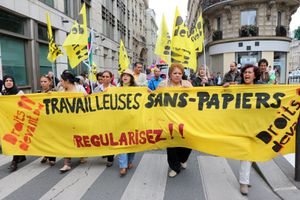
In France, undocumented immigrants, “les sans-papiers” have access to health care, through “l’aide medicale d’Etat” or AME (State Medical Aid), if they have been in France for at least 3 months. While this seems to be better than many other places in the western world, some barriers that have been erected to divide and control immigrants and residents.

For example, it used to be that in order to register, people could go to any regular center of the national health coverage “les caisses d’assurance maladie,” and there were many of them. Recently, new rules have been introduced. Since the end of 2011, in Paris only two centers have been processing applications to be registered in AME. After two months, the Observatory of Foreigners’ Right to Health, ODSE, has reported a series of problems. These include long waiting lines, starting in the middle of the night, summary selection of applications, loss of applications, mounting administrative red tape. All these difficulties contribute to delaying indispensable coverage and access to health care for people who are already among the most vulnerable.

Another recent development directly affects women’s health and well being. In 2001, a bill was passed that gave women’s reproductive rights a great boost. The new law includes provisions for anonymous access to contraceptive and abortion services for minors and without parental consent. It also provides for an ambitious sexual education program, lately the distribution of money to enforce this law has been problematic. Recent reports have shown the importance of sexual education through school as well as free and easy access to centers where women and men can access information on the various questions related to sexuality.

The law itself is beyond repeal, but that does not mean it is safe from dilution. Although officially budgeted for the 2012 fiscal year and voted by the parliament, apparently, 500 000 Euros slotted sex ed programs has disappeared. The Sarkozy administration must have misplaced it!

So how are these two issues related? Both are about creating barriers for some women to access services that allow full social participation and meaningful exercise of their rights. They are about relegating to the back seat some selected populations who are excluded through constraining policies on their bodies, which are, thus, made invisible in body politics of the nation. The reshaping of existing social advances concerning reproductive rights, health care for all, has become the priority of neoliberal governments. It follows the pattern that has already been developed for emerging countries, cutting public services. It is important to identify policies that follow this pattern. It is important to expose them in order to lessen the impact of the US neoliberal transformation anywhere it is being exported.

(Photo Credit: Femmes En Lutte 93)