Does David Cameron support slavery? Ask the domestic workers.

Last year, England declared October 18th as Anti-Slavery Day. Today is the second Anti-Slavery Day. How will Prime Minister David Cameron and his wife Samantha Cameron celebrate this day? Let’s ask their nanny, Gita Lima.

Gita Lima is originally from Nepal. She worked, in England, for a family that proved to be abusive. She received assistance from Kalayaan, an advice and advocacy center for migrant domestic workers. Lima’s situation was all too familiar to Kalayaan. According to Kalayaan, nearly 70% of migrant domestic workers work seven days a week, almost half work 16 hours a day, and nearly 20% have been physically abused. More than half of the transnational domestic workers report that their bosses seize their passports and do not let them leave the house unaccompanied. Many report being denied food, many report sexual abuse.

Among its services, Kalayaan runs an ethical employment agency. David and Samantha Cameron came to that agency and hired Gita Lima, a number of years ago. Lima cared for their four children. In particular, she took care of the eldest child, Ivan, who had been born with a combination of cerebral palsy and severe epilepsy, and required round the clock care. Ivan died in 2009, at the age of six. Gita Lima continued to work for the Camerons, moving with them to 10 Downing Street.

The government, David Cameron’s government, recently proposed a change in visa regulations. This change would require migrant domestic workers to stay with the employers who sponsored them. Like the song says, “You’d better dance with the one that brung ya.” Or else.

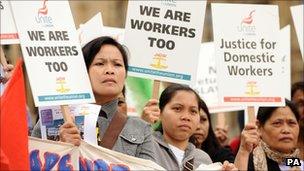
Many domestic workers, and their allies like Kalayaan and the trade union Unite, understand the removal of the limited protections provided by the current system, the elimination of the right to change employers, as slavery.

They’re right, it is slavery, and it’s the Parliament of the United Kingdom that says so, in its Anti-Slavery Day Act: “In this Act “slavery” includes—
(a) trafficking for sexual exploitation,
(b) child trafficking,
(c) trafficking for forced labour, and
(d) domestic servitude.”

Domestic servitude. Gita Lima, Marissa Begonia, Noor, Mira, and all the transnational domestic workers did absolutely nothing wrong, did everything right, in fact. They have worked hard, they have taken care of children and households, and in the case of some, like Gita Lima, they have wept at and mourned the loss of a loved one. Who is the criminal here, the one placed in slavery, in “domestic servitude”, or the one who holds the woman worker in bondage?


(Photo Credit: BBC)


Rural Women. Period.

October 15 is the International Day of Rural Women. This year marks the fourth celebration. According to the United Nations, the day “recognizes `the critical role and contribution of rural women, including indigenous women, in enhancing agricultural and rural development, improving food security and eradicating rural poverty.’”

Rural women do a bit more than ”enhance” and “improve”, and the do so in more areas than “the rural”.

Who, and where, exactly, are “rural women”?

On one hand, they are women in rural zones. As such, they are the heart of the current food crisis. They are the women working the sugar farms, or sweatshops, in KwaZulu-Natal and the citrus farms of the Western Cape, both in South Africa, too often overlooked or forgotten by the trade unions, the State, and, to a certain extent, large swathes of the women’s movement. They are also the South African women who comprise Sikhula Sonke and the Surplus Peoples Project, women who struggle, organize, keep on keeping on.

They are the rural and indigenous women in Argentina who speak out about and who organize to stop the environmental and economic devastation of climate change, a process they see and live with every day.

They are the rural and indigenous women across Asia who struggle with the intensification of patriarchal exclusion the emerges from the embrace of local power brokers, national governments and multinational corporations, especially but not exclusively those engaged in agriculture. They are women, like Rajkala Devi, who have broken glass, linen, silk, and concrete ceilings to attain public office in villages, as in hers in Rajasthan, India, and to move more than the village into more than recognition of women’s rights.

They are the fisherwomen like Rehema Bavuma, from Uganda, who struggle, along with their Asian and Latin American sisters, to do more and better than merely stop land grabs, to change the entire system. These women know, without the `benefit’ of longitudinal studies, that girls and women are the key to food security, to well being. They also know that girls and women are the key to food sovereignty, to something more and better than an end to hunger and an end to threat of starvation.

They are women who struggle with patriarchal governments, like Lind Bara-Weaver, a stone’s throw from Washington. Bara-Weaver struggles with the economy, as do all farmers. But she also struggles with the US federal government’s policies concerning loans to women farmers.

They are Dina Apomayta, in the highlands of Peru, the seed keepers, the guardians of diversity, the last station against what some call “Holocene extinction”, the end of diversity. And they are everywhere.

Rural women are not just in rural areas. They are in cities, too. They are women like Somali farmer Khadija Musame and Liberian farmer Sarah Salie, both now living and providing food for residents of San Diego … in the United States. They are women like Jenga Mwendo, founder of the Backyard Gardeners Network in New Orleans, and women like Regina Fhiceka, a garden and community organizer in Philippi, just outside of Cape Town.

Rural women are everywhere. They are in rural areas and they are in cities. They are the world. That’s the message we should carry on the International Day of Rural Women, today, and into tomorrow, World Food Day … and beyond. Rural women. Period.


(Image Credit: American Dairy Association of Indiana)

Soni Sori haunts more than India

Soni Sori


Sometimes the colonizer becomes the colonist
. For some, this is what has happened to India, specifically as regards land grabs in Ethiopia and elsewhere.

But the transformation doesn’t stop at “colonialism”. Colonialism is more than settlers and mass and brutal extraction of other peoples’ natural resources. Colonialism involves imperialism, empire building, and not only abroad. Welcome to Chhattisgarh … again.

Chattisgarh has been in the news the last few years for a series of “curious adventures” on the part of police, security, and military forces, responding to a purported Maoist “crisis”. Binayak Sen spent three years and some in prison, for no real reason. Earlier this year, Ilina Sen, a prominent feminist scholar and activist, was charged with organizing an international Women’s Studies conference without proper registration of “foreign nationals.” Kopa Kunjam, a Ghandian human rights and development worker, has also been in prison for years for similarly spurious reasons. Himanshu Kumar worked for almost two decades in the jungles of Chhattisgarh, teaching the poorest of the poor how to vote, how to access better food and any health care. His reward? His ashram was burned to the ground, two years ago. As is so often the case, when security forces occupy a zone, they bring sexual violence as part of the package. For women, the price of national security is high.

And so is the price of national “wealth”. Ask Soni Sori, recently arrested last week in Delhi, shipped back to Chhattisgarh, interrogated there, and sent to hospital yesterday, unconscious and with back and head injuries. Police claim she slipped in the bathroom There’s no real evidence against Soni Sori, nothing that actually links her with any Maoist group or identifies her as a Maoist. Instead, there are “suspicions.”

What is going on in Chhattisgarh? The State would tell us that these stories are part of the larger “security” narrative, that there is a Naxalite, or Maoist, emergency in Chhattisgarh that necessitates the infamous state of exception. Dangerous times require dangerous men … with even more dangerous guns and techniques, including torture.

This is not a story of “poverty”. Rather it is a story of wealth. Chhattisgarh is rich in resources, has an extensive forest, and a large tribal population. The women of Chhattisgarh historically have enjoyed a unique position in India … and beyond. The population is more or less equally divided between women and men. Women have participated in every aspect of agricultural production, of labor, and of public life. Chhattisgarh is a place in which gender equity and female subservience have always been in tension.

With the arrival of the global market, that tension has increased. The areas women dominated, in particular that of food security and food sovereignty, don’t carry the same value in a global economy. Both multinationals and the national government have given men positions of authority in the new economies.

Soni Sori is a primary school teacher. Thanks to “security” campaigns, Chhattisgarh has one of the lowest literacy levels in India. State security forces and their paramilitary brethren occupied schools. Then they were attacked by Maoists. The State then closed the schools and moved them to State-controlled areas. For village children, those are impossibly distant areas, both in miles and in culture. And so, literacy levels, never high, plummeted. And what is the shining solution? Build a residential complex, even further away, for the few high school students who are preparing for engineering and medicine.

The rest, and especially the girls, can simply work the fields, build the roads and bridges and malls, watch the distance between rich and poor grow greater and greater, and more and more violent. This is the crisis in Chhattisgarh. Chhattisgarh doesn’t need more troops. It needs more teachers, more schools, more women like Soni Sori. Soni Sori haunts more than India. Soni Sori haunts the world economy.

(Photo Credit: Front Line Defenders)

Kavita Srivastava is not a saint, she’s a feminist


Kavita Srivastava addresses the press

Dom Hélder Pessoa Câmara was a Brazilian Archbishop, a liberation theologian, who famously said, “When I give food to the poor, they call me a saint. When I ask why are they poor, they call me a Communist.” Kavita Srivastava could take that a step further. She might say, “If I give food to the poor, they call me a saint. When I ask why are the poor hungry, they call me a Maoist … and send the riot squads to my house.”

Today, October 3, 2011, the Indian government sent a truckload of Special Task Force police to the home of Kavita Srivastava, allegedly to find a woman who had aided the Naxalite movement. The implications, for Srivastava and for many others, were clear. This was meant as a threat, as intimidation, for her leading role in the Right to Food Campaign; for her leading role in questioning the draconian, and worse, conditions in Chhattisgarh, all in the name of rooting out the Maoists, the Naxalites, the `dangerous ones’; for her leading role in the pursuits of women’s rights, civil right, human rights, democracy. In fact, right now, Kavita Srivastava is locked in battle with the State around the very issue of how poverty itself is to be determined. Who’s poor? Ask that, and truckload of heavily armed men may visit your house early some morning.

Kavita Srivastava is the General Secretary of the People’s Union for Civil Liberties, a 35-year-old Ghandian-socialist (of sorts) organization. In that capacity, she witnessed, and documented, the trial of Binayak Sen, also charged with complicity with Maoists, in a highly publicized trial. Srivatasa wrote of the “sinister ways of the Chhattisgarh Police”. She described the climate of threat, violence, and vindictiveness the local police create. Even in a very public trial, the police assumed they could tamper with evidence and never be found out, or if found out, never be punished. Never is a long time, but it seems that in the long arc of the short term, the police may have been right.

Kavita Srivastava is a feminist researcher and activist who has researched the intricacies of so-called women-centered development program in Rajasthan; who has researched, and challenged, the impact of irrigation mega-projects, again in Rajasthan, on rural women and men, focused a laser beam on the ways in which such so-called development projects further marginalized women in particular; has researched gender politics, development, and women’s agency. Kavita Srivatasa has advised and counseled on ways to take the Right to Food to court … and beyond.

And that is why Kavita Srivastava is a dangerous woman, because of her simple and radical refusal. She refuses to accept hunger. She refuses to accept starvation. She refuses to accept anything less than justice, for women, for men, for all beings. No Naxalite was found in Kavita Srivastava’s home. No one, including the police, ever thought one would be found. But there was, and is, something there, something dangerous, more dangerous than the State can imagine or control. The question and practice of justice. Kavita Srivastava is not a saint, she’s a feminist.


(Video Credit: The Hindu / Rohit Jain Paras)

Saheli Women, New Delhi: After the fire update and appeal


Saheli is a women’s “collective” in New Delhi that started out as a crisis intervention center thirty years ago.  It was a time when the women’s movement had been mobilized by many national events that brought women’s vulnerability to the fore.  One of these was the forced sterilization campaign that Mrs. Gandhi’s government had imposed during the Emergency in the mid-1970s.

I came to know the women of Saheli through their opposition to all forms of coercive contraception directed especially against poor vulnerable women. In 1997 they were co-plaintiffs in a public interest lawsuit filed in the Supreme Court against the promotion of quinacrine sterilization, introduced by two American men who worked with local doctors to sterilize women without their consent.  [It was an off-label use of the drug (made into pellets for insertion in the uterus) that the FDA had not approved.  In the US the men were associated with the anti-immigration lobby].

Saheli Women have challenged laws and policies, demonstrated against all forms of injustice, and supported sister organizations in the women’s movement.  They are “autonomous” which in the context of the Indian women’s movement generally implies that they are not aligned with a political party.  They do not take funds from NGO’s, funders, donors or any institutional source.  They do accept support from individuals.  Consequently, I wanted to bring their appeal to the readers and supporters of Women In and Beyond the Global. Saheli Women would appreciate a note of support even if you do not send a check. To me they have always epitomized feminist solidarity and strength.  Thanks for reading this note and their appeal below.  And do go to www.saheliwomen.org for their stories and accounts in their own words.


———-

From: Saheli Women <saheliwomen@gmail.com>

Dear friends,

As you know, on 13th May 2011, a raging fire gutted many shops and along with that, our Saheli office. The devastation has been incredible, with much of our documents and other material collected over 30 years gone.

Many of you have been with us through these trying times  ̶ to keep our spirits up, to help clear the remains and to celebrate the spirit of ‘moving on’ on Saturday the 28th! Thanks so much for a fabulous evening, and for those of you who weren’t there, here’s a picture of what some called our “hip new york bar’ look!

But seriously speaking, the damage to the structure has been severe, and the Public Works Department says it will take them about 4 months to do their bit. In the meantime we taken temporary measures so we can begin to use the office in some form… so we actually have bricked up some sections and got ourselves a door with a lock to secure the place as ours!And we are now getting our first cabinet and bookshelf from friends.

But there is still a lot to be done: Civil works, re-furnishing the place, cataloguing and reprinting documents, scanning and uploading them, etc. Many of you have made specific offers and we will be sorting through our mails to get back to you for that…

Other help:

Physical work: For those of you who can help with sorting documents etc, we plan an intense spell again this coming week – so do call Vani @ 9891128911 to tie up. Once this work is done, we should be able to ask you all to dive into your archives for documents/reports etc we can’t trace at all…

Donations: Many thanks to all of you who have already made invaluable contributions, but we’re still quite short of our needs, so would be great if those of you who would like to donate, do it now, so that we can stop worrying at least on that one account.

Cheques: All cheques [personal ones only, of course] need to be in the name of ‘Saheli Women’s Resource Centre’ and sent with a letter/email stating they are meant for “rebuilding Saheli” along with your address and phone number/email to:

Saheli Women’s Resource Centre
C/o Ms Satnam Kaur
P-9/B, Ground Floor
Jangpura Extension
Near Eros Cinema
New Delhi 110014
Ph: 9899212066
saheliwomen@gmail.com

Bank Transfers: If this is easier, drop us a line and we’ll send you the details.

Cash donations, of course, you can give to any Saheli you know or meet…

All donations to Saheli are exempt under 80G, and yes, and new receipt books have been our first ‘print’ job, so expect them in the mail!

Thank you once again for your continued support, love and solidarity and hope to see you soon under the flyover.

All of us in Saheli
www.saheliwomen.org

Saheli Women’s Resource Centre
Above Unit 105-108
Defence Colony Flyover Market
New Delhi 100 024

Let them eat pesticide

There are hunger strikes and there are hunger strikes.

For the past 37 days, six pro-democracy Iranian asylum seekers have been on a hunger strike outside the central headquarters of the United Kingdom Border Agency, in Croydon, in the south of London. Some had sewn their lips shut. Sewing one’s lips is minor compared to the torture all six had suffered in Iranian prisons. They had the medical evidence to prove the torture, and yet were initially denied asylum. Finally, today, after 37 days on hunger strike, the six refugees – Ahmad  Sadeghi Pour, Morteza Bayat, Keyvan Bahari, Kiarash Bahari, Mahyrar Meyari and Mehran Meyari – were assured their cases would be reopened and they would at least be able to apply once again. They ended the hunger strikes, and proclaimed the struggle continues.

Sometimes, hunger strikes save lives and secure at least the glimmering hope of something like justice.

Then there are the hunger strikes that are fatal and ferocious drone strikes, assaults on the body, community, and land. Globally, over 900 million people go hungry every day. That’s down from one billion the year before, but the prospects for the next year are gloomy. Food prices are on the rise everywhere. In fact, food prices are at a twenty-year high. In Asia and among Pacific island nations, food prices are skyrocketing and food `shortages’ loom large. For example, in the Philippines, thanks in large part to marketization and speculation, rice is suddenly both scarce and overly expensive.  Egypt is running out of food, as is the entire Middle East and North Africa.

But it’s not all bad news. Glencore, for example, is “a leading commodities producer and marketer.” Glencore is doing fine. Along with tons of mineral, literally, Glencore controls 10 percent of the world’s wheat, and 25% of the world’s barley, sunflower, and rape seed. Glencore takes, the world slakes. And then dies … again, literally.

Across the United States, two million men, women and children work on farms, picking by hand fresh fruits and vegetables. The US government estimates that every year 10,000 to 20,000 of those workers suffer acute pesticide poisoning.

In India, over the last sixteen years, 250,000 farmers have committed suicide. That’s one farmer every 30 minutes. And this number only includes the farmers who are acknowledged as such by the national government. Those who can’t hold title, they’re not included. Women farmers, Dalit farmers, Adivasi farmers: they don’t count in life, they don’t count in death. What killed these farmers? Indebtedness. Market liberalization. The invisible hand of the market, that hand which polished shining India, provided farmers with loans they could never pay but had to assume, with dwindling access to water, with impossible competitive demands. And so the farmers die.

And they leave behind notes, addressed to the Prime Minister, to the President, to all the lofty people who are nestled in the invisible hand that killed them.

And they leave loved ones behind. Widows. Children. Women like Nanda Bhandare, a farmer, a widow since 2008. When her husband killed himself, she had to pull her two young children out of school to work the farm. The money, if there was any, has gone to pay off the predators. The land, a small parcel, no longer provides sufficient harvest in the current economies to feed even a family of three. Who will be next to drink the pesticide in that household?

There are hunger strikes and there are hunger strikes. For every hunger strike that saves a life, even temporarily, such as that of the six Iranians in England, there are literally 900 million deadly hunger strikes. The planet is aflame with hunger strikes. Farmers are poisoned and are dying, women and children in particular are starving, and the response of the global market, and of the nation-States it supports and controls, is as it has always been. Let them eat pesticide.


(Photo Credit: http://indiatoday.intoday.in)


Call them, simply, workers

Yesterday was May 1, 2011. Around the globe, millions marched. Among the workers marching were sex workers, domestic workers, other denizens of the informal economy. Today is May 2, 2011. What are those workers today? Are they considered, simply, workers or are they `workers’, part worker, part … casual, part … informal, part …shadow, part … contingent, part … guest? All woman, all precarious, all the time.

Categorizing workers as part of a somehow other-than-formal work force and work space naturalizes their exclusion and subordination. Why should they have full rights when they’re not full workers? Minimum wage? For `real’ workers, yes. For live-in domestic workers? Not yet.

Why should informal workers have full `protections’ when they’re not full partners in the social industrial contract? They didn’t sign on. They’re informal. How could they have? They were coerced, trafficked, seduced, forced into their current jobs. They must have been. Otherwise, how could they have accepted such abysmal working conditions? The logic is impeccable … and wrong.

Over the weekend, sex workers in South Africa and India brought the lie of the informal economy logic to light. In South Africa, three Cape Town sex workers are suing the State for harassment. They say they were repeatedly taken into custody and held for forty-eight hours, after which they were released without being charged. The three women argue that when they were arrested, they were not `on duty.’ They were not arrested as sex workers but rather as women who at some point or another have engaged in sex work.

This some-point-or-another is the main insight of The First Pan-India Survey of Sex Workers, a major study of sex workers in India, released on Saturday, April 30. Over the past two years, Rohini Shani & V Kalyan Shankar surveyed three thousand women sex workers from fourteen states.

They found that poverty and limited education matter, but not in the way many expect. Poverty and limited education push girls into labor markets early on, often at the age of six or so, but not into sex work. The largest principal employment sector for the very young was domestic labor. The majority of women waited until they were somewhere between 15 and 22 before entering into sex work. That means women had been wage earning workers, for nine to sixteen years before they entered into sex work.

Over seventy percent of the women said they entered sex work of their own volition. For the vast majority, income was the reason. Sex work pays better than domestic labor, agricultural work, daily wage earning or so-called petty services.

In other words, from the perspectives of the sex workers, sex work is one of a number of `livelihood’ options, as Shani and Shankar conclude: “Sex work cannot be considered as singular or isolated in its links with poverty, for there are other occupations as well which fit into the category of `possible livelihood options’ before sex work emerges as one of them. Sex work is not the only site of poor working conditions. For those coming from the labour markets, they have experienced equally harsh conditions of highly labour intensive work for very low incomes. It is from these background cases, that the significance of sex work as a site of higher incomes or livelihoods emerges.”

From South Africa to India and beyond, the sex worker story centers on the fluidity of identity. In South Africa, three women argue that sex work is a job. It’s not an identity, it’s not permanent. Like any other job, when the worker leaves work, she gets to become herself … again. As herself, she has rights, including the rights to dignity, security, and the preservation of freedom.

In India, the researchers learned that context counts. They had to accept women’s multiple work identities if they wanted to depict and understand women’s choices and situations. As women sex workers described their working lives, they moved fluidly among various occupations, often in the same time period. For Indian women struggling in an unforgiving economy, no occupation is an island entire unto itself.

South African sex workers suing the State, Indian sex workers discussing their lives have something to say to workers, trade unions, researchers, and allies everywhere. Sex workers are not like workers nor are they labor lite. They are workers. While it may be true that none of us is free until all of us are free, they tell us that none of us can talk about women workers’ freedom until all of us recognize the fluidity of women workers’ identities. But for now, as a start, call them, simply, workers.


Domestic workers Mwanahamisi Mruke and R Pranathi haunt labor

R. Pranathi’s relatives argue with police

Mwanahamisi Mruke and R Pranathi are two faces, two names, for global domestic labor. Perhaps they are the same face, the same name.

R Pranathi is a domestic worker in Ennore, a suburb of Chennai, India. For the last four months, she has worked as a household worker in a constable’s family. She comes from a poor family. She has worked in the house and taken care of the couple’s child. Pranathi is known as “a brave girl who would fight eve teasers in the locality.”

Pranathi is 14 years old, and she is dead.

The couple’s story is that the girl suffered stomach pains and hanged herself. People from her hometown and members of the Tamil Nadu Domestic Workers’ Union have a different story: the girl was raped, murdered, and then `translated’ into a suicide.

Whether or not Pranathi’s death was murder, and one suspects it was, the story of domestic workers being killed and then translated into suicides occurs every day, all over the world. Some gain some notice, such as the 31-year-old Nepalese domestic worker Samoay Wanching Tamang, who died by hanging in Lebanon in late February. Others simply vanish into the void. Some deaths are said to be mysterious, others are allegedly clear-cut. What is not mysterious is that domestic workers are dying, at work, across the globe, at an alarming rate.

Domestic labor is a growth industry, but it is also a labor killing field. And the ways of dying are many, some swift, others slow.

Mwanahamisi Mruke suffered the slow death. In October 2006, Mruke left Tanzania for England, where she had been promised employment as a domestic worker. She left her home and homeland for higher wages that would allow her daughter Zakia to attend college. She went to work for Saeeda Khan, a widow with two adult disabled living children, a hospital director with a good job. Khan kept Mruke a slave for the past four and a half years. Mruke’s passport was taken away, she was not allowed to leave the house, she worked from six am to midnight, sometimes more. Mruke was forced to sleep on the kitchen floor. After the first year, Khan stopped paying the worker. She was “treated like a slave.” Slavery, as sociologist Orlando Patterson explained in his magisterial work, Slavery and Social Death: A Comparative Study, “the slave’s powerlessness was that it always originated (or was conceived of having originated) as a substitute for death, usually violent death.”

On Wednesday, March 16, 2011, in a groundbreaking case, Saeeda Khank was found guilty of trafficking a person into the United Kingdom for exploitation. Mwanahamisi Mruke is now pursuing a civil suit.

These stories are an intrinsic part of the fabric of global waged domestic labor, one of the major growth industries of the past three decades worldwide. On one hand, they tell the story of terrible employers. Venal, corrupt, violent and vicious. It’s an important story to tell.

But there’s another story as well, that of the isolation, the silence, the exclusion of domestic workers from the world of workers and of labor.

This year, on May 1, 2011, Hong Kong will implement a Minimum Wage Ordinance. The new legislation will apply to full-time and part-time employees, regardless of whether they are employed under continuous employment contracts. Anyone who has been employed continuously by the same employer for four weeks or more, with at least 18 hours worked in each week, will be covered.

Almost anyone, that is: “the MWO does not apply to certain classes of employees, including live-in domestic workers, certain student interns and work experience students.”

In British Columbia, in Canada, this week, the minimum wage has been increased for the first time in ten years. This is good news, but does it cover domestic workers? Jamaica awaits a government study on livable wages. Will the study consider domestic workers?

In June 2011, the International Labour Organization may adopt a Convention on the rights of domestic workers. If so, it would aim to strengthen legal protection for the billions of paid domestic workers around the globe. The ILO Convention could be an important step. But it depends on the language of respective member countries’ labor laws.

Until the trade union movements formally include domestic workers in every worker protection campaign, in every campaign and action, billions of paid domestic laborers will remain super-exploited and under a death sentence. Employers have indeed been known to isolate, imprison, torture, and even kill domestic workers. But the rest of us, in our day-to-day failures and refusals to see domestic workers as real workers, and domestic labor as real labor, exclude, silence, and isolate precisely those workers.  Mwanahamisi Mruke and R Pranathi haunt us.

(Photo Credit: The New Indian Express)


In the steam room: Born in the you of SA

Some may call this past week in South Africa a turning point. I won’t. Because I think we are probably embarking on our fourth or fifth concentric circle now. It’s so dizzying and I have lost count. Racial identities and identifiers twirl in a myriad of hues in this rainbow nation.  So while leading political figures point accusing fingers and shout you are colored, you are black, but not quite, you are a gangster, you are a racist, I am left reeling and wondering who I am.

Some years ago it was all crystal clear. I knew that I was a South African fighting the evil of apartheid. Although I ate curry and rice and spoke Tamil, I knew I was not Indian. Some weeks ago I was sitting in the steam room and was trying to chill out by adopting a meditation pose, closing my eyes and desperately trying to ‘smile with my liver’ as Julia Roberts advised in ‘Eat, pray love’, I sensed a small movement to my right. Not assuming this to be any kind of political positioning I was mildly taken aback when a strong and delectable Indian accent accosted me with the words: “Are you from India”.

True, I was wearing bangles. True I had a Lutchmi red string on my hand. True I had a coloring that could be construed to be originating somewhere in India (nobody in my family actually knows where and this has not unduly disturbed us, nor has it been of any interest to us). I was quick to say no I was not and that I was (I think) fourth generation South African. It turns out of course that my detractor was indeed Indian, no less than the wife of the deputy ambassador to South Africa, a lively and wonderfully engaging woman who was fun to talk with.  She was quick to apologize for the assumption that I was Indian (perhaps the steam room did not quite warm up the chill in my reply) and said she had noticed my bangles and thought that I may have been from Indian. Good diplomatic training. Given that we are all sitting around naked in the steam room, bangles could probably pass for one of the few legitimate items we could focus on, without crossing any borders, imaginary or otherwise. We laughed about family, about her mother the strong and powerful women in her life, her own determination that one child was enough, her love of having her own job despite being a ‘diplomatic wife’. I secretly chastised my own preconceptions that expected from her a bride like shyness found only in Bollywood movies. And so a friendship was born. We exchanged advice on where to buy good fresh fish, how to survive Pretoria and promised each other that we were going to knocks the socks off the other in the next cricket season. I was proudly South African.

This week as I read the vitriolic attacks among leading political figures I find no place to belong. In the accusing voice of “you” reverberating though my country, while masculine and political posturing signal ever increasing battle lines, I wonder who ‘we’ are. There is no longer an ‘us’.  What is the legacy I hand over to my amazing daughters?


The State expresses its grief, and Felani is dead


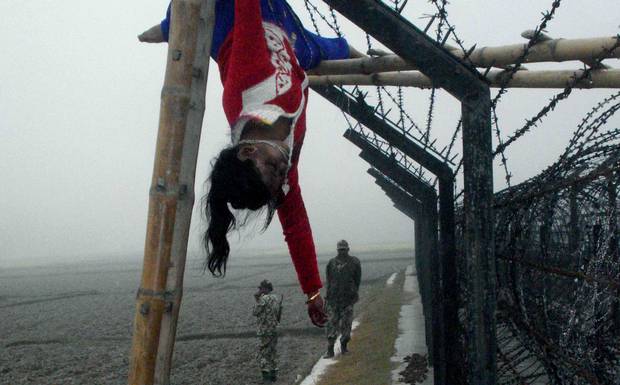
Children, girls and boys, are being killed by Indian soldiers on the India-Bangladeshi border. Each time it happens, the State claims grief and promises never again. The most recent girl to suffer this indignity, last week, was a fifteen-year-old girl named Felani:

“Indian border forces have handed over to Bangladesh Rifles (BDR) the body of ‘Felani’, 15, who was shot dead on Friday as she had gotten entangled in barbed-wire while crossing the border.… In the meeting, BDR condemned the brutal killing of the teenaged girl. BSF had expressed its grief over the incident and assured that such incident will not take place in future.”

What is to done with the grief of States expressed each time border troops kill or maim someone? What is the worth of their repeated assurances? Where is the future in which border guards will not shoot at children caught on barbed wire? And what is the name of the space that separates the dead body of 15 year old Felani, about whom the State is silent, and `the incident’ over which the State expresses its grief?

Apparently Felani and her father left their home in Bangladesh ten years ago and crossed into India. They were on their way home because a marriage to a local boy had been settled. Felani’s father successfully scaled the border fence. Felani got tangled up in the barbed wire and started to scream. The Indian Border Security Forces heard the screams, saw the girl, came, shot her and waited for her to die. Some say she bled and screamed for four hours, others say for less time. Whatever the duration, Felani, a fifteen- year-old girl, hanging upside down from the border fence, riddled with bullets, bleeding and screaming, died. The BSF then waited and finally cut her down and carried her away, hands and feet bound to a pole, like so much animal carcass. A day or so later, they arranged the meeting where they returned the body and expressed grief … over the incident.

Bangladeshis, and Indians, have expressed outrage at the incident and shock and disgust at the photographs. But who expresses grief at the border fence?

According to a Human Rights Watch report issued just last month, the Border Security Forces at that particular border are `trigger happy’. Children, such as 12-year-old Rumi Akhter Nipa, are routinely, randomly and indiscriminately shot. What do girls, like Rumi, want? According to Dr. Abdus Samad who treated her, she simply wants a daily life, to start school. What do children, like Rumi Akhter Nipa, get? “A pattern of grave abuses”. And, as Felani’s story suggests, they are to be considered the lucky ones.

The borderland is a graveyard. As long as the State, any State, is ruled by security first, as long as the borders are considered primary and the crossers, with or without documents, are secondary, the borderland will remain a graveyard. That is the reason that “despite numerous complaints no member of the BSF has been arrested, much less held to account in civilian courts.” Hundreds of Bangladeshis and of Indians have been killed and not a single member of the BSF has been arrested. Felani is not alone.

Grief emerges from graves, not from incidents. Apologies cover incidents, shrouds cover the bodies of the dead. The State of India expresses its grief? And Felani is dead.


(Photo Credit: BDNews24)