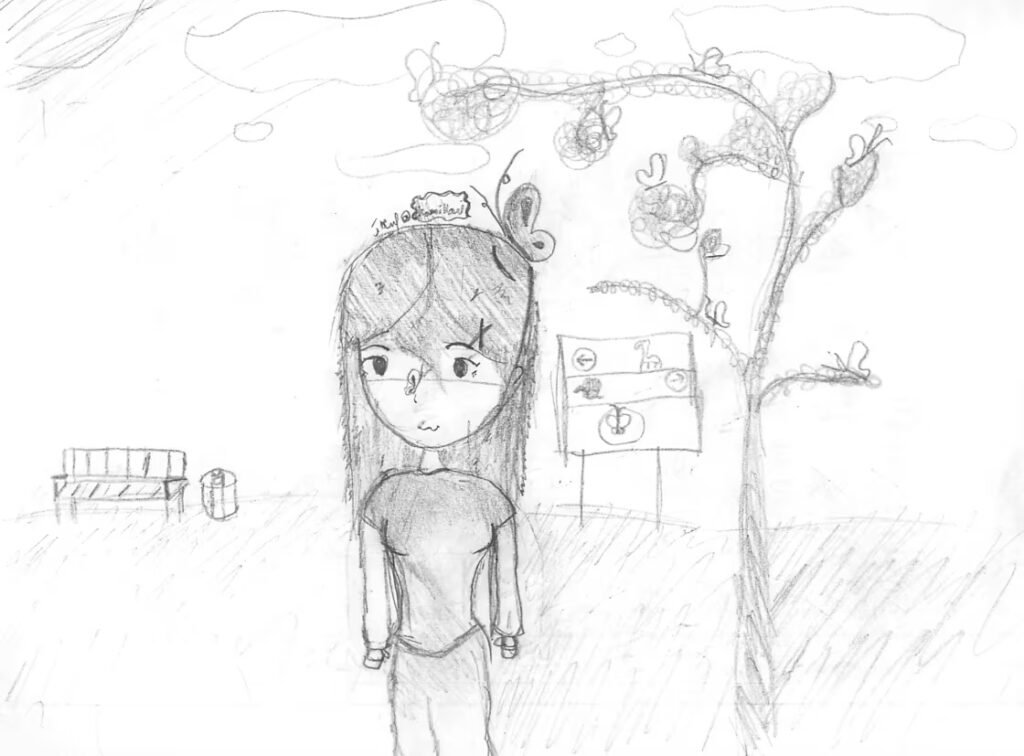
A self-portrait Kamilla made while her parents spoke to NBC News.
“Was I sleeping, while the others suffered? Am I sleeping now? Tomorrow, when I wake, or think I do, what shall I say of today?”
Samuel Beckett, Waiting for Godot
NBC News released a report this week, “‘Even in Russia, they don’t treat children like this’: A family’s nightmare in ICE detention”. The report opens: “Nikita and his wife, Oksana, fled Russia in desperation two years ago, believing America was their only hope of giving their three children a life free of fear and oppression. Instead, those children are growing up behind the razor-wire fences of a South Texas detention center, among hundreds of other families swept up in President Donald Trump’s immigration crackdown.” What else is there to say, really? Plenty.
The three children are Kirill, 13; Konstantin, 4; Kamilla, 12. The family has been held in Dilley Immigration Processing Center for four months … and counting.
Konstantin was once a social, outgoing child. Now, surrounded by guards, who “are just as tough as the guards at the adult facilities,” and constant sharp noises, Konstantin cries a lot and keeps to himself. Actually, the guards at Dilley are tougher than guards at adult facilities, inasmuch as they are “guarding” children. Other than guards, what precisely are the dangers the children face?
Kirill taught himself to play piano and then attended music school. A bright and talented child … who now “spends most days withdrawn, waking at night with anxiety and panic attacks”.
Kamilla is a dancer who loves to perform. She now has partial hearing loss, “thanks” largely to the conditions at Dilley, which include whatever is worse than substandard health and medical care. She now lives in constant pain, with little or no relief. When her mother made a makeshift headband, to cover and protect the ear, the guards removed it, claiming it was “contraband”. Kamilla cried. Again, what are the guards “guarding”?
With Kamilla’s birthday approaching, she was asked if she had any wishes. She replied she had only one, “To get out of here.”
Kamilla’s case is not an isolated one: “When several children fell ill with stomach ailments at Dilley, medical staff refused to treat them unless they had already vomited at least eight times.” A “medical staff” that refused to treat ill children is not a medical staff. Period.
In January of this year, an 18-month-old at Dilley had dangerously low blood-oxygen levels. The parents knew something was terribly wrong. For weeks, they begged for someone to address the child’s illness. No one did. Finally, after week, she was taken to a regional children’s hospital, where she was treated for treated her for pneumonia, Covid-19, RSV and severe respiratory distress. She stayed in the hospital for a ten days. She was prescribed medication. She was then returned to Dilley, where the “medical staff” refused to administer the drugs.
When “medical care” means refusal to care in any way, when the food is poisonous, when the “education” is such that children stop reading, when pianists go silent and the dancers sit all day, there can be only one wish: “To get out of here” Are we sleeping, while others suffer? Are we sleeping now? Tomorrow, when we wake, if we wake or think we do, what shall we say of today?
(By Dan Moshenberg)
(Image Credit: NBC News)