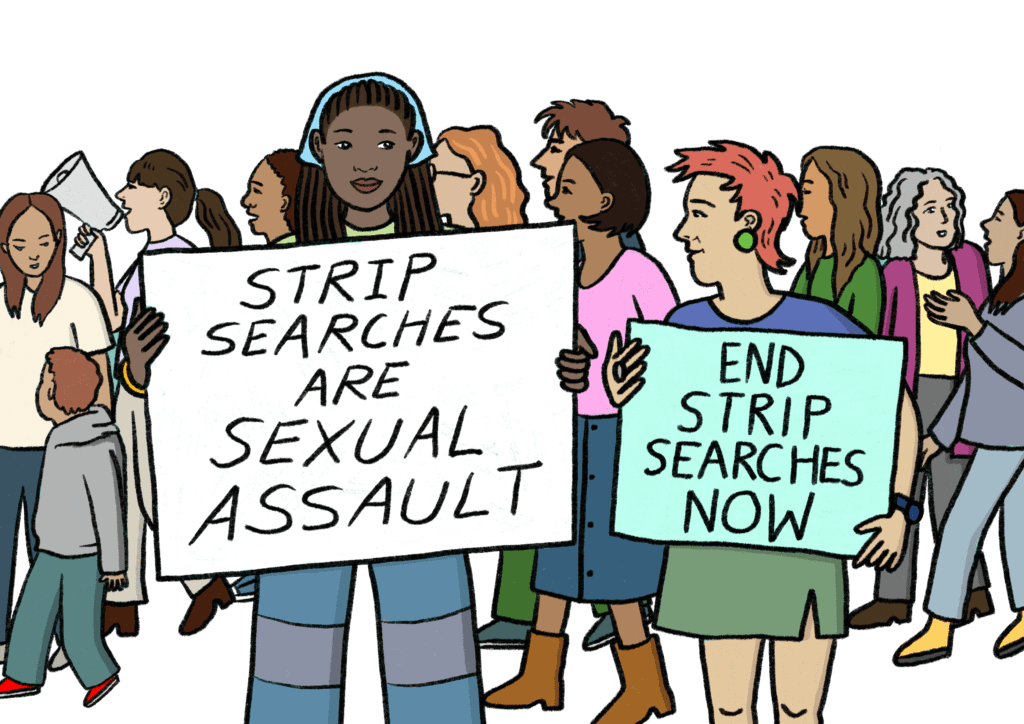
Early this week, the Australian Human Rights Commission, FIGJAM (Formerly Incarcerated Girls Advocates Melbourne), and Flat Out issued a joint report, Ending Strip Searching in Australian Prisons. The report offers eight key findings: there is no evidence of any relationship between strip searching and contraband detection; People in prison experience strip searches as acts of sexual assault and coercive control; strip searches are conducted routinely but rarely uncover dangerous items; less invasive alternatives expose strip searching as unnecessary; people in prison are routinely having their human rights breached by strip searches; children are being forced to strip in front of adult prison guards; the harms of strip searching compound the mass incarceration of Aboriginal and Torres Strait Islander peoples; there is a crisis of secrecy in prison.
Consider the findings concerning children: “In most Australian jurisdictions, children as young as ten are incarcerated and can be subjected to strip searching. Based on data covering varying periods in 2021-2022, it is estimated that, on average, children were subjected to more than 300 strip searches each month in prisons across seven Australian jurisdictions. In the month of April 2022 alone, 127 strip searches were conducted on children at two New South Wales (NSW) youth prisons. Only three searches identified items.” These children are disproportionately “Aboriginal and Torres Strait Islander children, children with disability and drug and alcohol dependencies, and children with complex trauma.” Not that it should matter, but many of the children who have been strip searched were not incarcerated; they were visiting incarcerated parents. A child is a child is a child.
In 2021, we wrote, ““Excessive strip-searching shines light on discrimination of Aboriginal women in the criminal justice system”. An article with that headline appeared yesterday. While the research and argument of the article is unimpeachable, one wonders about the shining light. The discrimination against Aboriginal and Torres Strait Islander women by and in the Australian so-called criminal justice program is a longstanding open secret. In 2018, Human Rights Watch issued a report, which noted, “Aboriginal and Torres Strait Islander women in prison are the fastest growing prison population, and 21 times more likely to be incarcerated than non-indigenous peers.” A version of that statement, “Aboriginal and Torres Strait Islander women in prison are the fastest growing prison population”, had appeared in major reports in 2010, 2011, 2012, 2013, 2014, 2015,2016, and 2017. Now it’s 2021, and where are we?”
Where, indeed. This week’s report opens with a foreword by Aunty Vickie Roach, “strong, proud Yuin woman”. The foreword begins, “As a strong, proud Yuin woman who was subjected to strip searches while caged in custody, I can tell you that it is state–sanctioned sexual assault. It is akin to being ambushed, raped and forced to strip naked in front of screws dressed in deliberately authoritarian, intimidating uniforms.” The foreword ends, “I have always fiercely advocated for people in prison, that they are deserving of dignity, and that their human rights must be respected. For us to be called human, we must respect everyone’s human rights. I have told my story far and wide – I have told the prisons, I have told the government, I have told the media and I have told the Yoorrook Justice Commission. Now I am telling you. And you need to listen.”
You need to listen.
(By Dan Moshenberg)
(Illustration: Judy Kuo / Human Rights Law Centre)