Make way for Alice Nkom

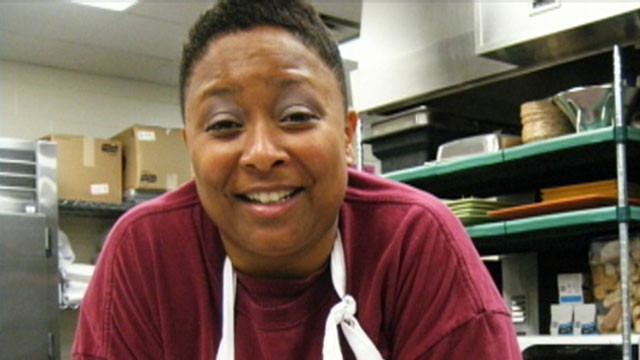
Alice Nkom

Last year was a busy year for Cameroonian lawyer Alice Nkom, but then again … it was a busy year for the Cameroonian government, and its various allies, persecuting and prosecuting anyone it suspects of being gay, lesbian, transgender, of a sexuality, feminine, or different.

This year promises, or threatens, to be equally busy. This week, leading Cameroonian LGBT rights activist Eric Ohena Lembembe was found tortured and murdered. These are urgent times in Cameroon, as noted today at Africa Is a Country, and Alice Nkom, as ever, is in the thick of the urgencies.

Alice Nkom was the first woman to become a lawyer in Cameroon. That was in 1969, and she was then 24 years old, and she’s been kicking through ever since. Over the last four decades, Nkom has been a leading civil rights and women’s rights activist and advocate in Cameroon, and for the last decade or so has become famous, or infamous, for her defense of LGBTIQ persons, communities and rights.

In February 2003, Nkom established ADEFHO, L’association pour la défense des droits des homosexuel(le)s. The Association for the Defence of Homosexuals has suffered threats, attacks, intimidation. Nkom has received death threats. She has been imprisoned. She has been threatened with being disbarred. And she persists and returns to court again and again.

In December of last year, Alice Nkom once again was in the news when an appeals court upheld the three-year sentence of her client Jean-Claude Roger Mbédé, whose crime was sending another man a text message that read, “I’m very much in love with you.” In July, Mbédé was released provisionally, and so this sends him back to jail, to the harassment and assaults “at the hands of fellow inmates and prison authorities on account of … perceived and unproven sexual orientation”. He goes back as well to the general hellhole of Yaounde incarceration, a prison originally built for 600 that now houses 4,000.

In February 2012, 10 women were arrested on suspicion of being lesbians. No proof was given. No proof was needed. Suspicion is enough, when it comes to protecting the nation. Men have been arrested and imprisoned for hairstyle and for drinking Bailey’s Irish Cream. These crimes of fashion proved the men were feminine and thus gay and therefore worthy of incarceration. Perception is everything.

All of this is happening, as Alice Nkom has argued repeatedly and to varying degrees of success, in a country that has a modicum of respect for the rule of law, to the extent that it has codified due process. The law that authorizes the current abuses is Article 347, which, somewhat ironically, may not even exist. Again repeatedly and to varying degrees of success, Nkom has argued that the law never passed through the appropriate committees and procedures in the National Assembly.

No matter. Somehow this non-law law has authorized the State disruption of a seminar on HIV/AIDS education and prevention, because there was something in the air about empowering sexual minorities. Perception is everything.

It’s not easy taking the high human rights road to attack the State. In Cameroon those organizations that have argued and mobilized around health issues pertinent to same-sex relationships, and particularly to MSM communities, have fared better in the international sphere, vis a vis funding, and have even received some support from the Cameroonian government. But when Nkom received funding from the European Union, “she was immediately threatened with arrest and a fatwa by pro-government youth groups.”

Last year, when her own arrest seemed imminent, Nkom wrote to leading Cameroonian LGBT activists: “Do not worry for me. I believe I will be arrested in the coming days, but I will not lose sleep over this or, especially, abandon what we have begun together.” It’s been a busy year for Alice Nkom, a year of pushing on, pushing back, pushing forward. Nkom has heard the rumble of violence, menace and threat, and has a direct response: “Threats like these show us that the fight must continue”

(A different version of this was originally published at Africa Is a Country. Thanks to Sean, Tom and the collective for the collaboration and support.)

(Photo Credit: Journal du Cameroun)

To present to the dead friend within oneself the gift of his innocence

The names. The names of places: Armadale, Marikana. The names of sectors: the garment industry. The names of those individuals whose names cannot be shared: Laura S. The names of the men: Jimmy Mubenga. The names of the women: Ishrat Jahan, Jackie Nanyonjo, Savita Halappanavar. The names of the children: Ashley Smith, Trayvon Martin.

These are but some of the names of the innocents, slaughtered by State policy and practice. These are but some of the people we have tried to describe over the last little time. These are the names of those whose tragedies have opened too many doors to the work of mourning.

We have written, others have written, to what end?

To write, to him – present to the dead friend within oneself the gift of his innocence. For him, I would have wanted to avoid, and thus spare him, the double wound of speaking of him, here and now, as one speaks of one of the living or one of the dead. In both cases, I disfigure, I wound, I put to sleep, or I kill. But whom? Him? No. Him in me? In us? In you? But what does this mean? That we remain among ourselves? This is true but still a bit too simple.”

After the silence, after the too-simple truths, what is there? If we are to present to the dead friends within oneself the gifts of their innocence, we must earn the gift. We must organize the State of peace, justice, mutuality, love. All else is … words.

And Trayvon Martin is dead.


(Photo Credit: Livemint.com/Gauri Gill)

A specter haunts California


At some point California dreamin’ and going back to California turned into Golden Gulag California. One day, the gulag too shall pass. After the gulag, what will emerge, and who shall write that history? Today marks the second day of the California prisoners’ hunger strike. Some 30,000 prisoners have laid down their tools, in this instance their bodies, in what is reported to be the largest hunger strike in state history. Prisoners across the state have put their lives on the line.

The core demands are straightforward and eminently reasonable: end group punishments; abolish the whole gang identification and `debriefing’ apparatus; end long term isolation; provide adequate and nutritious food; expand and provide constructive programs and privileges for those placed in indefinite solitary confinement in what California calls “secure housing units”. A secure housing unit is a warehouse of pain, suffering and slow death.

Indefinite solitary confinement is torture. Being buried alive is torture. But this hunger strike is about more than that. It’s about the future as well as the present. It’s about who will write the history, and what master narrative will rule that roost. It’s about being human

Solitary cells of America are filled with people living with disabilities. Prisoners, like Prisoner #6 in Pennsylvania SCI-Muncy, are depressed, live with mental disabilities, act out, try to commit suicide, and they are thrown into the hole and abandoned there. And then die horrible deaths.

But that’s not good enough for California. California has Secure Housing Units in which “security” means indefinite and long term isolation, and debriefing means coerced reporting on gangs, even if one is not in a gang.

Meanwhile, in the ordinary and everyday world of California prisons, until fairly recently, women prisoners were tricked or coerced into sterilization. 66% of the guards inside women prisons are male; most of the rapes inside women’s prisons are at the hands of male prison staff.

When the Valley State Prison for Women, VSPW, was closed, to turn it into a men’s “facility”, and the women were shipped to the already crowded Central California Women’s Facility, CCWF, what happened? Overcrowding, antagonism, tension, violence … and segregation and isolation. Take the case of Prisoner T: “T. has been incarcerated for 30 years, with a parole date in late 2014, and was among the women transferred from VSPW after 25 years of violation-free programming.” Twenty-five years without a violation. Because of CCWF circumstances beyond T’s control, T is segregated and will probably stay in segregation for the entire year, until she’s paroled. According to T., “It’s disheartening to be in Ad Seg as I am locked up in a cell 24 hours a day. I only receive six hours of exercise a week, which consists of a small fenced in cement yard that has no place to sit except on the cement floor. I just go out for the fresh air.” Fresh air. To get fresh air, T. is stripped naked and spends her hour in that cement yard completely naked and completely alone. When she returns, she is strip-searched. When she goes to shower, she is handcuffed behind the back. She is allowed to shower three times a week. T. is not in segregation for disciplinary reasons, and yet she is treated as if she were.

Meanwhile, in the “free world”, in California developmental centers, the in-house police do less than nothing to protect residents and patient, or to investigate incidents of abuse. According to a report today, “dozens of women were sexually assaulted inside state centers, but police investigators didn’t order `rape kits’ to collect evidence. Police waited so long to investigate one sexual assault that the staff janitor accused of rape fled the country. The police force’s inaction also allowed abusive caregivers to continue molesting patients – even after the department had evidence that could have stopped future assaults.”

The California prison hunger strike is about being-human. Across the state of California, people in prison are regularly abused, humiliated, tortured, and worse. Women are regularly attacked as women. Indefinite solitary confinement, “debriefing”, group punishments, toxic food regimens, denial of basic services and programs, forced sterilization, routine sexual violence, these are all public policies. They are not incidental nor accidental. The struggle taking place right now in California is for the soul of humanity, for that remote possibility that after the Golden Gulag, something human will emerge. A specter haunts California.


(Photo Credit: The Examiner)

Perception matters. Ask Australia’s women asylum seekers.


Recently, Geena Davis noted, “We just heard a fascinating and disturbing study where they looked at the ratio of men and women in groups. And they found that if there’s 17 percent women, the men in the group think it’s 50-50. And if there’s 33 percent women, the men perceive that as there being more women in the room than men.”

Perceptions matter, and perceptions of those in control are typically sexist and racist, especially when the `tipping point’ is involved, when those in power feel the threat of a `new majority’. That’s why perception can’t be the motor for public policy and, even less, for the pursuit of justice, Take Australia … please.

A key plank of Australia’s asylum policy has been deterrence. This has resulted in brutality, torture, horror, despair … and big profits for the private security corporations, most infamously Serco, who run the immigrant `detention’ and `transfer’ installations. With the shift in government over the past week, some wonder if anything will change in terms of Australia’s racist and sexist asylum policies.

If anything, it looks like they will get worse. Within hours of the new government’s installation, the new “de facto Immigration Minister” declared that most refugee applicants are “economic refugees”. There’s no evidence for that statement, but who needs evidence when `perception’ is on your side?

And what is the perception? The boats. The boats keep coming, and sinking. The refugees keep `swarming’. It’s a human tsunami bearing down on Australia. These images are merely part of the `ferocity’ of the anti-refugee anti-asylum-seeker discourse. Meanwhile, the women and children pile up in the `detention centers’. They’re prisons. Detention is too fine a word. Ask the children who go on hunger strike. Ask the 16-year-old Afghan boy who ended a five-day hunger strike yesterday. Why was he barreling towards his own death? He’s an unaccompanied child, in prison, in the middle of nowhere, surrounded by every form of hostility, with no visible end in sight to his torment. Perhaps that’s the reason.

The treatment of asylum seekers, and in particular of women and children asylum seekers, has been a mounting succession of cruel jokes. Each step of the way, the asylum seeker’s vulnerability and precariousness are intensified.

But here’s the thing: Australia is not drowning in asylum-seekers. Pesky numbers keep denying the `perception’. Yes, the numbers of refugees and asylum-seekers are rising. Yes, the numbers coming by boat are, for the first time, exceeding those coming by plane. BUT Australia takes a very small percentage of the world’s refugees, around 3 percent. Officially, there are 30,083 refugees currently living in Australia. That means, if you consider the size of the country, Australia has one of the lowest rates in the industrialized world. Australia has 1.4 refugees per 1,000 people. Germany has 7.3; Canada has 4.7; the United Kingdom has 2.4. (The United States has .8.)

There is no flood. Australia can stop building sea walls, prison colonies, and worse. It can. But it won’t. Rather, the new government will opt to continue, and probably fortify, the “`hard bastard’ approach.” Perception matters, as does patriarchy.


(Photo Credit: AAP / Julian Smith)

Women demand cities that value women

In this season of mass protests and demonstrations, much of the news media has decided that this global phenomenon is an expression of `middle-class rage’. It’s not. The waves of mass protests are a creative response to the form of urbanization that now covers the globe. Remember, already more than half the world population lives in urban zones, and, according to the United Nations, soon more than half the world population will live in urban slums. This means the urban local is global. That’s the lesson that protesters, and in particular women protesters, are once again bringing to the streets and beyond.

The march of protests is a global urban uprising. Ask the women, and their colleagues and friends, who, through policy brutality, have become icons of the protest movements.

When Ceyda Sungur, Gezi Park’s `woman in the red dress’, was interviewed, after the police pepper sprayed her in the face, she deflected personal attention: “A lot of people no different from me were out protecting the park, defending their rights, defending democracy. They also got gassed.”

How does protecting a park equal defending rights equal defending democracy? On one hand, in the specifics of the moment, the equation is part of the pro-democracy rhetoric. On the other, more pertinent hand, Ceyda Sungur is an urban planner. When Sungur says, “For me this is about freedom of speech and the power of the people”, she means the struggle for the park, rights, democracy, freedom, power, is an urban struggle, a struggle against authoritarian, anti-human, anti-woman urban development.

Then there’s Liv Nicolsky Lagerblad de Oliveira. She lives in Rio. One night, she was standing alone on a street corner where there had been demonstrations earlier. Hours earlier, the riot police had forcefully removed all the protesters, but they were still hungry. They descended upon Oliveira, alone, late at night, just standing, and pepper sprayed her full in the face at close range. Yet again, the riot police created a new icon, yet again a woman.

And yet again the message, this time Oliveira’s, was urban: “The city is being gentrified. The poor can no longer afford to live in some favelas and the elite is taking their place. The cost of life is increasing and the increase in bus fare was just the last straw.”

Around the world, thanks to `urban development’, the working poor can’t afford to live in the slums. Women know this story, because they’re the central, disallowed subjects.

Repeatedly, protestors argue the City has become the epicenter of debt-and-death. Worldwide women are protesting the designed hostility of `the new Jerusalem’ to women and girls. Women, like Ellen Woodsworth, the founder of Women Transforming Cities, are organizing with women to address the complete and systemic lack of gender equity lens that marks city planning and governance. Urban public lighting, transportation, access to medical care, access to police, affordable housing, green common spaces, toilets, living wages, decent working conditions, violence, crime, peace, well being, inequality, equality are all particular to women and are all feminist issues. For example, in Japan, the environmental recycling movement had to rethink everything when women challenged the assumptions of their mandated unpaid, unrecognized, `informal’ labor … in the name of a green economy. The women in Japan said, “No gender equity, no peace.” The women in Istanbul, Ankara, Dhaka, Rio, São Paolo, Vancouver, Cape Town, Barcelona, Buenos Aires, and beyond, are saying so as well.

The last green space in Istanbul is an urban women’s issue, and a feminist crisis. The rise in public transport fares and the pricing of slums out of the reach of the working poor in Rio de Janeiro is an urban women’s issue, and a feminist crisis. Thais Gomes, Brazilian `shantytown dweller’, understands that. It’s not “middle class rage”. It’s urban.

Around the world, women are saying “Hell no!” to the “gift” of global hyper-urbanization and “Hell yes!” to cities that respect all living beings as valuable, to city administrators and planners who see value in the social, to those who value women as humans, neighbors, partners.


(Photo Credit: Bianet)

The `taint of racism’ for Black Women and Girls On Death Row

Paula Cooper, savoring her freedom

Between Kimberly McCarthy and Paula Cooper lies either a chasm or a tremendous healing.

Texas is poised to execute Kimberly McCarthy, a 52-year-old African American woman accused of having murdered her White neighbor in 1997. If McCarthy is executed, she will be the 500th person to be executed by Texas since the death penalty was reinstated, in 1976. Texas is far and away the leader in this field, with Virginia a distant second.

According to Maurie Levin, McCarthy’s current attorney, the case must be revisited because the proceedings were `tainted by racism.’ That `taint’ is many layers deep and covers much. In Texas, 283 people are currently on Death Row: 39.2% are African American; 29.7 percent are Latino; 29.7 percent are White. Those racial demographics are geographic as well. Texas has 254 counties. In the past five years, 22 counties have sent people to Death Row. It’s not `Texas’ that fills the death rosters … but it is Texas that executes them. Rick Perry holds the record as the U.S. governor presiding over the most executions ever carried out. Texas is #1; Rick Perry is #1.

Nationally, Harris County, Texas, is the top county for executions, both in Texas and the United States. #2 is Dallas County. Kimberly McCarthy’s case was heard in Dallas County. In Dallas County, it was almost impossible for African Americans to get on a jury. McCarthy’s jury had one African American on it. That was no accident, according to Maurie Levin. It was also no accident that the attorneys who sort of represented McCarthy in her earlier forays never touched on the racial composition of the entire proceedings. Why would they? McCarthy was an African American, coke addicted woman worker who was accused of having brutally murdered a 71-year-old White woman. Case closed.

Last week, Indiana demonstrated that there’s a better way. Paula Cooper walked out of prison, not quite yet a `free woman’, but not a prisoner and not on Death Row.

In 1985, Paula Cooper was 15 years old. She was accused of having murdered Ruth Pelke, who was 78 years old. Cooper is African America; Pelke was White. Paula Cooper was convicted of murder and, at the age of 16, was sentenced to death. At that time, she was the youngest Death Row `guest of the State’ in the country.

A local, national, and global campaign erupted at the prospect of a 16-year-old girl being sentenced to death. Two years later, the Indiana Supreme Court agreed, and set aside the death penalty. The Court sentenced Cooper to 60 years behind bars.

In the intervening decades, Cooper has earned a college degree and time off for good behavior. On Monday, June 17, 2013, Paula Cooper walked out of prison.

That’s not all that changed during those decades. The prosecuting attorney in the case came to oppose the death penalty. Even further, Bill Pelke, Ruth Pelke’s grandson, has become a leading death penalty abolitionist. As Bill Pelke explains, “It was about a year and a half after my grandmother’s death, about three-and-a-half months after Paula Cooper had been sentenced to death, where I became convinced, beyond a shadow of a doubt, that my grandmother would have been appalled by the fact that this girl was on death row and there was so much hate and anger towards her. I was convinced she would have had love for Paula Cooper and her family. I felt she wanted some of my family to have that same sort of love and compassion. … I learned the most important lesson of my life that night, and it was about the healing power of forgiveness, because when my heart was touched with compassion, the forgiveness became automatic. And when it happened, it brought a tremendous healing.”

When the State of Indiana decided to forego vengeance against a child, to treat the child as one of us, as a sister or a daughter or a simply another human being, a tremendous healing began. The State can do that; it can opt for healing. Tell Rick Perry and Texas right away. Then tell everybody else.


(Photo Credit: ABC News)

Around the world, women say, “Hell no!”

Vinegar Revolution

Around the world, women are loudly, softly, even silently rejecting the `advances’ of repressive regimes, from Turkey and Greece to Senegal and Brazil, women are saying, “Hell no.” The State says vacate, and women say, “No, we’re staying.” The State says move on, and women say, “We’ll just stand still for a while.” The State says, “Come to our big event”, and the women say, “No, and here’s why.” The State says, “Ok, come on in,” and women respond, “You know what? After the way you’ve treated me, you can keep your so-called invitation.”

When the Greek state tried to close the ERT television station, workers, women like Maria Kodaxi, refused to move. Across Turkey, women refused to accept the violence of the State and, one by one and then in tens and hundreds, became “duran kadin”, standing women. In Greece and Turkey, the struggle continues.

As Turkey gave the world Gezi Park and #durankadin, Brazil this week gave the world … vinegar. Vinegar uprising. Vinegar revolt. The salad revolution. Police thought they’d quell and dispel a relatively small group of protesters with tear gas, batons, and violence. Instead of quell, they got rebel. Where there were tens, a million marched and more are on the move. And vinegar became the symbol of resistance and solidarity. It’s a good week for new symbols that match new forms of action.

Carla Dauden is one Brazilian woman engaged in protest, and she is not going to the World Cup. Dauden is a young filmmaker, a native of Sao Paolo, and the director, producer, narrator and face of “No, I’m not going to the World Cup.” Part of her reason is an ethical calculus: “Now tell me, in a county where illiteracy can reach 21%, that ranks 85th in the Human Development Index, where 13 million people are underfed every day and many people die waiting for medical treatment, does that country need more stadiums?” As of this writing, over 2.5 million people have watched and listened, and maybe heard, Carla Dauden explain why she is saying, “No”.

In Senegal, Bousso Dramé is not going to Paris. Bousso Dramé is, by any standards, an accomplished woman, whatever that means. The World Economic Forum thinks she’s a “global shaper”: “a proud African, committed Senegalese citizen and vibrant young woman.” Dramé works for the World Bank, has many advanced degrees, speaks many languages. She recently won a national spelling bee. Part of the prize was a round trip ticket from Dakar to Paris and back. When Dramé went to the French Embassy to apply for her visa, she was treated like dirt, “as less than nothing.” This abuse happened repeatedly, and was visited upon her by a number of embassy personnel. And so, when Dramé finally, finally was informed that she had finally been approved for a visa, she write an open letter to the French government saying, “No, thank you.”

Dramé said no not only in her own name, but in the name of Senegalese across Europe, of Africans across Europe: “If the price to pay … is to be treated like less than nothing, I prefer to reject this privilege altogether… I wanted to put forth a symbolic act for my Senegalese brothers and sisters who, every day, face being crushed in the embassies of Schengen zone.”

From Turkey to Greece to Brazil to Senegal and France, the particulars may change, but the dance is the same. And women across borders, in studios, parks and streets, videos, embassies, consulates, and open letters, are saying, “Hell no.”

(Photo Credit: Reuters)

From Gezi Park to Bakirköy Women’s Prison, the struggle continues

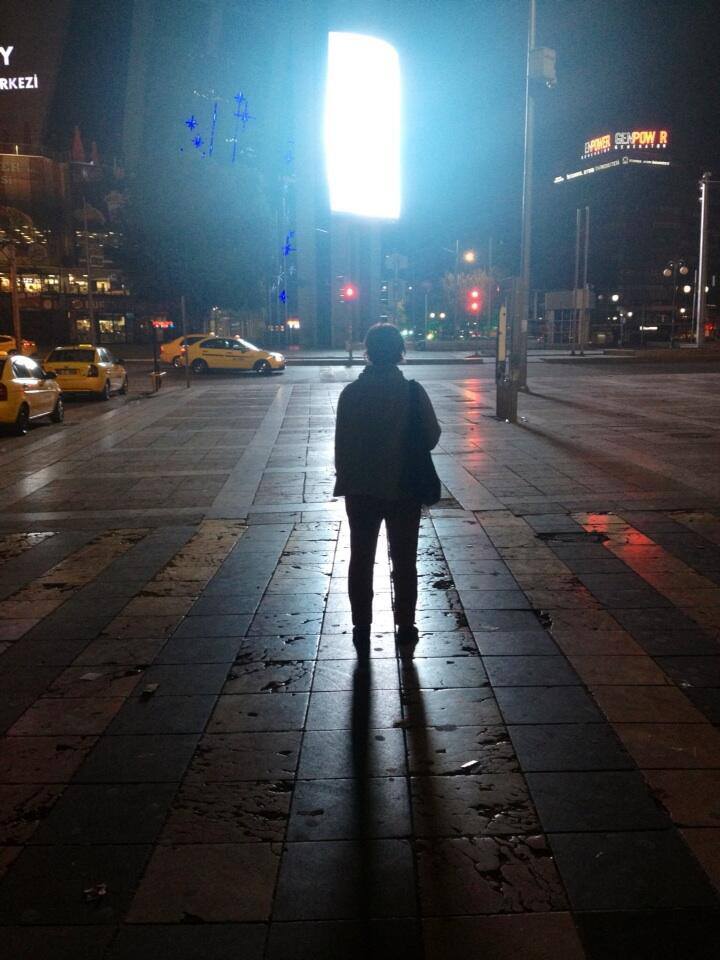
In Ankara, a #standingwoman surfaces. She is standing in Kizilay Sq, where Ethem Sarisuluk was shot dead by the police.” Across Turkey, individuals are standing, facing, moving while perfectly still. #duranadam. It means, “standing man.”

Revolutions change our language. How many around the world knew of Tahrir before the Egyptian uprisings? Now, we all do. It’s a gift Egyptians have given to the world.

The democracy and social movements across Turkey have given us Gezi, Taksim, and now #duranadam. This is part of the inherent creativity of people in movement.

The State has responded with predictable, moribund redundancies. First, it tried to criminalize the protesters. Then it claimed they were foreign agents. Then it tried to claim they were only a dissident, spoiled fringe minority. This is textbook `Statecraft’ at its emptiest.

Then the State sent in the police, to `clear’ the parks, to `reclaim’ the commons in the name of `the people’. Familiar, no?

Today’s news is filled with the predictable: “Turkey arrests dozens in crackdown”; “scores detained”; “dozens detained.”

Behind the `niceties’ of detention and arrest stands the prison. Turkish prisons are notorious for their human rights violations and abysmal conditions. On October 20, 2000, Turkey “gave” to the world the longest and deadliest hunger strike in modern history. Across Turkey, for three years, prisoners fasted, and died, protesting the construction of F-Type prisons, which are basically supermax. Across Turkey, women prisoners went on hunger strike, `even though’ women prisoners weren’t sent to F-Type prisons. In Turkey, solidarity is not a new phenomenon. Neither is standing, seemingly alone and yet decidedly with others.

Since then, hunger strikes, by prisoners and others, have become a regular part of the Turkish political landscape. Last September 60 or so Kurdish prisoners went on hunger strike. By the end of the strike, close to 70 days later, close to 700 prisoners had joined the strike, plus untold others across the country and even around the world.

At the same time, sexual violence, rape, and torture also form a part of the Turkish political landscape that emerges from and returns to prison. Women, like Hamdiye Aslan and Asiye Zeybek, have reported on the extreme and continuous violence they suffered. For more than a decade, national and international groups have documented this. Little to nothing has changed.

Some things have changed. In 2002, there were 55,000 people in Turkish prisons and jails. In early May, there were more than 130,000. Health care in the prisons has gone from bad to criminally worse, as acknowledged recently by none other than Recep Tayyip Erdogan.

In October 2011, Ayşe Berktay, writer, translator, peace and justice activist, pro-Kurdish activist, was arrested. She’s still in prison, two years later. In December 2011, Berktay wrote from Bakirköy Women’s Prison: “The situation here is rather critical. Feeling ever more powerful with the support he is getting from `Western powers’ as a representative of so-called `Western ideals of democracy and freedom’ in the region, Erdoğan has turned his back on—or done away with—all semblance of democracy at home and is preparing to intervene actively in the region. Your action is valuable in the sense that it exposes the true nature of the Erdoğan government…He feeds on this `democratic prestige’ he has abroad to take harsher measures against democratic opposition at home. Such prestige makes his hand stronger against opposition in the country. Anyone who does not agree or go along with his way of solving the problem is a terrorist, an enemy—familiar, no?”

Familiar, no?

This morning, Rumeysa Kiger, a journalist who had been part of the delegation that met with Erdoğan last week, was arrested. According to her husband, she was on the way to an interview when she saw police arresting protesters. She went to object and was herself arrested. Familiar, no?

As Berktay concluded, two years ago, “Protests against this anti-democratic obstruction of political struggle and the arbitrary nature of the detentions, against arbitrary detentions to obstruct political struggle and democratic opposition, are very important. They need to know that the world knows and follows.”

One man standing. One woman standing. Thousands of women and men standing, in prisons, parks, squares, and streets. Extraordinary, no?


(Photo Credit: http://www.ayresmendevrim.com/2013/07/dunyadan-ve-turkiyeden-duranadam.html)

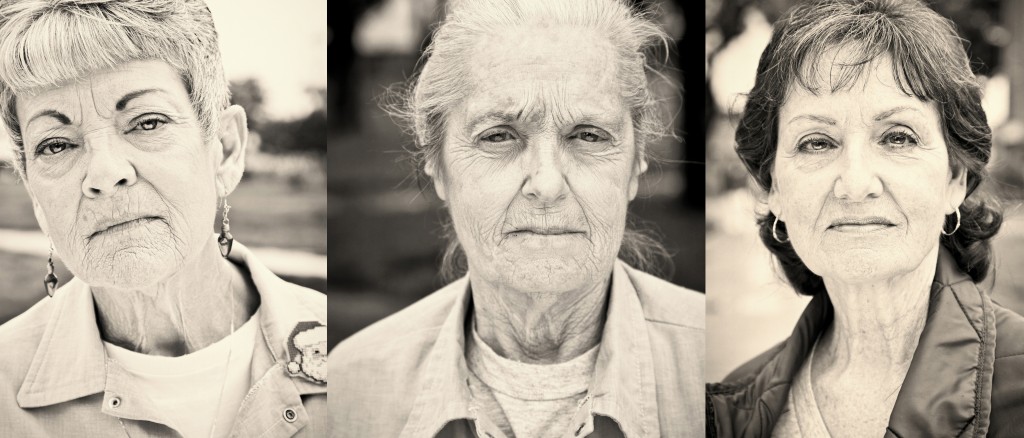
But some of us are older women prisoners

A new infographic, Aging Behind Bars, focuses attention on the grim realities of the graying prison nation: “Between 2007 and 2010, the number of state and federal prisoners age 65 or older grew 94 times faster than the overall prison population. Between 1981 and 2010, the number of state and federal prisoners age 55 and over increased from 8,853 to 124,900. By 2030, that number is projected to grow to 400,000, an increase of 4,400 percent from 1981.”

Thanks to three-strikes policies and other aberrations, prison is not only the national mental health institution. It’s also fast becoming the national senior “care” facility, except without the care. Elder women live poorly and die hard in those “care facilities”. For example, in California, a few years ago, Helen Loheac, 88 years old, nearly blind and deaf, suffering from late stage Alzheimer’s and in the very last phase of kidney failure, applied for compassionate release. She had a place waiting for her… for ten years. But she was denied parole because she would be a risk to public safety. And so on January 5, 2009, Helen Loheac died of pneumonia in a hospital near the Central California Women’s Facility (CCWF) in Chowchilla. She died shackled at her waist and ankles, two guards at her bedside. It’s called “care.”

In California, elder women prisoners call themselves Golden Girls and they’re organizing. Elder women prisoners in Alabama, residents of the Julia Tutwiler Prison for Women, are organizing as well. Some of them, like Erline Bibbs, are members of the Longtimers/Insiders. For over a decade, they have been pushing, through the courts and through collective advocacy and activism, to have a role in prison reform. They understand, with their bodies, that the women’s prison population is too large and that there have to be better conditions for women prisoners and for women, more generally. This means building identifying low-risk women prisoners and “sending them out the door”; building more work-release sites, rather than bigger prisoners, so that women prisoners could stay connected with the so-called free world and could have some savings when the get out; building and sustaining well-run drug facilities that would actually pay attention to the particularities of women’s lives, and especially of the lives of women of color and of low income women.

Eleven years ago, Bibbs and others sued the state of Alabama and won. Their overcrowded prison was found to be in violation of the Constitution. The Julia Tutwiler Prison for Women was designed to hold at most 370 prisoners. In 2002, it held a thousand.

So where are the women prisoners of Alabama today, and in particular the elder women prisoners?

Last year, Equal Justice Initiative investigated and found the following. Women prisoners are raped, sexually assaulted, and sexually harassed by the staff. Officials systematically under-report sexual assaults. Women prisoners who report sexual assault are punished, which creates a climate intimidation. Male staff members continually view nude women prisoners, despite the rules, and are never punished or disciplined.

The Federal government sent in an investigative team, and they found the level of sexual violence, harassment, and intimidation [a] as high as ever, [b] pervasive and part of the fabric of the place, [c] part of the physical architecture of the prison. According to the federal investigators, the spatial and architectural “inducements” to sexual violence could be fixed, and at very little cost.

But what is very little cost when talking about women prisoners, and especially older women prisoners? We know that elder care is costly, and yet the numbers continue to grow. We know that sexual violence preys on the vulnerable and does not discriminate among age groups. None of this is new, and none of this is hidden or esoteric knowledge.

In Alabama, some officials and some newspapers are “appalled” by the “shameful”. After over a decade of women prisoners organizing, advocates winning case after case, the Federal government intervening time and again, the Julia Tutwiler Prison for Women is one of the ten worst prisons in the United States. At Tutwiler, all the prisoners are women, most of them need help rather than imprisonment, and some of them are older.


(Photo Credit: Ron Levine/http://sowkweb.usc.edu)

Prison is bad for pregnant women and other living things


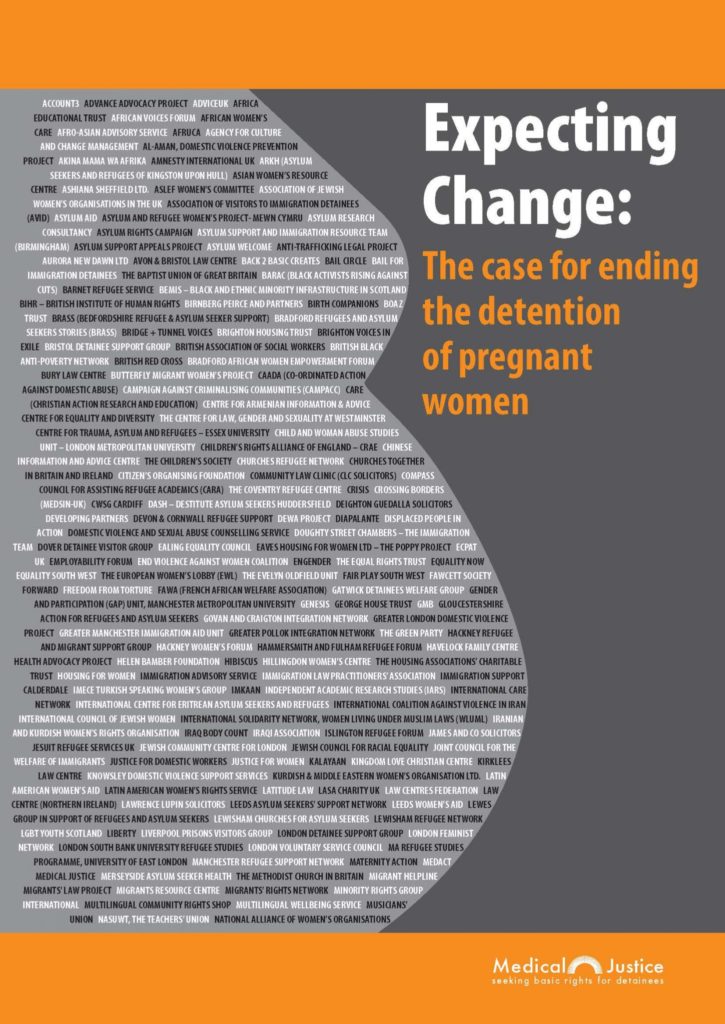
A report entitled Expecting Change: the case for ending the immigration detention of pregnant women was released today. It describes the nightmare that is Yarl’s Wood. The report bristles in its portrait of a system built of violence, planned inefficiencies and incompetence, and general disregard for women. You should read this report.

At the same time, a question haunts the report. So much of it is commonsensical that one feels compelled to wonder about the groundwork and horizons of social justice research. Here’s an example: “Asylum seeking women have poorer maternity outcomes than the general population. Many women in the sample were victims of rape, torture and trafficking.” The vast majority of women asylum seekers are fleeing sexual and other forms of violence, and so it comes as no surprise that they have poorer maternity outcomes than the general population. They also have poorer health outcomes generally, including mental and emotional health. They are asylum seekers.

On the one hand, we could discuss `the system’. We could talk about the planning that goes into systematically “failing to recognize” and “failing to appreciate” the particularities of women prisoners’ lives and situations. We could talk about the political economy of that planned failure, about who benefits and howbut we’ve done that already.

Instead, let’s imagine. Imagine what we could be researching and developing if we weren’t constantly working to undo over three decades of intensive, systematic and, for a very few, profitable mass incarceration.

Here’s where we are today. We have to conduct a multi-year study to prove that pregnant women asylum seekers shouldn’t be in prison.

We have to conduct other studies to prove that prison is an inappropriate place for children seeking asylum. We have to conduct another series of studies to suggest that maybe prison isn’t the best place for children, and that adult prison might be an even worse option. We need another multi-year study to `prove’ that sexual violence against children in juvenile prisons is epidemic. We need that same study to `demonstrate’ that the majority of acts of violence against those children, our children, were perpetrated by adult staff members.

We need another study to prove that the reason that self-harm and hunger strikes are so common, so everyday, in immigrant prisons is that the conditions are inhuman and dire. Prisoners have given up hope as they refuse to give up hope. We need many studies to demonstrate adequately that LGBT immigrants suffer inordinately in immigration prisons, and we need many more studies to demonstrate that the same is true for immigrants who live with disabilities. And then of course we’ll need more studies to prove that immigrant prisoners living with HIV have a tough time behind bars. We’ll need studies to prove that the prisons for immigrants and migrants and asylum seekers are extraordinarily cruel, and then we’ll need other studies to prove that the cruelty of those prisons is actually quite normal, and quite like the cruelty of all the other prisons.

We’ll need studies to prove that immigration prisons embody the architecture of xenophobia, and we’ll need other studies to prove that the asylum system is “flawed”. We’ll need other studies to understand that the xenophobia and the flaws are gendered. And then we’ll need meta-studies that will analyze the curious phenomenon of the complete lack of improvement. These studies will note, with compassion, that after decades of detailed research, the prisons are still hell.

I am grateful for the work scholars have performed. It’s often impossible work, and yet individuals and groups, such as those at Medical Justice who produced today’s study, do that work, and do it with grace. At the same time, imagine. Imagine what we could be researching and learning if we weren’t still drowning in our own Hundred Years’ War of Mass Incarceration. Imagine.


(Image Credit: Medical Justice)