A Better Half: A New Nose, And a Life Changed?

In Afghan culture noses symbolize respect and pride. A man who feels stripped of his pride by “his woman’s” immoral act of trespassing cultural limits and ignoring traditional norms conceptualizes this as his nose being cut. He in turn cuts “his woman’s” nose. Looking at a beautiful but “noseless” face with piercing eyes looking at you, how can anyone resist sympathy, compassion and an eagerness to help in any way possible?

Helping may be a general human instinct. However most “helpers” make choices on their own assumptions concerning the situation of the ones who need help. How could we know that our help is the help which is needed; how do we know our help is effective?

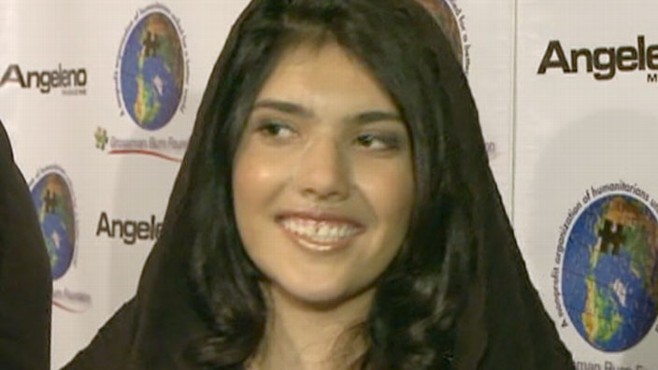
I agree with Krisof and WuDunn who claim in their book Half the Sky that saving one woman makes a difference, at least in that woman’s life.  However, it also makes me think about Bibi Ayesha, the girl with a mutilated nose on the cover of Time magazine in August 2010. She was maimed; punished for running away from an abusing, baad marriage (a marriage in which a girl is given to solve a dispute). She was helped by American doctors in Kabul and then sent to the United States to undergo plastic surgery to be “given“ a new nose.

Those who do not /cannot speak for themselves – someone will speak for them. Where is Ayesha’s voice? A deeper epistemological and political analysis comes through by replacing the term image with that of representation, representation as providing a likeness or replica for that which it is subject. Representation does not stand for, or as, the original subject itself but rather for its meaning. Representation poses the question of who speaks for whom and which one person stands for the entire group.

Ayesha became an image that represents Afghan women, all Afghan women. And when we see an empty hole on a face where a nose should be, the first thing that comes to minds is covering it.  And now our part is done. Ayesha has a new plastic nose.

But have we really helped? What have we changed? It reminds me of a joke. A man was at the beach when he heard a drowning person cry for help. He jumped into the water and saved him. He had just reached the shore when he heard another cry for help. He saved this one, too. This happened several times and he was saving one after another. What’s the joke? The man never realized that there was someone on a cliff near by pushing people into the sea.

How many noses can we give to “noseless women”? Kristof and WuDunn claim that donating a goat can make a change in a family’s lives, or educating women can make them autonomous. Maybe, but what if the new nose makes her face itch? The irritation might make her throw it away.

Women live not only in families. We live in a larger political, economic and cultural domain. Most developing countries are war torn, entangled in poor economies, and caught amidst international or regional politics. This has left those countries with a continuum of the culture of patriarchy and violation against women. How effective could it be to help individual women by giving them loans, donating a goat, or giving a new nose; whilst in most of these societies according to De Beauvoir, “humanity is male and man defines woman not in herself but as relative to him; she is not regarded an autonomous being”? How can a dependent “other” be addressed while ignoring the “self”?

When I became a feminist and became engaged in women’s rights advocacy, I wanted to change people’s minds, to help or at least “save” one friend. But sometimes when we don’t consider the pros and cons and do not understand the situation and the culture, we might make things worse rather than better. I ended up trying to encourage a friend to step up against her parents and say no to a forced marriage. My only intention was to help, but my ideas and beliefs, coming from an educated and open-minded family, ended up in a broken friendship and a forced marriage. I learned the hard way. There are people on the cliffs pushing women into the sea. We should not forget them.

(Photo Credit: ABC News)
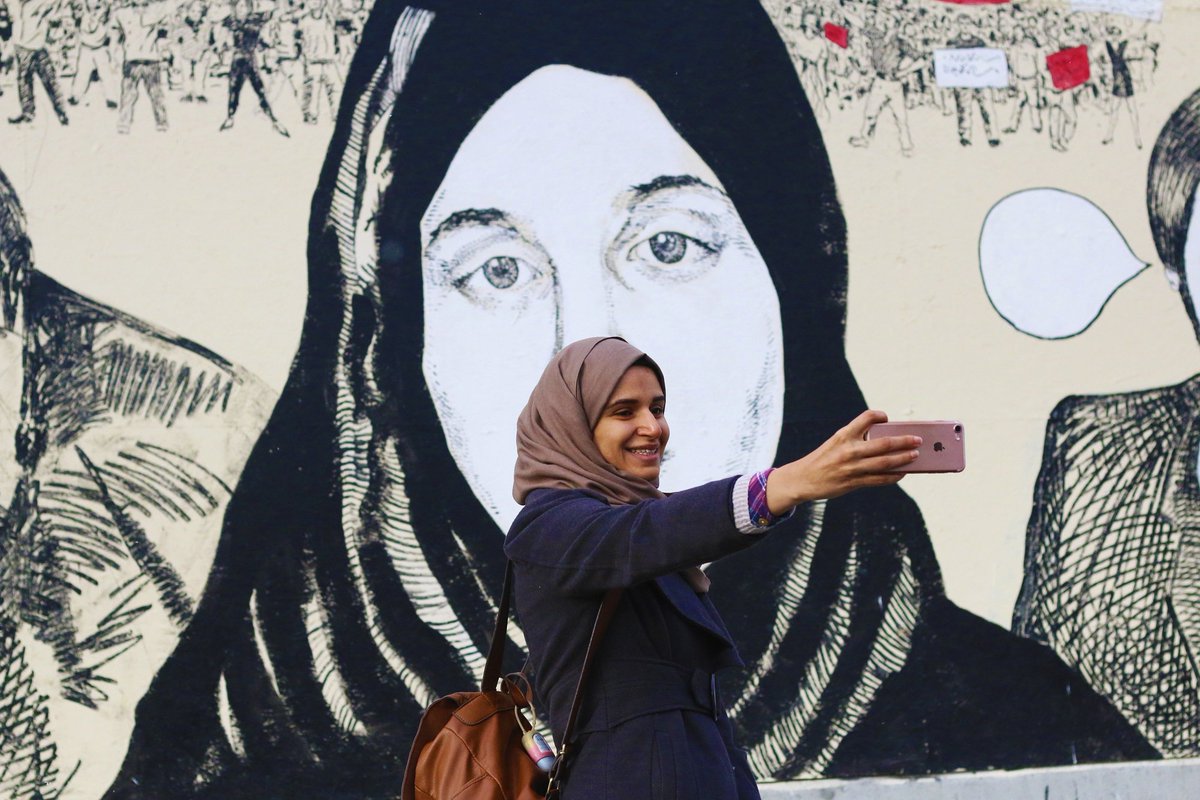
My name is Ayat al-Qurmozi. I am a student

In Bahrain yesterday, thousands filled the streets in pro-democracy protests. In Bahrain today, Ayat al-Qurmozi was sentenced to a year in prison. Her crime is poetry. In February, the twenty-year-old teacher trainee, a student at the Teacher’s College of Bahrain, attended a pro-democracy rally in the Pearl Roundabout. She read a poem to the crowd. The crowd went wild. Then the State did as well. It hunted her down. She went into hiding. Police, by the busload, flooded into her parents’ home and promised to kill her brothers first, and then the parents, if she wasn’t located … promptly. She turned herself in. That was March. Since then, Ayat al-Qurmozi has been tortured, held incommunicado for long periods, blindfolded and forced to sign a document which claims to be a confession. Today, June 12, she was sentenced to a year in prison. The State has invested quite a bit of energy and resources into the education of this young Shia woman student poet’s education.

Some now call the young Ayat al-Qurmozi the Revolution Poet. Others call her the Freedom Poet. What did Ayat al-Qurmozi say to the crowd? In part, the following:

“My name is Ayat al-Qurmozi. I am a student at the Teachers’ College of Bahrain, and I have a message. It is short. It is for those who think they will dance on our pain and suffering, built from sectarian strife and led by the one-eyed TV channel:

We do not want to live in a palace and we do not want to live like the President.
We are the people.
We are the people who kill humiliation and assassinate misery.
We are the people!
We are the people who use peace to destroy the foundation of injustice.
We, the people, do not want our brothers and sisters to remain in suffering and despair.
One day, a spirit came to the King and said, O Hamad!
They have touched me, your people. Do you not hear?
Do you not hear their cries?
Do you not hear?
Do you not hear their screams?
Sunni, Shia, brothers, sisters, God cares for you without distinction.”

And the crowd went wild. And so did the State. Today, Ayat’s mother asks, “What did she do? She wrote a poem.” Is the price of poetry really martyrdom?

Now Ayat al-Qurmozi sits with Zainab al-Khawaja, Dr. Fareeda al-Dallal, Eman Abdulaziz Alaswam, Roqaya Jassim Abu Rwais, Fadhila Mubarak Ahmed, and all the unnamed and all the unknown women and girls in Bahrain who have been targeted for repression, who receive special attention when seized, arrested, interrogated, incarcerated. The women of Bahrain are paying dearly for freedom of expression, for expression and for freedom. The State is investing a great deal in their education. But as elsewhere the revolution will not be educated.


(Photo Credit: Nobel Peace Center / Twitter)

When the State cares enough to kill and maim the very best

Members of Mr. Ward’s family

In Ireland, today, the court heard about a 15-year-old boy who was “institutionalized” in the Ballydowd Special Care Unit. Special Care. A Special Care Unit is a place in which the State can imprison children who are “troubled.” For their own welfare and safety. Ireland has three such units: Ballydowd, Coovagh House, and Gleann Alainn.

The court today heard that the boy has been diagnosed as living with Attention Deficit Hyperactivity Disorder. He has trouble with `regular’ classrooms. He spent much of his time at Ballydowd “detained for long periods of time by himself.” How the State care for `troubled’ children? Isolation. And now, according to the boy’s parents, attorneys and psychologists, he is “unfit for mainstream education”.

Two years ago, on August 31, 2009, the Health Information and Quality Authority, HIQA, issued a report stating unequivocally that Ballydowd must be closed. That report was a follow-up to a November 2008 report in which Ballydowd was deemed “no longer fit for purposes.” From practices to material conditions, the place was a disaster, and a danger to children.

The government pledged to close Ballydowd, and move the children to a nearby facility. In 2010, Ballydowd had twelve beds. In the most recent HIQA inspection, on October 27, 2010, Ballydowd housed seven children, four boys, three girls, all between 13 and 16 years old. And now, the Republic of Ireland claims it cannot find decent and adequate places for seven children who may or may not require “special care”.

In Australia, the State’s special care often proves fatal, especially for Black residents.

Consider the story of Mr. Ward, an Aboriginal elder. In January 2008, Mr. Ward, 46 years old, was taken on a 220 mile ride across the blistering Central Desert to face a drunk driving charge. Mr. Ward was a respected Aboriginal. He  had represented the Ngaanyatjarra lands across Australia as well as at international fora. The two people who drove Mr. Ward worked for a subsidiary of G4S. They did not see an Aboriginal elder nor a statesman. They saw “a man in his 40’s, 50’s, Aboriginal with a dark skin. He was dirty.”

They threw Mr. Ward into the back of a Mazda van, into the security “pod” with metal seating and no air conditioning. All male remand prisoners are considered dangerous, or “high risk”. The fact that Mr. Ward was known to be cooperative and congenial was irrelevant. For his own safety and welfare, he had to go in the back. The trip took almost four hours. The temperatures that day were 40 degrees Celsius, 104 degrees Fahrenheit. Mr. Ward died of heatstroke. He died with third degrees, presumably from where he touched the metal floor of the van. Mr. Ward cooked to death, slowly and in excruciating pain.

There was no possibility for Mr. Ward to survive that trip. There was no working panic button. There was no means of communication between the security section and the drivers in the cabin. He had one small bottle of water. He was destined to the death he suffered. It is Australia’s form of special care. It must be, because Australia pays a hefty price, literally, for the G4S services.

Again, every aspect of this story had been publicly described in earlier studies. In a 2001 government study, identical Mazda `pods’ were described as  “not fit for humans to be transported in.” They were seen as “a death waiting to happen.”

In the intervening decade, there have been other major reports, two in 2005, in 2006. To no avail. In 2008, Mr. Ward was dumped into the oven of the back of that Mazda. In 2009, G4S was awarded the contract for prisoner transport.

When asked about the implications of Mr. Ward’s story, Keith Hamburger, the principal author of the 2005 report, responded, “That’s a matter of great concern because this is not rocket science, we’re dealing here with duty of care.”

Duty of care.

Duty of care is a legal concept that ensures that people should not cause one another unreasonable harm or loss. But what is “unreasonable”?  Ballydowd is still open and consuming  children. G4S continues to ferry prisoners across the desert. Why? Because they have been deemed not “unreasonable”. Where is justice in that measure of reasonable and unreasonable suffering?


(Photo Credit: PerthNow.com.au)

A Better Half: The Poverty Onion

Anthropologist Clifford Geertz thought that to understand the world, you had to understand an onion.

It is the concept of social embeddedness.  The only way to understand an onion is as a whole; peeling back layers will never lead to a core – only more layers, and watering eyes.  Geertz was writing about culture, but feminist scholars Ellen Ross and Rayna Rapp made the same point about sexuality: it cannot be removed from social layers of family, politics, media, economics, religion, world systems.

Since reading Kristof and WuDunn’s Half the Sky, I have been thinking about the poverty onion.  The global women’s oppression onion.   The violence against women onion.

In their book, Kristof and WuDunn tell urgent, compelling, personal stories about individual women – primarily in poor countries – struggling to overcome poverty and violence.  They are inspiring writers that make readers want to act.  As a former nonprofit fundraiser, I know the power of these stories.  (I also know the danger of turning lives into stories.)

Yet with this kind of writing, we always have the responsibility of asking questions like who is speaking for whom?  What kind of picture are they painting?   Do they show the problems women are facing as rooted only in individuals (i.e. sex traffickers) or do they show larger systems that act to constrain agency?  Is there an examination of structural causes?  Can one woman’s struggles be separated from economic influences, cultural influences, global trade agreements being negotiated an ocean away?  Can one woman’s struggles be separated from the world?

In other words, are they writing about the onion, or an imaginary onion core?

In a chapter about sex work and sex trafficking, WuDunn and Kristof write: “We’re not arguing that Westerners should take up this cause because it’s the fault of the West… This is not a case where we in the West have a responsibility to lead because we’re the source of the problem.  Rather, we single out the West because, even though we’re peripheral to the slavery, our action is necessary to overcome a horrific evil” (24-25).

Is the West not at all implicated or connected to sex work in poor countries?  This view ignores unjust global economic systems – and how the poverty that is influenced by these systems affects decisions individual women make about sex work.  Kristof and WuDunn’s argument that it is not our fault in the West that women are in these situations – but that we should do the right thing and help them – is a framework that leaves people in rich countries as the central and powerful figures and women in poor countries as objects.  Truly feminist work should disrupt, rather than reproduce, terms of domination.

But how do we as people who are concerned about global women’s issues do that?  Is it ever okay to speak or act for others?  Philosopher Linda Alcoff writes that “there is a strong, albeit contested, current within feminism which holds that speaking for others – even for other women – is arrogant, vain, unethical, and politically illegitimate.”   At the same time, she notes that sometimes not speaking for others poses similar ethical questions: “If I don’t speak for those less privileged than myself, am I abandoning my political responsibility to speak out against oppression, a responsibility incurred by the very fact of my privilege?….Is my greatest contribution to move over and get out of the way?”

Alcoff warns of the dangers of what she calls this “retreat response” – the retreating into a position of ‘I can only speak for myself.’  While the neo-imperialistic overtones of speaking for or acting for others is evident, so too is the danger, politically and ethically, of an individualistic and isolationist retreat response.

I do not think that our greatest contribution should be to move over and get out of the way.

Nor do I think feminists should cast aside this book because of its shortcomings.  When I mentioned Half the Sky in an undergraduate class, a few of my 18 and 19-year-old students stayed after class to tell me how Kristof and WuDunn’s book had moved them, made them take a Women’s Studies class, or learn more about violence against women worldwide.  In the end, what I struggle with is how we can best work with the energy and inspiration the book generates.

Despite – or perhaps because of – feminist critiques of Half the Sky, what can we do with the fact that thousands of people are holding this book in their hands?  How can we best harness the fact that this is a bestseller?   That we as a country are reading something about global violence against women, and use that as a jumping off point for a more in-depth dialogue about power, patriarchy, economics, and justice?

How can we start to talk about the poverty onion?

(Photo Credit: The Atlantic / SPKW / Shuttercock)


Australia vows to turn Black children into specters


Australia’s Immigration Minister has vowed to ship off asylum seekers, including unaccompanied children, to Malaysia. This was meant to be Australia’s “solution” to a “crisis” of asylum seekers. Simple detention simply wasn’t enough. The State announced its intention late this week, and now seems somewhat surprised at the outcry. The government never thought that the fate of children of color, call them Black children, could matter quite so much.

This aspirational project of turning children of color, Black children, into distant and dimly remembered specters comes at a poignantly timely moment.

Today, June 5, 2011, is the last day of “Glenn Ligon: America”, a retrospective at the Whitney Museum of American Art in New York City. Ligon is famous for works that turn words into paintings, stencils that conjure histories of slavery, of racism, of homophobia, of violence. Some of these pieces have been described as “stenciled sentences pulled from different sources.” The sentences aren’t pulled nor are they transcribed.

They are, instead, translations, as they are invocations.

Consider, for example, “Untitled (I’m Turning Into a Specter before Your Very Eyes and I’m Going to Haunt You)”. This has been described as having been pulled from a play by Jean Genet, The Blacks: A Clown Show.

But the line in Genet’s play is actually, “You’re becoming a specter before their very eyes and you’re going to haunt them.”

And it has a particular New York history.

On May 4th, 1961, almost fifty years ago to the day, Jean Genet’s The Blacks: A Clown Show opened in New York, at the St. Marks Playhouse, and it was immediately hailed as a transformative event. When it opened, the play, a meditation on Blackness, Black rage and Black liberation, was described as “brilliantly sardonic”, “a lyrical tone poem”, a play of “furies

The original cast included Roscoe Lee Browne, James Earl Jones, Louis Gossett, Jr., Ethel Ayler, Cicely Tyson, Godfrey Cambridge, Maya Angelou, and Charles Gordone. The Blacks was the longest running Off-Broadway non-musical of the entire 1960s.

In an epigraph to the play, Genet claimed “One evening an actor asked me to write a play for an all-black cast. But what exactly is a black? First of all, what’s his color?”

Fifty years later, we watch the Australian government plan to ship unaccompanied Black children to Malaysia, and we ask, “But what exactly is a Black child? First of all, how old is she?”

The children Australia plans to send to Malaysia are children seeking asylum. Not failed asylum seekers, but rather children in the process of seeking asylum. Australia’s Minister of Immigration believes that turning children into specters will deter “people smugglers”.

Today it was announced that the “deal” is being altered. Girl refugees might not be sent to Malaysia. The girls “spared” from deportation will still be unaccompanied and still be behind bars. They will not thank the State for this “gift”, no more than the boys will. These children designated as specters-to-come will haunt the State for decades. Fifty years ago, the specters will haunt them. Today, the specters will haunt you. Fifty years from now … the specters will haunt … us.


(Art Credit: Glenn Ligon / Philadelphia Museum of Art / Washington Post)

Women and Water: Fitting into the Discussion

A recent lecture on water as the oil of the 21st century brought to mind several interesting points about where women fit into the discussion of water scarcity – or even if they have a place in the discussion.

Dr. Kellogg Schwab, one of the speakers on the panel, said that water is the nexus of energy, food, stability, and health. He went on to discuss the importance of looking at water scarcity from an interdisciplinary approach.  This is a great start to a discussion of water scarcity – not only is water the nexus of several different areas of life, it is also the nexus of several different disciplines.  With the acknowledgement of it being the tie between so many different areas should come the acknowledgement of water being the tie between several disciplines.  Of course, an interdisciplinary approach in this context means engineering, economics, public health, public policy and development.  Where, then, do women fit into this discussion?

In three out of the four presentations, women were cited as examples of how water scarcity can affect people – the tired statistics of how far women walk to gather so much water, or the impact of water scarcity on girls’ education.  But women were not included in the interdisciplinary approach – no women’s studies, no human rights or sociology perspective.  It is a discussion that, according to those involved, must still be dominated by science, or the mastery of men over nature.  To be truly interdisciplinary, we need to look at the gender norms and power dynamics behind how and why women use water they way they do.

A second interesting point came up when discussing agriculture’s use of water.  Agriculture uses 70 percent of the water supply, while household uses only use about 10 percent.  Yet women, who are often portrayed as the most affected by water scarcity (and as the reasons for working on water scarcity), are generally in charge of the domestic uses of water.  So if women are in charge of domestic uses of water and not agricultural ones, and agriculture is the biggest user of water, then why are women used to pitch the need for action on water issues?  Should the focus be on reducing the amount of water that agriculture uses?  (I recognize that there have been huge advancements on this point, however, the point is that it is not as widely known nor as widely used as a reason for acting on water scarcity).

Often, advocates for water issues discuss the need for a holistic view of water.  To be truly holistic, we need to be exploring all sides of water scarcity – including the gender implications or the gendered uses of water.  The division of labor among people, and the reasons that certain people do certain tasks, has huge implications for water use and scarcity.  The security issues involved in women’s access to clean water and sanitation are also intertwined with the gender norms of society.  To really address the issue of water scarcity, those issues have to be discussed as well.

Finally, the use of women as the reason for action strikes me as wrong as well.  It brings to mind Laura Bush’s advocacy for women in the Middle East just in time to help justify former President Bush’s push for war in the area.  Using women as justification for a larger goal is playing on sympathies of Western women for women in developing countries – ‘oh those poor women!  We must help them!’  Absolutely their situation is unfair and awful (I wouldn’t want to walks miles carrying a jug of water), but to look at it just on the surface misses some of the point.  Why is it just women carrying the water, and what role do men play in water scarcity?

This attitude also walks a fine line between sympathy and blame.  One of the presentations discussed maternal and child health initiatives that focused on increasing the practice of handwashing.  This is the perfect example – it is very easy to slip into thinking ‘how do these women not know to wash hands after going to the bathroom?’  I commend Koki Agarwal for not discussing it that way, but rather focusing on how they were targeting the message and how helpful it was in reducing child mortality.  But this is a side effect, if you will, of using women to pitch water scarcity.

I want to see a discussion that is truly interdisciplinary.  The other disciplines of economics, policy, and engineering are all important, but there needs to be a social context given to this discussion that allows women to not just be the subject of the problem.  We need a truly holistic dialogue here.


(Photo Credit: GRIID.org)

What will be our King trial?

As a teenager, I remember listening, watching, and wondering about the outcome of the Rodney King criminal trial. When the jury acquitted three of the four Los Angeles Police Department officers, and couldn’t determine guilt or innocence of the fourth officer, I felt anger, loss, and hopelessness. The riots that ensued in the greater Los Angeles area, although horrific, seemed justified in my teenage mind. A black man, savagely beaten by four white officers, all caught on candid camera.  An injustice unpunished.

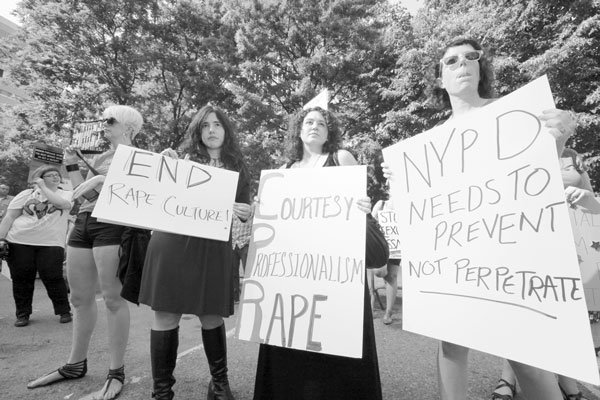
Flash forward to 2009. Two then-New York Police Department (NYPD) police officers were called to assist a taxi cab driver with a drunk female passenger. The police officers assisted the female to her apartment, and then one of them allegedly raped her, while the other stood guard. Last week, a jury acquitted both police officers of sexual misconduct and falsifying business records. This verdict comes on the heels of the International Monetary Fund’s then-Director Dominique Strauss-Kahn’s arrest and arraignment of committing several sex crimes towards a hotel maid.

As a lawyer representing sexual assault survivors in civil legal court, I have profound respect for the theoretical implications bolstering the legal system. Yet, in practical terms, the justice system seems unfair in sexual assault cases where, unlike in other cases, victims are met with profound skepticism by the trier of fact. Indeed, as one juror mentioned after the NYPD trial, the need for physical evidence that a rape occurred – which isn’t necessary in all criminal cases to reach the government’s burden of “beyond a reasonable doubt” – is often the linchpin.

What makes the Rodney King trial and the NYPD Rape trial interesting is a common thread: both victims were highly intoxicated. With the NYPD Rape trial, the questions were always “where is the DNA,” and “how can we believe a woman who doesn’t remember.” With King, the looming question was “is this a just way to act.”

To me, these are strikingly different questions to crimes where police abuse and power had similar lasting physical and emotional effects on the victims and the community at-large..

The acquittal of abusing a man, turned into race riots. It became a symbol of those in power versus those not in power, abuse of authority, police brutality, and historical implications of slavery.

The acquittal of raping a woman turned into social networking outrage, with change.org petition, Twitter and Facebook posts, a protest in front of NYC’s courthouse, and an attitude that this is another trial added to the long master list where the victim’s credibility was questioned and then destroyed, with the perpetrator walking away with nothing but a bruised ego.

Although I condemn riots and strongly believe in non-violence, I ask, where is our, female, feminist King-like response to this trial? Where are the boycotts, the outward anger and rage? Where are the speeches, the opinion pieces, and the gobbling of media airtime?

More importantly, where are the leaders of this movement who are willing to step forward and say enough is enough already?

Like the King trial shaped my understanding of the world, I wonder if and how the NYPD Rape trial is shaping the views of our youth.

(Photo Credit: The Villager / Jefferson Siegel)

Betty Tibikawa’s asylum nightmare

Yarl’s Wood

Betty Tibikawa is a Ugandan lesbian who has applied for asylum in the United Kingdom. She has been turned down and sits in Yarl’s Wood, waiting to be deported, struggling to live.

Betty Tibikawa’s family has disowned her. The infamous Ugandan tabloid, the Red Pepper, identified Tibikawa as lesbian, and so extended the threat to her life and well being.

And she has been tortured. Having just graduated from high school, Betty Tibikawa was preparing to go to university in Kampala when three men abducted her. They took her to an abandoned building and branded her thighs with a hot iron. They left her unconscious. She remained at home, in bed, for two months. In the home of the family that then disowned her for being lesbian.

The United Kingdom Border Agency has decided that Betty Tibikawa shall not receive asylum. The scars are real, and they do indicate having been branded with a hot iron, but she shall not remain in the United Kingdom. Has the agency decided, despite all evidence to the contrary, that Uganda is now magically safe for LGBTQ persons? That can’t be. There’s too much evidence to the contrary. Is Betty Tibikawa not lesbian enough for the UKBA, and thus not in enough danger? Being tortured, being abducted, being threatened by a national newspaper, being disowned and abandoned by one’s family aren’t enough? What would be credible enough?

Betty Tibikawa’s story is an old story, a familiar story. In pleading for asylum, Tibikawa is  “at the mercy of states not only jealous of their own sovereignty but dominant on the international scene, pressed to intervene here rather than or sooner than there”. Hers is a story of mercy, a test of the sovereign nation-State’s capacity to engage in mercy. The State has failed … again.

She has come before strangers and revealed herself. She has been prodded, poked, interrogated, poked again, prodded again, all in the name of some sort of science. In this, Betty Tibikawa mirrors Saartjie Baartman, a Khoisan woman brought to France, an African woman who, in the end, “craved … mercy. Mercy. I was one colored woman against a thousand dead white men.” All she craved was mercy. She found none. She found, instead, European men who claimed science, who claimed mercy.

Betty Tibikawa mirrors as well Joseph “John” Merrick, the “Elephant Man”, who looked at the world of English scientists and doctors and wondered aloud, “If your mercy is so cruel, what do you have for justice?” The doctors responded that Merrick had much to learn about science, about religion, about mercy.

Where is mercy?

Is it to be found in a court of law? Does mercy abide anywhere in the processes of asylum? Do mercy and justice ever meet? What crime did Betty Tibikawa commit? The crime of self knowledge? The crime of knowing whom she loves? The crime of love itself?

Betty Tibikawa says she can’t sleep and has terrible nightmares. The current practice of asylum is a nightmare, a nightmare from which we all must try to awake. Meanwhile, Betty Tibikawa waits to be deported back to Uganda.


(Photo  credit: Dan Chung / Guardian)


Florida has a drug problem

The State of Florida, the so-called Sunshine State, has a drug problem, a drug crisis actually. The State seems hooked on psychotropic drugs for children. And not just any children. The most vulnerable children. Foster children. Children in prison. Children in various forms and modes of `custody’.

Two years ago, on April 16, 2009, Gabriel Myers, a seven-year-old child, hanged himself. Gabriel was in foster care. At the time of his death, Gabriel was prescribed psychotropic medications. The State of Florida Department of Children and Families appointed a work group, the Gabriel Myers Work Group, to look into both the circumstances of Gabriel’s death, and life, and that of all children in State foster care.

Gabriel was placed in foster care in order to take him out of a traumatically abusive household. He was “brought into care June 29, 2008.” Ten months later, he was dead. It happens that quickly, and it happened that torturously slowly as well. Gabriel saw psychiatrists and therapists. He was described as “overwhelmed with change and possibly re-experiencing trauma.” He engaged in self-destructive behavior.

The Work Group found that, while there were many caring adults around Gabriel, in the end he was “no one’s child.” No one adult took full responsibility, and so there was no one to notice or address failures, gaps, and lapses in treatment. For example, there was no one to ask hard, even belligerent, questions about the effects and impact of psychotropic drugs on a child. According to the Work Group, there was no sense of urgency: “Because the perception of time for a child is compressed, a demonstrated sense of urgency by adults is vital.”

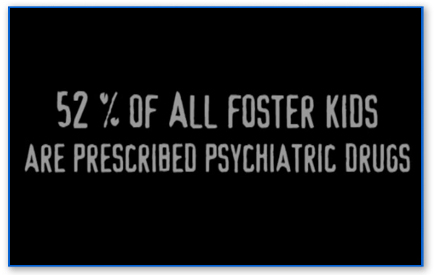
The Work Group found that, while nationally 5% of all children receive psychotropic medication, among Florida’s foster kids, the rate was 15.2%. Florida has all sorts of protocols and regulations, but if there’s no one, no adult, with a vital and demonstrated sense of urgency, the drugs flow. Gabriel’s tragedy was one of repeatedly missed opportunities for real treatment, for real help, for real care. That was the Report of the Gabriel Myers Work Group, November 19, 2009.

That was two years ago. And today?

Today, Florida distributes psychotropic drugs, with what amounts to abandon, to children in prison. Doctors are prescribing psychotropic drugs more often than ibuprofen. In 2007, according to a report last week, the Department of Juvenile Justice bought more than twice as much Seroquel as ibuprofen for its state-operated jails and homes for children.

Again, there’s little or no oversight. By its own admission, the State doesn’t know where most of the drugs are. This is called a “functionality” concern. There’s little or no oversight, as well, concerning conflict of interest between prescribing doctors and the pharmaceutical corporations.

What’s going on in Florida? According to Broward County Public Defender Howard Finkelstein, whose office represents children in juvenile court, it’s battery: “If kids are being given these drugs without proper diagnosis, and it is being used as a ‘chemical restraint,’ I would characterize it as a crime. A battery – a battery of the brain each and every time it is given.”

According to Dr. Glenn Currier, an associate professor of psychiatry at the University of Rochester in New York, the doses are extraordinarily high. When asked about a case involving one young female prisoner, Dr. Currier remarked: “I have heard of doses that high in large adult males. But not in girls.”

Florida used to put juveniles in prison for life, without any chance of parole, for non-homicide offenses. Last year, in Graham v Florida, the US Supreme Court ruled that it could no longer do so. In the 1990s, Florida sent 7000 children to adult courts. That’s more than the rest of the country, combined.

What’s going on in Florida is a crisis, a crisis of care, a crisis of urgency. The State is distributing deadly drugs to its most vulnerable children. And that’s a crime.


(Image credit: CCHR International)


As of 11 March 2011, there were 1030 children in immigration detention in Australia

Today, May 26, 2011, is national Sorry Day in Australia. On May 26, 1997, the Report of the National Inquiry into the Separation of Aboriginal and Torres Strait Islander Children from their Families was presented to the Australian Parliament. This report is better known as the Bringing Them Home Report. The report focused on the Stolen Generation, on the abuse of Aboriginal children, families, communities. Ever since 1997, many Australians have marked the event with a National Sorry Day. Of course, Sorry Day alone is not enough.

The Australian Human Rights Commission today issued a report, entitled 2011 Immigration Detention at Villawood: Summary of observations from visit to immigration detention facilities at Villawood.

Villawood is a private prison, run by Serco Australia. Comprised of two sections – Villawood Immigration Detention Centre (IDC) and Sydney Immigration Residential Housing (IRH) – Villawood is the jewel in the Australian immigrant detention crown.

The Australian Human Rights Commission “has raised concerns” about Villawood for over a decade.

According to the Commission Report, “As of 11 March 2011 there were 6819 people, including 1030 children, in immigration detention in Australia – 4304 on the mainland and 2515 on Christmas Island. More than half of those people had been detained for longer than six months, and more than 750 people had been detained for longer than a year.” Fifteen percent of those prisoners are children.

The section entitled “Children in Detention” begins: “As of 11 March 2011, there were 1030 children in immigration detention in Australia. The Commission has repeatedly raised concerns about the mandatory detention of children, the high number of children in immigration detention facilities, and the long periods of time many children are spending in detention.  These concerns were reinforced by the Commission’s visit to Sydney IRH.”

In March, the Sydney IRH housed 27 people. Eight were children, three girls and five boys. Thirty percent of the Villawood `residents’ were children. The youngest child was four months old, and the oldest was 16. One was unaccompanied; one had been born in prison.

As it has done, repeatedly, for over a decade, the Commission raised concerns about the detention of children. These include:

•            Child asylum seekers continue to be subjected to mandatory detention.

•            Many children are held in immigration detention facilities, such as Sydney IRH. These are closed detention facilities. Call them what you like, they’re prisons.

•            Many children spend long periods of time in immigration prisons. In Sydney IRH, all eight children had spent more than three months in detention. Seven had been in for more than six months. Three had spent more than a year behind bars.

•            There is no judicial oversight for the immigration detention of children.

•            There is no written policy at Sydney IRH identifying the delegated legal guardian for detained unaccompanied minors.

•            There is no written policy regarding the care and supervision of unaccompanied minors detained at Sydney IRH.

•            There are no independent observers for interviews with unaccompanied minors detained at Sydney IRH.

•            There is no Memorandum of Understanding between DIAC and the New South Wales Department of Community Services regarding the welfare and protection of children in immigration detention at Sydney IRH or elsewhere in NSW.

Australia has a policy of immigrant `detention’ as a last resort, and for as limited a time as possible. This has been the official national, Federal policy since 2008. And yet, families with children and unaccompanied minors are sent to prison rather than community-based alternatives. There is no plan for community alternatives. The Commission is concerned.

Today, in Australia, is national Sorry Day. Tomorrow begins national Reconciliation Week. Meanwhile, new Stolen Generations pile up behind bars in immigrant prisons. Sorry.


(Photo Credit: Australian Human Rights Commission)