Radical Feminisms & Occupy

As one who was an activist and a radical pre-occupy (as I have been during- and will be post-), I had mixed feelings upon occupy’s initial momentum. It is nice to be surprised once in a while. A friend put it best—“if someone had told you five years ago that Adbusters would be responsible for the next US protest movement, and that Crimethinc would be providing useful, levelheaded discourse on it, would you have believed them?” Not a chance. So when it kicked off, I was extremely skeptical. I had long ago dismissed anything resembling a mass mobilization as being unable to enact real change in the USA. Instead, I cast my lot (as did many of my friends and colleagues) with what we call somewhat euphemistically “long term movement building”: direct services, raising funds and resources for said direct services, and small-scale community building. But I was also excited that the national conversation was approaching a critique of capitalism, excited for there to be a left movement in the USA again, and intrigued by the possibilities of the encampment tactic. Occupy’s connection to the “Arab Spring” in the national imagination gave it a particularly tantalizing flavor of possibility.

On paper, occupy is inherently aligned with feminist critiques of power. The heart of occupy is an objection to unearned power—the same objection at the heart of work seeking to dismantle patriarchy, white supremacy, homophobia, ableism, and the myriad interlocking oppressions that both sustain the ruling order (or in the parlance of occupy, the 1%) and keep the 99% divided and conquered.

But at large and locally, the internal and external dynamics of the movement have not always reflected that ideological alignment which seems at once so obvious and so necessary. Instead, the physical spaces of occupy have often replicated oppressive social relationships, when they should have been sanctuaries for those who need it the most—people experiencing homelessness, people of color, queer and trans* people, women in need of shelter and childcare, and survivors of violence, to name a few. Also, the conversation with occupy seems to have shifted to mainstream liberal concerns such as Citizens United and away from poverty and structural violence.

Occupy’s shift to liberal values, if not tactics, did not come as a total surprise. Radicals have long known to be wary of our liberal and moderate compatriots. They can sometimes be our worst enemy or biggest obstacle, as The Rev. Dr. Martin Luther King Jr. so eloquently expressed in “Letter from a Birmingham Jail”:

…the white moderate, who is more devoted to “order” than to justice; who prefers a negative peace which is the absence of tension to a positive peace which is the presence of justice; who constantly says: “I agree with you in the goal you seek, but I cannot agree with your methods of direct action”; who paternalistically believes he can set the timetable for another man’s freedom…lukewarm acceptance is much more bewildering than outright rejection.

This is why a feminist critique is essential to occupy. We have got to keep an eye on the people who claim to be speaking for us or on our behalf, but are not. It is not a lack of demands or incoherence of message that weakens the occupy movement, but the lack of a radical analysis, and the unwillingness of privileged people within the movement to step back and let the movement be directed by the needs of its most marginalized participants.

For a moderated panel discussion of this and more—where is occupy going in relation to labor? To academia?—please attend a Panel Discussion on the Future of Occupy, GWU Gelman Library, Wed March 7

march_7_forum_flyer


(Photo Credit: Rabble)

The UK asylum system still isn’t gender sensitive

Participating at the Go Feminist conference earlier this month, I sat and listened to Herlinda. Herlinda was there to talk about her experience as a woman claiming asylum in the UK after fleeing persecution in the Democratic Republic of Congo (DRC), a country where rape is “commonplace” and perpetrators generally go punished.

Herlinda’s story – of claiming asylum in the UK, of being disbelieved by officials, of ending up destitute and sleeping rough – is similar to the accounts given by all too many women who seek asylum here.

Indeed, her story is dispiritingly familiar. In January Asylum Aid published our new report, “I feel like as a woman I’m not welcome”, which combines legal analysis and interviews with asylum-seeking women and their legal representatives to test the Government’s promise to make the asylum system more gender-sensitive. And while political rhetoric on this has been encouraging of late – the Deputy Prime Minister promised in May 2011 that “we’re ensuring the process is sensitive to the needs of women and girls” – the situation on the ground can still be desperate.

I spoke with women who had been denied even basic standards of privacy when claiming asylum at the UK Border Agency (UKBA) unit in Croydon, so that the information they were asked to share with officials was compromised from the start (something that has lately attracted the concern of the independent Chief Inspector of the UKBA). I talked with one woman who, having claimed asylum after escaping from sex traffickers, was asked by immigration officials how many men she had slept with and whether she enjoyed working as a prostitute. And I met with a mother who, having been forced to move cities so that she could receive accommodation and support from the UKBA, was so scared that she and her children dared not leave their unfamiliar new housing for three days. I heard story after story like this each day while conducting the research.

The stakes could hardly be higher. When someone flees gender-based violence and persecution in their home country, they turn to our asylum system in desperation. But too often they find a procedure which is dysfunctional and ill-equipped to meet their needs.

We know from previous research that women are too often disbelieved when they seek asylum, and that they have a higher chance of winning their appeal when the case is scrutinised in more detail. We know that the specific grounds on which victims of gender-related persecution might be recognised as refugees – as a Particular Social Group – is worryingly misunderstood and underused by asylum decision-makers.

The quality of decisions when women seek asylum has long been a concern, and this new research exposes how deeply other causes for concern run through the full, end-to-end asylum system. There is limited consideration of gender issues in current legislation, and where UKBA policies do provide safeguards to women they are too seldom implemented in practice. From the way asylum interviews are conducted to living conditions in accommodation and immigration detention, asylum-seeking women continue to be treated very poorly. This is morally indefensible.

The Government has tools at its disposal for addressing this. Focused work on the daily operation of the asylum system – ensured privacy for anyone making their asylum application in Croydon, for example, or accepting the need to reconsider a claim where there is late disclosure of rape or sexual violence – should go hand-in-hand with strategic leadership that places gender at the heart of the asylum system. With the position of Gender Champion of the UKBA currently unoccupied, now would be a good finally to time to invest that role with influence and real meaning.

The asylum system won’t be fair, the Deputy Prime Minister has admitted, “until we’re sure no single group is being singled out”. All of us who work with women asylum seekers will continue to hold the Government to account. We are only asking, after all, that they honour their own promises.


(This first appeared at The F-Word, here:  http://www.thefword.org.uk/blog/2012/02/the_uk_asylum_s. Thanks to The F-Word for sharing.)

Hopelessly devoted

Hopelessly devoted

Hopelessly devoted
actually utterly hopeful
and positive, they are

Hopelessly devoted
the Earth Children
from Rustenburg Girl’s High
(passionately green are they)

Hopelessly devoted
right here down South
in their vegetable garden
recycling at their school

Hopelessly devoted
an assortment of girls
enthused with their earth work

Hopelessly devoted
to their healthy vegetables
and farming worms too

Hopelessly devoted
eating flowers
reducing their carbon footprint
and fund-raising for our rhino

Hopelessly devoted
doing the each one teach one
(a collective consciousness)

Hopelessly devoted
might they re-energise
all of us out yonder
in the material world

[Hopelessly intrigued am I by the Earth Children down Rustenburg Girl’s High-way (“Earth Children passionate about all things green” – Tatler, February 23 2012).]


Cellar Wild: The Banquet

If you think that the definition of the word WIFE means something a woman becomes after she gets married, well think again.

I am sure that every mother who holds a job, self employed or otherwise, has asked or been asked the question: “How do you juggle family life with a career”? I am also pretty sure that every father who holds a job, self employed or otherwise, has never been asked the same question.

No one would dream of asking a guy this question because everyone automatically knows that his home affairs are safely in the “back office” department; in other words his home affairs are the terrain of the Wife.

Having been brought up by some one’s wife and seen and known a good number of wives in the course of my 36 years- (hell, I’ve even been a wife myself on occasion); I have had ample opportunity to discover the true meaning of the word wife.

A wife is any individual m/f who is prepared in exchange for payment, (assumed)security, symbiotic dependency, material comfort, all of the above, (and/or even more obscure reasons known only to the individual involved) to place ones interests on a secondary level and assume a subservient position for a given amount of time (usually a life-time) so that ones significant other can go out into the world, have achievements and discover ones’ genius.

As a teenager in boarding school; we had to attend mass on Sundays and there was this hymn, a favourite amongst other students, which I hated with a passion. This ultra-patriarchal song (like every thing else that reeks of church) was symbolically about a banquet, to which God intermittently invites man to attend in the course his lifetime. The refrain, the most awful part, is about the excuses that man, wallowing in his pathetic little world of self importance and materialism, gives as a response to God’s call. It goes like this:

The Banquet

Refrain:

“ I cannot come to the banquet,
Don’t trouble me now!
I have married a WIFE, I have bought me a cow.
I have fields and commitments, that cost a pretty sum,
Pray, hold me excused.
I cannot come”.

The question that always popped into my mind was whether the wife and the cow were one and the same. For some inexplicable reason I assumed this was the case. Thus assumed, my armpits would prickle and burn with outrage every time I heard this song and I always kept my mouth stubbornly shut at the refrain.

Life has taught me that in the grown up world, there are only 2 kinds of individuals: Husbands and Wives. Husbands are the Einsteins, the Picassos, Galileos, the Mandelas, the Stephen Hawkings and the Colombuses. Individuals who go out the there to conquer and shape the world.

Wives, on the other hand, are the back office of the former. They are the faceless, anonymous ones who stay at home, to hold the fort, raise the kids and the keep the fires burning so that the husbands out there can become heroes.

One can safely conclude that the key to the success of every genius lies in the having of a good wife. I have tried on both shoes and discovered that I am a born husband. (I swear I am!)

Having known both shoes, I have also learned to deeply and most humbly appreciate the wife.

So whenever anyone asks me again in the future, how I do the home-career spastic juggle I will look them in the eye with my best poker face and say that I rent me a good  PA (nervous cough) wife every now and then.

For behind every career, every success, every hero, every dictator, every genius, behind it all, is a damn good Back-office, or PA, or Cow,…. or a Wife.

(This was first published at The wild woman in the cellar, here. Thanks to Chinello Ifebigh for the collaboration!)

Feminism and Love: Borders Shift

“Each one of us here is a link”
Audre Lorde

Filled with love, our greatest tool is the ability to look across the border, acknowledging its existence, and into the eyes of another person. I ask you to teach me what the border means for you; I will teach you what the border means for me, and we will, together, recognize how we are linked across and beyond it. In that moment, the border begins to shift.

This is love; more than sympathy, more than compassion, more than solidarity, this is responsibility to another individual. This is the “slow, attentive mind-changing (on both sides), ethical singularity that deserves the name love,” a commitment to see, understand, and change the world—and ourselves— together.

To be a feminist is to be attentive. To be a feminist is to change one’s mind. To be a feminist is to be responsible to one another, to listen and to question, to learn and to teach, to criticize and to celebrate. To be a feminist is to refuse the comfort of our own borders and to struggle together to make the borders shift.

Such responsibility can be painful, exhausting, and can seem hopeless. Manissa McCleave Maharawal from Occupy Wall Street writes, in response to the first draft of the Declaration of Occupation:

“Let me tell you what it feels like to stand in front of a white man and explain privilege to him. It hurts. It makes you tired. Sometimes it makes you want to cry. Sometimes it is exhilarating. Every single time it is hard. Every single time I get angry that I have to do this, that this is my job, that this shouldn’t be my job. Every single time I am proud of myself that I’ve been able to say these things because I used to not be able to and because some days I just don’t want to.”

We, too, are called to talk about privilege, starting with our own. We are called to argue and to question, even when it hurts. And we are called to love so fiercely that we keep trying.

“No matter how hopeless that undertaking might seem,” and no matter how exhausting it can be to pry open a tiny crack in the border with your fingers, this is what love asks of us. When we love, we notice even the smallest of blessings, every shift in which “words…blades of grass” can push through.

To challenge the borders through love is to recognize that no matter how small the shift, it is seminal; no matter how hopeless or painful a moment, there is the possibility for transcendence.


(Image Credit: Huffington Post)

The group, mostly women, entered the morgue

There is nothing to say about last week’s fire in Comayagua, Honduras. Nothing. A prison at 200 percent capacity is a tinderbox. A prison in Honduras, like prisons all over the world, are not only `congested’. They are filled with people awaiting trial. This detail somehow `complicates’ the situation, adds some sort of `irony’.

Because if they were convicted of crimes, well then … there would be no presumption of innocence.

There is nothing to say about last week’s fire in Comayagua, Honduras. It was a catastrophe long foretold. It was simply another sign of the chaos that is Honduras.

And you know … Honduras … it’s a banana republic, after all. Notorious for its prisons and violence.

There is nothing to say about this week’s fire in a factory in Bhalwani village, in Solapur, Maharashtra, India. Nothing. On Monday, a fireworks factory `suffered’ a fire. Five women workers, at least, were burnt alive, at least nine women workers were injured, and 40 women workers were trapped inside the burning complex. Trapped.

The reports will say the fires were accidental. The one in Honduras, the one in India. The reports will say the death of those burnt alive is `tragic’. But the relatives and friends, and the survivors of the flames, the ones who walked out somehow, they know better. They know the work of mourning, they know the architecture of being-trapped.

They know that the burning factories and the burning prisons are part of the everyday of the global economy. These buildings in flames and the human bodies within them are not some ritual drama nor are they resistant pockets of primitive capitalism. They are the Shining Globe that has replaced the Brave New World. Shining India. Shining Free Trade Zones, such as the DR-CAFTA, Dominican Republic – Central America Free Trade Agreement. Smoke and ashes from sea to shining sea.

And every time the fire explodes, it is described as somehow exceptional. A throwback. It’s not. It’s the globe itself, today, now, here.

The women who come for their loved ones, they already know all this. They were struggling for their loved ones before the fire, and they will continue after the world’s attention has drifted elsewhere.

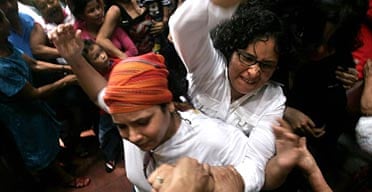
That is why the women stormed the morgue in Comayagua on Monday, the same day of the fire in Bhalwani.  That is why their demand for justice is total. Every corner of the prison, every corner of the nation-State that runs the prison, every corner of the Empire-State that runs the world economies on violence, must be swept clean.

But first … begin by honoring the dead, by reclaiming their bodies, by cleaning them of the ash and the gash, and returning them to the earth.

In the landscape of smoke and ashes, women must storm the morgues to reclaim their loved ones. There is nothing to say. Nothing.


(Photo Credit: NPR / Esteban Felix / AP)

I don’t want to come to terms with circumcision. I want to fight without fear

“It will take just a few seconds. And it will only hurt a little bit.” That was all my mother told me as I was held down on a stranger’s rug one afternoon, moments before the old lady’s blade-wielding hand came up between my legs and stole the hood of my clitoris forever.

In a few hours, as the pain disappeared, the memory, too, faded from my conscious mind. I trusted my mother and was satisfied to be told that this ritual, called khatna (circumcision), was a must for every seven-year-old Bohra Muslim girl. Now, nearly twenty years later, it is impossible to think of that day without feeling shudders of bitterness, frustration and outrage. My grandmothers were superstitious, true, but how could my mother – an educated, intelligent, urban woman – let them talk her into violating her daughter’s sexuality?

Over time, I have learnt to forgive my mother. I see her now as just another unquestioning victim of the insidious power that a religious community can wield over one’s mind. I could choose, like many other Bohra girls, to come to terms with the ‘minor scraping’ and move on with my life, but in the past few years, I have found that impossible. Why should I let go of the anger?

I come from the Dawoodi Bohra community, a small Shiite sect from Gujarat, India, that remains remarkably close-knit even though its members have spread out all over the world. Bohras pride themselves on being a wealthy and enterprising business community, and on their relatively ‘liberal’ attitude towards women. Unlike most other Muslim sects in India, Bohra women are well-educated, may work outside the house, and are often encouraged to run small businesses from their homes. Yet, in the cramped living rooms of untrained ‘surgeons’ (and now also in small hospitals all over the world), these very women perpetuate a ritual that has no definite sanction in Islam, but one that could permanently alter the sexual lives of their daughters.

Because of the hushed secrecy surrounding the ritual, it’s hard to estimate how many Bohra girls have been circumcised. It could be anything from 60 to 90% of them, and in a large number of cases, men in the family are not even aware of it. Most women, if you ask them, would not be able to tell you exactly why they follow this tradition – there is no written text they can refer to for a justification. But they know they could be ostracised if they don’t follow the practice.

Three months ago, when a fellow-journalist was reporting on an online petition against female genital mutilation (FGM) started by an anonymous Bohra woman, she asked an official from the community’s religious establishment for an explanation. “It’s done to protect a woman’s virtue,” he said. In a menacing tone, he added, “Be careful. Don’t write about this stuff.” More recently, my aunt (a 40-something psychology-graduate who has ‘disowned’ me for vociferously taking up the anti-FGM cause) defended the ritual with these words: “Women have far more sexual urges than men, and it is necessary to control them. Men have to go out and do the hard work; they cannot be having sex with their wives all day. That’s why the Prophet has emphasised khatna for girls – if they are not circumcised, they will all grow up to be prostitutes.”

Her words have echoed in my mind ever since, growing louder every day. Because of women like her – and a whole community that is a willing to be brainwashed – I don’t have the anatomy of a normal woman today. My clitoris was snatched away without my consent, at an age when I was powerless to protest. I look at my friends, at other women outside my little community, and sometimes feel an eerie sense of seclusion. I’m different. I will never get to experience womanhood completely, the way it was meant to be, all because some ancestors decided my ‘virtue’ was more important.

To me, male circumcision is just as hateful, particularly in my community, where little boys’ fates are sealed when they are barely six months old. But women have to protest for themselves, and some Bohras are taking a personal, though covert stand against FGM. But complete change can come only at an institutional level, when we force the community to abolish the practice. I don’t want to ‘come to terms’ with my situation; I want women to fight, without fear. Outrage has got to be our driving force.

(Photo Credit: WorldMuslimCongressblogspot.com)

Nicaraguan feminists protest for their bodies, autonomy, lives

The news of the day was that Democratic representatives walked out of a hearing on “religious liberty and birth control.” Republicans had blocked the testimony of a woman who wanted to speak in favor of the Obama administration’s compromise on birth control.  But the Republicans allowed representatives, men, from conservative religious organizations to testify.  House Representative Carolyn Maloney remarked, “What I want to know is, where are the women?”

A picture tweeted by Planned Parenthood illustrates this question completely.

Where are the women?  In Nicaragua, some women are in the streets.

Yesterday, at the International Poetry Festival in Granada, there was a parade, with dancing and singing and cheers.

There was also a protest by Nicaraguan women.  Nicaraguan feminists.

On the parade route, a group of Nicaraguan women, wearing signs that read “Fui violada y ahora estoy embarazada.  ¿Te parece justo?” (“I was raped and now I am pregnant.  Does that seem just?) lay down in the middle of the parade, stopping the flow of the marching.  They passed out flowers in protest of the ban against therapeutic abortion in the country.

Therapeutic abortion—an abortion performed to save the life of a pregnant woman—had been constitutional in Nicaragua up until October 2006.  When Sandinista politician Daniel Ortega re-assumed the presidency, he kept the law intact, a complete reversal from his stance before his re-election.  Women’s groups have been pressuring the State to repeal the ban, but Ortega’s switch came with the support of an important Catholic bishop.  Within a year of the law’s passing, 82 women had died due to lack to life-saving abortion procedures.

The State passes regulations preventing women from accessing health care that would save their lives.  Then the State uses religious institutions to embolden its position.  Sound familiar?

Violence against women more than often flows from patriarchal institutions trying to police their bodies and autonomy.  It happens globally, outside the United States, and inside the country just as easily.

Women are defending their equality all over the world, in the State and in the streets.  That is where they will be until the job is done.

(Photo Credit: Esteban Felix / AP / Guardian)


Domestics: A Blessing?

I had no idea. Despite limited activity on Saturday and Sunday. Despite eating every weekend dinner with my aunt. Despite extra trips to the grocery store. Despite added stress and limited sleep, it wasn’t until I was much older, did I finally have an idea that my mom was a domestic worker.

Starting when I was five years old, my mom started working every Saturday and Sunday evening cooking for an elderly couple. From 5:00pm until 8:30pm she’d stay at their home, preparing, cooking and serving dinner and dessert. She helped occasionally for several months, until the weekend cook left and she agreed to take her position and started working Friday, Saturday and Sunday nights. She says she considered the job, “a blessing. I received good pay for what I did. They were good if I wanted to take time off. I could always switch things around with someone else that cooked. Also, they were in good health and I could prepare things for them before I left and they still had a nice meal the night I wasn’t there”.

When the wife passed away, my mom started working more evenings and by the time I went to college she was working five, sometimes even six nights a week. Then, “Everything was a different story. He took advantage of me and the other people helping him. I observed how he treated the woman that helps him during the day. He refused to buy her health insurance and he expanded her hours, but didn’t pay her for the extra time”, my mom said.

Often, the line between her personal space when she is or isn’t at his house is blurry. “Last week he called my office because he said he didn’t know where I was. He called simply because he thought he had a right to”, she says. “Sometimes he asks me to go early to spend extra time with him, but he never pays me the extra hours,” she says.

“Other times he’ll call me when he is in town and I’ll help him out with rides to where he needs to go. I feel like I’m doing him a favor because I’m fond of him, but then I realized he’d ask for help because he knew he didn’t have to pay us,” she explains.

Despite the fact they had a friendly relationship, when I asked her why she didn’t ask him for compensation for the additional work, she said, “I needed the job and I felt lucky to have it”.

He also makes her feel extremely guilty. “Sometimes he’ll make snotty comments. That’s stressful,” she explains. If she does something he doesn’t like he’ll “be quiet with me for weeks on end. I know he’s mad and not happy. It’s his way of staying in control. He’ll do anything to stay in control no matter what the impact is on our schedule, time or personal lives”, she explains.

Last Christmas my mom was with him on both Christmas Eve and Christmas night. “He’ll be thrilled I’ll be there Christmas Eve and he doesn’t care that I won’t be with my family”, she said. Although two of his grandchildren want to cook for him on Christmas Eve, his children decided my mom had to cook the holiday meal because they said she is a better cook.  “Just because I’d be better, I can’t be with my family,” my mom says.

My mom’s employer is ninety-four. Contemplating the day he’s gone leaves my mom with many mixed emotions. “As frustrated as I’ve gotten, I think about him being gone and it makes me sad”, she says. She knows she’s going to miss him.  “He’s the person I’ve had dinner with five days a week the past three years and for the past seventeen years we’ve eaten dinner together at least two nights a week” she says.  On the other hand, “I’ll be relieved when he’s gone. I feel guilty about that”, she says as she begins to cry. “Knowing no one will yell at me or put demands on me will be nice,” she says.

When I asked her to express her general sentiments of being a domestic care worker. She says she never considered herself domestic help.

I just never thought about it. In my mind, I think of domestic help as taking place in a different time. I know I’m a caregiver, but I never put myself in the context of domestic care worker. I was always so quiet about the job and I just did what I did. I just felt like I was there to cook dinner and do odds and end things around the house. He needed so little care, that he was just looking for company. I think falling into the job and not considering it a profession made me never think of it that way. It was just an extra job, extra money.

Maybe I couldn’t identify my mother as a domestic care worker because she doesn’t identify as a domestic care worker. The work of care workers is defined as the relationships and activities involved in maintaining people on a daily basis and intergenerationally. It often involves emotional, physical and “community care”. Just as my mother and I didn’t know, I assume there are many other domestic care workers throughout the world unaware of the position they serve. In order to ensure all domestic care workers receive fair and just working conditions it is imperative that they accurately recognize the work they do.

(Image Credit: National Domestic Workers Alliance)

My mother’s habits

My mother’s habits

Leaks and not leeks
I declare, mortally offended
by a young British student
and her English (as she is spoke)

I excuse myself, though
whilst correcting her mixing
her vegetables with the state
of a little wooden structure
donated to a poor community

My mother’s habits
tea-drinkingly English
of nature as it were
in a manner of speaking

My mother’s habits
a teacher-mother who
inspired shaped liberated
and decolonised the mind

She who (once) jested
over a weekly paper’s title
on our Shaik-like Selebi
Me and Mbeki come from far
said he, his face on straight

My mother’s habits
teacher activist and librarian
retired her mind now
discharged from itself
somewhere (and somehow)

My mother’s habits
knowing her leaks
from her leeks
and the other way too

After all, such-like
and the Oxford comma
is what separates us
humankind from the beasts
who daily put our women
and children at risk

I find a moment in a TWC (The Women’s Circle) meeting to tease a British student and TWC volunteer, around and about the linguistic leakage in her mother’s tongue, Feb 9 2012.