In Australia, don’t `fix’ Banksia Hill Detention Center. Shut it down!

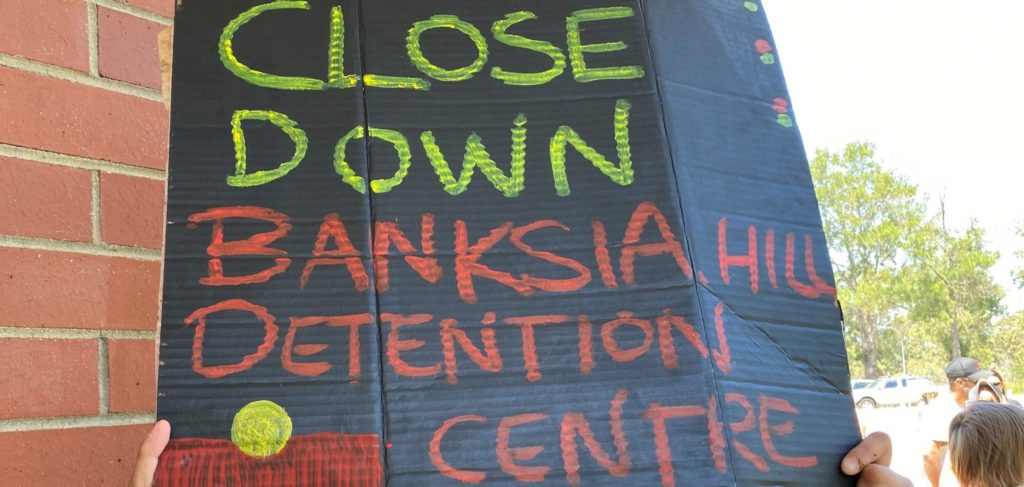
Today’s headlines read: “The juvenile prison where child was ‘treated like an animal’ gets funding boost”; “Banksia Hill juvenile detention centre gets $25 million to address ‘dehumanising’ conditions, cut incarceration rates”. Banksia Hill Detention Center is in Western Australia. It’s the only juvenile detention center in Australia that houses both males and females. The situation is so bad that, in January, Perth Children’s Court president Hylton Quail sentenced a 17-year-old child to Hakea Prison, an adult prison, rather than send to Banksia Hill. Hakea Prison is where 22-year-old Noongar man Ricky Lee Cound was kept in solitary and denied clearly needed medical care. On Friday, March 25, Ricky Lee Cound died. After weeks of self-harm and institutional refusal, Ricky Lee Cound died in a place that is preferable to Banksia Hill Detention Center, and today, Banksia Hill Detention Center received $25 million to improve its conditions. Don’t improve it. Shut it down.

In February, the same Judge Quail was presented with the case of a 15-year-old child. The boy had been held in Banksia Hill for 98 days. For 79 of the 98 days, the boy was held in what the judge called a “fishbowl” cell, where he had no privacy whatsoever. The judge described the exercise yard as a “10 x 20 metre cage”. For 33 of the 79 days, the boy wasn’t allowed outside the cell at all. The judge rightly called this “solitary confinement”. The boy received no education while in custody. The boy threatened self-harm and attacked staff. In fact, he was standing before the judge because he had attacked staff and damaged state property. Judge Quail responded to the situation, “When you treat a damaged child like an animal, they will behave like an animal. When you want to make a monster, this is how you do it.”

Today, Banksia Hill Detention Center received $25 million to address these conditions. Don’t address, don’t improve. Shut it down and build real alternatives.

The problems at Banksia Hill Detention Center go way back, continue to the present, and are hard baked into its design and purpose. According to the Office of the Inspector of Custodial Services’ 2020 Inspection of Banksia Hill Detention Center, “Aboriginal young people continue to be overrepresented at Banksia Hill, making up 74 percent of the population.” Even by Australian standards, where Indigenous young people typically make up 49% of those “under youth justice supervision”, 74% is high … and catastrophic.

And for girls, it’s especially bad. 80% of the girls are Aboriginal, a mix of sentenced and remand. While services for the girls had improved since the last inspection, the report notes that the improvement came from individual staff members, and not from any strategic or management plan. That means when the staff moves on, and they do move quite a bit, there’s no guarantee the improved services will remain. Further, a number of staff make it known, to the girls, that they don’t want to work in the female section. While girls form a minority of Banksia Hill residents, their numbers have been increasing, during a period where the general population has been decreasing. From 2017 to 2020, the numbers of girls generally doubled. Likewise, where they were 6% of the Banksia Hill population in 2017, by 2020, they comprised 13%. And yet, with all that increase, everything involving girls at Banksia Hill Detention Center was ad hoc.

Banksia Hill Detention Center has been open since 1997. It has gone through repeated cycles of “major redevelopment”, to no avail. That’s because the improvements, despite individual staff members’ best intentions or lack thereof of, were never meant to improve the lives of Aboriginal children. Don’t `improve’ the institution, yet again, with a fat purse. The children housed in Banksia Hill Detention have problems, but they themselves are not the problem. Shut it down. Build real justice by investing in real care.

(By Dan Moshenberg)

(Photo Credit: National Indigenous Times)
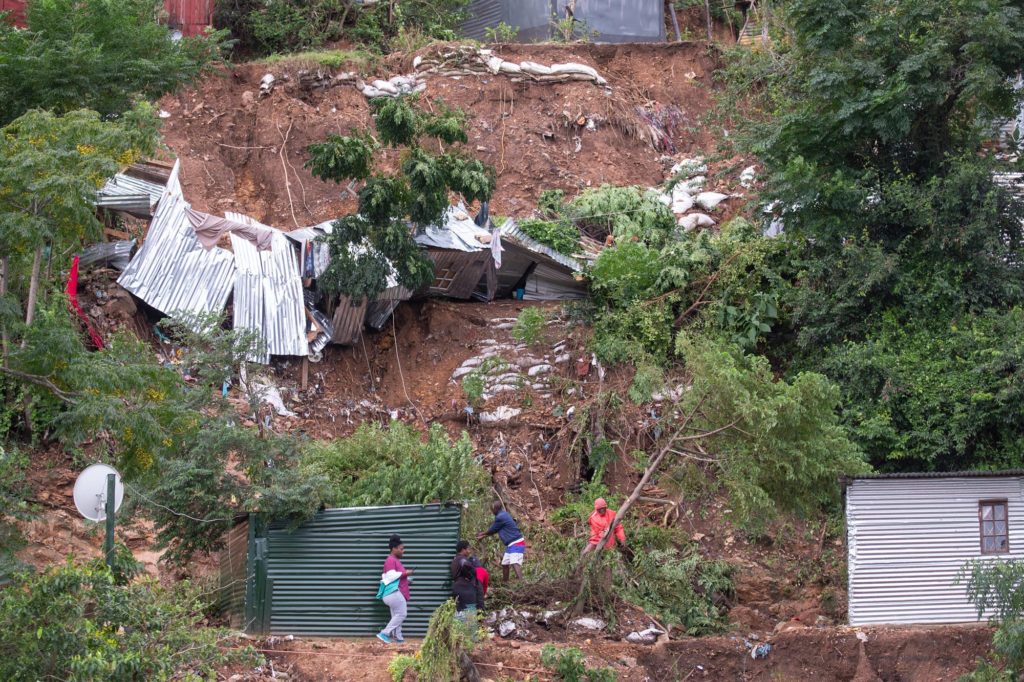
Devastation in Durban

12 April 2022: Flood-damaged homes in eNkanini shack settlement in Cato Crest, Durban.

The openly kleptocratic faction of the ANC has always had its strongest base in Durban. This is the city from which the late John Mchunu used his position as the regional chairperson of the party to organise the campaign that took Jacob Zuma to the presidency. In the Zuma years, the extent to which the country was run from Durban was significant.

It is here that the axe of day-to-day political repression falls hardest, and most frequently. Violence and the threat of violence have been normalised. In much of the city, automatic weapons are now an unremarked on and ordinary feature of political meetings.

Activists have their homes burnt, are beaten, tortured, arrested and jailed for long periods on farcically bogus charges and, all too often, murdered. The izinkabi, party thugs, the police and now elements in the prosecuting authority operate together to protect the political mafia that has captured the ANC and the City Hall.

That mafia has institutionalised itself in the city’s procurement policies and in the party’s structures in the wards where there is now formal accommodation for the “business forums” that seek to capture public money in the name of “radical economic transformation”.

The election of Zandile Gumede as the eThekwini regional chairperson of the ANC is a clear signal that, despite the party’s significant setback at the polls, its most brazen mafia – the radical economic transformation faction in Durban – are not beating any sort of strategic retreat.

The capture of governance by a mafia has many consequences, including the murder of activists. Another of those consequences is that money collected and allocated for social purposes – such as building and maintaining infrastructure, providing housing and so on – is appropriated for the private enrichment of a small, politically connected elite.

Every rand that goes into another McMansion in uMhlanga, or on another Italian sports car, is a rand taken away from building houses, or even the more modest work of making shack settlements a little safer and more liveable.

Lives made in mud

Durban’s hilly terrain means there is open land for impoverished people to occupy within the city, close to schools and opportunities for work. Here, shack settlements are not always on the urban periphery. But this terrain also means that large numbers of people often live together on steep slopes. Many settlements are alongside the streams that run through the valleys, streams that turn rapidly into torrents of angry water when heavy rain lands on hard surfaces without adequate drainage and rushes down slopes denuded of vegetation by the construction of shacks.

Even ordinary levels of rain turn these settlements into waterlogged places sitting on mud considerably higher than ankle-deep. It is standard for people’s homes to be full of water and mud, with water running under their beds. This is extremely uncomfortable. Residents often spend days with plastic bags tied over their shoes. Navigating steep slopes that have turned to thick mud is particularly dangerous for older people. Broken limbs are common.

The fact that the municipality has not bothered to pave paths and install basic drainage in the settlements is just one sign, among many, of the systemic contempt with which impoverished people are treated. Its failure to collect rubbish from these areas is another. And the drainage that does exist around shack settlements, built for the adjacent suburbs, gets blocked quickly when rain carries uncollected refuse into poorly maintained drainage systems.

The weather has not been an entirely natural phenomenon for a long time, since humans first began cutting down the vast forests that once covered much of Europe and North America. The scale of human impact on the weather and broader climate systems escalated rapidly with the onset of industrialisation driven by fossil fuels. But while the worsening climate crisis requires urgent attention, we cannot say that a particular municipality is responsible for the amount of rain that falls in its jurisdiction.

A politics of contempt

But the failure to make provision to keep people safe when the rain does come, to maintain existing infrastructure and to build new infrastructure, is the full and direct responsibility of those who allocate and oversee municipal expenditure.

In the same way that the tuberculosis epidemic and shack fires are a material expression of a politics of elite contempt, so too is much of the damage wreaked by floods. We can’t stop the rain, but we can prepare for it in a way that assumes the equal dignity and equal value of the lives of all residents.

But without a decisive political shift, the cycle of fire and flood will continue to shape the lives of impoverished people. Durban has by far the most extensive and impressive forms of popular organisation in the country. But while such organisation has defended much and won much, it has not acquired the strength to dislodge the political mafia that runs the city.

Nationally, it is on the Right that new forces are emerging and cohering on the terrain of electoral politics. As is common in much of the world, the deliberate incitement of and pandering to xenophobia has become a key technique for the Right to build political vehicles that exploit people’s suffering for electoral gains while aligning with the same forces that produce and sustain that suffering.

It is the Right that is currently best placed to profit from the decline in the standing and power of the ANC. Well-intentioned top-down initiatives, from non-governmental organisations to activists last rooted in popular organising in the 1980s, will not change this. Popular democratic power is always built from below. Right now the task of building mutually respectful alliances between the mass-based organisations of the Left, alliances rooted in practical forms of solidarity, could hardly be a more urgent starting point for the project to rebuild the Left as a national force.

This article was first published by New Frame.

(Photo Credit: Rogan Ward / New Frame)

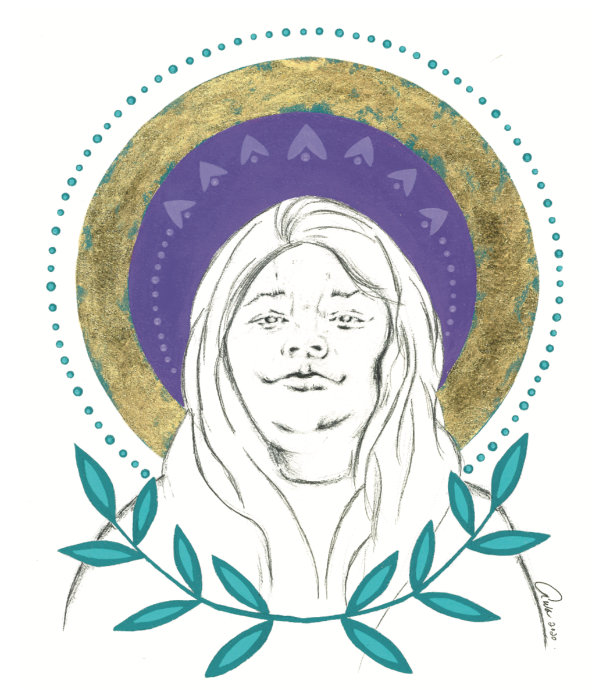
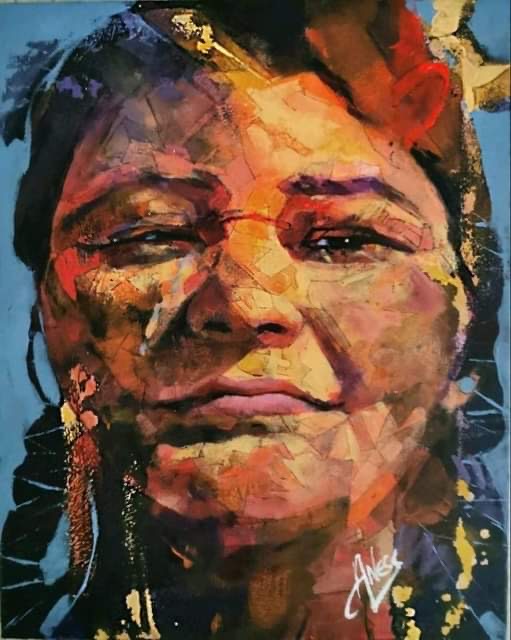
Quebec did not fail to address systemic racism against Indigenous women, it refused to.

I support Joyce’s Principle

On September 28, 2020, Joyce Echaquan — mother of seven, partner to Carol Dube, member of the Atikamekw nation of Manwan, 37 years old – died … or, better, was tortured to death, while lying in a hospital bed in Joliette, in Quebec, Canada. On September 26, suffering severe stomach pains, Joyce Echaquan checked herself into a hospital. On September 28, as her pain worsened, nurses administered morphine, even though Joyce Echaquan told them she was allergic to morphine and that she had a pacemaker. As Joyce Echaquan screamed in intensifying pain, the nurses told her, “You’re as stupid as hell”; “Are you done acting stupid? Are you done?”; “You made some bad choices, my dear. What are your children going to think, seeing you like this?”; “She’s good at having sex, more than anything else”. We know this because Joyce Echaquan, in excruciating pain, dying, pulled out her phone, started filming and posting on Facebook. The video is a bit over seven minutes long. Soon after Joyce Echaquan died, or, better, succumbed to torture. There was a brief `outcry’ in Canada at the treatment Joyce Echaquan received, which was perfectly ordinary treatment for Indigenous women.

Joyce Echaquan pulled out her phone because she knew. She knew because it had happened before to her. She knew because she was an Atikamekw woman. She knew because. Period. She knew that her family would organize and protest, decrying systemic racism. She knew they would hold her in their hearts and souls. She knew as well that the government of Quebec and Canada would deplore the horrible act, would demand an investigation, and ultimately would do absolutely nothing.

There was an inquest, which found that systemic racism played a key role in Joyce Echaquan’s death. The Quebec government promised it would do something. It did. It refused to adopt “Joyce’s Principle”, policies aimed at providing fair access to health services for Indigenous people, and it stopped discussion of Joyce’s Principle at the national level. Why? Because Joyce’s Principle includes discussion of systemic racism. The Atikamekw Nation is protesting and pushing for adoption of Joyce’s Principle, as a first step.

Meanwhile, the press continues to cover Quebec’s position as “failure”: “Quebec has failed to deliver on its promise that it would enshrine in the law the principle of cultural safety for Indigenous communities.” Quebec did not fail, it refused. It said, explicitly, there is no systemic racism in its health care system, and any mention thereof will be cut off, with the same brutal and racist efficiency that was applied to Joyce Echaquan. Where there is no attempt, there is no failure. Where an action is part of ongoing public policy, there is no failure. There is refusal. Period. Calling it by another name provides the torture, and the torturers, with alibi. Joyce Echaquan deserved, and deserves, better.


(By Dan Moshenberg)

(Image credit 1: Eruoma Awashish / Joyce’s Principle) (Image credit 2: Ernest “Aness” Dominique / canadianart)

#NoBabiesBehindBars: Prison will never, ever be a safe place to be pregnant

This week has been filled with movements towards improving the conditions of pregnant incarcerated people. The Missouri legislature considered the Missouri Prison Nursery bill, which would keep incarcerated mothers and their children together, in prison, for 18 months, establishing the Correctional Nursery Program. In Tennessee, the legislature is debating a bill that would end the shackling of incarcerated pregnant people. Similar laws have been passed in every state that borders Tennessee. The Alabama legislature is debating bills that would bring Alabama state prisons and jails in compliance with Federal legislation concerning incarcerated pregnant people. At present, the Alabama Department of Corrections does not include information on births and pregnancies in its monthly report. It’s just not important enough.

All these advances, and they are advances, come from the pain that pregnant people and people giving birth and people going through post-partum have suffered. All these advances, and they are advances, emerge from the extraordinary work of currently and formerly incarcerated people, especially women. Remember, for example, that Alabama’s women’s prison, the Julia Tutwiler Prison for Women, has long been established to be a terrible place, a hellhole for women.

But we must remember that the United States is deeply committed to mass incarceration, so much so that people have to debate whether or not a woman in childbirth should be shackled to a bed. In 2006, Rebecca Figueroa was two months pregnant when she was arrested and sent to Riverhead Correctional Facility, a jail on Long Island, New York. She wasn’t worried because she knew she was innocent. Seven months later, because she refused to accept a plea bargain, because she was innocent, she was still In jail, and living with a high risk pregnancy. When she went into labor, she was finally taken to the hospital, where, during childbirth, her hand and her leg were shackled to the bed. Four months later, all charges were dropped: “The judge looked at me and said, `We apologize.’”

We apologize.

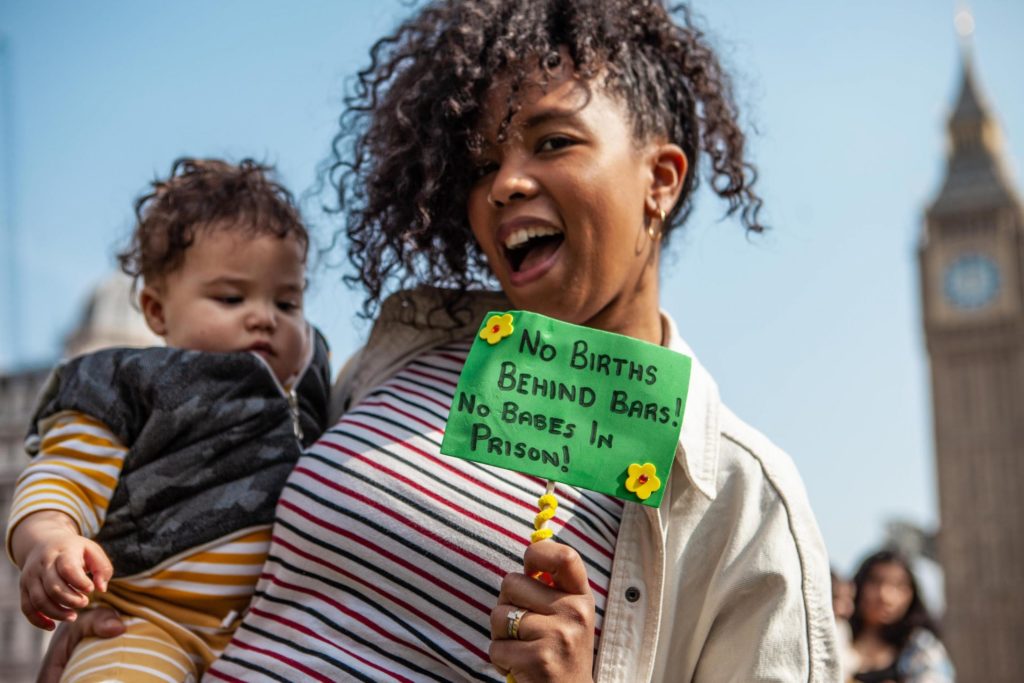
On Monday, 50 babies, and their parents, showed up at Parliament, in London, and demanded an end to incarceration of pregnant women. Level Up, an organization fighting gender injustice, and the campaign No Birth Behind Bars brought the group together. No births behind bars, no babies behind bars, no pregnant people behind bars. No more stillbirths such as those a Styal and Bronzefield in recent years. Between 2013 and 2018, the number of women going through childbirth while serving sentences rose 56%. 10% of those women never made it to a hospital. Most of those women are in for short sentences, involving non-violent offenses, not that that matters.

As Emma Hughes, of No Births Behind Bars, explained, “Nothing has been learned from the horrific deaths of two babies born in jail. Pregnant women and new mothers continue to be imprisoned by UK courts as part of a barbaric and outdated justice system. It is never OK for a baby to be in jail; it is never safe for a woman to go into labour in a cell, and pregnant women and babies in prison are exposed to lethal risks.”

`Anna Harley’ recounted, “When I was six months pregnant with my first child, I stood in court for the first time in my life and heard the words `remanded into custody’. This meant that I would be held in prison for six months as I waited for my trial date … No woman should suffer as I did.” The line connecting Rebecca Figueroa to Anna Hartley is actually a network, and it spreads across the globe.

Janey Starling, co-director of Level Up, concluded: “Prison will never, ever be a safe place to be pregnant. The trauma and toxic stress of the prison environment causes lasting harm to both mother and child. It’s time for the government to end the shameful imprisonment of pregnant women and new mothers, and make sure they are supported in the community instead.”

Why is that so difficult to understand? Ending the shackling of pregnant women, providing nurseries for them and their children, providing actual reproductive health care are all important, but in some sense, they only move us out of the negative. There is no reason to keep pregnant people incarcerated. Period. Prison will never, ever be a safe place to pregnant. Stop incarcerating pregnant women.

We must do more and we must do better than apologize.

(By Dan Moshenberg)

(Photo Credit: Huck Magazine)

In South Africa, the Court decides wealth cannot override the fundamental rights of First Nations Peoples


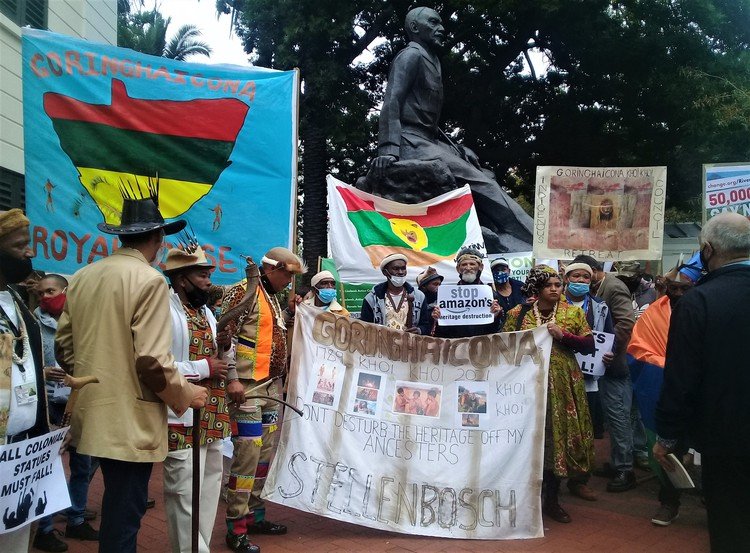
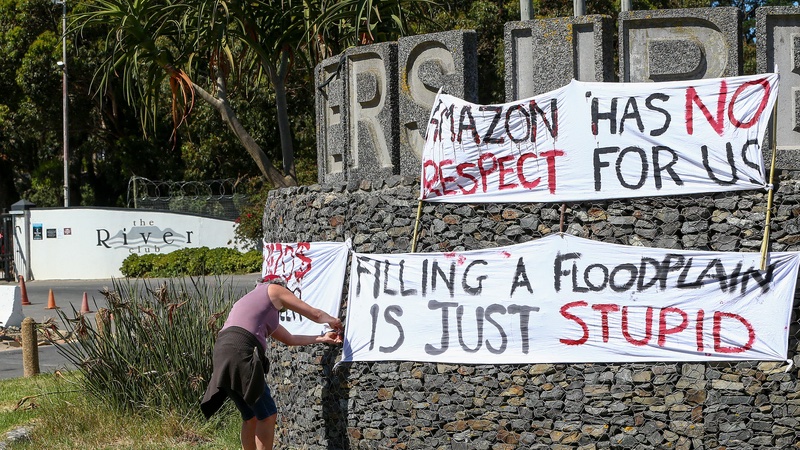
For the past few years, Amazon has said it’s building its new African headquarters in a neighborhood of Cape Town called Observatory. The site, known as the River Club site, is at the confluence of the Liesbeek and the Black Rivers. It’s a flood plain that had been zoned for Open Space and conservation. None of that mattered to Amazon and its partners, who proceeded to purchase property, permits and politicians, and three years ago began development of an urban park filled with ten-story buildings, the Two Rivers Urban Park, or TRUP. That flood plain is also sacred space for the indigenous Goringhaicona Khoi and San First Nation peoples. On Friday, March 18, Western Cape Deputy Judge President Patricia Goliath temporarily but fully stopped all development and construction on the site. Why? The developers failed to consult with the Goringhaicona Khoi and San First Nation peoples: “There had not been meaningful consultation with First Nation groups.” Some version of that statement figures repeatedly throughout the discussion and conclusion.

Judge Goliath’s conclusion begins, “The matter ultimately concerns the rights of indigenous peoples. The fact that the development has substantial economic, infrastructural and public benefits can never override the fundamental rights of First Nations Peoples. First Nations Peoples have a deep, sacred linkage to the development site through lineage, oral history, past history and narratives, indigenous knowledge systems, living heritage and collective memory. The TRUP site is therefore central to the tangible and intangible cultural heritage of the First Nations Peoples. I am of the view that the fundamental right to culture and heritage of Indigenous Groups, more particularly the Khoi and San First Nations People, are under threat in the absence of proper consultation, and that the construction of the River Club development should stop immediately, pending compliance with the fundamental requirement. I am satisfied that the Applicants had established a prima facie right, and a reasonable apprehension of irreparable damage and imminent harm if an interim interdict is not granted. I am further satisfied that the balance of convenience favour the granting of an interim interdict, and is the only appropriate remedy in the circumstances. In my view, Applicants have shown, on the evidence and the law, compliance with all the requirements for interim relief … I am accordingly satisfied that it is constitutionally appropriate to grant an interim interdict.”

The developers tried everything, from creating tension among First Nations Peoples to claiming they had conducted an impartial consultative and review process. None of that worked in Judge Goliath’s court. What mattered was the evidence and, equally, that the dignity of the First Nations People be respected.

In 1510, on the site of the Two Rivers Urban Park, wherein River Club is located, a Portuguese party tried to steal cattle from the Goringhaicona Khoi. The Khoi repelled them. A larger Portuguese force returned, to `teach the Khoi’ a lesson. The Khoi warriors soundly defeated the Portuguese, killing 64 Europeans, including their leader and eleven captains: “This devastating defeat put pause to Portugal’s run of victories in Africa and Asia.” In 1659, on the same site, the First Khoi-Dutch War ended with a resounding defeat of the Khoi. This established the rule of the Dutch East India Company, and began centuries of dispossession, immiseration and enslavement for the Khoi Peoples.

From the first announcement of Amazon’s intention, representatives of the Khoi and San Peoples argued that these specific sites are “holders of memory”. On Friday, Judge Goliath agreed. Khoi, San and their allies are celebrating and preparing for the next stages. As Goringhaicona Khoi Khoin Indigenous Traditional Council Commissioner Tauriq Jenkins said, “We are celebrating at the epicentre of liberation and resistance in defence of our country. We welcome everyone who would like to join us as we acknowledge the halting of the current destruction on the site.” There is no reconstruction without consultation. Spread the word far and wide: Wealth and power cannot override fundamental rights.


(By Dan Moshenberg)

(Photo Credit 1: GroundUp / Marecia Damons) (Photo Credit 2: Leon Lestrade / African News Agency / Weekend Argus)

Hope in the time of choler: Nigeria, South Korea, Guatemala, Colombia, Mexico, Chile

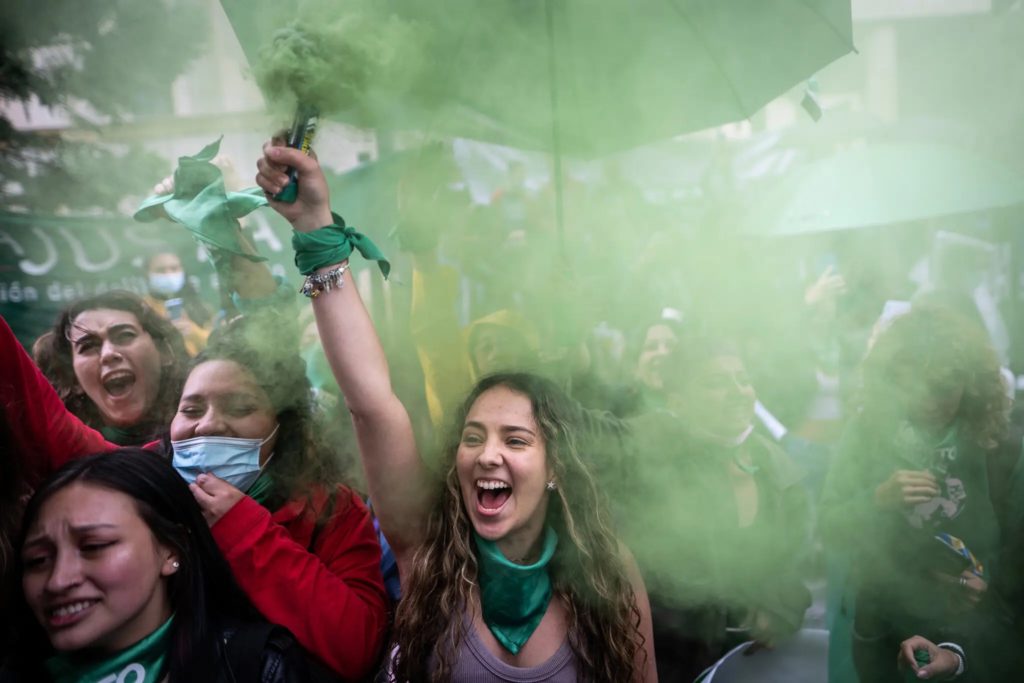
The Green Wave, Bogota, February 2022

Welcome to March 2022, International Women’s Month; welcome to March 8, International Women’s Day; welcome to … the Thunderdome where, amidst all the recognition and all the ceremonies honoring women’s accomplishments and very being, one government, Nigeria’s, rejects Constitutional amendments designed to begin the process of gender parity, equity, equality. Another country, South Korea, elects a new President largely because he’s not only misogynist but explicitly anti-feminist. In a third country, Guatemala, on March 8, the legislature passed a law which extended the prison term for terminating a pregnancy from three to ten years, banned the teaching of sexual diversity, and, for good measure, in the name of the “protection of life and family”, banned same-sex marriages. So, basically, we’re not in Kansas anymore. We’re in Texas. Welcome to the Thunderdome.

On Sunday, the newly elected President of South Korea reiterated his determination to eliminate the Ministry of Gender Equality and Family. He argued, first, that the work of the ministry had been completed. There was complete and total gender equality in South Korea. No matter that employment numbers, prior to the pandemic and even more, paint a different picture. No matter that violence against women and non-binary people is on the rise. What really matters is that `feminists’ have gone too far, and that’s the reason the new President is shutting the machinery, such as it is, down. It’s also a reason he was elected. He campaigned explicitly as an anti-feminist, who argued that gender based quotas stand in the way of “national unity”; that feminism caused South Korea’s low birth rate; that women falsely report sexual violence, and they must be punished, severely. Exit polls suggest that men in their 20s and 30s voted overwhelmingly for the anti-feminist.

These are grim times. But they are not without hope. There is light, there is real and serious opposition in the Thunderdome.

February ended with a landmark decision in Colombia decriminalizing abortion and setting the stage for the government to go further to codify and secure women’s access to reproductive health services as well as to dignity and autonomy. This victory in court was the product of numerous women’s organizations and movements doing the arduous, and joyful, work of reaching out and reaching in, of engaging with all parts of the society, with demanding while also educating while also learning. This is part of the great Green Wave that is surging across Latin America. It is also part of the electoral politics of Colombia, and so it is worth noting that in yesterday’s primary elections, leftist candidate Gustavo Petro has taken a resounding lead. The elections are in May. Further, on March 8, the Congress of Sinaloa, a state in northwest Mexico, decriminalized abortion.

And speaking of elections, in December, Chile elected 36-year-old, leftist, pro-feminist Gabriel Boric to be President of Chile. Boric is the youngest person to ever hold that position. Perhaps more importantly, he won with the largest majority ever recorded in a Chilean election. On Friday, March 11, Gabriel Boric was sworn in. He stood with his progressive, majority-women Cabinet by his side. Bread and roses, words and deeds. Hope springs in the place that served as the proving ground for neoliberal devastation, and not only for Chile, for all of Latin America and beyond. Even now, even here, there is hope and optimism, being found, being made.

Chile


(By Dan Moshenberg)

(Photo Credit 1: Nathalia Angarita / New York Times) (Photo Credit 2: Carolina Pérez Dattari / Open Democracy)

Indiana banned shackling incarcerated people in childbirth … `with certain exceptions’

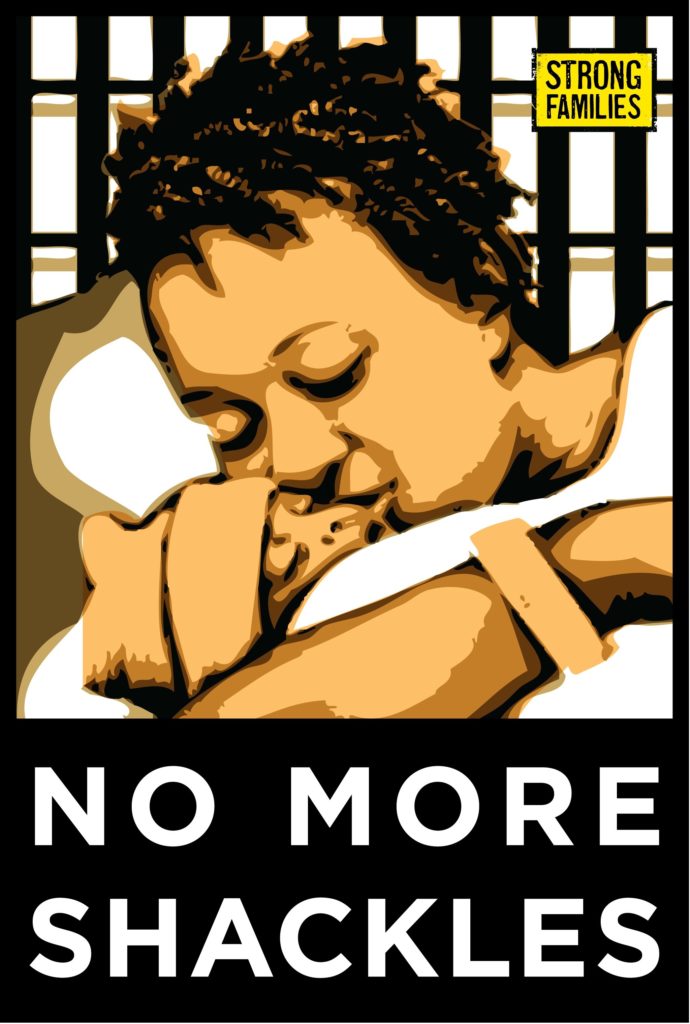
On Thursday, May 10, Indiana’s Governor Eric Holcomb received a bill, passed unanimously by both the Indiana House and Senate, concerning the “restraint of pregnant prisoners”. The Governor had until May 17 to sign the bill into law. He signed it immediately. The bill’s digest reads: “Restraint of pregnant inmates; pregnancy from certain sex offenses. Provides that a correctional facility, including a jail, shall: (1) use the least restrictive restraints necessary on a pregnant inmate when the pregnant inmate is in the second or third trimester of pregnancy; or (2) use no restraints on a pregnant inmate who is in labor, delivering a baby, during the immediate postdelivery period, or dealing with a medical emergency related to the pregnancy, with certain exceptions. Repeals the current statute concerning prenatal and postnatal care and treatment and incorporates it into the new chapter concerning pregnant inmates.” On Thursday, Indiana joins the District of Columbia, 31 states and the U.S. Federal government in limiting or banning the shackling of pregnant incarcerated people.

While this is welcome progress, the question of implementation and enforcement, not to mention why it’s taken this long and what’s going on with the remaining states, looms large, in at least two ways. “With certain exceptions” and enforcement, more generally.

Why do almost all the laws include exceptions? On one hand, it’s conceding to prison staffs and in particular prison staff unions. Who will decide that an exception is warranted? Again and again, we have seen doctors, nurses and other health providers object to the use of restraints on pregnant incarcerated people, and each time, the doctor was rebuffed by a member of the prison or jail staff. There simply is no reason to shackle or otherwise restrain a pregnant person, a person delivering a baby, in labor or immediately postdelivery. At a time when the use of shackles on juvenile incarcerated people and on incarcerated people in court is being debated and, in some places, banned, again `with certain exceptions’, it’s time to find more opportunities to codify “with no exceptions”.

This leads to the second issue, enforcement. Remember the case of Jane Doe, in New York, in 2018? In 2009, New York outlawed the use of physical restraints on pregnant women during labor and delivery. In 2015, New York outlawed the use of physical restraints on pregnant women during in-custody transportation and the eight-week postpartum recovery period. Despite nine years of having banned, “physical restraints” on pregnant women during labor and delivery, in February 2018, Jane Doe was forced to undergo labor and delivery while her ankles were shackled and her wrists were handcuffed to the bed. Who did this? The New York Police Department. Why? Because they could. Because she was already a Jane Doe, as far as they were concerned. That was February 2018. In December of that year, a second woman suffered the identical abuse. New York City settled with the second Jane Doe last year, four years later, for $750,000. The officers faced no discipline whatsoever.

In 2020, a woman was shackled in childbirth in Minnesota. Minnesota had passed its own anti-shackling and pregnancy needs laws in 2015. How many more times must we hear or read this story?

The history of shackling pregnant incarcerated people in the United States is the ongoing history of slavery. While we remove statues and rename schools and other institutions, we should end the shackling of all incarcerated people, beginning at the very least with pregnant incarcerated people. In 2011, Christina Kovatswas incarcerated.  A week after her arrest, she discovered she was pregnant. She was shackled during and after delivery. As she explained to the Indiana legislators, “It’s the most painful and traumatic thing that I can recall. I had nightmares. I still do have nightmares.” Eleven years later, she still has nightmares.

How many more times must we hear or read similar accounts before we take real action? It’s time to bring slavery to an end. End the shackling of incarcerated pregnant people, end the shackling of all people. Do it without exceptions.

(by Dan Moshenberg


(Image Credit: Radical Doula) (Image Credit 2: New York Times / Andrea Dezsö)


Thank you, Paul Farmer, for all you came here to do and did so exceptionally well!

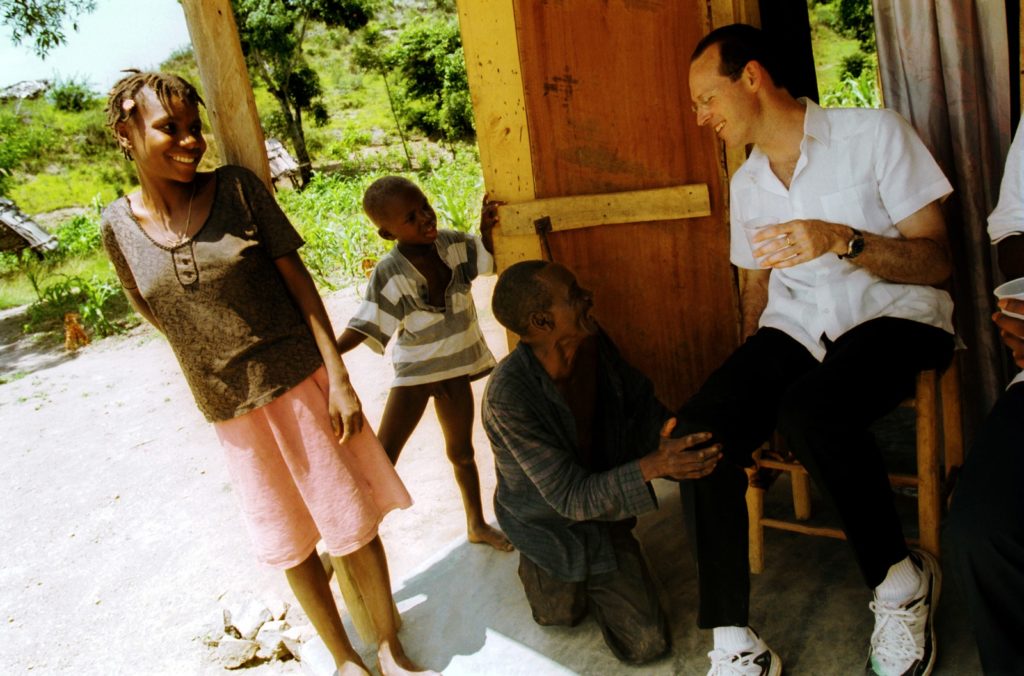
Those who know his work and its significance for understanding why despite (and because of) all the technologies and knowledge and money and means, so many people are sick, suffering and dying before their time will be devastated to hear about Paul Farmer’s death.

Being born and raised in a Black working-class family, in a society like ours, one does not need to be taught about inequity, let alone health inequity, how it is produced and shapes lives. The nature of societies has always fascinated me, as did the interplay between societies and the power contestations that shape the socio-political stratosphere called “the global”.

I studied a few “ologies” at varsity hoping they would help explain how mine and my society’s lived experience got to be what it is. Some of it helped. Some of it left me feeling like I was being sent to the North Pole on a boat sailing on dry land.

I came across Paul Farmer’s writings at what I felt was late but in the end was just the right time in my life. Among others, his Pathologies of Power; Infections and inequalities; and To Repair the World became the texts for the missing answers in my own journey as a social justice activist and leader. He helped me link the dots in ways that enriched my concept of social justice and why there can be no greater pursuit in life. I didn’t know him well at all. The few times I met him (no I never focus on taking photos when I meet people, a real flaw in my life), I was surprised how simple and understated he was, until he spoke. I loved how dedicated he was to elevating people, never making one feel diminished in his presence like some famous are wont to do.

Some people need to live.

But at minimum, with each passing of a great person we need to ask, what is it that needs to die for us to live.

I woke up with this haunting question this morning. Thank you, Paul Farmer, for all you came here to do and did so exceptionally well!

Because you did, the mission of global health equity gets to have a long lifespan!

Thank you!


(By Siphokazi Mthathi)

(Photo Credit: Gilles Peress / The New Yorker)

Covid Operations: Rebecca “Maria” Adams, Juanita Haynes, and Bree Eberbaugh asked for compassionate release. It never came.

Alderson Federal Prison Camp is the oldest federal women’s prison in the United States. Founded in 1927, Alderson was meant to serve as a model of “reform”. Ten years ago, it became famous, or infamous, for housing Martha Stewart for a while. At that time, it was reputed to be one of the best prisons for women in the country. And what did that model of the best look like? “Overcrowded, understaffed, and short on funds … It now follows a punitive rather than a rehabilitative model …  There’s intimidation, humiliation, and sexual harassment … a symbol of all that’s wrong with how the criminal justice system deals with women.” Ten years or so later, what’s Alderson? “Covid-19 rips through West Virginia women’s prison as federal agency takes heat”. This is the story of compassion in the covid carceral. The is the story of Rebecca “Maria” Adams, Juanita Haynes, and Bree Eberbaugh, three women who very reasonably asked for compassionate release. It never came, and, within one week in January, they died. There is no “heat” that can bring them back or bring justice for them or their loved ones.

Rebecca “Maria” Adams, Juanita Haynes, and Bree Eberbaugh’s collective list of preexisting medical conditions included Type 2 diabetes, hypertension, congestive heart failure, obesity, and chronic obstructive pulmonary disease. Any one of those should have qualified. Adams was denied. Eberbaugh was denied. Juanita Haynes was “granted release”, when she was already intubated. She died four days later. Because she died in hospital, a `free woman’, her death is not counted as a prison fatality by the Federal Bureau of Prisons. Alderson Federal Prison Camp is indeed a model, as is FCI Waseca, another low-security federal prison for women that functions as a death trap.

In March 2020, Bree Eberbaugh applied for compassionate release. In August, she was denied. The judge said the cases were too few to warrant compassionate release. As of February 8, Alderson, with fewer than 700 `residents’, reported 50 cases. Many assume the numbers of both cases, and, given what happened to Juanita Haynes, deaths is considerably higher. Eberbaugh appealed that decision. In April 2021, the appeal was denied. Nine months later, Bree Eberbaugh died.

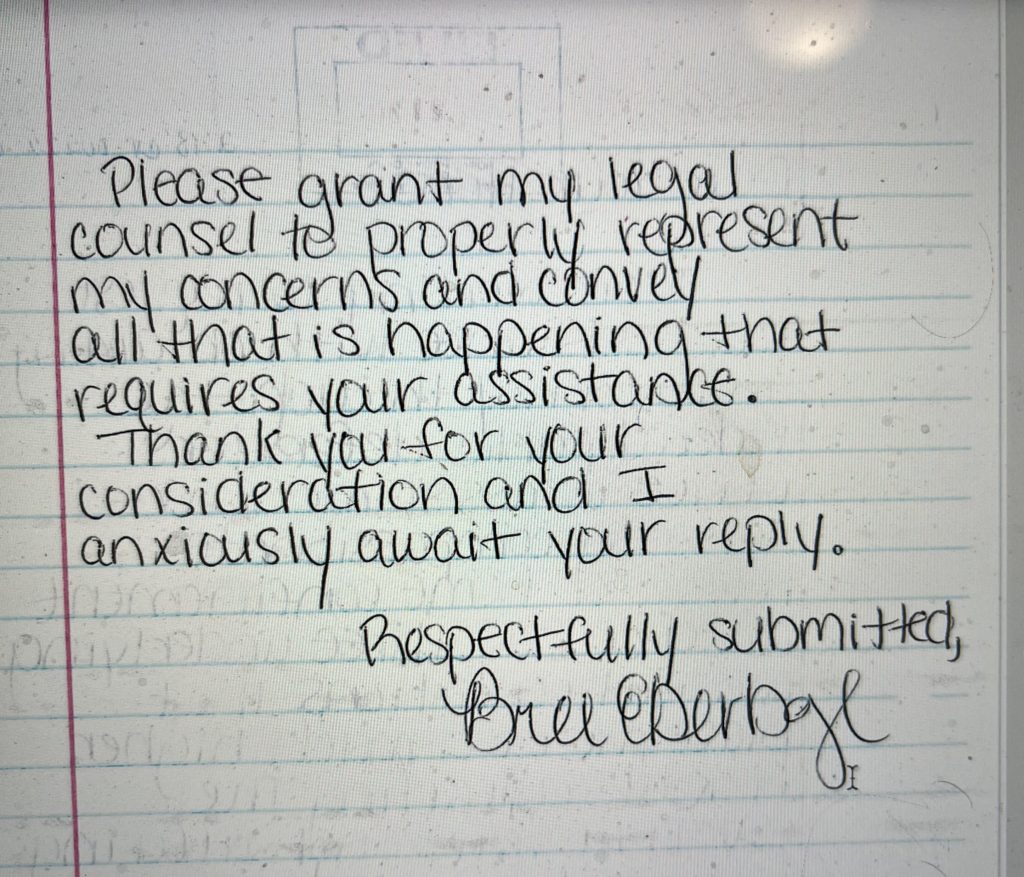
This is the text of the handwritten letter Bree Eberbaugh wrote to the judge after the first denial:

“Dear Your Honor:

I am writing to request your assistance to obtain an attorney through the federal public defender’s office to assist me with pursuing compassionate release or home confinement based on my three underlying medical conditions that place me at a much higher risk of contracting the COVID-19 virus and suffering irreparable medical damage or loss of life.

COVID-19 has been confirmed in 114 of the 122 facilities in the BOP, yet the BOP is opening the facilities up to accept transfers from other institutions. Your Honor, it is only a matter of time before it reaches here and I am in fear of my life.

Please grant my legal counsel to properly represent my concerns and convey all that is happening that requires your assistance.

Thank you for your consideration and I anxiously await your reply.

Respectfully submitted,
Bree Eberbaugh”

Incarcerated people in federal and state prisons are twice as likely to die of Covid as the general population. The situation in jails is presumed to be worse, but there’s no data as of yet. When the pandemic is over, will we recall Rebecca “Maria” Adams, Juanita Haynes, and Bree Eberbaugh, three women who asked for compassionate release that never came? Will we remember compassion itself?


(Photo Credit: Kaiser Health News / LJ Dawson)

From Yvonne Farrell to Nzinga King: The State’s war on Black women bodies continues

Nzinga King

In July 2021, 19-year-old Nzinga King was taken into custody in rural Jamaica, pepper sprayed, and then, while in custody, was forcibly subjected to having her hair cut. After some public outcry, an internal investigation was launched … sort of. The results came out this past week. According to the Director of Public Prosecution, it was all fine. In August 2018, 50-plus-year-old Yvonne Farrell was in her partner’s car in Stevenage, about a half hour north of London, when the car broke down. When the police arrived, with the tow truck, Yvonne Farrell refused to give her name. She saw no reason to. The police took her in. Since she didn’t give her name, they stripped her naked and left her on the cell floor for three hours. Yvonne Farrell sued, and last. Week, the police apologized and paid £45,000 in damages: “I accept that you should not have been arrested. I am extremely sorry for any injuries that you suffered as a result of the actions of Hertfordshire Police. On this occasion we got it wrong. I apologise unreservedly.” Nzinga King and Yvonne Farrell are Rastafarian women … unreservedly.

Nzinga King was travelling with friends in a taxi. Some were not wearing masks. Nzinga King was wearing a mask. The police stopped the car to question those not wearing masks. The police pepper sprayed some in the car. Nzinga King got out and started arguing with the police. She was arrested for disorderly conduct. On July 22, she received a $40 fine or 10 days in jail. She couldn’t pay the fine, and so went to jail, where a police officer cut her hair. As Jamaican journalist Emma Lewis noted this week, Nzinga King “had several counts against her from the start”: She is young. She is Black. She is poor. She is Rastafari. She is a woman. She is a rural dweller. With all that, Nzinga King should consider herself lucky to have been `merely’ humiliated. Right?

Yvonne Farrell is not young, poor or a rural dweller. She is Black. She is Rastafari. She is a woman. And she knows that and she knew that, and she knew that to be criminalized for the nexus of Black, Rastafari, woman is unjust. As Yvonne Farrell explains, “I could have been a Jewish woman. I could have been a Muslim woman … That just shows they wanted to humiliate me – they did humiliate me.” Yvonne Farrell has since `relocated’ to somewhere in the Caribbean.

Two years ago, in 2020, in London, Ruby Williams won an out-of-court settlement of £8,500 for the abuse she suffered, for wearing her hair in an Afro, for Being Black, from the age of 11 years old on. Two years ago, in 2020, Jamaica’s high court ruled that a school was within its rights to tell a 5-year-old girl student, identified as Z, that she must cut her dreadlocks or leave school.  By all accounts, she was an excellent student. By all accounts, she had not in any way prevented others around her from pursuing their education. To the contrary, she was described as an ideal student and learner who helped her fellow students. But Z’s desire to learn was deemed Constitutionally inferior to the politics of Black girls’ hair. Two years later, Yvonne Farrell and Nzinga King lock arms with Z and Ruby Williams. Compensation is not enough, apologies won’t do. Meanwhile, the State-sponsored war on Black women bodies continues.

Yvonne Farrell


(By Dan Moshenberg)


(Photo Credit 1: Petchary’s Blog) (Photo Credit 2: BBC)