Pennsylvania built a special hell for Miriam White

Yesterday, Ellen Melchiondo reported on a visit to the Restricted Housing Unit in SCI-Muncy, a women’s prison in Pennsylvania. She noted, “In one of the pods is confined Miriam White, who in 1999, at the age of 11, stabbed a complete stranger to death in Philadelphia. Miriam was sent to various institutions before landing in Muncy. I could barely see Miriam through her window, because on it, she was finger painting with her feces, slowly, deliberately and trance-like.” Here is Miriam White’s story.

On August 20, 1999, eleven-year-old Miriam White argued with a cousin. Miriam then grabbed a knife and ran out of her South Philadelphia foster home. She ran down the street, passing some children, turned the corner, and saw Rosemary Knight, fifty-five years old. Miriam ran up to Rosemary Knight and stabbed her in the chest. Rosemary Knight died on the spot.

Rosemary Knight was a hairdresser and the principal wage earner in her household. August 20, 1999, was the twenty-seventh wedding anniversary of Rosemary and Jerome Knight. Miriam did not know Rosemary Knight.

Miriam White was a young “troubled” Black girl. Her infancy and earlier childhood was one of violence and abandonment, followed by a succession of institutionalization and foster homes. In February 1995, Michelle White Stevens took in the then-seven-year-old Miriam and her two younger siblings. In 1999, Stevens adopted the children. By all accounts, the house was a loving household.

Miriam White progressed and crashed, progressed and crashed. She has been diagnosed with severe mental illness and severe intellectual disability.

According to Miriam White, she wanted to hurt someone so that she would be sent back to a juvenile institution. She was careful not to attack children. After she stabbed Rosemary Knight, she ran to nearby hair salon, “trembling and begging for help because she had just stabbed someone.”

Up to this point, the story of Miriam White and Rosemary Knight, and all those around them, is tragic. Then it gets worse.

Pennsylvania is one of the few states in which anyone charged with first-degree murder must be tried as an adult. That includes eleven-year-old Miriam White. So Miriam White was placed in solitary in an adult jail while the adults tried and failed to figure something out. The judge tried and failed to find a compromise. The defense attorneys tried and failed to argue for reason. As her attorney argued, “Who, judge, at Muncy is going to take young Miriam through her first menstrual cycle. . . . The older, nurturing inmates?”

And so, in August 2007, Miriam White, eighteen years old, pleaded guilty in adult court to third-degree murder and possession of an instrument of crime, and was sentenced to 18 to 40 years. According to some legal scholars, it’s doubtful that Miriam White is competent to take a plea or anything else in court.

Miriam White’s “case” is littered with fine language. She “haunts” the criminal justice system. The initial judge’s ruling concluded, “I cannot exonerate Miriam just because I feel sorry for her. I cannot return Miriam to juvenile court just because her life story makes my heart weep. My oath as a judge requires that I decide this case on the basis of the proofs in court. The decertification petition is denied.” Miriam White’s case is “tragic” as it is “heartbreaking.”

That’s how the story is told, but not how the life is lived. Today, sixteen years and two months later, where is Miriam White? “I could barely see Miriam through her window, because on it, she was finger painting with her feces, slowly, deliberately and trance-like.” Justice is served, humanity denied.


(Image Credit: Martin Vargas / Solitary Watch)
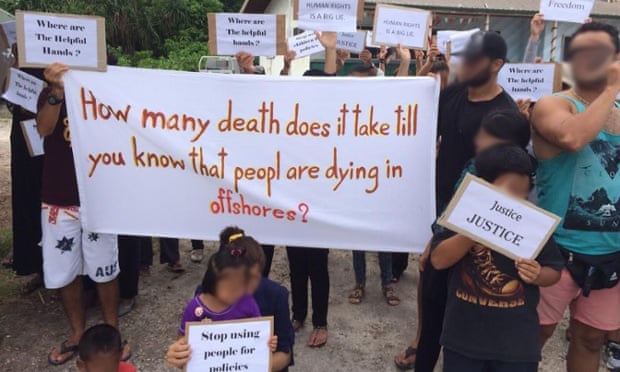
Australia is “shocked” by the routine torture of women and children asylum seekers

Australia routinely throws asylum seekers into prisons, mostly in remote areas or, even better, on islands, “an enforcement archipelago of detention … an archipelago of exclusion.” The gulag archipelago didn’t end; it became the intended end-of-the-road universe for asylum seekers and refugees. Last year, Australia was “shocked” by reports that children represent the greatest percentage of self-harm and suicidal behavior. Now, Australia is “shocked” once again to find that sexual violence against women asylum seekers and refugees occurs. Australia is shocked … but not shamed.

The incidents this time involve three women, two Somali and one Iranian woman. The Iranian is in hospital. One of the Somali women is pregnant as a result of the rape. It took the police four hours to arrive, and then … pretty much nothing happened. None of this is new or surprising. In July, the Immigration Department heard again of rampant violence against women and children, and then … pretty much nothing happened. Advocates Pamela Curr and Daniel Webster know that these three women are “the tip of the iceberg.” Despite the State trying to keep the media away from its penal colonies, none of this is secret or surprising. A week ago, the mother of the Iranian woman, despondent at the entirety of the situation, attempted suicide. Apart from placing under surveillance, under the guise of a suicide watch, nothing changed.

Pediatricians in Melbourne are organizing, refusing to send children back to detention centers, because the situation is so dire. The situation was always dire. It was meant to be. Study after study suggests that the problem of health care for asylum seekers in detention is not inadequate health care. The problem is detention. Study after study shows that children in detention breathe sadness and fear, trauma, that will stay with them, for many forever.

The news this weekend is that the Somali woman may be brought to the mainland to receive an abortion … and then what? Nauru said it would process everyone within a week and now backtracks on that. Australia is planning on moving some or all of the asylum seekers and refugees on Manus Island to the Philippines, and none of the refugees or asylum seekers has a heard a word about this from the State. Across Australia, many marched this weekend to protest the treatment of refugees and asylum seekers.

This is democracy in the current world order. To ask for help is to give up citizenship. If you are a woman and you ask for help, you give up your humanity. The gulag archipelago never left. It became the democratically elected global archipelago.


(Photo Credit: The Guardian)

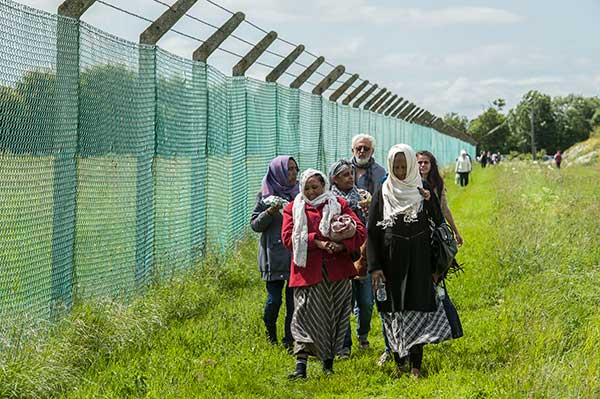
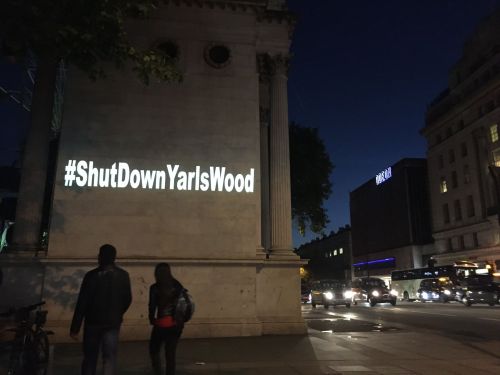
Welcome to Yarl’s Wood, the UK’s special hell for pregnant women


We have been here before … too often: “The Home Office has offered a formal apology and will pay compensation to a pregnant asylum seeker who was unlawfully arrested and detained at Yarl’s Wood immigration removal centre.” The woman, known as Ms PA, is Congolese. The horror of Ms. PA’s story is that there is no horror in the familiar. Ms. PA was one of 99 pregnant women held in Yarl’s Wood last year. The Home Office has apologized to Ms. PA. The other 98 women must just wait. The horror of Ms. PA’s story is that it is typical.

On February 3, 2014, Ms. PA was arrested, without notice, held for ten hours and then shipped eight hours to Yarl’s Wood. She was four months pregnant at the time. She told the officials she was due for her 20 week scan, and nothing happened. During her month in Yarl’s Wood, she was seen, once, by a midwife, and that was the sum total of her health care.

None of this was hidden. The Guardian interviewed Ms. PA while she was in Yarl’s Wood: “I am very worried about what is happening to my baby. I feel like I am being treated like a criminal here although I have not committed any crime.”

What crime did Ms. PA commit? The crime of being immigrant, African, woman, pregnant, each and all of these combined?

Now the Home Office says what it must. It apologizes. It will investigate. It will … do absolutely nothing.

Worse than nothing, it will continue to imprison pregnant women in open violation of its own policies, and with complete impunity. Last year, Richard Fuller, a Member of Parliament, inquired as to the situation of Ms. PA and three other women. Here’s what happened: “December of last year I had a letter from the Immigration Minster saying that he had asked Serco who were then in charge of Yarl’s Wood to look into these four case and he was assured that an independent health assessment said that there was no problem with their healthcare, that has now been contradicted in court.”

He was assured. Despite reports from the Chief Inspector of Prisons; Medical Justice; Channel 4; and testimony after testimony after testimony after testimony by current and former Yarl’s Wood prisoners, he … was … assured.

Many are now calling for the Home Office to apologize to all the pregnant women it has thrown into Yarl’s Wood. While a good call, that would not begin to arrive at the zero point of justice. Compensation to the women and to their children would also be a good move, and would also leave the nation, and justice itself, in the hole. The threat of Yarl’s Wood remains as long as Yarl’s Wood remains open. The pain of Yarl’s Wood remains as long as Yarl’s Wood remains open. Shut down the whole enterprise and apparatus now. Otherwise, he will always be assured, and she will always suffer harm and injustice. #SetHerFree #ShutYarlsWood Shut it down … now.

(Photo Credit: Socialist Worker / Guy Smallman)

“My rape was awful. But the way the police handled it was even worse.”


On Sunday, February 27, Buzzfeed reported at length on the story of Lara McLeod. It’s a devastating, all too familiar story. In brief, Lara McLeod was raped by the fiancé of her sister, Hera McLeod. Hera had given birth two weeks earlier. Traumatized, Lara went home and, the next day, told her parents. They immediately went and retrieved Hera and Prince, the two-week-old. To do that safely, they called the police in. That’s where the awful became the unbearable.

The police called Lara in, interrogated her, compelled her to file a complaint and then arrested Lara for filing a false complaint and charged Hera with aiding in the deceit. From there, it just gets worse. You can read the Buzzfeed account for yourself. The rape and arrest occurred in 2011. Using the charges against Hera, her fiancé won unsupervised visits. Three months later, Prince was found unconscious on his father’s apartment floor. The fifteen-month-old died the next day. The fiancé’s trial on murder is coming up soon. Hera has moved on, as best she can. Lara is struggling.

This story occurs in the leafy well-to-do suburbs of Prince William County, in the Virginia suburbs of Washington, DC, but it could as easily occur in the leafy suburbs anywhere. Every step of the way, every single time the State was called in, from the police to the courthouse, the State did more than merely fail these two women. It assaulted them. A French report on this case notes that in France, of women who report being survivors of sexual violence, only 4 percent have reported the crime formally. In the United States, the situation is the same. In South Africa, according to the Medical Research Council, one in nine rapes are reported to the police.

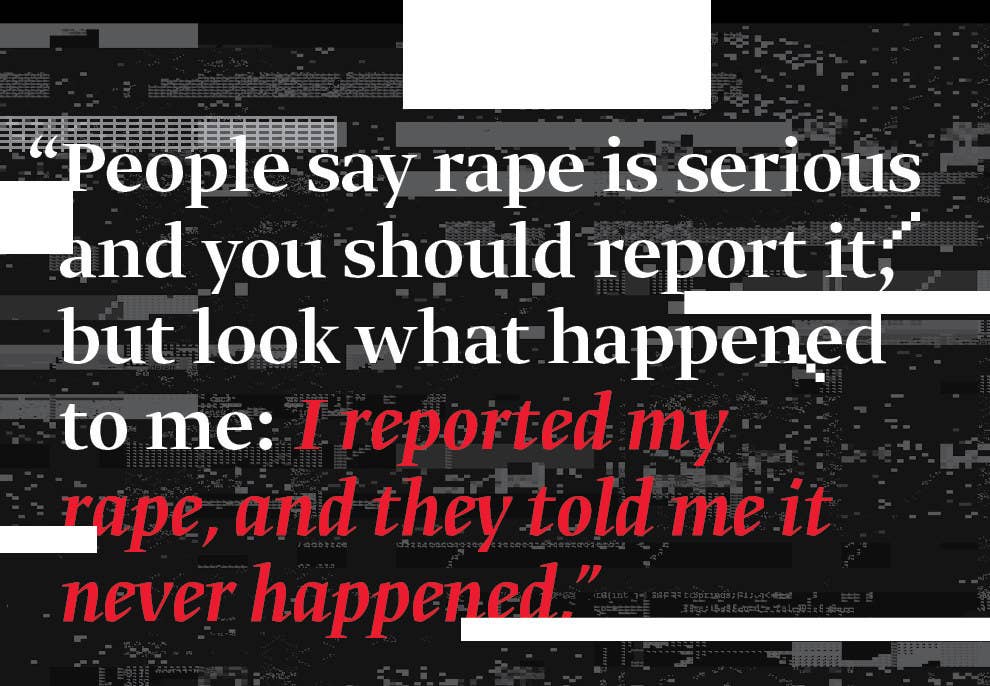
Why are the numbers so low? There are many reasons. Here’s Lara McLeod’s answer, “The night I was raped, I said I wanted to be left alone. People say rape is serious and you should report it, but look what happened to me: I reported my rape, and they told me it never happened.”

Buzzfeed and others have described the police investigation as “botched.” It wasn’t. Virginia, and beyond it the State, got exactly what it wanted, what it pushes strenuously to get: a woman living with trauma, agony and pain who has learned to silently absorb injustice directed at her as a woman. To botch means to clumsily repair or to bungle. No one clumsily repaired or bungled the investigation. No one cared enough to botch the investigation. How do I know?

Every year, on Prince’s birthday, Hera McLeod sends a letter to the two Prince William County police officers whom she holds responsible for the death of her son: “This year, she included a photo of Prince with his two front teeth in, smiling and sitting on a red truck — with his birth and death dates printed above. `On July 1st, 2015, I would have turned four,’ the card said. `May you always remember how the decisions you make impact the lives of innocent people. I will never forget you. I pray you will never forget about me.’ This year, Kimberly Norton, one of the two officers who charged the McLeod sisters, put the card in a new envelope and mailed it back to Hera unopened. She rewrote her return address in block letters. Not Detective Norton, as Hera had written, but “SGT K. NORTON.” She had been promoted. So had Detective Cavender.”

The State got what it wanted. It’s time for us to get the State we want.


(Image Credit 1: Buzzfeed) (Image Credit 2: Slate.fr)

Hamba kahle Nomthandazo Loliwe. Walk in peace.

Nomthandazo Loliwe died last week, although perhaps she died much earlier. The story of her death, barely told, is covered in silence. Only one news venue reported it, and only once.

Here is the story of Nomthandazo Loliwe’s death in its entirety, as reported last Friday: “A Western Cape woman facing two assault charges dropped dead in the holding cells of Cape Town Magistrate’s Court after reporting she had not eaten for three weeks. The Independent Police Investigations Directorate (Ipid) opened an inquest into the mysterious death of Nomthandazo Loliwe‚ 26‚ of Delft‚ on Friday afternoon. Ipid said Loliwe died whilst in the court cells after she appeared on two separate charges of assault. She was arrested and detained at Woodstock Police Station. Spokesperson Langa confirmed the incident‚ saying Loliwe was brought (on Friday morning) to the court and‚ at about 10.30‚ she complained to the police of feeling sick. `The ambulance was called and paramedics examined her‚ but didn’t find anything wrong with her and left. She appeared and after her appearance was taken back to the court holding cells where she collapsed at about 12.30 and was later thereafter declared dead by paramedics‚’ she said. Langa said their investigation has not suggested any foul play. She said Loliwe’s fellow detainees confirmed the deceased collapsed and died in the cell. `She also allegedly reported to them that she hasn’t eat anything for about three weeks‚’ she said.”

That’s it, 192 words. That’s the value of a woman’s life these days. Nomthandazo Loliwe told her sister detainees that she had not eaten for three weeks. She probably told others as well. Whether or not Nomthandazo Loliwe had actually not eaten for three weeks or two weeks or one hour is irrelevant. What matters is that she said she hadn’t eaten for three weeks, and that should trigger something, something called compassion or concern. But no one listened, though many heard.

No one listens to the women who talk of hunger, pain, desperation, despair, fury, rage, love, shelter, vulnerability, illness. The Daily Maverick today reports, “If there is a state all human beings understand it is that of hunger. While those of us with the means and access to food often glibly remark “I’m starving”, there are millions in the world who literally are and who find themselves in regions where food security, due to a variety of environmental, political and socio-economic issues, is critical or non existent. This month a food producer accredited by the United Nations Children’s Fund, a partnership between Norway and South Africa, officially opened in Cape Town, revealing that while hunger may take from some, it gives to others.”

No one gave to Nomthandazo Loliwe, and that is a shame we all share. Hamba kahle Nomthandazo Loliwe sala kahle. Go well; stay well. Go gently. Walk in peace. Perhaps in your next journey you will find humans who care, who offer food and shelter, because you certainly did not on this earth.

(Image Credit: Robert Motherwell / MOMA)


In Burkina Faso, women continue the spatula uprising. The struggle continues.


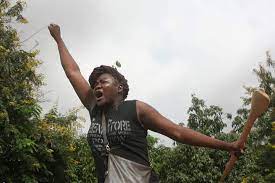
Last October, Burkinabé women picked up their spatulas and took to the streets, calling for the end of one-party and one-man rule. As women and as members of Balai citoyen, Citizen Broom, they charged the State with “a constitutional coup d’etat.” And they won, and ever since they’ve been organizing. On Wednesday, the military took control of the government, and the women have kept on organizing. Once again, they have taken to the streets, spatulas in hand.

Unable to organize in Ouagadougou, the women brought broomsticks and spatulas to the streets of Bobo-Dioulasso, the second largest city of Burkina Faso and the country’s economic capital. Once again, they demanded a clean sweep. Once again, women inspired others to principled, militant action.

Saran Sérémé, president of the Party for Development and Change, noted, “We must fight for the nation’s well being and for justice. The Burkinabé people are ready to defend ourselves, whatever the cost. We find the situation deplorable. We will not bow down to anyone.”

In Bobo-Dioulasso and across Burkina Faso, the women agree. They will not bow down, and they will stir the pot. In October of last year, hundreds of women marched, chanted, carried spatulas, and sparked an uprising, a spatula uprising. On Tuesday, tens of thousands marched in the streets. On Wednesday, a general strike was called, and soon after, the regime was swept out of power. The women did not put their spatulas away and they did not forget how to use them. The struggle continues.

Burkinabé women know the struggle continues. Women like Joséphine Ouédraogo, Genevieve Zongo, Mariam Sankara, and thousands of others know how to maintain the long march and the short sprint to democracy, while across Burkina Faso women hold on to their spatulas.


(Photo Credit 1: Twitter)

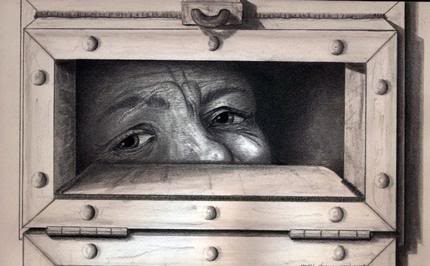
Yarl’s Wood’s “appropriate vulnerability” is violence against women

Every year or so, a new report uncovers the programmatic abuse of women asylum seekers in Yarl’s Wood. In 2006, Black Women’s Rape Action Project (BWRAP) and Women Against Rape (WAR) released Misjudging rape – Breaching Gender Guidelines and International Law in Asylum Appeals, which examined 65 rulings by immigration judges. The judges rejected rape claims in 65% of the cases, arguing each woman had failed to mention the rape early on and so must be lying. Since then, the reports have continued, and each shows the situation has, if anything, worsened. If everything stays the same, or declines, what’s new?

“Appropriate vulnerability.”

The most recent study, “Reason to disbelieve: evaluating the rape claims of women seeking asylum in the UK”, finds “the structural and practical obstacles faced in establishing credibility, and the existence of scepticism about rape claims and asylum-seeking more generally, mean that decision-making can often be experienced as arbitrary, unjust, uninformed or contradictory, making it difficult for women asylum applicants who allege rape to find refuge in the UK.”

In a more popular article this week, the author’s explained, “The structure of the asylum system, as well as working cultures around decision-making, can negatively impact women whose asylum claims involve rape allegations. Evaluations of credibility are often influenced by dubious assumptions regarding culture, gender, and sexual violence, and draw upon limited experience of, or empathy with, the peculiar challenges faced by ‘others’. The structural and evidential demands of the asylum process, as well as the political controversies that it attracts, do little to facilitate improvements in the handling of disclosures of rape. Ultimately, success in securing refugee status continues, for too many women, to depend upon their ability to position themselves as ‘appropriately’ vulnerable victims.”

Though grim, the report is in no way surprising. We know that asylum seekers who have been raped must struggle for justice, and, more often than not, don’t get it. We know that such is the case for women generally, and so even more so for the poor and the stranger in our midst. We know the misogyny that informs dismissal of claims of sexual violence. We know that the State and Civil Society built and maintain Yarl’s Wood, where survivors of sexual and domestic violence are not only routinely but brutally denied care services, as are their children, children who have often witnessed the violation of their mothers. We know that from before the beginning to beyond the end, the conditions are designed to further violate women asylum seekers, “this is a journey haunted by silence.” None of this is new, none of this is news, and we know and have known all of it for some time now.

“Appropriate vulnerability” suggests much more than “the treatment of those who come to the UK seeking protection from sexual abuse often remains inadequate.” It’s not inadequate. It’s designed to brutalize women. It is time; it is way past time, to stop analyzing the brutality of Yarl’s Wood as a lack or absence. The State wanted, and wants, a house of non-national women held in a state of perpetual and intensifying violence, and it built it, named it Yarl’s Wood, and called its light Day and its darkness Night, and behold …

Who aspires to “appropriate vulnerability”? No one should, but the State forces women to do so. We have had enough reasoned and balanced reports. We know it is time to end State violence against women, committed in our names. Do it now! #ShutDownYarlsWood #SetHerFree


(Photo Credit: CavaSundays) (Woodprint by Jacob Steinhardt, at Velveteen Rabbi)

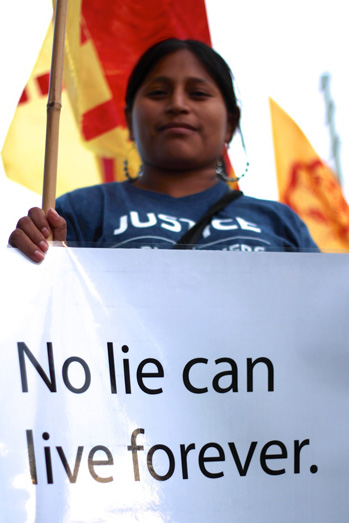
From Kerala to Florida, women farm workers are organizing and winning!


Around the world, women farm workers are on the move, organizing and gaining ground for women workers everywhere. This past week, women farm workers in Kerala, in India, and Florida, in the United States, won major victories. In Kerala, tea plantation workers, all women, rejecting the direction of male dominated unions and political parties, went on strike and won! In Florida, undocumented women farm workers rejected the business-as-usual of sexual exploitation … and won! Women farm workers are turning the common sense of global food chains into global food networks and communities.

In July, the Great Place to Work Institute and People Matters rated Kanan Devan Hills Plantation, the largest tea estate in Munnar, in Kerala, as one of the best places to work in India. In early September, over 5000 plantation workers, almost all women, replied, “No!” They went on strike, demanding higher wages and bonuses. Their strike lasted nine days. During that time, the women told trade unions and political parties that [a] that male-dominated unions and parties did not represent the women’s interests sufficiently and [b] the women could negotiate for themselves.

The women allowed only four politicians to join the strike. They unconditionally welcomed 92-year-old VS Achuthanandan, a founding member of the Communist Party India (Marxist) and widely respected for his integrity. They also allowed women politicians PK Jayalakshmi, Bindhu Krishna, and Latika Subhash to join the strike, on the condition that they would stay in Munnar until the strike was resolved.

On Sunday night, the women won their bonus demands, and called off the strike. The wage demands are still being worked out.

For over 20 years, Ananthalakshmi has worked the fields: “Men hardly get tough chores like us. We even load the sacks to the trucks and are disproportionately paid”. The struggle in the Munnar hills of Kerala is for wages, bonuses, equality, women’s dignity and women’s power. By enthusiastically welcoming VS Achuthanandan, the women workers demonstrated that women’s power is principled, rigorous and courageous in its forms of inclusion.

The line of women’s power from the tea fields of Munnar to the tomatoland of Felda, Florida is long and direct. On Friday, five women vegetable packers won a $17 million sexual harassment case. The five women had worked for Moreno Farms, Inc. They said they felt terrified whenever their supervisors threatened to take them to the cooler and trailer. Their bosses groped, threatened, and raped them. When the women refused to submit, the bosses fired them. Three of the five women were raped. When they went to the local sheriff’s office to report the rapes, the sheriffs did … less than nothing. A local attorney, Victoria Mesa, stepped in and took the case, and she persuaded the Equal Employment Opportunity Commission, EEOC, to represent the women.

Beatriz André, EEOC’s lead attorney in the case, said, “Having long been silenced by shame and fear, this trial offered these five women the opportunity to give voice publicly to their experiences and their desire for justice.” Robert E. Weisberg, regional attorney for the Miami office of the EEOC, added “I’m thrilled because this jury’s verdict sends a message to every other woman working in Florida’s fields. They do have rights, regardless of their immigration status.” For the Coalition of Immokalee Workers, this is a cautionary tale: “The women on Moreno Farms suffered unspeakable indignities that could have been prevented, had they been working on Fair Food Program farms.”

Moreno Farms closed in May, which means it’s unlikely that the women will see the 17 million dollars, but this is more than a symbolic victory. First, the women will receive special U visas for victims of crime who assist law enforcement in prosecuting cases. Second, the women won! Five undocumented Latinas won. This local victory is a cross-border, transnational victory, as has been noted in Mexico and beyond.

Tea and tomatoes are big global business. Over the past week, 5000 women farm workers on a tea plantation in Munnar and five women workers in a tomato processing plant in Felda have shown they are not too big to be cracked open by women’s power and mobilization for justice for workers, women, and women workers. The struggle continues!


(Photo Credit 1: Youth Ki Awaaz) (Photo Credit 2: Coalition of Immokalee Workers)

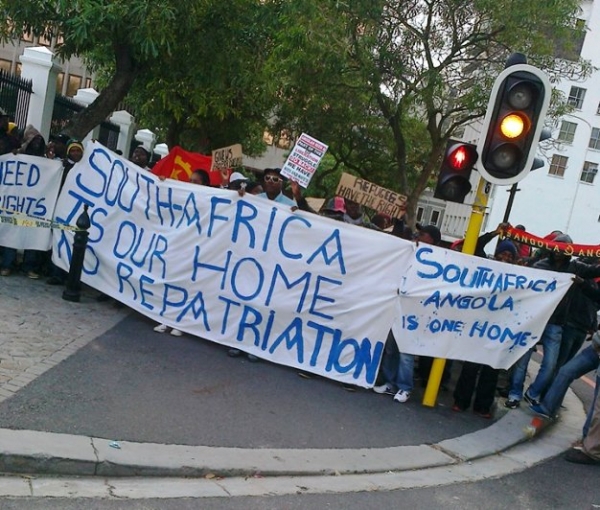
When does Rosie the refugee become South African? Never?

Rosie” was born in 1987 in Angola, during the civil war. In 1997, her father brought her and her three siblings to Cape Town, where he dumped them in a shelter and disappeared. At the time, Rosie’s siblings’ ages ranged from five to eight years old. Rosie has lived in South Africa ever since. She spent ten years in Angola, eighteen years in South Africa, but she’s still a `refugee.’ The war has ended, and so Rosie and her siblings are now liable for deportation, or not. “We don’t know Angola as ‘home’. We want to get student visas so we can stay here. We don’t have anything to go back to,” Rosie explains.

Last Friday, various reports circulated claiming that the South African government was set to deport as many as 2000 Angolan refugees, as well as a smaller number of refugees from Liberia, Rwanda, Sierra Leone. Over the weekend, the State leapt into action, explaining that it “is firmly committed to ensuring the fulfilment of its international obligations towards refugees and asylum seekers in terms of its ratification of the relevant international protocols.” Which means less than nothing.

Angolan community leader Jao Kaputo has been in South Africa since 1994. He explains the difficulties many Angolans face in the various registration processes, “Our homes were bombed. We lost everything, including documents. We are dispersed; our mothers went their own directions, and our fathers the other direction. As a result some of us are not documented, including children born here, and cannot apply for birth certificates.”

Pedro Nzazi” has been a refugee in South Africa for 20 consecutive years: “Starting over in Angola after 20 years of staying here will be very difficult. I have children at university and others still going to school. If I relocate to Angola, what will happen to them? Many Angolans, whose permits expired already are illegal, may be deported and they cannot access their bank accounts. I know five people who gave up and went back to Angola. They intend to apply for permits from there, but I am worried they might not be successful because of the strict immigration regulations gazetted on 22 May 2014.”

In 1989, Jesus Espirito Do Santos was born in Angola to a Congolese woman, Suzan Ntoto, and her Angolan husband. In 1992, Suzan Ntoto brought her three-year-old Jesus Espirito Do Santos to South Africa and applied for refugee status. In 2009, Ntoto died, and her South African employer offered to adopt Do Santos, but couldn’t because Do Santos couldn’t produce his birth certificate. In 2013, Do Santos, who speaks only English and Afrikaans, and not a word of Portuguese, faced “repatriation.”

Irene Kainda’s story is the same. She came to South Africa as a child refugee, grew up in Cape Town. She and her brother, Felipe, thrived, despite having been abandoned by their mother. And now she faces “repatriation” to a country she does not know that speaks a language she does not speak.

Everything about this is predictably wrong. One could argue that, while the civil war has ended, peace in Angola is still aspirational. For example, the past three months saw activists imprisoned for membership in a book club, and then their mothers were arrested. One could point to the gross injustice of Operation Fiela – Reclaim, an anti-immigrant sweep designed to “restore order” after the March – April Afrophobic, xenophobic pogroms in KwaZulu-Natal and Gauteng. South Africa’s firm commitment to the strangers in its midst under brutal attack has been to brutally attack those strangers. While the courts have temporarily stopped many of the deportations, the arrests continue, and the brutality intensifies in the Lindela Repatriation Centre. Here’s Fiela: a mountain of warrantless searches and improper arrests, deployment of the military as police, overly long stays in detention, evisceration of due process rights, intensification of xenophobia and Afrophobia. This does not restore or reclaim anything good. It merely terrorizes any South African-based, low to moderate income African born outside of South Africa.

The worst, though, is the willful imposition of inhumanity, the broad-brush practice of State terrorism and violence against those who came seeking succor and have actually thrived. The State will clothe its terrorism in legal language, but it remains terrorism. In South Africa today, what are the borders of being-a-refugee? When does one stop being a stranger and become simply a neighbor? Irene Kainda, Jesus Espirito Do Santos, “Pedro Nzazi”, Jao Kaputo, “Rosie”, and thousands of others want to know.


(Photo Credit: GroundUp)

On BBC News, amnesia passes for history, and the refugees are doomed

Young girl returning from the store with a pot of soup and a bottle of milk, Lodz

On BBC News today, Dariusz Rosiak from Polish National Radio concludes an interview with an afterthought, “You also have to understand that there is a cultural gap which is important and it has to be taken into consideration … Poland is a one-religion, one-ethnic country, and has been like that for the last 50 years. People, they have to understand the necessity to accept people of different color, of different creed, of different culture. You can’t expect them to be able to do it just like that.” And the interview ends.

For the last 50 years.

My father’s family came from Piotrków Trybunalski, near Łódź, and, apart from my father, they were all killed during the German occupation. My father, Charles Moshenberg, was born in 1926, in the midst of the Second Polish Republic, which ended with the September 1939 invasion of Poland. My own family’s history and that of Second Polish Republic haunt Rosiak’s comments as well as his historical amnesia.

When the Germans and their Soviet allies invaded Poland, the country was a patchwork of national minorities. While the 1921 Polish census listed 30.8 percent of the population as “national minorities”, the 1931 Polish census put that figure at 31.1 percent. During this period, Poland was also undergoing intense urbanization.

Who were the national minorities? Ukrainians, Jews, Belarusians, Germans followed by much smaller communities of Lithuanians, Czechs, Armenians, Russians, and Roma. Along with Jews, Poland also boasted, or not, an array of religions, from Roman Catholics to Greek Orthodox to Protestant.

By 1931, Poland had the second largest national Jewish population in the world: “At the time of the population census of December 9, 1931, there were about 3,136,000 Jews in Poland, i.e. 9.8% of the population, making them the second largest Jewish community in the world. In 1931 more than a fifth of all Jews lived in Poland.” At the time of the 1939 invasion, the number of Jews who claimed Polish as their first language was rising, as it had been for the past decade.

And then they were gone: the Jews, the Roma, the “national minorities”, the others, dead in the ghettoes and camps or fled.

Fairly quickly, Poland became used to the story of being one religion, one ethne. By letting the story stand, unquestioned, the BBC colluded in this myth making. Interwar Poland was not a model of diversity, but it was a thriving, growing multinational, multiethnic, multi-religious nation-State. The loss of that multi haunts more than Poland. Now more than ever, that history should be invoked. Rather than circulating naturalizing alibis for murderous inaction, open the doors to the refugees, asylum seekers, and migrants, around the world.


(Photo Credit: Roman Vishniac Collection, International Center of Photography)