Deprivation in Greece … just an emotional issue???

“It has become impossible to give birth in public hospitals,” Sofia Tzitzikou told me in a recent phone interview. She has been organizing and running community clinics in Athens since the 2010 financial coup against the Greece. She also recently appeared in the documentary, The Canaries in the Coal Mine.

Until recently in Greece, women in labor did not have to worry about safe deliveries, thanks to an efficient public health care system. Since 2010 the steamroller of structural reforms directed by the Troika of financiers – the European Central Bank (ECB) the European Union, and the IMF – has dismantled that public system. The financial attack on Greece has produced a deadly correlation of high unemployment rate and elimination of the social safety net.  Women, children and elderly people have been hit this hardest. The Troika demanded cuts and then more cuts of public services in exchange for loans supposed to restore the solvency of the country. Consequently, Sofia explains, the cost of health care represents now only 1.5% of the national budget, and the `hope’ is that it will go as low as 1% while the military budget has been increased.

Recently, Jeroen Disselbloem, President of the Eurogroup, said he hopes to have completed the current examination of the economic adjustment program of the country very soon. In the 1980s, structural adjustments programs became the only formula for development. Now, it’s `economic adjustment.’ Whatever the name, these plans have destabilized emerging countries, and crushed unions and public health care systems with dire consequences for women and reproductive and health rights.

The Eurogroup, in its pursuit of `economic growth’, is blind to the suffering of the Greek population. As Sofia noted, “This means violently taking over the right to health, to life, as children are not vaccinated because their parents have lost their jobs;” the unemployment rate is currently close to 40%.

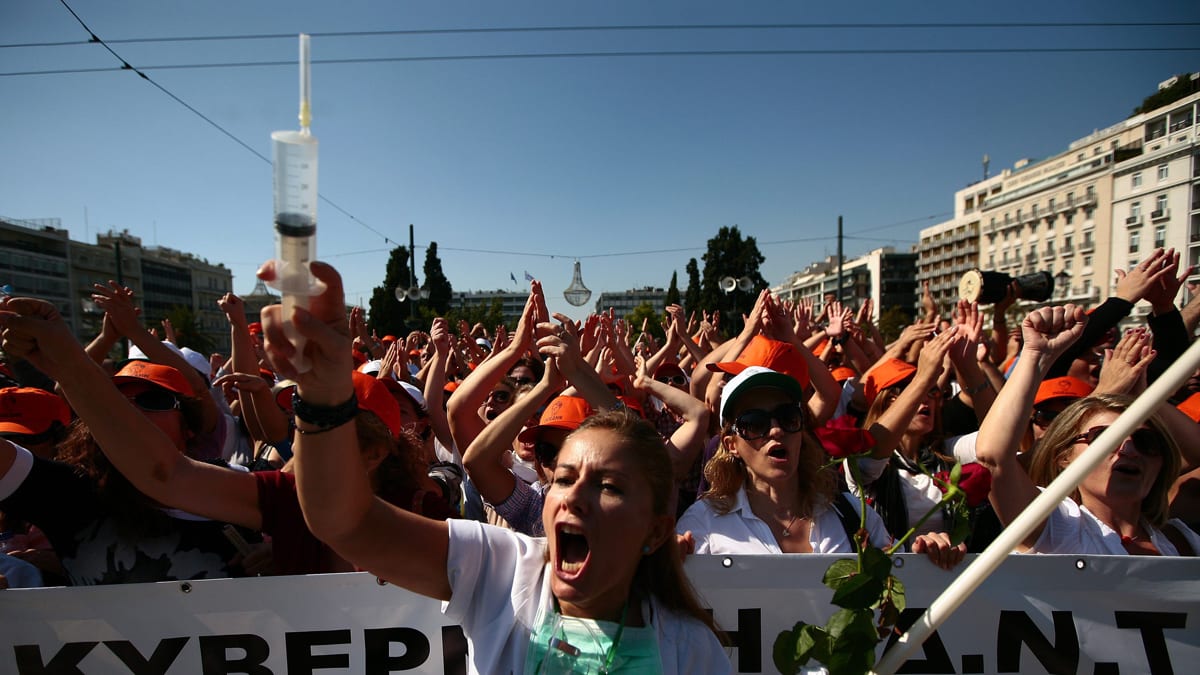
According to Sofia, the State now covers the fees for home delivery but not for maternity hospital care. Strong protests have forced public hospitals to reopen their doors to women in labor.  The bill will be sent to the tax system. Thus, women who are already extremely vulnerable incur a new level of debt just for giving birth. For Maurizzio Lazzarato,  “Debt constitutes the most deterritorialized and the most general power relation through which the neoliberal power bloc institutes its class struggle…” I would add gender struggle as well.

Since the ransack of Greek society by globalized financial power, the wages of those still employed has dropped 40%. Sofia tells me women are paid in kind in places such as supermarkets. Giving birth without health care coverage costs 600 Euros for a regular delivery and 1300 Euros for a C-section. In addition, explains Sofia, “Abortion rates have increased. Do women really choose?  Now we count three abortions for one birth … Childbirth is not a business, every one has the right to have or not have children.”

As we were talking on the phone, Sofia was interrupted several times to answer demands for medications no longer available in public hospitals: “Can you imagine, we as community clinics are asked to supply medications for public hospitals.” She has seen people abandon treatments because they cannot afford them. The suicide rate has been multiplied by four in three years.

Inequality is visibly on the rise, and for the first time, she says, we have deaths that were totally preventable. Women, again, are the most vulnerable. Sofia comments, “The State does not exist anymore. We are a country in regressive development.” The Troika is pushing for the privatization of education and health care. These privatizations produce more inequality. Additionally, there is little accountability in privately run services based on market logic. Sofia strongly opposes this dismantling of the State. She demands the government to be accountable for its decisions.

As vice president of UNICEF for Greece, Sofia was invited to the recent annual convention of the European Platform Against Poverty and Social Exclusion.  Although Sofia recognized that the convention broached important issues, she also noticed the presence of George Soros, one of the architects of the attack against Greece. He was the keynote speaker on “Roma and marginalized populations.” We both commented on his philanthropist high profile that allows him to be both arsonist and firefighter simultaneously.

Conference panels expressed the obligation of member States not to allow austerity over health services, and that the protection of children was central to this year’s platform.

In a workshop entitled “Ensuring adequate access to health care in times of austerity,” a Greek consultant to the Minister of Health in Greece gave the State line. On the panel, Sofia responded that his presentation in no way reflected the reality neither on the ground nor in the data. She explained the realities of poverty in Greece. She introduced the UNICEF and Athens’ University report “The State of Children in Greece 2013” released in May 2013. In Greece, 600 000 children live below the poverty line; 322 000 suffer nutritional deficiency. She pointed out the statistical data on social community clinics. She emphasized that it’s not enough to talk about generalities and that the State was absent.

The panelist angrily tried to belittle her, saying that she approached this question from an emotional perspective.

Sofia retorted: “I take that as a compliment when we persistently fight for the rights of people.”
We are all canaries in the coal mine

In December 2011 Swiss financial journalist Myret Zaki asked a group of economists a simple question, “Why now?  For example, you have all noticed that suddenly Greece was in crisis”. She noted that it was not because of Greece’s public debt, which had been fairly stable and not especially large. The economists mentioned Goldman Sachs, which had advised the Greek government to sell its financial products and then informed their own clients and friends about Greece’s “financial weakness”. Myret Zaki completed the picture with the story of the 2010 Soros Dinner, when a few hedge funds managers cooked up an attack on the Euro through Greece. The Wall Street Journal report on the dinner quoted Hans Hufschmid, a hedge-fund administrator (GlobeOp Financial Services SA), in London and New York: “This is an opportunity…to make a lot of money.”

We all know what happened next. We remember the demonstrations and how these speculators precipitated the demise of employees, citizens who were to pay for their financial coup. As France’s General Commissioner for Public Investment René Ricol explained, “This is a combat between the world of finance, the world who wants to make a lot of money very quickly, and the world of `true life’”. With the support of neoliberal doctrine, the world of finance has subsumed civil society.

But that was then.

Today, in Greece the world of “true life” has reorganized after the shock of the financial attack that sent many into poverty and precariousness. Taken by surprise, people believed at first that the country had overspent its revenues; now they know that overspending was not the problem.

The recent documentary, Canaries In the Coal Mine, shows how the State is controlling the revolt and the fight for reestablishing the democratic civil society values. This story should be understood as “a lot more than Greece’s tragedy.”

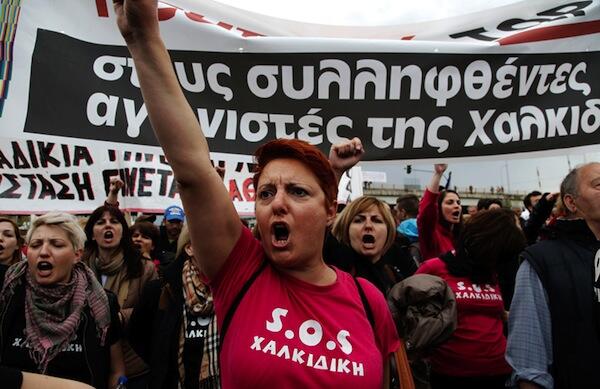
Greek trade unionists defending steel workers who were not paid during 18 months were sent to court, accused of terrorism for organizing demonstrations and for showing workers’ frustration. As prosecutions of heads of associations representing workers, immigrants, and others demonstrate, anti terrorist laws have been used to install a general surveillance of “true life” populations, producing the legal tools to choke any contestation.

The criminalization of Greece’s social movements has been generalized. The documentary makes it clear Greece is in Europe. Across Europe, many are being threatened by the same shock of the unfettered and ferocious financial powers. Everyone who fights for rights is in danger, according to Oliver Stein (Progress Lawyers Network) and Pierre Arnaud Perrouty (Human Rights League, Belgium): “The ones who carry the contestation protect the rights of us all…. They are the canaries in the coal mine”. Once the canaries are smothered, everyone will feel the blast.

Last week, Moodys upgraded its rating of Greece by two points. Why? “The Greek economy is bottoming out after nearly six years of recession”. Greece underwent appropriate structural reforms.

Yes, thanks to an artificially engineered recession, the Greeks touched bottom. That is not a positive sign!

Sofia Tzitzikou, who runs a community clinic in Athens, knows “the bottom” well. Greeks, who had a very effective health-care system until the “crisis”, lost their social security. Almost 50% of the population does not have access to social security, to health care. Women have been particularly affected as their reproductive rights are compromised, since women now have to pay for these services.

Sofia explains that the role of the community clinics is not to substitute for the public services that are the State’s responsibility. But people are suffering and dying, and so solidarity is indispensable. She explains that this engagement is also political work. Clinic workers explain to their patients that they have to get involved as well to revive and counter the structural reforms prescribed by the Troika (European Commission, IMF, European Central Bank).

“In Greece we have a systematic infringement on human rights, social rights, workers’ rights, on democratic rule of law, on the welfare state” declares Zoe Konstantopoulou, a representative at the parliament.

Canaries in the Coal Mine captures the aftermath of the neoliberal financial shock on “true life.” It debunks the construction of a crisis that is actually an experiment in controlling civil society for financial benefits for the few. That’s what happened in Greece, which, not that long ago, was one of the top 20 economies. Sofia explains that right now, in Greece, democracy is absent. Democracy is to serve people for the improvement of people’s lives, not the opposite. The documentary opens and ends with music by Greek rap artist Paulos Fyssas, assassinated in Athens by a Golden Dawn fascist activist.

What happened in Greece is possible anywhere. Only solidarity, in particular European solidarity, and true democratic resilience might counter this brutal attack on civil society. We should listen carefully to Athenian student Melanie Mavrogiorgi: “We don’t have the army in the government to control us. So we have hope as we see people still demonstrating. They are still hunting and fighting for their rights. I think that is a piece of democracy.”

The documentary ends: “Pay attention to the canaries in the coal mine. They warn us of the dangerous gas that neoliberal politics wants to blow up. It is time to get out of the mine!” The documentary ends; the struggle continues.


(Photo Credit: Twitter / 15M Barcelona)  (Video Credit: Yannick Bovy / YouTube)

Twenty years after Cairo, women’s rights are reduced around the world

Almost 20 years ago, the Conference on Population and Development (ICPD) took place in Cairo (1994). ICPD, also called the Cairo Consensus, declared women’s reproductive and health rights as fundamental to the well being of women and to the full political and economical participation of women.

In Paris last week, Medecins du Monde (Doctors of the World), Planning Familial and Equilibres et populations hosted a briefing, titled: “Access to contraception, unwanted pregnancies and unsafe abortions:  the state of reproductive rights and health in the global South.” The briefing panel consisted of Margarita Gonzales and Catherine Giboin, both of Medecins du Monde; Serge Sabier, from Equilibres et Populations; Lise Marie Dejean from Solidarité Fanm Ayisyen, SOFA, a Haitian feminist organization; and Véronique Séhier, of French Family Planning. They all agreed that the global conservative turn has had tremendous and destructive consequences for women. Serge Sabier, who participated in the drafting of the Cairo resolutions, said that today it would be impossible to get 172 countries to agree to sign such a document.

Véronique Séhier added that these rights are still not considered fundamental. The goals have not been reached. For young women, access to reproductive health services, and to education and education about sexuality in particular, is limited. In many regions, and not only in the South, contraceptives are difficult to obtain or unavailable. Meanwhile, many countries oppose the right to abortion. In Europe, three countries officially deny access to abortion services, thereby defying European law.  Séhier insisted that no dissociation should be made between contraception and abortion; access to both is a fundamental right.

Catherine Giboin reminded the audience that data on reproductive health were almost non-existent until 1985. She then shared some data to show that evidence is not enough to have sound politics to support women’s rights. One fourth of women in the world have no access to contraceptives. In 2012, 73% of the women who did not receive the contraceptives they needed were in the poorest countries. About 40% of the pregnancies in the world are unwanted, and this rate climbs to about 60% in Latin America and the Caribbean. One out of ten births occur with girls between the age of 15 and 19. The ratio of unsafe abortions has increased from 44% in 1995 to 49% in 2008; 98% of unsafe abortions are in developing countries. In 2008, 47000 women died as a result of not having access to safe abortion and 8 million had complications. 40% of the world women live in countries that have very restrictive abortion legislations. Chile, Malta, Nicaragua, and El Salvador forbid abortion without exception.

Lise Marie Dejean put these data and numbers in the reality of Haitian women who represent 52% of the country’s population. Haiti’s high maternal mortality and high rate of complications after abortion have to be linked to women’s under-representation and invisibility in Haitian institutions and politics.  Dejean affirmed the crucial role that the colonial and post-colonial patriarchal power has played, reminding the audience that contraceptive pills were tested on Haitian women, who now have little to no access to those very contraceptives. She insisted that women’s reproductive health and women’s health in general, are interdependent with women’s levels and quality of participation, women’s poverty, and rape. As Dejean noted, in Haiti “our body doesn’t belong to us, the patriarchal system has profited from this body to establish places of domination (des lieux de domination).” Across Latin American and the Caribbean, women are organizing to demand that their right to control their body be respected as well as their right to have equal participation in the decisions of their countries.

France’s Minister for Gender Equality, Najat Vallaud-Belkacem, presented the position of her ministry. Although France has some problems of access to abortion services, its situation is still one of the best in the world, with free-of-charge reproductive services, including for undocumented immigrant women. Vallaud-Belkacem insisted on the commitment of France and its diplomacy in asserting women’s rights and also more practically in supporting women’s organizations through its embassies. One NGO representative asked how activists from poor countries who are often poor themselves could have a voice in international instances. Vallaud-Belkacem replied that feminist diplomacy is there to facilitate their travel and to increase the visibility and real participation of those activists in international conferences.

The Minister’s language radically departed from the usual monolithic paternalistic language that often prevails in such meetings. She recognized the difficulties and said that while her action in promoting women’s rights and also participation of feminist organizations has been oriented to francophone countries, she also inscribed that in a broader feminist diplomatic perspective. For example, at the conference des ambassadeurs (ambassador conference) in August 2013, she argued for a new diplomacy for women’s rights. Additionally, according to Vallaud-Belkacem, France is the fourth country in terms of financial aid in the world and 500 million Euros were dedicated between 2012 and 2014 to support reproductive health initiatives around the world.

A member of the Greek’s family planning and the vice president of UNICEF Greek committee then made a striking remark that demonstrated once again that women are the first affected by the neoliberal order, which begets crisis. In Greece, women’s rights registered a major set back when austerity measures privatized public services and gutted the social state. And so now 40% of the population cannot access health services. While abortion remains legal, it now costs too much for many Greek women. The fee for an abortion is about half a minimum monthly wage, and contraceptives are expensive and hard to find. Greece, which had a good health care system, has seen a significant increase in infant mortality.

Greece demonstrates the pervasiveness of the neoliberal order on women’s health and reproductive rights. The current reduction of women’s reproductive rights and health has to be recognized as part of a political and economic order rather than as some unfortunate situation.


(Photo and Video Credit: Daily Motion)

Chilean resort worker Luz Herrera says `NO!’ to austerity

A funny thing happened on the way to austerity. Women workers said, `NO!” And won. This week, it happened in Chile.

Sebastián Piñera is the president of Chile. He is Chile’s first billionaire president. He is a family man. He says he is a “Christian humanist.”

In December of last year, Piñera was at a summit meeting in Mexico when, to `lighten’ the mood, he told a joke concerning the difference between a politician and a woman. The joke ends as follows: “When a lady says no, she means maybe; when she says maybe, she means yes; when she says yes, then she’s not a woman.” No one in the Chilean women’s movements or sectors laughed. Even Carolina Schmidt, Piñera’s Minister for Women’s Services, publically criticized the President.

Sexual violence is not funny. Neither is the exploitation of women workers.

This past Sunday, Piñera and his family were on their way to Mass, when three women workers from the Bahía Coique resort stopped him and started shouting. They explained that they had been working for years, were receiving criminally sub-standard and illegal wages, were forced to work too long hours with no time off. Piñera is part-owner of Bahía Coique, in the southern part of Chile.

The leader of the trio seems to have been Luz Herrera. She explained that she is a laundry worker who has worked at the resort for nine years. She hasn’t received a raise in three years. The salaries are below the minimum wage. She can’t take care of her family on the money she earns. There’s no contract, there’s no protections, there’s workers’ comp or health insurance. She’s forced to work without breaks and without days off, in the very place that the President goes `to relax’.

Piñera vacations, often, at Bahía Coique. That’s where he was when the women workers approached him. He was, no doubt, getting some down time after his grueling time making jokes on the summit.

The government response was textbook classic. First, they tried to ignore the women. Then they claimed that Piñera didn’t have any holdings in the resort. Then they argued that the President can’t be expected to pay attention to every detail of his vast holdings. It’s hard to see the workers from the commanding heights.

That was yesterday.

Today, Luz Herrera announced that she and her fellow workers had received a raise that would bring the company in compliance with the law. Herrera is neither impressed nor grateful: “For us, life is hard, but for him, as President, he always washes his hands of us. He’s rich, he has money, and so for him, it’s all fine and dandy. But for us, it’s not good. In fact, it’s very bad. I am not afraid of anyone. I began this, and I will see it to its conclusion, because it’s not just about me. It’s about all workers.”

The women students of Chile are indignant. The women workers of Chile are as well. And they are not afraid of anyone or anything. They have begun this, and they will see it to its conclusion. Ask Luz Herrera.


(Photo Credit: Radio Biobio)

The austerity of childbirth … in shackles

Austerity preys on women and children. So does State extravagance.

In Greece, women in labor were turned away from public hospitals in Athens, Thessalonika, Rhodes and Rethymnon. Why? They didn’t have jobs, they didn’t have insurance, and they didn’t have cash on hand. Because they couldn’t pay for their hospital visits, up front, they were turned away. It’s the new “health system”, the “unified medical care system”, also known as the “integrated unified hospital treatment”, under the new austerity. In this brave new world, women must pay in advance and then receive the childbirth allowance. The childbirth allowance is 600 Euros. The cost of childbirth is listed at 950 Euros, for `normal’, and 1500 Euros, for caesarean section. If a woman doesn’t have the full freight, she must just go. Even if she does have the money, in the end she bears the difference, anywhere from 350 to 900 Euros. Women bear the difference … literally.

Women’s groups, in particular the Women’s Initiative Against Debt and Austerity Measures and the Independent Women’s Movement, broke the news and mobilized public opinion. Greeks were outraged. The Ministry of Health and Social Solidarity was shocked and announced that, from here on, no woman would be turned away. However, she still must pay the difference.

This is the new face of Greece, the face of austerity. In the United States, this would be business as usual. As one Greek noted, “They turned us into America, where you are finished if you don’t have any good insurance!”. Another agreed, “I am touched, we are becoming America. Giving birth for free in public hospitals? Impossible. Wipe out childbirth allowance NOW as well.”

Welcome to the United States of America.

In the United States, if a woman prisoner is in labor, many states will spare no expense. They will buy the best shackles available. In 36 states, women prisoners in childbirth are handcuffed to beds and delivery tables, are shackled, are refused family in the birthing room, and are denied access to their newborns.

Florida is one of those states. A bill is currently in the legislature that would “create uniform and humane rules for the shackling of incarcerated pregnant women”. Gruesome as that phrase is, in Florida, and in the United States, it’s progress. Illinois passed a similar bill earlier this month.

For undocumented immigrant women prisoners, predictably, the situation is worse.

The line from shackling women prisoners in childbirth across the United States to refusing to treat women in childbirth in Greece is a direct line. In both instances, rational human beings decided that this course of action made sense. It makes sense to shackle women in childbirth? It makes sense to turn away a woman in childbirth? No, it does not.

Austerity and prison are parts of the new global unified medical care system, which is part of the global unified political economy. And in that `unification’, women bear the difference … literally.

(Photo Credit: Alkis Konstantinidis / The Daily Beast)

In the UK, disbelief haunts the asylum process for women

Two hundred years ago, poetic faith was described as “that willing suspension of disbelief.” At that point, a culture of disbelief meant folk cultures and fantasy were relegated to the dustbin of history by `the lettered classes.’ Today, disbelief sends women asylum seekers to prison. Progress?

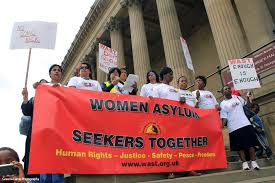
In the United Kingdom, women asylum seekers encounter a “culture of disbelief.” When Asylum Aid looked into the situation of initial decision-making in women asylum seekers cases, they found that 87 percent were turned down at the first hearing. Why? The UK Border Agency agents didn’t believe the claims. 87 percent is high, but that’s actually not the higher math. 42 percent of the rejected claims were overturned on appeal. In fact, 50% were ultimately overturned. The over-all average for overturning rejected appeals is 28%. That means that women’s stories are discounted as lies, at least by the border agents who make the preliminary decisions.

And it gets worse. Women wait longer than men to hear a final decision. How do they live while waiting?

In Scotland, all asylum seekers receive free healthcare. This includes those whose claims have been rejected. This means women. First, women make up a proportionately large part of those appealing, post rejection. Second, addressing women’s health concerns and, even more, women asylum seekers’ health concerns by engaging with the women as autonomous persons helps bring them into the larger and everyday social world. It is part of a larger Scottish project of refugee integration. But Scotland is the exception. For the rest of the United Kingdom, for Westminster, the situation is toxic, lethal.

Asylum seekers do not need to labor under the additional burdens, or are they punishments, of isolation and desperation. And depression. The vast majority of women asylum seekers are fleeing sexual and physical violence. Add to that isolation and a dehumanizing process, and you have a perfect recipe for self-harm and worse.

What is the architecture of the culture of disbelief? Prison. Private prison, at that, such as Yarl’s Wood, run by Serco. The typical scenario for a woman asylum seeker is travel long distance, end up in an overcrowded room with tons of strangers, approach a person sitting, austerely, behind a glass, and then, in a loud enough voice to be heard by a bunch of people, tell him or her the story of how you were violated. And then suffer rejection, being called a liar. And then go to Yarl’s Wood … or some other prison.

Welcome to the so-called “culture of disbelief.” Welcome to `democracy’.

It’s not disbelief. It’s efficiency. If 87 percent of the storytellers are rejected, that’s because the judge isn’t listening. Anyway, it’s more efficient to reject 87 percent, even if half will be overturned. Think of the savings from those who don’t appeal and from those who appeal and don’t succeed. And then think of the profits generated through the incarceration of innocent women courageous enough to tell their stories to strangers, courageous enough to seek a better world, despite all odds. That’s extraction of value, of profit, from time, from flesh, from pain and suffering, from degradation, from women.

This system, this version of `democracy’, was established during the bubbly times, during the economically ascendant times … for some. What is coming, as the UK charges from efficiency to austerity, is predictable. More cuts. Cuts to legal aid. Cuts to health services. Cuts upon cuts.

What is needed is a national campaign of willing a suspension of the culture of disbelief. Call it …  democracy. Call it, as well, feminism.

(Photo Credit: Liverpool Antifascists)

War on Workers? “Ladies First!”

A teach-in about the War on Workers took place recently in Washington, DC.

“The war”’ was described and analyzed by four panelists and a moderator. The moderator was male. Three of the panelists were males.  The one woman came from the National Education Association.  The panel discussed at some length the state of union activities in the U.S. given the struggles in Wisconsin and other areas of the country. Then the panel took questions.

I asked about gender politics, about the relation between the attacks on the funding of women’s resources, such as reproductive health, the general attack on collective bargaining rights from the State, and what labor unions were doing about it.  When Scott Walker and friends decided to eliminate collective bargaining rights from Wisconsin’s public sector workers, they only did it to female-dominated fields like teachers and nurses, but not to male-dominated ones like police and firefighters.

The panel did not answer my question.  But all four men did look to their right at the woman at the end of the table.  One of them then said, in a loud voice, “Ladies first!”

The response from the NEA representative was that women’s rights were something that unions had fought for as part of the broader labor movement, and that these attacks from the right were typical reactionary nonsense.  There was no discussion on what labor unions were doing to address this intersection between gender and the labor movement.

Needless to say, this response did not satisfy me.  But then I realized—the panel had relayed the philosophy that haunts women in the workforce, from the local to the global, from unions to the State: Ladies first!

Politicians can’t use the necessary vocabulary when discussing reproductive health, but a congressman can viciously tell lies about Planned Parenthood and alter records to get away with it.  The House of Representatives tried with all of its might to redefine the definition of rape to include a stipulation of whether the act is “forcible” or not, all for the sake of denying women access to safe abortions.  In the words of Congresswoman Debbie Wasserman Schultz, the proposed bill was “a violent act against women.”  Meanwhile, Supreme Court Justice Antonin Scalia claimed that the Constitution does not grant the same protections to women or the LGBTQ community as it does to other groups.

What is the logic behind who should be eliminated from the State’s dialogue, whether it’s in debate or in established law?  Ladies first!

New Jersey Governor Chris Christie is the poster-child for attacking teachers’ unions, whether he is stumping or berating individual teachers.  The rhetoric involves insults and putting dissenters “in their place,” as well as comments that sexualize State actions against teachers’ unions.  In the same period, Christie told the press to “take the bat out” against a female state senator, prompting two other women politicians from New Jersey to criticize his comments as advocating violence against women.  Earlier in the same year, Christie vetoed a bill that would have provided funding for women’s health and family planning through an expansion of Medicaid programs because of New Jersey’s budget crisis. Christie has blamed this budget crisis on teachers’ unions as a scapegoat to pass austerity measures, even though his administration “forgot” to apply for federal educational funding.

In Wisconsin, Scott Walker’s administration’s attempt to take away collective bargaining rights from public-sector workers has targeted women workers.  Other austerity measures being debated cut funding from women’s reproductive health services.  All of this austerity against women is in the service of a budget crisis that isn’t even real.

When the austerity State decides to cut funding for social services and get rid of basic workplace rights, which population does it look to?  Ladies first!

After the panel was over, the one woman panelist came up to me and said that although many high-ranking officials of the NEA are women, she and others in the organization never thought of the attacks on collective bargaining as a “women’s issue.”  Often women’s rights in reproductive health and in the workplace are painted as two separate issues, but they are not.

The panel’s response reproduced the same narrative.  And this narrative of women as secondary to the “movement” as a whole, brings up a final question:

When a progressive movement needs to react to the State’s austerity measures, what representation is conveniently forgotten in the overall narrative?

“Ladies first!”

It’s time to move beyond the chivalrous, neoliberal logics of “Ladies first!” and talk about, teach, and organize for all workers’ power and rights, equally and at the same time.


(Photo Credit: Workers World)