“International Women’s Day” in Paillaco (CHILE): A Story of Chiaroscuros

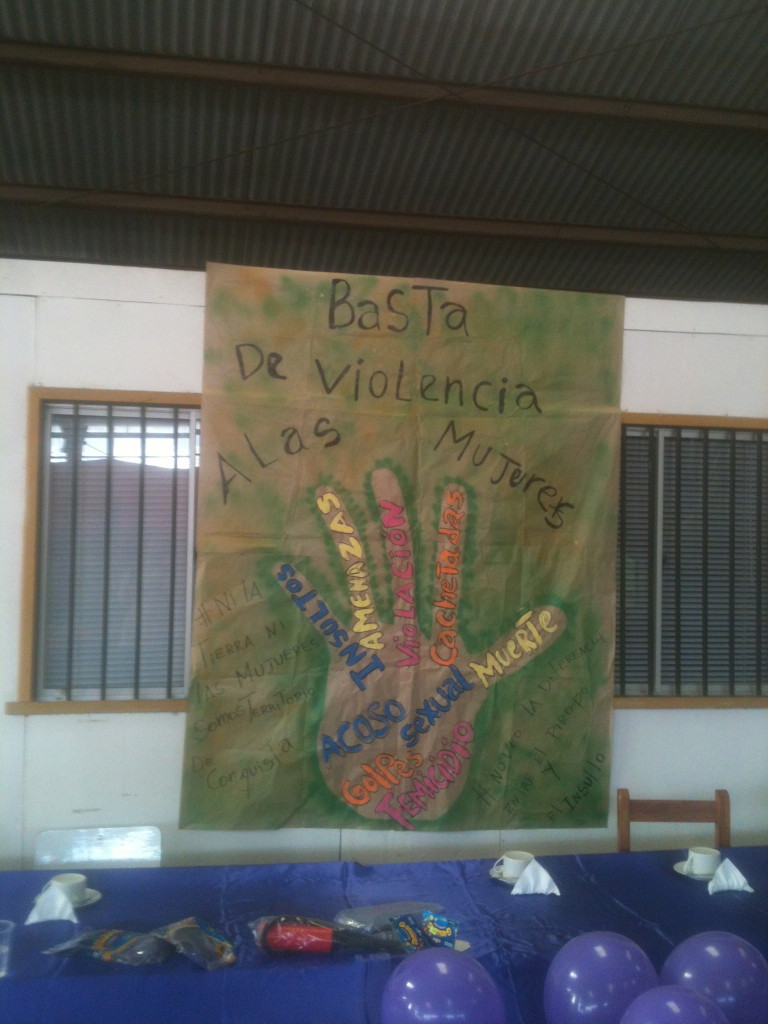
Basta de violencia

The active verb “to celebrate” is not the same as “to commemorate”. Commemoration implies the exertion or practice of our memory; it calls to the remembering of something that is significant to a single person or a group of people. I believe it is important to linger on this distinction considering that on March 8th I repeatedly heard these two phrases: “Congratulations on your day” and “Congratulations for being a woman”. Naturally I was not the recipient of these praises, since I am a heavily bearded and somewhat sturdy man; nevertheless I repeatedly heard these words both on the radio and in the cafe I usually go to work in. Even though they respond to the “International Women’s Day” –universally declared by the United Nations- such commemoration does not originally refer to all the women in the world. I believe March 8th immortalizes a bold, daring, and brave group of women who fought for a set of ideals and rights that were not yet enshrined in our modern societies. The 1911 fire in Triangle Shirtwaist Factory in the state of New York moved the hearts of people all over the globe, for this tragedy exposed the precariousness and fragility in which women exposed themselves daily in private and public spaces.

One hundred and five years have not passed fruitlessly. In Chile, women have conquered an array of political and social rights that have -in part- corrected their historically disadvantaged position in society. The multiple abuses and the asymmetrical circumstances existent between men and women have decreased over time, for these social anomalies have been present in our culture and social structures for far too long. Yet we can all agree that we have a long road ahead towards gender equality.

This year I had the privilege of commemorating “Women’s Day” with a wonderful group of peasant women in Paillaco: a rural village in the south of Chile. Paillaco uncovers the light and the dark present in the life of many Chilean women. This township, located in the region with the highest rates of violence against women in the country, drags a sad history of mistreatments and abuses. Therefore, it is not a coincidence that Paillaco became the first municipality in Chile to inaugurate a Center for Women (Centro de la Mujer), dedicated to support and aid abused women. During 2014, in less than two moths, two homicides alerted the community to act upon a situation that seemed untenable. This reveals the reality and the dark surroundings of rural Chilean women. It is a social pathology that befalls to one out of three women in the country according to the statistics of the National Service for Women or “Servicio Nacional de la Mujer” (SERNAM), victims of physical, sexual, and/or psychological violence. Due to incessant arrangements made by the city’s mayor, Paillaco has the first “Centro de la Mujer” in the country out of 23 “Centros” originated by the current administration led by President Michelle Bachelet to abused women.

Yet, the dark lives with the light; these atrocities coexist with a promising and enlightened local initiative. Paillaco now has the first public educational program aiming towards gender equality from preschool to high school: developing and implementing workshops involving students, parents, teachers, all following a solid curriculum that assess students undergoing gender issues. The proud city of Paillaco is commencing a profound path of social transformations through education.

If I had to tell a story that would reflect faithfully chiaroscuro phenomena in the present life of fighting Chilean women, I would speak of doña Rosa Barrientos Torres, a 90-year-old peasant. All of us, attendees to her commemoration, applauded in her honor due to her fortitude, tenacity and resilience against adversity. During the macabre coup of September 11th 1973, Rosa’s husband was killed together with 16 other peasants in the vicinities of Paillaco. The democratically elected president was being overthrown, and Rosa, alone faced distress and abandonment with nine children to be taken care of. Relentless in her struggle to feed, dress, and educate her children, Rosa managed to work day and night tackling deprivations, fear, and anguish for losing her life companion. The luminosity of her story comes with her message, which she shared with us that day: The struggle for a better living shall continue without hesitations. Forgiveness and reconciliation shall be our guide towards reaching true peace. Her wish was that her story served as an example of what shall never happen again, because life is a miracle that is well above all political, religious, economical or social considerations. At that moment, the room was static and speechless. I witnessed faces filled with emotion, watery eyes in all of us present. It was then when I understood the beauty, the powerful moral and righteousness of the courageous women that deserve to be commemorated all over the world. From her humbleness, doña Rosa shared with us a fraction of her wisdom and hope for humanity, and I was left with nothing but hope and gratitude.


(Photo Credit: Benjamín Elizalde)

Janika Nichole Edmond died in Michigan’s women’s prison: Who cares?

Janika Nichole Edmond

In November 2015, a twenty-five-year-old Black woman, Janika Nichole Edmond died, or better was executed, in the Women’s Huron Valley Correctional Facility, Michigan’s only women’s prison. Two years ago, Huron Valley was investigated for alleged human rights abuses against mentally ill female inmates, and today Janika Nichole Edmond is dead.

Janika Edmond’s story is short and terribly familiar: Janika Edmond lived with mental illness. Once in Michigan’s `criminal justice’ system, her condition deteriorated. She had a history of assaulting prison guards, which resulted in her being sent to solitary, which resulted in her becoming more aggressive. The rate of `incident reports’ skyrocketed. No one did anything. In 2014, Janika Edmond made a rope out of a towel and tried to hang herself. Earlier in 2015, Janika Edmond was found with a razor. She said, repeatedly, that she was “tired of being here” and was hearing voices. Unfortunately, no one on staff heard or listened to Janika Edmond’s voice. The day she died, Janika Edmonds asked for a suicide prevention vest. The guards laughed. Hours later, she lay dead on the floor. “The death report provided by the MDOC [Michigan Department of Corrections] for Edmond shows her presumed cause of death was suicide.”

That was no suicide. That was murder at the hands of the State. The State had agency, power, volition, and policy. The State wanted Janika Edmond dead, and Janika Edmond is dead.

Two prison officers have been suspended or fired, depending on the report. While they bear their own responsibility, this crime emerged from years of abuse and torture. When Janika Edmonds died, the State was still “investigating” the July 16 death of Kayla Renea Miller, in Huron Valley. From the Anchorage Correctional Complex in Alaska to the California Institution for Women to SCI-Muncy in Pennsylvania to the Women’s Huron Valley Correctional Facility, women were dropping like flies and they continue to do so.

None of this is new. In 2012, Carol Jacobsen, founder and Director of the Michigan Women’s Justice and Clemency Project, noted, “Abu Ghraib has nothing on Huron Valley.” She was describing the irony that Huron Valley was meant to solve the crisis of abuse of women prisoners in the Robert Scott Correctional Facility. As a result of widespread torture and abuse, Scott was closed in 2009, and all the women were moved to Huron Valley, which, according to Carol Jacobsen, is worse than Scott.

That was 2012. In the intervening four years, the conditions at Huron Valley have only worsened, as they have nationally. According to the United States Department of Justice, in state prisons, “suicide was the most common unnatural cause of death among female prisoners from 2001 to 2012.” What happened to Janika Nichole Edmond? Absolutely nothing out of the ordinary, just another Black woman crying out for help, dying in agony, “tired of being here.” In her death, she joins “the most common.” Who cares? Who cares? Who cares? #SayHerName


(Photo Credit: MLive.com)

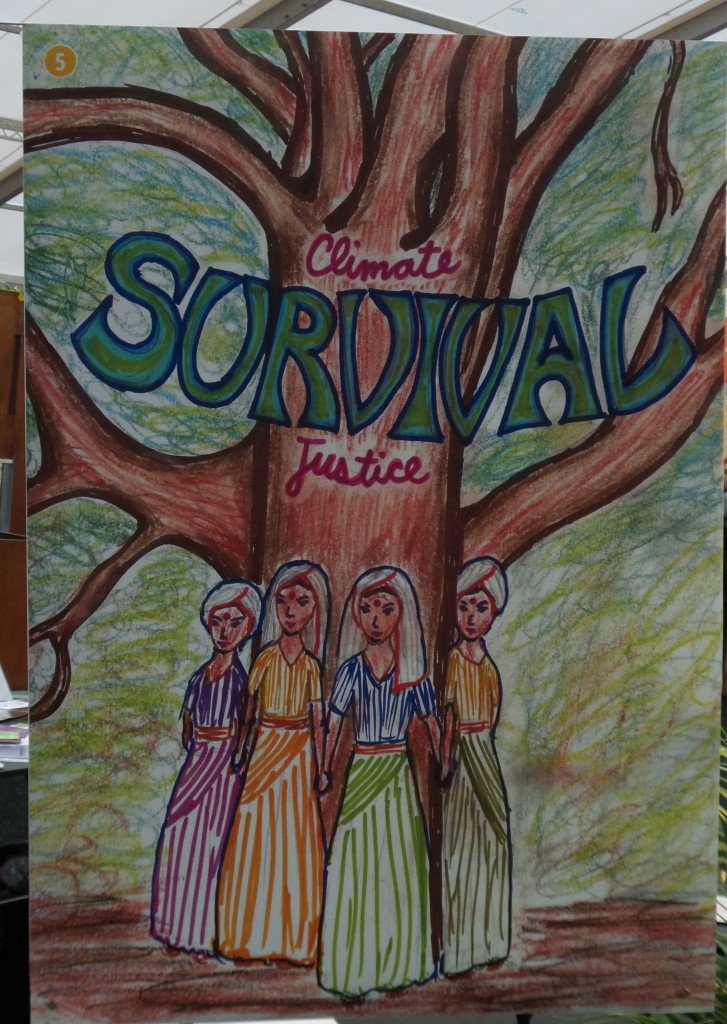
Three Months after the COP 21 the real fight for survival is on the ground

Climate Survival Justice

Last December in Paris, under the aegis of the French Minister of Foreign Affairs, the United Nations organized the conference on climate change, or COP 21. Representatives from the Global South, Indigenous people, Women’s constituency, and more, came to attempt to weigh in on agreements that were already negotiated among vested interests of the planet.

Evidently, this situation originated in the industrialized countries where wealth was exponentially increased through the capitalist neoliberal order. Accumulation of wealth equating with accumulation of power was the hidden part of the official discourse. The United States along with the leaders of the G20 countries imposed its economic corporate power and forced the elimination of some language from the initial document. Elimination of public voices also took place in Paris where many demonstrations were banned in the name of security.

To get a better insight into the situation, WIBG interviewed Tess Vistro, a representative of the people of the Philippines:

We asked her recently what the agreement meant from the perspective of the populations who are the most at risk with climate change and the most affected in contrast with the official discourse.

Here is her answer:

“The outcome is highly skewed in favor of rich developed countries and the target temperature limit put the planet and people into greater risks of damage which experts would say could already be irreversible; on the basis of the submitted intended nationally determined contribution (indcs); we are on a path to an increase of 3 degrees centigrade in the middle of the century – 2050;

“Paris treaty did not grasp the urgency of the risk and threat climate change is posing on humankind and all species in this planet. It just is divorced from the reality now that coastal communities in large numbers are now submerged in waters, that farming and food production have become unpredictable, and unsustainable; that women already reeling from poverty and gender discrimination to face again the problem of climate change devastations, is pushing millions of women into deeper poverty and deprivation and sexual violence; that climate change impacts are right in our midst, are with us, intends to stay with us with greater ferocity and destructiveness, and we urgently need to take bold actions now.

“The essence of the historical and primary responsibility of developed countries in bringing the planet and humankind out of this climate crises, has been passed on even to poor and climate vulnerable countries.

“Reneging on this responsibility, the Paris treaty called on private corporations to pitch in, making the task of combating climate change a huge profit taking endeavor, not a social responsibility of governments particularly developed countries. The treaty offered immense opportunities to rake in huge profits at the expense of poor vulnerable countries. Endorsed solutions are clearly cut out for the needs of private interests. The failed mechanism of reducing emissions from deforestation and forest degradation(REDD+) under the framework of market mechanism of internationally transferred mitigation outcomes is clearly spelt out in the treaty. Under this mechanism, developed countries can invest funds for REDD+ projects in developing countries, and can account the amount of reduced GHG emission in their respective INDCs, and thereby can continue to do business as usual in their respective countries. Worse as per practice, projects and investments for REDD+ invested in developing countries are false programs of reforestation and are actually plantation projects of high value cash crops designed for export.

“The Paris treaty gave a clear signal and mandate for private corporations to move in unhampered and with clear assurances of almost no regulation, with the treaty making sure that poor countries will not be able to hold rich countries and corporations liable and demand compensation for loss and damage that may result. The treaty stipulated that the `the Agreement does not involve or provide a basis for any liability or compensation.’

“The technologies for clean energy solutions are clearly in the control of rich developed countries, solar and wind and even seeds and production technology for biofuels are clearly in the hands of rich countries and corporations. Lands for the production of biofuels would surely come from countries in the global south, creating now the spectre of massive land grabbing, biofuels competing with lands devoted for food production, creating the spectre of food insecurity and hunger.

“In the Philippines an estimated 2 million hectares of lands is offered for the production of biofuels to foreign investors. This would have been enough to meet the rice needs of the current population of the country, based on a two cropping season. Another million hectares is allocated for palm oil plantations.

“The Philippines is one of the top 3 vulnerable countries to the impacts of climate change. And this is not a fiction. It happened already with typhoon Haiyan, the strongest typhoon that made a land fall in this planet’s history. (Cyclone Winston that struck Fiji last month has come second only to Haiyan) and in one quick swoop has left dead 7,000 people and three thousand others who went missing to this day, destroyed infrastructures worth Php18 billion,1.1 million houses, devastated agriculture to the amount of Php 17 billion, displaced 1.4 million agricultural workers. About 20 typhoons lash out the country annually, inflicting damages and untold sufferings for affected Filipinos. But despite this, the Philippines and other vulnerable countries were still mandated to contribute through their INDCs.

“It is a great injustice for the Paris treaty to have mandated the poor vulnerable countries who have scant carbon footprint, and who can barely break out now from an endless cycle of devastation- rehabilitation- devastation, from climate change disasters, to contribute; it is clearly injustice to have unleashed the reins of private capital to profit from solutions proffered – which could be more of profit taking endeavors than solutions.

“But if there is anything positive or success that came out of Paris, it is the movement of peoples from different countries, diverse sectors, that have committed to work for a safe planet, for all of humankind and the generations to come. This was shown not only with the people’s actions in and outside negotiations in Paris, but also the people’s mobilizations from different at different dates parallel to COP 21.

“The failure of the Paris treaty to deliver, should be enough reason to sustain the work of CSOs, grassroots organizations and networks movements of people and women, indigenous people, youth, trade unions working collectively locally, nationally, regionally and globally for a more just , and fair climate change deal. Enough reason to stir up a groundswell of work in local, grassroots communities – the key to winning the fight for climate justice.

“Currently in the Philippines, the biggest issue continue to be the impacts of typhoon Haiyan and the continuing slow grind of work for rehabilitation. As it is election campaign period now, these climate issues are brought out by candidates criticizing the incumbent administration for its ineptness in delivering the funds for rehabilitation to the victims, three years after Haiyan. Among NGOs, this is taken as an opportunity to raise the issue of climate change.

“Globally for women, from my own perspective, issues related to solutions, financing and important role of women in mitigation and adaptation plans must be put forward in the forthcoming COP agenda. To be vigorously monitored further would be to ensure that the principles of human rights, gender equality, etc. as enshrined in the preamble of the treaty, ( a win for CSOs who have persevered for its inclusion in the treaty), be faithfully used as a guide in all decisions related to the implementation of the Paris treaty.”

Tess Vistro March 9, 2016

(Image credit: Brigitte Marti) (Interview filmed by Joachim Cairaschi, conducted by Brigitte Marti)

Honor Mariam Ibrahim Yusuf by shutting down the detention centers

Mariam Ibrahim Yusuf

In England, today, the United Nations Refugee Agency (UNHCR) joined a local ngo, Migrants Organise, to award Mariam Ibrahim Yusuf the Woman of the Year Award. Mariam Ibrahim Yusuf fled Somalia years ago, landing up in Kenya, and then moved on to the United Kingdom. She knew no English, had no friends or acquaintances there, and knew nothing about asylum processes. She just knew she deserved to live with dignity and respect. Yusuf left her family, in particular her children, behind, and has not been able to contact them. Par for the course, Yusuf was dumped in Yarl’s Wood, days after arriving, and then denied asylum. She’s been appealing that decision for eight years. During the asylum process, the applicant cannot work, and so Mariam Ibrahim Yusuf is meant to beg. But instead she sings and speaks out and organizes. She is the woman of the year, and it is a year, another year, of shame and hope.

Mariam Ibrahim Yusuf moved to Manchester, found a place to live with other women asylum seekers, and joined WAST, Women Asylum Seekers Together. Together, Mariam Ibrahim Yusuf and her sisters have called, sung, stamped, chanted and organized to shut down Yarl’s Wood, and to shut down all detention centers. From Australia to the United Kingdom to the United States, abolition is in the air, and its current stations are immigrant detention centers. A global forest of hashtags is sprouting, from #ShutDownBerks to #ShutDownYarlsWood and #SetHerFree to #LetThemStay, individuals are forming local groups that are becoming national organizations that are becoming international, from Juntos to Women for Refugee Women and Movement for Justice to the International Alliance Against Mandatory Detention, made up of Australian activists living around the world. Another world is possible.

As nation-States built more and more special hells for women asylum seekers and for immigrant and migrant women, generally, the women organized and said, NO! We are not animals, we are humans. We are not trash, we are women. They also spoke for their children, who were daily being crushed by the prison experience. Their children cry out, “I am not a criminal. I don’t want to be locked up here anymore.”

The abuse of children in detention centers in Australia, the United Kingdom and the United States is torture, and it’s a crime against humanity, which is being called out and judged now. When a judge says that 3- and 4-year-old children can represent themselves in court, he has done more than condemn the process. He has shown what happens to the rule of law when it discounts the humanity of those who enter not only the court, but also the land itself. His tortured logic emerges as part of a systematic application of torture as a form of reasoned jurisprudence.

That system of torture is global, and it focuses on women and children.

Berks is inhumane and abusive, and even the lawmakers say so. Yarl’s Wood is a house of shame. Nauru, Villawood and all the Australian solutions to the crisis of human beings seeking help are one giant pit of disgrace. In each case, the arc of atrocity is expanding, infecting structures from education to health care but also the ways in which we view one another and ourselves. The debt that the abuse of asylum seekers creates is trauma for the asylum seekers and daily and increasing loss of our humanity.

Mariam Ibrahim Yusuf is the woman of the year, because another world is possible. Tomorrow, led by Movement for Justice, thousands will gather around Yarl’s Wood and raise a ruckus. Thousands are organizing across the United States to shut down Berks, Dilley and Karnes as well. Across Australia, people are organizing not only to shut down the detention centers and the entire juridical apparatus that feeds the monster. They are wondering if this is “the moment” in which we will join in solidarity, across oceans and borders. Maybe it is. One thing is certain. We’ve passed enough-is-enough. The time is now. #ShutDownYarlsWood #SetHerFree #LetThemStay #ShutDownBerks #Not1More #NeverAgain Do it for Mariam Ibrahim Yusuf, and for all the women and children. Until the prisons are closed, we are all imprisoned.


(Photo Credit: WorldPost / Rifat Ahmed) (Video Credit: Women for Refugee Women / YouTube)

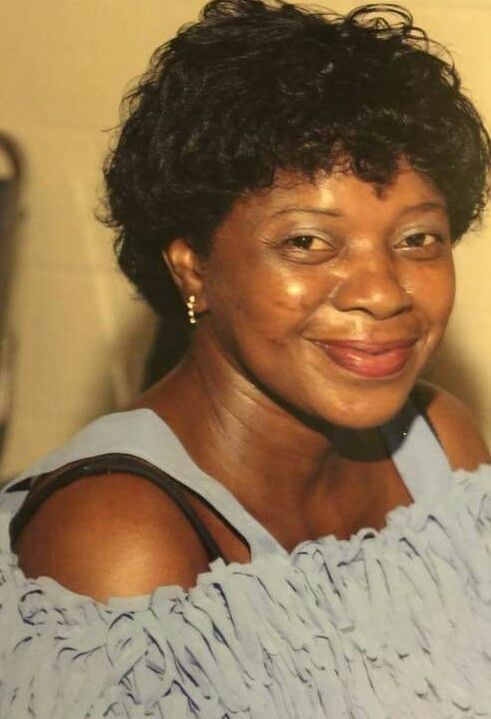
Berta Cáceres: “We have to take action”


Berta Cáceres, Coordinator of the Civic Council of Popular and Indigenous Organizations of Honduras, COPINH, human rights defender, environmental activist, indigenous rights leader was murdered. It was a murder foretold. Threats against Cáceres had mounted over recent weeks, but there had always been threats and danger: “The army has an assassination list of 18 wanted human rights fighters with my name at the top. I want to live, there are many things I still want to do in this world. I take precautions, but in the end, in this country where there is total impunity I am vulnerable. When they want to kill me, they will do it.”

Yesterday, they did it. Despite constant calls for State protection, Berta Cáceres was put in further danger by the State, by the Honduran government and by U.S. support of that government. Berta Cáceres struggled for the rights of people, all people, to live in peace and with justice. That means that no entity can treat a community like dirt, to be moved this way for a big dam and that way for a highway or airport runway and the other way for a shopping mall or an upscale housing development. She fought for the dignity of women and of all indigenous peoples.

When Berta Cáceres was awarded the Goldman Environmental Prize, she explained, “We must undertake the struggle in all parts of the world, wherever we may be, because we have no other spare or replacement planet. We have only this one, and we have to take action. The Honduran people, along with international solidarity, can get out of this unjust situation, promoting hope, rebellion and organising ourselves for the protection of life.”

We have to take action, in the memory of Berta Cáceres. No more devastation of the earth, no more global assault on indigenous peoples, no more systematic violence against women, no more silence. We must undertake the struggle.


(Photo Credit: AWID / Goldman Prize)

(Video Credit 1: YouTube / Goldman Environmental Prize) (Video Credit 2: YouTube / Nobel Women’s Initiative)

What woman has the right to travel safely to escape violence, with or without a passport?

When 17-year-old Aminata fled Guinea Conakry, she did not have a passport. One of her teachers helped her to break free from a cycle of constant domestic rape and sexual assault. The helping hand handed her to a smuggler, who was also her torturer. He raped her and, once in Paris, stole her ID documents. This is how she landed in France with only her school card in her pocket. In 2012, Aminata applied for asylum.

She joined the cohort of vulnerable and isolated migrants targeted by Afro Beauty salon owners and managers in search of cheap and vulnerable workers in the “Château d’eau” area of Paris. The conditions of work were unspeakable and their wages not paid.

After 11 months of struggle supported by the CGT union, the workers finally managed to receive their salary and proper documentation. Minister of the Interior Bernard Cazeneuve promised Aminata that she would receive her “titre de sejour,” her temporary work permit necessary to stabilize her situation, now that she finally holds a regular job.

The day she was supposed to receive her permit, she was arrested and detained for 3 days.

She was accused of having provided a false passport. Aminata could not have a passport without returning to Guinea where she would have been in danger, and so she authorized a relative to secure her passport. Aminata never had any control over the process and is now accused of not providing a valid passport.

Who is going to bring to court the ones who have created this situation in the first place?

The CGT Union, who defended her and her colleagues last year against the “chateau d’eau” mafia, is now organizing to defend her rights to keep working in France, simply to have access to a decent life without sexual assault or work abuse. A petition is circulating to demand that the victim does not become the accused.

Having a passport or traveling documents is the biggest challenge for the most vulnerable populations like Aminata, especially those, mostly women, who are escaping violence. The differential of rights is growing as much as financial inequalities are rising, making violence more acceptable than rights. Who is going to defend the dignity of “the wretched of the earth”? Who has the right to travel safely to escape violence, with or without a passport?


(Photo Credit: l’Humanité)

What happened to Joyce Curnell? #SayHerName

Joyce Curnell

Last July, Joyce Curnell, a 50-year-old Black woman, died of dehydration in the Charleston County jail, in South Carolina. In her death, she joined Sandra Bland, Kindra Chapman, Ralkina Jones and Raynette Turner: five Black women who died in one month in jails across the country. In her death, she also joined Kellsie Green, whose family called the police to arrest her because she needed help and there was no other help locally available. Joyce Curnell is the latest headstone to be placed alongside the highway of women missing and murdered by the State.

On July 21, Joyce Curnell went into hospital with severe stomach pains. She was diagnosed with gastroenteritis. When she was discharged, the local police picked her up on an outstanding warrant. Joyce Curnell’s son, Javon Curnell, had called the police and told them of his mother’s location and outstanding warrant. Joyce Curnell was struggling with alcoholism, and her children thought that the jail would provide her with the help she couldn’t anywhere else: “She’s my mom, but I’m trying to help her. She won’t listen, she drinks a lot. She needs some time to detox herself.” Javon Curnell saw only two choices for his mother: jail or the graveyard.

At the hospital, Joyce Curnell was hydrated, given medications and told to seek medical help if she had any more pain or vomiting. No one at the Charleston County jail did anything to address her pain. Joyce Curnell spent the night wracked with pain and vomiting. Guards brought her a trash bag to vomit into. No one moved her to any medical facility. Joyce Curnell grew too weak to go to the bathroom. In the morning she was too weak to eat and continued vomiting. No one gave her any water or helped in any other way. Medical staff “checked” her around 3 pm, and did nothing. By 5 pm, Joyce Curnell was dead. There was no failure here, but rather deliberate and lethal refusal.

The family is suing the Carolina Center for Occupational Health, which provide “health care” at the jail. As the family’s attorney explained, “This is not a situation in which Joyce needed access to cutting edge medical care to save her life. She needed fluids and the attention of a doctor. Not only has nobody been prosecuted in connection with Joyce’s death, it does not appear that any employee has even been reprimanded … You don’t need a medical license to administer Gatorade. At some point, she would have needed more than simple hydration, but early on, it probably would have worked.”

Who killed Joyce Curnell? Everyone. As has happened so often before in similar circumstances, the autopsy concluded that Joyce Curnell’s death was “natural.” What nature is that? The fault here is not in the stars but in ourselves, in our collusion with murders that, taken together, comprise a massacre. Where is the sustained outrage? The Curnell family sued the health contractors on Wednesday, and by today, the following Monday, the world has moved on, and Joyce Curnell, who died in agony, begging for help, for a drop of water, is dead.

(Photo Credit: The Post and Courier)

What happened to Kellsie Green? Just another death in Alaska’s state of prisons

Kellsie Green

In Alaska this week, KTUU News has run a three-part special series, “State of Prisons.” In early February, Dean Wilson was tapped to be the new Commissioner of the Alaska Department of Corrections. Why all the sudden interest? On January 10, 24-year-old Kellsie Green died in the Anchorage Correctional Complex, and her death was perhaps the straw that broke the camel’s back. This is the story of one woman and her family who tried the best they could; and of a policy of criminal and vicious abandonment that passes for neglect. Kellsie Green was not neglected nor was she failed. The State wanted her dead, and she’s dead.

According to John Green, Kellsie Green’s father, Kellsie was a happy girl-child, until she was sexually assaulted by schoolmates. Then Kellsie’s life turned to tragedy. She switched schools, to no avail; got involved with alcohol and drug abuse; and started engaging in self-harm and then suicide. Her family tried to help. They sent her to counselors; they took her to the hospital. Kellsie went to Arizona to try to detox, which didn’t work. She returned to Alaska. The Green family lives in an area known as the Mat-Su, the Matanuska-Susitna Valley, about 35 miles north of Anchorage. There are no detox centers in Mat-Su. In Anchorage, there’s one detox center. It has 14 beds. Anchorage alone has around 300,000 residents.

Desperate to assist his daughter and knowing no other route, the family called the police. John Green explains: “We believed that our last option was to have her arrested. That it would save her life.” State troopers arrested Kellsie Green, turned her over to Anchorage police, who then dumped her in the Anchorage jail. Six days later, she was dead. Cellmates report that Kellsie Green vomited continually, struggled with withdrawal symptoms, and grew weaker and weaker. When she died, she weighed 80 pounds.

The Green family turned for help for their daughter who suffered and lived with a drug addiction and wanted to find a way to healing and healing. Instead, according to John Green, they encountered this: “Their protocol is to throw these people on the floor and let them vomit … It’s pretty clear that the protocol they have in place for dealing with addicts and people who are detoxing isn’t adequate, and that needs to be addressed. When you weigh 80 pounds and are as sick as she was, that’s a no-brainer. Anybody would say she needs to be in a different facility.”

Kellsie Green was finally moved to a different facility, a morgue.

None of this is new or surprising. The prisons in Alaska have been filling up for over a decade, at the same time staff numbers have plummeted. Drug abuse has skyrocketed across the state, and mental health facilities have been defunded in the ongoing economic downturn in Alaska. Yet again, prison and jail has become the largest mental health provider, except that there’s little to no health provision.

For women in the system, the situation is even worse. Between 2010 and 2014, the female prison population in Alaska increased by 24%, while the male prison population has increased by 14%. Alaska’s Department of Corrections reports that 169 prisoners have died in Alaska prisons since 2000. In 2015, fifteen died.

The new Commissioner, the Green family, the Alaska Correctional Officers Association, the media and pretty much everyone agree. Something bad happened, and Kellsie Green is dead. But here’s the thing. The State had report after report that documented the lethal and worsening conditions in Alaska’s prisons and jails, and nobody did a thing. More to the point, everyone persisted in doing nothing. The State of Prisons is a State of Abandonment, and it’s vicious and violent. Despite her own efforts and those of everyone who loved her, Kellsie Green was never meant to survive … and she did not. Kellsie Green was the latest, not the last, woman to die in agony, begging for help.

(Photo Credit: Alaska Dispatch News)

Kinew James? Maureen Mandijarra? Just more Aboriginal women’s deaths in custody

Kinew James

Kinew James and Maureen Mandijarra were two Aboriginal women who went into custody and never came out. They are part of the Commonwealth of Missing and Murdered Aboriginal Women. Canada killed Kinew James; Australia killed Maureen Mandijarra. And the abuse of these two women doesn’t end with their death. Kinew James died in January 2013, and her inquest is finally going to take place in April 2016. Maureen Mandijarra died in custody in 2012, and her inquest is only now taking place. The State honors Aboriginal women with brutality.

Kinew James was a “troubled” young woman. She entered prison at 18, sentenced to six years. That doubled to twelve, thanks to “misbehavior” and to her deteriorating mental health. Subsequent years were a blur of self harm and attempted suicide; frequent relocation as one institution after another failed to help her; and long and frequent periods of solitary confinement.

But she was improving. Kinew James succeeded in graduating from high school while in prison, and, at the age of 35, was looking forward to getting out and moving on. On Saturday, January 19, 2013, Kinew James talked with her mother, and all seemed well. By evening, she was complaining of pains. That night, moaning and crying, she pressed the distress button … five times. The guards ignored her pleas, and are reported to have turned off or muted her alarm. After an hour, a nurse finally went in, and found Kinew James unresponsive. The nurse then waited 12 to 15 minutes to declare a medical emergency.

James died in the hospital, but she was killed long before the ambulance took her away.

Maureen Mandijarra was arrested for public drinking on the evening of November 29, 2012. She died in police custody the next day. Mandijarra was 44 years old. The police brought her in and dumped her on the floor in a police cell. She lay there perfectly still for at least six hours. She never moved, and no one, other than a cellmate, noticed, because no one ever checked. Over three years later, the inquest is now taking place. It’s taken so long because provincial and local police dragged their feet for years, and never provided any reports until recently.

Kinew James’ and Maureen Mandijarra’s stories are not the same story. What is the same narrative is that of State abuse of Aboriginal women. Like the United States, Canada and Australia have invested heavily in the devaluation of Aboriginal women’s bodies and lives. The rising rates of incarceration married to the plummeting budgets for assistance say as much. So do the women’s corpses, decade after decade, year after year. For Aboriginal women, the histories and lived experiences of colonial occupation and violence not only continue to this day. They are intensifying. Since the 1990s, the number of Aboriginal deaths in custody in Australia has skyrocketed, through one Royal Commission on Aboriginal Deaths in Custody after another.

State practices and policies generally criminalize mental illness, alcohol abuse, and poverty; and add additional punishments if the subjects at hand are women. For Aboriginal women who live with mental illness, alcohol or drug dependency, poverty, the sentence is death.

(Photo Credit: CBC News

Living in Fear: The Plight of African Nationals in India

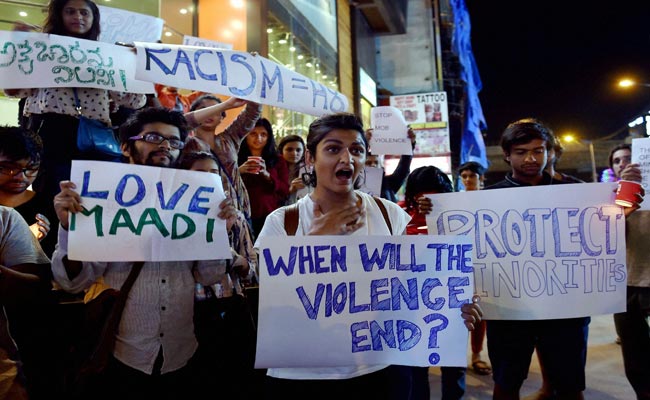
Late at night on 30 January 2016, a Tanzanian woman was dragged out of her car, stripped, and beaten in the south Indian city of Bengaluru. A local vigilante mob decided to punish her in this way because half an hour earlier a 35-year old Sudanese male driver, Micah S. Pundugu, had run over a local female resident and sped away. The Tanzanian student had no clue about the accident. Nor did she have any connection with Pundugu. Yet the crowd allegedly paraded her naked, and torched her car presuming that since both were African nationals there had to be a connection. When a local bystander tried to help her by handing her a t-shirt, he was thrashed too. The 21-year old woman – a second-year BBA student at Acharya College, Bengaluru – then tried to escape by climbing onto a passing bus that had slowed down to watch the ‘spectacle’. But the passengers immediately hurled her back into the arms of the mob. According to media reports, all of this happened as the local police stood by watching the events. When the woman finally managed to escape, she remained in hiding at a friend’s place for two days – with good reason given that there were reports of angry mobs scouting the area for African residents. In her conversations with the media, the Home Minister and the police chief, the Tanzanian student later noted that when she sought to file a police report soon after Saturday’s incident, the policemen told her she could file the report only after she brought to them the Sudanese national responsible for the accident.

As public figures like External Affairs Minister Sushma Swaraj, social activist and actress Nandita Das, and journalist Vir Sanghvi publicly condemned the incident, others like Karnataka Home Minister G Parmeshwara denied both its racial and sexual overtones. Union Law and Justice Minister DV Sadananda attempted to explain away the mob violence by emphasizing that Africans in India were involved in “illegal activities”, and outstayed their welcome in India on “expired visas”. Soon enough the issue devolved into political mudslinging between the BJP and the Congress parties over the issue of Congress Vice President Rahul Gandhi’s silence on this occasion vs. his prompt response in the Rohith Vemula suicide.

The latter kinds of response swiftly obfuscated the very real issues of everyday racist and sexual violence faced by African nationals in India. However, outraged by Sunday’s incident, several African students spoke out about their everyday encounters with racism. “People call us names. The ‘N’ word, blacky, blackberry, even ‘monkey’. It happens on the road while driving, at public places and even at the locality we live in”, said BSc student Axell Mouassoumy from the Republic of Congo. Abigail noted how her beloved Bollywood films are definitive in shaping prospective students’ expectations of India, i.e. they expect the same kind of warmth and color as portrayed in those films. But they are often sadly disappointed by the reality of racist attitudes in the country. Ironically, Bollywood films also perpetrate denigrating stereotypes about blacks and Africans. As Sai Hussain has noted, black characters in Indian cinema continue to be “written one-dimensionally, and often negatively”.

The Bengaluru incident is only one of the many recent cases of extreme violence against Africans in India. Other cases reported in the media include:

  • The stoning of Burundi national Yannick Nihangaza in April 2012. Yannick was heading to a party when nine young men repeatedly assaulted him with stones. Yannick’s injuries put him in a coma for 2 years ultimately leading to his death in July 2014.
  • The New Delhi Rajiv Chowk metro station case where three African male students were mercilessly beaten with fists, and sticks in September 2014. They “were allegedly “misbehaving with women.” The crowd looked like “a lynch mob beating the black men with sticks while yelling, ‘Bharat Mata Ki Jai’” i.e. “Victory to Mother India”.
  • The robbing and gang rape of a 24 year old Rwandese woman returning to her home near Delhi University, in December 2012.

In a critique of violence against Black people in India, journalist Palash Krishna Mehrotra wrote, “Indians may scream ‘racism’ abroad (U.S.A. and Australia) but they see no problem in mistreating the black community or anyone who looks different, at home”.

It is high time we realized the gravity of the situation, and took action to stop such minority discrimination and targeted violence in India. How can we continue to proudly claim the legacies of Gandhi and Gautam Buddha when we cannot follow their basic lessons in non-violence and respect for individuals of all classes, castes, and colors? No matter how developed a nation we become in terms of smart cities and world-class physical infrastructures, if we cannot show basic human respect and consideration towards gendered and ethnic minorities and immigrants; if we cannot respect trust in the law and order mechanisms of our country, the “Incredible India” we know and love will soon implode from within.


(Photo Credit: NDTV.com)