The women of Mali: “Indignons-nous!”


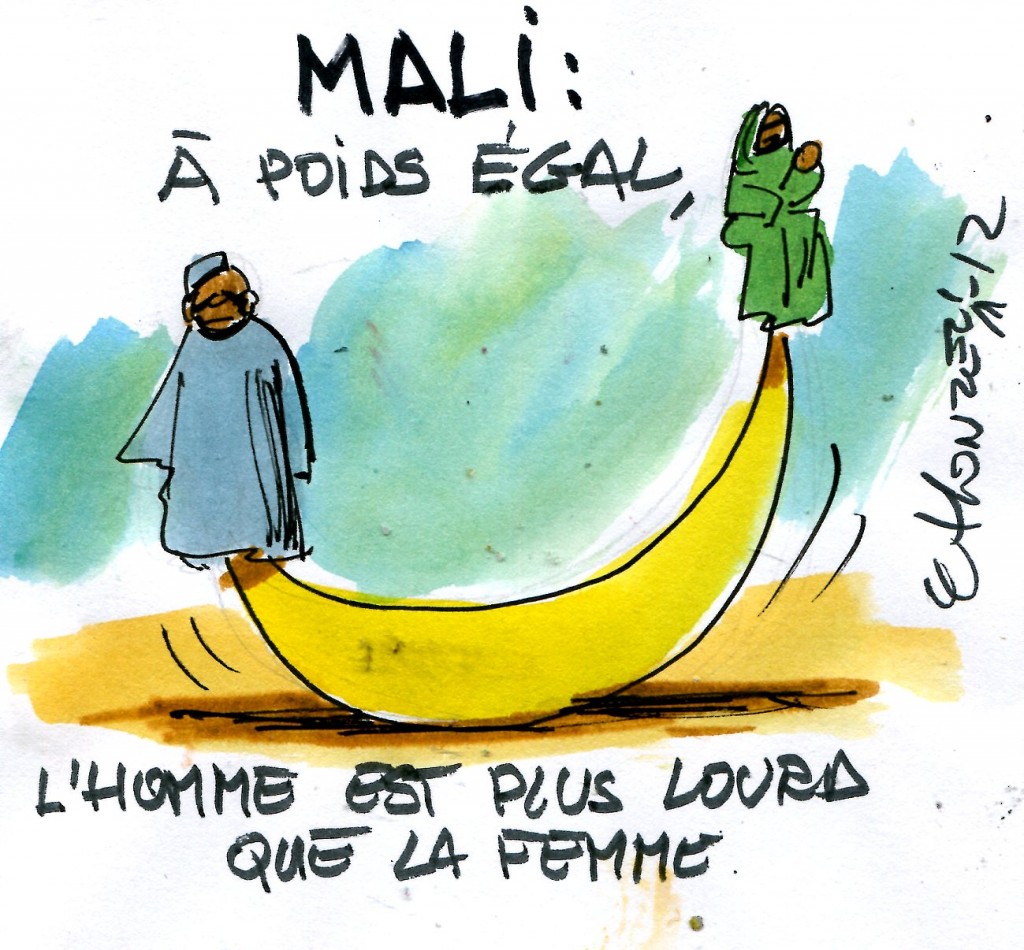
On December 2, 2011, the Malian parliament passed a Family Code, which threatens to set back women’s rights in Mali quite considerably. In 2009 the Parliament had passed a fairly progressive law, which didn’t quite bring women and men to equal status, but was a major step in that direction. Conservative, mostly religious, forces swung into action. The President quickly rejected the law, and sent it back to Parliament, where it has sat for two years. The new bill declares women’s legal obligation to obey and serve their husbands, as well as the husbands’ singular leadership, or dominion, over the household and all within it. Many argue that such terms violate the national Constitution, specifically in the articles where it codifies the meaning of Malian nationhood as an independent, democratic, sovereign, secular republic.

Women of Mali were immediately, and continue to be, indignant. More than indignant, they are indignées. They are organizing the Malian Spring.

The `world’ knows and often recognizes the labor and leadership of Malian women. Women like singer-songwriter Fatoumata Diawara, currently setting the world ablaze, and the even-better known singer Mariam Doumbia, who with her partner Amadou Bagayoko, continue to welcome the world to Mali and to set the dance floors on fire.

Militant and feminist women singers like Oumou Sangaré join younger defiant women singers such as Khaira Arby. Fiercely feminist women writers such as Oumou Ahmar Cissé have been writing, and organizing, for the rights and autonomous spaces of women and girls, while visual artists, like photographer Fatoumata Diabaté, continue to document and interpret the worlds of social relations, and in so doing awaken the art world to a new kid on the block.

Meanwhile, women like Fatoumata Dembel Diarra, First Vice-President of the International Criminal Court; and Cissé Mariam Kaidama Sidibé, current Prime Minister of Mali and the first woman PM of the country, have kept on keeping on, breaking new ground, shattering old glass ceilings.

This a short list, an incomplete list, of Malian women who have been identified, in the last year, as `women to watch’, women to follow. And they are on the move.

Some twenty organizations started a petition, NON AU NOUVEAU CODE DES PERSONNES ET DE LA FAMILLE DU MALI  ADOPTÉ LE 2 DÉCEMBRE 2011! It begins: “Indignons-nous face au nouveau Code des personnes et de la famille, qui vient d’être adopté en seconde lecture par l’Assemblée Nationale, le 2 décembre 2011.” That opening has two senses. First, we are indignant, or outraged, at the new Code. Second, and more to the point, we are the indignants, les indignées, and we are fomenting indignation.

Women’s organizations like WILDAF Mali, Women in Law and Development in Africa, have been pulling women, and men, together into various formations to inform and to organize. On December 31, they pulled together representatives from over twenty organizations to think through the intricacies of the new bill and of the new moment, to strategize and to begin to implement counter-strategies. And they are on the move.

This is what Malian women do. They organize. They don’t wait. Some have suggested, “For more than 10 years, women in Mali have been waiting for the adoption of a Family law to protect their fundamental rights.”

The women of Mali have not been waiting. They have been organizing, and now … they are les indignées du Mali, and their battle cry is direct: “Indignons-nous!” That phrase means Spring is coming to Mali. Indignons-nous!


(Photo Credit: Contrepoints)

Jakadrien Turner: there was no mistake


Jakadrien Turner walks with grandmother Lorene Turner and mother Johnisa Turner

Jakadrien Turner is a United States citizen. She is fifteen years old. She speaks no Spanish. She is African American. Last year, she responded to the death of her grandfather and the divorce of her parents by running away from her home in Dallas. Her grandmother immediately started to search for her.

At some point, Jakadrien Turner was picked up by police in Houston, apparently for theft of some sort. She gave police a false name. Remember, Jakadrien was fourteen years old at the time. The name she gave turned out to be that of a Colombian undocumented resident.

And so, Jakadrien Turner, at the age of fourteen, speaking no Spanish and with no contacts in Colombia, was deported. Yes, she was.

Today, finally, Jakadrien Turner was returned to the United States and to her grandmother, Lorene Turner’s, custody.

The news media and the blogs all agree that Jakadrien Turner was “mistakenly deported”. From Colorlines to Feministing to CNN to local Texas media, they all say the same thing. Mistakenly deported.

There was no mistake.

A system that puts children in prison for life, a system that deports unaccompanied minors, a system that treats women and girls of color as just so much opportunity for private-prison profit and for abuse, that system always was designed to deport Jakadrien Turner.

This is the immigration system, which imprisons and deports thousands of United States citizens, and does so ferociously. There was no mistake. The immigration system did what it does, what it is designed to do. It deported a fourteen-year-old African American girl, this time named Jakadrien Turner, who spoke no Spanish, who had no contacts, who was unaccompanied, and is and was a United States citizen.

Deal with it. Occupy the immigration prison system. There was no mistake.


(Photo Credit:  AP Photo/Mike Fuentes)

Women indignadas carry Tahrir Square and Spring, and occupy prison

Women occupy Yare Prison in Venezuela

In Nigeria this week, in response to fuel prices and, even more, to astronomical unemployment and crushing hopelessness among young people, protests, and more, have punctuated the landscape. Occupy Nigeria. Labor unions, women’s groups, farmers’ groups and others have joined, and to a certain extent followed, the lead of their younger comrades. In Kano, for example, the youth have established what they call “Tahrir Square”. Elsewhere, some say that an “Arab Spring” is coming to Sudan, to Zimbabwe, to a theater of engagement near you.

In Haiti, as in Chile as in the United Kingdom as in Spain, students are protesting the inequality of education and the crushing hopelessness it produces. As various forces attempt to privatize a university opening in Limonade, the students of the University of Haiti, l’Université d’Etat d’Haïti, have declared themselves indignés. Indignados.

We are all, or almost all, moving towards our own Tahrir Square; we are all, or almost all, indignés, indignados. Language, concepts, actions not only exceed the borders they cross, they redefine notions of nationhood, identity. Or such is the dream and hope. Indignados articulate with Zapatistas articulate with Arab Spring and Tahrir Square articulate with indigenous movements and keep sending out new feelers, new shoots, new threads that somehow link new and old into something possible, something happening right now.

And so in northern Venezuela this week, 800 women and 150 children occupied the Yare prison complex. They came to visit their loved ones, who suffer overcrowding and overly long waits for trials, as so many do in so many prisons around the world.  Then, they simply refused to leave. They `self-kidnapped.’ They invaded and occupied the prison space with their indignation.

950 women and children looked at armed guards and said, “Nope, we’re not moving.” They invented Spring, the beginning of a kind of liberation.

You want to know what this Spring could mean? Ask the many immigrant women in US immigrant detention centers, women like Julie, who are told they have no right to legal representation, no right to due process, because, well, they’re not in `prison’. They’re in `detention.’ And so they sit, watched, and often sexually harassed and worse, by guards. Most of the detention centers are privately owned. Profit flows from the time women, mostly women of color, sit and wait.

Many of the women live with mental health illnesses. Actually, many are in crisis. Many of the women struggle with the consequences and scars of domestic violence. Many of the women know they are in `detention’ because their English `failed’ them, and because, though they lived in neighborhoods in which English was a second language, somehow the police only spoke English. Who’s failing whom here?

This week, the young women and men of Nigeria have urged us to occupy and liberate public policy. The young women and men of Haiti have urged us to occupy and liberate education. And the young women and children of Venezuela have called on us to occupy prison.

Occupy prison. We have been occupied by the global prison for far too long. Follow the lead of the women and children of Venezuela. Occupy prison. It’s time.

Young women refuse to be sacrifices

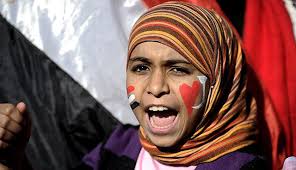
Welcome to 2012. The Arab Spring, the Occupy Spring, the Indignado Spring continue. In Tunisia, Egypt, Libya, Bahrain, Syria, Yemen, and beyond, women are on the move, on the march. In Saudi Arabia, women are on the drive as well. Young women.

Across the United States and Canada and beyond, young women are leading and expanding the Occupy movement. In Chile, women high school and university students are pushing to end the privatization of education, to open the schools to freedom, democracy, universal opportunity.

In India, young rural women are leading resistance campaigns to stop major land grabs.  In Afghanistan, teams of young women athletes are punching their way through centuries-old as well as recently devised glass ceilings.

In Kenya, young women are entering into local electoral politics. In Mauritius as well.

Women everywhere are on the move, keeping on keeping on, filling spaces with their voices, their bodies, their energy, their aspirations, their collective and singular power.

At the same time, women struggle with a master narrative in which they only function as sacrifices. In India, two farmers sacrifice a seven-year-old girl, Lalita, in order to ensure good crops. In Afghanistan, a fifteen-year-old girl, Sahar Gul, struggles to survive, and to live with dignity, having fled the torture inflicted on her by her husband and his mother and sister. When she first fled, the State actually returned her to `the family.

In the United States, girls like seventeen-year-old Nga Truong, are routinely forced into confessing crimes they didn’t commit and then are sent off to prison. In the United States, seventeen-year-old girls like Samantha L. are sent to prison for life, without possibility of parole.

In Australia, teen-age girls, like Danielle Troy, have to plead for compassion rather than punishment. Their crime? Being mothers.

And in South Africa, two teenage girls are attacked by a crowd of 50 or 60 `adult’ men. Why? Because one of them was wearing a mini-skirt. Four years ago, another young woman, Nwabisa Ngcukana, was stripped and assaulted for exactly the same `crime’, at exactly the same taxi rank.

From domestic violence to more general sexual violence to mob violence to State violence and beyond, the patriarchal story of young women is the story of being-sacrificed. If a man is told, by no less than God, to sacrifice his son, we are told that is a tragedy. A moral and ethical crisis. But where is the mother of that son in the story? And what if, instead, the father was told, by no less than God, to sacrifice his daughter? Would that too be considered a tragedy? An ethical and moral crisis?

Not by the patriarchs, it wouldn’t, as the Biblical tale of Abraham and Isaac so aptly demonstrates: “It is difficult not to be struck by the absence of woman… It is a story of father and son, of masculine figures, of hierarchies among men… Would the logic of sacrificial responsibility within the implacable universality of the law… be altered… if a woman were to intervene in some consequential manner? Does the system of this sacrificial responsibility and of the double `gift of death’ imply at its very basis an exclusion of woman or sacrifice of woman? A woman’s sacrifice or a sacrifice of woman? Let us leave the question in suspense.”

Women, and in particular young women, are saying, “No.” They reject the story that excludes them and the  `suspense’ that reduces them. They are saying – with their bodies, voices, actions and deeds – women and girls are not to be sacrificed. If `the Law’ says they must be, the Law is wrong. Women are making a better Law, living out a better story, and creating a better world. Another, better world is possible.


(Video Credit: WBUR)

Thank you to the women of Egypt

A court in Egypt ruled yesterday, December 27, 2011, that imposing `virginity tests’ on women prisoners in military prisons is wrong and unconstitutional. The court is expected to further decide that such tests are completely illegal, which would open the possibility of financial compensation for the wrongs committed.

This is one of two cases filed by Samira Ibrahim and Maha Mohamed, two of the women who had been subjected to the test. The other, equally important case challenges the referral of prisoners to a military court.

The court’s decision was a great one. The greater act, however, was that of Samira Ibrahim, Maha Mohamed, Salwa al-Hosseini and all the women across Egypt who have organized, pushed, repelled attacks, and kept on keeping on. When they have been attacked, they have said, publically, “I tell female activists go to the square and don’t be afraid, this is our square.” And then, they have gone to the square, to all the squares and all the streets.

Women pushed Mubarak out of office, and women today are pushing at more than the military. Egyptian women are pushing at patriarchy itself.

Much of the focus of the last day has been on Samira Ibrahim, a woman who refused to stay silent, refused to submit, refused to behave. While Samira Ibrahim is indeed a courageous and feminist woman, she is not “the woman” behind the ban nor is she “one brave woman.” Rather Samira Ibrahim is one of the women, one of the brave women, who have opposed the assaults on women and continue to do so.

At the beginning of the year, when the women of Egypt pushed Mubarak out, the world watched, and shared and cherished, their names. Today, as the year closes and the women of Egypt assault the very foundations of State patriarchy, we again remind ourselves that behind every individually named women – such as Ghada Kamal Abdel Khaleq, Sanaa Youssef, Samira Ibrahim, Maha Mohamed, Salwa al-Hosseini, Mona Eltahawy, Mona Seif – and behind every named women’s organization, such as Nazra for Feminist Studies or the New Woman Foundation, there is a world of women, on the march.

They know the military, they know the violence, they know the patriarchy, and they reject them, one and all. The women of Egypt are neither surprised nor daunted when a military prosecutor condemns the end to `virginity tests.’ They are, instead, in the streets, affirming their womanhood and their humanity, “I will not give up my rights as a woman or as a human being.”

So, as the year ends, let’s say, as Samira Ibrahim did after she heard the verdict, “Thank you to the people, thank you to Tahrir Square that taught me to challenge, thank you to the revolution that taught me perseverance.” Thank you to the women of Egypt.

(Photo Credit: ElMundo.es/AFP)

The women of Arlandria are organizing … and they vote

On December 17, 2011, the Alexandria City Council overwhelmingly voted to ignore low- to moderate-income residents of the Arlandria neighborhood who came to City Council to oppose a so-called redevelopment plan. Most of the residents who came and spoke were Latinas. Some were high school or college students. Some were young women workers. Some were women elders, who have lived in the neighborhood for decades. Many were members of the Tenants and Workers United, others small business owners, and some simply neighbors and friends.

Women who had grown up in the neighborhood, joined youth groups and women’s leadership groups and now attend college. Women from outside women’s leadership groups who had moved to the neighborhood because of its diversity and promise. To a person, they described their fears and aspirations, and a planning process that actively excluded them. To a person, they were ignored.

Each woman looked the Council members in the eyes and asked, or pleaded, or demanded that they slow down the process, that they listen, really listen, to what was being said. Each woman explained that she has had a critical role in building and sustaining the vibrant community of Arlandria. Each woman was ignored.

The women argued that the plans for upscale development [a] are a lousy deal, [b] threaten the fabric of the community, and [c] were devised without any real consultation.

Here’s the plan: turn a low-lying strip mall into two massive six-story buildings that will include 478 residential units. If the buildings are too high, as they are by city standards, throw in 28 `affordable’ housing units … out of 478, and get a waiver. This `affordable’ is designed for those earning around $50,000 a year. Basically, no one currently living in Arlandria earns that. So, no one currently living in Arlandria will qualify.

Then, claim that 450 upscale units in a tight neighborhood will have no impact on the rest of the housing market in the neighborhood. Nearby landlords will not raise their rents. No one will be dislocated. There is no need to worry about gentrification.

When the actual neighbors look at you in disbelief, tell them that they’re getting 28 new units that weren’t there before. Those units will go to someone else, but that’s not `our’ problem.

If anything else comes up, such as questions of traffic and parking, questions of public lands and recreational centers, respond with assurances and vague promises that everything will turn out fine when the time comes.

That was the plan and that was the argument presented to the residents of Arlandria by the Alexandria City Council and its staff.

The Council altogether ignored the fabric of the community. For almost thirty years, the Arlandria community has struggled to create a decent place for working people across generations; for Central and South American, African and Asian immigrants and their children, many of them US citizens; a decent place for all low income people; a decent place for all people. The Council refused to recognize that labor of dignity. Sometimes, decades of creating a community fabric must be tossed onto the trash heap of history… in exchange for 28 `affordable’ units.

The City Council did respond, at length, to the claims of lack of inclusion. They insisted that they had tried to `include’ the residents, but the residents had proven themselves to be difficult. The City Council, with one exception, Alicia Hughes, then began to express resentment at the exclusion claims and its claimants.

What’s going on here? The City Council outsourced inclusion, and democracy, to its staff. The staff reported that they were doing the very best job possible. Who monitors the staff? The staff monitors itself. When over forty people came to the City Council to say that the staff had not included them and never had a real consultative process, and that the so-called advisory groups were mostly developers and landlords, what did the City Council do? It turned to the staff, and the staff said, “We tried.”

And nobody on the City Council asked, “Why then do all these people say you have created a culture of exclusion?”

What happened in Alexandria happens everywhere. The State outsources inclusion, under the mask of liberal democracy, and then, when those who have been excluded protest, the State resents their presence, their voices, and their claims.

Meanwhile, in Arlandria, as everywhere, the women are organizing. And, as one Latina college student said, they vote.


(Photo Credit: WAMU.org/Emily Friedman)

The world is a ghetto


The world is a ghetto

The world is a ghetto
right up your very street
softball on a world scale
in little Belthorn Estate
(the local stadium filled)

(A neighbour is aghast
at the non-coverage
of the 2-week-long event)

The world is a ghetto
Junior Women’s Softball
a first in South Africa
a first out Africa-way
here on the Cape Flats

The world is a ghetto
reportage in local papers
restricted to group areas past
(is media self-censorship at work)

World Championships
Young Women
International Guests

What additional tick-boxes
do bureaucrats require
post-16 days of activism
of no violence against women and children

No footballing galacticos here
spitting and cussing and
abusing women on the side
(it’s just not cricket)

(This little revolution
will not be televised
not newsworthy enough
for the evening news)

The world is a ghetto
The global village is here
Where are we????????

The morning after (after I had teased a few Canadian softballers about drinking Canada Dry), a neighbour and I have an “over the wall” tête-à-tête, 18 December 2011; me with War and George Benson’s old ditty “The World is a ghetto” in mind.


Samburu women haunt the empire of charity

The Samburu of northern Kenya are pastoralists, and they are under attack. According to Survival International, the Nature Conservancy and the Africa Wildlife Foundation, two US-based `charities’, bought land, lots of it, from Daniel arap Moi. How’d he get the land? Good question.

The Samburu, who had been forced out of nomadic pastoralism by the encroachment of fenced off ranches, had settled there twenty years earlier. For twenty years they used this piece of land for grazing and access to water. They made land decisions on communal interests, with no one having the right to permanently dispose of the land. While the decision making process was dominated by male elders, women, especially married women, were involved in decisions concerning land use and allocation.

Until Daniel arap Moi bought the land, no questions asked. Then he sold it … to `charities’.

Since the sale, the Samburu have been harassed, beaten, raped. The lucky ones have `simply’ been evicted and had to fend for themselves in makeshift lean-tos. The Samburu have gone to court to retain their land … and to get some justice. Africa Wildlife Foundation has `gifted’ the land to Kenya, for `conservation’.

It’s a familiar enough story. “Native people”, “Africans” are caught, or not, in the crosshairs of conservation, charity, and gift economies bestowed upon them by the good people of the Global North.

But there’s more. Women. The Guardian featured Samburu women prominently … in pictures. There “Samburu women sing a song” and “the women wear colorful beaded necklaces.”

Samburu women do more than sing songs and wear colorful beaded necklaces.

It’s not the first time that foreigners have visited sexual violence on Samburu women … in the name of progress and civilization. For the past fifty years the Kenyan government has leased land in Samburu District to the British military. It’s a training ground. Over 600 complaints of rape have been filed against the British military. Women like Miliyan LeKanta, Lydia Juma and Nigaripen Lesiamito have testified, in public, to the rapes. Testimony that resulted in their isolation and even expulsion from their own communities. The British `internal’ investigation found the military not guilty. Then the Kenyan government `lost’ the evidence. As the women’s lawyer explained, “There is no glory in reporting rape.” That struggle is ongoing … and it’s more than colorful beads and the singing of songs.

Locally, the Samburu Women for Education & Environment Development Organization has been key in documenting the devastation of the evictions and abuse on the Samburu. In their report, which Survival International sent to the United Nations, they have shown the ways in which women as herders and farmers have been rendered helpless by the violence of police. They have reported as well on women who have had to watch as their husbands have been beaten, sometimes to death, by police or by paramilitaries, and then left for dead in the fields. Houses are burned, villages ransacked, women raped. It’s the price of charity.

And who pays the price?

The bitter irony of conservation here is that the Samburu women are actually at the heart of the indigenous preservation of wildlife, in particular of elephants. The Samburu claim a kind of kinship between elephants and Samburu women, a kinship of everyday village labor. This kinship results in cultures of respect and honor. But those kinds of ties mean nothing to an important not-for-profit multinational charitable organization. After all, those ties involve Samburu women, singing and wearing fantastic bead necklaces.


(Video Credit: Vimeo / Cultures of Resistance)

They are neither mules nor witches. They are women.

Janice Bronwyn Linden

Amina bint Abdul Halim bin Salem Nasser. Janice Bronwyn Linden. Sixteen elderly women, unnamed.

On Monday, Amina bint Abdul Halim bin Salem Nasser was beheaded by the Saudi Arabian government. The charge was witchcraft and sorcery.

On Monday, Janice Bronwyn Linden was executed, by lethal injection, by the Chinese government. The charge was drug smuggling, of being a `mule.’

On Monday, it was reported that, in one district of one province in Mozambique, from January to November of this year, sixteen elderly women had been accused of witchcraft and then were murdered.

Witches. Mules.

Amina bint Abdul Halim bin Salem Nasser was arrested in 2009. She was in her sixties. The charge was that she engaged in unorthodox healing methods. She charged people as much as $800 a session for … the claim of a cure. There is no way of knowing if this was, indeed, a fraud or if Nasser believed in her methods. She was never given the chance to explain. Instead, she was deemed “a danger to Islam”, and that was that.

Janice Bronwyn Linden was a thirty-five year old South African woman, from KwaZulu Natal, who was arrested in 2008 for smuggling three kilograms of crystal methamphetamine. The South African government tried to intervene, tried to appeal to the Chinese government for clemency. As is the practice in China, Linden was not informed of her impending execution until the morning of the day she was to die. Her family is distraught and despondent. South Africa, at least according to discussions in online forums and newspapers, is divided as to the execution. Many feel Linden deserved her fate. Why? She was a mule. She smuggled drugs into China. She should have known better. She `chose’ her path. She was a mule.

In Mozambique, in the district of Marromeu in the province of Sofala, women elders are under attack. A group of women elders, mulheres da terceira idade, women of the third stage, explained that when young men encounter failure, in work, in school, in life, they blame the elder women, they charge them with witchcraft, and then, filled with righteous indignation, they murder them. The women asked: “Estas situações estão a ser frequentes na nossa sociedade . Será que possuir 50 anos de idade deve constituir motivo para a idosa ser considerada feiticeira e condenada à morte?” “These situations are becoming common in our society. Is being old sufficient reason for being considered a witch and being condemned to death?”

Witches. Mules. These are terms that legitimate the murder of women. And they are terms of the current period, our period. They are the names of what is becoming common in our society. The real story is not crime but women’s power and audacity, “the struggle between orthodox men of the Establishment and an unorthodox woman making claims on forms of social power and authority. Ms. Nasir was low on the social hierarchy but making claims to high status by virtue of magical gifts. She posed not so much a danger to Islam as a danger to the authority of the clerics.”

The real crime is the witch-hunt. Amina bint Abdul Halim bin Salem Nasser. Janice Bronwyn Linden. The sixteen women elders. They are neither witches nor mules. They are women. Remember that.


(Photo Credit: South Africa History On Line)


The field of tension of informal settlements in the new millennium


Over the past decade, South Africa witnessed an upsurge in negative labelling of informal settlements in policies and programmes, the removal of informal settlements from strategic positions in the city, and legislative amendments to facilitate such ‘eradication’.

Why were South African politicians and different parts of the state so confident that their negative statements about ‘slums’ and their drives to evict and eradicate were legitimate and beyond question?

Why did they find it appropriate to resort to repealed apartheid era legislation, criminalising the formation of informal settlements and making it easier for municipalities to evict?

Informal settlements occupy a contradictory position in urban policy.

On the one hand, there is articulated concern about urban poverty, and acknowledgement of the need to increase access to water and sanitation and improve the lives of ‘slum’ dwellers. These concerns are captured in the Millennium Development Goals (MDGs).

On the other hand, there is the encouragement to country governments for cities to strive for global economic competitiveness in order to better function as engines of economic growth.

One source of this encouragement has been the UN’s Human Settlements Programme, UN-Habitat, in particular through its involvement in Cities Alliance’s ‘Cities Without Slums’ initiative. UN-Habitat uncritically internalised ‘Cities Without Slums’ as a slogan. The UN attached this slogan to MDG 7 Target 11 ‘to significantly improve the lives of at least 100 million slum dwellers by 2020’.

The presence of unsightly ‘slums’, of visible poverty and squalor in strategic locations, frustrates states in their efforts to portray an investor-friendly image to the world. This dynamic differentiates MDG 7 Target 11 from the other MDG targets.

MDG 11 contains an un-resolvable contradiction. Improving the lives of ‘slum’ dwellers (rather than removing them from strategic locations in the city) sits at odds with efforts to make the city more investor friendly.

City authorities, in their attempts to attract and hold on to investors, encourage and protect stakes in the urban land market. The adoption of this approach is not to be questioned. It is not submitted to public and political debate.

In South Africa, preparation for the 2010 Fifa World Cup brought this into stark relief. The urgent expenditure of massive public funds remained unchallenged. They resulted in soccer precincts and the acceleration of world class transport improvements, all enhancing economic stakes in the urban land market.

Spin-offs were promised to all, unconvincingly also to informal settlement dwellers. The provision of water, sanitation and housing to a fraction of informal settlements in turn received much public political attention.

The N2 Gateway pilot project in Cape Town, South Africa’s flagship ‘slum’ redevelopment exercise from 2004 to 2010, symbolised a tendency to override policy and legislation, as did numerous cases in South Africa’s six largest cities to evict informal settlement residents from strategic locations without court order and without provision of alternative accommodation.

All these interventions amounted to attempts at exclusion of the poor from South African cities.

In the light of those attempts, urban informality needs to be reinterpreted. It can no longer be viewed merely as the extra-legal, nor as a continuum with blurred edges, as defying measurement, or an organising logic or idiom of planning. Informality needs to be recognised as a field of tension.

While households living in informal settlements often choose an urban life and many find themselves with no alternative, they are confronted with more than just the physical inadequacies and hardships of informality – the lack of basic services, the unregulated and often overcrowded conditions, the inadequacy and insecurity of the shelter.

Recognising the reality of informal settlements as a field of tension forces us to look beyond mere physical symptoms. It forces us to grapple with the underlying causes of informality and the underlying causes of non-improvement of people’s lives, such as top-down interventions.

It also forces us to depart from a normative framework that labels informal settlements as ‘slums’ and condemns every aspect of these residential setups.

It forces us to recognise the tension between creativity and adversity which shapes and often defines ingenious solutions, models of human co-existence that are largely lost in the formal city. Opportunities for such forms of urban living and survival are closed down through tightened anti-land invasion measures and ‘slum’ eradication drives.

City authorities often repressively dismiss demands from economically weak households for space within the city. Their assumption is that such demands stem from poor migrants entering the city in large numbers.

However, the population of many cities in Africa is growing more slowly than is generally assumed. Urban poverty is largely generated by shrinking formal employment. In many instances migration has remained circular, binding rural with urban livelihoods on an ongoing basis.

Poor people’s responses, alternatives and innovations have been homogenised and problematised. Global usage of the term ‘slum’ since 2000 forms part of this homogenisation and problematisation. `Slum’ justifies blanket eradication of poor people’s footholds in the city.

In 2010, something different began to happen. South Africa experienced an about-turn with a new target to improve the lives of 400 000 households by 2014 through in situ upgrading of informal settlements.

Now the government faces the difficult task of chiselling away at the deeply entrenched problematisation and homogenisation, which has long informed largely flawed re-housing programmes. This prejudice has also blocked any investigation of the feasibility of in situ upgrading rather eviction and eradication. Perhaps it’s time to respect rather than remove those who live in informal settlements.


(This article is based on the author’s book Cities with “Slums”: From informal settlement eradication to a right to the city in Africa, University of Cape Town Press, Cape Town, 2011)