India’s film students are on strike and fasting. Is the Indian government listening?

While the Indian Prime Minister Modi’s upcoming visit to Silicon Valley is being much discussed in the media, less visible seems to be his government’s disturbing treatment of India’s film students over the last three months. Just hours ago, The Hindu and The Indian Express both reported that in India, the FTII students’ strike has reached 100 days, with no solution in sight. The Film and Television Institute of India in Pune (est. 1960) is arguably the most prestigious film school in India. For the past 10 days, many of these striking students have been fasting to protest the political appointment of a BJP party worker Gajendra Chauhan to lead this illustrious institution; five students were hospitalized in the last two days.

India’s Information and Broadcasting Minister who controls the institute and its appointments seems to show no interest in visiting the campus, or resolving the issue. Having called the students thrice to Delhi for talks, with no results, the government seems unable to hear the legitimate perspective of India’s students and indeed, the art and film community—which has resoundingly spoken up, tweeted, and marched, in support of the students’ demands. From Bollywood celebrities like Pallavi Joshi, Anupam Kher, Rishi Kapoor, Ranbir Kapoor, Kiran Rao, and others, to social activists and writers, many have concurred that FTII’s newest Chairman Gajendra Chauhan’s appointment is politically tainted, and students have a right to an education that is free from indoctrination in the dominant political party’s ideological agenda

The Indian film industry has a history of being strikingly diverse in terms of the politics, and the religious and ethnic affiliations of its various members. Indeed, India’s film, literary, and artistic community has historically been largely secular in its orientation. FTII is an educational institution that has produced some of the greatest artists and filmmakers of Indian cinema-experimental or ‘art’ cinema as well as popular films. No wonder then that the students of FTII have been upset at what looks like a political appointment of Chauhan as Chairman. Chauhan acted as Yudhisthira in the popular television series “Mahabharata” which aired on nation-wide state television from 1988-1990. That is his claim to fame in the world of film and television production; since 2004, he has worked for the Hindu nationalist BJP party. He hardly resembles the renowned and illustrious chairpersons who preceded him like the internationally acclaimed filmmakers Shyam Benegal, Mrinal Sen, and Adoor Gopalakrishnan; the legendary cartoonist R. K. Laxman; the actor, filmmaker and playwright Girish Karnad; and the writer and Padma Bhushan winner U. R. Anathamurthy, among others.

In comparison, students say, Gajendra’s appointment looks more like a reward to a good BJP party worker with a powerful position, than the appointment of a leader who has a track record of a genuinely creative body of work with national and international impact. Thus, FTII students have been on strike to protest his appointment: they want his resignation. One protesting student’s placard said: “We are against saffronisation of education;” in the meantime, the right-wing Hindu organization RSS has called the protest “anti-Hindu,” lending credence to the charge that the recent influx of BJP and RSS members in the institute’s ranks is politically motivated.

Some news reports note that the government seems to be intent on both privatizing and saffronizing the premier film school. However, if it wants to project a positive image in America with its claims of being an efficient and clean organization which will usher in “better days,” the Indian government must treat India’s students and schools better than it has thus far—and heed the legitimate demands of the striking young women and men for better, more qualified, institutional leadership. In support of the FTII strike, students on campuses across India’s cities have organized protests and will continue to do so: witness Delhi, Bangalore, Patna, Bhopal, Chandigarh, Thrissur and Lucknow.

So, where are the women? What remains unremarked is also the gender bias of these government appointments: overwhelmingly, it is men who have been appointed to the position of chairperson. In the past 20 years, FTII has only had 3 women full-time faculty; all 21 of its current faculty are men.
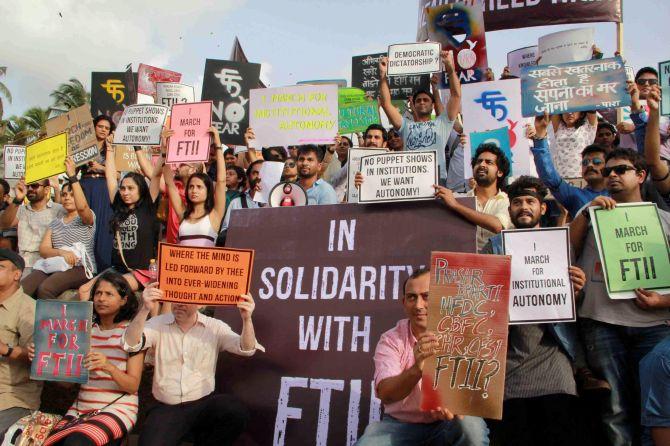
 

(Photo Credit: Rediff)

Radio WIBG: Lauren Tooker on student debt and women bearing the brunt

At the CADTM Summer University, the workshop on private debt and resistance broached the system of private debt as debt that is forced on people as public debt is forced on States. The workshop covered micro lending in Morocco, mortgage loan based eviction in Spain, financialization processes in Eastern Europe, and student loans in the UK.

Lauren Tooker talked to us about the student loan crisis in the UK. In 2012 a reform swept the universities in the UK introducing an important increase in education fees. This reform came with a system of loans specially designed to create a source of profit at the expense of equality in education. With a student debt system, women and minorities are losing space and rights.

The United Kingdom is the first European Country that has followed the path of the United States in the direction of for-profit education. As the scandal of the student unfair loan system in the United States is becoming more visible, finally hitting the news, the UK students have decided to organize and take action. Lauren came to the CADTM to link their struggle to the anti debt movement in general.

Resistance comes with conscientization, building spaces and organizing. Listen to Lauren Tooker.

(Recording by Brigitte Marti) (Debt Strike image: The Guardian)

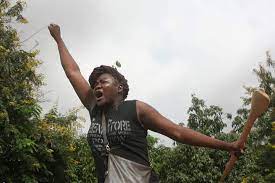
In Burkina Faso, women continue the spatula uprising. The struggle continues.


Last October, Burkinabé women picked up their spatulas and took to the streets, calling for the end of one-party and one-man rule. As women and as members of Balai citoyen, Citizen Broom, they charged the State with “a constitutional coup d’etat.” And they won, and ever since they’ve been organizing. On Wednesday, the military took control of the government, and the women have kept on organizing. Once again, they have taken to the streets, spatulas in hand.

Unable to organize in Ouagadougou, the women brought broomsticks and spatulas to the streets of Bobo-Dioulasso, the second largest city of Burkina Faso and the country’s economic capital. Once again, they demanded a clean sweep. Once again, women inspired others to principled, militant action.

Saran Sérémé, president of the Party for Development and Change, noted, “We must fight for the nation’s well being and for justice. The Burkinabé people are ready to defend ourselves, whatever the cost. We find the situation deplorable. We will not bow down to anyone.”

In Bobo-Dioulasso and across Burkina Faso, the women agree. They will not bow down, and they will stir the pot. In October of last year, hundreds of women marched, chanted, carried spatulas, and sparked an uprising, a spatula uprising. On Tuesday, tens of thousands marched in the streets. On Wednesday, a general strike was called, and soon after, the regime was swept out of power. The women did not put their spatulas away and they did not forget how to use them. The struggle continues.

Burkinabé women know the struggle continues. Women like Joséphine Ouédraogo, Genevieve Zongo, Mariam Sankara, and thousands of others know how to maintain the long march and the short sprint to democracy, while across Burkina Faso women hold on to their spatulas.


(Photo Credit 1: Twitter)

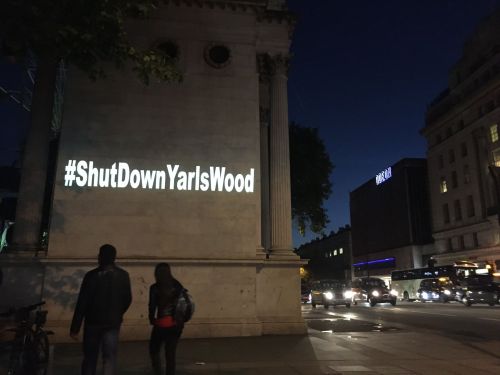
Yarl’s Wood’s “appropriate vulnerability” is violence against women

Every year or so, a new report uncovers the programmatic abuse of women asylum seekers in Yarl’s Wood. In 2006, Black Women’s Rape Action Project (BWRAP) and Women Against Rape (WAR) released Misjudging rape – Breaching Gender Guidelines and International Law in Asylum Appeals, which examined 65 rulings by immigration judges. The judges rejected rape claims in 65% of the cases, arguing each woman had failed to mention the rape early on and so must be lying. Since then, the reports have continued, and each shows the situation has, if anything, worsened. If everything stays the same, or declines, what’s new?

“Appropriate vulnerability.”

The most recent study, “Reason to disbelieve: evaluating the rape claims of women seeking asylum in the UK”, finds “the structural and practical obstacles faced in establishing credibility, and the existence of scepticism about rape claims and asylum-seeking more generally, mean that decision-making can often be experienced as arbitrary, unjust, uninformed or contradictory, making it difficult for women asylum applicants who allege rape to find refuge in the UK.”

In a more popular article this week, the author’s explained, “The structure of the asylum system, as well as working cultures around decision-making, can negatively impact women whose asylum claims involve rape allegations. Evaluations of credibility are often influenced by dubious assumptions regarding culture, gender, and sexual violence, and draw upon limited experience of, or empathy with, the peculiar challenges faced by ‘others’. The structural and evidential demands of the asylum process, as well as the political controversies that it attracts, do little to facilitate improvements in the handling of disclosures of rape. Ultimately, success in securing refugee status continues, for too many women, to depend upon their ability to position themselves as ‘appropriately’ vulnerable victims.”

Though grim, the report is in no way surprising. We know that asylum seekers who have been raped must struggle for justice, and, more often than not, don’t get it. We know that such is the case for women generally, and so even more so for the poor and the stranger in our midst. We know the misogyny that informs dismissal of claims of sexual violence. We know that the State and Civil Society built and maintain Yarl’s Wood, where survivors of sexual and domestic violence are not only routinely but brutally denied care services, as are their children, children who have often witnessed the violation of their mothers. We know that from before the beginning to beyond the end, the conditions are designed to further violate women asylum seekers, “this is a journey haunted by silence.” None of this is new, none of this is news, and we know and have known all of it for some time now.

“Appropriate vulnerability” suggests much more than “the treatment of those who come to the UK seeking protection from sexual abuse often remains inadequate.” It’s not inadequate. It’s designed to brutalize women. It is time; it is way past time, to stop analyzing the brutality of Yarl’s Wood as a lack or absence. The State wanted, and wants, a house of non-national women held in a state of perpetual and intensifying violence, and it built it, named it Yarl’s Wood, and called its light Day and its darkness Night, and behold …

Who aspires to “appropriate vulnerability”? No one should, but the State forces women to do so. We have had enough reasoned and balanced reports. We know it is time to end State violence against women, committed in our names. Do it now! #ShutDownYarlsWood #SetHerFree


(Photo Credit: CavaSundays) (Woodprint by Jacob Steinhardt, at Velveteen Rabbi)

Something has to change

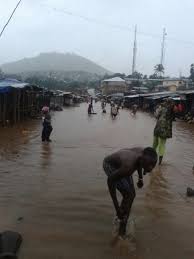
Something has to change in 2018. Something has to change, the gross injustice is no longer humorous or one for the ‘bear, how 4 do’ books. Sierra Leoneans deserve better and if the senseless deaths that have occurred this September 16th due to the heavy rains and loss of houses doesn’t further shock people into demanding change, I do not know what else will.

Before I fell into a deep gutter this mid-day, gulping brown germ infested gutter water, in the morning I accidentally splashed neatly dressed kids (about 7-9 years old). They screamed, one cried, and the group of them all cursed me out. I asked God for protection and guidance, fully aware that no one should begin their day with curses hanging over their head.

On my way to the clinic I stopped to grab coffee and the waitress at the café started laughing, explaining that her entire house had been washed away by the rains. She couldn’t stop laughing. Wilkinson Road, the bougie commercial area, is flooded, rubble scattered across the road. Behind the fancy wealth-signifying buildings and shops are slum communities where about four children have already died.

The roads are horribly made, lots of things don’t work, and there is absolutely no reparation offered to those who lose their lives, livelihood and health every day in this country because our social and political systems are weak with no real modes of accountability. .

Something has to change – beyond the self-glorifying messages that get shoved down our throats everyday by the ‘elite’ – something has to change. The worse part was seeing a minister’s big Prado drive past people drenched in water, crying, or stumbling on the roads and seeing the minister and his passenger laugh – yes laugh – at the scene.

Something has to change … this is not the Sierra Leone Sierra Leoneans deserve.

(Photo Credit: sierraloaded.com)

From Kerala to Florida, women farm workers are organizing and winning!


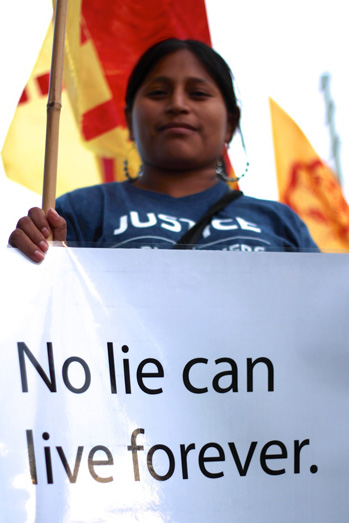
Around the world, women farm workers are on the move, organizing and gaining ground for women workers everywhere. This past week, women farm workers in Kerala, in India, and Florida, in the United States, won major victories. In Kerala, tea plantation workers, all women, rejecting the direction of male dominated unions and political parties, went on strike and won! In Florida, undocumented women farm workers rejected the business-as-usual of sexual exploitation … and won! Women farm workers are turning the common sense of global food chains into global food networks and communities.

In July, the Great Place to Work Institute and People Matters rated Kanan Devan Hills Plantation, the largest tea estate in Munnar, in Kerala, as one of the best places to work in India. In early September, over 5000 plantation workers, almost all women, replied, “No!” They went on strike, demanding higher wages and bonuses. Their strike lasted nine days. During that time, the women told trade unions and political parties that [a] that male-dominated unions and parties did not represent the women’s interests sufficiently and [b] the women could negotiate for themselves.

The women allowed only four politicians to join the strike. They unconditionally welcomed 92-year-old VS Achuthanandan, a founding member of the Communist Party India (Marxist) and widely respected for his integrity. They also allowed women politicians PK Jayalakshmi, Bindhu Krishna, and Latika Subhash to join the strike, on the condition that they would stay in Munnar until the strike was resolved.

On Sunday night, the women won their bonus demands, and called off the strike. The wage demands are still being worked out.

For over 20 years, Ananthalakshmi has worked the fields: “Men hardly get tough chores like us. We even load the sacks to the trucks and are disproportionately paid”. The struggle in the Munnar hills of Kerala is for wages, bonuses, equality, women’s dignity and women’s power. By enthusiastically welcoming VS Achuthanandan, the women workers demonstrated that women’s power is principled, rigorous and courageous in its forms of inclusion.

The line of women’s power from the tea fields of Munnar to the tomatoland of Felda, Florida is long and direct. On Friday, five women vegetable packers won a $17 million sexual harassment case. The five women had worked for Moreno Farms, Inc. They said they felt terrified whenever their supervisors threatened to take them to the cooler and trailer. Their bosses groped, threatened, and raped them. When the women refused to submit, the bosses fired them. Three of the five women were raped. When they went to the local sheriff’s office to report the rapes, the sheriffs did … less than nothing. A local attorney, Victoria Mesa, stepped in and took the case, and she persuaded the Equal Employment Opportunity Commission, EEOC, to represent the women.

Beatriz André, EEOC’s lead attorney in the case, said, “Having long been silenced by shame and fear, this trial offered these five women the opportunity to give voice publicly to their experiences and their desire for justice.” Robert E. Weisberg, regional attorney for the Miami office of the EEOC, added “I’m thrilled because this jury’s verdict sends a message to every other woman working in Florida’s fields. They do have rights, regardless of their immigration status.” For the Coalition of Immokalee Workers, this is a cautionary tale: “The women on Moreno Farms suffered unspeakable indignities that could have been prevented, had they been working on Fair Food Program farms.”

Moreno Farms closed in May, which means it’s unlikely that the women will see the 17 million dollars, but this is more than a symbolic victory. First, the women will receive special U visas for victims of crime who assist law enforcement in prosecuting cases. Second, the women won! Five undocumented Latinas won. This local victory is a cross-border, transnational victory, as has been noted in Mexico and beyond.

Tea and tomatoes are big global business. Over the past week, 5000 women farm workers on a tea plantation in Munnar and five women workers in a tomato processing plant in Felda have shown they are not too big to be cracked open by women’s power and mobilization for justice for workers, women, and women workers. The struggle continues!


(Photo Credit 1: Youth Ki Awaaz) (Photo Credit 2: Coalition of Immokalee Workers)

Radio WIBG interview: Tijana Okic


Tijana Okic

Tijana Okic

(Editor’s note: Today we inaugurate Radio WIBG (Women In and Beyond the Global). Brigitte Marti interviews Bosnian feminist activist Tijana Okic.)

From the CADTM Europe Summer University: The second day offered many workshops to continue the exploration of “The debt in all its state” and moreover the resistance that is being organized around the world.

In Women in and Beyond the Global we look for the voices and analyses that the neoliberal establishment would like to smother. Tijana Okic is definitely a voice that does not want to be smothered. She talked to us about her feminist commitment against this fraudulent racket organized around the story of the debt. Listen to her inspiring and important Bosnian perspective and testimony.


Recording and photo  by Brigitte Marti


Debt Over! A report from the Fourth CADTM Europe Summer University: Day One

For three days the Committee for the Abolition of Third World Debt, CADTM, is hosting its summer university. The theme is that the Debt economy needs to be investigated, as neoliberal leaders assert that debt governs society as a whole, proving that debt has become a key tool of the neoliberal economy. The goal of the conference is to look at multiple phenomena through the prism of the debt economy.

The conference is organized around several “itineraries”: debt in the South, debt in the North, environmental debt, audit, and feminist fights.

The first day started with a plenary session entitled “ La dette dans tous ses etats” (Debt in all its states), a play on words suggesting the multifaceted aspect of this neoliberal instrument.

The first speaker gave a snapshot of the cynicism of the situation that demands the scam that allowed the financial crisis of the patriarchal neoliberal to become the public debt crisis and the responsibility of the public. They play, we pay. In Europe, the offensive started seven years ago, taking aim at the social rights brought about by decades of social struggles. The recent financial reform Projet Barnier that was formed at the European Commission was influenced and largely designed by over 1000 financial lobbyists with a budget of 300 Million Euros.

The next speakers revealed the intricacy of finance and domination of the oligarchs in the form of debt in Ukraine that led to the current crisis that is still killing people.

After that, Gilbert Lieben, the Secretary General of the Centrale Générale des Services Publics, a Belgian union for public services employees, gave an overview of the work that unions have to do to debunk the traps of the debt system. He reminded the audience that, at first, the unions did not realize the importance of the formation of the concept of debt in social struggles.

Then, Olivier de Schutter, former United Nations Special Rapporteur on the right to food, exposed the connection between debt and farming as small farmers have been under siege since the agriculture sector has been open to free market deregulation.

CADTM spokesperson Eric Toussaint set the stage of the past and future stakes for the South in the debt economy. After listing several positive initiatives such as in Ecuador, Venezuela, Bolivia, and, to some extent, Argentina, he warned the audience of the possible devastating consequences for the South of a change by the FEDS of the interest rates in this intricate global debt system. He emphasized that alternative are not only possible but necessary if we want to break all forms of oppressions.

Amina Amzil, from Attac Morocco, delineated the feminist struggle. She explained the double burden on women in Morocco, where the debt economy devours 78% of the GDP. In Morocco between reductions in public social services and in public employment, women are particularly impacted. Austerity policies increase and intensify precariousness for women who are more likely to be illiterate, dependent and victims of domestic violence. Debt is another means of oppression for women.

The CADTM has been involved in organizing citizen audit of public debts everywhere in the world. Its latest involvement in the audit of the Greek debt under the aegis of Zoe Kostantopoulou, the President of the Greek Parliament, has brought attention to the importance of a transparent process in public policy.

The afternoon workshop, “Arming women against all forms of austerity”, addressed this lack of transparency as central to the exploitation of women. The workshop invited us to organize more effectively. As Sonia Mitralias said, we need new ways to imagine a different future.

Debt is gendered and the response must integrate women in their entirety and diversity. The group created a five-module educational kit, from austerity to what to do. One of the modules, “Exploitation of women knows no crisis”, helps participants understand that the few gains in women’s rights are again under attack. The audience was large and diverse and passionate. I met women from Cameroon, Tunisia, Morocco, and elsewhere.

Women in Belgium organized a feminist audit of the debt in which they account the number of services women provide for free, from reproduction and care work to cheap labor. Their conclusion is simple: the state incurs the huge debt, not the women! They called their project “La Facture” (the invoice, or the bill). The State plays, the women pay and pay and pay.

The fight against the debt economy is transnational and gendered.


(Photo Credit 1: CADTM)

Canada’s meager response to the current refugee crisis

Palestinians pay tribute to to Syrian boy Aylan Kurdi

Palestinians pay tribute to to Syrian boy Aylan Kurdi

“The true measure of the moral level of a society is how it treats the most vulnerable people,” –Noam Chomsky

As the woefully unprepared Europe struggles to handle the overwhelming influx of migrants who have endured perilous crossings arriving at its borders, Canada’s response has been terribly disappointing for a country that is proud of its record of compassion.

A week ago, the photograph of the three-year-old Aylan Kurdi lying dead on a Turkish beach, which woke up the world to the refugee crisis, also awakened the Canadian election campaigns. While the Canadian public ‘decisively and suddenly’ wants the government to start accepting more refugees, Canada’s federal leaders are still contemplating what Ottawa can do to help. The conservative Ottawa dithers, as Harper tries to approach this issue with the same unsentimental approach he brings to governing. As he stated in 2006, “My strengths are not spin or passion, you know that.”

The Liberal and NDP leaders who have also recognized this issue as a game changer in the upcoming October elections are trying to offer few specifics on how Canada could contribute as they still haven’t formulated any solid strategy.

Harper states that he has a target of settling 10,000 Syrian migrants over the next three years and 23,000 Iraqis by the end of this year. However, while pressing the necessity of ‘taking the military fight to Islamic militants responsible for the carnage’ to deal with the root of the problem, Harper said “We have plans to do more, but I would say repeatedly that as we are doing more, we can’t lose sight of the fact that refugee resettlement alone cannot, in any part of the world, solve this problem.”

Harper is concerned about security issues that could follow accepting refugees from the world’s current epicenter of ethno-religious violence. He suggests that these refugees require proper screening. But proper screening takes time and is a long bureaucratic process. As the NDP leader Mulclair said on Tuesday: “You shouldn’t have people in this desperate situation falling into a bureaucratic trap, where they’re being asked to produce identity papers as if you had time to renew your driver’s license when you were walking across the desert with your family”. He suggested that officials should be sent to the refugees in the camps and the Canadian military could help bring the refugees to Canada.

Trudeau, the leader of the Liberal Party, has pledged to take in 25,000 Syrian refugees if the party wins in October and has pushed the Liberals into the middle ground suggesting that Canada needs to keep in mind the importance of training the Iraqi fighters to stand up against ISIS, along with helping to ease the suffering of refugees. “We have a federal government right now that thinks military action is the only solution to the humanitarian crisis in the Middle East,” Trudeau said in Vancouver. “And we have an opposition party that takes the opposite extreme position that there is never a military role to play in solving challenges like the crisis in the Middle East.”

Recently it came to light that Aylan Kurdi’s family’s refugee application had been rejected in June by the Canadian Immigration Department, which allegedly drove the family to attempt their fatal voyage to Europe. Canada’s immigration minister, Chris Alexander, suspended his re-election campaign to investigate why the Kurdi family’s refugee application was rejected. Alexander claimed that “Canada has one of the most generous per capita immigration and refugee resettlement programs in the world”, saying that “the government was planning to accept 23,000 Iraqi refugees and 11,300 Syrians”.

In the wake of elections, the refugee crisis can become yet another rhetorical device to win the electorate, and then be shelved in the forgotten land of election promises. It is up to the public to remind the Canadian government of its moral responsibility following the election and pressure it to live up to its international image of an inclusive, peaceful, and immigrant-friendly society.


(Photo Credit: aboutpathankot.com)

When does Rosie the refugee become South African? Never?

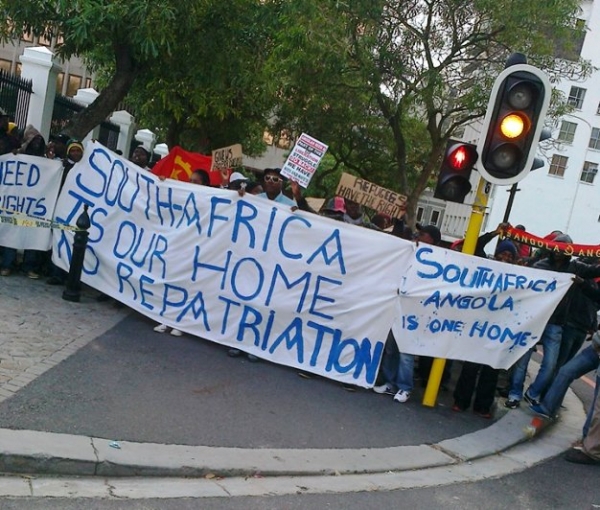
Rosie” was born in 1987 in Angola, during the civil war. In 1997, her father brought her and her three siblings to Cape Town, where he dumped them in a shelter and disappeared. At the time, Rosie’s siblings’ ages ranged from five to eight years old. Rosie has lived in South Africa ever since. She spent ten years in Angola, eighteen years in South Africa, but she’s still a `refugee.’ The war has ended, and so Rosie and her siblings are now liable for deportation, or not. “We don’t know Angola as ‘home’. We want to get student visas so we can stay here. We don’t have anything to go back to,” Rosie explains.

Last Friday, various reports circulated claiming that the South African government was set to deport as many as 2000 Angolan refugees, as well as a smaller number of refugees from Liberia, Rwanda, Sierra Leone. Over the weekend, the State leapt into action, explaining that it “is firmly committed to ensuring the fulfilment of its international obligations towards refugees and asylum seekers in terms of its ratification of the relevant international protocols.” Which means less than nothing.

Angolan community leader Jao Kaputo has been in South Africa since 1994. He explains the difficulties many Angolans face in the various registration processes, “Our homes were bombed. We lost everything, including documents. We are dispersed; our mothers went their own directions, and our fathers the other direction. As a result some of us are not documented, including children born here, and cannot apply for birth certificates.”

Pedro Nzazi” has been a refugee in South Africa for 20 consecutive years: “Starting over in Angola after 20 years of staying here will be very difficult. I have children at university and others still going to school. If I relocate to Angola, what will happen to them? Many Angolans, whose permits expired already are illegal, may be deported and they cannot access their bank accounts. I know five people who gave up and went back to Angola. They intend to apply for permits from there, but I am worried they might not be successful because of the strict immigration regulations gazetted on 22 May 2014.”

In 1989, Jesus Espirito Do Santos was born in Angola to a Congolese woman, Suzan Ntoto, and her Angolan husband. In 1992, Suzan Ntoto brought her three-year-old Jesus Espirito Do Santos to South Africa and applied for refugee status. In 2009, Ntoto died, and her South African employer offered to adopt Do Santos, but couldn’t because Do Santos couldn’t produce his birth certificate. In 2013, Do Santos, who speaks only English and Afrikaans, and not a word of Portuguese, faced “repatriation.”

Irene Kainda’s story is the same. She came to South Africa as a child refugee, grew up in Cape Town. She and her brother, Felipe, thrived, despite having been abandoned by their mother. And now she faces “repatriation” to a country she does not know that speaks a language she does not speak.

Everything about this is predictably wrong. One could argue that, while the civil war has ended, peace in Angola is still aspirational. For example, the past three months saw activists imprisoned for membership in a book club, and then their mothers were arrested. One could point to the gross injustice of Operation Fiela – Reclaim, an anti-immigrant sweep designed to “restore order” after the March – April Afrophobic, xenophobic pogroms in KwaZulu-Natal and Gauteng. South Africa’s firm commitment to the strangers in its midst under brutal attack has been to brutally attack those strangers. While the courts have temporarily stopped many of the deportations, the arrests continue, and the brutality intensifies in the Lindela Repatriation Centre. Here’s Fiela: a mountain of warrantless searches and improper arrests, deployment of the military as police, overly long stays in detention, evisceration of due process rights, intensification of xenophobia and Afrophobia. This does not restore or reclaim anything good. It merely terrorizes any South African-based, low to moderate income African born outside of South Africa.

The worst, though, is the willful imposition of inhumanity, the broad-brush practice of State terrorism and violence against those who came seeking succor and have actually thrived. The State will clothe its terrorism in legal language, but it remains terrorism. In South Africa today, what are the borders of being-a-refugee? When does one stop being a stranger and become simply a neighbor? Irene Kainda, Jesus Espirito Do Santos, “Pedro Nzazi”, Jao Kaputo, “Rosie”, and thousands of others want to know.


(Photo Credit: GroundUp)