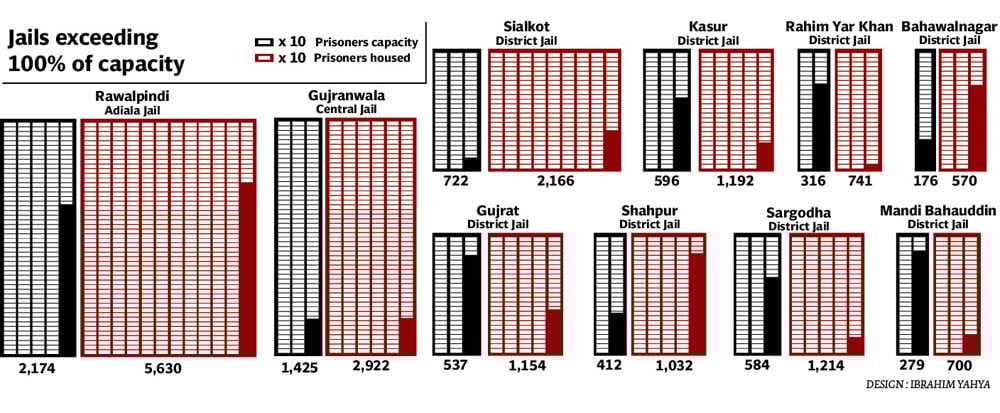
In Pakistan, women’s jails are overcrowded, mostly with women awaiting trial

According to today’s Express Tribune, in Sindh, one of Pakistan’s four provinces, jails are “bursting at the seams with twice the population”. Some jails are at six times their prescribed capacity. In another piece, still in today’s Express Tribune, in Punjab, the most populous province in Pakistan, 927 women are currently incarcerated. Of those women, 91 are mothers currently living, in prison, with their children. What do these numbers mean, and, even more, where are the women?

Sindh’s three women’s jails are located in Karachi, Hyderabad, and Sukkur. Together, they house 486 women. Their official capacity is 420, and so they’re 18% over capacity. To put that in perspective, Sindh’s jails’ official capacity is 13,500, and they currently house 23,500. The jails for men and women are 74% over capacity. Here’s the thing about the incarcerated women’s `rosy’ picture. Of the 486 incarcerated women, 421 are under trial, or remand, prisoners. That is, they are awaiting trial. 87% of the women have not been convicted of any crime. For the general prison population in Sindh, 77% are awaiting trial. If the State were to release people, and especially women, before trial, not only would there be no `prison overcrowding’ … there would be almost no prison. Further, if the State were to release women who are awaiting trial, the impact on their children would be beneficial.

Which brings us to Punjab, where 927 women are incarcerated. 91 of them are mothers raising their children in prison. Of the 91 mothers, 67 are awaiting trial. 74% of the women are officially not guilty of anything, but they and their children must suffer incarceration. As is so often the case around the world, the women explain they are charged with having assaulted abusive partners. In other cases, the partners can’t take the children, for any of a number of reasons, including divorce. And so, in one province alone, 105 children under the age of six live and grow, or not, in prisons, where the schools are mostly missing in action and where the environment is cruel and inappropriate.

Meanwhile, Punjab jails are 38% beyond their prescribed capacity. The jails experience regular food shortages, as well as staffing shortages. Punjab has 42 prisons; 21 have no doctors. The whole system has a grand total of 40 doctors, for a population of close to 51,000 and growing … and getting sick and dying.

At the end of last year, Pakistan’s prison and jails housed 85,670 individuals, of whom 60,000 – 70% — were awaiting trial. At that time, 1399 women were incarcerated. It’s not clear how long people wait in overcrowded, toxic, life-threatening conditions for `justice to be served’, but it is clear that the situation is untenable. None of this is new: “Pakistan inherited an outdated prison system from the British colonial regime in India and it has not changed much in over 200 years. Even today, the Prisons Act 1894 and the Prisoners Act 1900 are the main laws which govern prisons and prisoners in Pakistan.” The Prisons Act 1894 emerged from recommendations of the 1838 Prison Discipline Committee.

From 1838 to 2022, and beyond, from Pakistan, and India, to England and beyond, women and children suffer indignity, violence, cruelty, disease and death because State policy has created the circumstances in which prisons are crowded `beyond capacity’. You know what is within our capacity? Justice. Shut the prisons and jails. Decolonize justice systems today.

(By Dan Moshenberg)

(Infographic credit: The Express Tribune)
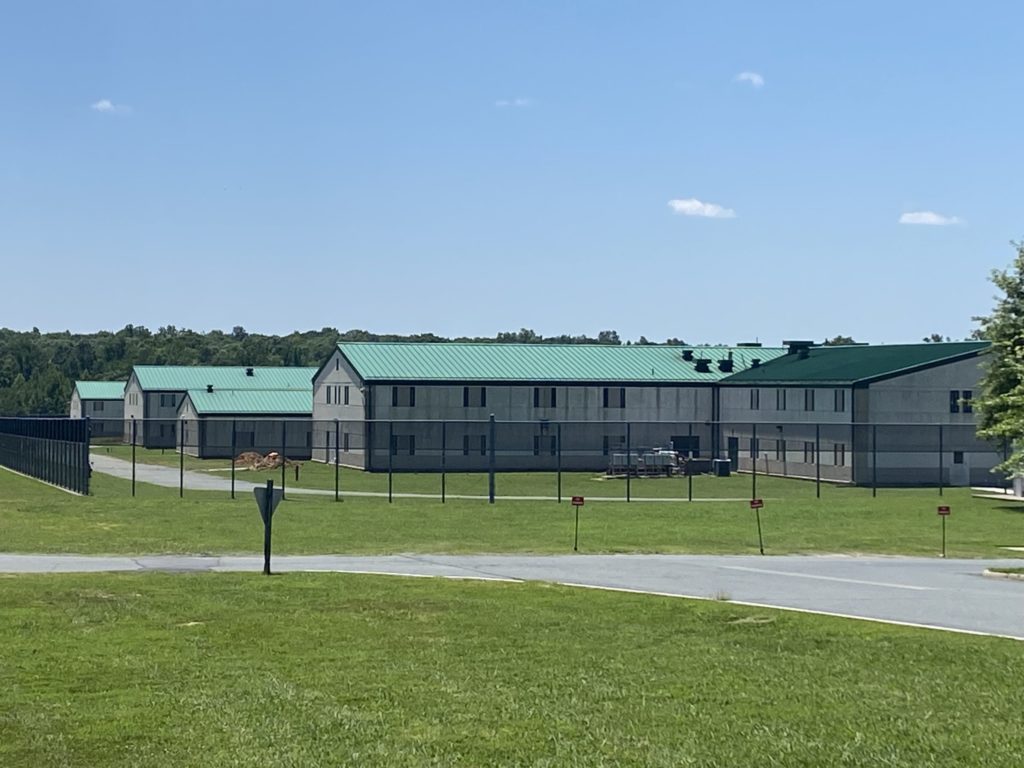
Strip-searches at Fluvanna Correctional Center for Women: “It’s akin to rape”

Virginia operates four `correctional facilities’ for women: Deerfield Work Center for Women; the Central Virginia Correctional Unit #13; the Virginia Correctional Center for Women; and Fluvanna Correctional Center for Women. In the October 2022 monthly census report, the Deerfield Center reported no `residents’ and the Central Virginia Correctional Unit doesn’t disaggregate male and female incarcerated persons in its census. That leaves Fluvanna and Virginia Correctional. Together they reportedly housed 1202 women, 768 women in Fluvanna and 434 in Virginia Correctional Center. For years, Fluvanna has been known as a place that routinely violates women’s rights, bodies, lives, hopes and dreams, and does so without compunction, all in the name of “correction”. In 2016, Fluvanna settled a lawsuit claiming its medical care was so bad that it violated the U.S. Constitution’s ban on cruel and unusual punishment. In 2019, Fluvanna continued to have “life-threatening medication failures.” And now, six years later, the court-appointed monitor’s most recent report shows that the medical care at Fluvanna is still failing the residents. So is general treatment of the incarcerated women, and that’s the reason Shebri Dillon is suing the facility, for its practice of routine strip searches.

Shebri Dillon was sentenced to Fluvanna for having engaged in a fraudulent real estate deal. Since she’s been at Fluvanna, she’s been a model prisoner, but that doesn’t matter when it comes to strip searches: “I live in the prison’s honor wing. I’ve never had a drug history, and I don’t have a violent history …. It’s akin to rape, because you have to leave your mind to be able to perform this – like leaving your reality, pretending you’re somewhere else. I mean you’re getting naked and showing the inside of your body orifices to a complete stranger … You don’t want to tell people when something abusive happens to you that is embarrassing and humiliating. I don’t want to tell you that somebody has looked at my tailgate, some of which may have been looking at me sexually, some of whom may be looking at me like I was the scum of the earth.”

For years, Shebri Dillon subjected herself to the sexual violence of strip searches, kept her silence, as did those around her. Then something changed. Covid and the long lockdowns: “When we had no visitation due to COVID, all of our movements were incredibly restricted, drugs exploded in here, because the corrections officers don’t make enough money, and half of them don’t stay here very long. They bring it to people who are locked in cages, can’t do anything, can’t go anywhere.” In 2021, there were 19 incidents involving drugs being smuggled into Fluvanna. Three of those involved visitors, the other 16 involved staff. But the routine strip searches continued, and not only did they continue, but with staff shortages, counselors, librarians, secretaries were asked to observe. All in the name of security, all in the name of corrections.

And so Shebri Dillon sued: “I understand we’re in prison. I understand there are security issues, but they also have to understand that we are human beings, and that a lot of the practices are degrading. They’re dehumanizing, and if they serve no security purpose they need to be revisited.”

Eight years ago, almost to the day, writing of the conditions in Fluvanna, we asked, “What exactly is the State “correcting” when it violates women’s rights, bodies, lives, hopes and dreams, and does so without compunction? What is the public policy here that condemns women on the basis of their gender? Want to end violence against women? End the epidemic of mass incarceration of women. Do it now!”

Strip searches are intrinsic to incarceration. Children in custody in the United Kingdom are routinely traumatized. Some respond by self-harming and attempting suicide. Aboriginal women and girls in Australia are disproportionately strip searched, and many of them respond by self-harming and attempting suicide. Ending strip searches in Fluvanna would be an important step. Ending mass trauma and violence against women and girls would be an important step, on the way to ending the epidemic altogether. Shut down Fluvanna and all its `sister institutions’. Do it now!

(By Dan Moshenberg)

(Photo credit: The Appeal / Rob Poggenklass)

Los Angeles faces a “flood of evictions”

With over 10 million residents, and counting, Los Angeles County is far and away the most populous county in the United States. Next in line is Cook County, Illinois, with just over 5 million inhabitants. Los Angeles County will end its pandemic-era tenant protections December 31. With just over 4 million residents, the City of Los Angeles is the second largest city in the United States. The City of Los Angeles eviction moratorium will expire January 31, 2023. This morning’s NPR headline read: “‘Flood of evictions’ looms in Los Angeles as pandemic tenant protections expire”. While the situation is dire, sometimes a metaphor hides as much as it reveals, and that is the case with the flood of evictions image. The same is true of the phrase “mass eviction.”

As today’s article accurately reports, according to Tim Thomas, director of UC Berkeley’s Eviction Research Network, Los Angeles “going to see the highest flood of evictions and, potentially, exacerbated homelessness on top of the conditions that they already had. As these moratoria and rental assistance end, we’re seeing across the country a lot of cities have reached historical averages of eviction by August of this year — and are actually surpassing the historical average.” And it’s not only cities. According to the Oklahoma Policy Institute, eviction rates in Oklahoma are at an all-time high. That’s not eviction filings but evictions. Eviction filings are also at an all-time high. Return to normal has meant skyrocketing rents, eviction filings, eviction, instability, disruption, menace.

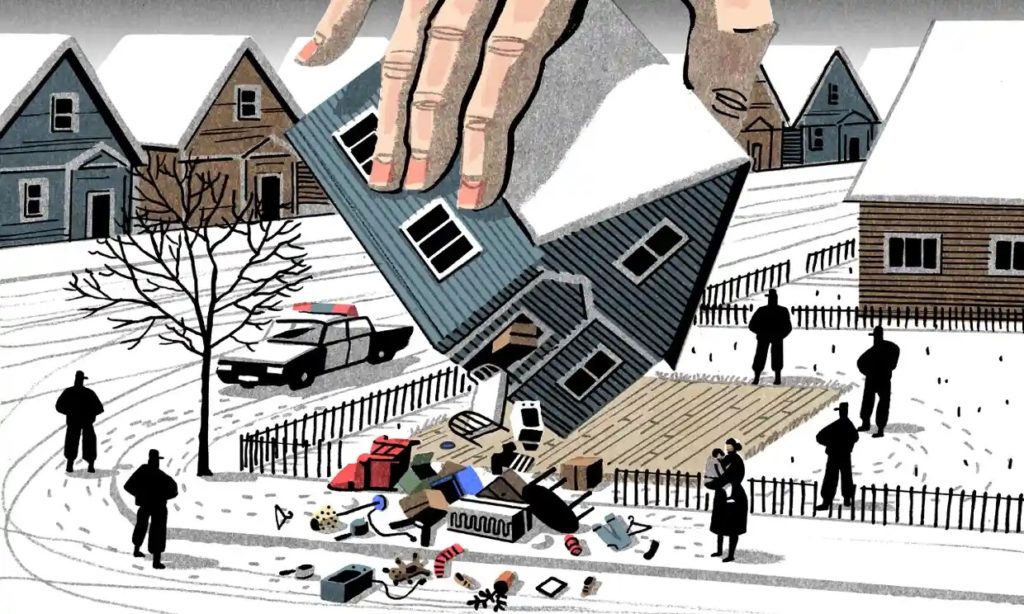
The problem with `floods’ and `mass’ is that they suggest an immediately perceptible phenomenon. What is a flood, after all? “An overflowing or irruption of a great body of water over land not usually submerged; an inundation, a deluge.” You can see the flood, immediately. You can hear the flood, and often you can even the smell the flood. The immediate impact is plainly visible. And that is precisely what does not happen in the kind of mass eviction engineered by corporate and hedge fund landlords. They don’t come in with bulldozers and remove whole blocks of residences. They work more or less privately and individually. You don’t see the harm to the neighborhood, to the community. Half the time, people leave before the sheriffs come, and so you don’t have the tragedy of family possessions thrown out into the streets.

In Baltimore, Maryland, there’s a new sheriff in town, literally: Sheriff Sam Cogen. On Thursday, Sheriff Cogen ended the policy of posting eviction notices in apartment complex common areas. As Sheriff Cogen explained, the posting of eviction notices in plain sight for everyone to read “was raised as an issue a while ago and the attorney general weighed in on an opinion and said that, barring any extraordinary circumstances, that the deputies should be posting on the individual doors, not on the common door, not on a mailbox, out in the lobby, not by an elevator. And to me, that’s a more difficult thing to do, but it’s also the more correct thing to do and the more humane thing to do, and we’re talking about trying to humanize this process as best as we can because what we need to do is we need to let the tenant know, absolutely and with certainty, give them notice that there’s an eviction proceeding.”

Delivering the eviction notice to the actual intended recipient is a reasonable first step. A greater step would be to extend, renew or initiate eviction moratoria and eviction diversion programs. The Scarlet E stigma and condemnation of eviction begins from the moment of filing and, currently, continues for a lifetime. While that was always the case, with corporate and hedge fund landlords and their propensity to file at the drop of a hat, this issue has itself become an invisible flood of sorts. So, publish not the name of those threatened with eviction, but rather the name of the landlords. Every jurisdiction in this country has a small group of `enterprises’ that comprise the overwhelming majority of those filing eviction. In Richmond, Virginia, for example, 15 large corporations are responsible for over half of the eviction filings.

There’s no flood looming. The flood is here, everywhere, every day. Every eviction is a flood of Biblical proportions. Every eviction filing is already part of that flood. We must do better than sink or swim, where swimming only occurs at someone else’s expense. The only way to control a flood is to contain it. Housing is a human right. Protect it.


(By Dan Moshenberg)

(Image Credit 1: William H. Johnson, Folk Scene–Eviction / Smithsonian American Art Museum)

(Image Credit 2: Hilda Katza, The Flood / Smithsonian American Art Museum)

Rent control would be good, controlling corporate and hedge fund landlords would be better

Despite much ballyhoo around Thanksgiving Day in the United States, and other celebrations around the world, the eviction and housing news of the past week has been relentless. In Oklahoma, where “it’s easy to be evicted,” evictions and rent are skyrocketing, thousands are being or recently have been pushed out of their homes into an environment where affordable housing is either unavailable or dangerous to your health. In Quebec, those hoping to flee domestic violence find, again, no available affordable housing. Faced with home-based violence or the violence being unhoused, many are forced to remain in perilous situations. In Florida, residents, often long-standing residents, of mobile home parks are being evicted by new landlords who, upon possession, jack up the rents. In Virginia, mobile home park residents are suffering the same fate. In Charlotte, North Carolina, new landlords are doing the same, taking possession, raising the rents precipitously with the intent of forcing the current residents out into, again, a hostile and even impossible local and regional housing environment. And then there’s the United Kingdom.

According to new government data, between January and March, the United Kingdom saw a record high number of no-fault eviction filings. From end of March last year to end of March this year, the United Kingdom saw a 76% rise in no-fault eviction filings. At least 20% of those receiving evictions ended up being forced out, often onto the streets. In the midst of a cost-of-living crisis and the approach of winter, the situation is expected to worsen. In June 2019, the United Kingdom government promised to end no-fault evictions. In the intervening three years, they have done nothing, actually less than nothing, given the rise in housing costs. Meanwhile, on Thursday, Michael Gove, the Secretary of State for Levelling Up, announced that tens of thousands of homes across the United Kingdom are unsafe because “they have not been looked after properly”, not by the landlords and not by the State, that has consistently looked the other way. Tens of thousands of homes do not mysteriously, suddenly become unsafe. So much for levelling up.

Across the United States, and beyond, the fact that the rent is too damned high and even worse, that it’s rising faster than ever before is perhaps finally becoming `newsworthy’. Yesterday, NPR reported, “After gutting local newspapers, hedge fund Alden Global is going after mobile home parks.” Today, The Roanoke Times editorial headline says it all, “Wealthy corporate investors prey on vulnerable mobile home park residents”. What is that preys on the vulnerable? A predator. This weekend, the news focused on Alden Global, a hedge fund that has bought a slew of mobile home parks across the country, including Massie’s Mobile Home Park in Christiansburg, Virginia. Alden comes in, does nothing about repairs, raising the rents impossibly, evicts residents, or just comes in and evicts residents, depending on the local laws. But the thing is, Alden is typical of hedge funds and corporate investors. This is what they do. And they are doing this, as never before, across the United States rental housing market. Rent control is good, essential even, but it won’t stop hedge funds. What is also needed is renter controls. There are tests for real estate agents, why not for landlords? How much is too much? Remember the housing market collapse of 2008, engineered by corporate interests in collusion with banks? Remember “too big to fail”? For some, the lesson was if you get big enough, you’re untouchable. It’s not too late to control the corporates from seizing the housing market altogether. Housing is a human right. Protect it.


(By Dan Moshenberg)

(Image Credit 1: Bill Bragg / The Guardian) (Image Credit 2: Elizabeth Olds / Smithsonian American Art Museum)

“They’re not evicting me. It’s just that, you know, on a fixed income, I can’t do it.”

Across the country this week, eviction filings are skyrocketing, evictions are spiking. In over 500 counties, evictions are now over their historical pre-pandemic averages. Evictions in Oklahoma County are 40% above pre-pandemic levels. Eviction filings and evictions are rising to and often exceeding pre-pandemic levels in Detroit, Michigan; Richmond, Virginia; Akron, Ohio; Nashville, Tennessee. From Virginia to Illinois to Californiaand all points between and beyond, mobile home park residents face rapidly rising rents and, again spiking eviction filings and evictions. Much of this is due to a `new breed’ of investors in the rental market, corporate investors and hedge funds, for whom, as one Richmond, Virginia, resident put it, “I’m not looked at as a human being. I’m looked at as a dollar sign”. Along with all the eviction filings and eviction proceedings, there is another multitude of people who, faced with steeply rising rents, move out. They don’t `decide to move’, they are forced to move, but because nothing was filed and no sheriffs were called, they don’t even figure in the accounting. These are the so-called `informal evictions’. They are the signature of low- and fixed-income people in the throes of the free market. According to one report today, “homeless shelters are seeing more senior citizens with no place to live.” It’s winter in America. Nowhere to go.

In Columbia Falls, Montana, Lisa Beaty, 64 years old, and her partner, Kim Hilton, 69 years old, report their landlord just doubled their rent. The two live on disability payments. They can’t find anywhere to go, and so Ms. Beaty will move into her daughter’s one-bedroom apartment and Mr. Hilton will move into his … truck. As Ms. Beaty explained, “They’re not evicting me. It’s just that, you know, on a fixed income, I can’t do it.” “That light at the end of the tunnel seems like it’s going out,” added Mr. Hilton.

In some places, people 60 and older are becoming the largest demographic living in shelters. What happens when elders move into homeless shelters, spaces not designed for seniors? As Lisa Sirois, a staffer at the Poverello Center in Missoula, Montana, explains, “As soon as someone is unable to make it to the restroom on their own, regularly transfer on their own, really operate independently, we do have to ask them to leave.” In Bozeman, Montana, an elder was asked “to find an alternative place to stay”. He was later found outside a department store, frozen to death. It’s winter in America.

With nursing homes closing, rents rising, and assistance – such as Social Security, Medicare, and Medicaid – nowhere near adequate to the cost of aging in America, the much-touted return to normal means an attack on the most vulnerable. Today, it’s the seniors, tomorrow … “They’re not evicting me. It’s just that, you know, on a fixed income, I can’t do it.” “That light at the end of the tunnel seems like it’s going out”.

(By Dan Moshenberg)

(Photo Credit: City Limits)

On Tuesday, across the United States, voters turned out to support affordable housing!

On Wednesday, a day after the mid-term elections, Diane Yentel, President and CEO of the National Low Income Housing Coalition, went to Twitter to announce, “Voters turned out to support affordable housing yesterday! @NLIHC is tracking nearly 100 affordable housing ballot measures advanced by our state and local partners – here’s what we know so far.” While some were fixated on the supposed, and dreaded, red wave or tsunami or tide or whatever it was, which happily never materialized, across the country, activists and organizers worked night and day to address the affordable housing crisis ravaging the country. Here’s what we know so far. First, most of the ballot initiatives supporting funding for affordable housing passed. Second, and equally important, many of them passed by large margins. For example, 70% of voters in Kansas City, Missouri; Austin, Texas; Columbus, Ohio approved initiatives for more, lots more, affordable housing. Want to watch a wave? Watch housing ballot initiatives across the country.

Let’s start on the West Coast and move eastward. California had 52 local ballot initiatives on housing. In the Bay Area, Berkeley authorized 3000 units of affordable housing. Oakland authorized 13,000 units and also expanded and extended eviction protections. Richmond passed a rent cap of 3% annually. That’s only in the Bay Area. In Los Angeles, voters weighed in on Measure ULA, United to House LA, which would raise taxes on home sales over $5 million. According to ACLU attorney Kath Rogers, “This city ballot initiative is a once-in-a-generation chance to end housing insecurity in Los Angeles. It will help keep people in their homes and support low-income seniors and disabled neighbors. Importantly, this measure will build the homes we need to reduce houselessness.” This initiative came from community-based organizations coming together to articulate their solutions and their visions for the future. The same is happening across the country. At last count, it looked like Measure ULA would pass and handily.

Voters in Flagstaff, Arizona, passed Proposition 442, which raises $20 million for affordable housing, by redeveloping city- and privately owned housing into affordable rental units.  Proposition 442 garnered over 60% of the votes.

Voters in Austin strongly backed a $350 million bond to be used for affordable housing acquisition, repair and rental programs.

In Missouri, Kansas City voters overwhelmingly approved $50 million for affordable housing: “According to the city, the $50 million will be Kansas City’s largest investment in affordable housing ever made.”

In Ohio, Columbia voters approved, again overwhelmingly, $200 for affordable housing: affordable rental construction; affordable home ownership; affordable housing preservation; homeless services.

In Florida, Palm Beach County voters approved a $200 million bond for affordable “workforce” units. In Orange County, Florida, 59% of the voters approved a rent control measure.

In North Carolina, 74% of Charlotte voters approved a $50 million bond for affordable housing. In Buncombe County, 62% of the voters approved a $40 million bond for affordable housing.

In Maryland, 82% of those who voted in Baltimore approved a $14 million bond for affordable housing.

Over the next few days, more results will come in, but the picture is already clear. From “overwhelming” to “strongly backing” to vote tallies showing 60 to 80% approval, the demand to provide adequate, decent affordable housing constitutes the wave. Yes, the country is divided, inequality continues to grow and intensify, `partisanship’ is expressed in both strident tones and acts of violence. But across the country, large majorities of people decided the time is now, housing is a right, make it happen. Housing is a human right. Support for adequate, decent, affordable housing is support for our basic, collective humanity. Join the overwhelming wave, vote for, work for affordable housing now.

(By Dan Moshenberg)

(Photo Credit: Martha Rosler, Housing Is a Human Right / e-flux)

Manston: The spectacularly ordinary cruelty of England’s abuse of the vulnerable

The past week has demonstrated, once again, if any demonstration was needed, the complete mess that is the English government’s `reception policy’ towards asylum seekers, refugees, and, more generally, migrants. At the center is the Manston `processing center’, located in Kent. Early this week, journalists arrived and were refused entry. Security guards began herding people into the buildings, when a group of children broke through their ranks and ran towards the fence. One girl got close enough to throw a message in a bottle over the fence. The letter describes abuse of pregnant women, children living with disabilities, everyone: “We really need your help.” Manston has a capacity for 1600. At the time of the letter, it housed at least 4000 people. In response to the uproar over conditions, the Home Office took some residents, drove them to Victoria Station, and dumped them there, in the middle of the night, without accommodations, winter clothing, information, or anything. This is what `processing’ looks like.

This weekend, it was revealed that people without any experience in asylum or immigration procedures are being hired off the street and, with little to no preparation, are put in charge of adjudicating asylum applications: “It’s a total disaster. They don’t know what they’re doing”. Meanwhile, asylum seekers who make it through the first rung of `processing’ are often dumped in hotels where they are forced to stay, often for over a year. As one Kurdish Iranian asylum seeker put it, “One, two, three months is reasonable in a hotel, but not 17 months. Expecting us to stay with nothing to do is intolerable.” What is going on? Processing. Processing disaster. Processing the intolerable.

The situation at Manston is so bad that the Border Force union is joining a legal action over “horrendous, inhumane and dangerous” conditions. 4000 crowded into a space where the maximum 1600 would have difficulty. People are not supposed to stay longer than 24 hours. They’re staying for more than 30 days. Infectious disease is spreading throughout the detained population. The sanitation is inadequate, to put it delicately. On Thursday, a minister in the Home Office admitted the center was operating illegally. It is still in operation. Seventeen-year-old Mohammad, who spent 25 days at Manston, put it succinctly, “It is not a situation that humans deserve to live in.”

It is not a situation that humans deserve to live in.

There is a tendency to report this situation as one of “neglect”: “Britain’s asylum system is broken after years of political neglect.” Others argue the system has `failed’ or it’s `broken’. Nothing could be further from the truth. The system wants to produce the public spectacle of cruelty. Cruelty is the point. Asylum originally meant `refuge’, “sanctuary’, `inviolable’. Today, it means both `vulnerable’, on one hand, and `dangerous’, on the other. The Home Office has described asylum seekers as an invasion. The Home Office has been using that rhetoric for over twenty years. So, when you read that children are being tortured, know that that is the intention. The spectacle of cruelty is the intention. It is not a situation that humans deserve to live in. Shut it down.

(By Dan Moshenberg)

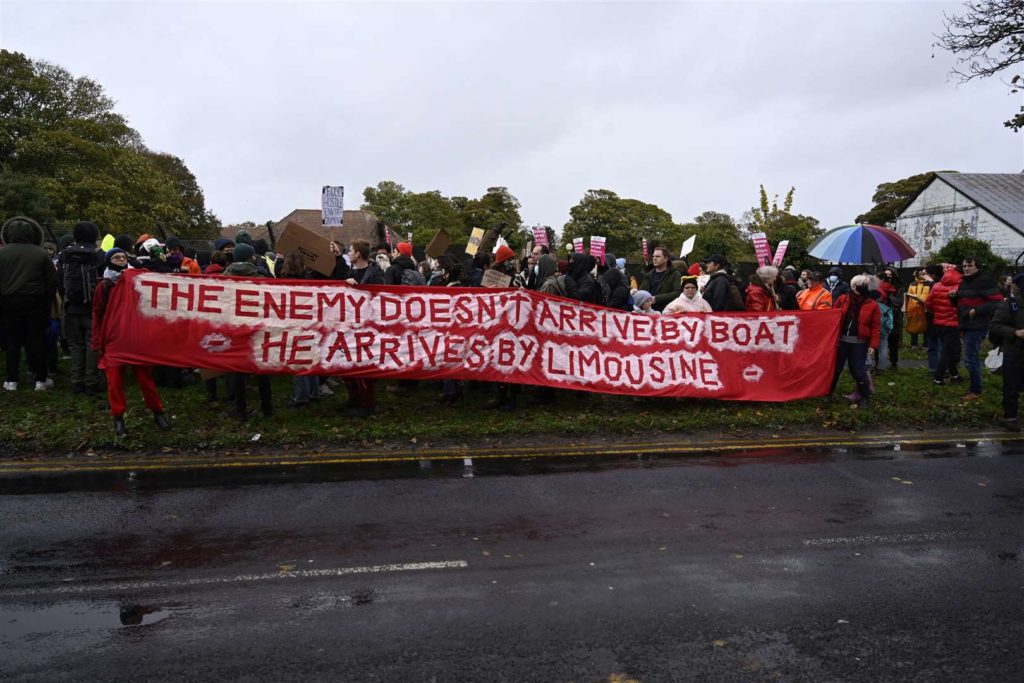
(Photo Credit: Kent Online)

In Richmond, Virginia, 15 large companies are responsible for half of all evictions

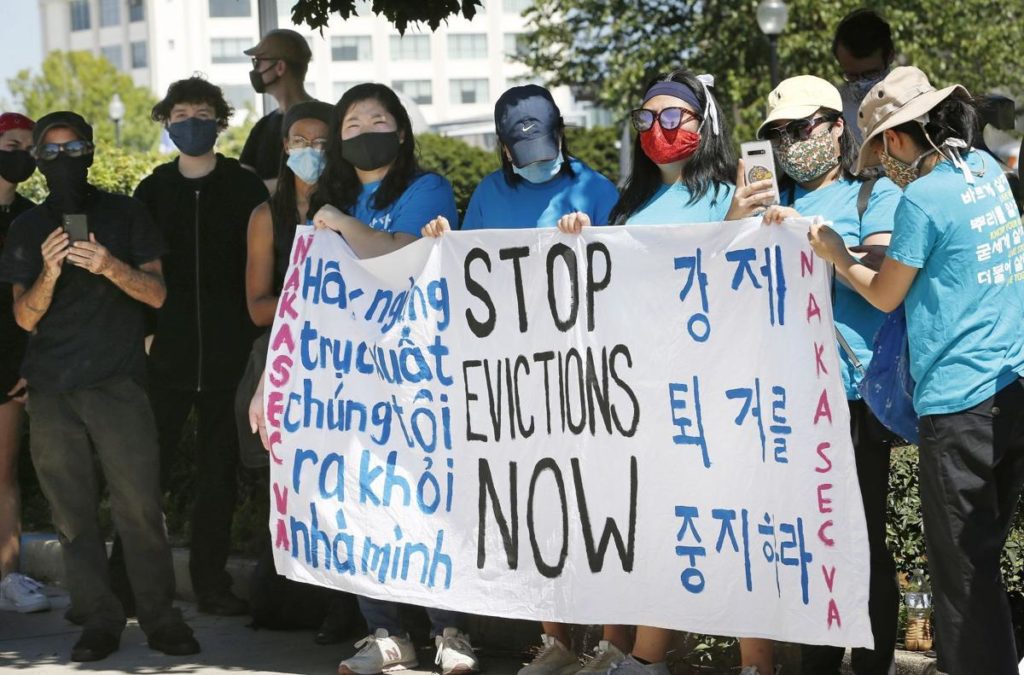
In today’s news, “the number of eviction notices filed in San Francisco has rebounded to pre-pandemic levels.” In New Bedford, Massachusetts, longstanding residents’ homes are being bought by developers who raise the rents precipitously, way beyond current tenants’ means, forcing them to move. In one complex, most of the residents received eviction notices. In others, they move before the notices come: “This situation is becoming the norm throughout the city. People are coming in and evicting people who have been living in these houses for 10 years”. And in Virginia, “fifteen large companies are responsible for half of all evictions in the Richmond area.” From coast to coast, this situation of eviction and forced displacement is becoming the norm. Consider Richmond and, beyond it, the Commonwealth of Virginia.

But first, consider the entire country, briefly. According to the Eviction Lab’s latest eviction report, issued on October 8: “In the 6 states and 31 cities we track, landlords have filed for 1,240, 656 evictions during the pandemic. They filed for 7,713 over the last week.” On July 27, the number of filings was 1,053,252. That means, in three months, landlords, disproportionately corporate landlords, filed 187,404 evictions. 15% of all eviction filings in the three years of the pandemic occurred in the last three months, and the number, and rate of eviction, is rising. The numbers for Virginia are equally disturbing.

According to the Richmond-based RVA Eviction Lab’s most recent report, in Richmond, 87% of eviction filings this quarter were filed by corporate landlords. Half were filed by 15 companies. This week, Richmond is set for a record week of evictions, 126 evictions. Pre-pandemic, the weekly number was between 50 and 60. This record breaking week was not a surprise, given a report the week before in which one apartment complex, James River Pointe, bought by a corporation, saw half of the residents receive eviction notices.

A major company, Homes of America, linked to a major hedge fund, Alden Global Capital, has been buying up mobile park homes across the country. This company bought a mobile home park in Montgomery County, in southwest Virginia, and immediately sent residents “notices to quit”, offering them the “opportunity” to pay $700 or vacate within a matter of days. Homes of America,has done the same in North Dakota, Florida, Louisiana, and elsewhere.

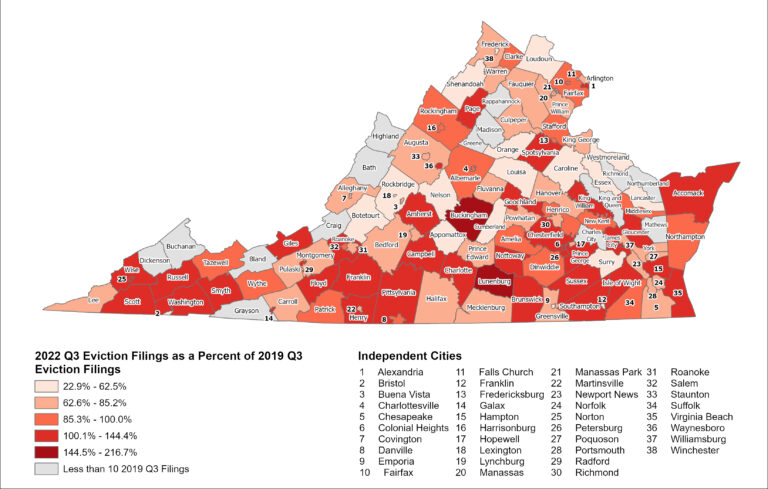
In northern Virginia, according to the RVA Eviction Lab report, with the exception of Fairfax County, which saw a dip, all the region experienced a rise in eviction filings and judgements. Alexandria lead the pack: “Eviction filings in Alexandria, Fredericksburg and Prince William increased by 109%, 75%, and 96%, respectively”. Default judgments in Alexandria are approaching pre-pandemic levels, with 26% of all evictions ending in a default judgment, meaning the tenant didn’t show and, by Virginia law, the landlord automatically wins the eviction.

This situation is becoming the norm. People are coming in and evicting people who have been living in these houses and apartments for years. These numbers do not take into account those who have `self-deported’ or been victims of `informal evictions” or “`invisible evictions.’ Essentially, when landlords offer new leases with much higher rents, many tenants are forced to move if they can’t pay.” Others move rather than suffer the Scarlet Letter of eviction filing attached to their name. An eviction filing is as damaging as an eviction, in terms of the ways in which future landlords consider an application. So, what’s going on? While there are many factors, report after report points to the entrance of major corporations and hedge funds into the rental market and the willingness, the eagerness, of corporate landlords to file for eviction. While eviction moratoria and rent control are profoundly important, as long as corporate interests are given a free hand to exert virtually monopolistic control over rental markets, the situation will worsen. That is not inevitable. Stop evictions, stop predatory rent hikes, end corporate domination of housing. This situation cannot be allowed to become the norm.

(By Dan Moshenberg)

(Photo Credit: Richmond Times-Dispatch / Alexa Welch Edlund)

(Infographic Credit: RVA Eviction Lab)

Velvet Paintings

Velvet Paintings

When I was young and there was no internet

We immortalized our heroes on Velvet Paintings sometimes sold at roadside stands near gas stations and fast food restaurants

And depending on the size of a free wall in your living space
You could hang one or all of the three martyrs

Abraham
Martin
And John

Our revolutionaries were photographed on wide backed wicker chairs seated next to large potted palm plants under a red black and green flag arrogantly breaking the fourth wall while staring directly into the camera as if to say:

Try it and find out,

Motherfucker.

When Martin was killed everyone said:

We’ll never see another Martin in our lifetime; but, we did get a Barrack and that worked out just fine.

No offense, Mike.

We thought there would never be another George Wallace, too.

But we got a Trump and suddenly I didn’t drink orange sodas anymore

or like to play Spades and other card games that used trump cards for victory

Every hero creates his own villainous counterpart

at least that’s what M. Knight Shyamalan  taught us in the new [old] mythological tales.

We have to stop whats happening before we see dead people

Everywhere

And have to paint more velvet paintings.

At some point we will discover the MAGA Kryptonite and the heroes, she-roes, and androgens strong enough to wield it.

Pray Tell and Uncle Clifford come and Z snap these bitches into the Phantom Zone.

Throw shade where shade is due from the overly long ties to the blaming everything on ANTIFA

But cast some light on 1/6 which was truly an inside job.
That’s why Pence told the secret service:

“I’m not getting in that car.”

The praetorian guards killed Caligula — maybe Mike Pence’s “mommy” had let him read a history book or two.

Velvet paintings of John Lennon who once quipped that his back up band, The Beatles, were bigger than Jesus.

People got upset and I don’t know why

Because Jesus got a velvet painting, too.

“…Everything is gonna be
Alright…”

Sing for us Audre Lord and quench our thirst for Justice with the blood of martyrs and mothers offered in vulval libation cups.

Georgia
shower us with your labial petals and prove to us that the soft and pliant can overcome the stiff and hard

Even the idiocy of a football player who never  sat in a wicker chair in his life but who himself is considered a Bizarro World hero.

“Just an old sweet song
Keeps Georgia on my mind..”

Memories of familial barbecues on southern home places where you could be poor

But you were never hungry

Don’t look back.
Just keep looking forward

We have come so far.

But we still have a ways to go.

Velvet Paintings of Fannie Lou who told us to “stay together children she was sick and tired of being sick and tired. Her radio broadcast was silenced

But we heard her anyway

The heroes have to be equivalent to the villains and as numerous. Here we are.

Still together.

“We don’t need another hero

we don’t need another way home

All we want is life beyond this Thunderdome”.

Where cartoonish carnival barkers sell lies, blood and circuses

And we painted velvet paintings for the fallen

To remember.

(By Heidi Lindemann and Michael Perry)
(Art Credit 1: Radcliffe Bailey, Up From / Nasher Museum) (Art Credit 2: Smithsonian Institution)

Ireland and South Africa reject the `natural’ inevitability of eviction

“Yet many of these issues, I found, could not really be thought through, and some of them, I believe, cannot even be focused unless we are conscious of the words as elements of the problems.”         Raymond Williams, Keywords: A Vocabulary of Culture and Society

The weather in the United States these days is terrible. Virginia and the Bay Area, in California, are threatened by tsunamis, while Hennepin County, in Minnesota, faces the prospect of monsoon. These are not meteorological events. They are eviction tsunamis and monsoons. While the figures of speech portray the intense destructiveness of the eviction situation, from coast to coast, they also provide a bit of an alibi, in that they naturalize the precipitous rise in eviction across the United States and beyond. Evictions are not natural events, they are created by humans, individually and in corporations. Likewise, skyrocketing rents and rates of eviction are not natural events; they too are created by individual landlords and, often, by corporate landlords. To the same degree that climate change is created by human action and especially `economic development’, so is eviction. Recently, Ireland and the Johannesburg High Court, separately, rejected the `natural’ inevitability of eviction and chose to promote the right to decent housing as a fundamental element of human dignity and the right to dignity.

In September, with winter approaching, Scotland temporarily froze rents and halted evictions. At the same time, in Ireland, with an equally bitter winter approaching, a third of renters reported they spend 50% or more of their income on rent. Rents in Ireland are “doubling, tripling”, according to Helen McEntee, Ireland’s Minister for Justice. In October, the Irish government decided to follow Scotland’s example and halted all evictions between November and March of next year. While landlords have claimed they are being `forced out’ of the market, tenants and their allies welcome the respite. Everyone recognizes that a five-month halt to evictions will not resolve the severe affordable housing shortage in Ireland, at least it will provide a momentary respite and a modest recognition of the humanity and dignity of those most vulnerable.

Meanwhile, in the case of Rycloff-Beleggings (Pty) Ltd v Ntombekhaya Bonkolo and Others, the Johannesburg High Court ruled that a group of working people’s access to work and right to dignity had to be considered when adjudicating an eviction notice. The case involves waste reclaimers who have been living on an `undeveloped’ stretch of farmland that lies between a residential complex and a business park in the Midrand section of Johannesburg. In 2018, the owners of the land, Rycloff-Beleggings, decided they wanted to `develop’ the land, and so issued eviction notices. The city offered a site with no possibility of developing waste reclamation economies, and so, in May 2019, the residents sued, demanding to either stay put or be placed somewhere where they could continue to work. On October 4, Judge Greg Wright agreed and gave the city until March 2023 to find appropriate site for the community. Anything else “would leave them at risk of not being able to maintain their dignity and care for their children.  It would be unfair and therefore unconstitutional to uphold the other parties’ rights while the reclaimers go hungry. Furthermore, the rights of children are paramount in cases involving children such as the present one.” If people are on the land, it is not `undeveloped’. If people live in a neighborhood, it too is not undeveloped.

At one level, both Ireland and the Johannesburg High Court chose to respect  the “indivisibility of all human rights”. While the Irish protections only last through the winter and the South African decision is only one court, the examples are illustrative. First, evictions can be stopped. Second, every human being and every community of human beings has the right to dignity. Third, eviction is not a natural, inevitable event. We can stop evictions. Finally, many descriptions and analysis of the housing crisis focus on large numbers, but we must also remember that every eviction is a housing crisis, and every housing crisis is an affront and an assault on all human rights. Scotland, Ireland, and the Johannesburg High Court acted in the name and service of human dignity and decency. Who will follow their example?


(By Dan Moshenberg)

(Infographic credit: The Irish Times)