Children are disappearing, into the night, into the fog

Children are disappearing. Sometimes spectacularly. Sometimes silently. Sometimes `without notice’. That children are disappearing is not new. Children asylum seekers and children of asylum seekers have been disappearing into detention centers in Australia, the United Kingdom, the United States, Greece, and elsewhere. In Australia, imprisoned children of asylum seekers are disappearing into the tortured self mutilation that must serve as a kind of escape from their current everyday circumstances.  Children of incarcerated mothers are disappearing in South Africa, Scotland, the United States and elsewhere. Children in schools are disappearing into seclusion rooms, aka solitary confinement.  In the United States, children of undocumented residents are disappearing, shipped like so much baggage, back to Mexico and parts unknown, often on their own.  In Jamaica, girl prisoners disappear into prison fires that were altogether predictable and preventable.  None of this is new. We have discussed this and more before. The events are not new nor is the failure to take responsibility.

Children are disappearing. Sometimes spectacularly, sometimes silently, other times `without notice’.

In England, an inquest opens today. It’s the second time around for this inquest. It concerns the death in custody, in August 2004, of Adam Rickwood. Adam was 14 when he was found hanging in his cell at Hassockfield Secure Training Centre, a private prison run by Serco, the same people who run Yarl’s Wood in the UK and all the immigrant detention centers in Australia, most notoriously Villawood.

When Adam Rickwood, who had never been in custody before, refused to go to his cell, he was `forcibly restrained’ with `a nose distraction’, a violent and invasive chop to the nose. Hours later, he was found dead, hanging, in his cell. At the first inquest, in 2007, the coroner refused to let the jury decide if the restraint constituted an assault.  It took thirteen years of struggle on the part of Adam’s mother, Carol Pounder, before the first hearing took place. Dissatisfied with the complete opacity of the system, she continued to push, and finally, finally a second inquest has been ordered. That starts today. Adam Rickwood would be thirty years old now.

Meanwhile, across England, there are 6000 children whose mothers are incarcerated, and, basically, no one officially knows their whereabouts. According to the Prison Advice and Care Trust, or PACT, they are “the forgotten children.”  According to PACT, the mothers of 17,000 children are in prison, and of those, 6000 are not in care nor are they staying with their fathers. They are `forgotten.’ Children are disappearing, some into the night, others into the fog.

At the same time, in Ireland, eleven unaccompanied children asylum seekers went missing last year.  Six have yet to be found.  Between 2000 and 2010, 512 unaccompanied children seeking asylum were `forgotten’. Of those, only 72 were ever found by the State. Forgetting children is not an exception, it’s the rule, when the children are children of color, children of asylum seekers, children of the poor, children in prison.  Children of strangers, children of neighbors are disappearing, into the night, into the fog.

In the United States, Phylicia Simone Barnes is a 16 year old honor student from Monroe, North Carolina. In December, she was visiting Baltimore, thinking of attending Towson University, a local university. Phylicia went missing on December 28. There has been little, very little, media attention, despite the efforts of family, the Baltimore Police Department, and the FBI to draw attention to this case.  Why? Baltimore Police spokesman Anthony Guglielmi thinks he knows the reason: “”I can’t see how this case is any different from Natalee Holloway. Is it because she’s African-American? Why?” When teenager Natalee Holloway disappeared, on holiday in Aruba, there was a `media frenzy.’ For Phylicia Simone Barnes, who is Black, there is fog. She is a forgotten child.

Christina Green was born on September 11, 2001, to Roxanna and John Green, in West Grove, Pennsylvania. She was one of the 50 Faces of Hope, faces of children born on that fateful day.  Like Phylicia Simone Barnes, Christina was a star student, an engaging child, bright, mature, `amazing’. She was killed on Saturday, in a volley of gunfire apparently directed primarily against Congresswoman Gabrielle Giffords.

What becomes of hope when a Face of Hope is lost? Children are disappearing, sometimes spectacularly, amidst blazing gunfire, sometimes through a policy of practiced omission and amnesia.  In the moment, the route of spectacle or silent lack of notice seems to matter. But in the end, they are all forgotten children, and they haunt the days and ways of our world.


(Photo Credit: BBC.co.uk)
The United States abandons Mexican migrant children to violence and despair

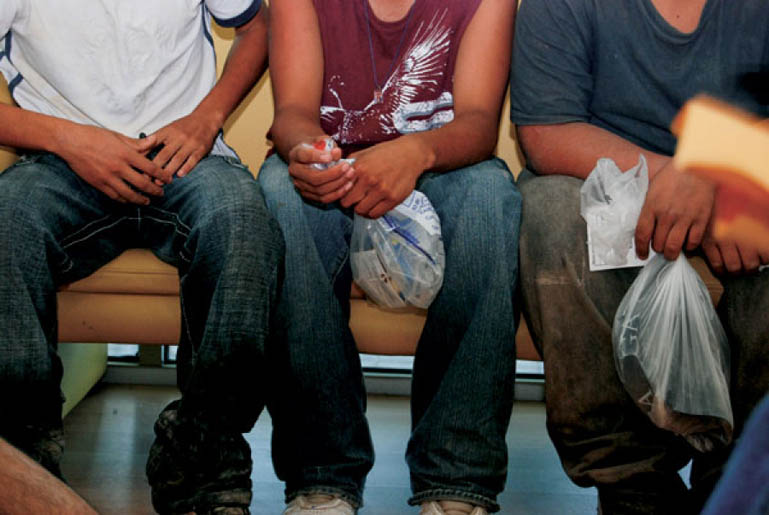
Children waiting in the Desarrollo Integral de la Familia in Reynosa, Mexico

Migration analysts talk about sending and receiving nations. Sending nations are those countries that send, or `export’, its citizens to other countries. Receiving nations are those nations that receive, or `import’ or `absorb’, them. The status of some nation States has changed in the last two or three decades. For example, Italy and Greece were once considered sending nations, and today they are thought of as receiving nations.

Certain countries, such as the United States, are thought of as receiving nations. But that is only the case if the transnational and global export-import business is thought to be one of labor brokerage of national citizens. What are we to call those countries that export non-citizens, those countries that have made a business, a big business at that, of exporting asylum seekers, migrants, children?

Every year, the United States exports tens of thousands of unaccompanied migrant children to Mexico. These children are sent to centers run by Mexico’s social services agency called the Desarrollo Integral de la Familia, or DIF. In 2008, a Mexican congressional committee reported that the United States had deported 90,000 children, of whom at least 13,500 were never claimed. “Never claimed”: that means the children were never reunited with their families.

Who are these children? They are Mexican children who are heading to the north, most often to be reunited with … their families, with their mothers and fathers: “With few exceptions they’ll cross again because their parents or loved ones are en el otro lado and on the other side of the Rio Grande there is hope. Hope to study, to work, or to just hug their mothers or fathers again.”

Susana is in many ways exceptional and in other ways typical of the 90,000 children. First, she’s a girl; 80% of the children are boys. Second, as she sits in a DIF shelter in Matamoros, she says she’s ready to give up, to go home: ““I don’t want to stay here. I’m tired of fighting.” Gender and the intent to return home make her exceptional.

On the other hand, Susana has tried to enter the United States five times, and on each of the five attempts has failed. Every time, she was returned, unaccompanied, to Mexico. Every time, she turned around and tried again. Her father works in Kansas. They haven’t seen each other in five years. He works, struggles, and pays to have his daughter brought over. Each time, the journey costs $2500. Again and again, he pays, again and again she tries. Just to hug her father again. This makes her typical.

The children are sent to centers in Reynosa and Matamoros, centers of the current drug cartel and War on Drugs violence. Reynosa is reported to be one of the most dangerous places in Mexico. Often the children are released to strangers or to distant relatives. Often, some say more often than not, they are returned to the mean streets, and in particular those of Reynosa. So, they then go North because they want to, to be reunited or to study or work, or they go North because they are forced to. Some girls, some boys, may be tired of fighting, but that doesn’t mean they are safe. That doesn’t mean the fighting has tired of them.

What do you call a nation that seizes children, sends them unaccompanied into a violence torn war zone, and then washes its hands of the whole affair, and closes its eyes and ears to the fate of the children? That is neither a sending nor a receiving nation. That is a state of abandonment.

Susana wants to go home, but it’s not that simple. The center wants one of her parents to come and get her. Her father is in Kansas, her mother has to take care of her younger brothers and sisters. And so Susana waits, and like the other 90,000 Mexican children the United States has abandoned to violence and despair, haunts more than the borderlands. Susana haunts citizenship.


(Photo Credit: Texas Observer / Eugenio del Bosque)


Those who recall the future were never meant to survive

Marta Candeloro was abducted on June 7, 1977 in Neuquen. She was then taken to the Secret Detention Centre “La Cueva.”

On January 30, 1972, British soldiers opened fire and killed thirteen men in a peaceful civil rights march in the Bogside neighborhood of Derry. That day is called Bloody Sunday. Next Tuesday, thirty eight years later, the British government will release a report that states the killings were unlawful.

Thirty eight years is a long time. Ask the survivors. Ask those who remember.

Ask Kay Duddy. Kay was 25 years old then. Her brother Jackie was 17, a textile worker. He was shot dead as he fled across the Rossville Flats car park. He was the first person killed on Bloody Sunday. “We put Jackie’s 50th birthday in the paper and I thought, `That’s all we can do for you now, a wee memorial in the paper, people will say a prayer for you on your 50th birthday when we should have been out partying with you’. It is the everyday things, the wee family things that get you.”

It is the everyday things, the wee family things that get you.

Ask Regina McKinney. She was the third child of Gerry McKinney, 35, a wrought-iron worker and dance hall manager. He and his wife had eight children. On that Sunday, he blessed himself and put his hands in the air when confronted by soldiers. Then, one of them shot him dead: “Mammy never got over it. It took 25 years for her to even start to come to terms with it.…These men took away everything….My daddy was shot with his hands  up. I was proud the way my father died, that he had his hands in the air, that he had nothing in his hands, that he did not retaliate. To me he was a hero….The only thing I want out of the report now is for the men who were shot to go down in history as innocent. I think that is the only truth we need. The soldiers are going to have to stand before God.”

And ask Kate Nash, now 60 years old. She was the oldest daughter in a family of 13 living in Creggan on Bloody Sunday. Her 19-year-old brother William was shot dead at the Rossville Street barricade. Her father Alex went to comfort his dying son. He was shot and wounded. According to Kate, her mother laid the blame on her father’s shoulders: “She blamed my father because he survived. She wanted my brother back, not her husband. My father accepted that blame and carried it until he died.”

It is the everyday things, the wee family things that get you. Thirty eight years is a long time. Ask those who have waited, ask those who wait. Ask those who remember and those who cannot forget.

Ask Paula Luttringer. On March 31st 1977, Paula Luttringer was 21 years old and pregnant. She was kidnapped by the Argentine police and held, for five months, in a secret prison. While there, she gave birth to a daughter. She was then abruptly released and forced to leave the country immediately or face further violence. She fled to Uruguay and then to France. That was thirty three years ago. Thirty three years is a long time.

In 1995, Luttringer returned to Argentina and began to use photography as a way to explore the memories of the State violence committed against her and other women. El Lamento de los Muros (The Wailing of the Walls) emerged, a photographic essay, an archive of memories. Pete Brook, who has interviewed Luttringer, notes: “I have twice heard people urge Paula happiness in that she survived. Paula is unequivocal; having survived does not make her happy, living in a world in which people didn’t have to be survivors would make her happy. The violence once it is done, cannot be undone.”

The violence, once it is done, cannot be undone. Happiness would emerge from living in a world in which people didn’t have to be survivors, in which people don’t have to remember they were never meant to survive.

Estella Jackson remembers she was not meant to survive. Estella Jackon is 60 years old, a convicted killer, and a prisoner in Mabel Bassett Correctional Center in Oklahoma, the largest women’s prison in the state. Oklahoma incarcerates more women per capita than any other state in the United States.

Estella Jackson chose when there was no choice: “I didn’t have a choice in what I did. It was either kill or be killed. And I chose to live”. Now the hardest thing now is explaining her life to her grandchildren. She says it’s hard to explain to children that she took a life because there were no choices and because she chose to survive. For Estella Jackson, the hardest thing is the painful memory of her grandchildren’s future, a memory in which it’s not clear they will know she chose to survive.

Herbert Murray remembers he was not meant to survive. Herbert Murray was a young man convicted by a jury for having robbed and murdered a blind man in New York City. The judge thought Murray was innocent, but had no choice, according to the mandatory guidelines, and so sentenced Murray to prison for 15 years to life. That meant after 15 years, Murray could come up for parole. He was denied repeatedly. Why? Because he claimed his innocence, he could not demonstrate remorse and so remained in jail. This is called “the innocent prisoner’s dilemma”.

And what of those who cannot remember?

New York’s Fishkill Correctional Facility has the first prison unit for the cognitively impaired. The average age of its residents is 63. Everyone suffers from dementia. Many, maybe most, live with Alzheimer’s. Dr. Edward Sottile directs the center. Recently he was asked how prisoners with dementia, who don’t remember their own histories, can be rehabilitated. Dr. Sottile smiled a Hippocratic smile and replied that he had the same question and his solution is to do the best he can, to provide humane and compassionate care.

Remorse, remorse of conscience, remorse of mind is grief, sorrow, torment, painful memory. Ask those who remember, and those who cannot, they were never meant to survive, for they recall the future.


(Photo Credit: Prison Photography / Paula Luttringer, The Wailing of the Walls)


Asylum haunts the foreign service

Bita Ghaedi fled to the UK in 2005 to flee a forced marriage. Then her troubles really began.

Asylum haunts the foreign service. People face violence, persecution, torture, from the State, from partners, from various sectors. Finally, they flee. They escape. They go to the United Kingdom, say, or the United States. Where they apply for asylum. And are treated like criminals. Often they are placed in immigrant detention centers, where they are treated as immigrant detainees, which is to say where they are treated as common criminals … or worse. Then they are returned to the torture zones and the killing fields. They tell their stories, others tell their stories. Their stories circulate, in the languages of those who suffered throughout their communities. Their stories, their bodies, their scars and their memories, precede the ambassadors and the envoys.

This week Bita Ghaedi was informed that she would not be deported immediately to Iran. Further, she was informed that she could finally leave Yarl’s Wood. In 2005, Bita Ghaedi fled a violently abusive family and an imminent forced marriage. In the UK, she has been a civil rights, women’s rights and human rights activist who has publically supported the opposition to the Iranian government. She has reason to believe she would be killed if she is returned to Iran. The question is whether it would be the State or her family who would commit the deed.

In 2007, Bita Ghaedi’s application was turned down. She attempted suicide. She appealed the decision. In January of this year, she was on weeks long hunger strike. She was supposed to be deported April 20, but Icelandic volcanic ash postponed that. She was supposed to be deported this past Wednesday, May 5. That’s when the high court decided, again, to delay the deportation and hold another hearing. That is meant to happen July 21.

Bita Ghaedi’s story parallels that of Rodi Alvarado. Rodi Alvarado was born and raised in Guatemala.  In 1984, at the age of 16, she married a man, a former soldier, who immediately began beating, torturing, raping her. She went to authorities who did nothing. She ran away, was caught by her husband, and beaten unconscious. Finally, in 1995, she fled to the United States, leaving her two young children with relatives. She applied for asylum. In September 1996, an immigration judge granted her asylum.

That’s where the story turns: “The Immigration and Naturalization Service appealed the grant to a higher court, the Board of Immigration Appeals (BIA). And in June 1999, the BIA reversed the decision of the immigration judge, by a divided 10-5 vote, and ordered that Ms. Alvarado be deported to Guatemala”

The case then lingered on until December 2009, when Rodi Alvarado was finally, and without explanation, granted asylum. For fourteen years, Rodi Alvarado waited in terror.

In March 2009, Amnesty USA released Jailed Without Justice: Immigration Detention in the USA. Without naming Rodi Alvarado, the report suggests that, in the context of US treatment of asylum seeking women, Rodi Alvarado’s case is not unusual. In fact, it’s almost benign.

In the United States, women asylum seekers are routinely abused. Some, like Saluja Thangaraja, can share their names: “Saluja Thangaraja fled the brutal beatings and torture that she suffered during the Sri Lankan civil war only to endure more than four and a half half years of immigration detention upon arrival in the United States in October 2001. She was granted asylum in 2004. However, immigration authorities appealed the decision, and Ms. Thangaraja remained in detention. She was finally released in March 2006 after filing a habeas petition. Despite posing no danger to the community and demonstrating a commitment to pursuing her asylum claim, Ms. Thangaraja was never given a custody hearing during the four and a half years she was detained.”

Others must continue to insist on anonymity: “A 26-year-old Chinese woman cried as she told AI [Amnesty International] researchers that she fled persecution after she and her mother were beaten in their home for handing out religious fliers. She arrived in the United States in January 2008 seeking asylum and was detained at the airport before being moved to a county jail. No one explained to her why she was being detained. An ICE Field Office Director decided that she should remain in detention unless a bond of $50,000 was paid. Neither her uncle in the United States nor her family in China had sufficient funds to meet the required amount. Her attorney told Amnesty International that the immigration judge indicated that he did not have the authority to release her from detention or change the amount of the bond set. Family members in the United States were finally able to raise the money needed to secure her release in December 2008, after she had spent nearly an entire year in detention.”

Women asylum seekers in detention centers are shackled in childbirth, placed in isolation for the crime of not speaking English, sexually harassed, abused, exploited. In other words, women asylum seekers are treated exactly the same as women immigrant detainees.

Bita Ghaedi, Rodi Alvarado, Saluja Thangaraja, the “Chinese woman”, and the thousands of other asylum seekers who are and have been abused, these are the ambassadors of the United States and the United Kingdom. Not the Secretary of State nor the Foreign Secretary. Not Hillary Clinton nor David Miliband, or whomever it will be next week. The lives and bodies of these women testify to the story of women who have sought refuge and the manner in which they have been treated in the great democracies of the early twenty first century. These women and the asylum they have sought haunt the foreign service and will continue to do so for a long time to come.


(Photo Credit: indymedia.org.uk)

What is left: after solitary confinement in schools

Prison is a bad place for children. Solitary confinement is worse yet. Extended solitary confinement is lethal. These are not surprising statements, and the news that underwrites them, though dismaying, is not particularly shocking.

Immigration detention centers in the US, such as the Eloy Detention Center in Arizona, run by Corrections Corporation of America, or the Reeves County Detention Center, run by GEO, are lethal, fatal black holes for all residents. Joe Arpaio’s jail in Maricopa County is only the best known example of humiliation and terror against all Latinas and Latinos, irrespective of status, and which results in increased anxiety and mental health problems for Latina and Latino children.

And it is estimated that more than 60 of those held in Guantanamo were under 18 when they were arrested and sent to Cuba.

In England, Yarl’s Wood Immigration Removal Centre is so terrible for children that the entire nation is now considered unsafe for children of immigrant parents, including those seeking asylum and refuge. The place literally drives children mad.

Juvenile centers in the United States report that sexual abuse of prisoners, by other prisoners and, more, by staff, is off the charts. In 2008 – 2009, in more than a few juvenile detention centers, a recent study suggested that nearly one out of every three prisoners suffered some sort of sexual abuse.

When children go to prison, how are they educated? According to some, they’re not at all. California is being sued in a federal class action case for failing to educate youth in their `probation camps.’

These are terrible and tragic and all too familiar. Prison is a bad place, after all. Bad things happen.

Those bad things that happen to children are not restricted to prisons. Take “seclusion rooms”, for example: “Seclusion is the involuntary confinement of a student alone in a room or area from which the student is physically prevented from leaving. This includes situations where a door is locked as well as where the door is blocked by other objects or held by staff.”

This happens in schools all over the United States.

In the state of Georgia, public schools have “seclusion rooms,” solitary confinement cells. The doors are double bolted on the outside: “Seclusion rooms are allowed in Georgia public schools provided they are big enough for children to lie down, have good visibility and have locks that spring open in case of an emergency such as a fire. In 2004, Jonathan King, 13, hanged himself in one such room, a stark, 8-foot-by-8-foot “timeout” room in a Gainesville public school.” Time out. When schools put children into solitary confinement, what time is left?

What is left for Jonathan King’s parents, so many years later? Pain, anguish. Only now is Georgia finally responding by considering a law that protects all students from seclusion and restraint. It only took the State legislature six years … equal to almost half of Jonathan King’s entire life.

In May 2009, the Missouri state legislature passed a law giving the school districts two years in which to devise written policies governing the use of seclusion rooms. Before that, there were no policies, only the practice of solitary confinement of school children without a single written guideline or rule. This is now an issue in the upcoming GOP primary for State Senate. One candidate sees restrictions on solitary confinement of children as a violation of local sovereignty.

Florida state legislators are also considering a bill to restrict the use of restraint and seclusion. There are seclusion rooms all over the state school system, from elementary on up. Up til now, there has been no written policy.

Not surprisingly, solitary confinement is of particular concern to parents of children living with disabilities. Here are two stories from Florida:

When a twelve year old girl with autism repeated names of movies, shoved papers off her desk or waved her arms and kicked her legs toward approaching teachers, they responded by grabbing the eighty pound girl, forcing her to the ground and holding her there. This happened forty-four times during the 2006-07 school year.  She was held once for an hour, and, on average, twenty-two minutes at a time.  At least one incident left her back badly bruised.

When a seven year old girl, diagnosed with autism and bipolar disorder had her head pushed to the floor, the parents discovered several other frequent inappropriate uses of restraint and seclusion. The county where they live leaves it to individual schools to write their own policies on restraint or seclusion use.

These come from a 2009 report issued by the National Disability Rights Network: School is not supposed to hurt: Investigative Report on Abusive Restraint and Seclusion in Schools.  The stories come from all over the United States.

On the cover is the picture of a lovely, smiling seven year-old girl, from Wisconsin:

A seven year old girl was suffocated and killed at a mental health day treatment facility when several adult staff pinned her to the floor in a prone restraint.  This child, who was diagnosed with an emotional disturbance and Attention Deficit Hyperactivity Disorder, died because she was blowing bubbles in her milk and did not follow the time-out rules regarding movement.

Greenfield School District, outside Milwaukee, Wisconsin, applied to use Federal stimulus funds to build seclusion rooms in elementary and middle schools. The Wisconsin Department of Public Instruction recently rejected the application, instructing all school districts in the state that stimulus funds and special education funds not be used for that purpose. Greenfield is disappointed.

School is not supposed to hurt. It’s not only the children sent to isolation who suffer. What are the other children in the classrooms, in the hallways, in the school offices, who witness these acts and know of these rooms as part of the norm, what are they being taught? What becomes of a generation of child witnesses to torture?


(Video Credit: Vimeo/StopHurtingKids.com)

Critical: Does Social Injustice Alter Our Epigenome (for generations to come)?

A new subset of genetics—“epigenetics”—appeared on the horizon in the 1990s and has been getting a lot of attention lately because it suggests some fascinating and frightening things about how “lifestyles and environment can change the way our genes are expressed” over the course of our lifetime. It has even reintroduced the once discredited idea that “traits acquired during an organism’s lifetime could be passed on to future generations”, and several studies on plants and animals have already shown that such modified gene expression can be inherited. Unfortunately, other more problematic scientific theories—that activists and social scientists worked hard to debunk—are also being resurrected in the wake of epigenetic research, including genetic (or epigenetic) determinism”.

On one hand, research into epigenetics has the potential to strengthen social justice movements, especially environmental justice, by uncovering yet another way in which low-income communities of color are disadvantaged on a global scale. We already know that the so-called “Green Revolution” has wreaked havoc on women’s health, a fact which becomes even more ominous in light of epigenetic research showing that exposure to pesticides (in mice) has negative impacts on their offspring’s health for at least four more generations. This is not good news for migrant farm workers and their families in the United States or Yaqui girls in Mexico who are already unable to breastfeed due to pesticide exposure. Although epigenetic studies of human populations are just beginning, there is already some cutting edge research that supports these findings- for instance, Kaati, et al, analyzed a century of demographic information from Sweden, exposing that even temporary famine experienced by grandparents can affect the life expectancy of grandchildren.

On the other hand, in our neoliberal age that stresses “personal responsibility” it may be more likely that this research will be used to blame people rather than help them. In his appearance on the PBS show about epigenetics, Dr. Randy Jirtle, Director of the Epigenetics and Imprinting Laboratory at Duke University, says that people have a responsibility to consider their lifestyle choices in light of the impact it could have on their children. In a similar vein, Dr. Szyf, professor of pharmacology and therapeutics at the McGill University School of Medicine, explains the relevance of epigenetics for psychiatry as follows:

the environment early in life anticipates the kind of life the person is going to live, for example whether it is going to be a stressful life or a calm life…The mother can convey to the offspring the type of world they are going to live in; that changes DNA methylation in the brain, and now we know, also in peripheral cells… I think that social environment can be as toxic as the chemical environment, if not more so.”

This sounds frighteningly similar to twentieth-century psychiatric theories on the etiology of mental illness- for instance, the once popular belief that children developed schizophrenia because they had a “schizophrenogenic mother”. In fact, schizophrenia.com has already jumped at the opportunity to re-open the mother-blaming theory- the website uses epigenetics to assert that “Research findings suggest that a mother’s parenting style can affect the activity of a child’s genes”, leading to mental illness. As always, no mention of the father’s (or other guardian’s) parenting style here.

In their interview for PBS, Szyf and Meaney explain their research on rats: offspring put in cages with “attentive” females could deal with stress better later in life than those raised by more “neglecting” females. To prove this was an epigenetic response, Szyf and Meaney gave the rats a drug that undoes the effects of epigenetics, which miraculously made the neglected rats “normal” again. How is this a women’s issue? Well, to build on this research there is a “10-year study, now underway, that will look at children from both nurturing and neglected backgrounds”. Szyf predicts that as a result of this research scientists will be able to show how stressful childhoods lead to poor health in adulthood, including depression, anxiety, drug abuse, diabetes, heart disease, and obesity. In other words, being a “neglecting” mom can give your kid heart disease. Surprisingly (or not surprisingly) the show fails to explore the idea that other stresses in a child’s environment—such as aspects of social inequality—might have similar effects. Given that disadvantaged groups, such as low-income African American women, often have disproportionately high levels of these illnesses (depression, obesity, heart disease, diabetes), will epigenetics be used to investigate the links between stress and poverty, racism, and sexism, or to blame these women for their children’s poor health?

In the Psychological Bulletin, Lawrence Harper (Chair of the Human Development program at UC Davis) does argue that social injustice can alter epigenetic expression:

oppression, is another recurrent, if unpredictable, and often long-term event that also meets the criteria for a selective advantage for epigenetic transmission. In this case, the nature of an adaptive response is not so obvious, but some aspects of temperament would be likely candidates for consideration….To the extent that undue bravery in the face of a potential enemy could lead to anything from reduced access to resources to death, caution would be an adaptive trait” (p. 11).

In other words, disadvantaged individuals may pass on “advantageous” personality traits to their children, like timidity. That’s a troubling assertion. Moreover, Harper decides that women are most likely responsible for this: “because the egg provides the larger contribution to the developing zygote, any epigenetic modifications are most likely to be transmitted via the mother”.

Epigenetic research is still in its infancy and there are certainly many scientists—perhaps even the majority—who think that the above studies relating to humans are correlational at best. However, the potential implications of future epigenetic research are virtually endless. In all likelihood, the field will lead to significant advances in medicine, including therapies for cancer that “turn off” the expression of certain genes. Yet the seemingly endless human propensity for using science to support ideological agendas makes it imperative that academics outside of the “hard” sciences, and activists, are included in the discussions about epigenetic findings in the coming decades.

The rule of lawless

The United States immigrant detention system has been called a gulag. The California state prison system has been called a golden gulag. Millions of women, children, men inhabit severely overcrowded, ferociously under-resourced, rigorously unmonitored and opaque `centers’. This gulag has been likened to sites of bare life where national sovereignty is articulated by the power and capacity to kill and to reduce life to physical survival, and less. These descriptions are accurate, but they miss something. It turns out that the U.S. immigration detention system is just the most recent articulation of the rule of lawless.

The rule of lawless haunts the rule of law. In fact, when the rule of law looks in the mirror, it’s the lawless it sees, and then quickly names as dangerous other. This became clear this past week, when the Obama administration announced its intention to overhaul the immigrant detention system.

National Public Radio reported, “The Obama administration is planning to overhaul the nation’s immigrant detention system.” According to The New York Times, “The Obama administration intends to announce an ambitious plan on Thursday to overhaul the much-criticized way the nation detains immigration violators, trying to transform it from a patchwork of jail and prison cells to what its new chief called a `truly civil detention system.’” The Austin American-Statesman called it a larger and then, the next day, a broader “overhaul of the nation’s immigration detention system”.

Everyone cried overhaul. Overhaul, to change significantly, abruptly, swiftly, with force or violence.

The first site of this supposed overhaul is the T. Don Hutto Residential Center, in Taylor, Texas, a notorious private prison, run by the Corrections Corporation of America, and just down the road from Austin.

Hutto came to public attention over the past few years for its abysmal treatment of children and women. The ACLU, the Women’s Refugee Commission and others weighed in and waged mighty campaigns. Now, children will no longer be sent to Hutto. In fact, `families’ will no longer be sent to Hutto. They’re going to the Berks Family Shelter Care Facility, in Leesport, Pennsylvania.

But Hutto will stay open, as an all-women’s immigration detention center. Michelle Chen, of RaceWire, wrote a terrific piece, “New Direction for Detention?”, that explains in great detail what Hutto means for women, what immigrant detention has meant for women. It’s been terrible, and there’s no reason to think it will improve.

At the same time, and here’s where the rule of lawless kicks in, many think the only way to overhaul the system would be to actually overhaul the system. NPR reporter Michelle Brand interviewed NPR reporter Daniel Zwerdling on the overhaul. Zwerdling reminded Brand that immigrant detainees are “civil detainees”. They are charged with having broken civil, or administrative, laws, “like overstaying a visa”, but are housed with “regular criminals”, and so are treated accordingly: beaten, overcrowded. Many die for lack of medical care. Treated like prisoners in the U.S. system. Ask California, under order to release 43,000 prisoners. The difference is that the immigrants are, again, civil. As Zwerdling explained, “government officials have told me that 90 percent of the immigrants they detain never have a lawyer. So they can’t really even challenge their own detention.”

Why don’t they have lawyers? Because constitutionally, they don’t exist.

“Zwerdling: ` lawyers say the best way to make sure the jails treat immigrants humanely is to pass a law that requires it. Period.’

Brand: ` So, wait, there’s no law that says treat detainees humanely?’

Zwerdling: ` No, absolutely not. The detention standards are legally just guidelines, you know, so nobody can actually force the government and the jails to obey them.

And now some members of Congress have introduced bills that would turn those standards into law. And I asked the Homeland Security spokesman today, will you support that? And he said, no. And I said, why? And he did not give me an answer.’”

That, in a nutshell, is the rule of law. If no law says your category must be treated humanely, you have no legal, juridical protection. Period. And you will not get an answer from members of State about that. More accurately, radical silence shall be your answer.

According to Michelle Brané, Director of the Detention and Asylum program at the Women’s Refugee Commission, when it comes to immigrants, “Our current laws are unforgiving and unrealistic.” Yes, but our current system of non-laws is lethal.

This legal system is one of negation. Everywhere, this negation, this system of absence-of-law, this reliance on written law as the only means of preventing abuse and atrocity, as the only means of `protection’, this is the rule of lawless. The rule of lawless haunts the rule of law, and it targets women. Don’t send women to Hutto. Shut it down.

(Image Credit: WomensRefugeeCommission.org)

The babies’ give-and-take

Hillary Clinton visits Angola this week. The caregivers of Angola, the United States, and the world haunt her mission as they haunt this age.

Isn’t it curious that those who care for others can be called caretakers or caregivers? A caregiver is “a person, typically either a professional or close relative, who looks after a child, elderly person, invalid, etc.; a carer”. A caretaker is “one who takes care of a thing, place, or person; one put in charge of anything”. This explains why caregivers are mostly women, underpaid or not paid at all, who look after others in need: children, the sick, the elderly, you, me. This explains why there are caretaker governments and why there are no caregiver governments or States.

In Ireland, a caretaker is “a person put in charge of a farm from which the tenant has been evicted”. Angola is evicting thousands of people right now. 3000 family households were just bulldozed on the outskirts of Lusaka, to make way for gated condominium `communities’ and shopping malls: “`They arrived at around 3am,’ explained Rosa, a pregnant mother of five who has lived for three years in the area of two neighbouring informal settlements known as Baghdad and Iraq. “First came the police, and then the machines and they just started to knock down the houses. There was no warning, we had no choice but to leave because of all the police so we just grabbed what we could and then watched as they pulled down our homes,” said the 29-year-old.”

What happens to Rosa and her five children, what happens to that future child of hers, if it survives its birth? What happens to Rosa, now homeless, when she goes into childbirth? The maternal mortality roulette is now firmly stacked against her. And what happens then to the five or six kids?

Maki knows. Maki is a fictional character in “Porcupine”, the title story of Jane Bennett’s collection, Porcupine. Maki is Black, Zimbabwean, lesbian, a writer and student living in South Africa, and she knows: “The statistics have been stable for centuries; the babies of the caretakers died with much more frequency than those in the caretakers’ care. It’s not a riddle.”

Rosa and her children, the women, men, children of Baghdad and Iraq, in the southlands of Lusaka, they must just die. If that’s economic and social progress, if their eviction and death is part of community formation, then Angola is a proper Caretaker State.

And Angola is not alone. We are living in a Caretaker Era, on a globe of evictions in the name of progress, in a world of caretakers’ children dying. The statistics have been stable.

Take the United States, a wealthy country. With all its wealth, the United States health care system is “one of the worst of all the industrialized nations.” In 2000, the World Health Organization stopped ranking national health care systems, because the data, they said, became too complex. In their 2000 assessment, of 191 nation states, the United States ranked 37th, and this despite spending a higher portion of its gross domestic product on health than any other country.

So, what happens to the Rosa’s of the United States? What happens to their children?

According to the Organisation for Economic Co-operation & Development Health Data 2009 report, “Most OECD countries have enjoyed large gains in life expectancy over the past decades.  In the United States, life expectancy at birth increased by 8.2 years between 1960 and 2006, which is less than the increase of almost 15 years in Japan, or 9.4 years in Canada. In 2006, life expectancy in the United States stood at 78.1 years, almost one year below the OECD average of 79.0 years….Infant mortality rates in the United States have fallen greatly over the past few decades, but not as much as in most other OECD countries.  It stood at 6.7 deaths per 1 000 live births in 2006, above the OECD average of 4.9.”

If Rosa is a caregiver in the United States, she’s an underpaid woman of color. She’s Black, Latina, Native American, Asian. What happens to Rosa, to her children, to her next child, if she’s, say, Black?  “Black infants in the United States are more than twice as likely as white infants to die in the first year of life. In New York City, infant mortality rates were 3 times higher for black infants than for white infants in 2001. Neonatal deaths, that is, deaths that occur within 28 days after delivery, account for nearly two thirds of all infant deaths. Similar to the racial disparities in infant mortality rates, black neonates are more than twice as likely to die, compared with white neonates.”

These deaths are called amenable mortality. That means they are considered amenable to health care. That means, they could have been prevented. They could be prevented. They can be prevented. In the United States, the worst industrialized nation in reducing amenable mortality, Rosa’s death will be another `amenable mortality’. That of her children as well.

Prior to the recession, in the United States, women were foregoing health care, which is like saying that caregivers have been foregoing living in gated communities and shopping at upscale malls. Around the world, women are `foregoing’ needed health care. Rosa is, her five children are, her impending sixth child is. They are foregoing housing, health care, education, water, food. Whether Rosa lives in Angola or in the United States is irrelevant. She is meant to die, her children are meant to die. The statistics have been stable for centuries. It’s not a riddle.


How do you like your torture, fast or slow?

Saleyha Ahsan has been visiting Y, an Algerian who fled Algeria for the United Kingdom, seeking asylum. His story is being enacted in a video on the Guardian website. He can’t see it, because he’s “a threat to national security”, and so he can’t access a computer, much less the internet or a mobile phone. His crime? “Y was tortured in Algeria – the evidence is clear from the scars on the front and back of his head. His crime was to speak out against human rights abuses in the early 1990s. When it was clear that he had to leave he came to the UK, and with his powerful testimony he was given full rights to remain. Not a false passport or fake name in sight. Leaving saved his life. Not long after, he was issued with a death sentence in absentia in Algeria.” Wait. That can’t be right. His crime is that he `agreed’ to be tortured? Yes, that made him a threat. However one parses the niceties, Ahsan has watched “an isolated edgy young man turned old through the “slow torture” of these last eight years in the UK. Detained for a total of 57 months in prison – first for the ricin case, for which he was fully acquitted, then detained again based on…? Your guess is as good as mine. It’s called secret evidence and neither Y or his lawyers have any idea what it is.”

This practice of slow torture is particular to women and takes many forms.

In the UK, according to the most recent Prison Reform Trust Fact Files, “The number of women in prison has increased by 60% over the past decade, compared to 28% for men. On 12 June 2009 the women’s prison population stood at 4,269. In 1997 the mid-year female prison population was 2,672. In 2007, 11,847 women were received into prison.” Twelve years of step-by-step, rung-by-rung escalating incarceration of women. Twelve years of silence. Slow torture.

Nadera Shalhoub Kevorkian has been thinking and writing about the slow torture of Palestinian women. Palestinian women have been placed in a condition of betweeness: “we as women are in a state of betweeness, we are kind of border patrolling everything, we are border patrolling the border between the outside and the inside, the private and the public – our bodies, our lives, our future are all in the state of betweeness….Look at the example of the checkpoints …; I was dropping my partner off at his clinic… they stopped us and they put the men on the right side and the women on the left side, and they told the men to raise their hands and body searched them, and we were on the other side, and this kind of not knowing, this uncertainty that we were all living at that moment, this geography of fear that they created in a very small space, our space as women, all of a sudden it became militarized and they kind of stole our space from us. We became exilic in our own space and the men became dehumanized and demonized in front of our very eyes….This militarization … ends up putting us, as women, as boundary markers, so we are the punching bag for the men outside and the punching bag for the men inside, and we want to move and change the situation, but we are in a state of ‘betweeness’.” The checkpoints are the fast and the quick of torture. The slow torture is the state of exile in one’s own home. How many decades of silence before a new language and a new home are fully established?

Slow torture is a product of a particular application of the rule of law to women and men deemed to be foreigners, and so [a] menace to society and [b] meant to be grateful for whatever juridical crumbs they can get.

In California, for example, activists have targeted undocumented residents and their U.S.-born children. They want to cut off public services to undocumented residents, to challenge the citizenship of any U.S. born citizens of undocumented residents, and set harsh new standards for birth certificates. Who’s targeted here? Women. Making pregnant women worry about what will happen, to them and their children, if they go to hospital in labor is that same as shackling women prisoners while in labor and childbirth. It’s criminal, and it happens all the time. It’s slow torture.

Veronica Lopez  is from Guatemala. She lives in California. She lived with a violent and abusive partner. She reported him. He was tried and deported to Guatemala. Lopez then spent nine months in immigration detention, terrified that she would be deported back to the reach of her abusive husband. Only at the eleventh hour, and then some, did the State come through and grant her a U-Visa, which is designed precisely for women in Lopez’s situation. Others have not been so lucky, and have been deported. The state of betweeness for women stretches across the world. The practice of slow torture haunts us.

(Photo Credit: Los Angeles Center for Law and Justice)

Children of Incarcerated Mothers, or Albie Sachs haunts U.S. prisons!

Albie Sachs is a South African judge who haunts the U.S. prison system. Why? Because he is a decent human being, that’s why. He decided to listen to a woman colleague. He decided that primary caregivers of children should not be sent to jail. Here’s a version of the story:

“Albie Sachs…was fleetingly in the UK last week, primarily to tell the story behind the judgment he made in South Africa not to send a woman to prison because it would infringe the human rights of her three children.…

“Judges are the storytellers of the 21st century,” says 74-year-old Sachs….

At first sight, he had intended to throw out an appeal on behalf of Mrs M, who was facing four years in jail for up to 40 counts of credit card fraud that she had committed while under a suspended sentence for similar offences. “I remember drafting an extremely dismissive response. I said: ‘This doesn’t raise a constitutional question. She simply wants to avoid going to jail. She doesn’t make out a case, and her prospects of success are zero.’ “It was a female colleague…who insisted that the case be heard. She argued that the human rights of the accused woman’s children were not being looked at separately.

“She said: ‘There is something you are missing. What about the children? Mrs M has three teenage children. She lives in an area that we politely call fragile, an area of gangs, drug-peddling and a fair amount of violence. The indications are that she is a good mother, and the magistrate gave no attention to the children’s interests.’

“The minute my colleague spoke to me about the importance of the three teenage children of Mrs M, I started to see them not as three small citizens who had the right to grow up into big citizens but as three threatened, worrying, precarious, conflicted young boys who had a claim on the court, a claim on our society as individuals, as children, and a claim not to be treated solely as extensions of the rights of the mother, but in their own terms.”

As a result, Sachs created a legal precedent in 2007: a woman who otherwise would have gone to jail did not have to, because of her children’s rights. “We could have said the children’s rights must be considered but sent Mrs M to jail anyway, perhaps for a lesser term. But that would not have changed anything.”…

Although three judges dissented from the majority verdict, the precedent was set in South Africa that – at least in borderline cases – primary caregivers of children should not be sent to jail. And if the court decided to jail a primary caregiver, it had to take some responsibility for what happens to the children. “The court can’t simply say that she should have thought of that before she committed the offence, or that she can’t hide behind her children.”…

At the time he was drafting the judgment, Sachs did not know of any country that took the rights of offenders’ children into account, but he subsequently discovered that similar ideas were being framed in Scotland in a report by the then children’s commissioner, Kathleen Marshall. The report, Not Seen, Not Heard, Not Guilty, argues that the rights of offenders’ children to family life under the UN Convention on the Rights of the Child are systematically ignored by the court system. The report found that almost two-thirds of prisoners in the Cornton Vale women’s prison in Stirling had children under 18, but there was no provision to take their rights into account during sentencing.

“This was astonishing,” Sachs told the audience. “In a totally different legal system, in a totally different society, a conclusion was being reached that is almost identical. It showed that the time has come for new ways of thinking.””

Albie Sachs haunts the United States, home of “the incarceration generation”: “The chances of seeing a parent go to prison have never been greater, especially for poor black Americans, and new research is documenting the long-term harm to the children they leave behind. Recent studies indicate that having an incarcerated parent doubles the chance that a child will be at least temporarily homeless and measurably increases the likelihood of physically aggressive behavior, social isolation, depression and problems in school — all portending dimmer prospects in adulthood. “Parental imprisonment has emerged as a novel, and distinctly American, childhood risk that is concentrated among black children and children of low-education parents,” said Christopher Wildeman, a sociologist at the University of Michigan who is studying what some now call the “incarceration generation.” Incarceration rates in the United States have multiplied over the last three decades, in part because of stiffer sentencing rules. At any given moment, more than 1.5 million children have a parent, usually their father, in prison, according to federal data. But many more are affected over the course of childhood, especially if they are black, new studies show. Among those born in 1990, one in four black children, compared with one in 25 white children, had a father in prison by age 14. Risk is concentrated among black children whose parents are high-school dropouts; half of those children had a father in prison, compared with one in 14 white children with dropout parents, according to a report by Dr. Wildeman recently published in the journal Demography. For both blacks and whites, the chances of parental incarceration were far higher than they were for children born just 12 years earlier, in 1978.”

None of this is new, news or surprising. Cage the fathers, superexploit the mothers, forget the children. It’s simple. Put a nation of mothers behind bars, where too often there are no fathers or other guardians around and there is no public support, and you imprison the children. Where’s the surprise? Shackle pregnant women prisoners in labor and delivery, in the name of security. Are you surprised? This has all been said before. It’s common knowledge.

In South Africa, Albie Sachs acted. In Scotland, so did Kathleen Marshall. In the U.S., it’s time, it’s way past time, for similar action.

(Image Credit: http://childrenofprisoners.eu)