When the State cares enough to kill and maim the very best

Members of Mr. Ward’s family

In Ireland, today, the court heard about a 15-year-old boy who was “institutionalized” in the Ballydowd Special Care Unit. Special Care. A Special Care Unit is a place in which the State can imprison children who are “troubled.” For their own welfare and safety. Ireland has three such units: Ballydowd, Coovagh House, and Gleann Alainn.

The court today heard that the boy has been diagnosed as living with Attention Deficit Hyperactivity Disorder. He has trouble with `regular’ classrooms. He spent much of his time at Ballydowd “detained for long periods of time by himself.” How the State care for `troubled’ children? Isolation. And now, according to the boy’s parents, attorneys and psychologists, he is “unfit for mainstream education”.

Two years ago, on August 31, 2009, the Health Information and Quality Authority, HIQA, issued a report stating unequivocally that Ballydowd must be closed. That report was a follow-up to a November 2008 report in which Ballydowd was deemed “no longer fit for purposes.” From practices to material conditions, the place was a disaster, and a danger to children.

The government pledged to close Ballydowd, and move the children to a nearby facility. In 2010, Ballydowd had twelve beds. In the most recent HIQA inspection, on October 27, 2010, Ballydowd housed seven children, four boys, three girls, all between 13 and 16 years old. And now, the Republic of Ireland claims it cannot find decent and adequate places for seven children who may or may not require “special care”.

In Australia, the State’s special care often proves fatal, especially for Black residents.

Consider the story of Mr. Ward, an Aboriginal elder. In January 2008, Mr. Ward, 46 years old, was taken on a 220 mile ride across the blistering Central Desert to face a drunk driving charge. Mr. Ward was a respected Aboriginal. He  had represented the Ngaanyatjarra lands across Australia as well as at international fora. The two people who drove Mr. Ward worked for a subsidiary of G4S. They did not see an Aboriginal elder nor a statesman. They saw “a man in his 40’s, 50’s, Aboriginal with a dark skin. He was dirty.”

They threw Mr. Ward into the back of a Mazda van, into the security “pod” with metal seating and no air conditioning. All male remand prisoners are considered dangerous, or “high risk”. The fact that Mr. Ward was known to be cooperative and congenial was irrelevant. For his own safety and welfare, he had to go in the back. The trip took almost four hours. The temperatures that day were 40 degrees Celsius, 104 degrees Fahrenheit. Mr. Ward died of heatstroke. He died with third degrees, presumably from where he touched the metal floor of the van. Mr. Ward cooked to death, slowly and in excruciating pain.

There was no possibility for Mr. Ward to survive that trip. There was no working panic button. There was no means of communication between the security section and the drivers in the cabin. He had one small bottle of water. He was destined to the death he suffered. It is Australia’s form of special care. It must be, because Australia pays a hefty price, literally, for the G4S services.

Again, every aspect of this story had been publicly described in earlier studies. In a 2001 government study, identical Mazda `pods’ were described as  “not fit for humans to be transported in.” They were seen as “a death waiting to happen.”

In the intervening decade, there have been other major reports, two in 2005, in 2006. To no avail. In 2008, Mr. Ward was dumped into the oven of the back of that Mazda. In 2009, G4S was awarded the contract for prisoner transport.

When asked about the implications of Mr. Ward’s story, Keith Hamburger, the principal author of the 2005 report, responded, “That’s a matter of great concern because this is not rocket science, we’re dealing here with duty of care.”

Duty of care.

Duty of care is a legal concept that ensures that people should not cause one another unreasonable harm or loss. But what is “unreasonable”?  Ballydowd is still open and consuming  children. G4S continues to ferry prisoners across the desert. Why? Because they have been deemed not “unreasonable”. Where is justice in that measure of reasonable and unreasonable suffering?


(Photo Credit: PerthNow.com.au)

Australia vows to turn Black children into specters


Australia’s Immigration Minister has vowed to ship off asylum seekers, including unaccompanied children, to Malaysia. This was meant to be Australia’s “solution” to a “crisis” of asylum seekers. Simple detention simply wasn’t enough. The State announced its intention late this week, and now seems somewhat surprised at the outcry. The government never thought that the fate of children of color, call them Black children, could matter quite so much.

This aspirational project of turning children of color, Black children, into distant and dimly remembered specters comes at a poignantly timely moment.

Today, June 5, 2011, is the last day of “Glenn Ligon: America”, a retrospective at the Whitney Museum of American Art in New York City. Ligon is famous for works that turn words into paintings, stencils that conjure histories of slavery, of racism, of homophobia, of violence. Some of these pieces have been described as “stenciled sentences pulled from different sources.” The sentences aren’t pulled nor are they transcribed.

They are, instead, translations, as they are invocations.

Consider, for example, “Untitled (I’m Turning Into a Specter before Your Very Eyes and I’m Going to Haunt You)”. This has been described as having been pulled from a play by Jean Genet, The Blacks: A Clown Show.

But the line in Genet’s play is actually, “You’re becoming a specter before their very eyes and you’re going to haunt them.”

And it has a particular New York history.

On May 4th, 1961, almost fifty years ago to the day, Jean Genet’s The Blacks: A Clown Show opened in New York, at the St. Marks Playhouse, and it was immediately hailed as a transformative event. When it opened, the play, a meditation on Blackness, Black rage and Black liberation, was described as “brilliantly sardonic”, “a lyrical tone poem”, a play of “furies

The original cast included Roscoe Lee Browne, James Earl Jones, Louis Gossett, Jr., Ethel Ayler, Cicely Tyson, Godfrey Cambridge, Maya Angelou, and Charles Gordone. The Blacks was the longest running Off-Broadway non-musical of the entire 1960s.

In an epigraph to the play, Genet claimed “One evening an actor asked me to write a play for an all-black cast. But what exactly is a black? First of all, what’s his color?”

Fifty years later, we watch the Australian government plan to ship unaccompanied Black children to Malaysia, and we ask, “But what exactly is a Black child? First of all, how old is she?”

The children Australia plans to send to Malaysia are children seeking asylum. Not failed asylum seekers, but rather children in the process of seeking asylum. Australia’s Minister of Immigration believes that turning children into specters will deter “people smugglers”.

Today it was announced that the “deal” is being altered. Girl refugees might not be sent to Malaysia. The girls “spared” from deportation will still be unaccompanied and still be behind bars. They will not thank the State for this “gift”, no more than the boys will. These children designated as specters-to-come will haunt the State for decades. Fifty years ago, the specters will haunt them. Today, the specters will haunt you. Fifty years from now … the specters will haunt … us.


(Art Credit: Glenn Ligon / Philadelphia Museum of Art / Washington Post)

Betty Tibikawa’s asylum nightmare

Yarl’s Wood

Betty Tibikawa is a Ugandan lesbian who has applied for asylum in the United Kingdom. She has been turned down and sits in Yarl’s Wood, waiting to be deported, struggling to live.

Betty Tibikawa’s family has disowned her. The infamous Ugandan tabloid, the Red Pepper, identified Tibikawa as lesbian, and so extended the threat to her life and well being.

And she has been tortured. Having just graduated from high school, Betty Tibikawa was preparing to go to university in Kampala when three men abducted her. They took her to an abandoned building and branded her thighs with a hot iron. They left her unconscious. She remained at home, in bed, for two months. In the home of the family that then disowned her for being lesbian.

The United Kingdom Border Agency has decided that Betty Tibikawa shall not receive asylum. The scars are real, and they do indicate having been branded with a hot iron, but she shall not remain in the United Kingdom. Has the agency decided, despite all evidence to the contrary, that Uganda is now magically safe for LGBTQ persons? That can’t be. There’s too much evidence to the contrary. Is Betty Tibikawa not lesbian enough for the UKBA, and thus not in enough danger? Being tortured, being abducted, being threatened by a national newspaper, being disowned and abandoned by one’s family aren’t enough? What would be credible enough?

Betty Tibikawa’s story is an old story, a familiar story. In pleading for asylum, Tibikawa is  “at the mercy of states not only jealous of their own sovereignty but dominant on the international scene, pressed to intervene here rather than or sooner than there”. Hers is a story of mercy, a test of the sovereign nation-State’s capacity to engage in mercy. The State has failed … again.

She has come before strangers and revealed herself. She has been prodded, poked, interrogated, poked again, prodded again, all in the name of some sort of science. In this, Betty Tibikawa mirrors Saartjie Baartman, a Khoisan woman brought to France, an African woman who, in the end, “craved … mercy. Mercy. I was one colored woman against a thousand dead white men.” All she craved was mercy. She found none. She found, instead, European men who claimed science, who claimed mercy.

Betty Tibikawa mirrors as well Joseph “John” Merrick, the “Elephant Man”, who looked at the world of English scientists and doctors and wondered aloud, “If your mercy is so cruel, what do you have for justice?” The doctors responded that Merrick had much to learn about science, about religion, about mercy.

Where is mercy?

Is it to be found in a court of law? Does mercy abide anywhere in the processes of asylum? Do mercy and justice ever meet? What crime did Betty Tibikawa commit? The crime of self knowledge? The crime of knowing whom she loves? The crime of love itself?

Betty Tibikawa says she can’t sleep and has terrible nightmares. The current practice of asylum is a nightmare, a nightmare from which we all must try to awake. Meanwhile, Betty Tibikawa waits to be deported back to Uganda.


(Photo  credit: Dan Chung / Guardian)


Florida has a drug problem

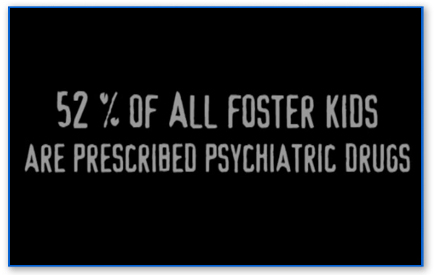
The State of Florida, the so-called Sunshine State, has a drug problem, a drug crisis actually. The State seems hooked on psychotropic drugs for children. And not just any children. The most vulnerable children. Foster children. Children in prison. Children in various forms and modes of `custody’.

Two years ago, on April 16, 2009, Gabriel Myers, a seven-year-old child, hanged himself. Gabriel was in foster care. At the time of his death, Gabriel was prescribed psychotropic medications. The State of Florida Department of Children and Families appointed a work group, the Gabriel Myers Work Group, to look into both the circumstances of Gabriel’s death, and life, and that of all children in State foster care.

Gabriel was placed in foster care in order to take him out of a traumatically abusive household. He was “brought into care June 29, 2008.” Ten months later, he was dead. It happens that quickly, and it happened that torturously slowly as well. Gabriel saw psychiatrists and therapists. He was described as “overwhelmed with change and possibly re-experiencing trauma.” He engaged in self-destructive behavior.

The Work Group found that, while there were many caring adults around Gabriel, in the end he was “no one’s child.” No one adult took full responsibility, and so there was no one to notice or address failures, gaps, and lapses in treatment. For example, there was no one to ask hard, even belligerent, questions about the effects and impact of psychotropic drugs on a child. According to the Work Group, there was no sense of urgency: “Because the perception of time for a child is compressed, a demonstrated sense of urgency by adults is vital.”

The Work Group found that, while nationally 5% of all children receive psychotropic medication, among Florida’s foster kids, the rate was 15.2%. Florida has all sorts of protocols and regulations, but if there’s no one, no adult, with a vital and demonstrated sense of urgency, the drugs flow. Gabriel’s tragedy was one of repeatedly missed opportunities for real treatment, for real help, for real care. That was the Report of the Gabriel Myers Work Group, November 19, 2009.

That was two years ago. And today?

Today, Florida distributes psychotropic drugs, with what amounts to abandon, to children in prison. Doctors are prescribing psychotropic drugs more often than ibuprofen. In 2007, according to a report last week, the Department of Juvenile Justice bought more than twice as much Seroquel as ibuprofen for its state-operated jails and homes for children.

Again, there’s little or no oversight. By its own admission, the State doesn’t know where most of the drugs are. This is called a “functionality” concern. There’s little or no oversight, as well, concerning conflict of interest between prescribing doctors and the pharmaceutical corporations.

What’s going on in Florida? According to Broward County Public Defender Howard Finkelstein, whose office represents children in juvenile court, it’s battery: “If kids are being given these drugs without proper diagnosis, and it is being used as a ‘chemical restraint,’ I would characterize it as a crime. A battery – a battery of the brain each and every time it is given.”

According to Dr. Glenn Currier, an associate professor of psychiatry at the University of Rochester in New York, the doses are extraordinarily high. When asked about a case involving one young female prisoner, Dr. Currier remarked: “I have heard of doses that high in large adult males. But not in girls.”

Florida used to put juveniles in prison for life, without any chance of parole, for non-homicide offenses. Last year, in Graham v Florida, the US Supreme Court ruled that it could no longer do so. In the 1990s, Florida sent 7000 children to adult courts. That’s more than the rest of the country, combined.

What’s going on in Florida is a crisis, a crisis of care, a crisis of urgency. The State is distributing deadly drugs to its most vulnerable children. And that’s a crime.


(Image credit: CCHR International)


As of 11 March 2011, there were 1030 children in immigration detention in Australia

Today, May 26, 2011, is national Sorry Day in Australia. On May 26, 1997, the Report of the National Inquiry into the Separation of Aboriginal and Torres Strait Islander Children from their Families was presented to the Australian Parliament. This report is better known as the Bringing Them Home Report. The report focused on the Stolen Generation, on the abuse of Aboriginal children, families, communities. Ever since 1997, many Australians have marked the event with a National Sorry Day. Of course, Sorry Day alone is not enough.

The Australian Human Rights Commission today issued a report, entitled 2011 Immigration Detention at Villawood: Summary of observations from visit to immigration detention facilities at Villawood.

Villawood is a private prison, run by Serco Australia. Comprised of two sections – Villawood Immigration Detention Centre (IDC) and Sydney Immigration Residential Housing (IRH) – Villawood is the jewel in the Australian immigrant detention crown.

The Australian Human Rights Commission “has raised concerns” about Villawood for over a decade.

According to the Commission Report, “As of 11 March 2011 there were 6819 people, including 1030 children, in immigration detention in Australia – 4304 on the mainland and 2515 on Christmas Island. More than half of those people had been detained for longer than six months, and more than 750 people had been detained for longer than a year.” Fifteen percent of those prisoners are children.

The section entitled “Children in Detention” begins: “As of 11 March 2011, there were 1030 children in immigration detention in Australia. The Commission has repeatedly raised concerns about the mandatory detention of children, the high number of children in immigration detention facilities, and the long periods of time many children are spending in detention.  These concerns were reinforced by the Commission’s visit to Sydney IRH.”

In March, the Sydney IRH housed 27 people. Eight were children, three girls and five boys. Thirty percent of the Villawood `residents’ were children. The youngest child was four months old, and the oldest was 16. One was unaccompanied; one had been born in prison.

As it has done, repeatedly, for over a decade, the Commission raised concerns about the detention of children. These include:

•            Child asylum seekers continue to be subjected to mandatory detention.

•            Many children are held in immigration detention facilities, such as Sydney IRH. These are closed detention facilities. Call them what you like, they’re prisons.

•            Many children spend long periods of time in immigration prisons. In Sydney IRH, all eight children had spent more than three months in detention. Seven had been in for more than six months. Three had spent more than a year behind bars.

•            There is no judicial oversight for the immigration detention of children.

•            There is no written policy at Sydney IRH identifying the delegated legal guardian for detained unaccompanied minors.

•            There is no written policy regarding the care and supervision of unaccompanied minors detained at Sydney IRH.

•            There are no independent observers for interviews with unaccompanied minors detained at Sydney IRH.

•            There is no Memorandum of Understanding between DIAC and the New South Wales Department of Community Services regarding the welfare and protection of children in immigration detention at Sydney IRH or elsewhere in NSW.

Australia has a policy of immigrant `detention’ as a last resort, and for as limited a time as possible. This has been the official national, Federal policy since 2008. And yet, families with children and unaccompanied minors are sent to prison rather than community-based alternatives. There is no plan for community alternatives. The Commission is concerned.

Today, in Australia, is national Sorry Day. Tomorrow begins national Reconciliation Week. Meanwhile, new Stolen Generations pile up behind bars in immigrant prisons. Sorry.


(Photo Credit: Australian Human Rights Commission)


California’s cruel and usual prisons: who cares?

Exercise cages for prisoners at California State Prison, Corcoran

The Supreme Court handed down its decision this week on the California prison system. The decision, by Justice Anthony Kennedy, and the dissenting opinions, are riveting reading, from beginning to end.

The decision involves two cases. The first, Coleman v. Brown, concerns prisoners with serious mental disorders. The second, Plata v. Brown, concerns prisoners with serious medical conditions. The Supreme Court was asked to decide whether a lower court decision that mandated California reduce the size of its prison population should stand. By a 5 – 4 vote, the Court decided it should.

Many issues are engaged here. Is overcrowding the primary cause for the longstanding “needless suffering and death” that occurs in a system that has double the residents it is designed to hold? If California were not mandated to release prisoners, or otherwise reduce the prison population, would it do so on its own? Is the relief sufficiently `narrow’ to meet the legal requirements of `narrowly drawn’ and `no further than necessary’? Are the remedies imposed overly intrusive?

The public discussion has focused on overcrowding, but consider the grammar of Justice Kennedy’s argument. Here’s an example: “Because of a shortage of treatment beds, suicidal inmates may be held for prolonged periods in telephone-booth sized cages without toilets. A psychiatric expert reported observing an inmate who had been held in such a cage for nearly 24 hours, standing in a pool of his own urine, unresponsive and nearly catatonic.  Prison officials explained they had `no place to put him.’ Other inmates awaiting care may be held for months in administrative segregation, where they endure harsh and isolated conditions and receive only limited mental health services. Wait times for mental health care range as high as 12 months. In 2006, the suicide rate in California’s prisons was nearly 80% higher than the national average for prison populations; and a court-appointed Special Master found that 72.1% of suicides involved some measure of inadequate assessment, treatment, or intervention, and were therefore most probably foreseeable and/or preventable.’”

The situation for prisoners with serious medical illness is equally dire and cruel.

Overcrowding in California prisons has led to “serious constitutional violations”. But overcrowding is not the crisis. Overcrowding is the symptom. The two cases, Coleman v. Brown and Plata v. Brown, speak to the responsibility of the State to take care of the most vulnerable.

“A prison that deprives prisoners of basic sustenance, including adequate medical care, is incompatible with the concept of human dignity and has no place in civilized society. If government fails to fulfill this obligation, the courts have a responsibility to remedy the resulting Eighth Amendment violation.”

The California prison crisis is not overcrowding. The crisis is not the sum total and ratio of human bodies to square feet, of good and `bad’ beds to properly residential spaces, of toilets to hundreds of individuals, of medical care providers to mentally and medically ill. The crisis is human dignity. The crisis is sustenance. The crisis is responsibility. The prison crisis in California is a crisis of State and a crisis of society. It is a crisis of care. Care haunts the Plata v. Brown decision. Care haunts California. Care haunts us all.


(Photo Credit: James L’Etoile)


Who remembers the seven girls who died in Armadale?


The children of Jamaica are in crisis, especially the girls: “The Jamaican child is, more often than not, poor, barely educated, vulnerable to paedophiles, exposed to acts of crime and violence, at risk of being raped, trafficked, and of becoming pregnant. This, according to social workers and child rights activists who insist the State has failed its children.” Girls and boys share some of the crisis. The entire crisis and each part and element of the crisis targets girls.

Today is May 22, 2011, a mere two years since seven young girls were killed in a fire, on May 22, 2009, at Armadale Juvenile Correctional Centre, in Alexandria, St. Ann Parish, Jamaica. Seven girls were burned to death. Five died the night of the fire: Ann-Marie Samuels, Nerrissa King, and Rachael King, all 16 years old; and Kaychell Nelson and Shauna-Lee Kerr, both 15. Later, two more died from the fire: Georgina Saunders, 16, Stephanie Smith, 17. There were 23 girls in a small space. Sixteen managed to crawl through the fire, to the narrow windows, and out.

Armadale was shut down. An inquiry was launched. The Armadale Enquiry Commission met for over nine months. Its report roundly condemns the government. The fire was set by a spark from a tear gas canister, tossed in the room by a guard. The straw bedding ignited.

On March 2, 2010, Prime Minister Bruce Golding reported to Parliament. The Jamaican press reported then that the government “accepts `ultimate responsibility’ for Armadale.”

What qualifies as `acceptance’? What is `ultimate responsibility’?

In February of this year, the government accepted “financial liability.” This meant the State paid survivors. How much is a life worth? What is the value of pain and suffering? Who decides? Individual payment “is largely dependent on the extent of the injuries sustained by each girl.” The State says it is difficult `negotiating’ the settlement because many of the girls are in rural areas and because all of the girls are trying to put their lives together, are trying to live with dignity.

The payment is for the fire damage. Not for the inhumane conditions at Armadale at the time of the fire. The payment is for the event, the specific event, not for the situation. Nor for the `erosion of moral and ethical standards.” That remains intact.

The pain that continues is not only the pain of memory, of loss, of recognition. It also the pain that is administered by the State to children in prison every single day.

Children today are still in lock up, and often lockdowns, often in adult prisons. As of last month, more than 100 children were being held in adult cells.

Today is May 22, 2011, two years since the Armadale fire. There were no proclamations from the State, there were no memorials in the leading Jamaican papers. If there were ceremonies, they were private. The State has `accepted ultimate responsibility.’ It has washed its hands and declares them, and itself, clean. Who remembers the seven girls who burned to death in Armadale, and for how long will we remember?


(Photo Credit: The Jamaica Observer)

I’m a human. I know the fear

The governor of Texas recently declared a state of legislative emergency. The emergency is sanctuary. Cities in Texas are declaring themselves `sanctuary cities’ or are acting as such, and that somehow threatens Texas.

The Texas House of Representatives leapt to action and dutifully passed a bill, HB 12, that would effectively outlaw sanctuary zones. The moment the bill passed, House Representative Ana Hernandez Luna requested to speak to the body, as a matter of personal privilege.

Representative Luna explained that she, her sister, and her parents had come to Texas from Mexico. The family overstayed their visa and lived in the shadows until the 1986 amnesty was signed, by Ronald Reagan. In the intervening twenty-five years, Ana Hernandez Luna attended and successfully completed grade school, college, law school, and was elected to the House of Representatives at the age of 27.

Representative Luna began her remarks by articulating the new version of W.E.B. DuBois’ color-line: “I’m not an alien. I’m not a problem that must be handled. I’m a human.”

She then described the new, and not so new, world order: the politics of fear: “I remember the constant fear my family lived with each day.”

And then Ana Hernandez Luna found it difficult, impossible, to simply speak the words. Tears began to flow, as she struggled to speak: “The fear my parents experienced each day as their two little girls went to school – not knowing the there would an immigration raid that day – and they wouldn’t be able to pick up their daughters from school – and not knowing who would take care of them if that were to occur . . . . The daily task of going to the grocery store to buy groceries might seem a simple task to you, but to us it was a death sentence, that one of my parents may be deported. . . . I know the fear.”

The Texas Senate managed to gut the bill, but the fear persists. Twenty-five years after receiving amnesty, after twenty-five years of steady work and accomplishment, Ana Hernandez Luna still lives, immediately and viscerally, with the knowledge of the fear and with the fear itself.

The politics, and the politicians, of fear dream of a world without sanctuary. Some say that when it comes to prison reform, to addressing mass incarceration, money trumps civil rights. When it comes to children, whose access to `civil rights’ is already tenuous, fear trumps sanctuary. It’s a war zone.

Seven years ago, Else Temesgen and her daughter Betty, who was seven at the time, fled to the United Kingdom. Else was fleeing, first, an abusive husband and, second, a situation of certain separation. Else is Eritrean-born, and her daughter is Ethiopian-born, and so, if the two had returned to Ethiopia, the mother would have been deported. They arrived in England and immediately applied for asylum.

The two were detained in a variety of centers before, finally, receiving asylum. Else describes Yarl’s Wood as “very horrible.” Asylum only came because of the intervention of a prominent local politician. Otherwise, they would still be in the shadowlands of immigrant detention … or worse. They know the fear.

The politics of fear sows only tears. Twenty-five years after coming out of the shadows, Ana Hernandez Luna lives with the knowledge of fear, a shared knowledge, a knowledge whose borders are expanding, and weeps. Twenty-five years from now, how will Betty tell the story of her sojourn in Yarl’s Wood?

What exactly is the nation-State that would be threatened by sanctuary? Sanctuary is not an emergency. If anything, sanctuary is holy. Sanctuary is a time and space in which the human can be recognized and sustained. “I’m a human.”

Sanctuary haunts the State of fear.


(Video Credit: YouTube / Texas Impact)

Ashley Smith died while seven guards followed orders and watched


Ashley Smith

Ashley Smith was 19 years when she was allowed, or encouraged, to die. At the time, she was a prisoner of the Grand Valley Institution for Women, in Kitchener, Ontario, Canada.

According to the Canadian government, Grand Valley is in many ways a model women’s prison. Organized around cottages, allowing for maximal self-sufficiency, it fosters a sense of personhood and humanity through what might be called normative social contacts. Women prisoners are allowed a certain level of discretionary time, quiet time, social time, alone time.  According to a 2005 commission report, by HM Chief Inspector of Prisons for England and Wales, Grand Valley, or GVI, is a relatively open and `healthy’ prison, fostering “safety, respect, purposeful activity and reintegration”. It’s not perfect, it’s not ideal, but as prisons go, it’s pretty good.

When thinking of Ashley Smith’s story, remember that the place in which she was allowed, or encouraged, to die is one of the model women’s prisons in Canada and in the world at large. This is as good as it gets.

Ashley Smith was a `troubled’ youth, in and out of trouble for minor offenses. She needed help, and in New Brunswick, where her family lived, the public mental health system could not address her needs. And so, instead, she was allowed to go `into the system.’

In March 2002, at the age of 14, Smith was sentenced to one year of probation for harassing phone calls, assaulting strangers on the streets, insulting bus passengers and drivers. A year later she was ordered into a youth center for probation violations. There she underwent psychiatric evaluation that suggested borderline personality disorder, among other possibilities. She was released. Seven months later, while at home, Ashley Smith threw apples at a postal worker. For that she was returned to the youth center, where she spent most of her time in solitary. From then on, she stayed pretty continuously in prison.

In October 2006, Ashley Smith was moved to federal prison, for violations committed while in prison.  A year later, she hanged herself.

In less than a year, her last year on earth, Ashley Smith was transferred seventeen times, from Nova Scotia to Saskatchewan. Different prisons, same treatment.  Full body constraints. Shackles. Solitary confinement.

On August 30, 2007, Ashley Smith was returned to the Grand Valley Institution for Women.

During her time at GVI, Ashley Smith somehow made ligatures, strips of cloth clearly intended for self-harm. In a two-month span, fifty ligatures were confiscated. On September 24, 2007, Kim Pate, executive director of the Canadian Association of Elizabeth Fry Societies, visited Ashley.  At her request, Pate filed a grievance, pleading for release from segregation and transfer to a hospital.

Smith knew she needed help. She knew that segregation was a death sentence. She had spent almost the entire preceding eleven months in solitary confinement. That’s a cell 6 feet by 9 feet: no books, no mattress, no writing implements; often, no clothes. The prison calls it `therapeutic quiet.’ While in federal custody, Ashley Smith received much `therapeutic quiet’, but never a comprehensive psychological assessment.

Pate’s grievance was placed in a grievance box that is only checked once the box is full. The box never filled. In the meantime, Ashley Smith hanged herself.

Seven guards watched and did nothing. They did nothing because they had received orders, in September, to not intervene. Ashley Smith had attempted suicide on numerous occasions. If guards entered to stop her, their actions were considered `use of force’, and involved videotaping, paperwork, and hearings. Rather than waste resources, the prison instructed the guards to not enter as long as Smith was breathing. Once dead, it’s no longer use of force.

This week, almost four years later, the coroner’s court began its inquest. Psychologists argue that Ashley Smith did not commit suicide. She thought people would come to her. She was trying to get help.

Seven guards watched and did nothing, which is to say, they did a great deal. They followed orders.

And Ashley Smith struggled to get help.

There are `ghastly’ videotapes of Ashley Smith’s death. Some say, “Ms. Smith’s death should haunt Canada.” Indeed, it should. At the same time, it would be more apt to say that Ashley Smith haunts Canada and the world. Ashley Smith was sick, she needed help, tried to get help. How did the State respond? It condemned her to live in a box for her last year on earth in a box, preceded by an endless series of cages.

Seven guards watched and did nothing. They were not alone in doing nothing. Ashley Smith haunts everyone.


(Photo credit: UWaterloo.ca)

Where do the children live? Prison

I’ve been here for two weeks, and this is my third time in. I’m in the sixth grade. I was in placement but I ran away. They accused me of assault against my mom, but she scratched herself and said I did it. My dad lives in Atlanta and works in a barbershop. -E.Y., age 11 Juvenile Detention Center, Houston, Texas.

For the past forty years, the planet has been engaged in a global prison lockdown and a worldwide prison – building binge, which have resulted in the confinement of more women than ever before. This build up of lockdowns began in the United States in 1973, and has since blossomed, or mushroomed, into a global frenzy of incarceration of working class women of color and indigenous women.

The hyper-incarceration of women affects children, especially in those communities in which single women predominate as heads of households. The assault on children is more direct, however. At the same time that women, especially working class women of color and indigenous women, are being caged, their children are also being locked up as never before.

What is a child? A child is one’s offspring, a child is a minor. A child is a child, and tell me, where do the children live?

Given the prison boom, there are more offspring behind bars than ever before. Typically, the task and labor of maintaining social and sustaining contact is left to mothers, secondarily to female partners.  This is the lesson of Mothers Reclaiming Our Children, in California. When children are sent to prison, mothers are launched into a global reclamation and reconstruction project that, for many, never ends.

For example, Diana Montes-Walker’s son is an adult man in his 20s, living with bipolar disorder, complicated, predictably, by alcohol and drug dependencies. Equally predictably, her son `encountered’ the state criminal justice system, in this instance the California system. Ever since her son has been in prison, he has suffered one form or another of solitary confinement. Either he was in solitary in prison, or he was in solitary in so-called medical facilities that are actually prisons for inmates with `special needs’. In the latter, he is in solitary, but, according to his mother, with a little more freedom. He made it into the `better’ solitary confinement because his mother pushed, shoved, organized, shouted, wrote, met incessantly with everyone. And now, Diana Montes-Walker drives back and forth to scheduled meetings with doctors and social workers who don’t appear. And her son stays in solitary, and she has no idea how he’s doing.

Why is this happening to Diana Montes-Walker’s son, and so many others like him, young men and women living with mental disabilities and illnesses of one form or another? Why is he in prison? He is in prison because public mental health budgets have been shredded and then vaporized. Prisons are the new public mental health institutions. Meanwhile, Diana Montes-Walker, inhabits a State-sponsored hell, built because it’s more efficient to have her run around and take care of her son, more efficient and less costly.

Where do our children live? In prison.

In Turkey, close to 500 children live in prison with their mothers, who have been convicted. Why are they in prison? “Financial difficulties”.  For the children, three to six, there might be a kindergarten. For those under three years old, they spend the entire time in the cell with their mothers. These children are not in prison because of their mothers’ “financial difficulties”. They are in prison because of the moral and ethical bankruptcy of the State and because of the social structures that support that State.

Because of `financial difficulties’, Mississippi’s one juvenile detention center is run by a private corporation, the GEO Group. According to parents of the children being held there, the place is a horror, another State-sponsored hell. Fights break out, and the staff ignores calls for help and protection. Worse, the staff is accused of brutalizing children. Parents gaze upon their wounded and maimed children and feel a pain they describe as torturous. The lawyers describe the prison as barbaric and unconstitutional. The children describe the place as a war zone.

War zone is too nice a phrase for a place in which civilians are butchered for profit.  Child prisoners, children’s bodies and lives, bloat the coffers of private industry. They are an extractive resource whose market value continues to grow. Where do the children live? They live, and often die, in prison.

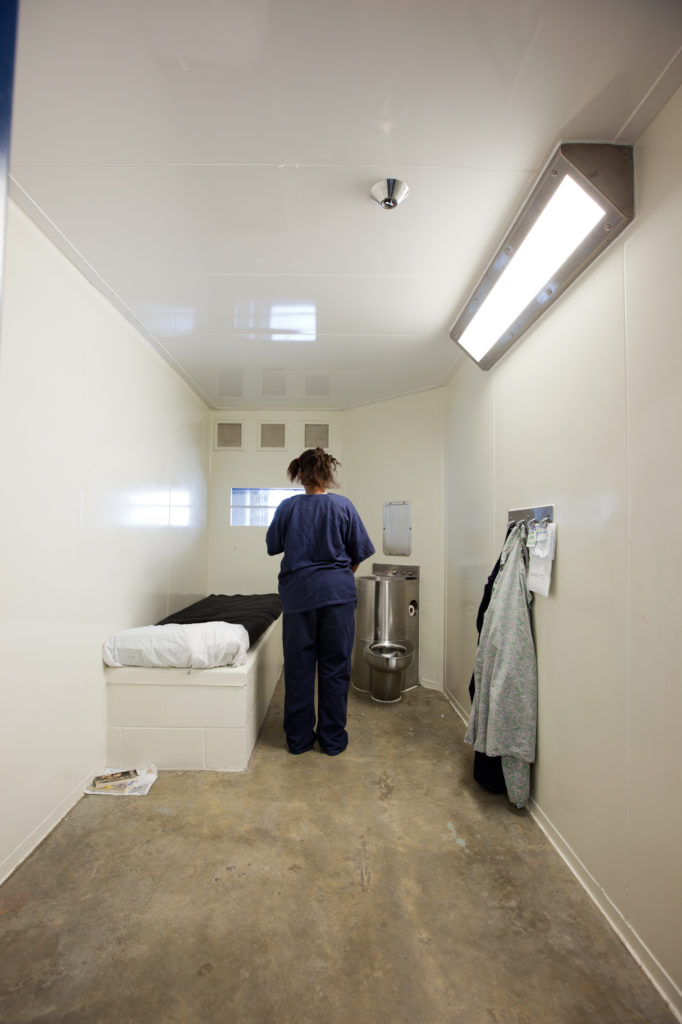
(Photo Credit: Richard Ross, Juvenile In Justice)