Women haunt land grabs and mass evictions

Oxfam came out with a major report this week on land grabs in five countries, Uganda, Indonesia, Guatemala, Honduras, and South Sudan. In Uganda, over 20,000 people were evicted from land they had farmed for decades, evicted so that a British corporation, New Forests Company, could come in, create tree plantations, earn carbon credits, sell timber.

The residents were never consulted. Quite to the contrary, tales of violence abound. For example, Olivia Mukamperezida, whose house was burned to the ground. Her eldest son, Friday, was at home because he was sick. He was killed in the fire. She buried Friday, and now is not sure if he’s even in his grave. “They are planting trees,” she says.

Christine was forced off her land as well: “We lost everything we had .… I was threatened – they told me they were going to beat me if we didn’t leave.”

Christine lost more than everything she had. She lost the future. Before she and her family lived in a six-room house, farmed six hectares, sold produce, sent their kids to school. They had been doing so for twenty years. Now, they live in two rooms, eke subsistence living out of a small plot, eat once a day, and the children no longer attend school.

The Oxfam report highlights the particular vulnerabilities of women, and the specific impact of eviction on women around the world. They note that in Africa, the situation is particularly dire: “Women’s land rights are less secure and more easily targeted. They also depend more on secondary uses of land, which tend to be ignored in large-scale acquisitions. Furthermore, although women comprise the majority of farmers, men effectively control the land and the income derived from it, even if it is the fruit of women’s labour. In practice, a new commercial opportunity often means that men assume control of the land at the expense of women’s access. Thus, new sources of income from the land are likely to burden women and benefit men. The new competition for land between biofuels and food crops, leading to less availability of food and higher prices, is also likely to affect women more than men, as women tend to take responsibility for feeding the family.”

From direct physical and verbal assaults to the processes to the consequences, the entire land grabbing machinery is violence against women.

None of this is new. Previous researchers have issued reports on that describe the gendered impacts of commercial pressures on land, that wonder if land grabs aren’t simply, and intentionally, another bigger, badder yoke on women’s land rights. Activists, such as Esther Obaikol, Executive Director of the Uganda Land Alliance, have also been organizing with women farmers … for decades.

When it comes to land grabs in Uganda, as elsewhere, women farmers have been pushed harder, deeper, further. They are the first and final targets of land grabbing. Mass evictions attack women. Women haunt land grabs and mass evictions … everywhere.


(Photo Credit: Sven Torfinn for The New York Times)

Gender equality is so “sticky”, says the World Bank

The World Bank this week issued its so-called flagship report, The World Development Report 2012: Gender Equality and Development. The report proclaims that “gender equality is at the heart of development.” It goes on to suggest that progress has been made, but it’s spotty or mixed … or “sticky”. Sticky? In almost 400 pages, that word, “sticky”, is the only surprise.

According to the report, for the past 25 years, women have been ascending … with some exceptions. Here are just some of the exceptions to the rule of women’s improvements.

There are more schools and more students in schools, but the excluded, the ones who never get formal education or receive very little, are still overwhelmingly girls. Globally, more women have entered the formal labor market, but women still make up the vast majority of low-wage job holders. The pay gap between women and men continues, and in some cases widens.

According to the report, “culture” is still a hard nut to crack. Household culture, faith based culture, community culture, you name it. In rich countries and poor, women are still at risk of domestic violence, by commission and omission. Women are under attack, and the State too often refuses to do anything.

In fact, “culture” and “economy” have merged … to the detriment of women. In countries with “shining” economic growth, such as India and China, high maternal and child mortality rates continue, as they do in the United States. Rapid income growth has led to higher levels of sex selection. Women are dying in childbirth, and girls are going “missing”. It’s the price of “progress”.

The report calls these “exceptions” “sticky”. They are either “`sticky’ domains” or “`sticky’ problems.” The quotation marks are the World Bank’s, not mine. Sticky? What does that mean? As a term, “sticky” is never defined, although it begs, screams, for some definition. Here’s how “`sticky’ domain” is defined: “Improvements in some domains of gender equality—such as those related to occupational differences or participation in policy making—are bound by constraints that do not shift with economic growth and development. Gender disparities endure even in high-income economies despite the large gains in women’s civil and economic rights in the past century. These outcomes are the result of slow-moving institutional dynamics and deep structural factors that growth alone cannot address.”

That is precisely the sort of sleight-of-hand that feminists have long criticized.  When it comes to women, according to the Bank, the improvements are fine. Growth, like greed, is good. The internal contradictions, the flaws, such as increased violence and broadening poverty, those are not part of growth. Those are … the signs of a backward culture! And the fact that they’re persistent just means they’re … sticky.

“Sticky” was a perfect word choice, because it accurately describes the mentality of this sort of “gender equality and development.” After all, what takes care of persistent “sticky”? A thorough “cleansing”.


(Image Credit: Alberto Barreto / CIPE)

It wasn’t sex. It was rape.

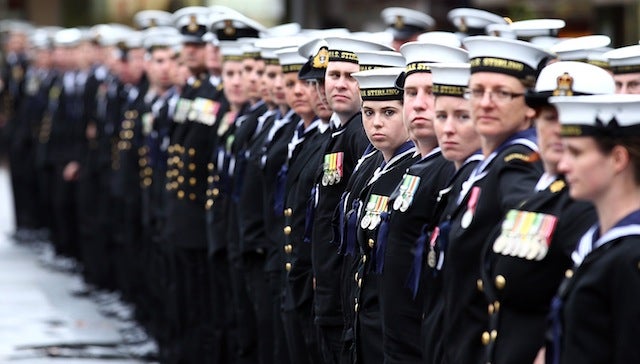
Last month, in Australia, a cadet was found guilty of two counts of having raped a woman cadet while she slept. The rape occurred in 2009. He filmed the act, ostensibly as evidence for his mates. His lawyer claims the kid just wanted to fit in. A horrible, and all too familiar, story, and not only in Australia.

The language of the coverage is telling. The woman was a `colleague’. Really? When did  rape become a collegial act? “Culture” comes into play as well. The military culture of “work hard, play hard” is offered as part of the context. Really? Rape is, somehow, play?

The most telling instance, in the BBC coverage of the story, is the link on their home page. There, the headline reads: “Filming sex `rife at Navy base’”. Only when a reader links to the actual article does the headline read, “Australia Navy cadet filmed rape ‘to be accepted‘”.

It wasn’t sex. It was rape.


(Photo Credit: Jezebel)

Women at work, not miracles, feed the village


At the end of November, Durban, South Africa, will host COP 17, the 17th Conference of the Parties (COP 17) of the United Nations Framework Convention on Climate Change (UNFCCC). As happened last year, in the run-up to the Cancun conference, the press yet again `discovers’ women farmers, women fisherfolk, women workers, who are at the core of the struggle for climate justice, both as active participants and as targets of environmental devastation and climate change. Yet again, the story is that women `bear the brunt.’

This story takes one of two routes, miracle or mercy. According to the first, by some miracle, women discover a way to feed their communities. According to the second, the slow death of climate change shall have no mercy on women. This week’s Mail & Guardian offers a prime example of the miracle narrative.

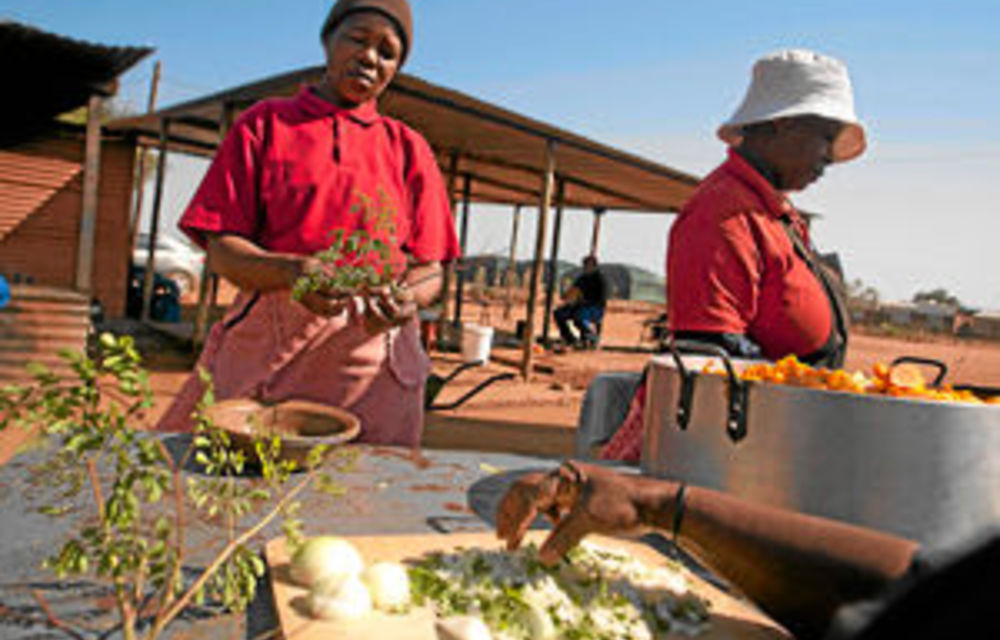
In “The `miracle’ tree”, the village of Tooseng is saved by the `miracle’ of the moringa tree. It was no miracle. It was instead Mavis Mathabatha, of the Sedikong sa Lerato drop-in center, which feeds 320 children and provides after-school care. As well it was her mentor, Mamakgeme Mphahlele, who directs Lenkwane Lamaphiri drop-in center, in Mphahlele Seleteng. Both Mathabatha and Mphalele have committed their centers to planting the super-nutritious moringa trees. The moringa leaves are a treasure of nutrients: calcium, vitamin C, potassium, iron, vitamin A, protein, and lots of each.

There was no miracle. Mathabatha and Mphalele, as women in charge of drop-in centers, did what women in charge of drop-in centers do. As Mavis Mathabatha tells the story, the women performed research. They asked questions. They went on-line and researched some more. They found the information, then they found the agencies to provide the seeds, then they found the means. They took care of the children, the community, and, in their way, the world.

Climate justice. Sustaining and sustainable food. Healthy children. These are not lofty, impossible goals, and they are never the result of miracles. They are, instead, produced by women who live in the everyday, in the odinary world we all inhabit, and who struggle to improve it. We have had too many stories of miracle workers. Instead, let’s hear about the neighbors and friends, the women around the corner or in the next village, and what they’re doing. Let’s admire Mavis Mathabatha and Mamakgeme Mphahlele for their radically ordinary pursuit of well being for all.


(Photo Credit: Mail & Guardian)


Marta Orellana must just live with the devil that haunts her

Marta Orellana

In the 1940s, the United States sent doctors to Guatemala to address syphilis, gonorrhea and chancroid. Not to stop them but rather to spread them. Specifically, the U.S. Public Health Service wanted to know if penicillin after sex would prevent sexually transmitted diseases. So the doctors went to Guatemala and `recruited’ some 5500 soldiers, mental patients, children, sex workers into the program. They told them nothing, actually less than nothing. They infected the mental patients, all women; the children, all girls in orphanages; and the sex workers, all women, and then sent them to the soldiers. For Guatemalans, this was “the devil’s experiment.”

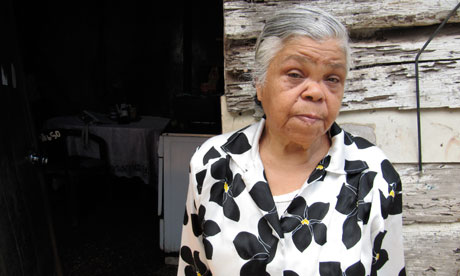
Marta Orellana was one of those orphans. She was nine years old when she was injected. For years, for decades, she lived with syphilis but was told that she had “bad blood”. She was in pain, and tired, her entire life. As she puts it, a “loving and patient” husband helped her overcome intimacy issues.

More than sixty years later, the United States [a] acknowledged the event, [b] apologized to the government of Guatemala, and [c] appointed a commission. The commission met yesterday and heard `shocking’ testimony. The story that attracted the most attention thus far is this: “a woman who was infected with syphilis was clearly dying from the disease. Instead of treating her, the researchers poured gonorrhea-infected pus into her eyes and other orifices and infected her again with syphilis. She died six months later”.

There are other stories, and others will follow … of injections, of pain and suffering, of abuse; of torture, grand and petty, slow and swift. Of 13,000 infected Guatemalans, around 700 received any treatment. 83 died.

The Commissioners have found the research to have been “grievously wrong”, “chillingly egregious”, “morally culpable”, unjust, tragic, shameful, reprehensible, “cruel and inhuman”, unethical.

The medical researchers did not act in a vacuum nor were they without context or history. The problem isn’t that they were unethical but rather that they were ethical men engaged in `ethical’ violence. In the same way that the experiments in the Nazi death camps, occurring in the same period, didn’t require justification because they were part of a moral crusade, a longstanding war against Jews, people of color, gay and lesbian people, the disabled, the experiments in Guatemala didn’t require justification because they were part of a longstanding war against the indigenous and the rural, against women of color, against the weakest and the most marginal who somehow … somehow … pose the ultimate threat.

The US medical researchers in Guatemala were not rogues, renegades, or outlaws. They were ethical White men who saw as part of their dominion over all living things the obligation to decide the fate, and design the excruciating death, of women, people and nations of color.  The United States of America has apologized to the Republic of Guatemala. Marta Orellana must just live with the devil that haunts her.

(Photo Credit: Rory Carroll / The Guardian)

Indignant women and girls ignite the Chilean Winter


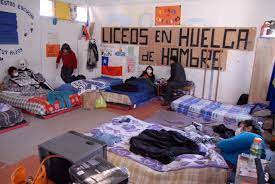
Hunger strikers at a secondary school in Buin, near Santiago.

For two days this week, the streets of Chile filled with indignation … and indignados. These protests are the latest event in a movement that began over three months ago, with a scattered series of classroom boycotts and protests. Since then, students from secondary and tertiary institutions have led teachers and professors, parents and custodians, trade unionists and government workers in protest, in action, in song and dance, in hunger strike, in organizing. The State has responded by arresting 14,000. Already one 16-year-old has been shot and killed. And now, after waves of protest, after State-sponsored bloodshed and belligerence, the State claims it wants a dialogue.

The students began their protests to challenge and change the inequalities within the educational systems and structures, inequalities that are funded, or better de-funded, by mass privatization, on one hand, and a tax structure that sends relatively little money into the schools. Most students attend grossly underfunded public universities while the wealthy few attend the very few exclusive and exclusionary private universities. At present, Chilean university education is one of the most expensive in the world. Students assume extraordinarily high debts, with 50% of them considered heavily indebted. The schools are both expensive and lousy.

As inequality has grown in Chile, so has segregation. According to some, Chile is the second most socially segregated country in the world. The rich study – and play and live — only with the rich, the poor with the poor.

Students began to see the inequality gap as well as the increasing barriers and increasingly high walls as the State condemning them to a slow death sentence. Rather than roll over, they responded with outrage.

Women and girls lead the student movement. 23-year-old Camila Vallejo, for example, is the president of the University of Chile’s student union and the principal spokesperson for the Confederation of Chilean University Students. 18-year-old Francia Gárate is on hunger strike. So are 17-year-olds Johanna Choapa and Maura Roque. María José Zúñiga is spokeswoman for secondary school students at Liceo A-131, high school in Buin next to the capital, Santiago. Pictures and articles show innumerable unnamed women and girls on the front lines, at the bullhorns, on the various stages, in the hunger strikes.

Why are women leading the charge? For almost four decades, Chile has “manufactured modernity” by relentlessly pursuing a neoliberal economic policy: privatization, free trade, the works. And who “bears the brunt” and who literally does “the dirty work of neoliberalism” in Chile? Women. Who looks at the promises of an `emerging’ first world national economy and sees that the money goes for teargas canisters rather than books, for corporate palaces and hotels rather than classrooms? Who looks at the gap and sees who’s making those decisions? Women.

Indignant, insightful women and girls are igniting the Chilean Winter with their outrage.


(Photo Credit: Fernando Fiedler / IPS)


Women farmworkers haunt South Africa’s fruit and wine industries

Farm work is hard work, and farm workers around the world suffer abuse and exploitation that often seems to marry predation to sadism. A most recent, and vivid, picture of this emerges in this week’s Human Rights Watch report, Ripe with Abuse Human Rights Conditions in South Africa’s Fruit and Wine Industries. The report focuses on the fruit and wine industries of the “wealthy and fertile” Western Cape, where the greatest number of farmworkers, around 121,000, live. The report documents the active abuse, and worse, of farm owners and farm managers, and the often active failure of the State to live up to its Constitutional obligations to protect workers, families, citizens, people, women.

In South Africa, the report was picked up by the Mail & Guardian, the Sowetan, the City Press, The Times, The Cape Times, to name a few. Internationally, the BBC, the Guardian, and the Telegraph commented. In a number of reports, women farm workers or farm dwellers appeared.

For example, farmworker Sinah B struggled against forced eviction. Her employers cut off her electricity and running water, in the middle of winter, while farm security guards harassed and persecuted Sinah B and her two children morning, noon, and night.

Johanna Flippies and her family have been forcibly evicted from three farms in the last ten years, because her husband is a union shop steward. For Flippies, life on the farm is hell, life off the farm is … hell.

For workers on Western Cape farms, life is dismal, misery.

The news coverage of the Human Rights Watch report universally avoided the gender of misery. In the farmlands of the Western Cape, hell and misery have a face, and it is a woman’s face.

Farmworkers are divided into two large categories, permanent and casual or seasonal. Permanent farmworkers are in the main men. Women are seasonal. Even if they work year round. On the same farm. For the same employer. For years. Non-permanent farmworkers are the most abused, the most exploited, the most vulnerable, the most precarious, the under assault. They have fewer State-sponsored protections, for what they’re worth. Very few are organized in unions. As women, they’re paid less than men farmworkers, who are themselves paid, by law, less than domestic workers. Occupational health violations, such as lack of protection around pesticides, targets women. For women living on the farms, workplace sexual violence flows into domestic violence.

Human Rights Watch, in its report, explicated the gender dynamics of farmworker abuse and exploitation. Why have the news outlets avoided the women? Farmworkers around the world suffer abuse and exploitation. In the Western Cape of South Africa, farmworkers generally have it hard. But women farmworkers are the heart and soul, and target, of abuse and exploitation. Women farmworkers haunt South Africa’s wine and fruit industries … and silence about women farmworkers haunts the news.


(Photo Credit: Marcus Bleasdale/VII for Human Rights Watch)

The blood and distress of Olayinka Ijaware and her two children

Olayinka Ijaware is a young Nigerian woman who has been living in County Waterford, in Ireland, for the last four years. She is the mother of two children, aged five and seven. Until quite recently, Ijaware was pregnant with a third child. Then she suffered a miscarriage.

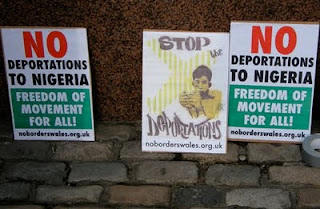
Early Tuesday morning, August 16, the Gardaí, or Irish national police, showed up and `escorted’ Ms. Ijaware and her two young children to the Dublin airport, where she was `prepared for deportation.’ Olayinka Ijaware is an asylum seeker. According to the State, she is a failed asylum seeker. According to her, her attorneys, and her friends and supporters, she is in the process appealing the decision, and so is still an asylum seeker.

As she was being `prepared’, Ms. Ijaware complained of pains and bleeding, the result, she explained, of her recent miscarriage. She was taken to hospital. She was seen by doctors. The doctors said she should not fly if she was suffering vaginal bleeding. Witnesses say she was bleeding and in deep distress. The Gardaí disagree. And so, Olayinka Ijaware and her two children, two children who basically know only Ireland, were shipped back to the airport, to `prepare’ for deportation.

Magically, and without explanation, the flight was cancelled. Ijaware was told to report to the Gardaí next week, for deportation.

The date and time of Ms. Ijaware’s miscarriage is being debated. That she was bleeding at some point that night is not debated. That she and her children were taken in the very early hours of the morning, without warning, is not debated. That currently the Irish government is conducting a mass deportation of so-called asylum seekers is not debated.

The full name of Ireland’s national police force is An Garda Síochána na hÉireann. That means “Guard of the Peace of Ireland.” The Gardaí are the Guardians, and Ireland is Ireland. But what is the peace? What is the peace when women’s blood and distress count for nothing, for less than nothing if the women are Black?

What is the peace of Ireland? Ask Olayinka Ijaware. Ask the children of Olayinka Ijaware. They know.


(Photo Credit: http://victorikoli.blogspot.com)

Instead of Women’s Day, What About Women’s Enjoyment of Freedom Day?


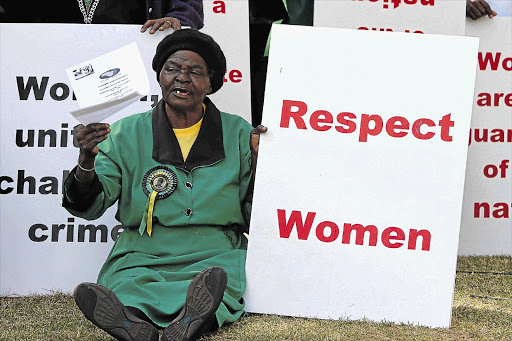
In South Africa, August 9 is National Women’s Day, and August is Women’s Month. This August, the Tshwaranang Legal Advocacy Centre, a South African women’s rights and well-being organization has a simple and direct question for everyone, “So just how real are women’s rights?”

They began, publically, to answer that question yesterday, August 11, with a new report, “The Right & The Real: A Shadow Report Analysing Selected Government Departments’ Implementation of the 1998 Domestic Violence Act and 2007 Sexual Offences Act”. On one hand, the answer paints a dismal picture. Only 8% of police stations meet their obligations under the Domestic Violence Act. Compliance would include helping a victim to find shelter and obtain medical assistance, serving notice on an abuser to appear in court, arresting an abuser who breaks a protection order, and, critically, keeping records of domestic violence. Failure to comply means misconduct, and should result in various forms of sanction and punishment. It hasn’t. Police stations ignore their responsibilities with impunity.

In 2007, 57% of police stations were compliant. Now … less than 8%. That’s not a drop, not even a steep drop. That’s a nose dive.

The report focuses on the failure of the South African Police Services and the Department of Justice and Constitutional Development (which includes National Prosecuting Authority), as well as the Departments of Health, Social Development and Correctional Services. The press has covered this failure as a failure to protect women and women’s rights, which it certainly is.

But Tshwaranang’s analysis goes far beyond the failure to protect.

The real of women’s rights is more than, bigger than, and more profound than “protection”. The real of women’s rights is freedom, and specifically the enjoyment of freedom:

“South Africa’s Constitutional Court makes it clear that, `few things can be more important to women than freedom from the threat of sexual violence.’ So important is this right to be free from all forms of violence that, along with the rights to life and dignity, it imposes two sorts of duties on the state: the first obliging the state to refrain from acting in ways that infringe on these rights, and the second compelling it to develop legislation and structures guaranteeing those rights….It is not only sexual violence that constitutes a rights violation of the sort requiring state intervention: `Indeed, the state is under a series of constitutional mandates which include the obligation to deal with domestic violence: to protect both the rights of everyone to enjoy freedom and security of the person and to bodily and psychological integrity, and the right to have their dignity respected and protected, as well as the defensive rights of everyone not to be subjected to torture in any way and not to be treated or punished in a cruel, inhuman or degrading way.”

Imagine a South Africa in which all women are free to move around as they please, dressed as they please. Imagine a world in which all women are free to move around as they please, dressed as they please. Imagine a world in which democracy means the enjoyment of freedom. Instead of celebrating Women’s Day, what about Women’s Enjoyment of Freedom Day?


(Photo credit: Halden Krog / Times Live)

Violence against women haunts independence


Egyptian men and women in one hand

“After the revolution”. In Egypt and Tunisia, women who made the revolution, women who pushed Mubarak out, are now facing the struggle for more rights, autonomy, and physical safety. This should come as no surprise to the rest of the so-called independent world.

Yesterday, August 6, Jamaica celebrated 49 years of independence from the United Kingdom. There were celebrations. At the same time, sexual violence against girls is both increasing and intensifying.

Across the African continent, August is celebrated as Women’s Month. August was chosen to commemorate the August 9, 1956, women’s march in Pretoria, in protest of the infamous pass laws. The women chanted, shouted, screamed: “Wathint’Abafazi Wathint’imbokodo!”. “Now you have touched the women, you have struck a rock!”

That was 55 years ago. Today, the women are still being `touched’, and in the most violent ways. Across the nation, campaigns, such as the One in Nine Campaign, and organizations, such as the Rape Crisis Cape Town Trust, struggle to address and end violence agains women. Organizations such as Free Gender struggle to address and end violence against lesbian, and in particular Black lesbian, women. All of these women’s organizations, all of these women, all of these feminists, struggle to address and end the hatred that is rape.

In many places, such as in the United States, that hatred often takes the form of legislation. For example, in 2005 Wisconsin passed a law that barred access to hormone therapy or sex reassignment surgery for prison inmates and others in state custody. Three transgender women prisoners, Andrea Fields, Jessica Davison, Vankemah Moaton, challenged the law, and this week, after six years, won their case in a federal appeals court.

Meanwhile, in Washington, DC, the nation’s capital, transgender women are hunted, attacked, often killed. For the crime of being transgender women. For the crime of being women.

What is independence? What is a revolution? Across the globe, women continue to struggle for the basics of independence, of autonomy. That begins with real recognition, that begins with the State as well as the citizenry and the population ensuring women’s safety. Women are not specters and are not promises to be met. Until women’s simple physical integrity is ensured, rather than promised, violence against women will continue to haunt independence.


(Photo Credit: NPR / STR / AP)