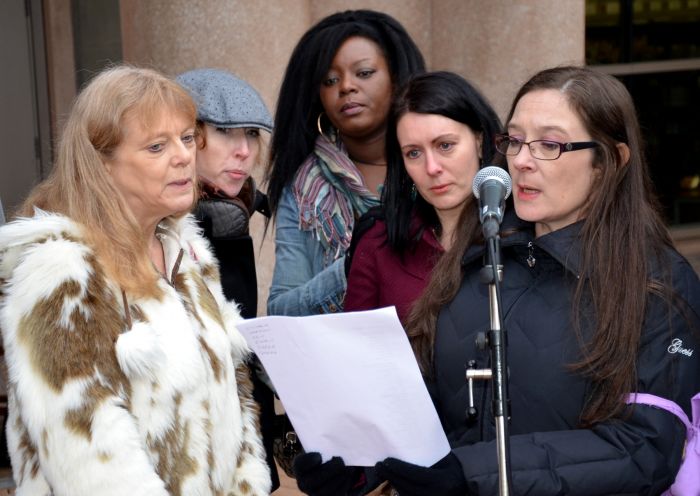
Reading the names of missing women
Across Turkey, women are at the forefront of the demonstrations. And not only women. Feminists: “At first groups of students chanted: `We are the soldiers of Ataturk’; this died out after feminist protesters objected to its militaristic overtones.”
From the first eruption through today, the Turkish movement has been a giant popular feminist education site, and one that includes sex workers: “`We used to sing ‘Erdogan is the son of a whore’. But when the police teargassed us, one of the brothels on Taksim Square opened its doors, and the women gave us shelter and treated us with lemons. We don’t sing that any more.’”
The solidarity of sex workers taught demonstrators that sex workers are workers, sisters, and women. Sex workers are not epithets or metaphors, and they are not criminals. They are part of the working mass, and they can represent themselves.
In the past week, sex worker organizations have taught exactly the same lesson to workers, social movements, and the State, around the world.
Across Canada this weekend, sex workers and supporters demonstrated, under the Red Umbrella, for legalization of sex work and for sex workers’ rights as workers, women, and women workers. This week, Canada’s Supreme Court will finally hear a challenge by Terri-Jean Bedford, Valerie Scott and Amy Lebovitch to the constitutionality of the laws concerning sex work.
Former and current sex workers have argued that criminalization makes sex workers more vulnerable, forces them further underground, further isolates them, and impedes access to public and social services. It’s a hard life, and the laws only make it harder, sometimes fatally so: “When Kerry Porth remembers her life as a sex worker in Vancouver, she can’t help but wonder how she survived when so many other prostitutes died a gruesome death at the hands of notorious serial killer Robert Pickton. `They were women just like me. Looking back, realizing just how much risk I was at, it was a real eye-opener.’”
In Kenya, sex workers in Laikipia District have organized a group called the Laikipia Peer Educators. They want formal recognition. They want the protection that formal recognition might provide, and they want the citizenship, the opportunity to participate and contribute to the common good in the same manner as every other worker. They want to trade in stigma for taxes.
In Australia, the Scarlet Alliance, representing Australian sex workers, lobbied to have foreign sex workers included among the skilled work visas. Sex work is legal across Australia, to varying degrees, but it’s not considered “skilled labor” by the State, at least not yet. Massage therapists, gardeners, florists, cooks, dog handlers, fashion designers, bed and breakfast operators, entertainers, dancers, recreation officers, makeup artists, jockeys, gymnastic coaches and horse riding instructors are considered skilled labor, but not sex work.
This is about work that is not called work, workers who are not called workers, and women who are told they cannot represent themselves. This concerns sex workers, as it concerns domestic workers in the United States. Both Hawaii and California seem to be on the verge of implementing or of passing respective Domestic Workers Bill of Rights. All workers are workers. Period.
Feminist political economists have argued for decades that women’s work is work, whether it’s waged or not, whether it’s called work or not. Women workers have known this and have organized for centuries for recognition, dignity, autonomy, rights and power.
From the social movements in Turkey to the courthouse in Canada to the District government in Kenya to the Australian Department of Immigration and Citizenship to the state houses across the United States, it’s time. It’s time to recognize women’s work, all work, as work, and to recognize all workers as workers. It’s time to change the song.
(Photo Credit: Rabble.ca / Murray Bush / Flux)