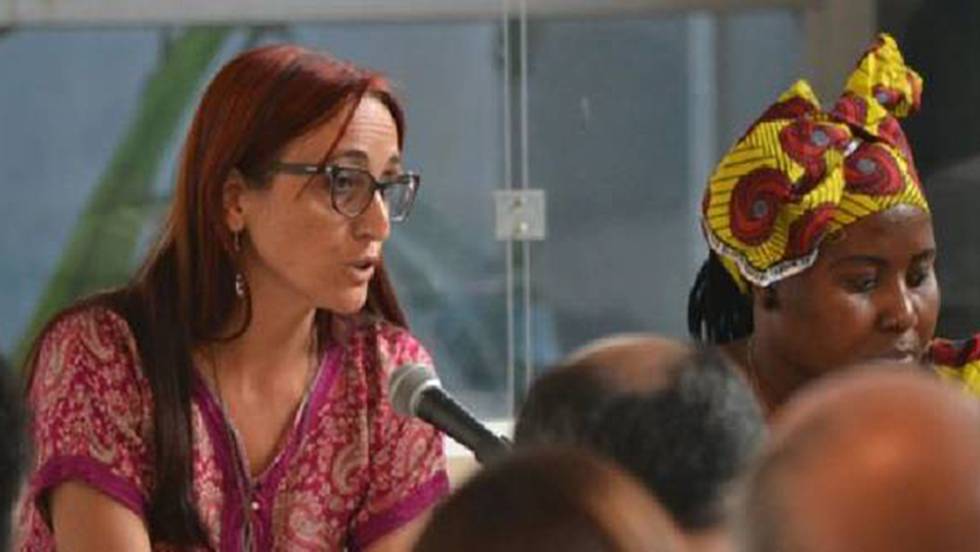
Helena Maleno Garzón refuses to let all that is human drown in the Mediterranean

Helena Maleno Garzón at a workshop

The year ends with the surface of the Mediterranean concealing thousands of humans lost, sinking into the sea bottom as it reveals the sinking of our own collective humanity. Last year, over 5000 women, children and men drowned in the Mediterranean. The year before close to 4000, and the year before that, a little over 3000. This year, the reported death toll hovers just over 3000. That “success” is largely due to draconian measures that have sent refugees back to slave markets and brutal prisons in Libya and life-in-death in Morocco. Spain has replaced Italy as the preferred port of entry for those seeking a life, be they called migrants, refugees, or asylum seekers. Such is today’s morbid mathematics that over 3000 innocents drowned in one body of water in one year is touted as “success”. This is who we are … or not. Helena Maleno Garzón is a Spanish activist and journalist based in Tangiers. Working with Caminando Fronteras, a human rights group founded in 2002 that monitors and reports on the Spanish – Moroccan borders, Helena Maleno Garzón has spent the last years documenting, working with, rescuing and insisting on the dignity of migrant, refugees and asylum seekers crossing the Mediterranean into Europe. Helena Maleno Garzón refuses to let all that is human drown in the Mediterranean, and for that refusal, she is described as a criminal by both Morocco and Spain.

Two Spanish cities – Ceuta and Mellila – sit on Morocco’s coast. In 2015, Helena Maleno Garzón described the two enclaves as “the most heavily guarded borders in the EU to keep out African migrants.” Two years ago, Helena Maleno Garzón described a scene of mounting violence, excessive and illegal use of force, and preventable tragedies, such as the massacre of 15 African migrants on February 6, 2014, at the El Tarajal beach, in Ceuta. As a Liberian woman refugee explained, “We are subjected to ongoing institutional violence when we reach the border. This can range from denial of access to basic rights, to torture, physical abuse, and even sexual violence. What you see on the Melilla fence is only a fraction of what we suffer in transit.” In the intervening years, that fraction has grown as it has intensified. After 15 years of engagement in the area, Helena Maleno Garzón and her colleagues at Caminando Fronteras have declared that the area is now a war zone.

And so, the Moroccan government, at the behest of the Spanish government, has charged Helena Maleno Garzón with smuggling and human trafficking. The Spanish government tried the same trick a few years ago, but had to withdraw the charges earlier this year. Earlier this week, the Moroccan court postponed Helena Maleno Garzón’s trial until January 10 of next year. In Morocco and in Spain, many are rising to Helena Maleno Garzón’s defense. Across Spanish social media, #DefendiendoAMaleno appears next to #NoEsDelito. The defense of Helena Maleno Garzón rejects the criminalization of assisting others in need.

Helena Maleno Garzón stands trial for asking which is the greater crime, to cross a border, to assist crossing a border or to maintain that border with lethal force?  Spanish policy mirrors European policy, and “what you see on the Melilla fence is only a fraction of what we suffer.” Look into the mirror. Let us move closer to the water’s edge, grasp one another’s hands, encircle the Mediterranean, and speak the names of every child, woman, and man who died in the sea or at the hands of border guards while trying to find haven. Let us do so for the sake of humanity.


(Photo Credit: El Pais / Caminando Borders)
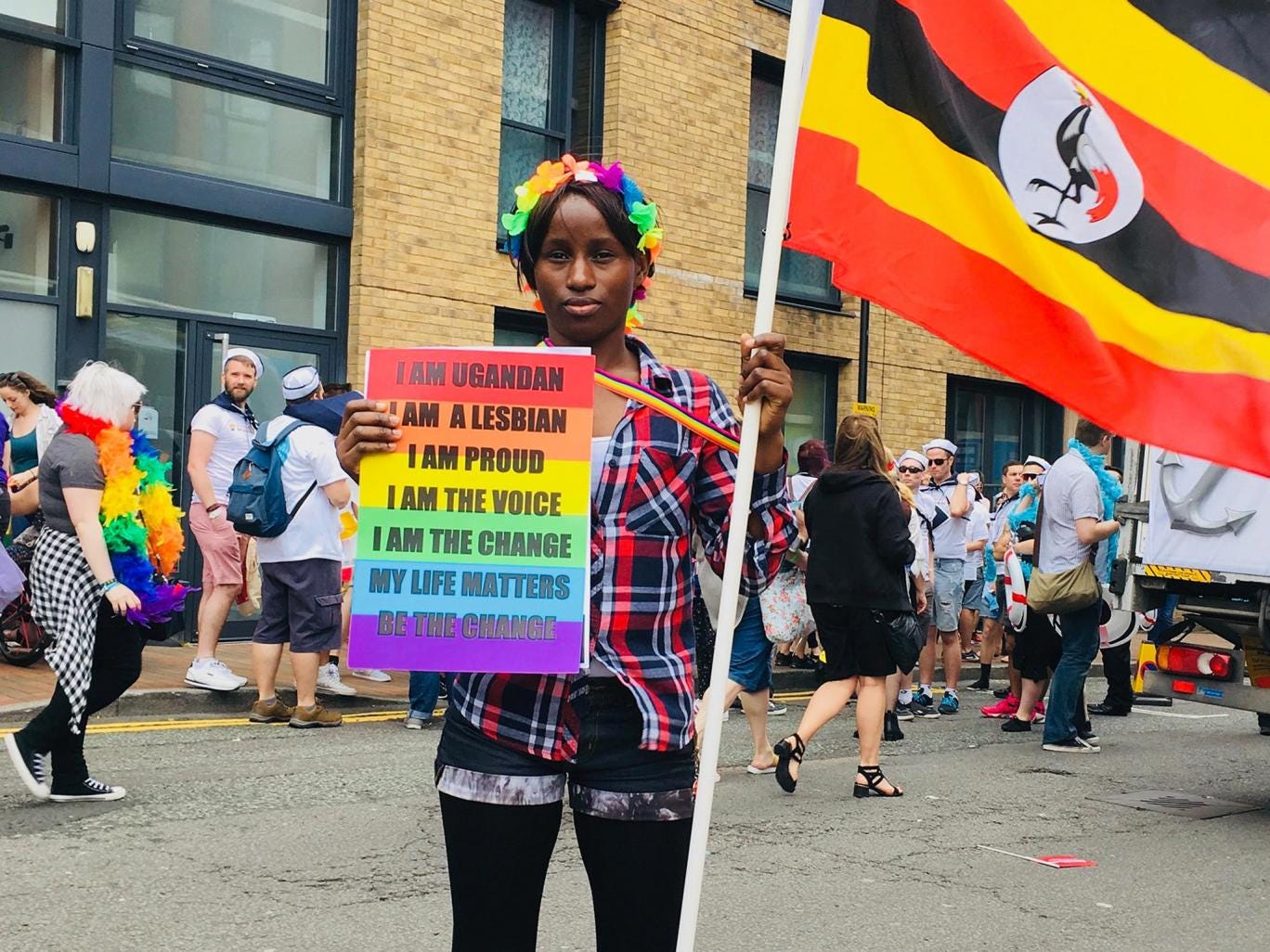
Why does England hate Ugandan lesbian asylum seeker Lazia Nabbanja? #SetHerFree

Why does England hate Ugandan lesbian asylum seeker Lazia Nabbanja? For that matter, why has England hated Ugandan lesbian asylum seekers Brenda Namigadde, Jackie Nanyonjo, Betty Tibikawa, Anne Nasozzi and so many others? Why has England invested so much time, energy, resources into torturing these women who have already been tortured by their families, neighbors and the State? Why does England continue to subject lesbian asylum seekers to the degradations and humiliations of the society of the queer spectacle? What threat do these Black lesbian women pose to the security of England and Wales? Today, Lazia Nabbanja, just another Ugandan lesbian asylum seeker, sits in Yarl’s Wood awaiting deportation. Why?

Lazia Nabbanja’s story is all too familiar. In 2009, Lazia Nabbanja’s family forced her to marry a man. Seven years later he discovered her with her girlfriend. He beat her and left her unconscious. She fled, first to her grandparents’ house and then to the United Kingdom, where she applied for asylum. In England, Home Affairs decided that Lazia Nabbanja is not sufficiently lesbian to warrant asylum and sent her to Yarl’s Wood. Lazia Nabbanja’s story is all too familiar.

Despite Lazia Nabbanja’s story, including photos, being spread across Ugandan media, Home Affairs claims that she would not be in danger if she returned “home.” Again, Lazia Nabbanja’s story is all too familiar. This is the story of Brenda Namigadde, Jackie Nanyonjo, Betty Tibikawa, Anne Nasozzi, and now Lazia Nabbanja.

An online petition is circulating: URGENT: STOP THE REMOVAL OF LAZIA NABBANJA (A LESBIAN WOMAN) TO UGANDA. Please consider signing it. Consider, as well, the urgency of this question: Why does England hate Lazia Nabbanja?


(Photo Credit: The Independent / The Petition Site)

In Botswana, a great victory for Tshepo Ricki Kgositau and women everywhere

Tshepo Ricki Kgositau

On Tuesday, December 12, Tshepo Ricki Kgositau heard the news she has struggled to hear for years. Botswana’s High Court ruled that Tshepo Ricki Kgositau is who she says she is, who her family and friends and colleagues have long said she is. A woman. High Court Justice Leatile Dambe gave the Registrar of Births and Deaths seven days to amend Kgositau’s birth certificate to identify her as female. The High Court also gave Botswana’s Director of the Registrar of National Registration 21 days to issue a new Identity Document identifying her as female. This is a major victory for Tshepo Ricki Kgositau; transgender women in Botswana and across the continent; and women everywhere. In every generation, a woman stands up, asks “Ain’t I a woman?”, and then gets to work.

Thirty years old, born in Gaborone, raised between Botswana and South Africa, Tshepo Ricki Kgositau helped found the Rainbow Identity Association in Botswana. From there she moved on to work with Gender DynamiX, based in Cape Town, where she is now Executive Director.

In 2011, Tshepo Ricki Kgositau applied to the Civil and National Registration to have her gender marker changed from male to female. She was then rejected, ostensibly because at that time Botswana’s laws did not recognize transgender people. And so, Tshepo Ricki Kgositau sued to have her identity recognized and her identity card and birth certificate corrected. Last December, Tshepo Ricki Kgositau underwent gender confirmation surgery, in Thailand. Her family and childhood friends confirmed her female identity from her childhood, and confirmed their love for her as well. A psychologist confirmed her “innate” identity. The case was to be heard in August, but had to be postponed because Justice Dambe was unavailable.

Justice Dambe’s decision follows on another landmark decision, in September of this year, in which a transgender man, known as ND, won a ten-year battle to have his gender marker changed. That decision followed upon a court decision, in 2014, that forced the government to unban and formally register Lesbians, Gays and Bisexuals of Botswana, or Legabibo. It’s been a year for transgender rights in Botswana, and a decade for the rights of lesbians, gays, bisexuals and transgender people in Botswana.

Thanks to the High Court and, even more, to the work and labor of hundreds and thousands of women and their supporters, it’s been a decade for women in Botswana, and through them, across the continent and the globe.  On October 12, 2012, the High Court ruled that Edith Mmusi and her sisters, Bakhane Moima, Jane Lekoko, Mercy Kedidimetse Ntshekisang could continue to live in the house they had always inhabited. In a landmark ruling, the Court ruled that women should be allowed to inherit by customary law; that Edith Mmusi, who had lived continuously in her house and home, should not be excluded from inheriting … her own home. On December 12, 2017, the same Court ruled that Tshepo Ricki Kgositau should not be excluded from the identity and body that she had inhabited for almost all of her life. In both instances, women – Edith Mmusi and her sisters, Tshepo Ricki Kgositau – said they would not haunt their own lives. They would be present, active, alive … and they forced the State to agree. Just as five years ago, so today, it’s a great day for Tshepo Ricki Kgositau, for women across Botswana, across southern Africa … and beyond.


(Photo Credit: Tshepo Ricki Kgositau / The Independent)

Around the world, domestic workers demand decent, living wage and work conditions NOW!

Across the globe, domestic workers are struggling and organizing for decent work conditions, a living wage, respect and dignity. In 2011, the International Labour Organization passed C189, Convention concerning decent work for domestic workers. In 2013, the Convention went into effect. As of now, 24 countries have ratified the Convention. And yet … Yesterday, domestic workers in Tamil Nadu, in India, gathered to demand a living wage and legally enforced protections. Yesterday, in Mexico, the ILO reported that 1% of domestic workers in Mexico have any kind of social security. Yesterday, a report from England argued that the way to end exploitation of migrant workers, and in particular domestic workers, is a fair and living wage. Today, an article in South Africa argued that Black women domestic workers bear the brunt of “persistent inequality”. Today, an article in France argued that economic indicators systematically exclude “domestic labor” and so exclude women. What’s going here? In a word, inequality. Women bear the brunt of urban, national, regional and global inequality, and domestic workers sit in the dead center of the maelstrom.

Today, the inaugural World Inequality Report was issued. Since 1980, income inequality has increased almost everywhere, but the United States has led the way to astronomic, and catastrophic, income inequality. In the 1980s, inequality in western Europe and the United States was more or less the same. At that time, the top 1% of adults earned about 10% of national income in both western Europe and the United States. Today in western Europe, the top 1% of adults earns 12% of the national income. In the United States, the top 1% earns 20% of the national income. It gets worse. In Europe, economic growth has been generally the same at all levels. In the United States, the top half has been growing, while the bottom half, 117 million adults, has seen no income growth.

According to the report, the United States “experiment” has led the a global economic, and state, capture: “The global top 1% earners has captured twice as much of that growth as the 50% poorest individuals …. The top 1% richest individuals in the world captured twice as much growth as the bottom 50% individuals since 1980.” The authors note, “The global middle class (which contains all of the poorest 90% income groups in the EU and the United States) has been squeezed.”

Call it global wealth – state capture relies on expanding “opportunities” for the global poor – particularly in countries like China, India, and Brazil – while squeezing the global middle class, and that’s where domestic workers come in. Paid domestic labor has been one of the fastest growing global labor sectors for the past four decades. Women have entered the paid labor force thanks to other women who have tended to the household work. After its preamble, the ILO C189 opens, “Recognizing the significant contribution of domestic workers to the global economy, which includes increasing paid job opportunities for women and men workers with family responsibilities, greater scope for caring for ageing populations, children and persons with a disability, and substantial income transfers within and between countries …”

That language was formally accepted in 2011. Six years later, domestic workers are still waiting, and struggling, for that recognition. In Mexico, groups are organizing to include domestic workers into Social Security programs as well as to ensure that employers pay the end of year bonus that all decent, and not so decent, employers in Mexico pay. In India, domestic workers are marching and demanding protections as well as a living wage. Domestic workers are women workers are workers, period. Today’s Inequality Report reminds us that the extraordinary wealth of those at the very top has been ripped from the collective labor and individual bodies of domestic workers. Structured, programmatic ever widening inequality, at the national and global level, begins and ends with the hyper-exploitation of domestic workers, through employers’ actions and State inaction. Who built today’s version of the seven gates of Thebes? Domestic workers. It’s past time to pay the piper. NOW is the time!

(Photo Credit: El Sie7e de Chiapas)

December 6 should be the International Day of Remembrance and Action on Violence Against Women


In Canada, December 6, is the National Day of Remembrance and Action on Violence Against Women. In 1991, the Canadian government made December 6 the National Day of Remembrance and Action on Violence Against Women to commemorate the December 6, 1989, Montreal Massacre, also known as the École Polytechnique Massacre. On December 6, 1989, a man entered campus, sought and found a Women’s Studies class, separated the men and women, and killed 14 women, whom he identified as “feminists”. Those women were Geneviève Bergeron, Hélène Colgan, Nathalie Croteau, Barbara Daigneault, Anne-Marie Edward, Maud Haviernick, Maryse Laganière, Maryse Leclair, Anne-Marie Lemay, Sonia Pelletier, Michèle Richard, Annie St-Arneault, Annie Turcotte, Barbara Klucznik-Widajewicz. Across Canada, people hold memorial services. Everyone in Canada knows of the Montreal Massacre, the worse mass shooting in the country’s history. But what about elsewhere? Where are the memorials for the 14 women, and for the horror of the event, in other countries? What is the geography of our compassion?

After the assault on the women of the École Polytechnique, rape laws were strengthened. Men formed the White Ribbon Campaign, which, according to the organization, is the world’s largest movement of men and boys working to end violence against women. The École Polytechnique established the Order of the White Rose, which created the White Rose Scholarship, a $30,000 prize given to a Canadian woman studying in an engineering Master’s or PhD program.

For days after the massacre, people brought white roses to lay at the site of bloodshed. It was a sea of white roses.

Michele Thibodeau-Deguire was the École Polytechnique’s first woman civil engineering graduate. She graduated in 1963. In 2013, when she was appointed Chair of the Board of Directors of the École Polytechnique, Michele Thibodeau-Deguire became the first woman to chair the Board. On Wednesday, she reflected on Canada’s National Day of Remembrance and Action on Violence Against Women: “It was something that came out; people just wanted to show how they felt. And every year, white roses were brought here at the door of Polytechnique.” Along with the White Rose Scholarship, the Polytechnique sells white roses to contribute to a science camp for girls from marginalized communities. “From something horrible, something beautiful came out,” said Michele Thibodeau-Deguire.

Valerie Provost, a survivor of the Montreal Massacre, reflected, “In 1989, for me, for my classmates, everything was possible. We didn’t imagine that these doors could be shut, but that’s what Marc Lépine did. He slammed the door in front of us. My classmates will never enter the country of their dreams. No diplomas; no career; no professional achievements; no great love story; no children; no flourishing talents.”

Canadian feminist activist journalist Judy Rebick noted, “Today, rape is the only violent crime that has not declined to the degree that most other violent crimes have. In Canada, women reported 553,000 sexual assaults in 2014 according to Stats Canada. Fifty-three per cent of all women and 82 per cent of young women told pollsters that they experience sexual harassment in a 2017 Abacus poll. Levels of violence and harassment against Indigenous women, women of colour and women with disabilities are even higher. There has been a decline in domestic violence, but 32 women were killed by intimate partners so far this year in Ontario.” The Abacus report opens with numbers, “There are almost 15 million adult women in Canada and according to our latest survey, almost 8 million of them (53%) have experienced unwanted sexual pressure. The prevalence of this experience is highest among women under 45.”

For one day a year, across Canada, people discuss sexual violence, remember the names of the 14 women, remember the Missing and Murdered Indigenous Women, remember that the struggle continues. Why only Canadians? A review of major news outlets this past week has none in English, French or Spanish even mentioning the day. Canada remembers, the world ignores. What exactly is the geography of our compassion? Why must each nation, and each national community, be left to its own devices and ways of remembering? I live in the United States. Montreal is close; Canada is close, and yet, in the United States, there was no mention of the day. Commodities and capital flow across the border, in ever faster and increasing numbers. People move back and forth across the border as well. Why not memory? Why not the honoring of the martyrs of the war against women? It’s not only Canada’s war. December 6 should be the International Day of Remembrance and Action on Violence Against Women.


(Photo Credit 1: Feminist Current) (Photo Credit 2: Paul Chiasson / Canadian Press / CBC)

In England, it’s official. Immigrant detention is bad for health. Shut them down!

Today, the British Medical Association issued a report calling for the closure of immigration removal centers. They’re bad for the detainees’ health. The British Medical Association, or BMA, “is the voice of doctors and medical students in the UK. It is an apolitical, professional organisation and independent trade union, representing doctors and medical students from all branches of medicine across the UK and supporting them to deliver the highest standards of care.” While nothing in the report is particularly new, it’s the first time the doctors’ union has formally acted.

According to the BMA, “The UK operates one of the largest immigration detention systems in Europe. It holds around 3,500 individuals in 11 immigration removal centres (IRCs) at any one time. There is no fixed time limit on immigration detention in the UK. This means detention can be for an indeterminate period. Individuals will rarely know the term of their detention. The BMA believes immigration detention should be phased out, and replaced with more humane means of monitoring people facing removal from the UK.”

The report is a study in the obvious. Detention is bad, worse for those living with mental health issues. Detention is particularly bad for the most vulnerable. The negative impacts of detention don’t end when detainees leave the prisons. The obviousness is the point. What kind of world needs yet another study to tell us that prison is bad for survivors of torture, rape, persecution, genocidal violence? What kind of world needs yet another study to tell us that the most vulnerable are most vulnerable?

What follows are excerpts from the report. Read them and weep.

“Various studies have identified the negative impact of immigration on mental health, and that the severity of this impact increases the longer detention continues. Depression, anxiety, and post-traumatic stress disorder (PTSD) are the most common mental health problems, and women, asylum seekers, and victims of torture are particularly vulnerable. Even if it does not reach a clinical threshold, all immigration detainees will face challenges to their wellbeing during their time in detention.”

“Detention can be especially detrimental to the health of more vulnerable individuals (including children, pregnant women, victims of torture, and those with serious mental illness) who should only be detained in exceptional circumstances.”

“Women:

–– Various bodies of work show increasing evidence that women in detention have distinct needs and particular problems and vulnerabilities.
–– Pregnant women have specific health needs, and can be particularly vulnerable in detention. [NB: Pregnant women are identified in the Home Office guidance asbeing particularly vulnerable to harm in detention.]
–– Women experience the same prior traumatic experiences as men, but can also experience trauma that is specific to women, such as female genital mutilation (FGM). They are also more commonly, but not exclusively, the victims of domestic or sexual violence, or trafficking. They are therefore likely to require care and interventions that acknowledge the differences in their experience and context. [NB. Victims of sexual or gender-based violence (including FGM) or victims of human trafficking or modern slavery are identified in the Home Office guidance as being particularly vulnerable to harm in detention.]
“–– Immigration detention has a negative impact on mental health;
–– The severity of the impact on mental health increases the longer detention continues;
–– Depression, anxiety and post-traumatic stress disorder (PTSD) are the most common mental health problems;
–– Women, asylum seekers, and victims of torture are all particularly vulnerable groups; and
–– The negative impact on mental health persists long after detention.”

“Retraumatisation can take on specific forms. Female asylum seekers, for example, report higher levels of sexual assault and gender-based violence, yet are frequently detained in centres with male custody staff, where a number of allegations of sexual assault have been made. The Home Office has continually refused to release details of the allegations or the outcomes of investigations. The detention environment may also be particularly retraumatising for LGBT individuals, many of whom will have faced persecution, victimisation, and violence as a result of their identity.”

The United Kingdom has 11 immigration removal centers: Brook House, Campsfield House, Colnbrook, Dungavel House, Harmondsworth, Larne House, Morton Hall, Pennine House, The Verne, Tinsley House, and Yarl’s Wood. They are factories for the production of trauma, and the assembly line is speeding up. The time for “concern” is over. The 11 black sites are a constellation of abomination: bad for the health of detainees, democracy, and humanity. Tear them down now. Shut Yarl’s Wood, shut all 11 centers, and shut their fraternal order of detention centers across the “free world”. Do it now! The doctors have spoken.

(Photo credit: The Justice Gap)

In Guatemala, 12 Q’eqchi’ women say NO to the violence of mining and may change the world

Angelica Choc, at the grave of her husband, Adolfo Ich Chamán

Angelica Choc, Margarita Caal Caal, Rosa Elbira Coc Ich, Olivia Asig Xol, Amalía Cac Tiul, Lucia Caal Chún, Luisa Caal Chún, Carmelina Caal Ical, Irma Yolanda Choc Cac, Elvira Choc Chub, Elena Choc Quib, Irma Yolanda Choc Quib are Q’eqchi’ Mayan women who live in El Estor, located on the northern shores of Lake Izabal, Guatemala’s largest lake. The Q’eqchi’ Mayan populations suffered during the long civil war, and then came “peace”, which meant further marginalization and exclusion, and then came the multinationals. There’s nickel in the ground under El Estor. Despite a ban on open pit mining, the Guatemalan government gave a 40-year lease and a promise of “stability” to a company owned by a Guatemalan company owned by a Canadian company owned by an even larger Canadian company, being Hudbay Minerals. “Stability” meant evicting the Q’eqchi from their ancestral lands. “Eviction” meant mass rape and murder.

On January 17, 2017, eleven Q’eqchi’ women were raped by security forces “removing” them from their homes and lands. In 2009, community leader, teacher and father of five Adolfo Ich Chamán was brutally murdered. His widow, Angelica Choc, sued Hudbay Minerals. In a separate case, Margarita Caal Caal, Rosa Elbira Coc Ich, Olivia Asig Xol, Amalía Cac Tiul, Lucia Caal Chún, Luisa Caal Chún, Carmelina Caal Ical, Irma Yolanda Choc Cac, Elvira Choc Chub, Elena Choc Quib, Irma Yolanda Choc Quib sued Hudbay Minerals for its involvement in their rape. In both cases, Hudbay Minerals was sued in Canadian courts. That makes these landmark, precedent setting cases. The cases are yet another testament to the courage and persistence of women saying NO to the seemingly inevitable devastation of mining corporations.

Canada is home to a majority of the world’s mining companies. In 2014, Canadian exploration and mining companies had overseas mining assets worth $170 billion in 100+ countries. When it comes to mining in Latin America, “Brand Canada” is toxic. According to a recent report, between 2000 and 2015, 28 Canadian mining companies were directly involved in 44 deaths, 30 of which were “targeted”; 403 injuries, 363 of which occurred during protests and “confrontations”; and 709 cases of “criminalization.” The violence was spread across Latin America: deaths happened in 11 countries; injuries in 13, criminalization in 12. Again, these figures are for Canadian mining companies in Latin America, 14 countries all told. Of those, only Argentina, Chile and Guyana had no deaths. Guatemala led the pack with 12 deaths; followed by Mexico with 8 and Colombia with 6.

Twelve Q’eqchi’ Mayan women refused to accept the violence as part of the natural order. They refused to submit to intimidation and worse. In 2010, with Toronto-based attorneys, the women initiated lawsuits in Canadian courts. Hudbay Minerals argued that the women had no standing in Canadian courts, and that the issue should be returned to Guatemala. In July 2013, the courts decided that the cases could go forward. This week, Margarita Caal Caal, Rosa Elbira Coc Ich, Olivia Asig Xol, Amalía Cac Tiul, Lucia Caal Chún, Luisa Caal Chún, Carmelina Caal Ical, Irma Yolanda Choc Cac, Elvira Choc Chub, Elena Choc Quib, Irma Yolanda Choc Quib gave their depositions. In January, Angelica Choc will be in Toronto to give hers.

Hudbay Minerals thought they could sweep the local women away and then bury them. They were wrong, just as mining companies have been wrong in Indonesia, Papua New Guinea, South Africa, Peru, and so many other places. As Margarita Caal Caal explains, “In my community we are fighting for our lands and we will protect them until we die. I am here to tell you the truth.”

From left to right: Lucía Caal Ch’n, Luisa Caal Ch’n, Rosa Elbira Coc Ich, and Elena Choc Quib


(Photo Credit 1: Adriana Zehbrauskas/The New York Times) (Photo Credit 2: Vice/James Rodriguez/ Mimundo)

In India, 24-year-old Hadiya Jahan says, “I want freedom”

Hadiya Jahan at today’s Supreme Court hearing

Today, November 17, 2017, Hadiya Jahan spoke … or better, was “allowed” to speak and perhaps be heard. Hadiya is a 24-year-old woman, who for the past year has been caught in a web of “protections” “for her own good.” Throughout, Hadiya has tried to speak in her own voice, and has been thwarted. Today, she spoke, and she was partly listened to. More people should be listening, because Hadiya Jahan’s story haunts women, and womanhood, everywhere.

Hadiya’s story is both straightforward and complicated. She was born in Kerala to an atheist father and Hindu mother. Her birth name was Akhila Ashokan. In 2010, at 18 years of age, she went off to study homeopathy. In 2015, she publicly declared she was considering converting to Islam. In January, she attended school, wearing a hijab. Her Hindu “friends” reported this to her parents. Her father rushed to the school, did not find his daughter, and filed a missing person’s complaint. Meanwhile, his daughter had gone to Sathya Sarani, a self-described Islamic educational and charitable trust. They provided her with shelter. Akhila changed her name to Hadiya. When the missing person’s case came to court, Akhila showed up and said she was neither missing nor abducted. The court agreed.

In August 2016, Hadiya’s father filed a second petition, claiming there was a plan to move his daughter out of India. The implicit claim was trafficking. Hadiya denied this. The court placed her in a women’s hostel. At the next hearing, on December 19, 2016, the Court said Hadiya must be allowed to return to college and complete her studies. Meanwhile, also on December 19, Hadiya married Shefin Jehan. When the Court was informed that Hadiya had married, they returned her to the hostel. The Court told Jehan to keep away from Hadiya. No interaction whatsoever. On May 24, 2017, the Kerala High Court annulled the marriage, and sent Hadiya to “live” with her parents. Hadiya appealed to India’s Supreme Court, and that’s who heard her today.

Since May, Hadiya has been under house arrest, at her parents’ house. She has been forbidden from talking with the world. Everyone has spoken for, and even as, Hadiya, but Hadiya has been silenced. Finally, the Supreme Court demanded that Hadiya be produced.

Much has swirled around this case, from claims of “love jihad” to “mental kidnapping.” Hadiya’s story has split women along predictable lines. In a smuggled video, shot in August, Hadiya said, “You need to get me out. I will be killed anytime, tomorrow or the day after, I am sure. I know my father is getting angry. When I walk, he is hitting and kicking me.” She begged for freedom. Who listened?

Today, Hadiya spoke, and not only to the Court. She said, “I want freedom… I want to complete my studies and live my life according to my faith and as a good citizen.” The Court released Hadiya from her parents’ custody and sent her back to homeopathy college to complete her studies. In late January, the Court will hear the couple’s appeal to undo the annulment of their marriage. Hadiya, a 24-year-old woman, wants to be free. It’s not complicated.


(Photo Credit: Vipin Kumar / Hindustan Times)

Lupe Gonzalo: “We are women, and nobody is going to keep stepping on our dignity.”

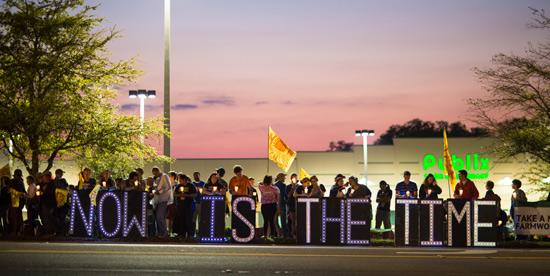
For women farmworkers seeking an end to workplace sexual violence, now is the time! On January 6, 1941, in his State of the Union Address, Franklin Roosevelt elucidated the four freedoms: freedom of speech, freedom of worship, freedom from want, and freedom from fear. The Monday before Thanksgiving, the Coalition of Immokalee Workers’ Women’s Group declared it’s time to demand a Fifth Freedom: freedom from sexual violence. With other members of the Coalition of Immokalee Workers and with supporters, including the T’ruah Tomato Rabbis, women tomato pickers from Florida stormed the Park Avenue office building where Wendy’s Board Chairman, Nelson Peltz, holds court. They chanted, “Nelson Peltz, escucha, mujeres en la lucha!” and “Nelson Peltz, shame on you, farmworkers are people, too!” Denied entry to the building, they shouted their message to the streets and to the world. Workplace sexual violence must end. Now is the time!

The Coalition of Immokalee Workers has been working with the Fair Food Program to secure real dignity and justice in the tomato fields of Florida and beyond. At this point, Wendy’s is the only large restaurant chain to refuse to sign onto the Fair Food Program code of conduct. Why? They say they have their own code … which is precisely the problem. McDonald’s, Taco Bell, Subway, and Burger King have signed onto the code, and have found that it works. Whole Foods, Aramark, Walmart, and Trader Joe’s have also signed. All these major players find that a worker-run code of conduct works. Report after report after report after report after report demonstrate that the Fair Food Program works. And yet Wendy’s continues to hold out.

In the decades’ long process of organizing and of developing strategies and structures, women tomato pickers and farmworkers – such as Lupe Gonzalo, Silvia Perez, Nely Rodriguez, and scores of others – began organizing a quiet revolution. As the Coalition of Immokalee Workers organized, the Immokalee Women’s Group pushed the recognition of women as central to the struggle for farm workers’ rights, dignity and power. Recognizing women’s centrality meant recognizing that the struggle for rights, dignity, and power is a community wide struggle rather than strictly a `shop’ issue. From exorbitantly expensive, predatory housing to food deserts in the midst of farmlands to rampant, and often illegal, use of pesticides to sexual abuse at work, women were particular targets.

On Saturday, March 8, 2014, the women of Immokalee wrote and delivered a letter to Wendy’s, “Hear the voice of the woman, who today dares to defend her dignity in the fields. A new day is coming to Florida’s fields, with the Fair Food Program. It guarantees that dignity of women is respected. We have to keep fighting, and we have to keep shouting, at Wendy’s and other corporations, that the hour has arrived. NOW IS THE TIME!”

They have kept fighting. Lupe Gonzalo was one of the leaders then, as she is today. On Monday she had a message for Nelson Peltz, for Wendy’s and for all of us: “It doesn’t matter which country we’re from, which language we speak, which color is our skin. We are human beings, we are women, and nobody is going to keep stepping on our dignity. It’s time to take the hand of the person that’s next to you, to walk together.  Let us not abandon each other, let us not leave each other.  Wendy’s will sign.  Sooner or later, they will come to the table of dialogue, and we will feel so proud to walk together with them in this struggle.”

Today, November 25, is the International Day for the Elimination of Violence Against Women and Girls. That sounds big, and it is. But it’s also realizable. Ask Lupe Gonzalo and the other members of the CIW Women’s Group. It takes commitment, clarity, concrete structures and collective action. It’s time to walk together. Now is the time!

Lupe Gonzalo

(Photo Credit 1: Forest Woodward / Facebook) (Photo Credit 2: Coalition of Immokalee Workers)

Zimbabwe: The uncountable time of eternity has come to an end

It was 2003. Green Bombers were roaming the streets of Zimbabwe. It was 2005. Operation Murambatsvina was in full swing. And then there were the daily unreported unnamed acts of violence. Zimbabwe seemed like a swirling mass. I remember the moment when, looking from afar, looking from either Washington or Cape Town, and seeing the spectral image of Robert Mugabe, as he was in his later years, emerging from the devastation being created not only in his name, but by his direction. Where was Zimbabwe, the bread basket of the southern region? Where was Zimbabwe, the thriving economy? Where was Zimbabwe, that boasted, rightfully, of its educational structures, that provided quality education for so many? Where was Zimbabwe?

In 2003, I decided that Zimbabwe was somewhere in Colombia. For decades, I had maintained that the one thing one needed to read to “understand the world” was Gabriel Garcia Marquez’s One Hundred Years of Solitude. Watching the machinations of this other Gabriel, Robert Gabriel Mugabe, I saw that I had been wrong. If Zimbabwe was to be taken as the center of anything, the essential reading would have to be Gabriel Garcia Marquez’s Autumn of the Patriarch.

Autumn of the Patriarch ends with the patriarch coming to know what he has known all along:

“… he had known since his beginnings that they deceived him in order to please him, that they collected from him by fawning on him, that they recruited by force of arms the dense crowds along his routes with shouts of jubilation and venal signs of eternal life to the magnificent one who is more ancient than his age, but he learned to live with all these miseries of glory as he discovered in the course of his uncountable years that a lie is more comfortable than doubt, more useful than love, more lasting than truth, he had arrived without surprise at the ignominious fiction of commanding without power, of being exalted without glory and of being obeyed without authority when he became convinced in the trail of yellow leaves of his autumn that he had never been master of all his powers … because we knew who we were while he was left never knowing it forever with the soft whistle of his rupture of a dead old man cut off at the roots by the slash of death, flying through the dark sound of the last frozen leaves of his autumn towards the homeland of shadows of the truth of oblivion, clinging to his fear of the rotting cloth of death’s hooded hassock and alien to the clamor of the frantic crowds who took to the streets singing hymns of joy at the jubilant news of his death and alien forevermore to the music of  liberation and the bells of glory that announced to the world the good news that the uncountable time of eternity had come to an end.”

Gabriel Garcia Marquez wrote those words between 1968 and 1975. Now, at last, it’s time to find another book.


(Photo Credit: Bloomberg / Getty Images / AFP / Jekesai Njikizana)