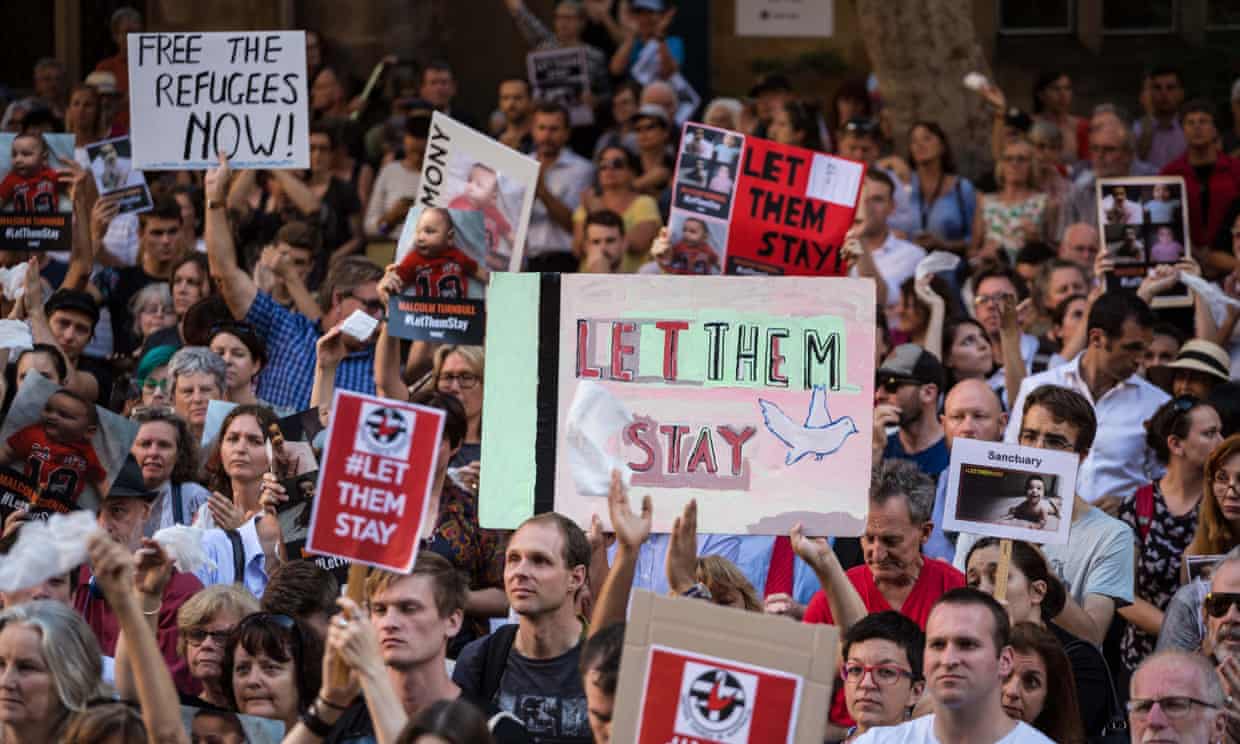
#LetThemStay: Australia tells asylum seekers detention is freedom

What does freedom mean? Don’t ask the Australian government, who this weekend hit a new low by proudly announcing it had released all refugee and asylum seeking children in Australia, when, apparently, it had merely changed their designation from “held detention” to “community detention”, without actually moving them. When torturing children just isn’t enough, try torturing the language as well. Freedom’s just another word …

Years ago, Australia’s government looked out upon the waters, saw small boats filled with desperate people, declared them a crisis and installed a state of emergency. The State has tried everything, from detention and torture to offshore detention and torture to way offshore detention and torture, from places like Villawood Immigration Detention Centre to Nauru Regional Processing Centre to who knows what or where in Cambodia. The landscape is littered with rising piles of bodies, commission reports, and expressions of shock at the routine torture of women, children, and men. Lately increasing numbers of Australians have protested in favor of a more open policy, under the banner #LetThemStay. And so, over the weekend, the State tried a new sleight of hand, and declared the war is over, even though the fighting actually continues.

When challenged on the terms of “release”, Australia’s Immigration Minister explained, “We’ve been able to make a modification to the arrangement so the children aren’t detained, they can have friends over, they can go out into the community.” Pushed by reporters, he further explained, “The same definitions apply today as they did before. There are certain characteristics that need to be met in relation to all these definitions, but that’s all beltway stuff. They’re outside of ‘held detention’, so that’s the answer that I’ve provided to you before.” Still unsatisfied with the release that is not a release, reporters continued to seek clarification, and a spokesperson for the Minister complied, “There are arrangements that have been put in place. Those arrangements now sit with the fact that it’s community detention.” That kind of obfuscation is “stuff” that beltways are made of.

Here’s the situation in plain words: “Families with children in `held detention’ in the `family compound’ of Villawood detention centre were told by letter on Friday that their detention was now classified as `community detention’. They have been `released’ from detention without moving.”

On Saturday night, a nineteen-year-old woman attempted suicide. Others will follow. Today Australia’s Immigration Minister vowed to ship the families to Nauruand beyond. The bodies pile up, the lies grow more intricate and more brazen, the shame deepens, and people and words are made to disappear. Soon, if all goes according to plan, no one will care about words like democracy, freedom, decency, or humanity.


(Photo Credit: The Guardian / Pacific Press / REX / Shutterstock)

Qumotria Kennedy said NO to debtors’ prison … and won!

Qumotria Kennedy

Despite having been outlawed and declared unconstitutional, debtors’ prisons and even more debtors’ jails exist all over the United States. In Biloxi, Mississippi, Qumotria Kennedy said NO to all of that, and, a couple weeks ago, she, and we, won! On the same day Qumotria Kennedy won, the U.S. Department of Justice warned state judges that courthouses are not supposed to be ATMs, but, of course, the national shakedown of the poor persists.

In July 2015, Qumotria Kennedy, 36 years old, Black, a single mother, was riding with a friend, going to pick up their kids. The car was stopped by the police. Even though Qumotria Kennedy was the passenger, the police ran her identity `through the system’ and found an outstanding warrant for having “failed to pay” court fines, which stemmed from traffic violations in 2013. The thing is, Qumotria Kennedy didn’t fail to pay. She couldn’t pay. She didn’t have the money. She explained that to the probation officers, who are employees of Judicial Corrections Services Inc, a private processing company. They refused to hear her explanations.

Qumotria Kennedy works off and on as a cleaner. She earns under $9000 a year. She raises two children, on her own. By any standards, and by formal government standards, Qumotria Kennedy is indigent. She said as much. She asked for help. She was sent to jail for five days. That’s what counts as help these days.

In October, Qumotria Kennedy, Richard Tillery and Joseph Anderson sued The City of Biloxi; John Miller, Chief of Police of the City of Biloxi; Judge James Steele; and the Judicial Corrections Services, Incorporated. Qumotria Kennedy and her co-complainants were represented by the ACLU. The complaint begins: “Defendant City of Biloxi … operates a modern-day debtors’ prison. The City routinely arrests and jails impoverished people in a scheme to generate municipal revenue through the collection of unpaid fines, fees, and court costs imposed in traffic and other misdemeanors cases. As a result, each year, hundreds of poor residents of the City and surrounding areas, including individuals with disabilities and homeless people, are deprived of their liberty in the Harrison County Adult Detention Center for days to weeks at a time for no reason other than their poverty and in violation of their most basic constitutional rights.”

As Qumotria Kennedy explains, “I decided to bring a lawsuit against Biloxi because I don’t like what the city is doing to people. All it cares about is money. Biloxi locked me up for being poor. But it costs them money to keep me in jail. So this system doesn’t even make any sense. I hope that everybody knows that the system is trampling on poor people, and it’s not fair.”

Last month, Biloxi settled with Qumotria Kennedy and her co-complainants. The city agreed to pay each $25,000. Additionally Biloxi said it would stop jailing people for nonpayment of fines and that it would no longer use probation companies to collect fines. Additionally, it would hire a full-time public defender to represent the indigent charged with nonpayment and would not charge additional fees to people who entered into repayment plans or performed community service in lieu of payment. Furthermore, people will not be given a hearing to see if they’re able to pay imposed fines. For those who can’t pay, alternatives will be found.

Qumotria Kennedy was dumped into jail because she’s a low-income Black woman. Qumotria Kennedy is the embodiment of intersectional violence. The violence against her and the extraction of value from her body intensified with each convergence of components of her identity. This revolving cash register of injustice is happening in jails across the country. Thanks to Qumotria Kennedy, who refused to be the sum total of her oppressions, who said NO to the City and the Police and the Judge and the Corporation and the injustice and indignity of debtors’ prison, it may be ending in Biloxi, Mississippi.


(Photo Credit: American Civil Liberties Union)

After COP 21, the murders that hide behind international treaties

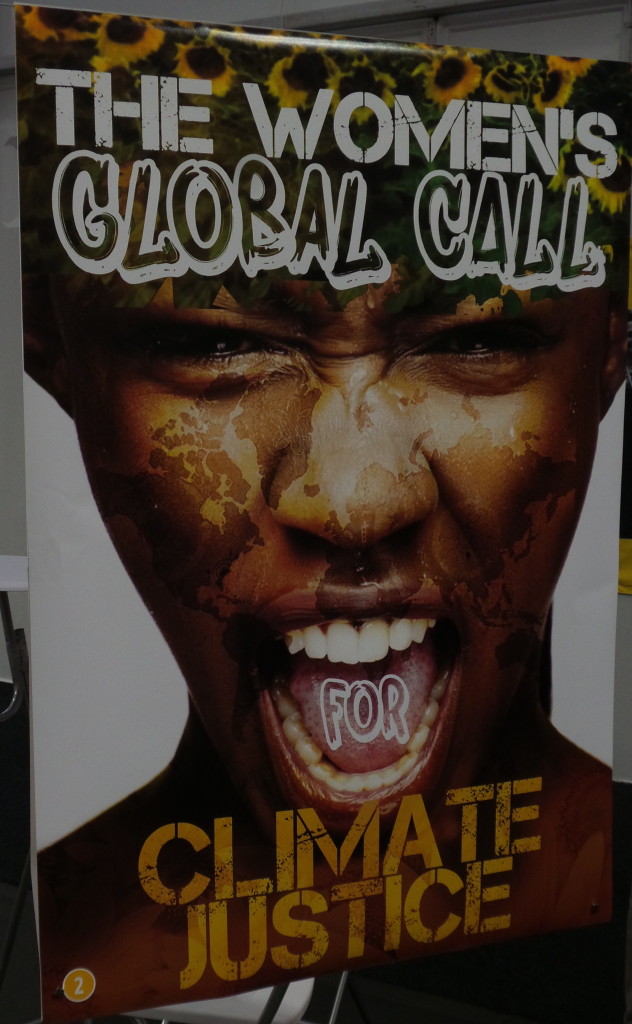
The Women's Global Call for Climate Justice

At COP 21, Grace Balawag, member of the IIPFCC (the International Indigenous People’s Forum on Climate Change) told us her concerns as the language of the treaty being negotiated started to exclude indigenous people. She talked about indigenous right to land, about indigenous peoples’ knowledge and expertise and how, instead of being respected, they were excluded from negotiations while the world’s largest corporations were ubiquitous throughout those discussions.

Three months after the agreement, women and men environmental activists from indigenous communities are still being murdered by hit men working for vested interests often supported by governments, as was recently the case in Honduras and South Africa. Countries like Honduras with its violent repressive regime are just proxies for the violent global market.

As Billy Kyte from Global Witness said, “Indigenous people are being killed in alarming numbers simply for defending rights to their land.” Land means subsistence for indigenous people certainly, but also for the human population as a whole. However, land means carbon exchange market for vested interests. For instance, the REDD program (Reducing Emissions through Deforestation and Forest Degradation) is actually a carbon market mechanism that treats the business-made environmental deficiencies as more business and speculative opportunities. Indigenous people see carbon exchange value programs like REDD made by and for unscrupulous corporations as a land grabbing mechanism, a new form of colonialism, “Yesterday’s genocide was done with guns and blankets with small pox. Now they are using carbon trading and REDD.” All this entails murders, and fabricates aggressive justifications for “potentially genocidal policies.” Shouldn’t we all see that?

It is women who have suffered and are still suffering the most under this oppressive system. And so it is indigenous women who show the way toward real solidarity for transformative actions for “Climate justice and women’s rights.”

Why has this market mechanism superseded legally binding resolutions? For the first time, the Paris Accord recognized the climate catastrophic disruption, but by not expressing strong support for indigenous rights, the signers have been complacent with those powers that order the murder of people who fight against the causes of this environmental and human disaster. Therefore, it has failed to propose meaningful solutions.

Grace Balawag reminds us how difficult it is to negotiate under this corporatization and financialization of “nature” and the importance of collaboration.

(Photo Credit: Brigitte Marti) (Interview filmed by Joachim Cairaschi, conducted by Brigitte Marti)

Considering Masculinity in the Terrorist Stereotype

Recent events in Brussels have brought to the forefront once again the idea of terrorism. As feminists trying to understand acts of violence in our world, we must remember that by classifying these acts as terrorism we are inviting certain implications, just as when we fail to classify other violent acts as terrorism we incur other implications.

International relations scholar Caron Gentry and political scientist Laura Sjoberg describe “the stereotypical (new) ‘terrorist’” as “a hypermasculine man, politically motivated but religiously inspired, aggressive, dominant, and violent without the restraint that would come from civilization”. This stereotype particularly implies a Muslim male identity for terrorists. The emphasis on hypermasculinity in terrorists also suggests that women cannot be terrorists, unless they have lost their feminine identities. Gentry and Sjoberg further assert that “these racialized and gendered conceptions of all people associated with Islam have allowed for problematic international and domestic counterterrorism policies to emerge”. By ascribing to assumptions about the type of person that can be a terrorist, we ignore entire violent groups and acts of terror that fall outside of these stereotypes.

Stereotypes about masculinity are part of a larger issue that contributes greatly to the violence in our world. Defining traits and activities to be masculine or feminine assumes a hegemonic definition of what it means to be male or female. This definition does violence to any male who does not fit the prescribed definition of masculinity or to any female who does not align with the definition of femininity. Additionally, the use of femininity as an insult towards men implies being feminine as a negative, simultaneously criticizing men for having certain feelings or sensitivities that are not masculine and women for having those feelings in the first place.

Masculinity tends to be associated with acts of aggression. According to Cynthia Cockburn, masculinities “are socially constructed through activities such as competitive sports and computer games”. Certain sports, such as football in the United States, are especially violent compared to others. However the governing mentality of all sports is an aggression and testing of bodily abilities that tends to be associated with masculinity. Even though women can participate in most sports today, teams are almost always segregated by gender, leading to the development of a culture of hyper-masculinity on all male teams. Cockburn identifies the way that “domestic violence by men against women surges during significant football events and at the onset of wars”. All those institutions that cultivate masculinity through expressions of aggression tend to have higher rates of violence against women. In regards to battery of women, for example, 1996 study of violence against women among Division I athletes found that “[f]or the combined 3 years, male student-athletes comprised 3.0% of the total male population, yet represented 35% of the reported perpetrators”. In regards to sexual assault the same survey found “[f]or a combined 3 years, male student-athletes were 3.3% of the total male population, but were 19% of the reported perpetrators”.

The trends of violence against women continue in the military, where uncovering the true extent of sexual assault becomes even harder as women are strongly discouraged from reporting. Between one-fourth and one-third of women in the military are estimated to have experienced sexual assault, compared with 1 in 6 women in the civilian population. Because of the military’s hyper-masculine culture that encourages men to be violent and assumes the superiority of masculinity to femininity, sexual assault among members of the armed forces does not come as a surprise: “Cultures that displayed a high level of tolerance for violence, male dominance, and sex segregation had the highest frequency of rape”. These traits characterize hypermasculine cultures including the military, certain sports teams, and fraternities.

All of this contributes to what we, as feminists and as people, mean when we talk about terrorists, terrorist attacks, and acts of terror.


(Image Credit: The Conversation / Shutterstock)

Ghomeshi’s trial: Men are complicated, women are liars

Humans are complicated beings; they can surprise, anger, disappoint, amaze or frustrate you by what they do and how they react. That is a common and acceptable narrative when one refers to “men”. The narrative changes and complexity is viewed differently when women are the subject of the talk.

In my years of working with perpetrators and survivors of domestic and sexual violence, I have witnessed many women who have felt compelled to ‘be nice’ to their perpetrator. Many often apologize, authorize contact and seek to get back with him. This reaction to trauma is the result of a ‘social conditioning’ that most women are taught from an early age, which they have internalized to be deferential, fix problems, and avoid conflict at all costs. It leads them to second guessing and undervaluing their own experiences with a question hovering over their heads most of the time: “Maybe I’m overreacting?”

If a woman’s reaction to trauma is anything less than “perfect” behaviour deemed suitable for a victim, people are inclined to dismiss it. And when we realize women’s passivity in dealing with trauma and having difficulty with confrontation, we get frustrated and turn on them. We ask them: Why did you stay in touch? How bad could it have possibly been?

So for Lucy DeCouture, the only one of the three women who was publicly named in the trial of Jian Ghomeshi – the former CBC host who was acquitted of one charge of choking to overcome resistance and four charges of sexual assault related to three women, on the basis of ‘inconsistencies’ and ‘deception’- everything came back to one big question: Why did she keep in touch with Jian?

Sometimes, in the moment, says Jaclyn Friedman, “It’s less painful to convince ourselves that we made a poor decision and shouldn’t blame whoever did it because we don’t want to internalize the violation. You then reach for the niceness training as a way to express this denial. Especially as a woman, blaming yourself is really familiar. That script is super handy.” One can see this pattern in DeCoutere’s testimony when she told the packed Toronto courtroom: “As I say this now, it’s outrageous that I stayed and did not leave but that was my reaction.” Later in an interview she said that after giving her testimony she felt like she had to “go up to every person in the world and apologize for ruining the case.”

Among other troubling aspects, the trial of Jian Ghomeshi exposed a double standard, that deep down we have all been taught that a complicated man is a just a complex human being, but a complicated woman is a liar. We need to draw on our innate understanding that no one can be a perfect victim, people are complex, trauma is complicated and reactions to it differ from person to person in different circumstances and should not be scrutinized from outside.

Carissima Mathen, an associate professor of law at the University of Ottawa, says that the frustration and outrage spawned by the judge’s decision is understandable: “Sexual assault law has been stained by sexist myths, unsupportable evidentiary rules, and skepticism of women’s basic truthfulness. Owing largely to the efforts of feminist advocates, Canadian law has formally shed itself of many of those deficiencies. Yet, translating rules into effective enforcement has proved damnably difficult.” However, some have concluded that the judge was left with no choice but to acquit Ghomeshi as a result of the damaging cross-examination of the complainants.

It should be highlighted that in his verdict, Judge Horkins said that while the evidence in the case raises a reasonable doubt, it is not the same as deciding in any positive way that these events never happened. It is also equally important to keep in mind that during the trial Ghomeshi’s lawyer, Marie Heinen, did not ask his accusers the single most important question that was at the centre of this trial: whether Ghomeshi actually assaulted them.


(Photo Credit: Kenny Mason / News 1130)

This Easter, spare a thought for refugee women and children in detention


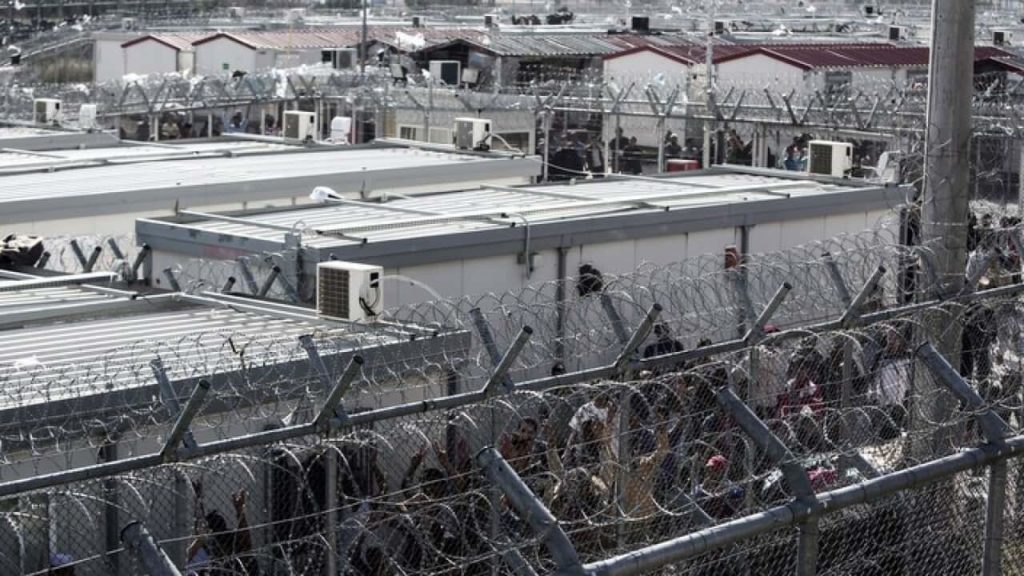
Greece’s Amygdaleza detention camp near Athens

Concerns about the detention of children have become an international issue. International human rights legislation provides that child migrants should not be detained for immigration-related reasons. Detailed information about un-accompanied children is not available; however, it is known that within some countries children are routinely being detained. For example, in November 2015 more than 100 countries criticised Australia for detaining women and children within offshore facilities.

The detention of children, even for short periods is understood to be harmful. The United States has the largest number of immigration centres and some of these detain families. #ShutDownBerks is campaigning to stop this Pennsylvania detention centre operating illegally and violating not only human rights but also domestic civil law.

Concerns about the welfare of women and children in immigration detention centres are shared by campaigners around the world. In the United Kingdom, Women for Refugee Women has organised a campaign called #SetHerFree. This campaign not only highlights that women are being detained indefinitely without their friends or family but are also pregnant.

In April 2015, the government of Greece said that people were being held in horrendous conditions and their continued incarceration was unaffordable. United Nations Human Rights High Commissioner’s European representative Jan Jarab explained, “There has to be facilities of a non-prison type character and it is clear that to create all this will require a kind of redirection of the government’s energies”. This is clearly needed within all countries around the world, especially within the most developed countries where there are many examples of acts against humanity for refugee women and children in detention. In the report about the release of refugees from immigration centres in Greece, a detainee said, “This was like prison, this was not a centre, at centres you can go outside, you can play ball, this was like a prison.”


(Photo Credit: SBS)

I don’t like (to be black)

I don’t like (to be black)

A mere chess game it was
where a young lass had
to decide on the hue
of her chess pieces

I don’t like to be black
she duly declared
not a hint of anything

no Freudian slip
no racism

not even an appreciation
(in a manner of speaking)
of the import of her words

I cringe almost instantly
peering around furtively
in the local library

in the local library
these things happen
not just in places
of ill-repute

(you know like
board-rooms like
sub-committees like
on official government forms
and in Public Holiday speeches like)

I don’t like to be black
merely a game of chess
two sides of different shades
one light and the other dark

there are pawns too
doing their bidding
some pieces more
valuable each trying
to capture the other

I don’t like to be black

A mere chess game it was

Our emperor’s relapse into black-white during the anti-racial-non-racial-tolerance part of his Human Rights Day speech, reminds one that we have far to go, still, 21 March 2016.

(Image Credit: Wikipedia)

Berta Cáceres, Nelson Garcia, Sikhosiphi Bazooka Rhadebe: We must take action!

Death, be not proud, though some have called thee
Mighty and dreadful, for thou are not so;
For those whom thou think’st thou dost overthrow
Die not, poor Death, nor yet canst thou kill me.
John Donne, “Death Be Not Proud”

Sikhosiphi Bazooka Rhadebe, chairman of the Amadiba Crisis Committee, on the Wild Coast of South Africa, was brutally assassinated last night, and so joins Berta Cáceres and Nelson Garcia, and who knows how many others martyred in this month alone? The Amadiba Crisis Committee, largely made up of women, has been struggling to stop mining in Xolobeni, the Mgungundlovu area of Amadiba Tribal Administrative Area in Pondoland, and to continue a program of people-driven, sustainable development. The response has been a reign of fear and intimidation. Repeatedly, the women and men of Xolobeni have said, We are ready to die for this land. Last night, Sikhosiphi Bazooka Rhadebe was murdered, or better executed. It did not come as a surprise. As Nonhle Mbuthuma explained, for the last year, the police have waged a campaign of intimidation, and, when called on to stop the violence, “There has been nothing.”

Men come with guns and women respond, “My tears won’t fall on the ground for nothing. You can bring your machine guns. I am prepared to die for my land; I am not going anywhere.”

The crisis is not mining. The crisis is violence: violence against nature, women, the community, and democracy. Nonhle Mbuthuma has grown up in the struggle for a decent and better life, and for a State where one can’t say, “There’s too much `democracy’ in this democracy”; and Sikhosiphi Bazooka Rhadebe is dead, having striven to make that democracy-to-come a reality today.

It is not a reality today. Reality today is State violence, from Honduras to South Africa and beyond. As Berta Cáceres exhorted, “We must take action!” We must turn the swords of murder into the ploughshares of sustenance. Berta Cáceres, Nelson Garcia and Sikhosiphi Bazooka Rhadebe will not rise out of the earth, no matter how fervently some might pray, but their dream, their collective unified dream, cannot be killed. We must take action!


(Photo Credit: United Front)

Memory and other mirages

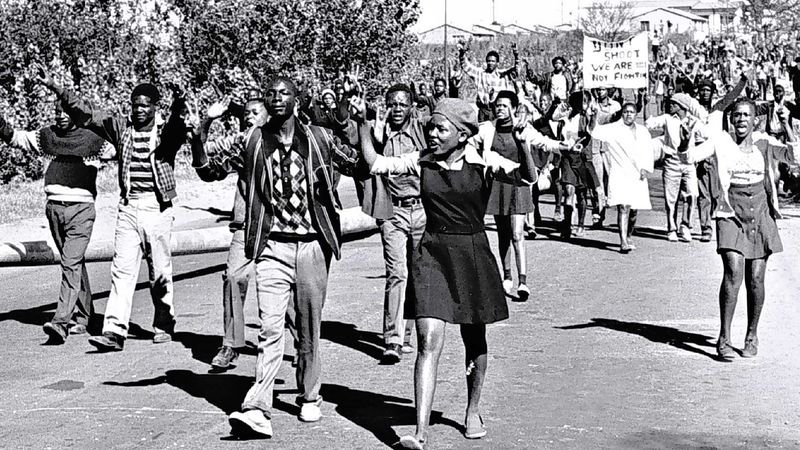
Like June 16th, March 21st and the many dates in between, another missed opportunity to advance a truthful discourse on ownership of both the past and the present looms. The politics and ethics of memory present an ongoing tension for countries such as ours, which are emerging from a period of deeply fragmented recollections of what was and was not. Andre Brink suggests that: “the best we can do is to fabricate metaphors – that is, tell stories – in which, not history, but imaginings of history are invented. “ Although deeply dissatisfactory, this seems to be the narrative pursued by Official historydom.

South Africa is not the only country that is contending with heritage as a site of political battles.

Memory is an act of defiance particularly because erasure is an instinct of conquest. Cultural identity and truthful interpretation of the past are scarce currency in South Africa today. This is largely because the official archives and accounts of political exploits and the historical context of Apartheid colonialism are constructed to privilege partisan political interests. Equally inimical is officialdom’s insistence on erasing or diminishing the wrong doing of former oppressors. The act of remembering is nourished by deliberate and vigilant consciousness that is anchored by a strong ethical framework. It must be divested of party political claims that clutter the national discourse.

A particularly capricious form of national identity and nationalism, which is often utilised in neo–colonial states, can promote or consolidate political objectives. The fabricated reconciliation, as part of South Africa’s heritage, serves the merchandising of the fictitious rainbow nation rather than the redemption of the Afrikan psyche. Such sentiment is difficult to reverse or reshape once wielded. The United States has similarly built itself on the imagination of the American Dream even though the contradictions of racism, sexism and class oppression have kept a huge part of the population in conditions of poverty, early death, police brutality, unemployment and despair. Despite this, millions of people enter America to partake in a heritage that extends to very few people beyond the white, male, middle class. The South African scenario is similarly unfolding and the practise of manufactured nation building has come at a price of dispossession, coercive silencing and constant un-remembering. This contributes to creating the condition of unknowing and unseeing the truth as a survival mechanism.

The ethics of remembering should not allow the sacrifices of the dead to be diminished by acts of political vandalism. The vandalism that we witness daily has multiple locations. The education system has remained uncritical of allowing a colonial aesthetic to shape the minds and discourses of young minds. The manipulative form of nationalism that has been sanctioned over the past twenty years seems determined to reconstruct a nation of disfigured memories and half-truths. The heritage industry is sometimes another site of vandalism rather than a broadly representative recollection of the past 350 years of battle and painful formation of this nation in all its contradictions. Corrosive recollections are not unique to this country. They reflect the characteristics, power and intent of the ones who shape history.

The most spurious wars such as the ‘War on Terror‘ have been valorised for posterity in some quarters. Enquiry of memory must be accompanied by an underlying discomfort and reality that memory is often subjective and chauvinistic. This necessitates greater space for multiple and competing narratives. In the context of neo-colonial nation building, these narratives should be anchored to formation and celebration of Afrikan stories, contexts, histories and herstories. The extent of the genocide on our being, our continent, our imaginations and humanity requires an ongoing and dynamic rehabilitation of our core. An ethical memorial framework should transfer not only political and economic power, but also transfer the sovereignty of memory and Afrikan identities.

Erasure has allowed and enabled the men and nations who violated the ‘comfort women ‘during the World War 2 to remain unaccountable. Erasure has enabled the slave trade in Congo, which reduced the population by 70%, to be airbrushed even in national discourses. Erasure was the catalyst for the forced removal of millions of aboriginal children in America, Australia, Canada and New Zealand (Aotearoa) from their loving families, in order to be culturally whitewashed in cruel state orphanages or adopted into white families. Erasure is the reason that Welsh and Irish children’s tongues were cut in English run schools, to prevent them from asserting self-knowledge in Gaelic. Erasure has removed Shaka from Heritage Day, removed Moshoeshoe, Bambaatha, Manthatisi, Modjadji and countless others from the national calendar. The names and battles of the ones who fell and continue to fall today should be etched in our consciousness .

Heritage is always contested and the uncomfortable connection with colonial legacies is evident in the architecture around us, the food we eat, the music we hear, the languages of instruction and commerce. This hybrid of culture should neither confuse nor befuddle our aspirations towards Afrikan consciousness embodied in our poetry, languages, literature, moments of national remembrance and ways of being. Millions of Afrikan minds, ideas, words, thoughts, inventions, musical notes, physical efforts, intellectual endeavours and epistemic undertakings have contributed towards and built imaginations, monuments and empires across the world. Despite this, the US and European empires remains unapologetic and impervious to the huge debts they owe to Afrikan creativity, brilliance and blood. The subjugation of others seems to be an indelible core of those empires and the defence of the indefensible an inherent legacy born out of a culture of conquest.

The interrogation of memory and the heritage creates is an ethical requirement of nation building and also a powerful opportunity to reframe and challenge the narratives of “reconciliation and truth” that have been efficient midwives for erasure and amnesia. It is a potent instrument of vexing political sentiment. Democratisation of memory removes domination of memory discourse from those who can write or conquer media & publishing houses to essentially frame a narrow and often disjointed interpretation of history. Democratisation brings the stories and accounts of communities and individuals across the socio-political spectrum to the centre. Shared or social memory is the gamut of traditions, languages, food, struggles, legends, taboos, spirituality, battles and interpretations of events and that lend themselves to the act and practise of being Afrikan. Self-knowledge is the highest forms of sovereignty and any nation or people who do not protect or even recognise multiple forms of knowing and remembering are disfiguring their identities.

The negation of one set of memories over another is inscribed by the negation of one set of experiences over another. The politics of negation and erasure in neo-colonial South Africa have resulted in a particular framing of patriotism that has dislocated the Africanist and Black Conscious contributions from the struggle and corralled collective thinking accordingly. Equally problematic is the elitism and othering that is promoted by the framing and site of heritage. Rather than being diminished to a dashiki or Seshoeshoe once a year, heritage ought to form the normative acts, symbols and forms of our daily existence. Traditional clothing is a powerful symbol of being and rather than being fetishised once a year, should from the tapestry of our community, work places, schools until the colonial imagination is diminished. This tapestry includes the languages, names, poetry, literature and human ethic that contribute to the people we are. Nation building requires that we stand as witnesses to the full truth of the past and the present. It requires a critical mass comprising of the plurality of the many who know, who see and who speak.

To quote Cabral: “The colonists usually say that it was they who brought us into history: today we show that this is not so.”

(Photo Credit: Mail & Guardian / Gallo)

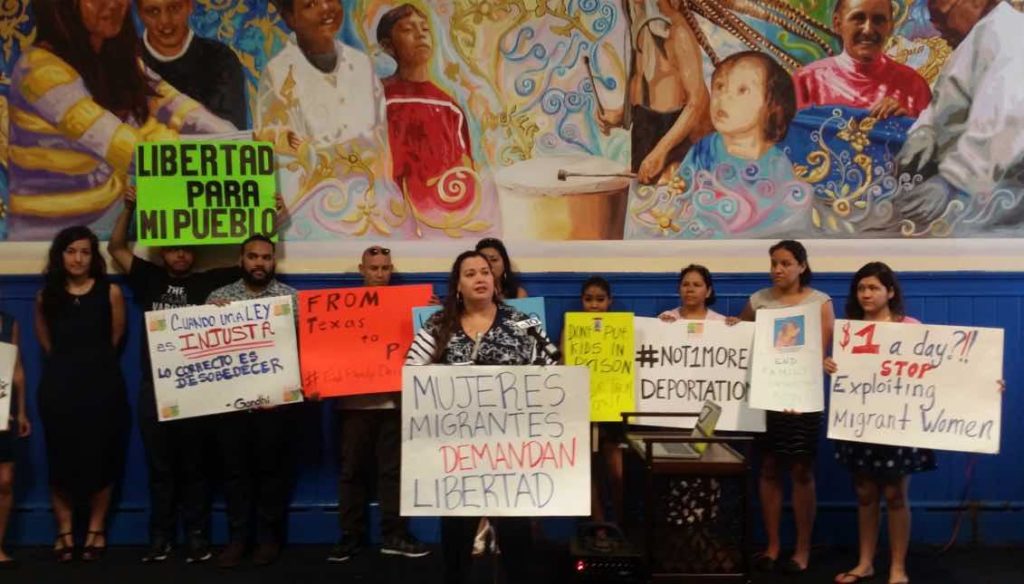
#ShutDownBerks: The mothers of Berks Family Detention Center demand justice!

The United States built a special hell for immigrant women and children, Berks Family Detention Center. While U.S. immigration policy has swung between hang-em-high and hang-em-higher, the one constant since 2001 has been Berks Family Detention, which from the beginning has been criticized for inhumane treatment and general brutality towards its prison populations, largely women and children. Last year, the women inside Berks turned up the heat, and the Center’s license was revoked. That hasn’t mean the prison closed, though. It continues to operate, without a license, while appealing the decision. Meanwhile, the brutality continues. The most recent turn is an outbreak of what could be shigellosis, which would be particularly dangerous for children. Despite documented symptoms, the Center has refused treatment. The response of ICE has been, “Go back to where you came from.” Increasingly poor health and more and more damaged bodies is part of the plan, especially for immigrant women and children.

A mother of a five-year old daughter wrote, “My daughter has been having diarrhea for about three weeks now and we went to see a doctor but they did not give us any medication not even serum. With every passing day her behavior is getting worse and the psychologist just tells me to be patient. I need you to give me the adequate medication and that you give me the opportunity to take my case outside of here. I am not a criminal. You gave the opportunity to other persons that have been deported to leave, why did you not give it to me. It has been more than four months that I have been detained.”

ICE responded, “Thank you! You may dissolve [sic] your case at any time and return to your country. Please use the medical department in reference to health related issues.”

You may dissolve your case at any time and return to your country, which means, “Die here, in custody, or at home. It’s all the same to us, and thank you! Have a nice day.”

This week, mothers inside Berks petitioned to be heard, concerning the license issue and more. They want to describe the conditions inside and the impact on their children and on themselves. According to Pennsylvania State Senator Daylin Leach, “As the minority chairperson of the Senate Judiciary Committee, I am intimately familiar with lawful and appropriate detention conditions and protocols. While the Berks facility is not a state prison under my purview, it is a facility in our Commonwealth that is currently holding human beings, including children, against their will in conditions that seem negligent, abusive, and tragic. Though the legal status of the facility is in question, the treatment of human beings should not be.”

The treatment of human beings should not be in question, but it is. The very humanity of human beings, Central American women and children, is continually denied and diminished, by the “humane treatment” of Berks Family Detention Center. Berks is a prison designed as a house of the dead, with a cheerful “Thank you!” over its entrance door.

Last month, thirty mothers in Berks wrote an open letter: “Our children have suffered psychological damage, and many of them have suffered health-wise, because of this confinement, and not to mention the racist abuse and poor treatment from certain members of the staff in this detention center, but especially by the agents of ICE that play and mock our dignity as immigrants. We came here seeking refuge. We came to this country to save our lives and the lives of our children.”

They came as refugees and were dumped into cages, where they were told to rot or return. This is the syntax of asylum: you may dissolve your case at any time and return to your country. #Not1More #ShutDownBerks #SetHerFree

(Photo Credit: vamosjuntos.org)