Afrikan Football Economy Subsidising the World

Scholarship on Afrikan football has increasingly moved beyond celebratory narratives of sporting success towards a more critical examination of football as a political and economic institution. Scholarship has increasingly located Afrikan football within wider histories of colonialism, labour migration, commercialisation and global governance (Akindes; Cornelissen; Darby). Yet most studies begin with migration or professional contracts.

Recent Afrikan-centred writing on football has begun to name this contradiction more clearly. Gerard Akindesasks whether Afrikan countries can dominate global football while losing control of their own game, locating contemporary football within a longer history of globalisation, migration, commodification and institutional dependence. This framing is useful because it avoids two common simplifications: the romantic claim that global football is simply opportunity, and the reductive claim that Afrikan players are merely victims. The more precise question is how Afrikan talent becomes incorporated into global football markets, and who controls the institutions that convert that talent into enduring value.

Every time we watch the UEFA Champions League, we see twenty-two footballers. We rarely see the thousands of people employed because those twenty-two players exist: physiotherapists, nutritionists, AI analysts, statisticians, broadcasters, lawyers, hotel workers, camera operators, journalists, betting companies, sportswear manufacturers and software engineers. Football is not simply a sport. It is an industrial ecosystem. Europe did not become wealthy from football because it had the best players alone. It built the industries around them.

This market is racialised. Afrikan players are often described through a vocabulary of pace, power, hunger, instinct and resilience, while European football institutions are associated with intelligence, discipline, tactics, science and development. Such language is not neutral.  It presents Afrikan footballers as raw athletic material requiring refinement elsewhere, while obscuring the labour already invested by Afrikan families, schools, communities, coaches and academies. Talent is not raw. It is socially produced.

The racialised industry of exporting sporting talent also extends beyond football. Afrikan athletes have long been central to global markets in athletics, rugby, basketball and combat sports. Football, however, provides the clearest case because its transfer fees, media rights and commercial revenues make the commodification of human capability highly visible. A young player may leave an Afrikan academy with limited immediate market value, then appreciate dramatically after entering European club systems, global broadcast markets and elite competitions. The question is not whether the player benefits. Many do. The question is where the largest share of appreciation accumulates.

This is why the language of “talent drain” is insufficient. Afrikan footballers are not simply lost to Europe and other parts of the world. They become part of a global value chain in which European clubs, Gulf investors, international broadcasters, sponsors, data firms and governing bodies capture different layers of value. The player is labour, but also asset, brand, media content, transfer commodity and speculative investment.

The 2026 FIFA World Cup makes this visible. European and North American teams increasingly rely on Afrikan and Afrikan-diaspora footballers. France, Belgium, Portugal,  Germany, England , Canada and the US all illustrate the extent to which Afrikan and migrant capability has become embedded in national football projects beyond the continent. This should not  always be read simply as loss: diaspora players often maintain powerful ties to Afrikan identities, communities and national teams. But it demonstrates that Afrikan footballing labour circulates through multiple national projects while the commercial infrastructure remains concentrated elsewhere.

This is also where football’s colonial geographies remain visible. Recruitment corridors linking Senegal and Mali to France, Ghana to Belgium, Nigeria to England, Morocco to Spain and France, and ‘Lusophone’ Afrika to Portugal are shaped by language, migration regimes, earlier colonial relations and existing institutional networks. Football does not mechanically reproduce colonialism, but it often travels along routes that colonialism and postcolonial migration helped build.

The geography of capital is also changing. European clubs remain central, but Gulf capital has become increasingly influential. Qatar’s Aspire Academy has run extensive talent identification programmes in Afrika. Gulf-based media and sponsorship networks have also become significant to Afrikan football governance. CAF’s long-term broadcasting deal with beIN Media Group, reported at roughly US$415 million, and the staging of marquee Afrikan football events in Saudi Arabia show how Afrikan football is increasingly positioned within wider geopolitical and commercial strategies. The axis is therefore no longer simply Afrika-Europe. It now involves Afrikan talent, European football institutions, Gulf capital, global media and FIFA/CAF governance.

Scarlett Cornelissen’s work on sport mega-events in Afrika is useful here because it treats sport not as entertainment but as part of global capitalism, state ambition and geopolitical positioning. Her analysis of sport mega-events shows how Afrikan states and institutions enter global sport through promises of development, visibility and modernisation, while the actual distribution of economic benefit remains uneven. This helps frame football as an institutional economy rather than a cultural spectacle.

My  recent football writing also extends this analysis by linking FIFA, empire, anti-Blackness, securitisation and the capture of the “beautiful game.” In Fortress Football, I argue that football’s global spectacle cannot be separated from borders, policing, racism, exclusion and the corporate enclosure of spaces built by working-class and racialised communities. This article builds from that argument but shifts the focus from mega-events and access to the prior question of production: how Afrikan human capability is produced, commodified and absorbed into global football’s value chain.

The political economy is therefore not adequately captured by saying that Europe “takes” Afrikan players. The structure is more complex. Afrikan families, communities and institutions contribute substantially to producing footballing capability. European clubs and increasingly Gulf-linked capital identify, purchase, develop and commercialise that capability. FIFA and CAF govern the rules of circulation. Global media platforms and sponsors monetise the spectacle. Domestic Afrikan leagues, however, often remain undercapitalised, administratively fragile and commercially marginal relative to the value produced by Afrikan footballers abroad.

The developmental question is not whether Afrikan players should migrate. It is whether Afrikan football economies can build institutions capable of retaining a greater share of the value generated by their own human capability.

Afrika’s Hidden Subsidy to Global Football

The scale of Afrika’s contribution to global football is no longer anecdotal. It is measurable.CIES Football Observatory data show that international football migration has continued to rise, with expatriate players reaching a new record in 2024 across 135 men’s leagues in 88 national associations. Between 2020 and 2025, Nigeria recorded one of the largest increases in expatriate footballers globally, rising by 181 players, behind only France and Argentina. Earlier research on Afrikan football migration found that more than 500 male Afrikan players were active in Europe’s eleven biggest leagues in the 2021/22 season, with Senegal, Morocco, Nigeria, Côte d’Ivoire and Ghana among the leading sending countries.

Afrika’s contribution to world football is not only cultural or sporting. It is also financial, although much of that finance never appears in football’s official accounts.

It is difficult to place an exact monetary value on this subsidy because most of it takes the form of unpaid care, informal community investment and public expenditure spread across many institutions. But the scale can be approximated from the value captured later. European football generated a record €38 billion in revenue in 2023/24, with the big five leagues alone contributing more than €20 billion. Afrikan players are active across these leagues in significant numbers. Earlier estimates placed the number of Afrikan players in Europe’s eleven biggest leagues at more than 500, with Senegal, Morocco and Nigeria alone contributing 62, 55 and 54 players respectively in 2021/22.

If Afrikan players constitute even a modest share of the labour force sustaining this €38 billion industry, their economic contribution runs into billions annually. This does not mean those billions can be mechanically attributed to Afrika alone. Football value is jointly produced by clubs, coaches, broadcasters, sponsors, supporters and competitions. But it does mean that Afrikan labour and Afrikan social investment are embedded within one of Europe’s most profitable cultural industries.

The transfer system gives us another way to see the imbalance. FIFA’s solidarity mechanism recognises that player development is cumulative by allocating up to 5% of a transfer fee to clubs involved in training a player between roughly the ages of 12 and 23. That 5% is important, but it also reveals the problem. Even when properly paid, it recognises only a narrow institutional slice of development. It does not compensate mothers, schools, communities, municipal facilities, national youth systems or the years of unpaid and underpaid labour through which the athlete was produced.

Consider the arithmetic. On a €75 million transfer, 5% solidarity compensation amounts to €3.75 million distributed across eligible training clubs. The remaining €71.25 million circulates through selling clubs, buying clubs, agents, wages, taxes and associated commercial structures. The Afrikan social investment that made the player possible is acknowledged, if at all, only indirectly and partially.

This is why the language of subsidy matters. Afrika is not merely exporting footballers. It is helping finance the early production of a global football labour force whose highest commercial returns are realised elsewhere. The subsidy is hidden because it is dispersed across households, communities and underfunded local institutions rather than recorded in the ledgers of UEFA clubs, FIFA, broadcasters or sponsors.

The developmental loss is therefore larger than the departure of individual players. Afrikan leagues lose potential stars who could increase ticket sales, domestic broadcasting value, sponsorship markets, youth participation, football journalism, sports medicine, coaching jobs, data analytics, merchandising and tourism. In this sense, Afrika exports not only players but future football economies.

This does not mean Afrikan players should be prevented from migrating. Mobility has transformed lives and created enormous opportunities. The question is whether Afrikan football institutions can capture a fairer share of the value that Afrikan societies help produce.

Accumulation, Value Capture and the Afrikan Football Economy

Political economy distinguishes between the production of value and its consumption. These are not synonymous. Countries may produce indispensable commodities while capturing only a small share of the wealth generated through their circulation. Contemporary debates on global value chains have demonstrated that the highest returns increasingly accrue not through production alone but through ownership, finance, branding, technology, logistics, intellectual property and control over distribution. Football demonstrates these dynamics with remarkable clarity.

Victor Osimhen did not become a €75 million footballer overnight. Long before Napoli paid one of the largest transfer fees ever for an Afrikan player, his value had already been patiently assembled. It had been built by his mother, by neighbourhood football in Lagos, by years of coaching, by school competitions, by the Nigerian football system and by the communities that sustained him. Napoli did not purchase a raw talent. It purchased nearly two decades of accumulated social investment whose greatest commercial appreciation was still to come.

The global football economy is now estimated to generate well over US$60 billion annually, while European professional football alone generates annual revenues exceeding €38 billion. The “Big Five” European leagues account for the overwhelming share of broadcasting income, commercial sponsorship, merchandising, hospitality and global media revenues.

Afrikan footballers contribute substantially to this commercial ecosystem. Players from Nigeria, Senegal, Morocco, Ghana, Côte d’Ivoire, Mali, Cameroon, Algeria and South Afrika feature prominently across Europe’s leading competitions, while Afrikan-born and Afrikan-diaspora players have become central to the competitive success of clubs in England, France, Spain, Italy, Germany, Belgium, Portugal and increasingly North America. Their performances generate value far beyond wages or transfer fees. They contribute to television audiences, global merchandising, sponsorship contracts, digital engagement, tourism, betting markets, licensing agreements and club valuations.

The issue, therefore, is not whether Afrikan footballers are rewarded. Many are among the world’s highest-paid athletes. The question asked by the  political economy is different. Which institutions capture the greatest share of the wealth they help generate?

The answer lies in football’s institutional architecture.

Elite clubs own the contracts through which player value is realised. Broadcasters own the media rights through which audiences are monetised. Sportswear corporations commercialise global identities through branding and merchandising. Data analytics firms transform player performance into proprietary information. Betting companies derive profits from football’s uncertainty, while digital platforms monetise fan engagement through subscription models and advertising. Governing bodies regulate entry into these markets, while sponsors convert sporting visibility into commercial advantage.

The footballer remains indispensable to each of these processes.

Yet the footballer is only one participant within a much larger ecosystem of accumulation.

This distinction has profound implications for Afrika. Domestic leagues continue to experience comparatively low broadcasting revenues, limited commercial sponsorship, weaker sports infrastructure and constrained institutional investment relative to European football. As Gerard Akindes argues, Afrika has become increasingly integrated into the global football economy while remaining structurally disadvantaged within its most profitable segments. The result is not the absence of Afrikan participation but its concentration within labour-intensive stages of the football value chain, while ownership of higher-value activities remains disproportionately located elsewhere.

The developmental challenge therefore extends beyond player migration. It concerns industrial organisation. Europe has spent decades constructing dense football ecosystems comprising professional coaching, sports medicine, biomechanics, nutrition, artificial intelligence, performance analytics, legal services, financial management, sports media, marketing, hospitality, event management and advanced broadcasting industries. Football has become an industrial cluster whose economic significance extends far beyond the ninety minutes played on the field.

This insight has received insufficient attention within Afrikan development debates. Football is too often understood either as entertainment or as a source of national prestige. It is neither alone. It is an economic sector capable of generating employment, technological innovation, research, tourism, manufacturing, creative industries and financial services. The export of footballers therefore represents only one component of a much larger economy.

This article argues that Afrika’s strategic challenge is not to reduce football migration. Rather, it is to reposition Afrikan football within higher-value segments of the industry’s global value chain. This requires investment not only in players but also in domestic leagues, coaching systems, sports science, sports medicine, broadcasting, digital media, data analytics, legal expertise, intellectual property, women’s football, sports manufacturing and commercial management. It also requires stronger institutions capable of negotiating media rights, protecting young players, enforcing solidarity payments and retaining a greater share of football’s economic surplus within Afrikan economies.

As I argued in recent analyses of FIFA, the World Cup and the global football economy, contemporary sport mirrors wider patterns of global capitalism in which Afrika contributes indispensable human capability while ownership over finance, governance, media and commercial infrastructure remains concentrated elsewhere. Football therefore offers more than a sporting case study. It reveals a broader political economy in which the central developmental question is not whether Afrika creates value, but whether it possesses the institutions necessary to retain, compound and govern that value.

Football as an Industrial Ecosystem

Football’s political economy extends far beyond the labour of the player. An elite club is not simply a team. It is a complex economic ecosystem.

Around every first-team squad sits a large workforce. The match is only the most visible part of the economy. The larger value lies in the industries that surround it.

The scale is substantial. Deloitte estimates that the top twenty football clubs in the world generated more than €12 billion in revenue for the first time in the 2024/25 season.

These revenues are not generated by players alone. They come from broadcasting, commercial partnerships, matchday income, museums, hospitality, restaurants, stadium tours, retail, licensing, sponsorship, digital media and global brand management. Deloitte reported that matchday revenue for the top clubs surpassed €2.1 billion in 2023/24, driven by larger stadiums, premium hospitality and year-round commercial use of club facilities.

The employment effect is equally important. An EY study for the Premier League found that in the 2023/24 season, the League and its clubs generated £9.8 billion in gross value added to the UK economy, supported more than 100,000 full-time equivalent jobs and contributed £4.4 billion in tax. These are not only football jobs. They include transport, tourism, security, hospitality, broadcasting, retail, construction, media, legal services, finance and local supply chains.

Afrikan players on the pitch are therefore only one node in a much larger economy. This is what Afrikan football  is not yet capturing at scale. Afrikan countries contribute substantially to the football labour that sustains this global economy, but the surrounding industrial ecosystem is still largely located elsewhere. Europe and increasingly Gulf-backed football capital capture value not only through players but through the entire architecture around them: sports medicine, performance analytics, broadcasting, licensing, tourism, betting, merchandising, apparel, stadium real estate, image rights, finance and legal services.

This matters because the developmental loss is not only the player who leaves. It is the absence of the industries that could have grown around him. A domestic league capable of retaining elite players for longer could support jobs in sports medicine, coaching, media, kit production, stadium management, sports law, fan tourism, data analytics and digital content. A stronger football economy would not only employ footballers. It would employ thousands of people who may never touch the ball.

Afrika therefore subsidises global football twice. First, through the social investment that produces footballers. Second, through the lost industrial ecosystems that are built around those footballers elsewhere.

The article has followed the political economy of that footballer across successive stages of value creation. Drawing on Gerard Akindes’ work on the globalisation of Afrikan football and Iwebunor Okwechime’s analysis of Afrikan football labour migration, the article demonstrated how Afrikan capability is incorporated into international recruitment systems, transfer markets and global football value chains that increasingly operate across Europe, North America and the Gulf. (Afrikasacountry.com; Okwechime, 2019)

The empirical evidence reinforces this argument. CIES Football Observatory data consistently identify Nigeria, Senegal, Ghana, Côte d’Ivoire, Morocco, Mali and Cameroon among the world’s leading exporters of professional footballers. Deloitte estimates that European football generated approximately €38 billion in revenue during the 2023/24 season, while the top twenty clubs generated more than €12 billion in annual revenues. FIFA’s transfer regulations, solidarity mechanisms and training compensation rules further acknowledge that football talent is produced cumulatively across multiple institutions, even if they recognise only a small fraction of that developmental investment. Collectively, these data demonstrate that Afrikan footballers are indispensable contributors to one of the world’s largest cultural and entertainment industries. Yet the greatest commercial returns continue to accrue through ownership of clubs, broadcasting rights, commercial partnerships, sports technology, intellectual property and financial services rather than through player production alone.

Conclusion

This article has argued that Afrikan country contributions to global football extends far beyond the export of talented players. Afrikan societies contribute one of the game’s most valuable resources: the continual production of world-class human capability. Yet the greatest economic returns generated by that capability are largely realised elsewhere, through clubs, broadcasters, sponsors, governing bodies, sports technology, finance and the wider commercial ecosystem that surrounds the modern game.

Understanding football through this wider political economy shifts attention away from transfer fees alone towards the institutions through which value is accumulated, retained and compounded. The transfer market represents only one moment within a much larger system of wealth creation. Long before players generate commercial returns on the pitch, Afrikan households, communities, local clubs and public institutions have already invested in the capabilities upon which the global game depends. Long after players retire, meanwhile, the greatest value increasingly lies beyond the player—in broadcasting rights, data, merchandising, sports medicine, intellectual property, finance and global media.

The central question is therefore not whether Afrikan countries can continue producing exceptional footballers. It clearly can. The more pressing question is whether Afrika can participate more fully in the industries that surround football itself. The future of Afrikan football will depend not only on developing players but on building stronger domestic leagues, retaining commercial rights, expanding coaching and sports science, investing in digital technologies and data, strengthening governance and creating regional football industries capable of capturing more of the value that Afrikan talents and capability already generates.

Afrika has never been peripheral to the global game. It has been one of its principal producers. The challenge now is to move beyond supplying football labour towards shaping, owning and benefiting from the broader football economy itself.

The question is whether Afrikan countries can increasingly own, govern and expand the football economies that their societies have helped to create.

Answering that question requires moving beyond the political economy of talent extraction towards a political economy of institutional ownership, regional industrial development and Afrikan value capture. Only then can football become not merely one of Afrika’s greatest exports, but one of its most important engines of structural transformation.

(By Liepollo Lebohang Pheko)

(Image Credit: Clint Strydom, “Transkei (4)” / Clint Strydom Photography)

Before the Transfer: Speculative Childhood and How Afrika Sustains the Global Football Economy

Introduction

Football is not exceptional because it commodifies childhood; it is exceptional because it makes visible processes of anticipation that increasingly characterise capitalism more broadly. Like many extractive global industries, football systematically values the commodity while obscuring the labour, care and social infrastructures that produce it.

Scholarship on Afrikan football has increasingly moved beyond celebratory narratives of sporting success towards more critical analyses of football as a political and economic institution. Scholars have situated Afrikan football within broader histories of colonialism, labour migration, commercialisation and global governance (Akindes, 2011; Cornelissen, 2011; Darby, 2007). Yet most studies begin with migration or professional contracts. This article argues that the political economy of Afrikan football begins much earlier: in childhood itself. This is long before migration or professional contracts. I describe this phenomenon as speculative childhood.

Speculative childhood refers to the incorporation of children’s future productive capacity into circuits of commercial calculation, institutional competition and financial anticipation long before they become professional workers. The concept does not imply that football academies are inherently exploitative or that international sporting careers should be discouraged. Rather, it identifies a structural shift in which childhood itself increasingly becomes subject to market valuation.

Elite football like most sports increasingly operates through this anticipation of future value. Across West, North and Southern Afrika, children are identified, monitored and evaluated through academy systems, scouting tournaments, private intermediaries and transnational recruitment networks years before they are eligible to enter professional football. Although FIFA’s Regulations on the Status and Transfer of Playersprohibit most international transfers of minors, the commercial identification of talent frequently begins much earlier. Childhood therefore becomes incorporated into a global economy organised around projected future productivity rather than present performance. The frontier of extraction has shifted. Increasingly, it is not only Afrika’s land, minerals or labour that are anticipated by global markets, but Afrikan childhood itself.

Rather, it identifies a structural transformation in which childhood itself increasingly acquires economic value through the anticipation of future performance as Twum -Danso outlines(Twum-Danso Imoh, 2013; 2020 ).

Drawing on feminist political economy, Afrikan political economy and critical childhood studies, this article  utilises ‘speculative childhood’ theory to explain how Afrikan boyhood becomes incorporated into the global football economy long before young players enter professional labour markets. By foregrounding social reproduction rather than transfer markets, it shows that football talent is not discovered but collectively produced through years of unpaid care, community investment and public provision. The work  engages with  contemporary scholarship by Awino Okech, Sara Salem, Yolande Bouka, Shirin Rai and Bina Agarwal on power, social reproduction, mobility and care under contemporary capitalism (Okech, 2020; Salem, 2020; Bouka, 2021; Rai, 2013; Agarwal, 1997).

Although childhood has long been recognised as socially and economically constructed, this article departs from existing scholarship by foregrounding anticipation rather than exchange. Viviana Zelizer’s  pioneering work demonstrated that children have long occupied complex positions within economic life rather than existing outside markets (Zelizer, 1985). This article extends that insight by arguing that contemporary football increasingly commodifies not children’s present labour but their anticipated future capability. What is being valued is not the child as worker but the possibility that the child may one day become commercially valuable.

Football provides one of the clearest illustrations of this transformation. Across West, North, East and Southern Afrika, boys are identified through grassroots tournaments, academies, school competitions, private intermediaries and transnational scouting networks years before they are eligible to play professionally. Although FIFA regulations prohibit most international transfers of minors, the commercial identification of talent begins much earlier. The object of investment is no longer simply the professional footballer; it is the future footballer. Childhood itself becomes incorporated into a global economy organised around projected future productivity.

The consequences extend beyond sport. Football is now one of the few global industries in which large numbers of Afrikan boys are recognised not primarily as future citizens, students or workers, but as future financial assets. Families invest scarce household resources in training, travel and equipment. Communities organise around the promise of exceptional talent. Scouts, academies and agents compete to identify potential before rivals do. Hope itself becomes economically organised. Yet while the possibility of extraordinary success receives considerable attention, far less scrutiny has been given to the unequal distribution of the risks that accompany this speculative economy.

Understanding those risks requires shifting our analytical lens from football markets to the social worlds that produce footballers. Before an Afrikan player becomes commercially valuable, years of unpaid and under-recognised labour have already been invested by mothers, families, schools, local clubs, coaches, neighbourhoods and public institutions. The football economy depends upon these forms of social reproduction, yet they remain almost entirely absent from football’s financial accounting. Patricia McFadden, Sara Salem, Shirin Rai and Bina Agarwal remind us of this (McFadden, 1992; Salem, 2020; Rai, 2013; Agarwal, 1997). The transfer fee recognises the player only after the most fundamental work has already been done.

This article therefore makes three interconnected arguments. First, it argues that Afrikan boyhood has become increasingly incorporated into a speculative economy in which children’s futures are valued long before they become professional athletes. Second, drawing on feminist political economy, it shows that football talent is not naturally endowed but socially produced through extensive processes of care, education and community investment that remain economically invisible. Finally, it argues that the unequal distribution of risk and reward begins in childhood itself: Afrikan families and communities absorb the costs and uncertainties of producing football talent, while the greatest commercial returns are realised elsewhere. In this sense, the global football economy reproduces a familiar colonial political economy: Afrika finances the production of value while others retain the institutions through which that value is accumulated.

By relocating the political economy of football to childhood rather than migration, this article shifts attention from the transfer market to the production of human capability itself. Before there is a contract, there is a child. Before there is a transfer fee, there are years of care, sacrifice and social investment. The global football economy begins not at the moment a player leaves Afrika, but at the moment Afrikan boyhood becomes an object of economic anticipation.

Speculative Childhood: The Political Economy of Anticipation

Most analyses of Afrikan football begin when young players enter professional labour markets through migration, academy recruitment or international transfers. While these approaches have generated important insights into labour mobility, exploitation and global sporting inequalities they begin their analysis only after the most significant political-economic work has already taken place (Darby, 2007; Akindes, 2011; Cornelissen, 2011). By the time a young Afrikan footballer signs a professional contract, years of investment, evaluation and social reproduction have already transformed him into a commercially desirable asset.

This article therefore shifts the analytical starting point from migration to childhood. It argues that the incorporation of children’s future productive capacity into circuits of commercial calculation, institutional competition and financial anticipation long before they become professional workers. The market no longer waits for footballers to emerge. It actively seeks to identify, evaluate and secure future value while that value is still embodied in children.

This speculative logic has become central to elite football. Across West, North, East and Southern Afrika, boys are identified through school tournaments, neighbourhood competitions, academy trials, youth leagues and increasingly sophisticated scouting networks. Their technical ability, physical growth, athletic potential and psychological attributes are monitored years before they are legally eligible to sign professional contracts. Clubs, intermediaries and academies compete not simply for talented players but for the possibility of future appreciation. Like financial investors purchasing assets before they mature, football institutions seek to secure talent before its market value escalates.

Importantly, speculative childhood does not imply that football academies are inherently exploitative or that international careers should be discouraged. Many academies provide high-quality coaching, education and opportunities that have transformed the lives of thousands of Afrikan players and their families. Nor does every young footballer become subject to commercial exploitation. Rather, the concept draws attention to a broader structural transformation in which childhood itself increasingly becomes organised around anticipated future economic value.

Football is particularly revealing because its speculative dynamics are unusually visible. Unlike many other sectors, football openly assigns monetary values to future potential through scouting systems, academy recruitment, transfer markets and player development pathways. Yet similar dynamics increasingly characterise other areas of the contemporary economy, where children are assessed, ranked and cultivated according to their projected future productivity. Football therefore provides a powerful lens through which to examine wider processes of commodification under contemporary capitalism.

The Afrikan context gives this process particular significance. The continent has become one of the world’s most important producers of elite football talent, supplying players to leagues across Europe, North America, the Gulf and increasingly Asia. Yet the identification of this talent begins long before migration. Across neighbourhood pitches, municipal leagues and local academies, Afrikan boys are increasingly viewed through the language of potential, promise and future value.   not simply observe children playing football; they assess future market possibilities often parading them online disturbingly, like chattel.  The gaze is not neutral. It is organised through a political economy that increasingly treats Afrikan boys as repositories of future commercial value.

The consequences are profound. Once a boy is recognised as possessing exceptional footballing potential, his childhood is often reorganised around that possibility. Schooling, family finances, mobility, daily routines and community expectations increasingly orient themselves towards a future professional career that remains statistically improbable. The child is not yet a worker, yet his future labour has already begun to shape present decisions. His value lies less in who he is today than in who markets believe he may become tomorrow.

Football migration does not occur across a neutral global landscape. Recruitment networks have developed through layered histories of empire, language, migration policy, diaspora formation and institutional relationships that continue to shape contemporary football markets. In some cases, these routes clearly reflect colonial histories, as seen in longstanding recruitment links between Senegal and France, Mali and France, Morocco and France or Spain, and Lusophone Afrikan countries and Portugal. In other cases, contemporary pathways are less directly colonial and are instead organised through the commercial strategies of academies, intermediary clubs, migration regimes, linguistic affinities, established diasporas and global scouting networks.

The geography of Afrikan football migration is therefore best understood not as a simple continuation of colonialism, but as an evolving infrastructure in which historical imperial connections intersect with newer commercial and institutional forms of global football governance. Empire did not disappear from football; it changed organisational form. Colonial infrastructures have been reconfigured into commercial recruitment infrastructures.

This speculative orientation fundamentally alters how we understand the political economy of Afrikan football. Rather than beginning with migration, the global football economy begins with anticipation. Before there is a transfer fee, there is projection. Before there is a contract, there is expectation. Before there is a professional footballer, there is an Afrikan boy whose future has already entered the calculations of families, scouts, academies and global football markets.

Producing the Footballer: Social Reproduction and our Mothers

The speculative economy of football obscures a more fundamental question: where does a footballer come from? Elite football often presents talent as something that is discovered—a rare gift identified by scouts and refined through professional coaching. This language of discovery conceals the long social process through which footballers are actually produced. Before an Afrikan boy is recognised by an academy or signs his first professional contract, years of unpaid labour, public investment and collective care have already shaped the capabilities that later acquire commercial value.

Feminist political economists have long argued that economies depend upon forms of labour that remain systematically undervalued because they occur outside conventional markets. Patricia McFadden and  Rama Salla Dieng remind us that human capability is neither spontaneous nor naturally occurring (McFadden, 1992; Dieng, 2022). It is produced through the everyday work of social reproduction: feeding children, caring for illness, supporting education, maintaining households, nurturing confidence, building communities and sustaining the conditions under which human beings are able to flourish. Markets depend upon this labour, yet rarely recognise or reward it. What remains invisible in football accounting is not incidental; it is precisely the hidden subsidy upon which profitable accumulation depends.

Football offers a striking illustration of this insight. Before an Afrikan boy ever appears before a scout across sports, countless people have already contributed to his development. Mothers wake before dawn to prepare meals and uniforms. Fathers, grandparents and extended families find money for boots, transport and tournament fees despite precarious household incomes. The feminist economics of this process are particularly important  including the labour that makes  transfers possible ((Agarwal, 1997; McFadden, 1992) Much of the labour that sustains aspiring footballers is undertaken by women whose work remains both unpaid and unrecognised. Mothers and grandmothers frequently become the logistical and emotional infrastructure of football careers, organising household budgets around training schedules, travelling long distances to matches, preparing food, washing kits and sustaining children through inevitable disappointments and injuries. Teachers accommodate absences for competitions. School coaches volunteer evenings and weekends. Community clubs organise leagues on poorly maintained municipal pitches. Public schools provide spaces in which sporting talent first emerges, while clinics and public health systems help maintain children’s physical wellbeing. Neighbours, siblings and friends contribute time, encouragement and emotional support. These investments rarely appear in football’s financial accounting, yet they are indispensable to the production of football talent. Global football therefore reproduces the oldest logic of capitalism: the systematic appropriation of Black women’s reproductive labour without equivalent recognition or remuneration.

Football talent, then, is not an individual possession. Nor is it simply a biological gift waiting to be discovered. It is a socially produced capability. Every successful footballer embodies years of collective labour undertaken largely outside the market. The global football economy depends upon this labour while simultaneously rendering it invisible.

This invisibility reflects a broader pattern within global capitalism. As feminist political economy has consistently demonstrated, the costs of producing human capability are frequently borne by households and communities, while the returns are realised elsewhere. Football reproduces this logic with remarkable clarity. Afrikan families absorb the costs of raising children. Local clubs invest years in coaching and player development. Public institutions contribute education, healthcare and sporting infrastructure. Yet the greatest commercial returns are often captured only after the player enters international football markets.

Their labour is indispensable to the production of football talent, yet it disappears entirely once that talent enters commercial markets. Transfer fees compensate clubs and agents; they do not recognise the years of care that made those transfers possible. As Bina Agarwal has argued in different development contexts, household provisioning is not simply an economic activity but one deeply shaped by unequal access to resources, decision-making power and social norms ((Agarwal, 1997). Football illustrates these dynamics vividly. Women frequently absorb the hidden costs of producing future footballers while remaining entirely absent from football’s commercial accounting.

Nor is social reproduction confined to the household. Across Afrika, football is deeply embedded within neighbourhoods, churches, schools, youth clubs and informal associations that create spaces in which boys develop technical ability, discipline, confidence and collective identity. These institutions perform far more than recreational functions. They cultivate forms of human capability that later underpin one of the world’s most lucrative sporting industries. The production of football talent is therefore not simply an individual achievement but a collective social accomplishment.

Recognising football as socially reproduced also changes how we understand value itself. Conventional football economics tends to locate value at the moment of transfer or contract, when players acquire an explicit market price. A feminist political economy perspective suggests a different chronology. The most important investments occur long before the market assigns monetary value. By the time a European club purchases an Afrikan footballer, the most labour-intensive stage of production has already been completed. What appears as the acquisition of talent is, in reality, the acquisition of years of accumulated social investment.

Seen in this light, the familiar claim that Afrika “exports talent” is profoundly incomplete. Afrika does not simply export footballers. It exports socially produced human capability and, with it, the cumulative investments of households, communities and systems of care (McFadden, 1992; Ossome, 2021; Salem, 2020).

It also exports value already created. Europe purchases finished capability while rarely paying the full social costs of its production. Embedded within every player are years of unpaid care, public expenditure, community commitment and institutional investment that remain largely invisible once the footballer enters global circuits of commercial accumulation. Before Europe discovers talent, Afrikan societies have already created it.

This perspective also reframes the political economy of football migration. The central issue is not merely that players leave the continent. It is that the costs of producing football talent and the rewards generated by that talent are geographically and institutionally separated. Afrikan households and communities shoulder the uncertainties of development, while global football increasingly captures the returns. Understanding this separation requires us to move beyond the language of talent alone and towards the politics of social reproduction, where the real foundations of football’s global economy are laid.

The Unequal Burden of Hope: Speculative Football Economy

Speculative childhood redistributes more than economic value; it redistributes risk. While elite football clubs diversify uncertainty across hundreds of young prospects, Afrikan households often concentrate that uncertainty within a single child. In many communities, one gifted boy comes to embody not only his own aspirations but also the hopes of an extended family. Football becomes more than a game. It becomes an imagined pathway out of poverty, unemployment and structural exclusion. This also carries  gender stratified impacts. Scholars of Afrikan masculinities, including Kopano Ratele, Robert Morrell and Tamara Shefer, have shown how boys frequently come to understand successful adulthood through expectations of provision, achievement and responsibility (Ratele, 2016; Morrell, 2001; Shefer, 2017). Football intensifies these expectations by presenting exceptional sporting success as one of the few globally visible pathways through which young men might fulfil these socially constructed obligations. This burden of expectation, as Tamara Shefer and Yolande Bouka variously demonstrate in different contexts, is inseparable from the broader political economy(Shefer, 2017; Bouka, 2021).

Across much of the continent, young men confront persistently high rates of unemployment, shrinking opportunities for secure work and education systems that often struggle to translate qualifications into livelihoods. In this context, elite football appears to offer one of the few globally visible routes to social mobility. Families do not simply invest in football because they love the game. They invest because the alternatives are often profoundly constrained. Hope itself becomes financialised, transforming aspiration into one of the most powerful yet least recognised mechanisms through which unequal global markets reproduce themselves. Although this article focuses on the Afrika region Afrikan  countries are not  alone in converting racialised aspiration into sporting labour. Across Brazil and Latin America, and within Black communities in the United States, families similarly invest hope in sons (and daughters)whose bodies and capabilities may offer one of the few visible routes to mobility. These sporting economies are rooted in different but connected histories of slavery, colonialism, segregation and racial capitalism: communities produce the talent, absorb the risks and carry the losses, while institutions elsewhere retain control over the wealth.

The consequence is that boyhood itself becomes organised around possibility. Daily routines, schooling, family expenditure and social expectations increasingly revolve around football. Time that might otherwise be devoted to education, recreation or other forms of childhood becomes increasingly structured by training sessions, tournaments, travel and trials. Success promises extraordinary transformation. Failure can carry equally profound consequences.

One of the first casualties is often education. Many boys recruited into intensive academy systems, regional development programmes or overseas trials experience disrupted schooling or abandon formal education altogether in pursuit of professional careers that remain statistically improbable. While some academies provide excellent educational opportunities, many young players find themselves with limited qualifications should football not materialise. A childhood organised around one uncertain future may leave few alternatives when that future disappears.

The emotional and mental health consequences are equally significant. Adolescence is a critical period of psychological and social development, yet for many boys football gradually ceases to be an activity they enjoy and becomes the principal measure of their worth, identity and future. Selection can bring validation; rejection can produce profound experiences of grief, shame, anxiety, depression and identity loss after years in which football has become central to a young person’s sense of self. The pressures are intensified where entire families and communities have invested scarce financial resources and collective hope in one child. Boys may come to experience not only personal disappointment but a sense that they have failed those who sacrificed for them. The silence surrounding boys’ emotional wellbeing within elite football cultures, where resilience and toughness are often privileged over vulnerability, means that many struggle to seek support precisely when they need it most. Players released from academies frequently describe experiences of grief, shame, anxiety and identity loss after years in which football had become central to their sense of self. The families that have invested scarce resources may also experience disappointment , shame financial hardship,  societal pressure , further intensifying the emotional burden carried by the young player. As James Esson reminds us:

Football becomes more than a game. It becomes an imagined pathway out of poverty, unemployment and structural exclusion (Esson, 2015).

Migration compounds these vulnerabilities. Boys who leave home for academies or overseas trials must navigate unfamiliar languages, cultures and institutional environments during formative years of development. Separation from family networks can produce loneliness and isolation precisely when stable emotional support is most needed. Those who fail to secure contracts may return home carrying not only unrealised ambitions but also the weight of perceived failure within communities that had invested collective hope in their success.

Trafficking and the Shadow Football Economy

The speculative economy surrounding Afrikan football has also generated a shadow market that exploits the aspirations of boys and their families. Investigations by FIFPRO  (2023), the International Organization for Migration (IOM,2021) and the United Nations Office on Drugs and Crime (UNODC, 2020) have documented how unlicensed agents, fraudulent academies and criminal intermediaries profit from the global demand for Afrikan football talent. Families are promised professional contracts, scholarships or trials in Europe in exchange for substantial fees, often selling livestock, land or borrowing money to finance what they believe is a child’s opportunity.

For many boys, these promises prove entirely fictitious. Some arrive in Europe or North Afrika to discover that no club is expecting them, no contract exists and no legal support has been arranged. Others are abandoned immediately after unsuccessful trials, left without accommodation, valid visas or financial resources. Unable to return home and fearful of admitting failure to families who have invested everything in them, some drift into undocumented migration, precarious labour or homelessness. In the most severe cases, investigative reports and international organisations have documented links between fraudulent football recruitment, traffickingnetworks and forced labour (see also Bouka,2021).

These practices should not be understood as unfortunate anomalies operating outside the football economy. Rather, they emerge from the same speculative logic that values future footballing potential before it materialises. Whenever children’s anticipated value becomes commercially significant, opportunities arise for actors willing to commodify hope itself. The trafficking of young footballers therefore represents not simply criminal behaviour but the darkest expression of a wider political economy that transforms Afrikan boyhood into an object of speculation

Importantly, these abuses should not obscure the many legitimate pathways through which Afrikan players migrate successfully to professional football. Most academies, clubs and licensed agents operate lawfully and potentially create good opportunities , for thousands of Afrikan youth. The point is not to criminalise football migration but to recognise that markets built around children’s future value inevitably create opportunities for exploitation unless robust systems of safeguarding, regulation and accountability are in place. Trafficking is not the opposite of the football economy; it is its shadow. Both emerge from the same exploitative, speculative valuation of Afrikan boyhood, although one operates within regulated markets and the other through criminal networks.

The existence of these abuses should not obscure the reality that most Afrikan football migration occurs through legitimate academies and regulated transfers. The point is rather that speculative childhood generates conditions in which exploitation becomes possible. Whenever future economic value is attached to children, markets emerge to profit from the hopes of families. The speculative economy therefore produces both extraordinary opportunities and profound vulnerabilities. Whenever futures become commodities, predation follows close behind.

Conclusion

James Esson names these unequal risks reveal a defining feature of the contemporary global football economy (Esson,2015). European clubs  minimise uncertainty by investing in large portfolios of young players, fully  and cynically aware that only a small proportion will ultimately succeed. Afrikan families, by contrast, often invest their limited financial resources, emotional energy and future aspirations in a single child. The probabilities may be similar, but the consequences are radically different. For the club, an unsuccessful prospect is one loss among many. For the family, it may represent years of sacrifice that cannot easily be recovered.

The football economy therefore socialises risk downward while concentrating reward upward. As indicated Afrikan families, communities and local institutions absorb the uncertainties of producing football talent, while the organisations that eventually commercialise that talent enter the process only after much of the developmental work has already been completed. Before the transfer market distributes wealth, childhood has already distributed risk.

Recognising this unequal burden of hope fundamentally changes how we understand both Afrikan football and Afrikan boyhood. The central question is no longer whether individual boys succeed or fail. It is why one of the world’s most profitable sporting industries continues to externalise the costs of producing football talent onto those least able to bear them. The celebrated mobility of the global game rests upon a quieter political economy in which care, sacrifice and social reproduction are systematically appropriated while the institutions that generate wealth remain elsewhere.

This is not simply an unequal market. It is an extractive one. Like earlier colonial economies that accumulated wealth through the appropriation of Afrikan land, labour and resources, the contemporary football economy increasingly accumulates value through the appropriation of socially produced human capability. The frontier of extraction has shifted. What is being anticipated, evaluated and commercialised is no longer only Afrikan labour, but Afrikan futures. Childhood itself becomes incorporated into circuits of global accumulation long before young people enter the labour market.

Football is often celebrated as a universal language of merit, mobility and opportunity. This article suggests a different reading. It is also a story about whose labour remains invisible, whose care remains uncompensated and whose hopes become available for commercial appropriation. The spectacle of the global game rests upon forms of social reproduction that rarely appear in balance sheets, transfer fees or television rights, despite constituting the indispensable foundation upon which football’s commercial success is built.

To recognise this is not to deny the transformative opportunities that football has created for many Afrikan players and their families. It is to insist that these individual successes cannot obscure the structural political economy that makes them possible. Before football becomes entertainment, it is extraction. Before it becomes commerce, it is care. Before there is a transfer market, there are households, mothers, communities and boys whose lives have already been reorganised around the demands of a global industry.

The scout arrives on Saturday.

The transfer market arrives years later.

But long before either,

Afrikan communities have already done the work.

(This article forms part of a series of four articles  on African football and global political economy. A companion article, Afrikan Football Economy Subsidising the World (Pheko, forthcoming)is being concurrently published.)

(By Lebohang Liepollo Pheko)

(Image Credit: Clint Strydom, “Transkei (4)” / Clint Strydom Photography)

Fortress Football: Empire, Anti-Blackness and the Capture of the Beautiful Game

Omar Abdulkadir Artan returns home

The 2026 FIFA World Cup will unfold during a period of intensifying U.S. militarism, imperial consolidation and border securitisation. Rather than standing outside these realities, the tournament risks functioning as spectacle for empire — projecting “global unity” while systems of extraction, anti-Blackness and unequal mobility deepen globally. Yet football mega-events have perhaps never been politically neutral. From the 1934 World Cup staged under Benito Mussolini’s fascist regime to the 1978 tournament hosted under Argentina’s military dictatorship, global football has repeatedly been mobilised to legitimise authoritarianism, elite power and geopolitical influence. The question is therefore not whether football is political, but whether the game can resist capture by corporations, militarised borders and increasingly authoritarian forms of governance.

The 2026 tournament arrives amid escalating geopolitical instability and declining U.S. legitimacy globally. Ongoing support for Israel’s assault on Gaza, confrontation with Iran, sanctions against Cuba and Venezuela, and the expansion of military infrastructures all form part of a broader architecture of imperial control. The United States maintains roughly 750 military bases globally and spends close to a trillion dollars annually on military infrastructure and warfare. In this context, the World Cup becomes useful soft power at a moment when U.S. authority is increasingly contested. Football is used to project openness and multiculturalism while borders harden and migration is criminalised. As sports scholar Jules Boykoff has argued, mega-events increasingly function as political spaces where expanded state power is normalised through spectacle.

FIFA meanwhile presents itself as politically neutral while functioning as one of the most powerful corporate institutions in global sport. FIFA generated approximately $7.5 billion during the Qatar World Cup cycle while host states and cities absorbed enormous public costs. Mega-events are routinely sold through the language of jobs, regeneration and economic opportunity, yet the outcomes are often far more uneven. The 2012 London Olympics were promoted as a vehicle for regenerating East London, yet researchers and local activists documented rising property values, displacement pressures and accelerated gentrification across areas such as Hackney Wick and Stratford. Similar dynamics emerged elsewhere. In South Africa 2010, FIFA exclusion zones restricted informal traders and local vendors from accessing lucrative commercial spaces around stadiums and fan parks. In Brazil 2014, stadium expansion and urban redevelopment displaced poor and largely Black communities while billions in public resources flowed into tournament infrastructure. In each case, the language of regeneration concealed a transfer of value: from public to private, from local to global, and from communities to corporations. Ticket pricing and corporate hospitality increasingly exclude ordinary supporters and working-class football culture. The World Cup increasingly resembles a heavily securitised corporate commodity rather than a genuinely public sporting festival.

The 2026 tournament also risks deepening border securitisation under the language of “World Cup security.” Canada, Mexico and the United States have already outlined trilateral security coordination frameworks for the tournament, including cross-border policing and security cooperation. Human rights groups have warned that the U.S. World Cup may create a climate of fear for fans, workers and journalists because of aggressive immigration enforcement and visa uncertainty including for players. Fans from countries outside the U.S. Visa Waiver Program must obtain visitor visas to attend matches in the United States. U.S. visa refusal rates remain extremely high for several African and Global South countries, meaning the tournament’s promise of “global unity” will be filtered through deeply unequal mobility regimes before many supporters even reach the stadium. Sponsors, executives and wealthy tourists move through expedited systems while supporters from Africa, the Caribbean, the Arab world and Latin America confront suspicion, delays and exclusion. The border is not outside the tournament. It is one of the tournament’s hidden infrastructures.

One of the opening matches of the tournament, Haiti versus Scotland, symbolically exposes many of these contradictions. Haiti represents one of the greatest anti-colonial victories in modern history: the only successful slave revolution resulting in the first Black republic in the Western hemisphere. France imposed an “independence debt” that extracted wealth from Haiti for generations after liberation, while the United States continued cycles of occupation and intervention. As Jemima Pierre argues, Haiti remains a powerful illustration of how anti-Blackness operates through intervention, debt, dispossession and containment rather than through overt racism alone.

The anti-Black architecture of the World Cup is similarly visible not only on the pitch but in how mega-events reorganise cities, ownership and economic opportunity. FIFA 2010 in South Africa demonstrated how the benefits of the tournament were often captured by global corporations while indigent and working-class communities were pushed to the margins. Informal traders and local vendors were excluded from lucrative trading zones around stadiums and fan parks while FIFA-controlled commercial spaces prioritised licensed sponsors and approved vendors. Similar dynamics emerged in Brazil 2014, where urban “beautification” and securitisation displaced poor and largely Black communities. Racism within football itself also remains deeply entrenched despite FIFA’s diversity campaigns. Black players continue to face racist abuse across elite football systems, from the treatment of Vinícius Júnior in Spain to repeated incidents across European football. As Amira Rose Davis reminds us, sport is inseparable from broader struggles over race, labour, citizenship and belonging. Ben Carrington similarly argues that modern sport often celebrates Black visibility while resisting deeper transformations in power and inequality.

Yet football became the world’s game because it was a working-class game: built in factories, docks, mines, plantations, townships and marginalised urban communities long before FIFA transformed it into corporate spectacle. The exclusion of ordinary supporters through pricing, securitisation and corporate hospitality is therefore not incidental — it is the displacement of the very communities that built the game itself. Football has historically carried anti-colonial and democratic possibilities, from Algerian liberation organising to township football under apartheid and Palestinian football under occupation.

The next World Cups, including those linked to Morocco and Saudi Arabia, will raise many of these same questions again: who controls global football, who profits from mega-events, whose labour and land are mobilised, and whether football can remain public culture rather than elite spectacle. Reclaiming football therefore means resisting its capture — by authoritarianism, by corporations, by militarised borders and by elite governance structures that increasingly displace the very communities that made the game global in the first place.

As Eduardo Galeano once wrote, football’s history is a struggle between the joy of the game and the demands of the market. The question is no longer whether football is political. The question is whether football can survive the militarised and unequal order increasingly governing the world itself.

(By Lebohang Liepollo Pheko and Anna Marie Collins)

(Photo Credit: Feisal Omar/Reuters)

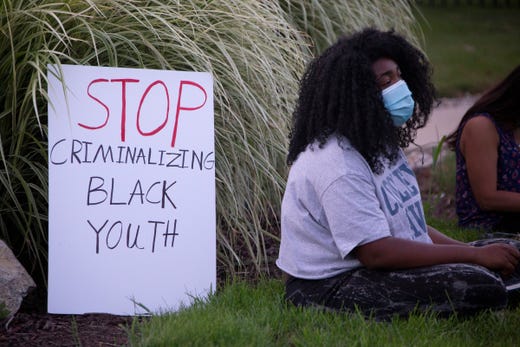
The struggle to end the shaming of Black girl students in schools continues

In the past three days, a Black 15-year-old girl student was finally released from juvenile detention in Michigan. She had been incarcerated for 78 days for the crime of not having completed her homework. At the same time, a 7-year-old Black girl student in Jamaica was informed by the High Court that when, as a 5-year-old, she was told to cut her dreadlocks or be forced to leave school, her Constitutional rights had not been violated. At the same time, England’s Department of Education reported that, in many regions, Black students face three times as many fixed term exclusions as do White students. Girls are particularly targeted for their hair, or at least that’s the official reason. This is the world of Black Girl Education today, a world that believes that Black girls pose a particular danger to themselves and, even more, to `the world’. 

In Michigan, a Black 15-year-old girl student known as Grace was sent to juvenile detention for having violated probation. Her `violation’ was not having completed her online school assignments. According to her mother, when Grace’s school went online, Grace had trouble keeping up. The Judge decided that Grace’s difficulty, as well as her learning disabilities and other issues, constituted a threat to the community, and so sent her to juvenile detention, where she would “thrive” and the community would be saved. This all happened in the Oakland County court. Over the last four years, the Oakland County Court adjudicated around 4800 juvenile cases, of which 42% concerned Black youths. 15% of Oakland County youth are Black. After a major campaign, Grace has been `released’ to home detention.

For Black girls, the assault on their integrity is even more intense. Four years ago, girls were being forced into the juvenile `justice’ system at an alarmingly increasing rate, largely because girls were arrested more often than boys for status offenses and were more severely punished for those offenses. Those `offenses’ are not crimes. That’s what makes them `status’ offenses. If the girls were older, there would be no offense, no crime. But they are girls, and they must be protected from themselves. This is the vicious cycle that has been constructed in exactly the same period that has witnessed girl power on the rise: “In a 2010 national census of youth in custody, girls comprised 16% of all detained youth but 40% of those were detained for a status offense. At one time and in some states, girls comprised more than 70% of youth detained for status offenses.” This is the United States’ program of no girl left behind. This is girls’ education in the United States, and, in the past four years, the situation for Black and Brown girls has only grown worse. Despite activists’ great work, the school-to-prison pipeline has not only grown but is sucking in Black and Brown girls at a faster and faster rate. In that context, there’s no surprise that a judge would say that sending a young Black girl student to prison is the best thing for her, for her wellbeing and her education. Boys will be boys, and girls will be jailed, especially Black girls

Meanwhile, on Friday, Jamaica’s high court ruled that a school was within its rights to tell a 5-year-old girl student that she must cut her dreadlocks or leave school. The girl student, identified as Z, and her parents have challenged the school for two years. Z is now 7 years old. By all accounts, she is an excellent student. By all accounts, she has not in any way prevented others around her from pursuing their education. To the contrary, she is described as an ideal student and learner who helps her fellow students. Z’s desire to learn must give way to the politics of hair, of Black girls’ hair, and that’s Constitutionally fineZ’s parents have sworn to challenge the ruling and to continue the struggle.

Meanwhile, in many parts of England, Black students are disciplined three times as often as their White counterparts. Their offense, other than Being Black? “Black hairstyles, kissing teeth and fist-bumping.” “Black hairstyles” can send a child student, more often than not a Black girl student, into isolation or expulsion. An assistant head of school remembers a Black girl student who was told to cut her Afro because other students “couldn’t see the board … These may be small, micro things that you are doing to change yourself, but after a while it really wears you down. It’s the message that you are almost not good enough. You are having to tame your hair, tame your blackness, and it’s happening from when you are a child.”

This is happening in the same year that Ruby Williams won an out-of-court settlement of £8,500 for the abuse she suffered, for her hair, for Being Black, from the age of 11 years old on. It’s happening when you are a child, when you are a student. What is the child student learning, what is Black girl’s education in this world? 

Four years ago, almost to the day, Liepollo Lebohang Pheko wrote about a similar situation in South African schools: “Black Girl – you MATTER. Your HAIR matters, your LANGUAGE matters, your CHOICES matter and your VOICE matters. In case I haven’t told you today – you are valuable, loved, precious and powerful. Speak even if your voice shakes and fight even while you are scared. I LOVE you Black Child, Black Girl, and I stand with you. You give me such hope and courage. #Racism and imperialism ARE falling #Afros and Dreadlocks are Rising.”

Four years later, from the United States to Jamaica to England and beyond, say it loud, say it proud: “Black Girl – you MATTER. Your HAIR matters, your LANGUAGE matters, your CHOICES matter and your VOICE matters.” The struggle continues.

(Photo Credit: Detroit Free Press)

South Africa’s Covid-19 economic stimulus plan: A chance to rethink or same old same old?

South Africa’s Covid-19 economic stimulus plan contains several of the features of a solid emergency plan, albeit cobbled together under the most unusual circumstances, at least on the surface. At 10% of GDP, far higher than Italy, Spain or the United Kingdom, it is one the largest stimulus packages in the world. To put this into further perspective the United States has committed 11% of its GDP to keeping the lights of its economy on.

President Ramaphosa’s announcement arrives at a time that global economic markets are haemorrhaging, a sad necessity of withdrawing large percentages of the working population from public spaces. Like so many components of the Covid-19 pandemic, we are presented with ongoing trade-offs and dilemmas all of which lead to their own paths of landmines. The largest fork in the road globally has been the cost of closing down the economy whilst livelihoods are increasingly precarious, many communities are restless, some families are starving to death. For countries in the Global South such as South Africa with lower welfare, this is all the more complicated by the uneven pace of dispensing relief to small businesses who employ the largest chunk of the employed workforce. The effort has been further hampered by the disgraceful diversion of food parcels to economically vulnerable communities by parts of the very state machinery that should be distributing relief.

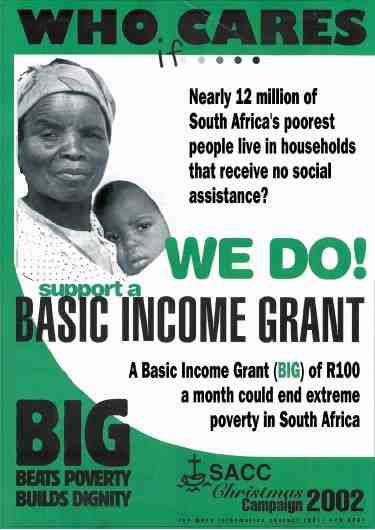
That said, the plan offers clusters of intervention, many of which sound encouragingly social welfarist. It is not dissimilar to the basic income grant suggested by social policy analysts and formulated by several NGOS post 1994. As long ago as 2004, a coalition of NGOs, faith-based organisations and unions across SADC formulated well-researched funding models to finance this. They suggested that the Basic Income Grant (BIG) was affordable, particularly for South Africa, and noted that the political and economic history of South Africa would otherwise consistently reproduce the toxicity of racist and race based social and economic outcomes. These have produced the intergenerational, structural flaws in South Africa’s economy which no amount of foreign direct investment and market orthodox approaches of the past 22 years have resolved.

The proposals suggested a financing menu of diverse local taxes and strongly suggested that a universal grant would be part of a developmental social compact. So while painful, the Corona virus and the measures suggested by the President  might be bringing us closer to the recognition that structural deficits need to be addressed by investing into developing key sectors of the economy, enabling workers to remain in the economy and by cushioning those who are not able to participate in that economy.

Part of this compact is the R200 billion loan scheme to provide companies with relief to remain operational and to pay salaries. At a time when almost a third of the workforce have either been retrenched or are uncertain of their post lockdown future, a R50billion grant has been introduced to augment existing grants for a six-month period. Significantly, relief will be offered to people who are out of the current benefits matrix and receive neither Unemployment Insurance Fund benefits nor social grants.

The R100 billion grant to small businesses includes spazas and those often bypassed and ‘informalised’ by conventional market policy. These horizon industries, including chisa nyamas,   are largely bootstrap businesses that play a significant role in job creation,  community welfare and even a space to report domestic violence. They act as a meeting place for many, and the intimacy of the relationships represents an important part of community welfare in ways that larger supermarkets cannot replicate. During this virus, with limited transport, these outlets are the closest retailers. R70 billion in the proposal represents a tax respite for such businesses, including on skills development levies.

The second major fork in the plan is in the distribution of all this to various stakeholders. To be fully effective, cash transfers and relief subsidies must reach their intended targets including indigent communities, people in the parallel or ‘informal’ sector, and women who largely run household economics and are placed at the helm of social reproduction. They must also represent value for money. The modalities of transfer funds are risk-filled not least because the State itself has often been unreliable and corrupt. The perceptions around cash transfer programmes are often tainted with misinformation, poverty shaming and the idea that social grants or income support are for ‘free loading’ or ‘lazy’ social delinquents and ‘welfare queens’ rather than a recognition that these grants can enhance human capital and social engagement. It is also a form of risk sharing which potentially minimises the ongoing risk of huge parts of the population falling out of the social and economic compact, absent from the market economy. There is little evidence to support the view that child maintenance grants result in dependency.  This is the moment to reframe a socio-economic inclusiveness that is not biased towards corporates. If 2008 taught us nothing else, it’s that we cannot privilege companies over workers and families.

The strained and compromised SASSA machinery would require far greater capacity to minimise risk and maximise fast delivery. Conditional cash transfers linked to particular goods like school uniform, services like medical access or specific food items at listed outlets have often worked better than unconditional transfers in other developing economies to avert the flaws in the systems. The sustainability of these transfers and subsidies was debated as soon as the President mentioned the 6-month time horizon. Most economies, sectors, companies and families will still be on the difficult road to recovery beyond November 2020 and probably into the next 24 to 60 months.  

All this comes at a cost and herein is the final fork in the road, the IMF. The IMF presents a departure from South Africa’s correct historical aversion to securing their assistance. The IMF works on capital account liberalisation, removing barriers to flows of capital; and fiscal consolidation, or austerity. Structural conditions, or Structural Benchmarks (SBs), involve economic actions that require legislation and critical policy changes.

In 2008, in 21 countries over two decades, researchers demonstrated that IMF programme conditionalities help produce worsening health outcomes. Whilst this Corona inspired compact is an opportunity to rethink our economic model, it is crucial to appreciate that this moment is partly a manifestation of historical neglect and a market orthodox model. The solution in form of IMF and World Bank funding models may in fact lead to even more indebtedness and invidious conditionalities in future. A full cycle of market led, corporatist potential disaster. The real pandemic.


(Image Credit: Medialternatives)

State power in the time of Corona: To protect and serve … whom?

At the time of writing, nearly half the world has closed down or is waking up to an unfamiliar world of  encroachments on physical mobility in ways not seen since the War of  1914 to 1918. Covid-19 has exposed existing fault lines in public health care provision and in  public health crisis in both the global South and the global North. The realities of socioeconomic exclusion have exposed ongoing inertia in public service provision and the rescinding role of the State in those provisions. Race, gender and class have been foregrounded in this time of crisis.  Whilst the Corona virus offers a critical moment to rethink and reframe the social compact between state, citizens and residents, it is also a dangerous and alarming time of enforced mass  enclosure. This is not the first time that humanity has been here though the scale and reach are unprecedented

Following Hurricane Katrina, many people sought to answer the question of whether its social effects and the government response to the country’s biggest natural disaster had more to do with race or with class. Media images broadcast from Louisiana showed nearly all those left behind to suffer and die were Black Americans—it looked a race, gender and class issue because it was. A few years later during Hurricane Sandy, it was clear that the US had learnt nothing from the traumatic upheaval wrought by Katrina. In this instance, it appears that nearly all might be left behind, but that the social  binaries of race based poverty and gender would endure, starkly. 

Though often hampered by  resource constraints, most African countries have a better track record of deploying state support and resources to deal with the upheavals of disease and the aftermath of war. The Ebola virus, the ongoing HIV/AIDs pandemic and malaria have provided lessons in the folly of denial, the importance of protecting health workers, of accessible and low-cost medication, robust public education, and open and consistent communication. So much of what seems like basic sense has been found wanting in the handling of Covid -19.  The news that British Prime Minister   Boris Johnson has tested positive after robust handshaking  whilst we have been advised to keep a distance and wash our hands shows a reckless leadership deficit during a defining moment.

The last forty years of globalisation as market orthodoxy has commodified health care. The globalisation of trade is  central  to  health services that have become a tradeable commodity  in an era in which many States have disinvested from health services altogether. Like education, access to water and electricity,  health provision  has been a casualty of structurally  adjusted States and the curve between the global South and the North has been exposed during this crisis as the UK and the US, often considered to be ‘developed’, have again been found weak and unprepared for a health trauma of this scale. The prescripts and onerous impacts of conditional aid and state disinvestment in social provision  have long been felt by African and Latin American countries. 

Globally, states are all experiencing the impacts and limits to free market logic. Though  characterised by many as the great equaliser, a time when States are equally fragile across the global north and global south, the true genesis of this global devastation is northern capitalism and demobilised  States. Structural adjustment as a project has evolved and is a continuing mantra of the  International Monetary Fund and the World Bank. Both  recently unveiled their market driven response of emergency loans targeting developing countries  primarily in the Global South. The depleted  health and sanitation systems in many  countries  is testimony to the devastating success of neoliberal globalisation in immobilising national  state capacities.  

Following structural adjustment programmes, most health care and essential services – including water, energy, education – may be removed from state purview for cost recovery  arrangements. In this scenario private companies invest their funds in return for state guaranteed monopolies and price control, further dispossessing and excluding vulnerable communities. Public Private Partnerships – which are essentially polite privatisation – have existed for centuries,  thriving even more when States are weakened. These have also  become the easy allies of disaster capitalism as seen in the wake of Hurricanes Katrina and Sandy where education and energy supplies were privatised, monetised and removed from the domain of public good.  

Despite decades of state neglect, social apartheid and various global traumas, consensu has formed on closing down public movement and curbing personal freedoms to address the War called Corona. The introduction of “lockdowns” with no tangible provision for social safety nets has posed significant risks to workers in the parallel economy, internally displaced persons, the working poor, fragile urban communities and other marginalised sectors. 

Notwithstanding  outsourcing their most fundamental functions to the private sector and ignoring their duty to distribute social and economic benefits to the most vulnerable in society, States are now  calling on us to trust them as they invoke martial law. This has  resulted in the largest shutdown of the last century. Unlike the two European wars (1914-1918 and 1939-1945) the impact of this situation is not localised to a few European nations, the Soviet Union, Australia,  Japan and the United States. Globalisation has transmitted both the disease and uniform approaches to problem solving. 

Students of civil liberties, human rights and social cohesion have opined on the politics of enclosure in times of war and peace.  Even during enclosed times, States exhibit inherent biases and weaknesses that maintain privilege for corporate and masculinised interests.  South Africa has lived through public control  in living memory, and distrust of the State and state security is still embedded in social discourses. Like many other  countries, the spectre of securitisation of human mobility sits badly, particularly as we still recall the dehumanising policing of colonial Apartheid exemplified by the Sharpeville Massacre, Soweto Uprising and Uitenhage massacres among many.  Troublingly, the Marikana Massacre  and the violence against the #FeesMustFall activists illustrates that the State can be a brutal  personality regardless of the supposedly progressive underpinnings of the Government in power.

At the time of writing, South Africans are required to carry Identity Books in case we are stopped by the police or army when going to buy  groceries or medical supplies. Once more, personhood is linked to a form of the much reviled Apartheid Passbook.  It is deeply unsettling, albeit necessary, that states are containing us to  control a warlike virus that might have been prevented had the same States not neglected  and commodified health care  so shamelessly. The same could be said of nearly every country battling the Corona pandemic.  

Whilst allowing already problematic Father States to lead us through very complex terrain, we recall that States are often inclined towards repression. Public order policing and martial law have often been the retreat of authoritarian regimes, evoking public safety, order and emergencies real or created to control citizens and residents . Late last year the Chilean government clamped down on high school protestors who demanded that the State provide  cost effective public transport. The escalating rage resulted in something resembling a nationwide, cross-issue movement against price increases, poor social services, and unemployment. It remains to be seen whether  the promise of a constitutional reform will quell public dissent. France has faced similar protests on public pension funds  and the retreat of the State in maternity clinics and postal services . Macron  effectively  ‘closed down’ France nearly two weeks ago. In the midst of their lockdown, thousands marched against him the day before local government elections. While States might have found the opportunity to indulge their regressive impulses during the time of Corona, not all of us are amnesiac about how we got here.  


(Photo Credit: Daily Maverick / EPA – EFE / Kim Ludbrook)

On xenophobic violence: Press Release by Pan African Network in Defense of Migrant Rights

10 -September -2019

The entire continent is watching in pain, confusion and anger as South Africa struggles to contain massive social implosion  and manifestations of profound  contradictions. The loss of all life and disunity among Afrikans is everything that progressive formations including the Pan African Network in Defense of  Migrant Rights (PANiDMR) stand against. The symptoms of these contradictions have most recently  leaked into  attacks among  the marginalised and  neglected underclasses, where precarity and desperation co-exist.  State responses include deploying ‘social cohesion’ programmes as a catch all attempt to mop up these violent social conditions.  

The recent attacks  on 13 Africans in South Africa form part of an undercurrent of historical fissures. The nature of  violent  interstate, attacks that have been witnessed in the past seven days pre-date the end of the colonial apartheid  dispensation. In the 1980s what is  now often described as Afrophobia or Xenophobia was mischaracterized  under a blanket of  political violence.

The historical DNA of South African political contestation is embedded in ways of addressing difference that  is situated in the theatre of vanquish and  party political extremism. The bloodshed across urban South Africa in the 1980s and 1990s pre-1994 was partly stoked by various political interests, played out on Black bodies. The necklacing in African communities was the most vivid and vicious instrument to enforce political discipline of real or imagined infractions and betrayals. It was also a marker of deep inter-community distrust primarily among political and ethnic communities. The specter of being labeled as  ‘other’ was sometimes  sufficient cause for comrades to sell each other’s lives in return for their own. The inherent trauma that communities are still carrying with them was largely airbrushed by the  ‘Rainbow’ narrative even though it is clear that centuries of dehumanizing behavior was not going to go away as  new flag was raised.

This occurred in the context of the South African state machinery that  systemically dehumanized and brutalized African people in this country. The colonial imagination legislated and constantly enforced the idea that African people are sub-human interlopers in a racialised and privileged ‘White’ world. This was prescribed through structural enablers like labour, education and land legislation all of which created an intergenerational cohort of African people who would always  be  a marginal , sub class of work horses. In the era of growing unemployment , this too has created a subaltern formation that are fully disposable and for whom the State has no tangible plans beyond ‘social cohesion’ to bring from the margins. 

There are further problems emerging from this. Firstly, South Africa has done very little to alter the social and economic  pathways made available to the African majority in this country. White priviledge through land, economic ownership patterns, social relations and life outcomes has been left virtually intact.  In tandem to this , multiple countries in the global South and across Africa were virtually disemboweled by structural adjustment and ongoing incursion of capital into State power. Instances of civil war and ongoing wars that some States wage against their nations – both often with the ‘ invisible hand’ of Western interests – have resulted in weakened States and limited economic opportunities. 

There are other issues that include the expectation by locals to  have first preference for jobs while many companies choose to employ vulnerable migrants for lower wages, creating working toxic and inevitable class resentment. In addition to this, porous borders with weak and often corrupted border controls, sloppy and complicit police are adding stress to a difficult situation.  Well documented reports of criminal rings run by a section of  African compatriots were a large cause of  the attacks in Tshwane (Pretoria) last week. In many areas including there, police have failed to investigate allegations or make arrests, which contributes to the ‘those people’ narrative rather than situating this within a failed and compromised criminal justice system.

Naturally, there will be movement in search of better lives and perhaps naturally, to  countries that appear to offer the most hope, possibility and for some refuge from political repression.

Tragically for all these periphalised people, the South African state has not deconstructed the machinery of ‘othering’  the most vulnerable and as the Marikana massacre showed, is well able to unleash brutal force against Black bodies, many of whom were migrant workers.  The exodus  of millions of people to South Africa from across the world illustrates a  shared aspiration that they have towards the victory over political apartheid that South Africa still represents. 

And yet co-ordinated and periodic combustions related to inadequate public service delivery, organised labour strikes, student uprisings, and other demonstrations of public anger are a huge part of the character of modern South African politics. A politics steeped in historical trauma, ongoing dispossession, a breakdown in state institutions and frenzied attempts by the government to ‘act normal’ for the benefit of international investors while the underclass of all nationalities battle for scarce resources in the most brutal ways. Local and migrant Africans across the African continent are exhausted by the wait for something more from our governments. 

Self-serving elites have driven many African compatriots to South Africa only to find that many South African political actors have fallen into a similar abyss of myopic disregard for the masses. The statements issued  by President Ramaphosa in recent days lacked empathy, class analysis and any semblance of a Pan African understanding of how deeply embedded our fates are tied together as African countries. This is an opportunity to raise a challenge to our African leaders to create nations that are nourishing and  accountable. Nations that appreciate the talents at their disposal, create environments where all Africans can thrive and contribute. The retaliatory attacks on South African businesses across the continent ultimately hurt the marginal and working classes yet again and though this may be a  temporary ‘blue eye’ for White owned corporations, it only fuels more resentments while eroding authentic African  economic and political agendas. 

 At the time of writing, 13 Africans are reported dead, 8 of whom are  thought to be South Africans. Most regrettably, attempts by formations such as PANiDMR and Trade Collective to obtain the names and countries of origin from relevant  authorities have so far yielded no results. Beyond dying a dehumanising death, our family members have died namelessly. So emblematic of the State’s careless, dispassionate relationship with the underclass. PANiDMR sends heartfelt condolences to the families, friends, communities of the Africans killed over the past week and all the years before. We pray that the death toll of 13 will not rise further and renew our commitment to building a Pan African vision that affirms and valorises African lives and Black lives in and out of the Diaspora.

(Photo Credit: News24 / Kola Sulaimon / AFP)

Chibok: Why is our outrage so muted?


1001 days ago, at least 276 young women were kidnapped from Chibok. It is not the first instance of kidnapping in the area and their return in ‘dribs and drabs’ is an exercise in agony. I spent my birthday weekend surrounded by love, family, safety and assurance of my place and value in this world. Surely that is the bare minimum of life and existence? And yet about 200 of this last group of young women and girls remain captive not only to Boko Haram but also to our silence. Our shared inertia. Our disinterest in stories that do not have fast and happy endings. Our appalling attention span that is further diminished by tweeting and Instagram and yes…Facebook.

I am so frustrated by my own lack of ideas and inability to make a meaningful contribution to bringing these young women home. The state seems to be sleepwalking, the AU seems to be disinterested and ECOWAS has seemingly not yet found the means to do something that ought to have happened 1000 days ago – find these women. How many more days? A 1000 more? Do Black lives and Afrikan lives have so little value even to us? Do Women’s lives and Black women have such little currency? Is this why our outrage is so muted?

I watched as these women were paraded by President Buhari recently, many of them so disoriented, distant and deeply haunted. Many have lost their families who moved away from the volatile Chibok area. Others have been so dislocated that they are unable to re-adjust. Nothing can ever be the same again. One cannot unsee, unfeel and unremember.

Many have come back with children, the product of rape and coercive sex. Few of us want to speak of the stigma and shame that accompanies their return. Post Traumatic Stress Syndrome, nightmares, shame, STDs, fear, paranoia and so much more. A pretty dress and a visit to the President do not erase all this. I suppose this is my own attempt to make sense of such a senseless event and to find balance in such a bizarre and violent context. #1000daystoomany.


(Photo Credit: TRT World)

The Second Coming

Nebuchadnezzar outcast in the wilderness

At the risk of evoking the wrath and ire of my own faith community, I am using the metaphor of Donald Trump’s incumbency to describe the ascendancy of so many things that are so wrong with the idea of a Trumped up world. Like most sane and caring quarters of humanity, I was and remain somewhat shell-shocked by the US election result not least its decisive outcome.  Even though it could have gone either way, I had no idea that it veered so far away from an ethical universe.  During his thundering and violently divisive approach to the White House, Trump already created the sort of racist, misogynist, anti migrant, anti-anything that is not full-blooded American sentiment. Whatever that means. Whoever those are including himself, his many wives and children. Even in locker rooms, his coming is a bizarre apparition.

He is certainly anti-anything thoughtful, decent, kind, inclusive, nuanced. Which brings me to the second coming.  A second coming of a rabid re-invention of a polarised and razor thin interpretation of privileged whiteness.

America is in an era that has been marked by a new civil rights movement, one that has necessarily taken social and race solidarity global again. This internationalism had in many ways diminished since the end of the South African apartheid colonial struggles.

Globalised struggle was subverted by most countries’ hard battle to remain afloat in the midst of ongoing assaults of market fundamentalism, state retreat, social exclusion and disenfranchisement that have accompanied society’s underclass and marginalised. The ‘Black Lash‘ against Obama has been apparent by the increased lynching of Black people.  Although largely seen as male targeting men, several Black women and girls have also been targeted.  The othering of non-whiteness has been a rehearsal of the Second Coming. A rehearsal to lynch the reality that America and the world beyond are not the White bastions.

Attempting to recreate and impose a misplaced post Darwinian imagination on the rest of the world is beyond naïve. In today’s global power matrix, it is a risk that the US dare not assume will be met with passively. The world beyond the United States has moved on, and the centrality of the United States as the axis of global power has plummeted probably beyond repair. Like Great Britain before, their era of invincible imperial domination has ended. However like a macabre scene, the decapitated chicken runs dead with its head off causing chaos and blood letting in their wake particularly for those who do not know they are dead yet.

Hillary Clinton remains a deeply divisive candidate who polarised many of my friends on the progressive left. She has a recent history of presiding over Gaddafi’s extra judicial killing and her centrist, hawkish stance did not differentiate her from the bland establishment. Unlike Bernie Saunders, she did not evoke excitement and support. Her and Bill’s race baiting when she ran against Obama in the 2008 are also not entirely forgotten, and the rumours that she ran her husband’s many mistresses out of town have not been quashed. Nevertheless, she is a better option if only because she is a known quantity and somewhat familiar adversary particularly in the Global South. So I remain annoyed at my friends who opted to sit this one out or to vote elsewhere thus splitting the vote and enabling the second coming.

The community insurrections in Ferguson and Baltimore have resonance with the demands made in Cairo and Tunis in 2011. Across South African metropoles, recent protests form a part of a constant reclamation and reiteration of every liberation dividend that was conceded in 1994. It is from one of these cities that I write, in a country that is facing its own paradox of a leader who defies insurmountable odds, using or bypassing democratic, legal and constitutional processes. So Trump is the second coming of familiar phenomena of political impossibilities that become not only tangible realities but almost immoveable beams of obstruction.

His comments on trade policy are complicated mainly because they are a zealously protectionist part of the re-invention of a great America in which Trump predicts America will  ‘win so much that they will get sick of it‘. A world without bi-lateral agreements and international trade obligations that require reciprocity and demand full access to markets for the bullying Northern countries. Trump’s reluctance to proceed with the Transatlantic Trade and Investment Partnership [TTIP] has caused some consternation from markets and cautious relief from some countries in the southern hemisphere who have been resisting the potential assault of global mode of free trade.

Yet Trump is coming from such a toxic place of  ‘Ameri-absorption‘ that any potential gains must be counted and calculated carefully. Indeed the climate denialists have come out to play and global action in this regard is unlikely to be easy. The second coming of increased militarisation of international life and domestic instruments notably the US police give me a cold sweat. How Trump will deal with the insurgencies that sometimes arise on my continent given his hawkish tendencies can only be speculated.

His remarks on South Africa as a crime-ridden mess were ill judged and inflammatory, typical of a parochial invention of Africa as a basket case that Trump favours. Unfortunately for him, we have long memories. There are multiple democratic deficits that have been revealed about the US electoral system (re-counting in three States is taking place at the time of writing) and I have proposed external election monitoring particularly from African, Asian and Latin American countries.  What is particularly disgusting about the Trump moment is that despite all these and his flaws, a whole bunch of people believes him. Along with Brexit, the Global South can only ponder and recalibrate these moments. The re-invention that they represent is as thin and fragile as a reed and subject to the sort of head winds that varied social forces can easily demolish or manipulate for their own ends.


(Image Credit: William Blake / Art and the Bible)

#RememberKhwezi: This woman was a revolutionary in the truest sense of the word


A million thoughts running and sprinting across my mind. Fezekile-otherwise known by her nom de guerre ”Khwezi” transitioned from this life two days ago. I have been numb, angry, grief stricken and like many of us, left with a sense of injustice, shame and guilt. This woman was a revolutionary in the truest sense of the word. She sacrificed her relative youth and life aspirations and laid down her life, for a truth that could not be contained in life and will not be crushed by death. I wrote and mobilised along with many other women across this country, many of whom were abused, spat at and received death threats for supporting Fezekile. I often wondered whether I could have done differently, more, been more vigourous and robust in protecting and loving Fezekile both before her exile and after her return. I am ashamed to have been reminded to become ‘un-numb’ when the four young activists, who at the IEC 2 months ago, jerked me out of my sleep walk.

I have sometimes thought of myself as brave. Fezekile was much more than brave. Bravery in fact looks like her and cowered in her presence. She deserves to be remembered as more than ”an accuser”. She was in fact the one who accused us as her name was taken, her face obscured, her mortal life in danger and her being displaced. Her fortitude quietly accuses and reminds me of the value of life, the cost of being steadfast, the disregard of women’s bodies, the ongoing rape of our decency & solidarity, the shame of silent forgetting. Those who knew her speak of her great humour, her deep compassion, her zest for life and learning.

She is a reminder of the brokenness of this country, the neglect of many children of struggle, the violations of trust and our complicity with masculine entitlement. But more than that, she is a reflection of what one day I hope to be. Truly Brave. Brave at all costs for the truth.

To quote Nawal El-Saadawi :

“You are a savage and dangerous woman.
I am speaking the truth. And the truth is savage and dangerous.”

(Photo Credit: The Sowetan)