The European Union, France and the attacks on the Roma: who’s next?

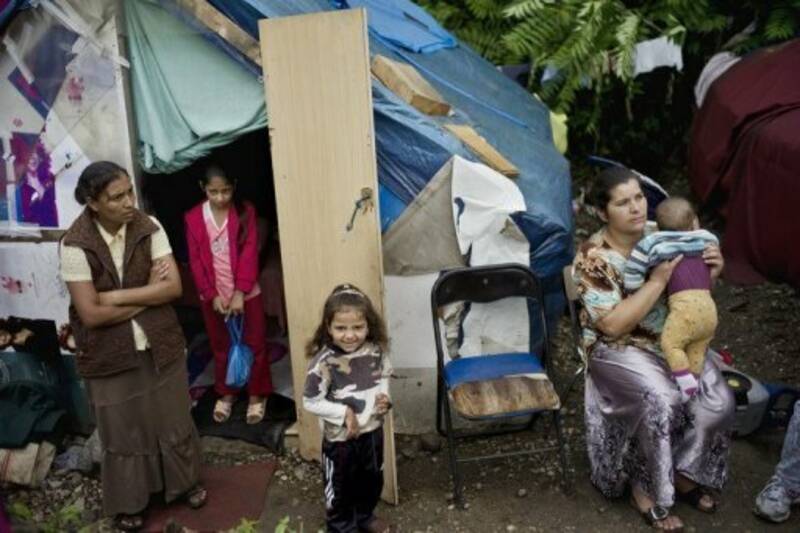
Members of the Roma community in a camp in Lyons, 2010

When, in 2007, the European Union opened its membership to Eastern European countries, it only left the door ajar. As Renault or other European corporations had welcomed the entrance of Eastern European countries into the Union, seeing the potential for reserve of cheap labor, the promise of a “we stand together European citizenry” of these new members did not apply to the Roma, who are European citizens. In eight European Countries including France, the Roma have been under work restrictions, with only 150 types of work or “métiers” opened to them. Moreover, an employer who would like to hire a Roma would have to pay a monthly 700€ (about $900) flat tax on salary, a huge deterrence to employment.

This summer, despite the recent formation of a French socialist government, which includes a few Europe Ecology ministers, under the presidency of François Hollande, the policies of removal of Roma camps from some sites in France, a practice started by Sarkozy and opposed at the time by one François Hollande, have been reenacted under the aegis of Manuel Valls, the minister of the interior.

These removals triggered a series of criticism, including from other members of the government such as Cecile Duflot (Europe Ecology) who pointed out the counterproductive nature of such actions that push already stigmatized population toward more precariousness.

Martine Aubry, socialist mayor of Lille, one of the cities where Roma were evicted, was reported to be furious at M. Valls for having engaged in this action without any consultation with her or her administration.  She also emphasized that it was a serious breach in the work that her city has done to welcome the Roma. This work included construction of camps, with three more being built when the police dislodged the Roma from unofficial sites.

M.Valls claimed that the camps were unauthorized and therefore unlawful, adding that the law of the republic had to prevail. However, the laws have consistently ignored the reality of life for the Roma community and have targeted them as scapegoats by describing a surge of Roma population that would occur if they were to be `unleashed’.

The `surge’ of Roma in France amounts to 15 000 people. That number has remained stable for years despite the politics of expulsions, according to anthropologist Martin Oliviera, a member of the European Observatory Urban-Rom who works in a suburb of Paris. He adds that the Roma are not nomadic, as the cliché supports. He emphasized that their vocation is not to gush, or spill, westward “as if Europe was slanted.”

The politics of exclusion, on the other hand, are slanted. They are part of a capitalist framework that has evolved to a new neo liberal order that plays out to build (or to generate) the “vulnerable” that becomes the “filthy” as the politics of exclusion grows, and the French socialists are themselves entangled in this. The impediments to living and working for the Roma are in place. Unquestionably, various critics forced the government to make a gesture: the tax on salary was removed and the number of Métiers authorized increased. But it is too little and will not produce the real support that the Roma need.

So now, many are being rendered vulnerable under the same framework. Many are in the streets with no sense of belonging. This is not about charity for the Roma. It is about living in resistance to an order that we have allowed to be ours.


(Photo Credit: Libération / Jeff Pachoud / AFP)


La République et la jupe

Les français se pensent-ils libérés avec ce nouveau couple présidentiel hors des institutions du mariage?  La république permissive a pourtant une vue particulière sur les tenues vestimentaires des résidentes de ce pays. Nous avons tous suivi les débats sur le foulard, le hijab, puis le jilbab, mais qu’en est il de la jupe ? Autrefois seule tenue autorisée dans les lieux d’études, elle est devenue taboue.

Lors de la journée de la femme, le 8 mars dernier, le scandale est apparu dans un collège d’une petite bourgade de l’Ain. Le magazine Marianne a même été saisi de l’affaire. Les faits : une trentaine de filles décident d’enfiler une jupe pour, comme elles dirent : « honorer la féminité ».  Le film la journée de la jupe avec Isabelle Adjani avait été leur inspiration. Puis, dès leur arrivée au collège, elles ont été remarquées par des professeurs et par voie de conséquence par le principal adjoint présent au collège ce jour-là. Aussitôt les gamines sont les cibles de quelques insultes : « journée de la jupe, journée de la pute » et surtout la cible des autorités. Elles doivent être mises à l’écart, car elles ont enfreint la loi, mais quelle loi ? Car comme l’affirme le principal, la jupe n’est pas interdite au collège. De même, ce collège est loin des banlieues des grandes villes où, comme le dit la journaliste de Marianne, Marie Huret: « la jupe est réputée échauffer les hormones », ce qui peut être interprété comme une bonne raison pour se couvrir des pieds a la tête si la jeune fille ne veut pas d’ennuis. En effet, comme l’avait signalé Simone de Beauvoir, les filles grandissent dans une autorité virile qui décide, entre autres, de leur apparence acceptable pour la république comme pour la religion, c’est à dire pour l’autorité patriarcale. Il faudra donc qu’elles se soumettent.

Revenons à notre affaire de jupes, après cette journée fatale, il y a eu réunion entre les parents et le principal de l’établissement. Celui-ci n’a pas voulu revenir sur les décisions prises ce jour là. Quand les parents ont demandé des excuses, il n’en était pas question, car il ne faut pas remettre en cause l’autorité.  En cause, un nouveau pouvoir ou bien devrait-on parler du pouvoir qui s’inscrit dans la biopolitique décrite par Michel Foucault qui ne demande pas seulement une domination hiérarchisée, centralisée, et fondée sur la discipline, mais une abnégation et une acceptation au plus profond de soi qui mimique la liberté du choix. Michel Foucault avait omis de rapporter cette description, fort juste par ailleurs, au control du corps de la femme.

Heureusement, les jeunes filles ont trouvé soutien parmi les enseignants, car leur seule demande de reconnaissance et de droit n’aurait pas suffit. L’un d’entre eux explique à la journaliste de Marianne que « cette affaire doit nous permettre d’ouvrir une réflexion collective. Pour l’heure, la priorité c’est de remettre les enfants au travail. » Voilà qui est dit, revenons aux bonnes valeurs, de travail, et pourquoi pas de servitude et celle ci se doit volontaire comme le décrivait déjà La Boétie dans son ouvrage rédigé en 1549.

Effectivement il y a du chemin a faire ou a refaire, car malgré les efforts  comme la parité gouvernementale pour montrer que la condition des femmes est prise en compte, les actes qui touchent de la vie quotidienne des filles, jeunes filles et femmes leur rappellent qu’elles sont a la merci de l’autorité masculine.


Resistances, les femmes, le pouvoir et l’élection


Les électeurs français viennent d’élire un président socialiste, François Hollande. Il a été investi dans ses fonctions le 15 mai dernier et un nouveau gouvernement a été formé dans la foulée. Le changement est de taille pour beaucoup et une source d’espoir pour les femmes et les minorités. Ainsi le nouveau président avait affirmé qu’il appliquerait le principe de parité entre hommes et femmes pour former sa nouvelle équipe ministérielle. Il a pour ainsi dire réussi, 34 ministres dont 17 femmes. Il y a eu passation de pouvoir et à la suite du premier conseil des ministres il y a eu séance de photos et en particulier une photo du président et du premier ministre (Jean-Marc Ayrault) avec les femmes ministres de la parité. « Pourquoi une photo avec les seules femmes ministres?» demande la présidente de l’association des femmes journalistes, Isabelle Germain.

Est-ce un trophée ? Isabelle Germain ajoute qu’il n’y a pas eu de photos avec les hommes, ou les ministres issus de la diversité, elle en conclut que le concept de diversité est plus accepté que la parité politique entre hommes et femmes. Bien que cette décision doive être applaudie, il faut remarquer que la parité joue sur le nombre et non sur l’importance des postes de ministres, et il faut ajouter qu’il n’y a pas de parité parmi les conseillers du président et du premier ministre, comme le déplore Osez le Féminisme.

Toutefois image de progrès, la nomination de Christiane Taubira comme garde des Sceaux (ministre de la justice). D’abord cette nomination rappelle  l’histoire coloniale de la France, en effet, Christiane Taubira, est sénatrice » de Guyane. Elle représente les populations des caraïbes et a commencé sa carrière comme activiste indépendantiste de la Guyane.

Une de ses premières remarques qui mènera à une action rapide concerne la justice des mineurs. Elle a clairement indiquée que l’ère Sarkozy était terminée. Plus question de juger les délinquants récidivistes de 16 ou 17 ans dans des tribunaux correctionnels ordinaires, c’est à dire comme des adultes, cette mesure venait directement de l’exemple américain. Les mineurs seront de nouveau jugés comme des jeunes, ce qui veut dire pas d’incarcération dans les prisons des adultes et plus de programmes d’accompagnement. Bien sur l’ancienne ministre Rachida Dati (UMP) a immédiatement critiqué cette décision la qualifiant  d’ “acte irresponsable”. Rappelons que l’argument de dissuasion avancé en faveur du jugement des mineurs comme adulte, bien connu aux Etats Unis, s’est toujours avéré  erroné. Il est remarquable que Rachida Dati ministre de Sarkozy, elle aussi représentait l’intégration puisqu’elle est issue de l’immigration. Son approche était bien différente de celle de ces nouveaux ministres.

Cela nous mène à la nomination de la ministre des droits de la femme. Ce ministère avait purement et simplement été supprimé par le gouvernement précédent. Il avait été créé par le dernier président socialiste, en 1981 et avait eu un effet bénéfique pour les droits des femmes en France.  La nouvelle nommée Najat Vallaud-Belkacem est née au Maroc de parents marocains, elle refuse la comparaison avec Rachida Dati (elle aussi d’origine nord africaine). Najat Vallaud-Belkacem a aussi montré que les identités peuvent être multiples puisqu’elle a siégé au Conseil de la communauté marocaine à l’étranger (CCME) jusqu’à ce qu’elle s’engage avec François Hollande.  Beaucoup de travail à venir pour elle, notamment avec la loi sur le harcèlement sexuel qui a été invalidée par le Conseil Constitutionnel  récemment, créant ainsi un problème juridique pour les femmes voulant intenter une action en justice. Cette loi doit être repensée et surtout doit apporter une protection nécessaire aux femmes qui sont en France comme ailleurs de plus en plus victimes de violence.

Il est clair qu’après une campagne présidentielle menée par Nicolas Sarkozy sur le thème de la peur de l’étranger et de l’immigration, la formation de ce gouvernement montre une claire démarcation de la ligne ultra de Sarkozy, celui-ci n’avait pas hésité à remettre en cause la laïcité tout en utilisant la peur de la religiosité musulmane comme raison, alors qu’il prônait le retour a la morale chrétienne comme référence. Le débat s’éloignait de la nécessaire remise en cause de la colonisation dans ce moment où la mondialisation néolibérale représente une nouvelle forme de colonisation.

Dans ces temps qui révèlent les effets de l’organisation financière de la mondialisation néolibérale sur la société toute entière et avec les renégociations des accords européens pour instaurer les politiques économiques d’austérité destinées à mettre à genou les populations, le changement, si petit qu’il soit, venu de cette élection est une source d’espoir qu’il ne faut pas laisser échapper.


(Photo Credit: Reuters / Guillaume Paumier, Joëlle Dollé)


Let’s hope France does not vote for US-style prisons

As France goes to the polls in May, I think of women in prison in France and those in the United States, and I shudder. Consider the following.

These are the rules applied to pregnant women in prison in France, and they are clear:

No restriction of rights and access to Public Health Care during pregnancy.

Women are automatically covered by the health care system, mothers with babies under 18 months of age may receive maternal subsidy in prison the same as any woman in the “free world.”

No surveillance during delivery or at any stay at the public hospital where women who are incarcerated have to go for their regular visits and delivery.

The stay after delivery is the same as for any other, that is to say a minimum of 4 days and for as long as the doctor judges they have to stay.

Mother can be sent to a special section of the prison and keep their infant if they want to. The child is not incarcerated, and so receives all regular subsidies from the state, without restriction, and the mother manages the money, if she so chooses.

The hospital director may ask for surveillance outside the room, if deemed  necessary.

Those are the rules, and they’re a far sight better than those in the United States. Nevertheless, we cannot ignore the distances, in France, between conditions as they for women in prison are and the claims made in official documents. Life for pregnant women in prison is difficult and not often talked about.

In France, for instance, there are 64 000 people incarcerated and 2500 are women. Women in prison often complain that because they are so few, their conditions are not taken seriously. There are political women prisoners, the majority of whom are Basque activists. Women may have private visits with their spouses, so it is possible, within the rules, for a woman prisoner to become pregnant.

Take the much-publicized story of Véronique Le Gall.

Véronique Le Gall was in jail for having killed and stored her newborn baby in a freezer. That was most likely a case of post-partum depression. At any rate, while in prison, she became pregnant. The authorities didn’t know and so only at the last instance was she sent to the hospital to give birth.

The point of the story of Véronique Le Gall is that it’s not unusual. It’s not unusual for women prisoners in France to become pregnant. There are several, formally sanctioned ways to get pregnant in prison. If a couple is incarcerated in the same institution, they have access to an internal visiting room. Women prisoners may be released on weekends. Finally, women can meet their family for 6 to 72 hours in a unité de vie familiale, or family life unit, which are small private apartments.

From one perspective, the standards in prisons in France are much better than those in the United States, but that’s not saying much.

What remains an issue is the prison environment in which a no-exception rule reigns. Pregnant women are trapped in this no-exception rules situation. Their parental right is not going to be compromised but their parenting is. Women prisoners in France can become parents, but they can’t be parents. They can’t act as parents, because they can’t make autonomous decisions about their children.

The last few years has seen both an improvement and a degradation of detention conditions. Recently, both the Controleur General des Lieux de Privation de Liberté, Jean Marie Delarue, and the European Committee for the Prevention of Torture and Inhuman or Degrading Treatment or Punishment have identified disturbing, new elements: increased use of force, lack of training among wardens, increased use of solitary confinement, inadequate food provided by outsourced provisioners, slow psychiatric response to needed attention, and increased use of hand cuffs, especially for male prisoners. In France, doctors oppose the use of any restraints on medical grounds.

The International Observatory of Prisons sent a letter to both President Nicolas Sarkozy and to his main election contender Francois Holland. Neither said much. Hollande declared that French prisons should remain in conformity with principles of dignity. His chargé d’affaires explained that they wanted to render prison “useful” and work to decrease the rate of repeat offenses. As for Nicolas Sarkozy, he announced that he wanted to add 24 000 beds to the 56 000 already in place, and to rework the sentencing reduction program in place as a kind of zero tolerance program. He calls this “reinforcing the authority of justice”.

Prisons reflect as they participate in the evolution of the political economy of a society. That has certainly been the case in France. Let’s hope that the May 6th election marks a positive turn that keeps France’s prisons distant from those of the United States.


(Photo Credit: Robin des Lois)

Expose the attacks on the undocumented and on women in France


While in the United States, attempts to hurt, reduce and constrain women’s bodies are multiplying (as the recent bill in Virginia to impose vaginal sonogram on women who seek an abortion demonstrates), two recent developments in France show that the politics of constraint and control of the body and in particular of women’s bodies are also expanding in Europe.

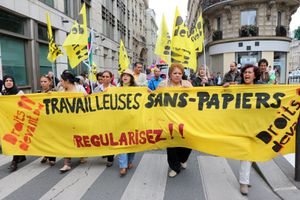
In France, undocumented immigrants, “les sans-papiers” have access to health care, through “l’aide medicale d’Etat” or AME (State Medical Aid), if they have been in France for at least 3 months. While this seems to be better than many other places in the western world, some barriers that have been erected to divide and control immigrants and residents.

For example, it used to be that in order to register, people could go to any regular center of the national health coverage “les caisses d’assurance maladie,” and there were many of them. Recently, new rules have been introduced. Since the end of 2011, in Paris only two centers have been processing applications to be registered in AME. After two months, the Observatory of Foreigners’ Right to Health, ODSE, has reported a series of problems. These include long waiting lines, starting in the middle of the night, summary selection of applications, loss of applications, mounting administrative red tape. All these difficulties contribute to delaying indispensable coverage and access to health care for people who are already among the most vulnerable.

Another recent development directly affects women’s health and well being. In 2001, a bill was passed that gave women’s reproductive rights a great boost. The new law includes provisions for anonymous access to contraceptive and abortion services for minors and without parental consent. It also provides for an ambitious sexual education program, lately the distribution of money to enforce this law has been problematic. Recent reports have shown the importance of sexual education through school as well as free and easy access to centers where women and men can access information on the various questions related to sexuality.

The law itself is beyond repeal, but that does not mean it is safe from dilution. Although officially budgeted for the 2012 fiscal year and voted by the parliament, apparently, 500 000 Euros slotted sex ed programs has disappeared. The Sarkozy administration must have misplaced it!

So how are these two issues related? Both are about creating barriers for some women to access services that allow full social participation and meaningful exercise of their rights. They are about relegating to the back seat some selected populations who are excluded through constraining policies on their bodies, which are, thus, made invisible in body politics of the nation. The reshaping of existing social advances concerning reproductive rights, health care for all, has become the priority of neoliberal governments. It follows the pattern that has already been developed for emerging countries, cutting public services. It is important to identify policies that follow this pattern. It is important to expose them in order to lessen the impact of the US neoliberal transformation anywhere it is being exported.

(Photo Credit: Femmes En Lutte 93)