Susan Sontag haunts Mumbai?

Susan Sontag showed up in Mumbai this week. Mumbai is hosting its first ever photography festival, the FOCUS Photography Festival. The Festival has two key exhibitions: `A Fantastic Legacy: Early Bombay Photography, from 1840 to 1900’; and `A Photograph is Not an Opinion – Contemporary Photography by Women’. The title of the latter exhibition “borrows its title from Susan Sontag’s essay `A Photograph Is Not an Opinion. Or Is It?’ from the book Women.” As one of the curators explained, “The book implies that while men are under pressure to produce one strong opinion, the strength of the women’s point of view it accommodates many viewpoints. What I am trying to say in the title is that there are variations of the truth being presented in this exhibition.’”

What was the truth of women that Sontag was trying to understand in her 1999 essay, which introduced Annie Leibovitz’s book, entitled simply, and impossibly, Women, and how does that truth ring today?

Sontag’s essay opens wondering about “a book of photographs of people with nothing more in common than that they are women (and living in America at the end of the twentieth century)… A large number of pictures of what is, nominally, a single subject will inevitably be felt to be representative in some sense. How much more so with this subject, with this book, an anthology of destinies and disabilities and new possibilities; a book that invites the sympathetic responses we bring to the depiction of a minority (for that is what women are, by every criterion except the numerical), featuring many portraits of those who are a credit to their sex. Such a book has to feel instructive, even if it tells us what we think we already know about the overcoming of perennial impediments and prejudices and cultural handicaps, the conquest of new zones of achievement. Of course, such a book would be misleading if it did not touch on the bad news as well: the continuing authority of demeaning stereotypes, the continuing violence (domestic assault is the leading cause of injuries to American women) belongs to the ongoing story of how women are presented, and how they are invited to think of themselves. A book of photographs of women must, whether it intends to or not, raise the question of women— there is no equivalent `question of men.’ Men, unlike women, are not a work in progress.”

The rest of the essay attempts to think historically, aesthetically and politically about a book that photographs only women, about a book of photographs of women. Sontag concludes: “A book of photographs; a book about women; a very American project … It’s for us to decide what to make of these pictures. A photograph is not an opinion. Or is it?”

A very American project in 1999 becomes … a very metropolitan, Indian, transnational, global project in 2013? What does that mean? What happens when the subject of women moves from women as the object and objects of `our’ gaze(s), a crisis of representation, to women as the makers, and specifically as the makers of vision? What happens when a book of photographs `about women’ becomes a space of women?

In her last book, Regarding the Pain of Others, Sontag noted, “Narratives can make us understand. Photographs do something else: they haunt us.” Women photographers do not haunt the galleries of Mumbai this week, but their photographs might. As we have seen recently in debates about domestic violence in India, South Africa, the United States, and beyond, there is perhaps the beginning of a question of men. Meanwhile, Susan Sontag haunts the FOCUS galleries as she asks, “Is there still only a question of women?”


(Photo Credit: Mohini Chandra)

Jackie Nanyonjo died last Friday

Jackie Nanyonjo

My grandmother did not die of uremic poisoning. She died because she was in hiding, in Nazi-occupied Brussels, and could not get the medical care she needed. And so she died and was buried in an unmarked grave in a potter’s field `somewhere in Brussels’.

Jackie Nanyonjo died in Kampala, Uganda, last Friday. Jackie Nanyonjo was a lesbian who fled Uganda, made it to England, and applied for asylum. In so doing, she joined women like Betty Tibikawa, Linda Nakibuuka and so many other Ugandan lesbians who, having asked for safe haven, trade one rung of hell for another.

Jackie Nanyonjo fought for the rights, power and dignity of women, LGBTI individuals and communities, lesbians, asylum seekers. She fought for those rights on the streets; in the cells and corridors of Yarl’s Wood; and in the airplane that took her, abducted her more accurately, to Kampala two months ago. When she arrived in Kampala, she went into hiding. She didn’t contact members of the organized LGBT rights communities, most likely because of the current pogroms against lesbians and gays and their organizations. And so, on Friday, March 8, 2013, International Women’s Day, Jackie Nanyonjo died, in hiding, in Kampala.

Friends report that she was in poor health in the United Kingdom and in very poor health when she arrived in Kampala.

My grandmother did not die of uremic poisoning. Jackie Nanyonjo did not die of poor health. They were both killed. May they both rest in peace. May we do better than merely remember and intone their names.


(Photo Credit: PinkNews)


In Italy, prison is a death sentence … and no one knows?

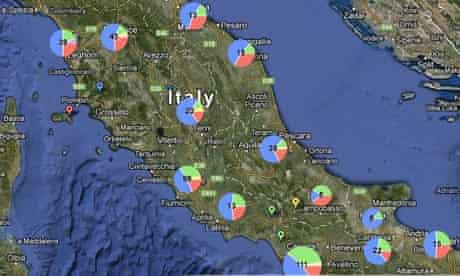
Deaths in Italian prisons from 2002 to 2012

The death sentence comes in many shapes and sizes. In too many countries, capital punishment is a State function. In Europe, France was the first country to abolish capital punishment. In 1994, Italy became only the second `abolitionist’ nation-State in Europe. But that doesn’t mean Italy doesn’t execute its prisoners.

Italian prisons are notoriously overcrowded, and the life inside is famously harsh. A 2008 Council of Europe report found the prisons “severely overcrowded”: “For prisoners, an overcrowded prison often entails cramped and unhygienic accommodation, a constant lack of privacy, reduced opportunities in terms of employment, education and other out-of-cell activities, overburdened health-care services, and increased tension – and hence more violence – between prisoners and between prisoners and staff. In addition, due to lack of adequate living space, a number of prisoners were transferred to prisons far away from their families.”

Who are the prisoners? Undocumented immigrants, drug users, remand prisoners figure prominently. Italy has one of the worst records on alternative sentencing. In Italy, you do the time, even when you’re awaiting judgment as to whether or not you’ve committed the crime.

The prisons are not just overcrowded. They are severely, even criminally, overcrowded. In January of this year, in the case of Torreggiani and Others v. Italy, the European Court of Human Rights held, unanimously “that there had been: A violation of Article 3 (prohibition of torture and inhuman or degrading treatment) of the European Convention on Human Rights. The Court’s judgment is a “pilot judgment” concerning the issue of overcrowding in Italian prisons. This structural problem has now been acknowledged at national level. The Court called on the authorities to put in place, within one year, a remedy or combination of remedies providing redress in respect of violations of the Convention resulting from overcrowding in prison.”

The prisons are not just severely and criminally overcrowded. They are fatally, toxically overcrowded. From January 2002 up to May 2012, 915 prisoners died in Italian prisons. Of that group, a whopping 518 committed suicide. That’s 56% “killed themselves.” That’s astronomical, by any standards, whether compared to the rate of the Italian general population or to other national prison populations. [The 56% suicide rate does not include death by drug overdose (26) or death “under unclear circumstances” (177). If half of those two groups, put together, actually committed suicide, then the suicide rate becomes 61%.]

Imagine a place in which, basically, 6 out of every 10 persons commits suicide. That place is the prison system of Italy. In individual prisons, the situation is actually more lethal. A map of the prison deaths reveals a great deal: “Many stories can be found by viewing the map. Most of them did not find coverage in the mainstream media. For instance, almost nobody was fully aware about the almost forty deaths of those detained in mental hospitals; or about prisoners who took a drug overdose behind bars. Some stories clash with our perceived stereotypes: nobody normally imagines that those who die in jail may be women, such as Manuela Contu and Franca Fiorini, 42-year and 37-year respectively, died of overdose in Civitavecchia in 2003. Or like Francesca Caponnetto, deceased in Messina in 2004, aged 40. Other prisoners died very young, such as a 17-year old boy, who committed suicide in Firenze, in 2009. No one knows about 50 young prisoners who died aged under 20.”

No one knows. Historically, in Italy, as elsewhere, when it comes to women in prison, the story has always been no one knows, from the first days of the independent so-called liberal nation-State to today. At the outset, women prisoners were relegated to obscure and never-discussed prisons run by nuns. No one knew. And today, when it comes to women prisoners, and especially the recently criminalized immigrant women prisoners, nobody normally imagines.

In Italy today, there is no `life inside’. Prison is a death sentence, administered through a policy of mass and collective suicide. And no one knows?

(Image Credit: The Guardian)

Texas’ Minimum Security Death Row for Women


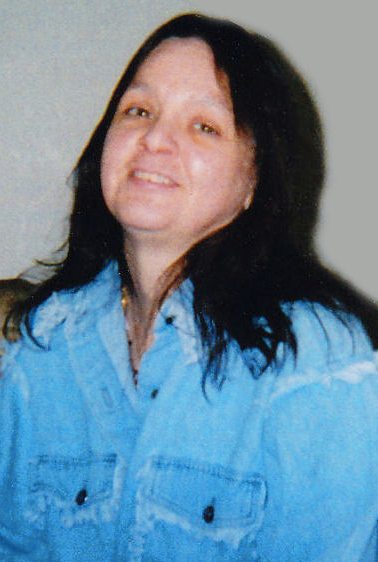
Pamela Weatherby

The Jesse R. Dawson State Jail, in Dallas, Texas, is a minimum-security prison for women. Corrections Corporation of America, CCA, runs the jail and turns a tidy profit doing so. Actually, the profit is messy and bloody. Dawson State Jail is a hellhole, literally a death trap for women.

Wendy King spent a year at Dawson. She knew that she and her sisters and her mother all have uterine problems. When she started bleeding, she called immediately for a doctor. None ever came. Ever. She bled continuously for nine months. No doctor ever came.

And Wendy King is one of the `lucky ones.’

Ashleigh Shae Parks, 30 years old, died of pneumonia. Her family, and others, say she was denied medication until way too late. Pamela Weatherby, 45 years old, died. Weatherby was taken off her prescribed insulin injections, and repeatedly went into diabetic coma. Until finally she died. Sheeba Green, 50 years old, suffered from diarrhea and difficulty breathing. Nobody did anything for a full three days. When she was finally allowed to go to the medical unit at Dawson, she lay for a full three hours before anyone even looked at her. Seven hours later, a doctor finally called an ambulance. The next day, Sheeba Green died of complications due to pneumonia.

Autumn Miller was in Dawson for a probation violation. She was in for a year. Miller knew something was wrong. She asked for a PAP smear and for a pregnancy test. She was denied. As time wore on, cramps and pain increased. Finally, one night, her pains became too intense for guards to ignore, and they took Miller down to the `medical unit’. Of course, there are no doctors at Dawson overnight, and so guards `took care’ of Miller, or, better put, took care of business.

The guards said Miller merely had to go to the bathroom, and so they gave her a menstrual pad and locked her in a holding cell. Despite Miller’s pleas, nobody came in to check, and so Autumn Miller gave birth to Gracie Miller, in the holding cell toilet. Guards then came in, shackled and handcuffed the mother, and took mother and daughter to the hospital. Gracie died four days later, in her shackled mother’s handcuffed arms.

Autumn Miller’s story is one of love and grief: “I kissed the baby and told her I loved her, and then I had to get back in the van and go to Dawson…. It’s unfortunate that it had to go this far for us to get to the point that someone noticed that something is wrong.” Her attorneys are more direct: “Autumn is traumatized and Gracie is dead.”

On Friday, Autumn Miller joined the ranks of women survivors and of families of women who died currently suing CCA and the State of Texas.

Advocates, prisoners current and former, politicians and just plain folk are campaigning to close Dawson. Others wonder, “Why is Texas’ worst state jail still open?” Why? Because the lives of women literally count for less than nothing.

Gracie Miller, Autumn Miller, Sheeba Green, Pamela Weatherby, Ashleigh Parks, Wendy King are the visible tip of an underground volcano that stretches across the United States, from sea to shining sea and beyond. These women were never meant to survive, and in many instances they did not.

Their deaths were planned. Their deaths, the harm done, the suffering were planned. Look at the books, look at the budgets, follow the money. You’ll see. Gracie Miller was never meant to survive. And she did not.


(Image Credit: Texas Observer)


Australia tortures migrant children


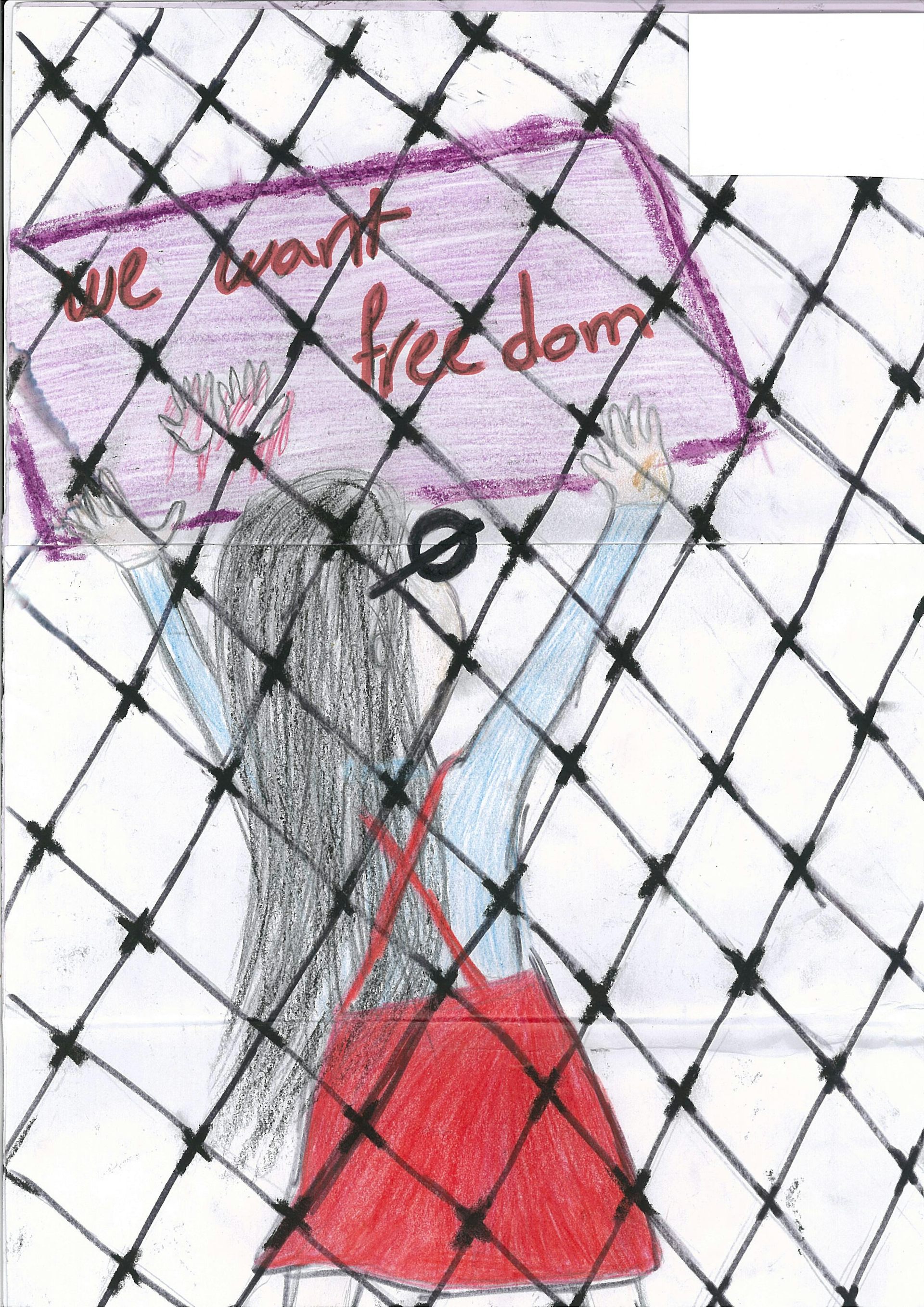
The Australian government continues to torture refugee and asylum seeking children. The State currently holds some 2000 children in detention. That’s mandatory detention for all non-citizens who arrive without prior authorization. That rule includes children. And so there is a `furor’ of  `concern’ for the well-being, and in particular for the mental health, of the children behind bars.

None of this is new, and none of it is surprising. A mandatory incarceration policy that makes no exceptions for children, and in particular for children fleeing violence and persecution, will have exactly the effects you imagine. Seemingly healthy children will engage in `self-harm’. This includes slashing one’s body and suicide by any and every means possible. Children report not being able to sleep. Children report a desperate desire to go to school, to play, to have normal children’s lives. Children report fear that they will go crazy and kill themselves. And then they kill themselves.

For girls, the situation is equally predictable. Girls are `particular’: “Girls and young women are at particular risk of gender based violence and sexual abuse… Girls and young women are particularly at risk of harm due to their sex… Moreover, girls are particularly susceptible to marginalization, poverty and suffering during armed conflict, and many may have experienced gender-based violence in the context of armed conflict.” The particularity of girls’ vulnerability emerges from both detailed and extensive research scholarship and from simple common sense. You know migrant girls, girl refugees, and asylum-seeking girls are `particular.’ So does the Australian government. What does the State do in recognition of this particularity? Absolutely nothing. Less than nothing. It intensifies and increases the pain, the torment, and the torture.

Children in low-security prisons in Pontville, in Tasmania, and in Darwin, in the Northern Territory, are falling apart. Their precariousness is not about this condition or that condition. It emerges directly from the totality of being-caged. The intensity and levels of self-harm in both locations is off the chart. Meanwhile, Australian Human Rights Commissioner Gillian Triggs has been informed that she cannot visit the refugee and asylum seeker detention camps on Nauru and Manus Islands because that would violate the sovereignty of the island nations. Australia’s massive funding of those prison camps apparently did not violate any sovereignty. Australia’s insistence on shipping off hundreds of women, girls, boys, and men to the island nations also did not violate any sovereignty proprieties. This is the way of sovereignty, the wink-wink nudge-nudge of fraternal violence.

This is why the Australian government can so easily ignore reports of sexual violence against Tamil refugees, and especially the `particular’ targeting of Tamil girls. To accept such reports would violate Sri Lankan sovereignty, and after all, the refugees and asylum seekers had already violated Australian sovereignty. That’s why they’re in prison, isn’t it? It’s a perfect circle … of hell.

Rather than `discovering’ yet again the nightmare of child detention, why not discover the simple, open alternative? Recognize and respect the particularity of girls. Take the children, all the children, far from the cages. Teach them to respect themselves and others. Help them to find peace and love. End child detention. Do it now.

(Image Credit: The Conversation)

Child prisoners lose more than their clothes in strip-searches


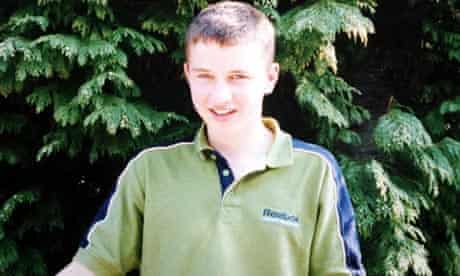
Joseph Scholes, 16, hanged himself in custody, in March 2002

Over the weekend, Carolyne Willow revealed that when it comes to the treatment of child prisoners in the United Kingdom, Charles Dickens is alive and well.

Willow looked at admittedly incomplete records for 21 months leading up to December 2012. These records cover 25 institutions, 15 child prisons and 10 `secure’ children’s homes. The children are anything but secure … in the homes and in the prisons.

In the past 21 months, child prisoners suffered 43,960 strip-searches. The real number is higher, but the State can only do so much to document its abuses. For example, “The data does not reveal what proportion of the children were subjected to intimate cavity searches.”

The numbers are actually worse than they seem, because they tend to be concentrated in some institutions and not others. So, Ashfield, a private prison run by Serco, holds a maximum of 400 boys, and performs an average of 399 strip-searches … every month.  At the other end, three of the “secure children’s homes” never conducted a single strip-search in the entire 21 month period.

Some of the children are as young as 12-years-old. Think about that. Think about a 12-year-old being forced to strip naked in front of a crew of adult strangers. Think about a 12-year-old having her clothes ripped and often cut from her body. Think about a 12-year-old being forcibly restrained while being stripped naked. You don’t have to think about. You don’t have to imagine. Here’s what the children say.

One girl said: “It makes me feel upset, embarrassed and really violating because I have been raped and it’s awful being strip-searched.” Another girl explained, “When I had my first full search I was 14, it was horrible as I have been sexually abused and I didn’t feel comfortable showing my body as this brought back memories.”

Who are these children? Forty-eight per cent of the children who were subjected to strip-searches were children from Black and minority ethnic communities. To no one’s surprise.

Ironically, or tragically, two years ago this month, the State announced the end of routine strip-searches for juveniles. Those were replaced by … necessary strip-searches? And what’s the necessity? Of 44,000 violations by the State of children’s bodies and persons, something illicit was found a whopping 275 times. The overwhelming contraband of choice was tobacco. Drugs were found 15 times. No guns, no knives, no explosives, no big deal. No need.

All of this is happening while the incarceration rates of children have actually declined. But the restraints continue, the indignities post-release continue, and the violations of dignity and person continue. Some children, like 14-year-old Adam Rickwood and 16-year-old Joseph Scholes, commit suicide, largely in response to the abuse and what it triggers.

It’s not irony. It’s tragedy. And it’s also not rocket science. It’s injustice. First, the strip-searches must stop. Without adjective. Routine. Necessary. Strip the language of its obscurantist deceit rather than strip children of their dignity and their personhood. Second, reconsider the use of prison and `secure homes’ for children. If people knew the children were going to be violated, would they send those children into the system? Would you? Remember, a strip-search takes more than the clothes off a child. It robs their dignity, their hope, their last bit of trust in adults, their last bit of trust in others more generally. It turns children’s dreams into so much trash by telling the dreamers, the children, that they are less than nothing.


(Photo Credit: The Guardian / PA / Empics)

I didn’t see malice in Oscar


Thanks, if that’s the right word, to Oscar Pistorius, the international community has once again `discovered’ South Africa, and it’s dangerous, violent, even paranoid. From various angles, the press was eager, if not desperate, to demonstrate the `typicality’ of Pistorius. Pistorius’ murder of Reeva Steenkamp has been trumpeted as highlighting something crucial about South Africa. Somehow, in all of this, Reeva Steenkamp’s typicality, or exceptionality, gets completely lost. For the media, Steenkamp’s value is as statistic and as corpse, and not much else. Successful and ambitious law student? Who cares?

What does the event `highlight’? On the bright side, Pistorius’ oh so brief imprisonment highlights the plight of South Africa’s disabled prisoners. It would be good if the world, and even more if South Africans at large, paid more attention to the conditions in South Africa’s prisons. Meanwhile, locally, some have noted that the treatment of the Steenkamp case “highlight(s) the police’s general bungling of gender violence cases.”

Pistorius’ fixation, as some have called it, with guns “highlights the violence at the heart of South Africa, a country that suffers more than 15,000 murders every year … The truth is this: guns are us.”

The murder of Reeva Steenkamp “sheds light on the humongous problem of domestic violence, in particular femicide, which is murder of an intimate partner. There are so many cases that happen on a daily bases that don’t even get reported because so many of them that have been reported have just been thrown out of court. The numbers are astounding. And so people get discouraged. They don’t — they don’t report those cases, because there’s just no real justice for women at this point.”

Not every reporter has fallen for the highlight hype nor does every reporter recognize his or her South Africa in the international descriptions, nor, by the way, in Pistorius’ self serving statements in court. For example, Globe and Mail reporter Geoffrey York noted, “Even in the most dangerous cities, gun-wielding paranoia is not nearly as common as outsiders believe… Studies suggest that 12 per cent of South Africans own guns. It’s a relatively high percentage by global standards. But it still means that the vast majority of South Africans prefer not to have guns in their houses – mostly for safety reasons, since they realize how often guns can be stolen, misused, or accidentally fired.”

As development blogger Tom Murphy noted, homicide is actually down in South Africa. Furthermore, violent crimes tend to occur in areas with high unemployment and low income, while property crimes tend to occur in areas of, well, property. This pattern is true for most of the world, and it suggests that those who live in wealthy areas have reason to protect their property, but not with lethal force.

Who’s at risk? Women: “guns play a significant role in violence against women in South Africa, most notably in the killing of intimate partners.” So, it’s Reeva Steenkamp who’s typical, whose life and death should highlight something. That of course hasn’t happened.

This sludge stew all came together the night of the murder, in an interview on PBS with Michael Sokolove, a New York Times reporter who had written an earlier, long profile of Pistorius. Here’s part of what he said:

“Oscar liked his guns. Oscar felt under threat, and South Africa is a place that apartheid is over, but there’s a terrible chasm between rich and poor, income equality, and people with money, people with homes, tend to live behind walls, behind barbed wire, behind gates with guns. And this is not a pretty thing. It is somewhat understandable, but I think Oscar’s paranoia, if that’s what it was, was not uncommon to his class in South Africa … I think that perhaps even more than our own violent society and our own gun-soaked society, South Africa society is on a hair trigger. And I think it’s fair to say… that Oscar was on high alert. Oscar was on a hair trigger. Oscar had a paranoia about who might be coming into his house … I didn’t see malice from Oscar. I didn’t see him as a violent person. I did see him as a man of action, coiled, and on a hair trigger. And that has its own dangers.”

So, that’s the story. The paranoia of the White master class explains violence. The hair trigger does what hair triggers do. High alert is high alert; `we’ are in a Code Red. And the facts be damned. What matters are the impressions, on the one hand, and the perception of malice. Because, as we know, the perpetrators of domestic violence, as of sexual violence more generally, are always recognizable. Aren’t they?

(This appeared, in slightly different form, at Africa Is a Country.)


(Image Credit: The Globe and Mail / Masi Losi / AP )


Israel’s `emergency’ stalks Ethiopian women’s bodies

According to a recent report, Israel has been administering Depo-Provera to Ethiopian women without any informed consent. At present, it’s estimated that thousands of Ethiopian women are receiving regular shots. The women never consented to receiving this highly controversial treatment. Many were never told that the shots are contraceptive, and questionable contraceptives at that.

The Ethiopian women started receiving `the treatment’ in the so-called transit camps in Ethiopia. Exactly who originated the program and who runs it now, from the camps in Ethiopia to the clinics in Israel, is under investigation.

Some women say they were told, in the camps, “No shot, no Israel.” Others say they were told it’s a flu shot.

At one level, this news is not new. In 2008, a day care center director noticed a sharp decline in the numbers of Ethiopian children. She went to the nearby clinic and was informed the clinic had been “had been instructed to administer Depo Provera injections to the women of child-bearing age.” They were merely following instructions.

In 2010, the Women and Medical Technologies Project of Isha L’Isha, or Woman to Woman, released a study, “Depo Provera: A contraceptive method given via injection: A report on its prescription policy among women of the Ethiopian community in Israel.” They noted that while Ethiopian women made up 2% of the female population in Israel, of “the mentioned 4833 cases, 2759 (57%) were women of Ethiopian origin.”

The most recent `discovery’ occurred in December of last year, thanks to a documentary made by Sava Reuben, a woman of Ethiopian origin. Reuben has been in Israel since 1984. The `nation’ was shocked. Outcry ensued.

How is one to read this tale of racial, xenophobic, sexist violence against women … all under the sheltering sky of State health policy? In Namibia, South Africa and elsewhere, women have been forcibly sterilized because they were HIV-positive. In Namibia, the women took the State to court … and won: “Non negotiable: my body, my womb, my rights”. In India, Indira Gandhi’s government, in the mid-1970’s, launched a campaign of forced sterilization. It was `the Emergency.’

It’s always `the Emergency.’ From Namibia and South Africa to India to Israel and beyond, it’s always `the Emergency’ and women always pay. Emergency is the state of the modern State. This too is not new. In 1940, Walter Benjamin wrote: “The tradition of the oppressed teaches us that the ‘state of emergency’ in which we live is not the exception but the rule. We must attain to a conception of history that is in keeping with this insight.” Almost sixty years later, Giorgio Agamben commented on Benjamin’s insight: “Walter Benjamin’s diagnosis … has lost none of its relevance. And that is so not really or not only because power no longer has today any form of legitimization other than emergency, and because power everywhere and continuously refers and appeals to emergency as well as laboring secretly to produce it. (How could we not think that a system that can no longer function at all except on the basis of emergency would not also be interested in preserving such an emergency at any price?)”

None of this is new.

What is the price of a permanent State of emergency? Ask the Ethiopian women in Israel. They’ll tell you.


(Photo Credit: Care2.com)

The women of Namibia say, “Rape is not NAMIBIAN”

We mean business, and we really are serious. We are just tired of being disempowered, being talked to like little children.”

In Namibia last week, Police Inspector General Sebastian Ndeitunga issued a ban on miniskirts. He warned women that too short and revealing clothes are not African. He acknowledged that in Namibia there’s something called a Constitution, but then went on to explain that “culture” trumps constitutional rights. He then warned that wearing clothes that are too revealing would lead to arrest.

The Namibia Press Agency reports that 40 women were arrested, over the festive season, for wearing “hot-pants.” The women were held in custody overnight and then released to their parents, with lectures on public indecency. As the Police Inspector explained, “I don’t want to prescribe how people should wear, even if it’s new fashion style, it should be within our tradition.”

While women have been threatened with arrest for wearing miniskirts, it has been noted that no men have been threatened with arrest for wearing sagging pants. Apparently `culture’ and `tradition’ only `protect’ women.

Not surprisingly, the women rejected the ban, and even more its political context, vociferously and boisterously. Women’s organizations filed protests. Women, and men, wrote in opposition. Women and men organized public demonstrations. Finally, the Inspector General claimed, predictably, that he had been misquoted. The actual arrests of women in hot pants can’t be brushed away quite so conveniently.

Namibian women understand “culture” and “tradition” and know that assaults on their clothing are never what they seem. Banning the miniskirt, of course, is itself a long and often violent tradition. Edith Head banned the miniskirt from the Academy Awards. (Somewhere Seth MacFarlane is singing, “We saw your knees”, and it’s still not funny.) At various times, the governments of Swaziland, Russia, and the Democratic Republic of Congo have outlawed or come close to outlawing miniskirts. In recent years, women wearing miniskirts have been attacked because of their attire in Zimbabwe, Malawi, and South Africa.

In each case, the women rose, organized, and attacked, because in each case, the women understood that the attack on their clothes was an attack on their bodies and themselves.

In the recent past, Namibian women have been organizing, working at the unfinished business of creating national and local democracy. Herero and Nama women have been organizing for the rights and realities of indigenous populations as they have organized to increase the presence and power and expand the rights of Herero and Nama women. Namibian women farmers have been organizing and developing sustainable agriculture political economies. And Namibian women, who were forcibly sterilized, without their consent, have been organizing, organizing, organizing, and gaining ground.

When Namibian women heard of the Inspector General’s remarks, they understood the context immediately: sexual violence. Namibian women know about the sexual harassment, violence and threats they often face, for example at taxi ranks, and they know it has nothing to do with their clothing. Namibian women know about rape and other forms of sexual assault, including what gets called “corrective punishment”. They know about the everydayness of date rape. They know about the often-limited access to sexual and reproductive health services, and the severe restrictions concerning abortion, and they know that lack of access and prohibition is part of a structure of violence against women. HIV-positive women know about the reproductive and sexual rights violations they suffer repeatedly, and in particular in doctors’ offices, clinics and hospitals. Women know they are tired partly because all matters of contraception and family planning are left to them. They take the burden and the blame.

They know all that. They know the miniskirt is a diversion, on one hand, and serious, on the other.

And they said as much at the protest rally in Windhoek:

There is no excuse to rape a woman, no excuse, no matter what she wears.”

The women of Namibia refused to be limited to a discussion of clothing, of mini this and hot that. Instead, they put the issue forward directly and squarely. As one placard said, “Rape is not NAMIBIAN.”


(Video Credit: OATV News / YouTube)

America’s seclusion rooms form a landscape of atrocity

Recently, legislators in Oregon, Arizona, and Indiana began to address so-called seclusion rooms. Seclusion rooms are solitary confinement cells in schools. They’re also called `isolation booths’, `isolation boxes’, and `behavior support’. George Orwell is alive and well, and apparently in charge in the schoolhouses of the United States.

Jared Harrison is now 12 years old. He went to primary school in Eugene, Oregon. According to his testimony, for four years, starting in first grade, he was forced into a seclusion room pretty much every day, often for hours. Further, his parents were never informed. Ever. As his mother, Jennifer Harrison, explained, “”I was never notified. I didn’t know it was happening until I walked in and found him screaming facedown on the ground with two adults sitting on top of him.”

Parents have notified the State that they’re considering a lawsuit.

Parents in Arizona are also suing the State for having put their child in seclusion for hours on end. When the child asked, begged, to go to the bathroom, he was refused. And so finally, he urinated in the cell. The boy’s mother, Leslie Noyes is quite clear on at least one point: ““It’s like five by six, padded walls, no windows.  It is definitely like a cell.” Don’t call those rooms `seclusion rooms’, don’t call them `cool-down’ spaces, and certainly don’t call them `open air rooms’. Call them prison cells.

In Indiana, parents and advocates are also saying those prison cells are not “quiet rooms” or “safe rooms.” They’re specifically not safe because no one monitors the child while she or he is in the cell. They’re simply left there, absolutely alone. That’s not quiet, that’s not safe, and that’s not education. That’s violence.

Repeatedly, the story of violence is at least twofold, and each fold intensifies the other. First, there is the forced seizure and abandonment of a child into a cell for an extended period of time. Second, there is the discovery by the parents of what has been going on. The parents and the children share in the tragedy. When the children testify, the mothers, such as Jennifer Harrison, listen by their side and weep. The violence doesn’t stop once the door to the `seclusion room’ has been opened.

This is a tale of atrocity: “[M]ore often than not, [contemporary psychiatric]’medicine’ is a complete atrocity-comparable only to the history out of which it grew: is four-point restraint-being tied down at the wrists and ankles-an improvement over being bound with chains? Is the cage inhumane whereas the seclusion room is not?”

Speak the truth fearlessly. Solitary confinement in our prisons is torture. Seclusion rooms in our schools are an atrocity. The solitary confinement of seclusion rooms comprises the social human landscape of the United States today. Close the seclusion rooms. Do it now.


(Video Credit: Dan Habib / Vimeo)