The scale of India’s “one small incident of rape”

According to India’s National Crime Records Bureau, in 2013, there were, nationally, 33,707 rape cases, up precipitously from 24, 923 in 2012. New Delhi suffered the highest incident of rape, accounting for 1,636 cases in 2013. That’s up from 706 in 2012. Mumbai, Jaipur and Pune, the next three cities with the highest reported incidents of rape, together had 754 rape cases in 2013. In 2013, in 13,304 of the reported cases, the victim was a minor. In 2012, that number was 9,082. Finally, in 94% of the cases, the offender was “familiar to the accused”: a parent, neighbor, relative other than parent, or someone else. 94%.

These numbers are beyond disturbing.

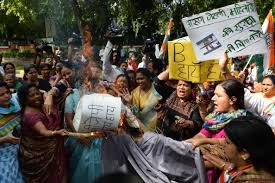
Last month, India’s Finance Minister Arun Jaitley raised a storm of protest when he reflected, “One small incident of rape in Delhi advertised world over is enough to cost us millions of dollars in terms of lower tourism.” The “one small incident” was the 2012 gang-rape and murder of a young woman, now known as the Nirbhaya case. Nirbhaya means fearless.

When protests exploded all around him, the Finance Minister regretted his words, and, of course, the ways in which they had been “misconstrued”. As witness to his recantation, the formal, published version of the Finance Minister’s talk removed the word “small.”

While the diminishment of a terrible event of violence against a woman, and of violence against women, was horrible, and according to many of the responses and critiques much worse, the reduction of sexual violence to an economic equation is equally problematic and wrong. If the `one small incident of rape’ only cost, say, a thousand dollars, would it then be fine? Would it then not be a matter of concern for India’s Finance Minister? Is finance exclusively and only a matter of hard, cold cash, and curiously that of other nations?

There are calls – from the victim’s family, from women’s groups, and from the general citizenry – for the Finance Minister to resign. It’s not enough. Words of repentance and regret are fine, but they do not suffice. Arun Jaitley is part of State power. He has been for years, both in the opposition and now in Cabinet. Let him and his colleagues say less and do more. If they feel they must talk, let them say, publically, that as members of State they take full responsibility for the 33,707 women and girls.

But the place to show real remorse is in the national budget. Invest in those organisations in India that are sisters to organisations such as Rape Crisis Cape Town Trust in South Africa, organisations made up of women and men, made up of individuals and communities, hard at work at the coalface of sexual violence. Incidents of reported rape rose 35% in one year. Raise the budget for prevention of sexual violence and for care for survivors of sexual violence by 70%. Don’t talk about the millions of dollars lost to “one small incident of rape.” Instead, invest in stopping violence against women. Be fearless.

(Photo Credit: Al Jazeera)

(This is part of a collaboration between Rape Crisis Cape Town Trust and Women In and Beyond the Global. The original, in a different version, can be found here. Thanks to the staff and volunteers at Rape Crisis Cape Town Trust for their great and urgent work.)
Irom Sharmila’s struggle against militarization and for peace


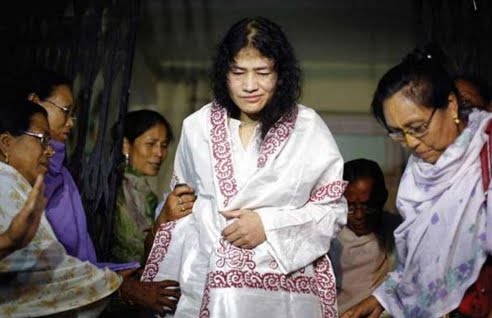
After fourteen years in “protective detention”, fasting, and being force-fed (in the name of protection), Irom Sharmila, anti-militarization and just peace activist walked away from the shackles of State protection yesterday.

On November 1, 2000, in the state of Manipur, in India, insurgents exploded a bomb as a battalion was passing by. No one was hurt, nothing was damaged. Nevertheless, the battalion retaliated, on November 2, by mowing down ten innocents standing at a bus stop in Malom. Included in what has come to be known as the Malom Massacre were “a 62-year old woman, Leisangbam Ibetomi, and 18-year old Sinam Chandramani, a 1988 National Child Bravery Award winner.” A pregnant woman was also reported as being one of the dead.

The army knew it could act with impunity. It was covered by the Armed Forces Special Powers Act, or AFSPA. AFSPA was imposed in Manipur in 1961. Much of the rest of the Northeast has been under its rule since 1972. By the government’s own testimony, tens of thousands of people have been disappeared, tortured, beaten, abused. In Manipur, this began in 1961. By 2000, it had gone for almost four decades.

Irom Sharmila decided then and there that enough was too much. On November 4, 2000, she entered into an indefinite fast, a hunger strike that would continue until the Armed Forces Special Powers Act is rescinded, the soldiers withdrawn, the people restored. She was arrested almost immediately and put into “custody” for attempting to commit suicide.

This week a judge decided that there was no evidence of a suicide attempt, and the State must release Irom Sharmila, and so on Wednesday, she walked out of the hospital, a “free woman.”

Asked about her feelings, Irom Sharmila smiled and described the air outside as “refreshing.” She then got down to business: “I will not touch food or water. I want a mass uprising on the AFSPA issue. I don’t want people to glorify me. I want them to come forward and support my cause, my protest against AFSPA. It’s a draconian law that has widowed many women, robbed women of sons, husbands and fathers. It must be repealed.”

Fourteen years ago, Irom Sharmila began a hunger strike against militarization in one part of India. Today, we see a global network of supposedly democratic, ostensibly protective militarization of everyday life, a “special powers” global factory that produces only corpses and widows and mothers in mourning in the name of security, just war, and, worst of all, peace. When Irom Sharmila left the hospital, where she’d been held for fourteen years, she walked a short distance to a tin shack, where her supporters have been camping. She wanted to spend her first day of independence in the arms of solidarity, surrounded by women. The struggle for peace continues.


(Photo Credit: The IndiAgent)

Trauma and violence have become the global school curriculum


Paballo Seane, 19, was buried recently: “Paballo Seane, 19, a Grade 12 pupil at Cefups Academy, which is on a farm 11km outside Nelspruit, died in hospital over a week ago after allegedly being sjambokked by a teacher. She was buried on Saturday in her home town, Bloemfontein, in the Free State.”

Since Paballo Seane died, or was killed, former students of the Cefups Academy have reported their memories of sjamboks as a fairly regular “pedagogical tool.” Parents are threatening to take their children out of the school, and Mpumalanga Premier David Mabuza has said if corporal punishment was used, the academy will be closed.

Will it be closed?

This is not the first time Cefups Academy has run into precisely this trouble. In 1999, Simon Mkhatshwa, the school’s founder, was convicted for sjambokking a teacher.

South Africa’s Deputy Minister of Higher Education Mduduzi Manana, a graduate of Cefups Academy, describes Simon Mkhatshwa as a “typical traditional man who believed that what must happen at school was teaching and learning and nothing else”.

Is the sjambok teaching, learning, or nothing else?

The violence done to Paballo Seane in school by a staff member is no anomaly, neither in South Africa nor around the world.

Across the United States, schools use so-called seclusion rooms, which are solitary confinement cells. Teachers are not supposed to use the rooms for punishment, but they do regularly. More often than not, the children believe that their punishment was not apt and normal, because teachers are fair and just. And so they don’t tell their parents. Not surprisingly, the majority of children are living with disabilities.

Suffer little children, and forbid them not, to come unto me: for of such is the kingdom of heaven? No longer.

And in India, in the state of Madhya Pradesh, the State Commission for Protection of Child Rights “has written to state government to make it mandatory for teachers to sign an undertaking against torture to students.” This is due to a spike over the last two years in complaints of torture of students by school staff.

Teachers need to sign a document that says they will not “undertake” the torture of students?

The gender dynamic of staff violence has yet to be studied conclusively. What is known is that the experience is traumatic, hurts deeply and lasts forever. Trauma and violence have become the global curriculum.

Last week, Kathleen Dey, of Rape Crisis Cape Town Trust, urged South Africans not to use Women’s Day, August 9, as an alibi for hiding from precisely violence against women. This week, on August 12, the world `celebrated’ International Youth Day. Think of that, and think of Paballo Seane dying under the lash of a sjambok. Think of the girls across South Africa, the United States, India and around the world who suffer violence in the one place that is meant to help precisely girls advance in this world and the next: school. Remember Paballo Seane and all the girls, and then do something.


(This is part of a collaboration between Rape Crisis Cape Town Trust and Women In and Beyond the Global. The original, very different version can be found here. Thanks to Kathleen Dey and all the staff and volunteers at Rape Crisis Cape Town Trust for their great and urgent work.)

(Photo Credit: Lowvelder)

For rural women around the world, NOW IS THE TIME!

Around the world, rural women are organizing and mobilizing, and leading agrarian movements, land rights movement, farm workers and peasant movements, and more. From the farmlands and highlands of Peru and Colombia to the farmlands of Zimbabwe and the United States, to the polling stations of India, and beyond, rural women are taking charge.

In the highlands of Peru, in Cajamarca, women are fighting to stop a multinational mining consortium from devastating their waters, lands, and lives. At the helm of this struggle are Máxima Acuña Chaupe, who began her campaign as an attempt to secure her family’s land; and Mirtha Vasquez Chuquilin, a lawyer who works for Comprehensive Training for Sustainable Development (Grupo de Formación Integral para el Desarrollo Sostenible, GRUFIDES). Together, these two women are bringing together popular forces, women’s groups and knowledge, and legal and technical skills. They combat the mining security forces as well as the mining companies’ lawyers while they also combat State security forces and other, more anonymous agents.

The risk to their lives is great, but the risk of not struggling is greater.

Likewise, in Colombia, peasant farmers are engaged in an agrarian strike that has paralyzed much of the country. At the helm of this campaign is Olga Quintero, a leader of the Asociación Campesina del Catatumbo, which was on strike last year for 52 days. Last December, two armed masked men broke into Quintero’s home. She wasn’t there, and so they bound and gagged her three-year-old daughter. Quintero’s response: “Ni el dinero ni la tierra. El miedo fue lo único que quedó bien repartido entre todos en Colombia.” “Neither money nor land. Fear was the only thing well distributed among all in Colombia.”

Her response is to meet fear with courage, hope, love, and mass organization.

In Zimbabwe, Lena Murembwe, saw a problem. Rural women didn’t know their rights to land. More to the point, rural women didn’t know they had any rights. And so Murembwe’s organization, the Women’s Resource Foundation, began giving workshops and trainings to women in their own rural districts. Widows like Lucia Makawa, 43 years old and the mother of five children, grabbed the opportunity, studied hard, organized, met with traditional chiefs, and took claim to their land. Now Makawa owns six hectares of land, and can see something like a future: “As women we were not even allowed to own a piece of land. But with support from WRF, we have managed to mobilise the support of the chiefs and we have helped solve cases where women were deprived of their right to own land. Now I have my own land and I am in the process of sourcing materials to start building structures. I also have enough space to do my farming.”

Other women, such as Beulah Muchabveyo, studied, learned their rights, and organized to create a dignified, safe space for themselves: “In the past my husband was not treating me as a person at all. He was abusive and never helped with farming work but expected me to give him money after selling our produce. Things are now different in my family after I underwent training in gender and human rights. The training has also given us a platform to meet and discuss issues affecting our lives as women.”

These women know and teach: there is power in knowledge, in union, and in organizing.

In India, as the elections proceed, there’s unprecedented movement among rural women, and unprecedented discussion of `what rural women want.’ What do rural women want? Everything! Rural women say they want public dialogue. They want to be heard. They want a say. They want respect and dignity. They want decent jobs, education, health care. They want an end to violence against women and girls. They want an end to violence. They want an end to predatory lending that targets rural populations and often sends them headlong into bondage or death. They want their own representatives – like Dayamani Barla or Soni Sori – and their proven allies, like Medha Patkar, in Parliament. They want the State. They want democracy. They want it all.

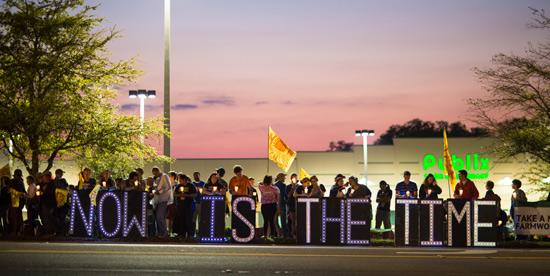
And in the United States, the women of the Coalition of Immokalee Workers want it all as well. When women in the tomato fields of Florida, women like Lupe Gonzalo and Isabel, organize for farm worker’s rights and dignity, they put the struggle to end sexual violence and harassment front and center. They say they cannot wait til after the vote, after the contract, after the revolution for their bodily and spiritual well being to become `an issue.’ They say now is the time.

From Peru and Colombia to Zimbabwe to India to the United States, and beyond and between, rural women, peasant women, women farm workers are organizing intensely because their lives matter urgently: NOW IS THE TIME!

(Photo Credit: Forest Woodward / Facebook)

At least 254 poor Indian women die in clinical trial. `Predictably nothing was learned’

Over the past fifteen years, at least 254 Indian women died in a clinical trial, and the response from the critical scientific community is, “Predictably nothing was learned.” Sadly, something was learned, and it’s precisely the market value of a poor Indian woman’s body.

For the past fifteen years, US National Cancer Institute (NCI) and the Bill and Melinda Gates Foundation funded a study that involved 363,553 women from the slums of Mumbai, and from villages in Osmanabad in Maharashtra and in Dindigul in Tamil Nadu. These women are variously described as “women from modest backgrounds,” “women of the lowest socioeconomic status”, “women from the most marginalised sections of society”: “those screened were chosen for their poverty and ignorance because they would come cheap and be amenable to being used as guinea pigs without knowledge of possible consequences.”

The study divided the women into two groups, in order to compare cervical cancer death rates. The larger, luckier group of 224,929 women was offered cervical screening. The other group of 138,624 was offered no screening whatsoever. At least 254 poor, poorest of the poor, women in that second group died of cervical cancer.

Three years ago, discussing another clinical trial, Satinathi Sarangi, of the Bhopal Group for Information and Action, noted, “These are people with no other options, people with reduced autonomy. . . India is increasingly becoming a colony of U.S. corporations.”

From Bhopal to Mumbai to the villages of Maharashtra and Tamil Nadu, and beyond and between, the colonization continues. This is merely the most recent in a series of clinical trial `scandals.’ Last year, India’s Supreme Court heard a case involving Gardasil, PATH, and poor, dead girls in rural Gujarat and Andra Pradesh. This year’s scandal involves a different locale and the same population, poor girls, poor women.

And the discussion always ends up focusing on `ethics’, `corruption’ and `conflict of interest’. That’s a reason the discussion never gets anywhere. Framing the issues as ethical presumes that ethics was ever a part of the operation. It wasn’t, and it isn’t.

When critics argue that the latest clinical trial actually may have impeded the development of “indispensable, lifesaving public health infrastructure,” there can be neither surprise nor contradiction. The same industry has forsaken research into cheap cancer curing drugs for the more lucrative long shots: “What is scientific and sexy is driven by what can be monetized, and that becomes the norm.”

From Mumbai to Manhattan, the message is clear: monetization becomes the norm. From the economies of manufacturing and sales to the economies of research and development to the economies of clinical trials to the economies of health, the name of the game is intensifying extraction of value from women’s bodies, turning health, illness, and death into investment opportunities.

254 poor Indian women died, and here’s the lesson: You can always further monetize poor women’s bodies. You can always further monetize poor women’s illness. You can always further monetize poor women’s deaths. You can always get away with murder … if the dead are poor women, and especially poor women of color.


(Image Credit: Times of India)

Devyani Vs. Sangeeta: Domestic Workers’ Rights

Sangeeta Richard

The recent strip search, including cavity search, of a female Indian diplomat, Devyani Khobragade, in New York, raised a hue and cry in India. Prime Minister Manmohan Singh, including much of the administration and the public, denounced the U.S. act as demeaning, primarily because a body search of a female is considered dishonorable by Indians for it brings shame upon the woman, her family and the country, and secondly the Indian court would not consider a salary issue between an employer and her maid tantamount to a crime that necessitated a strip search.

But we need to look at some underlying blind spots this issue glaringly reveals:

1. While Devyani’s experience of undergoing a strip search is demeaning, I believe that such a treatment of any woman in the U.S. who is in police custody or in customs/immigration, whether the crime is unremarkable or severe, as unacceptable. We have not protested enough about strip searches of women especially since such searches are now placed within the umbrella of security and anti-terrorism jurisdiction.

2. While there is now a history of protest to raise minimum wage in the U.S. and the pay discrepancy between men and women is a hot button issue, brought to light by the Lilly Ledbetter bill signed by President Obama in 2009, enforcing this in reality has been tough. But many grassroots movements, such as Working Families and Occupy, are making their mark in trying to make employers conscious of pay gaps and inequities. While Devyani’s lawyer may argue that she has done everything legal under the contract with the maid, Sangeeta Richard, nevertheless, the reaction of the Indian government and a mortified public brings up the fact that Indians have internalized the notion that since most of middle class has maids and there are no unions to protect their wages or their treatment, that there is nothing shocking in the continuation of this practice when domestic workers work in Indian households locally or abroad. The protest about wages and treatment of domestic workers both local and migrant is heard loudest only among feminist organizations. Governments have not taken it seriously; there is no proper jurisdiction regarding wages for domestic work, therefore the issue prevails in the shadows.

3. The irony of the Devyani case is that Devyani is Dalit herself—the oppressed class in India’s caste system. The Dalit movement began during the time of India’s nationalist movement for Independence from British rule. Although the reservation system (similar to Affirmative Action) was put in place to address the rights of the underprivileged castes in the caste hierarchy, nevertheless the oppression of Dalits continues. Devyani’s family is Dalit, but well to do, and she is a diplomat employed by the Indian government. It is indeed a lesson in the nature of oppression to see one who has risen to a privileged position in terms of economic class and status to pay a low wage to a woman she hired to work in her household. Of course, since this act is an allegation until proven, and Devyani may after all be innocent, nevertheless this case brings to light two questions: Should foreign diplomats be allowed to get away with anything because they have diplomatic immunity? Should the U.S. use cavity search and strip search on women in immigration violation cases? How can we separate wage issues from labor trafficking cases, since labor trafficking is another charge brought against Devyani? How can we take personal responsibility to make sure someone we know is not being paid below minimum wage?


(Photo Credit: Times of India)

Labor, Migration, and the Movement to Stop the Traffic in Women

The traffic in women (or sex trafficking, as it is usually called) has gained central attention in the humanitarian world of nonprofits and nongovernmental organizations. The emergence of sex trafficking as the ultimate humanitarian crisis has led to an uncritical, melodramatic discourse. Governmental and non-governmental organizational rhetoric posits women and children as the main protagonists in a tale of capture, rescue, and redemption. Slogans such as “Free the slaves,” “End slavery,” and the authenticity-promising  “Sex trafficking through the eyes of survivors,” prod audiences to learn about human trafficking and embark on rescue campaigns, by donating to anti-trafficking causes or by founding anti-trafficking NGOs.

Human trafficking (sex trafficking included) is a serious problem. What is unrealistic and uncompassionate is anti-trafficking activists’ presentation of trafficking in a political and economic vacuum, and the resultant erasure of capitalist socioeconomics, including labor migration and trade globalization. The Asia Pacific Network of Sex Workers (APNSW) sums up the problem best: “Don’t talk to me about sewing machines. Talk to me about workers’ rights.” The slogan refers to the frequent brothel raids undertaken by western humanitarians, raids that result in the so-called rehabilitation of sex workers as employees in the textile industry. Rejecting their easy subsumption under the logic of capitalist accumulation, sex workers mobilize the language of rehab only to reinvest it with their own struggles as workers and women living in deeply racialized and inequitable local and global economies. The APNSW re-channels the trafficking conversation into debates about labor exploitation, in the process recognizing sex work as a legitimate part of the labor sector, as well as situating human trafficking in the broader context of work migration.

So who are the sex trafficked? According to most anti-trafficking activists, the story is simple: the sex trafficked are non-western women and children coming from poverty-stricken places and desperate to move west for a better life. Enter pimps, traffickers, and organized criminal groups who pry on desperation and poverty. The poster child of anti-trafficking campaigns is the naïve and innocent young woman or girl — unfamiliar with capitalist transactions and ignorant of the perils of immigration — beaten into prostitution, her body a living testimony to the cruelty and inhumanity of the sex industry. The reality of migration is messier and less straightforward. As scholars and activists Laura Augustín, Jo Doezema, Kamala Kempadoo, among others, have shown, women migrate for a variety of reasons (poverty being only one of them) and go through a variety of situations that rarely resemble the absolute captivity envisioned by mass media.

The easy equation of sex trafficking and sex work jeopardizes anti-trafficking initiatives. Sex workers, not anti-trafficking activists, are more successful at fighting forced prostitution. The Durbar Mahila Samanwaya Committee in Sonagachi, the largest red-light district in Kolkata, India, is a network of sex workers who take upon themselves to locate underage sex workers or those workers who are in the trade against their will. Committee’s success in removing sex workers forced into prostitution should represent a lesson for the anti-trafficking movement. Despite evidence to the contrary, however, anti-trafficking scholars and activists  continue to discount sex workers as reliable allies in the fight against human trafficking.

The misguided conflation between trafficking and prostitution has had serious effects on AIDS prevention programs. The U.S. President’s Emergency Plan for AIDS Relief (PEPFAR requires all organizations that receive PEPFAR funding to oppose prostitution and trafficking, both seen as equally oppressive. This anti-prostitution pledge has had negative effects, such as forcing the closure of AIDS prevention programs geared towards sex workers. In 2013, the U.S. Supreme Court struck down the provision as unconstitutional.

Equally pernicious are the law enforcement and rescue paradigms that characterize current approaches to sex trafficking. In 2004, the U.S. Secretary of State, the Secretary of Homeland Security, and the Attorney General created the Human Smuggling and Trafficking Center (HSTC), a center that brings together officers and investigators from the FBI, CIA, and the Homeland Security to combat the traffic in women. The makeup of the Center mirrors the State Department’s punitive anti-immigration approach to human trafficking. The law enforcement approach relies on raids of red light districts and indiscriminate arrests of sex workers. The migrant women rescued during these raids have two options: return to their countries or testify against their so-called traffickers.  Following the 2000 Trafficking Victims Protection Act, Section 103.8, women must also prove that they suffered “severe forms of trafficking” in order to qualify for the T-Visa that enables them to remain in the United States.

Returning to the APNSW, one is puzzled by the exclusion of issues of labor and migration. What would change if activists were to heed the APNSW slogan and consider the rights of women as workers in a globalized capitalist economy. What if anti-trafficking activists acknowledged the fight of migrant women and sex workers for decent work, respect, and social inclusion? While this alternative is unlikely to dominate the anti-trafficking community too soon, the prospect of a justice paradigm centered on labor and migration will continue to inspire migrant workers, sex workers, and their allies.


(Photo Credit: Twitter / Lela Who)

Biopolitics, and business as usual, in India

The clinical trial is a form of neo-imperialism. Heralding modernity under the banner of science, the West makes the Third World its guinea pig to promote scientific innovation. It exists as the sovereign power, which controls the lives of developing countries, exercising a right over life and death through imperial and capitalist measures, and taking advantage of another’s need for self-empowerment/ perpetuation. The Indian layperson is exploited with the rise of clinical trials, and the body, deprived of its humanity, becomes an instrument to promote political interest; scientific advancement is made at the cost of human life.

In Over 2,500 Deaths During Indian Clinical Trials, Ranjita Biswas disparages clinical trials. She argues clinical trials in India lack standard protocols and unethical practices are rampant in the Indian drug industry. SAM, a health rights forum, draws a petition for transparency in the clinical trials, appealing for equal compensation to participants and informed consent from participants. Chinmoy Mishra, the coordinator of SAM extrapolates: “We are not against clinical trials in the country. But there should not be exploitation of participants. Human life is precious.” What exactly is the value of human life?

Clinical trials exploit the disadvantaged, whose lives are bought for experimentation: after all, who would want to die for the sake of scientific advancement alone?  The rhetoric of “transparency”, “equal compensation”, and “informed consent” rings hollow as it strives to justify the worth of human life in the market. The Supreme Court’s decision to ban clinical trials until the government comes up with a “‘foolproof’ mechanism to regulate experiments”, would probably suspend the deaths resulting from clinical trials, subsequently interrupting scientific development– but for how long? How would India progress/regress if it completely banned clinical trials? How does the political body use the personal body for its advancement? Can there be a “foolproof” mechanism at all for a health experiment? These are some of the pressing questions we need to ask ourselves.

Health rights forums, such as SAM, fix a price tag on the human species and strive in good faith to educate the participants and prevent them from capitalist exploitation. But conversely, such health rights forums work in favor of capitalism by quoting a price for health. It is not “transparency” that SAM champions—it is business. By ascribing health rights to humanity, organizations tend to overlook the disadvantaged position of the participant who is ready to trade health for monetary fulfillment.

Several unacknowledged guinea pigs must die before an experiment succeeds. Unfortunately, science has to feed on human health for the advancement of welfare. Clinical trials queer the individual in complex ways, combining personal and political interests to exploit the body and de-humanize humanity.


(Photo Credit: The Times of India)

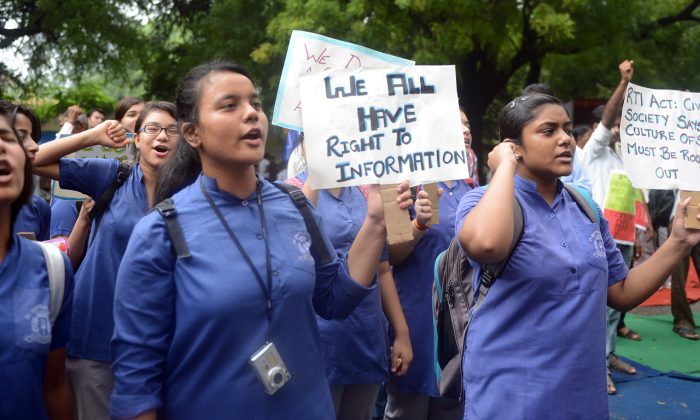
The Right to Know is the Right to Live … in a democracy


In the late 1980s, three activists – Aruna Roy, Shankar Singh and Nikhil Dey – moved to a village in Rajasthan, in the northwest of India, and set out to live by Gandhi’s precepts. The plan was simple, ie to live simply. Out of that simple plan emerged, first, the “people’s organization” Mazdoor Kisan Shakti Sangathan, “Movement for Workers’ and Peasants’ Power”, or MKSS. MKSS has been at the forefront of India’s Right to Information, Right to Work, and Right to Food movements, and they’ve had a stunning record of accomplishments, based broadly and deeply in the works and days of poor rural women.

What Roy, Singh and Dey found in Rajasthan is common enough. An agricultural zone, mostly single crop, relied on rain for survival. When the rains didn’t come, as happened often, the men went off to find work and the women stayed behind. The men sent money, but it was seldom enough and irregular. So, the women had to find work and wages where there was none.

And so the women of Rajasthan organized, with and across the MKSS, and with Aruna Roy pulling, pushing, leading, following, listening, talking, organizing. After a long and mighty struggle, they won. In 2005 the Indian government enacted the National Rural Employment Guarantee Act, or NREGA. NREGA assures rural workers 100 days of paid employment, at minimum wage, in every fiscal year.

It was a major victory, especially for rural women. The only problem was wage theft and general corruption on the part of employers, both private and State. Again, what happened in Rajasthan is a common enough story. The women rejected and rewrote the master narrative.

They understood that the Right to Know is the Right to Live. They understood that part of their suffering and super-exploitation came from the fog at the contracts’ end. And so, under the banner of MKSS and with the leadership of Aruna Roy, they pushed. They rejected their `destiny’ of ignorance and submission, and demanded to see village records. And, again, they won. They won the right to know and the right to live.

Today, across Rajasthan, the information is in plain sight … literally. Across hundreds of thousands of walls, village governments are required to paint all of their budgetary decisions and contractual arrangements. It’s some of the best and most exquisite graffiti in the world.

Aruna Roy and her colleagues didn’t stop there. Once the information was available, they pushed for social audits. According to the Indian government, “Social Audit is an independent evaluation of the performance of an organisation as it relates to the attainment of its social goals. It is an instrument of social accountability of an organisation. In other words, Social Audit may be defined as an in-depth scrutiny and analysis of the working of any public utility vis-a-vis its social relevance. Social Auditing is a process that enables an organisation to assess and demonstrate its social, economic and environmental benefits. It is a way of measuring the extent to which an organisation lives up to the shared values and objectives it has committed itself to. It provides an assessment of the impact of an organisation’s nonfinancial objectives through systematic and regular monitoring based on the views of its stakeholders. Stakeholders include employees, clients, volunteers, funders, contractors, suppliers and the general public affected by the organisation.”

Who are stakeholders? Everyone … equally. That’s the women’s point. 100 days of employment is neither charity nor welfare. It is part of shared values and objectives, and it’s not lodged in some impossibly complex cloud. It sits right in front of everyone, and everyone can and must evaluate its social relevance.

The social audit is, or can be, democracy in action. For MKSS, it involves obtaining information, through participatory research, and then holding meetings in which all stakeholders attend, and then finding out what’s going on and whose responsible. The State of Andhra Pradesh has led the way in social audits, training and sending out thousands of researchers to engage with millions of residents, often door-to-door. The program is now being considered for national implementation.

At some level, all of this began with three people moving to a village in order to follow Gandhian precepts. At another, it’s about the feminist Aruna Roy and the millions of rural women, first in Rajasthan and now across the country, who refused to be left out or written out, who organized, over decades, for a feminist understanding of democracy as a shared social engagement that is open and available to scrutiny and intervention. The Right to Information is the Right to Live … in a democracy.

(Photo Credit: RAVEENDRAN / AFP / Getty Images / The Epoch Times)

Daughter of darkness

Germane a ‘Poona girl” travelled many a path to find the one she sought –relevance. From joining the mission of healing with the Medical Mission Sisters, to moving out of their institutions to work with a Jesuit missionary in the Santhal Adivasi homeland, to moving further out into the forest of Hazaribagh in Jharkhand where she finally settled to work and be one with them in revered relevance.

In the twenty odd years we knew each other we could meet on not more than three or four occasions. Yet I remember well that we never exchanged more than a few dozen words. But she conveyed enough for me to know her more deeply than she probably guessed.

Stubbornly determined she stuck deep there to serve a people being dispossessed and pauperised by the outside world. To empower them she built a school, a boarding, a chain of health clinics and microcredit groups for women.

Silly enough to risk her own health needs that finally shortened her precious life she died on 5th April 08. At her funeral as I stood in that deep forest experiencing such glory such bonding and such blindness of the religion of my birth, I just could not help penning these feelings on the blackboard of my mind. I owe this to her – the one who may never be remembered in history (and I am sure couldn’t have cared less), but who went on to make it………

Daughter of darkness[i]

 Unseen she just wanted to be
Detached, silent, from us –her we
In search of love
She went aground
And grew a tree with fruits of love

No trumpets, no fuss, no flatter
A messenger minus the clatter
Their being, was all she lived to be.
Their flesh, their word, their humanity
Enliven with her humble humility
One with them in their eternity

For Sarhul[ii], she called us all.
“Come, Come ye all”
“Partake of the Mahua[iii] fall”
“Spring has come and so has my call

Covered by a dense crowd
There she hid
Peeping though heaps of shroud[iv]
A teasing wink, yellow turmeric paste,
Her beautiful brown face
Was all she bared in that haste

And then they came en masse
To rescue her back, after mass
A mass, so genuine and germane
From the concluded ritual profane
One people, one body, hoisted her
It just couldn’t be any grander
Such attention she once detested
Now in slumber she just couldn’t resist it
Yelling multitudes marched in rounds
Drummers, trumpeters around the grounds

No Saints go marching here
No heaven’s inn to get in
No burning hell too to fear
As saintly women anointed her
To be their new ancestor

Xavier Dias 6th April 2008


[i] The Adivasis of Jharkhand have been an unacknowledged people and kept in the darkness of any human rights.

[ii] The Santhal festival of spring

[iii] A beautiful spring flower of the Mahua tree a staple food as well as used to make alcohol.

[iv] The number of shrouds people brought to cover her on her final journey was overwhelming