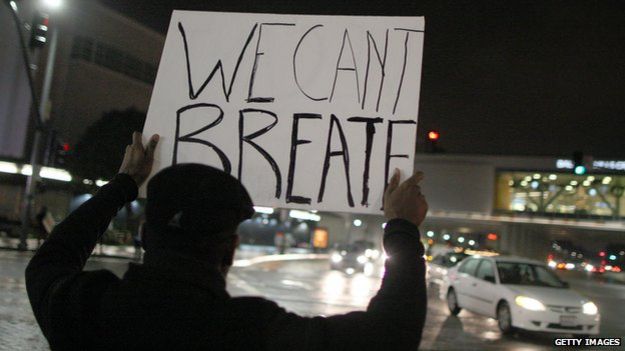
You’re killing me. I can’t breathe.

Many murals will emerge bearing the words, “I can’t breathe.” Maybe one of them will show Charles Jason Toll, Jimmy Mubenga, and Eric Garner, brothers in arms, tender comrades in a war they never declared but which killed them nevertheless. Perhaps another will show Jane Luna, Adrienne Kambana, and Esaw Garner and their combined struggle for justice.

Charles Jason Toll, Jimmy Mubenga, Eric Garner all died, or were killed, by `criminal justice officers.’ In each case, according to witnesses, they repeatedly said, “I can’t breathe.” In all three cases, coroners concluded the death was a homicide. In the cases of Charles Jason Toll and Eric Garner, those charged were acquitted. The trial for those involved in the death of Jimmy Mubenga is going on right now.

2010: Charles Jason Toll was 33, diabetic and living with mental illness. One hot August night, in Riverbend Maximum Security, in Tennessee, where Toll was in solitary confinement, guards rushed into his cell, pushed him to the floor, handcuffed and shackled him. When he repeatedly begged, “I can’t breathe”, he was told, “You wanted this.” A little while later, he died. Toll was in prison for a parole violation. Why was he in solitary? Why did no one in charge know his medical history? Part of Charles Jason Toll’s story is the vindictive system in which a slip can send you down a hole from which there is no escape, and for which there is no accountability. Toll’s mother, Jane Luna, is suing Tennessee for having killed, and tortured, her son. Jane Luna didn’t even know her son was arrested until she received notice of his death.

2010: Jimmy Mubenga had fled Angola and gone to England seeking asylum. According to his wife, Adrienne Makenda Kambana, he was on a government hit list, “They killed my father and they threatened to kill Jimmy. They were looking for him. We had no choice but to leave.” On October 12, 2010, having lost his last battle for asylum in the UK, Jimmy Mubenga boarded a plane for Angola. Within 50 minutes on the plane, he was dead.

Witnesses report that the guards, G4S private deportation `escorts’, jumped on Mubenga and throttled him to death.  Escort deportation has become big business. This week, in court, witnesses on the plane testified that they could hear Jimmy Mubenga screaming, “You’re killing me” and “I can’t breathe.” Passenger David Brown was sitting 15 rows from Jimmy Mubenga: “I could hear that things were still happening. I could still hear him saying ‘I can’t breathe, I can’t breathe‘.” Brown said he heard Mubenga scream and, again, cry, “I can’t breathe.” When Brown spoke to the guards, one responded: “He (Mubenga) is OK, once we take off he will be all right. He is on his way home.”

He is on his way home but he is not quite there yet.

In July of this year, Eric Garner repeatedly said, “I can’t breathe, I can’t breathe,” as a police officer ignored and held him in an outlawed chokehold. Garner died, speaking those words. When Eric Garner’s widow, Esaw Gardner was asked if she accepted the apology of the man who killed her husband, she replied, “Hell no. The time for remorse for the death of my husband was when he was yelling to breathe.”

This is what happens when prisons become zones of abandonment, including abandonment of any rule of law or sense of humanity, and then the streets become extensions of prison. When almost nobody can breathe – Black men, Latinos, Black women, Latinas, Native men, Native women, working people, youth, those living with mental illness, elders, the poor, the homeless, trans women, trans men, lesbians, gay men, those living with HIV, `heavyset people’, diabetics, asthmatics, women on the streets `at the wrong time’, people with shadows, people without shadows – when almost nobody can breathe, the time for remorse is over. I can’t breathe. You’re killing me.


(Photo Credit: Getty Images)
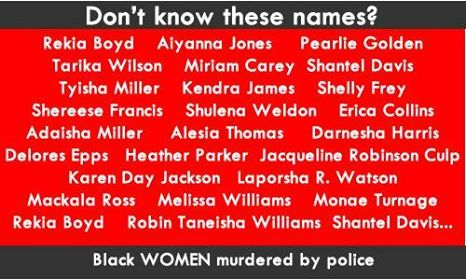
They were never meant to survive

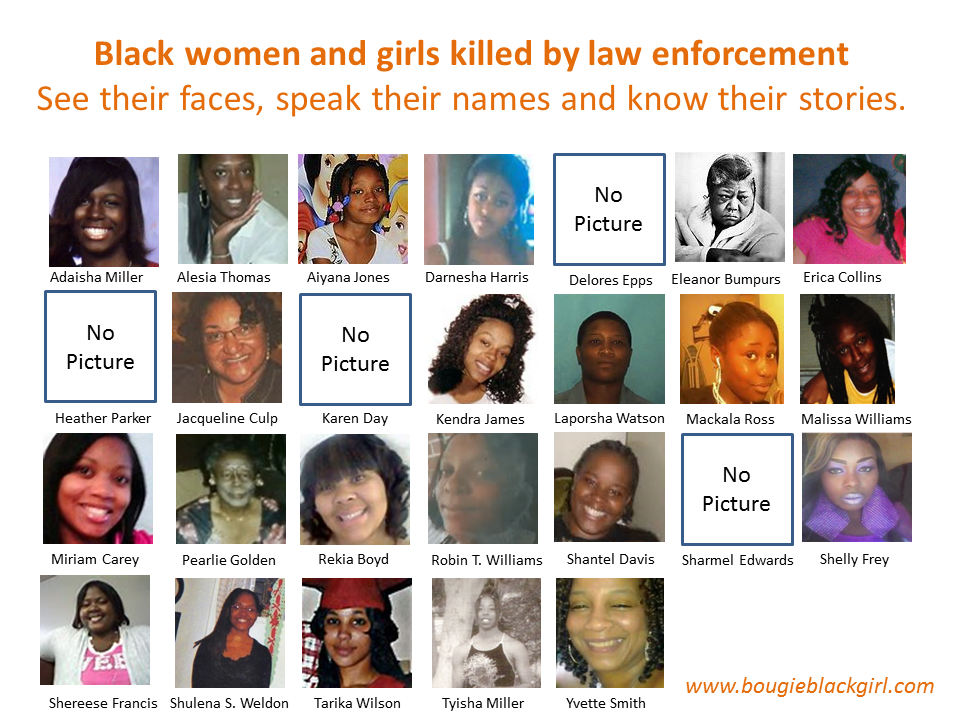
Do you know these Black women’s names? They are part of a national tradition, from sea to shining sea. And this is only a very partial list.

Yvette Smith (Bastrop, TX) 2014: Bastrop woman’s family, friends say she was unarmed when she was killed by deputy

Miriam Carey (Washington, DC) 2013: Her name was Miriam Carey

Malissa Williams (Cleveland, OH) 2012: Deadly police chase from Cleveland into East Cleveland brings questions, leaves families sorrowful

Rekia Boyd (Chicago, IL) 2012: Off-Duty Chicago Police Officer Shoots Couple On Chicago’s West Side

Shantel Davis (New York, NY) 2012: The Shantel Davis Story Ignites Protests in Brooklyn

Shereese Francis (New York, NY) 2012: Did The NYPD Suffocate a Mentally Ill Woman To Death While Trying to Cuff Her?

Aiyana Jones (Detroit, MI) 2010: How a Police Officer Shot a Sleeping 7-Year Old to Death

Tarika Wilson (Lima, OH) 2008: Police Shooting of Mother and Infant Exposes a City’s Racial Tension

Alberta Spruill (New York, NY) 2003: Woman Dies After Police Mistakenly Raid Her Apartment

“So it is better to speak
remembering
we were never meant to survive”

Audre Lorde, “A Litany for Survival”, The Black Unicorn

They were never meant to survive.


(Image Credit: BougieBlackGirl.com)

Pregnant women refugees Maryam and Tahere refuse Australia’s prisons

Maryam and Tahere, two Iranian women, each heavily into the eighth month of pregnancy, are spending a third night on a bus outside the Wickham Point Detention Centre, in the blistering heat of Darwin, in the Northern Territory of Australia, Australia’s refugee detention capital. They refuse to get off the bus and subject themselves to the indignities of the Australian prison system. Their story is the latest chapter in Australia’s shameful trade in refugees and asylum seekers.

Maryam and Tahere are Iranians who, with their families, have spent the last fifteen months in detention on Nauru. The Australian government found them to be `credible’ refugees, and so were “resettled” within Nauruan communities earlier this year. When their pregnancies turned out to be too complex for the hospital on Nauru, they were flown to Australia … where they were put on a bus headed for the detention center. Their families offered to pay for a motel in the area, and the authorities refused. Apparently, the women are more valuable as `guests of the State’ than on their own. And so the women said, “Enough. No more. No!” They refused to leave the bus and enter, or better re-enter, confinement.

No good news comes from inside the walls of Wickham Point. At the beginning of the year, it was the focus of a campaign protesting the humiliating treatment of women asylum seekers and refugees. The treatment of asylum seekers in Wickham Point is often called dehumanizing, inhumane and shameful, and each report highlights the particular indignities that women are forced to undergo. Suicides, such as that of Haidar Ali Ikhtiyar last year, and self harm, such as that of the 17-year-old woman asylum seeker who jumped from a second story window three months ago, are regular features at Wickham.

Maryam and Tahere may or may not know the details of what’s been transpiring at Wickham Point, but they know. They know it’s a bad place. They know they deserve better. And so they have said, “Either take me to a hospital here or ship me back to Nauru. Better a hellhole than this.” They know. They know that the desperate one here is the State, desperate to incarcerate and cage by any and all means. And they say, loudly and clearly, No!

No good news comes from inside the walls of Wickham Point Detention Centre, but perhaps something like good news will come from outside the walls, the news of women’s refusal and of women’s insistence on their dignity.


(Photo Credit: Refugee Action Coalition)

End the epidemic of mass incarceration of women!


Once again, the celebration of Thanksgiving, in the United States, coincides with the 16 Days of Activism to End Violence Against Women. One way to acknowledge that intersection could be to address the place of mass incarceration of women. The New York Times lead editorial today, “Mass Imprisonment and Public Health”, argues that incarceration has reached epidemic proportions, and, they insist, when they say “epidemic”, they mean that as literal, not figurative. Nebraska legislators this week heard that, in their state, prisons and jails have become the leading institutions for health care provision for those living with mental illness: “In Nebraska, the Douglas County Jail holds the most mentally ill people.” The legislators heard of the mental illness of people as they enter prison and jail, and they heard of the mental health crises engendered by rampant use of solitary confinement. In Boston, on Tuesday, when over a thousand people marched in solidarity with Ferguson residents and protesters, they marched to the South Bay House of Corrections, chanting, “Black lives matter!” and “We see you!”

We see you. Where are the women in this vision?

On Tuesday, inmates at Fluvanna Correctional Center for Women reached a settlement with the Virginia women’s prison. In 2012, five prisoners, represented by the Legal Aid Justice Center, sued the prison, claiming that the medical care was so bad that it violated the U.S. Constitution’s ban on cruel and unusual punishment. Last week, a Federal judge extended the suit to a class action suit, covering all 1200 prisoners. The judge also ruled that hiring a contractor doesn’t absolve state prison officials of their responsibility to provide adequate health care. He further ruled that the women had serious medical needs. When the State heard that, they caved, and the settlement ensued.

What’s going on here? A Vera Institute report issued last week gives one version, under the title GREATER HEALTH DISPARITIES FOR WOMEN: “The number of women imprisoned in the U.S. increased nearly 6.5-fold from 1980 to 2010. Today, women comprise about 7 percent of all prisoners and 13 percent of all local jail populations, and face a greater burden of disease than incarcerated men, which is partly explained by disturbingly high rates of sexual victimization, substance use, and trauma. An estimated 6 percent are preg­nant, with the majority having conceived within 3 months of release from a prior incarceration. A significant percentage of these women have not seen an obstetrician on a regular basis prior to incarceration and are in unhealthy states due to substance use and malnutrition prior to entering custody. While a structured environment, regular meals, and access to care can improve birth outcomes, according to a recent survey, state prisons often fail to use best prac­tices and established standards when caring for pregnant women.”

Additionally, “Today, about 14.5 percent of men and 31 percent of women in jails have a serious mental illness, such as schizophrenia, major depression, or bipolar disorder, compared to 3.2 and 4.9 percent respectively in the general population … Women experience higher rates of sexual victimization than men. A 2008 survey found three times as many females (13.7 percent) reported being sexually victimized by another prisoner than males (4.2 percent); and that twice as many women reported being sexually victimized by staff.”

All of this happens under the title of “correction.” What exactly is the State “correcting” when it violates women’s rights, bodies, lives, hopes and dreams, and does so without compunction? What is the public policy here that condemns women on the basis of their gender? Want to end violence against women? End the epidemic of mass incarceration of women. Do it now.


(Image Credit: Vera Institute of Justice)

Women cleaners and domestic workers confront violence against women

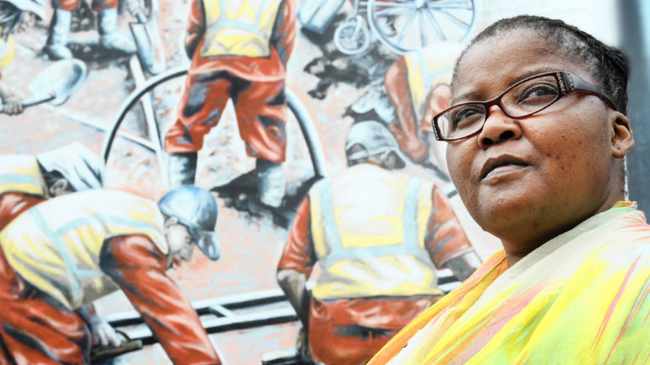
Gloria Kente

From Hong Kong to Qatar to Greece to the United States, domestic workers and women cleaners are under attack. They are under attack because they are women. In South Africa this year, domestic workers and women cleaners have confronted the attack head on.

Delia Adonis works as a cleaner in a mall in Cape Town. Last month, Adonis saw five men attack a sixth. She called the police, who intervened. She then went to the parking lot, where the five men encircled her, knocked her to the ground, and beat her. Throughout the assault, the men used racist and sexist epithets.

Adonis called the police and laid charges on the five men. It turns out they’re UCT students. Adonis claims that the police came to her and offered her money to drop the case. The officer allegedly said that the men were afraid of being kicked out of school. Adonis rejected the offer, and all it represented: “I’m really angry about this. I’m traumatised and still in pain. These youngsters verbally abuse us every weekend, and now this? I’m a mother of six – how would they feel if someone beat up their mothers like that? There was so much blood pouring from my face I couldn’t see. When I washed my face. I just thought to myself: ‘Boys, you can run but I leave you in the hands of the Lord’.”

Cynthia Joni works as a domestic worker in Cape Town. One morning, Joni was walking to work, when a white man leapt out of his car, slapped and threw her to the ground. She screamed, and he drove away. He was later identified and charged. His `explanation’ was that he mistook Cynthia Joni for a sex worker and `snapped.’ To no one’s surprise, it turns out that Cynthia Joni is not the first woman he’s assaulted. Now others are coming forth.

While the toxic mix in both the physical violence and then the subsequent violence that passes for explanation are important, the women’s response is more important. Domestic workers, sex workers, women workers reject the violence and call on the State to address it … forcefully and immediately.

Gloria Kente is a live-in domestic worker in Cape Town. Last year, her employer’s then-boyfriend got angry with her, allegedly grabbed her, spat in her face, and screamed a racist epithet at her. Kente called the police and had him charged with both assault and a violation of her human and civil rights. She called him out for hate speech and harassment. When the man tried to extend `an apology’, Kente said, “NO!” If an apology meant not going to court, not having the State fully involved, then Gloria Kente wanted no part of it.

Today’s stories echo the past. Over six years ago, four white students at the University of the Free State videotaped their assault on five cleaners, Mothibedi Molete, Mankoe Phororo, Emmah Koko, Nkgapeng Adams and Sebuasengwe Ntlatseng. The video went viral, as did disgust, and the cleaners, four women and one man, fought back. This June, the five cleaners launched their own company.

Today, however, domestic workers and women cleaners are making demands on the State. Domestic workers and women cleaners reject the protectionism that would see them as a separate class in need of help. They are workers with rights, women with rights, and humans with rights. As women workers increasingly demand their civil, labor, and human rights be respected, they consolidate power. The struggle continues.

(Photo Credit: IOL)

Youth has constitutional significance: Ending life without parole


Sharon Wiggins died last year. Wiggins was a 62-year-old Black woman living with serious health problems. But it wasn’t her health that did her in. What killed Sharon Wiggins was the criminal justice system in Pennsylvania. Sharon Wiggins died behind bars at SCI-Muncy, the maximum security and intake `facility’ for all women prisoners in Pennsylvania, as well as the site of its death row for women.

Wiggins entered Muncy at the age of 17, convicted initially to death and then to life without parole. She spent 45 years behind bars. When she died she was the oldest and the longest serving woman prisoner in Pennsylvania. Pennsylvania has more prisoners who began as juvenile lifers than any other state in the Union. This means Pennsylvania has more juvenile lifers than any place else in the world. It’s the Pennsylvania way.

South Carolina has a better way.

A couple weeks ago, the South Carolina Supreme Court took the United States another step towards ending life without parole, LWOP, for those convicted of having committed crimes while juveniles. The Court’s decision in Aiken et al v Byar has been described as “notable for its breadth” and “groundbreaking.” It could be.

Fifteen South Carolina prisoners, including Jennifer L. McSharry, petitioned the Court to reconsider the constitutionality of their having been sentenced to life without parole, to death-in-life, when they were children. The Court largely agreed with the fifteen, arguing, “Youth has constitutional significance. As such it must be afforded adequate weight in sentencing.”

The Court’s judgment is based on a 2012 U.S. Supreme Court decision, Miller v Alabama, which decided that mandatory sentences of life without parole are unconstitutional for juvenile offenders. That decision built on, and expanded, a 2010 U.S. Supreme Court decision, Graham v Florida, which found that life without parole for juveniles who had not committed murder was unconstitutional. Each decision has expanded the space for decency, common sense, and humanity, and these from a Court not renowned for any of those qualities.

The South Carolina Supreme Court had to decide on whether Miller v Alabama was retroactive. That is, if it’s wrong today, does that mean it was wrong before we came to our senses? The Court answered decidedly Yes: “We conclude Miller creates a new, substantive rule and should therefore apply retroactively. The rule plainly excludes a certain class of defendants— juveniles—from specific punishment—life without parole absent individualized considerations of youth. Failing to apply the Miller rule retroactively risks subjecting defendants to a legally invalid punishment.”

Sentences have consequences, and they too must be subjected to at least a constitutional review. There’s more to the South Carolina decision, and it all expands the application of Miller v Alabama. Would that earlier courts had decided that perhaps the impact of punishment should be thrown into the equation, rather than rely on mandatory sentences. Would that earlier courts had decided, and long ago, against a system that cared more waging a war on this and a war on that than it cared about the actual individuals and whole populations thrown into increasingly overcrowded, underfunded, toxic environments. Would that all of this had never had to come to courts at all.

Would that this had all happened long before Sharon Wiggins ever entered prison. Since 2008, the number of women sentenced to life without parole has risen precipitously, and who are they? “Among the females serving LWOP for offenses committed in their teenage years, the vast majority experienced sexual abuse in their childhood.” They are the abandoned, the sacrificed. But the end may be near. For Jennifer L. McSharry in South Carolina and thousands of women across the land, a change could be coming. They stand a chance, a bare chance, of not becoming another such sacrifice.


(Photo Credit: TakePart.com)

My name is Erwiana Sulistyaningsih

Over the weekend, hundreds of feminist and women’s rights organizations and networks gathered in Bangkok, Thailand, for the Asia Pacific Civil Society Forum on Beijing+20. Participants strategized, organized, talked and listened. They listened to former domestic worker Erwiana Sulistyaningsih. Here’s what Erwiana said:

“My name is Erwiana Sulistyaningsih. I am 23 years old, and come from a poor peasant family of Indonesia and am a former domestic worker from Hong Kong. I did my high school and then wanted to go to the University, but because my family had no money for this I started working as a restaurant service worker in Jakarta. The pay was very low. I still dreamt of going to the University because with a graduation degree it would be easier for me to find a good job. As I really wanted to bring a change in my life, and the pay in Jakarta was not enough I decided to be a migrant worker abroad.

“I chose Hong Kong because it is said to be a safe country and I had heard no news about migrant workers being abused there. So I applied through a private recruitment agency and I stayed in a training centre for 8 months and finally I flew to Hong Kong in 2013. When I arrived in Hong Kong all my papers, such as my passport and employment contract, were taken by my agency and I began working as a domestic help. My employer was very rude, beat me up, would only let me sleep only for 4 hours a day and did not give me sufficient food to eat. I was not allowed to go out or speak with other people or use the telephone. So I decided to run away from her. I called up the agency in Hong Kong for help. But they told me to go back to the employer’s house. 8 months of abuse and torture left my body badly bruised and in pain. So one day she decided to send me back to Indonesia. She brought me to the airport, helped me check-in, and then left. She threatened to kill my family if I ever spoke of my plight to any other person. Abandoned at the airport and unable to walk, I luckily met an Indonesian lady who not only helped me reach home but also took a photograph of my injuries and posted it on her Facebook.

“Finally my case was taken up by the Indonesian Network of Migrant Workers and Asian Migrant Workers’ Coordinating Body to fight for justice for me. Around 5000 people marched on the streets of Hong Kong demanding justice, and finally the Hong Kong government took up my case. My case is under investigation and the trial will be held in December next month (December 2014) in Hong Kong.

“The system enforced by my own government and Hong Kong government has made me suffer this way. In my orientation done at the training centre I was not given any information about my rights and about the justice system in Hong Kong. There is no direct hiring and we are given only 14 days to stay after visa termination and have to leave to re-apply if we want to find another job. These unjust government policies damage our lives as migrant workers. It is not only me who has suffered exploitation, but there are thousands of migrant workers who get into similar situations and are forced to stay in silence”.

“My case was finally exposed because of the unity of the migrant workers’ movement in Hong Kong. I am happy that through my case more such cases of exploitation are being exposed and given more attention. I hope that both—the sending as well as receiving governments– will give more attention to the protection of migrant workers. I hope there is no more exploitation against migrant workers, against women and no more cases like me”.

When Erwiana left Hong Kong, she weighed around 55 pounds. She was covered with burns and scars. She was so weak and injured she couldn’t walk. How could an injured, incapacitated woman pass through immigration without any officer wondering about her condition? The Immigration Department’s Director explained: “It is difficult to judge whether there were injuries because of her complexion. We cannot blame the officer.”

We cannot blame the officer … because of her complexion. This is the complexion of violence against women workers that empowers employers to torture and inspires the State to pretend to look the other way while academics and pundits go on about the `invisible workforce.’ There is no invisible workforce. Women workers are part of an altogether visible and public regime of violence that airbrushes the scars, bruises and burns, and then declares itself blame free. The women know better, and that’s why they flooded the streets of Hong Kong and will do so again.


(Photo Credit: Nora Tam/South China Morning Post)

Chhattisgarh is everywhere: The global state of forced sterilization of women

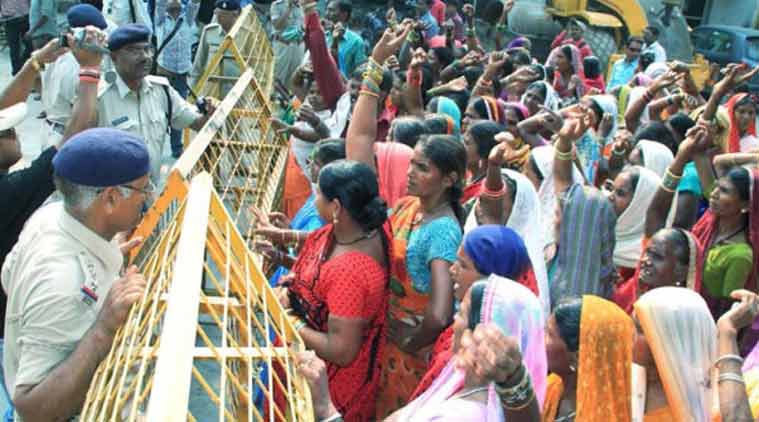
The news this week from Chhattisgarh, India, is tragic. At latest count, 15 women have died in a `sterilization camp’. Fifty others are in hospital, with at least 20 in critical condition. At first the operations were widely described as `botched.’ After only preliminary investigations, the response moved from `botched’ to `criminal’ and `corrupt’. Finally, the reporting has landed on how Indian this all is. It’s not. Forced sterilization of women is a global phenomenon, actually a global campaign, and it needs to be addressed, immediately. The women, all poor, of Chhattisgarh are part of a global public policy in which women’s bodies are, at best, disposable and, more often, detritus.

Consider the last two months from the perspective of forced sterilization of women.

In November, the Namibian Supreme Court upheld a 2012 High Court decision that health workers sterilized HIV-positive women without their consent. Switzerland was called upon to consider compensation for survivors of its “contract children” program, which included forced sterilization of girls.

In October, Belgium faced UN scrutiny, under the CEDAW procedures, concerning forced sterilization of women living with disabilities. Women in Peru complained that, eighteen years after the formal cessation of forced sterilization programs, they have seen no justice. Promises, yes. Justice, no. North Carolina began paying compensation to survivors, poor and minority women, of its forced sterilization program. After much debate, the California legislature passed a bill formally banning the forced sterilization of women prisoners.

And this doesn’t take into account ongoing inquiries and discussions of forced sterilization of Aboriginal and Indigenous women across the Americas as well as Australia. This list is not even the tip of the global iceberg.

And so the charge of coercion, as raised by Kerry McBroom, director of the Reproductive Rights Initiative at the Human Rights Law Network in New Delhi, comes as no surprise. That the coercion flows through cash incentives to desperately poor women rather than cudgels and batons is merely a facet of the current world order. There is no informed consent in so-called sterilisation camps. There are quotas, cash incentives, and the occasional pile up of women’s corpses. Monetizing and incentivizing the assault on women’s bodies is key to the modern democratic nation-state, thanks to the Washington Consensus.

Along with local investigation into the individual cases, as in Chhattisgarh, what is called for is immediate global action to change the global public policy that trashes women’s bodies and lives. The global state of forced sterilization of women is dire, and it’s expanding. It’s past time to address the global crisis of forced sterilization of women: impose an immediate moratorium on all programs of mass sterilization, everywhere; codify just compensation for survivors of such programs; pay just compensation to survivors of such programs; and establish serious global structures to enforce informed consent. Remember, Chhattisgarh is everywhere.


(Photo Credit: Indian Express)

In Namibia, a victory for HIV-positive women, for all women, everywhere


Pushed by women’s organizations, by women organizing, courts and legislatures around the world are forcing the end to coerced sterilization of women. A little over a month ago, the California legislature finally outlawed the forced sterilization of women prisoners. This month, Namibia’s Supreme Court upheld a 2012 High Court ruling that health workers sterilized HIV-positive women without their consent. As Michel Sidibé, UNAIDS Executive Director, noted, “This is a great victory for all women in Namibia and the world. This decision reinforces the right to sexual and reproductive health for all women, irrespective of their HIV status.”

This latest chapter began, formally, in 2009, when three Namibian women sued the State. They claimed they had been forcibly sterilized and that they had been sterilized because they were HIV positive, and so were victims of discrimination. Three separate women, ranging in age from 20s to 40s, at the height of labor, were presented with the sterilization `option’. In one case, the woman had been in labor for over four days and was in severe pain. She was led to believe that her caesarean could only take place if she signed the form. In such circumstances, what is the gender of informed consent?

In 2012, Judge Elton Hoff took two hours to read the decision. He argued there was clearly no informed consent. He noted that the women were Oshiwambo-speaking and that none of the health staff spoke Oshiwambo. He further noted that the forms the women signed were filled with acronyms no one, other than a specialist, could be expected to understand. In all three cases, the women only discovered the meaning of “BTL”, bilateral tubal ligation, long after they had undergone the surgery. Judge Hoff concluded, “There could not have been counselling in those circumstances.” When, after two hours, Judge Hoff looked up from his papers, he faced a courtroom packed with women in black t-shirts that read, “Non negotiable: my body, my womb, my rights”.

The three women are members of the Namibian Women’s Health Network. During a routine inspection of post-treatment papers, Network members started noticing BTL on members’ treatment cards. No one knew what BTL was, and absolutely no woman knew that this had happened to her. The women then hooked up with the Southern Africa Litigation Centre, and in particular with Priti Patel, then deputy director and HIV program manager, who managed the case.

According to Jennifer Gatsi-Mallet, Director of the Namibian Women’s Health Network, “The three women at the heart of this case are just the tip of the iceberg. We have documented dozens of similar cases of women living with HIV being sterilised without their informed consent. This judgment presents the strongest possibility that the Government of Namibia will be held to account for subjecting HIV-positive women to coerced sterilisation,” said Mallet.

Priti Patel added, “Monday’s decision will have far-reaching consequences not only for the three women at the heart of this case, but for the dozens of other HIV-positive women who have been subjected to coerced sterilisation in Namibia and throughout southern Africa.”

This victory in the Namibian Supreme Court extends beyond hospitals and prison and before human rights to women everywhere organizing to sustain their dignity as women, and in so doing, pushing the State to do more than pay lip service to women’s rights and equality. This is a victory for women’s autonomy and power, everywhere. The State, and not just Namibia, did more than fail to stop forced sterilization. The State engaged for decades, and centuries, in medical pogroms against women. It’s way past time for the State to be held to account for violence committed against women across the African continent and around the world.


(Photo Credit: Namibian Women’s Health Network)

The Burkinabé women’s spatula uprising


Burkinabé civil society, opposition forces, students, youth, workers, and women have been taking to the streets to protest a parliamentary move to extend the president’s 27-year rule. These demonstrations are as much about one-party rule as they are about one man. Since August, youth have been organizing, under the banner of Le Balai citoyen, the Citizen Broom. Many have spent their entire lives under the leadership of one man and they have had enough.

This week, the broom hooked up with the spatula.

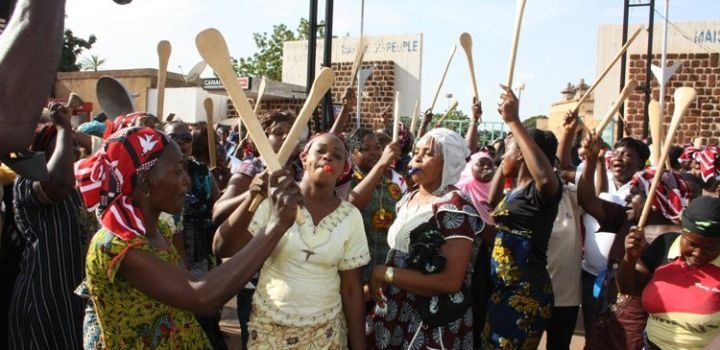
On Monday, hundreds of women took to the streets of Ouagadougou. In their raised fists, they carried broomsticks, spatulas, and some carried pestles. Why spatulas?

As one demonstrator explained, “The spatula is the most important cooking utensil for women. It has a symbolic weight in our traditions. When it is used to hit a man, it’s a sacrilege; the consequences are disastrous and irreversible. Hitting a man with a spatula automatically undercuts his power, his virility, which he cherishes above all. This is the reason the women came out with spatulas. Because of the President’s monarchic tendencies, his refusal to hear anyone but himself, the women came with spatulas to warn him, to bring him back to reason.”

According to Juliette Congo, of the Movement of People for Progress, “We came out with our spatulas to give a warning to a man hell-bent on destroying our country … If Blaise Compaoré does not change his tune, the women of Burkina Faso will rise in civil disobedience!”

Cendrine Nama, 28, agreed, “Burkinabé women came out, armed with our spatulas, October 27, to say NO to a constitutional coup d’etat planned by those in power, with the complicity of the Deputies elected to represent the people. I am proud of my people who rise today. It’s time we took an active role in the decisions that affect us, for the people are sovereign.”

Germaine agreed and added, “The time for discussion is over. We want him to leave and leave us in peace. We, the women, we weep for our children, we weep for our nation, we weep for the fate and future of the Burkinabé people. We came out with our spatulas to show him that when a woman comes with a spatula, that says it all. We came into the streets with our spatulas because we are burning inside. The next time we will strip and come naked and cry on the head of Blaise Compaoré.”

On Monday, hundreds of women marched, chanted, carried spatulas, and sparked an uprising, a spatula uprising. On Tuesday, tens of thousands marched in the streets. On Wednesday, a general strike was called. And tomorrow … ?


(Photo credit: Fasozine.com)