The cruel and usual treatment of women in jails


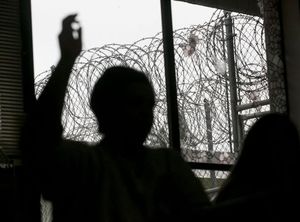
In the United States, jails are filling up, with particularly catastrophic consequences for women. Caging more and more women in jails for longer and longer periods of time is how the State protects its interests … and `its women.’

The Vera Institute released a report last week on the misuse of jails in the United States. It details the ways in which jails have become the repository for the poor, mentally ill, of color. For women, the situation is dire: “Serious mental illness, which includes bipolar disorder, schizophre­nia, and major depression, affects an estimated 14.5 percent of men and 31 percent of women in jails—rates that are four to six times high­er than in the general population … While most people with serious mental illness in jails, both men and women, enter jail charged with minor, nonviolent crimes, they end up staying in jail for longer periods of time. In Los Angeles, for example, Vera found that users of the Department of Mental Health’s services on average spent more than twice as much time in custody than did the general custodial population—43 days and 18 days respectively … Although women still make up a relatively small proportion of the jail population—14 percent in 2013— their share has been steadily increasing, up from 11 percent since 2000 … In 2005, 79 percent of women in jail were mothers, with nearly 250,000 children between them.”

The key here is serious mental illness affects 31 percent of women in jails. Mental illness has a gender here, and it’s women. Somehow, that salient feature drops out of the various news reports, which focus on the warehousing and punishing of the poor for their poverty and often of people of color for their race and ethnicity. Women, mostly poor, mostly women of color, and an extraordinarily high number of whom are living with mental illnesses, are being piled into jails across the country, in increasing numbers and for longer periods of time. As the Vera report notes, the money that pays for this adventure comes from “the same pool of tax revenue that supports schools, transportation, and an array of other public services.” So, first cut the services that might help these women, then pop them in jail, and then, in order to pay the freight, cut the services even further. And for the quarter million children, who are left behind, show no mercy.

Women haunt the entire prison project of the United States. Last month, California `celebrated’ its prison population dipping below the federally mandated level, which is 137.5 percent of capacity. So, the prison system is still overcrowded but not unconstitutionally so. The one exception here is the Central California Women’s Facility, the largest women’s prison in the world, built to house at most 2,000 prisoners. It currently has 3,383. That’s almost 170 percent of capacity, but it’s not cruel and unusual. It’s cruel and usual. The same is happening in the more than 3000 city and county jails across the country. It’s cruel and usual, and so it’s fine.


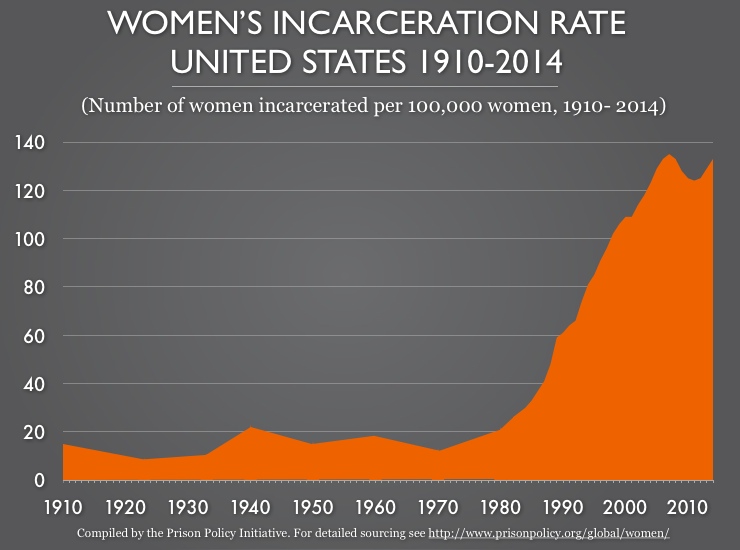
(Infographic: Prison Policy Initiative)
Domestic workers Gloria Kente, Erwiana Sulistyaningsih, Sumaira Salamat shake the world

Gloria Kente is a live-in domestic worker in Cape Town. In 2013, her employer’s then-boyfriend got angry with her, allegedly grabbed her, spat in her face, and screamed a racist epithet at her. Kente called the police and had him charged with assault and a violation of her human and civil rights. She called him out for hate speech and harassment. When the man tried to extend `an apology’, Kente said, “NO!” If an apology meant not going to court, not having the State fully involved, then Gloria Kente wanted no part of it. Last November, the man was found guilty, and on Friday he heard his sentence.

The man was sentenced to two years house arrest, 70 hours of community service “in the service of Black women”, successful completion of various programs addressing substance abuse, prohibition from owning any firearms and from using any substances.

Gloria Kente was not in court on Friday, but her attorney said she was happy with the sentence.

As so often happens, the news coverage of this case focuses largely on the man. Employers disrespecting and abusing domestic workers is not news. Employers disrespecting and abusing domestic workers’ rights under the law is also not news. The news is that around the world, domestic workers are saying “NO!” to abuse. Around the world domestic workers are on the move, organizing, advocating, going to court and winning civil and criminal cases, organizing unions, consolidating power for domestic workers and for women workers generally. That’s the story.

In Hong Kong today, a court found that Erwiana Sulistyaningsih’s employer had indeed abused her. Her employer was found guilty of criminal intimidation, grievous bodily harm and wage theft. Again, the story is not the employer, but rather Erwiana Sulistyaningsih’s refusal to accept the veil of secrecy that enshrouds household labor. Erwiana Sulistyaningsih said “NO!” to the violence of like-one-of-the-family, and, instead, said “YES!” to workers’ right, women’s rights, migrants’ rights, humans’ rights, and every configuration thereof. As Erwiana Sulistyaningsih explained, after hearing the verdict: “To employers in Hong Kong, I hope they will start treating migrant workers as workers and human beings and stop treating us like slaves, because as human beings, we all have equal rights.”

In Lebanon, immigrant and migrant women domestic workers are organizing a union. In Pakistan domestic workers have formed their first trade union, partly as a response to increasing violence against domestic workers and partly as a response to the affirmative recognition of their combined rights and power. Last December, the Pakistan Workers Federation formed the Domestic Workers Trade Union. Of 235 members, 225 are women domestic workers. Sumaira Salamat, in Lahore, is a member: “It’s only in the last year-and-a-half that these women have finally realised the importance of what it means to become a united force. We want to be recognised as workers, just like our counterparts working in factories and hospitals are. We would also like to get old age benefits like pensions when we retire; but most of all we want better wages and proper terms of work.”

Everywhere, women domestic workers are on the move.

Remember that when you read about this court case or that decision and the abusive employer receives all or most of the attention. The days of employers owning history are over. Gloria Kente, Erwiana Sulistyaningsih, Sumaira Salamat are shaking the world up. Remember their names.

(Photo Credit: IOL / Jeffrey Abrahams) (Photo Credit: Philippe Lopez / Agence France – Press / Getty Images)

Maxima Acuña de Chaupe and her family have decided to stay

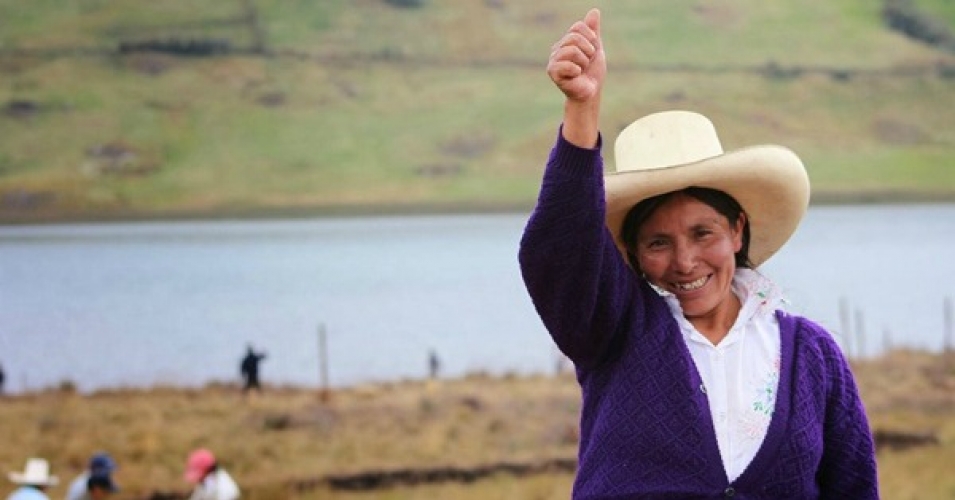
Maxima Acuña de Chaupe is an indigenous small hold farmer, a woman from the highlands of northern Peru. She lives in the department of Cajamarca. In 1994, she and her husband Jaime Chaupe bought a small parcel of land to farm and to live on. They began building their home, clearing the land, preparing for the future. In 1994, Cajamarca also `welcomed’ the Yanacocha Mine, the largest open-pit gold mine in Latin America and the second most `productive’ gold mine in the world. Yanacocha is owned by Newmont Mining Corporation, a US-based company and the largest gold mining company in the world; Buenaventura, a Peruvian company; and the World Bank. Newmont owns more than half the mine. Here’s Yanacocha, 2010: “Yanacocha is Newmont’s prize possession, the most productive gold mine in the world. But if history holds one lesson, it is that where there is gold, there is conflict, and the more gold, the more conflict.” More gold, more conflict, and more company and State violence.

This is a story of the largest assaulting the smallest, and the smallest fighting back.

Although Yanacocha is the largest, Newmont wasn’t satisfied. The owners knew there was more gold, just up the road a pace. And so they launched the Conga Mine project, which would be bigger than Yanacocha. Conga promised, or threatened, to be the largest single investment in Peruvian mining history. The mine owners approached Maxima Acuña de Chaupe with an offer, which she refused. She and her family liked their farm, the region, the community, and had no interest in leaving.

That is when the assaults began. In May 2011, company representatives and police tore down the fences and smashed the Chaupe home. The family stayed. In August company representative and riot police bulldozed the Chaupe’s new home and seized all of their possessions. The family stayed. Then private security guards and police beat Maxima Acuña de Chaupe and her daughter unconscious, and took her husband and son to jail. The family stayed.

And so, of course, Yanacocha sued the Chaupe family, charging them with illegal occupation. From Indonesia to South Africa to Canada to Peru, the one constant in mining is there is no irony in those killing fields. The family decided to stay: “I may be poor. I may be illiterate, but I know that our mountain lakes are our real treasure. From them, I can get fresh and clean water for my children, for my husband and for my animals! Yet, are we expected to sacrifice our water and our land so that the Yanacocha people can take gold back to their country? Are we supposed to sit quietly and just let them poison our land and water?”

In August, a judge found for the mining company, but in December, an appeals court struck down the lawsuit. Maxima Acuña de Chaupe won the battle! The small woman on her small piece of land had stopped the largest mine, one of the largest mining corporations, and one of the most intensive forms of industrial violence against people, the environment, and democracy. Maxima Acuña de Chaupe was supported by many women: her lawyer, Mirtha Vasquez; the members of Asociación de Mujeres en Defensa de la Vida (Association of Women in Defense of Livelihood) and of the Unión Latinoamericana de Mujeres – ULAM, the latter of whom named Maxima Acuña de Chaupe as the Defender of 2014.

That was December. This week, over 200 fully armed private security guards and police entered the Chaupe farm, again without any warrant or formal authorization, and tore down a second small shack the family was constructing. They held the family hostage for hours. The struggle continues. Maxima Acuña de Chaupe and her family have decided to stay.

Maxima Acuña de Chaupe

(Video Credit: Vimeo / Alexandra Luna) (Photo Credit: Common Dreams / Jorge Chávez Ortiz)


For women in England and Wales, `safety in custody’ means harm, death, hopelessness

On Thursday, the United Kingdom’s Ministry of Justice issued its Safety in custody quarterly update to September 2014. The report is grim. In 2014, 84 people killed themselves `in custody’ in England and Wales That’s the highest figure in seven years and an increase of 12% over the year before. The rise in suicide is surpassed by the rise in self-harm, up more than 25%. Overall, it was a banner year for the prison state, with 243 deaths in custody: “The 243 deaths in prison custody was an increase of 28 on 2013 and is the highest number of deaths recorded in a calendar year. This increase has been the result of both natural cause and self-inflicted death.”

Wrong.

The increase has been the result of rapidly rising prison populations, decreased access to mental health and other services, overworked prison staffs, and the general toxic soup that goes under the genteel name of `austerity.’

For ten years, the prison population has increased. The rise in prison suicides has more or less kept pace with that rise, but the rise is self-harm far exceeds the rise in population. And that’s where gender kicks in. Of the 84 people who committed suicide, three were women, up a bit from the one in 2013, but still low. Self-harm, on the other, is another story. According to the Ministry’s report, “Females are more likely to self-harm than males.”

Women make up 5% of the prison population and 27% of the incidents of self-harm in prison, over the past year. Where men had 222 incidents of self-harm per 1000 male prisoners, women had 277 per 1000 female prisoners. Even more telling, of those men who engaged in self-harm, each did so 2.8 times. Of those women prisoners who engaged in self-harm, each individual did so 6.2 times within a twelve-month period.

This what passes for safety in custody. As Frances Cook, of the Howard League, noted, concerning the rate of suicide in prison, “The numbers hide the true extent of misery inside prisons and for families.”

While the gender maths didn’t make headlines, they should have. As Soroptimist UK Programme Action Committee along with the Prison Reform Trust have noted, too many women are being sent to prison [a] for too little cause,[b] for too long, when [c] they could easily receive alternative sentences in their home communities. Furthermore, women prisoners know what the deal is when they leave prison: fewer than one in 10 women released from a prison sentence of under 12 months managed to secure a ‘positive employment outcome’ within a year of release, three times worse than the equivalent figure for men. Once in, there’s no way out.

There has to be a way out, and it begins with closing a so-called justice system that reflexively sends increasing numbers of women into overcrowded and often distant prisons for little or no reasons. If women are committing self-harm six times in a year, the problem is not `criminal justice.’ The problem is the criminal denial of access to health care. There is no justice where, for women, “safety in custody” means hopelessness, self-harm, and suicide.


(Image Credit: The Mental Elf)

Domestic workers in Lebanon organize a union!

Yesterday, more than 200 women from Ethiopia, Nepal, the Philippines, Sri Lanka, Bangladesh and beyond met to establish a first in the country, a union for migrant domestic workers. For decades, domestic workers have struggled with the `kafala system’, a `sponsorship’ system that binds migrant workers to their employers. This system gives employers practically absolute free rein over their domestic workers, because, under the kafala system, a domestic worker cannot quit. That would mean losing her sponsorship. It’s a vicious and often deadly cycle.

Domestic workers have struggled to tell their own stories and to frame the larger narrative for themselves. Ethiopian born domestic worker and filmmaker Rahel Zegeye explained, “We often hear stories of abuse and bad treatment of Lebanese employers towards their foreign domestic workers (maids). Most media and organizations working to help migrant domestic workers (MDWs) in Lebanon portray the worker as a helpless victim, her fate ruled by evil agencies and bad madams. Although this often does happen and is definitely an issue that needs attention, reality is much more complicated.”

In Lebanon, domestic workers have joined with organizations, such as Kafa (enough) Violence & Exploitation, the Migrant Workers Task Force, and others, to end the kafala system and more. They’ve launched research projects, social media campaigns, film and other media projects, to decry the inhumanity of the system and the brutality that is visited upon them regularly. They’ve tried to contextualize the tragic and regular tales of suicide among migrant domestic workers in Lebanon. Throughout, they’ve insisted that their human rights story is a women workers’ story.

To that end, the women persuaded Lebanon’s National Federation of Labor Unions to endorse their union proposal. Five weeks ago, the Federation submitted a proposal to the Labor Ministry applying for formal recognition of a migrant domestic workers’ union. As Carlos Abdullah, head of the Federation, explained, “We’re in a struggle phase now … This is the start of the journey and we don’t know how much time it will take to set up the union.”

With the National Federation of Labor Unions on board, migrant women workers, from all over the world, established their own autonomous women workers’ space. According to Lily Jacqueline, from Madagascar, “It’s a big step forward. Maybe we could have a common contract for all domestic workers and force employers to abide by it.” Gemma, who has lived in Lebanon since 1993, concurs, “We domestic workers are not seen as real employees. We are … employees, not … slaves.” Leticia, a Filipina domestic worker, agreed, “We want to be treated like human beings, like real workers. With this union, I will no longer feel alone in the face of abuse.”

To no one’s surprise, the Ministry of Labor today rejected the proposal, saying it prefers a legislative route, which has thus far completely failed women workers, rather than one of trade unionism. The struggle continues, and the women continue to organize to be treated like human beings, like real workers.

(Photo Credit: AFP/ Anwar Amro)

African Women Stand their Ground Against Big Coal

For the past week, women from mining communities in South Africa, Mozambique, Botswana, Zambia and Zimbabwe have been meeting in Johannesburg to share their experiences, strengthen their networks, map and take the way forward. They have been brought together by WoMin, African Women Unite Against Destructive Resource Extraction. They have had enough of environmental devastation, corporate predation, and State violence. They are sick and tired of living and dying in communities and households where everyone is tired, sick, and dying. And they have had enough of being ignored or silenced. They come together to say, Now is the time! They come together to make NOW the time.

In an hour long interview this week, Samantha Hargreaves, Regional Coordinator of WoMin; Nhlanhla Mgomezulu, Coordinator of the Highveld Environment Justice Network; and Susan Chilala, Secretary of the Rural Women’s Assembly, in Zambia, laid out the program. Generally, the women are calling on the State to divert its massive investments in the infrastructure of fossil fuel extraction into alternatives, particularly solar, wind, tidal, and thermal, all plentiful in the Southern African Development Community, SADC, region. All of the countries are already investing great sums of money to make mines happen. The women say: Make something else happen; something sustainable and renewable that will meet the challenge of growing consumption in growing economies.

This diversion would mean that the State would have to reconsider its comfortable relationship with those few who make huge profits at the expense of the many. This would also mean, the women said pointedly, that politicians, such as Cyril Ramaphosa in South Africa, would have to address their complicity as shareholders and leaders in the mineral extractives sector.

The majority of the interview describes the impact of coal mining on local communities. Susan Chilala explained that coal mining attacks women small scale farmers most viciously. She described the impact of coal mining on farming and food security. She talked about the impact on women when their space is taken over by an industry that is so deeply male dominated, from top to bottom.

Nhlanhla Mgomezulu described the impact on women in the South African Highveld: “We women are the ones who suffer most.” Women suffer as individuals, in that their own health is endangered by poisoned water, air, and land, but they suffer even more as principal caregivers of the community. When the children are sick, women work more intensively. When the men return from the mines with asthma, kidney failure, tuberculosis, injuries and more, women are work more intensively. And this labor is `free’ and it’s 30 hours a day, 8 days a week, for life. If that’s not slavery … what is?

Last year, Greeenpeace published a report, which looked at Witbank, in Mpumulanga, in which they found that Witbank has the dirtiest air in the world. This is the gift of coal as a mainstay of `development’: “Sonto Mabina … works at a small tuck shop that’s just a short walk from her home in an informal settlement over the train tracks outside Witbank, in Mpumalanga. She’s lived here for 25 years, arriving well before the three coal washeries that now surround her house … Sonto Mabina, or Katerina as she likes to be called, lives with her husband, Andries. Their house has no electricity or water and Katerina uses a coal stove to cook their suppers, the black plumes of smoke clouding their home. A municipal truck brings water once a week, but most say it’s too polluted to drink. If you can afford to, you buy bottled water in this area of the country; if not, you boil it like Sonto does and you hope for the best. `Dust is my main problem,’ she says. `Every time my child goes to the hospital it’s because of the dust. The doctors say his chest is full of it. The doctors asked me where I lived and I told them. My other child also has problems with his nose because it is always running – the dust affects him too.’ It’s an everyday problem here.”

The women who have gathered in Johannesburg are saying NO to that everyday. They are engaging in a public dialogue, breaking down barriers, transforming isolation into community, teaching as they learn, and they are demanding a better present. Not a better future, a better present. They have lived too long with politicians and others ignoring them. They are demanding that the State take climate change, the environment, community health and wellbeing, and women seriously. African women are standing their ground and more. They are organizing and on the move. The time is now!

(Photo Credit: Mujahid Safodien / Greenpeace)

Where are women prisoners in Obama’s community college plan?


In the room the women come and go, talking of Michelangelo, and Virginia Woolf and Jane Austen, and the Constitution of the United States, not to mention sociology, psychology and comparative religion. The room is a room in Washington Corrections Center for Women near Gig Harbor. On Monday, The Seattle Times reported that college classes “are starting to creep back, operating on shoestring budgets with private money.”

This college program arose out of women prisoners’ demands and dreams. Women prisoners heard that the vocational education program certificates didn’t open employment opportunities, and so they pushed for college courses. After organizing and pushing, they succeeded, no thanks to the State.

Alyssa Knight is a student in this program. She’s in her early 30s. She anticipates leaving prison in 2025: “The fundamental question is, what do we expect from our justice system? Do you expect it to rehabilitate a person? If you are just basically warehousing people, then you are not going to get a change.”

Why must college programs in prison creep? Why are they privately funded? Why are they on shoestring budgets? Because 21 years ago, in 1994, the United States Congress eliminated Federal student Pell Grant aid to prisoners. In 1995, Washington State legislators banned the use of tax money for post secondary education for prisoners.

At the time the Pell Grants were cut, across the country, public colleges and universities were running somewhere around 350 degree and certificate granting programs in prisons. That number quickly dropped to almost zero, and the prisons were formally declared warehouses of the abandoned.

Predictably, the deepest cuts were to women’s prisons.

Last night, President Obama proposed “a bold new plan to lower the cost of community college – to zero.” Want boldness? Take that plan to women’s prisons, and open community college programs there. The President says he wants education to be “free and universal”. Women prisoners are at the heart of higher education’s “free and universal.” Turn their warehouses of abandonment into community colleges. End 21 years of educational war against women. As President Obama said, “Really. It’s 2015. It’s time.”

As Alyssa Knight said of the impact of education, “It pervaded our existence in here — it started to transform what people were thinking about.” Another woman prisoner Tonya Wilson puts it this way, “Who would you rather live beside, a person that’s just getting out of prison who just sat in her cell and stewed, or do you want somebody who has transformed, who is educated, who will not be a drain on society?” It’s time to choose and support transformation.

(Photo Credit: The Seattle Times)

#SetHerFree: Women call for the closure of Yarl’s Wood and beyond

Women for Refugee Women’s latest report, I Am Human: Refugee women’s experiences of detention in the UK is hard and all too familiar reading. Women seek asylum because they have been tortured, raped, forced into marriage, persecuted, and then they are imprisoned and tortured anew when they apply for asylum. Two thousand women are locked up in Yarl’s Wood, every year. Detention is never good for women asylum seekers. Detained asylum seekers suffer much higher rates of depression, anxiety and PTSD than those who live in the community while their applications are assessed. None of this is surprising.

Yarl’s Wood staff is 52% male, 48% female, according to testimony before Parliament last year. So, the reports of routine violation of privacy and sexual intimidation and exploitation are also not surprising. All of this is part of the design of a program that imprisons women who seek help.

Margaret fled the DRC, ended up in the UK, applied for asylum: “We arrived at midnight. And I saw it was a prison. I came here only just to ask asylum, I’m not a criminal. I am so depressed that they think I am going to kill myself here and I am watched by men and women night and day. When the men watch me it makes me have so many bad feelings about myself and my body. I feel full of shame about what happened to me and what is happening to me. Being in prison here is a torture in my head.”

Margaret now has refugee status in the United Kingdom. What exactly is the investment the State has made in driving Margaret mad? What good can possibly come from such a policy? None. Repeatedly, current and former prisoners of Yarl’s Wood describe the programmatic assault on their humanity, and they wonder, “What good can from a policy of dehumanizing women?” None.

The only good is from those women who are organizing to smash this system. The report ends with a straightforward message: TOGETHER WE ARE STRONG: CAMPAIGNING TO END DETENTION ACROSS THE UK. Women Asylum Seekers Together Manchester organize with Aderonke Apata to shut down Yarl’s Wood and beyond. Embrace in Stoke-on-Trent is doing likewise. Why Refugee Women, in Bradford, was organized by Beatrice Botomani, a former detainee. There’s Hope Projects, in Birmingham, and the London Refugee Women’s Forum. And there’s Women for Refugee Women, and in particular, the #SetHerFree campaign, launched by former Yarl’s Wood prisoners, Meltem Avcil and Lydia Besong.

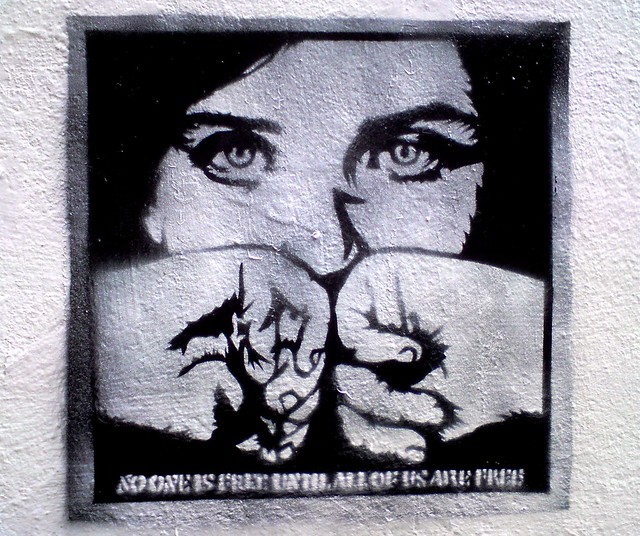
Women refusing to be silent, speaking and shouting and dancing in the streets, halls, corridors, meeting rooms, classrooms and everywhere else – that’s the real story here. While it’s not surprising to those who know anything about women’s social justice work, across the centuries, it’s still a welcome astonishment. Women asylum seekers ask for haven and shelter, but they know that TOGETHER THEY ARE STRONG, and they will tear down the walls of Yarl’s Wood. And that will be only the beginning of the real asylum process. Setting them free is a next step in setting us all free. Set her free. Set us free.


(Image Credit: flickr.com)

What is your sister’s name? Christa Allen

The story of Christa Allen is all too common. In 2002, Christa Allen underwent male-to-female gender reassignment surgery. In 2006, she was sentenced to time in Indiana’s Rockville Correctional Facility. Later, she was moved to the Indiana Women’s Prison.

When Christa Allen entered prison, she explained her medical needs: female hormones and a vaginal stent. Allen explained the stent was medically necessary to prevent closure and loss of tissue. Without the stent, she would most likely suffer medical complications that could necessitate a second, and extremely expensive, operation.

At first, the prison authorities agreed to the stent. Then they found is a security issue, and told Allen to use a vibrator. Then they found that a security issue, and told Allen to use a tampon.

Allen complained of pain and vaginal bleeding. She argued that she needed the stent, and the prison doctors and authorities refused. Christa Allen spent one and a half years in prison, leaving in 2007. At that point, she was unable to continue her treatment, and so would need new reconstructive surgery. She sued the prison doctors for medical malpractice.

Christa Allen’s case is going through the court system now. In the most recent hearing, the Indiana Court of Appeals sided with Allen, stating [a] there was no reason to prevent the use of stent or vibrator, and [b], and most importantly, prison doctors should follow the standard of care that all doctors are meant to follow.

Prisoners are people. Women prisoners are people. Transgender women prisoners are people.

The doctors have asked the appellate judges to rehear the case.

In jails and prisons and immigrant detention facilities across the United States, the most vulnerable are women, and the most vulnerable women are juveniles; women with drug addictions; lesbians and transgender women; women with a history of mental illness, physical or sexual abuse; and women convicted of sexual offenses. Each one of these groups is meant to suffer their own particular form of hell, composed of a particular category of extra violence.

For the transgender woman, the extra violence stems from a claimed failure of `being real’. Deprivation is the program response: denial of gender self-definition, preferred names, pronouns, underwear, hair length, or appropriate and necessary medical care. It’s always the same: your needs cost too much. For the prison economy, being transgender woman is deemed inefficient, and so cost-cutting measures must be put in place.

Repeatedly, transgender women prisoners have organized and sued for their rights to decent medical treatment as transgender women. Repeatedly, these women have won: Kari Sundstrom and Andrea Fields; Vanessa Adams; Michelle Kosilek. In each case, the court ruled that transgender women are people, transgender women prisoners are people, and prison doctors are doctors.

The legal arguments will continue as will prison authorities’ and prison doctors’ claims that taking care of the special needs of women is just too much. Christa Allen provides us all with a mirror. When asked, “Where is your sister?” will we hide behind “Am I my sister’s keeper?” Will we cover over the violence, or will we act to keep our sisters out of prison and then, finally, to close the prisons themselves? What is your sister’s name? Christa Allen.

(Photo Credit: Indiana Department of Corrections)

Haiti, cinq ans déjà


I believe the message I could share with the Haitian people is that they must learn to say, `STOP! That’s enough. We won’t accept this anymore.’ And start claiming and defending their rights.”

We cannot continue to live without hope.”

These are some of the concluding messages from a film, Resilient Hearts/ Kè Vanyan/ Cœurs vaillants, a documentary of the January 12, 2010 earthquake that devastated Haiti, as much in `reconstruction’ as in the event itself. For thirty five seconds, the earth shook, opened, and then a world collapsed. Thousands of people killed, thousands of thousands of people injured, maimed, displaced, traumatized. And in some ways, that wasn’t the worst of it.

The earthquake didn’t take peoples’ rights. Goudou Goudou, as the event is known, didn’t remove hope. That grand theft was committed by something called the international community.

Three years ago, many watched as women organized, in the camps, in the streets, in the countryside. Women like Jocie Philistin and Earamithe Delva, the women of KOFAVIV, Komisyon Fanm Viktim pou Viktim, the Commission of Women Victims for Victims, took their experiences from the past and applied them to the present and future. They organized. Two years ago, many watched as women continued to organize. For example, in the Morne Lazarre section of Pétion-Ville, Réa Dol continued to organize the SOPUDEP school.

KOFAVIV and SOPUDEP continue, the women continue to organize. They continue building community and building strength, and they continue to blow the whistle on sexual violence, to insist on the importance of their own autonomy and well being, as the gears of so-called reconstruction try to grind their self-respect into so much dust.

And today, after so many billions of dollar of so-called `foreign aid’, Haitians ask, “For whom are we rebuilding the country?” Massive resort development construction in previously protected agricultural zones? Palaces for a few and seemingly permanent refugee camps for many? Begging on the streets? What does rebuilding a nation mean?

And they answer, in varying ways, “STOP! We can’t accept this anymore!” Women’s groups, community organizations, trade unions, farmers and farm workers and peasant organizations, LGBT groups, and others are connecting and organizing and not so much rebuilding as building anew. They are demanding and organizing for inclusion, democracy, and sustainability, and they are demanding more than token seats at the tables where decisions are made.

They are demanding dignity. When they demand permanent housing and clean water and safe spaces and decent work and more, it’s not because infrastructure is the end all and be all, but because to build anything, especially after having come through the fires, would be a betrayal of dignity and hope. Many in Haiti say that they must build life, not death. They must build cities and farmlands of life, not temples of death for many so that a few might live richly. The story of Haiti’s reconstruction continues, day by day, and it’s a contested narrative. There is no grand triumph, neither of the will nor of capital. But the good news from Haiti is that the struggle continues. La lutte continue. Lit la ap kontinye. It’s five years already.


(Photo Credit: Vimeo / Resilient Hearts)