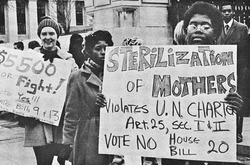
In South Africa this week, 48 women living with HIV and AIDS responded to the indignity and abuse of forced sterilization. Represented by Her Rights Initiative, Oxfam, and the Women’s Legal Centre, 48 women who had suffered forced sterilization in Gauteng and KwaZulu-Natal came forward and lodged a formal complaint. These 48 `cases’ were from 1986 to 2014. These 48 women are the tip of a rumbling volcano. They are the faces and bodies of gendered inequality in South Africa and beyond. They represent the untold numbers of women living with HIV and AIDS who have been forced to suffer one indignity after another. They represent all women in national and regional economies where women’s bodies are viewed as consumables with ever declining values.
The women tell their own stories, for example, Zanele, who was 19 years old and 38 weeks pregnant: “As I was thinking about it, [the doctor] turned to this lady who was with her, I think she was an intern, and said we [referring to HIV-positive women] were a problem to the hospitals, we give birth all the time … at that time I felt guilty as a patient. Then [the doctor] came back and asked me if I wanted to be sterilised and I said yes.”
There is another, connected story, as told by Dr Ann Strode from the University of KwaZulu-Natal. In 2012, Dr. Strode published a study published that examined the situation of forced sterilization of women living with HIV and AIDS. At the time, the research team believed that the practice had more or less ended by 2006, with the national rollout of antiretroviral drugs, or ARVs. In the present group of 48, more than half of the violations took place after 2006. Dr. Strode and her colleagues were surprised by the findings.
Consider the story of surprise. When those who are the most informed and the most engaged, when the advocates and the organizers, think the story is over, it takes the subjects, the women themselves, to step forward and `surprise’ the public consciousness out of its slumber. Two of the cases were from last year, and one has already resulted in a civil suit in Gauteng.
Some talk about the double stigma women living with HIV and AIDS suffer: being HIV positive, being unable to have children. But there’s a third stigma: having failed the nation-State. Women who are HIV positive are viewed as failed citizens. That’s why they can be treated this way, despite Constitutional and legal protections to the contrary. The Department of Health says forced sterilization is not department policy, but it is practiced, in the open, regularly.
Each of those 48 women represents tens and hundreds of other women living with AIDS, and each of those 48 women represents thousands and tens of thousands of women who struggle and organize in the unequal and violent spaces between policy and practice.
“End this violation on women’s bodies! My body, my rights, my womb, my choices.”
(Photo Credit: The Star / Chris Collingridge)
_LRG.jpg)