Women pay for rising food prices

Jenga Mwendo

Youth in Algeria are `rioting’ to protest, and change the conditions of, high unemployment and high and quickly rising food prices. In Egypt, where food inflation is running at a staggering 17 percent, the women are talking once again of the food lines, and the food riots and uprisings, of 2008.

In Bolivia, shopkeepers, such as Pilar Calisaya, are battling with police because of quickly rising bread prices. As she explains, “I am not at fault”.

In China, as Xu Shengru shops for food to feed her family, she notes that cabbage, a staple, has doubled in price since last year. That’s actually the good news. Recently, rice prices rose 30 percent in just 10 days.  Pepper prices rocketed an astonishing 1,000 percent.  In Indonesia, where pepper prices are also scaling new heights at new speeds, the government is imploring citizens to plant chilies in their backyards.

In India, food inflation has `zoomed’ to 18.32 percent this week alone, spurred by onion, vegetable and milk price rises. Last year alone, the price of onions rose 40 percent.

According to the United Nations Food and Agriculture Organization, world food prices in 2010 hit a new high, especially cereals and sugar. Wheat prices soared, corn as well. The price of meat and of milk also rose precipitously. These are the highest prices in thirty years. Put differently, well over half the world’s population has never lived with such high prices. It’s no surprise the youth of Algeria are protesting.

The brunt is back, and yet again the analysts inform us that it’s the world’s poorest who will bear the brunt.  And yet again there will be stories of individual women, such as Pilar Calisaya, or the unnamed woman in Egypt, or the unnamed woman in Algeria facing down a row of police, or Xu Shengru, and their struggles with food political economies, but there will be no analysis or reporting on the place of women in the `danger territory’ of food provision and consumption.

As the discussions of food prices, food riots, food protests, food markets, and food counter-markets spiral, keep an eye out for structural analyses of women’s positions.

One woman who knows something about women, food, crisis, is Jenga Mwendo.   Mwendo is the founder of the Backyard Gardens Network in New Orleans. After Katrina, she began rebuilding her own home, in the devastated Lower Ninth Ward, and began building a new food political economy in the middle of food desert and in the midst of a food desertification.  She organized the rebuilding of two community gardens, the planting of fruit trees, and more. Mwendo understands that the only buffer against the predations of market control of food is community production. For some, this would be community gardens, for others, coops. In all of these, and other alternative community food experiments and projects, women historically have been the principal agents and constituency. Women still are.

Jenga Mwendo is precisely not exceptional. Women do not only bear the brunt of the devastating food market economies. Women are neither the victims nor the survivors of food catastrophes and crises. Instead, women are the change agents, from food uprisings to community gardens, and beyond.

Meanwhile, “fresh rioting broke out in Algiers today.”

(Photo Credit: Civil Eats)

…And Ishrat Jahan is dead

President Barack Obama went to India last week. He declared that India is “not simply an emerging power but now it is a world power.” President Obama suggested that India’s emergence as a world power now gave it the authority to “promote peace, stability, prosperity.”  He embraced Prime Minister Manmohan Singh. He met with leaders of the business community and spoke to the Parliament. He met with university students, he danced with primary schools students.

The President of the United States of America met with many people of the Republic of India. He talked of peace between nations, in particular Pakistan and India. He announced that the United States would support India’s permanent membership on the United Nations Security Council.

Security is on the minds of many in India, and across South Asia. Many want to redefine security. National security. Personal security. Community security. Many of those who seek an alternative to security through military means and, even more, through the militarization of domestic spaces are women. President Obama did not meet with those people. He did not meet with those women who counsel nonviolent alternatives to security based on arms and force. Instead he talked about the Security Council

President Obama did not meet with Medha Patkar, the driving and visionary force behind the Narmada Bachao Andalan movement, a movement of tribal and aboriginal people, of farmers and peasants, of women, and of supporters. Narmada Bachao Andalan is a nonviolent direct action mass and popular movement that this year celebrates, in song and struggle, twenty-five years of organizing for real security. This began as a struggle to stop a big dam being erected on the Narmada River, and has evolved into an alternative vision of statehood, nationhood, security. President Obama did not meet with Medha Patkar, and no one is surprised.

President Obama did not meet with Irom Sharmila, who has been on a hunger strike for ten years now. In early November 2000, in the state of Manipur, insurgents attacked a battalion. The battalion retaliated, later, by mowing down ten innocents standing at a bus stop. Included among them was “a 62-year old woman, Leisangbam Ibetomi, and 18-year old Sinam Chandramani, a 1988 National Child Bravery Award winner.” A pregnant woman was also reported as being one of the dead.

The army knew it could act with impunity because it was covered by the Armed Forces Special Powers Act, or AFSPA. AFSPA was imposed in Manipur in 1961. Much of the rest of the Northeast has been under its rule since 1972. According to government reports, more than 20,000 people. By the government’s own statistics, tens of thousands of people, have been disappeared, tortured, beaten, abused. In Manipur, this began in 1961. By 2000, it had gone for almost four decades.

A young 28 year old woman, Irom Sharmila, decided enough was more than enough. She entered into an indefinite fast, a hunger strike that would continue until the Armed Forces Special Powers Act is rescinded, the soldiers withdrawn, the people restored. November 4 marked the tenth year of Sharmila’s fast. President Obama did not meet with Irom Sharmila, and again no one is surprised.

President Obama did not meet with these women of peace, considered by many to be the true Gandhians. Nor did he meet with Ishrat Jahan.

In 2004 there was a `police encounter’ in Ahmedabad, in the state of Gujarat. Police encounter is a delicate euphemism for extrajudicial killings. Extrajudicial killings is a discrete euphemism for police murder, assassination, torture, disappearance, terror.

In 2004 the police encountered Ishrat Jahan. She was nineteen years old, a college student. She and three others were gunned down. The police claimed they were part of a terrorist organization and were planning to kill the Gujarat Chief Minister Narendra Modi. Five years later, in 2009, a police investigation determined that Jahan and her three colleagues had absolutely no ties to any terrorist organization of any sort. It was further determined, by police, that assassinations had been planned and carried out by senior officials who wanted to impress the Chief Minister. In a word, they were seeking promotion. Through security.

Jahan’s family was relieved and demanded further inquiry. The Gujarat High Court appointed a Special Investigative Team to delve deeper. The State of Gujarat appealed to the Supreme Court to disband the SIT, saying the High Court had no power, had no standing, when another agency was already investigating. The Supreme Court decided against the State … and for due process, and perhaps the people. This has been described as “an embarrassment to Gujarat government.” The investigation will continue.

…And Ishrat Jahan is dead. As she lies with the tens and hundreds of thousands killed in the name of security, killed and tortured in the pursuit of prosperity, Ishrat Jahan haunts the peace of so-called world powers.


(Photo Credit: BBC.com/AFP)


Ishrat Jahan and the gender of aftermath

Ishrat Jahan

On the morning of June 15, 2004, in Ahmedabad, in the state of Gujarat in India, Ishrat Jahan and three others were killed by police. In India, these events are commonly referred to as encounters. The government claimed that Ishrat Jahan was “India’s first woman terrorist”. A recent magistrate report suggests that Jahan was simply a college student with no ties to any terrorist group whatsoever, and that the claims by the State were cynically manufactured. In India, this is a cause célèbre. In Gujarat, it is said, a dead woman haunts the State. The State is haunted.

A haunted State is a state that exists in the aftermath, a state in which the real occurs after the event, in which ethics is always deferred, always for a later determination.

Italy is a haunted State. Six Italian soldiers were killed last week in Afghanistan. Monday was a national day of mourning. As Italians gathered in the tens of thousands, it was not the soldiers who were said to haunt the assembled but rather “this gray area between peacekeeping, peace enforcement and combat operations….The ambiguity has haunted the country”. This ambiguity is precisely the clarity of the aftermath. We don’t know exactly what our mission is, but we will, once it’s accomplished. When it comes to war, the aftermath justifies the means … and the deaths.

But it’s not just the military branches of government that rely on the continual deferral of the aftermath. For example, Lauro L. Baja, Jr., a distinguished Philippine ambassador at the end of an illustrious career, faces the ignominy of a court trial: “When Lauro L. Baja Jr. returned to his native Philippines in 2007, he had just finished a four-year stint as ambassador to the United Nations that included two terms as president of the Security Council. A storied diplomatic career that began in 1967 culminated with the Philippine president conferring upon him the highest award for foreign service. Then a three-month episode from his U.N. days returned to haunt him. He was sued by Marichu Suarez Baoanan, who had worked as a maid in New York City for Baja and his wife, Norma Castro Baja. Baoanan, 40, said the Bajas brought her to the United States in 2006 promising to find her work as a nurse. Instead, Baoanan said, she was forced to endure 126-hour workweeks with no pay, performing household chores and caring for the couple’s grandchild. Baja denied the charges, saying Baoanan was compensated. He also invoked diplomatic immunity — a right that usually halts such cases in their tracks.”

How does this haunting work, and what does it tell us? If the allegations in the Baja case are proven, somehow those who committed the violence are haunted, because they are the subjects of history, the actors. What about Marichu Suarez Baoanan? Or Mildrate Yancho Nchang, who worked without pay or a day off for three years and then went to hospital when her employer, a Cameroonian diplomat’s wife, beat her severely. What happened to the diplomats? They got off. Diplomatic immunity.

Diplomatic immunity is one issue, a matter of rule of law and interpretations of sovereignty. Existential immunity is another. Who haunts, who is haunted, how does haunting work, and, finally, is haunting gendered?

These are stories of aftermath. From India to Italy to diplomats’ households, the haunting only begins once the period called aftermath has begun. To be confronted with or to struggle with aftermath is to be haunted, but what exactly is aftermath? “A state or condition left by a (usu. unpleasant) event, or some further occurrence arising from it” and before that, aftermath is the “second or later mowing; the crop of grass which springs up after the mowing in early summer”. The math is the mowing itself, the action and process of chopping down. The aftermath is the grass that follows the violence and the act of mowing it, again and again and again. What is the gender of math? At its root, feminine. And what is the gender of aftermath? Woman. Ask those who haunt. They’ll tell you.

(Photo Credit: news18)

The gender of stampede

There was a stampede in Jakarta, Indonesia today. Few agencies have reported it, I’ve found only one. Thirteen people are reported injured, and it is reported that the thousands who gathered for free food and cash handouts, to mark the end of Ramadan, were overwhelmingly women and children.

Human stampedes are reported throughout the year, everywhere. In the past week or so, four human stampedes have been reported, Jakarta’s being the most recent.

In New Delhi, India, on Thursday, September 10, “Tragedy struck a government secondary school in Indian national capital New Delhi Sept 10 when five girls were killed and 27 other students injured, six of them very critically, in a stampede. The incident occurred when students were trying to make their way up and down a narrow staircase when they were asked to shift classrooms during an examination in the Khajuri Khas Senior Secondary School….Some students said they were asked to shift classes as certain classrooms were water-logged due to incessant rains since Sept 9 night. One of the girls, going down the staircase, fell leading to the stampede….All but one of the 27 injured students were girls.” In the end, 34 students were reported injured, five killed.

That was Thursday. On Saturday, in KwaNongoma, KwaZulu Natal, South Africa, “Tragedy struck at the annual Royal Reed Dance … when one of the maidens was crushed to death during a stampede that broke out following a scramble for promotional caps. Another maiden is in a critical condition while 10 others were seriously injured as the event turned into pandemonium.”

That was Saturday. On Monday, September 14, in Karachi, Pakistan, “Eighteen people were suffocated to death during a stampede here on Monday as poverty-stricken women battled for a free bag of flour being distributed by a philanthropist in Khohri Garden. The dead reportedly include a number of children as well. Meanwhile, several unconscious women were rushed to the emergency ward of the Civil Hospital in Karachi.” Actually, it was twenty women and girls killed, and fifteen were injured. Or was it at least 25? At any rate, the women and girls were waiting for free food.

Stampedes occur all the time. It could be sports events, such as in March of this year at the Houphouet-Boigny Stadium in Côte d’Ivoire at a football, or soccer, match when a wall collapsed and the crush killed 22 and injured over 130. It could be the proverbial fire in a crowded theater or club, as happened in Bangkok this New Year’s, when at least 59 people were killed and over 200 were injured. Or it could be a sale at a big store, like Wal-Mart, as happened late last year, in Valley Stream, New York, not far from New York City. That was on the Friday after Thanksgiving, when people couldn’t wait any longer and broke through the doors, trampling a worker, Jdimytai Damour, to death. It happens all the time.

All of these incidents were described as stampedes. In the most recent, the dead and injured were all or almost all women and girls, but that is not my point here today. What exactly is a stampede, and how does a crowd crush become a stampede?

Stampede is a relatively new word, and it seems to be North American. According to the Oxford English Dictionary, it was coined early in the 1800s, Cowboys in the United States borrowed the Spanish word, estampido, which means crash, explosion, or report of a firearm, and estampida, which means a stampede of cattle or horses. It was an early example of transnational vaquero cowboy culture. The word didn’t come from Spain, it came from Mexico. Stampede, or stompado, was a “sudden rush and flight of a body of panic-stricken cattle” or horses. Later, stampede came to mean a “sudden or unreasoning rush or flight of persons in a body or mass”.

Here’s the thing. At its inception, stampede meant a thundering herd, powerful, dangerous. Today, when referring to people, it means a mass of people in flight who are threat mostly to themselves. How does that happen? Here’s one possibility. At the beginning, stampede was virile, masculine, big roaring animals and big riding cowboys. People, on the other hand, that was panic. In fact, the word in Spanish for the phenomenon of people rushing as a crowd and crushing one another in the process is precisely pánico. Panic. Sudden, wild, unreasoning, excessive, at a loss and out of control. And what is the term for mass panic?  Hysteria, the women’s condition: “Women being much more liable than men to this disorder, it was originally thought to be due to a disturbance of the uterus and its functions”.  Hysteric: “belonging to the womb, suffering in the womb”.

It doesn’t matter who is trampled in the event called a stampede. What began as an articulation of masculinity, the enraged capacity to destroy all in its path, has become the embodiment of womanhood, the helpless implosion of self. What began as a roar has become somehow a whimper. When you read that a group was in a stampede, know this. It is not a neutral word. It is a gender, and the gender is woman.

And those who were in the stampede? Writing of the trampling to death of Jdimytai Damour, one person commented, “I’m particularly troubled by reports that police are thinking about charging individual members of the crowd. When people behind you start pushing you forward, there is often nothing you can do. And there’s a real fear that if you try to resist, you too will be trampled. Part of the tragedy is that there are undoubtedly people in that crowd who know they stepped on something that day, or who, in their excitement, spurred on the surge. These thoughts may haunt them for many years.”  Those who trampled will be haunted, those who lost loved ones will be haunted. The rest of us, we are meant to be haunted by the gender of stampede.

(Photo Credit: NDTV)

The peculiar women


Women are the peculiar of the contemporary world. Two recent articles, published on the same day, suggest as much. Here are five aspects of the women-peculiar.

The peculiar trend

Girls’ sports events bring more cash and more carriers than do boys’: “As the popularity of youth tournaments has intensified over the past decade, a peculiar trend has emerged: girls’ sporting events tend to attract more relatives and generate more revenue for tourism than similar events for boys. And that is drawing increased attention from economic development officials. `There are far more people who will travel with 12-year-old girls than even 12-year-old boys,” said Don Schumacher, executive director of the National Association of Sports Commissions, a trade group that advises communities on attracting sporting events. “And vastly more people will travel with 12-year-old girls than 18-year-old boys.’”

Whether this reported trend is bogus or not, what would make it peculiar?

The peculiar sensation

On the same day, Saaret E. Yoseph reported on watching a KGB commercial that featured an all Black female cast, and wondered, “Why can’t ads get Black women right?” Good question. Here are the first two paragraphs of her reflection:

“`It is a peculiar sensation, this double-consciousness, this sense of always looking at one’s self through the eyes of others, of measuring one’s soul by the tape of a world that looks on in amused contempt and pity. One ever feels his two-ness,—an American, a Negro; two souls, two thoughts, two unreconciled strivings; two warring ideals in one dark body, whose dogged strength alone keeps it from being torn asunder.’

—W.E.B. Du Bois, The Souls of Black Folk

I wonder if the peculiar sensation W.E.B. Du Bois had in mind when writing The Souls of Black Folk is the same one I get when watching KGB’s latest ad. The directory assistance turned question-and-answer text service has me experiencing the 21st century version of double-consciousness—an American Negro woman, a consumer—two warring identities and one bad commercial break.”

When Du Bois wrote about peculiar sensation, he placed that between being-a-problem and becoming-a-coworker. “To the real question, How does it feel to be a problem? I answer seldom a word. And yet being a problem is a strange experience,—peculiar even for one who has never been anything else, save perhaps in babyhood and in Europe.” For Du Bois, the peculiar sensation begins there, with the real question that elicits seldom a response, that is, the question of the Black Real.

The goal of the Black Real project is simple: “The history of the American Negro is the history of this strife,—this longing to attain self-conscious manhood, to merge his double self into a better, truer self….This, then, is the end of his striving: to be a co-worker in the kingdom of culture, to escape both death and isolation, to husband and use his best powers and his latent genius”.

For Du Bois, the question of the Black Real was the question of the Black Man: “For Du Bois, the African American male was the paradigmatic Black intellectual”. The Black Woman? The “American Negro woman”? She did not attain the status of problem. She was peculiar.

As she is today: “For black American women, our two-ness is never more evident than when people are trying to sell us something. As advertisers vie for our attention, the incongruity of our two identities—who we are and who we are perceived to be—could not be more clear than in those 32 seconds.”

The peculiar paradox

Jayathi Ghosh has a new book out, Never Done and Poorly Paid: Women’s Work in Globalising India. I hope to read it soon. A recent review quoted Ghosh as having written: “We have a peculiar paradox emerging in India, of women doing both more paid work and more unpaid work, and also looking for but not finding more paid work….[These] indicate the reduced economic and social bargaining power of women as workers”.

Women’s peculiar paradox, in the neoliberal political economy, is that the more they work, the fewer jobs they have, the less wealth they have, the greater debts they incur, all the while suffering a reduction in economic and social bargaining power, as workers, as women workers, as women, at home, in the streets, in the so-called work sites.

The peculiar institution

In United States history, peculiar is a key word. Plantation owners, and for generations after them historians, referred to slavery as the peculiar institution. Kenneth Stampp, who died earlier this month, wrote The Peculiar Institution: Slavery in the Antebellum South, published in 1956. That book “juxtaposed the views of slaves themselves with the more conventionally researched perceptions of slave owners, yielding a far different picture of the institution than historians had previously created.”

The slaves never referred to slavery as `peculiar’. Slaves never referred to those who claim to be their owners as `peculiar’. Slaves never refer to their situation today as `peculiar’.  The `peculiar’ of the `peculiar institution’, slavery, was not the peculiar of odd or strange. It was the peculiar of the slave woman and of the women in patriarchy, although neither figured prominently in Stampp’s account.

The peculiar

The peculiar trend, the peculiar sensation, the peculiar paradox: these are terms of art for the categories of woman and of women. Peculiar means particular, of one’s own, odd or eccentric. Peculiar, from peculiare, a sixth century word meaning private property … sort of. Peculiare derives from peculium, which meant “money or property managed by a person incapable of legal ownership.” Under Roman law, it was the “property which a paterfamilias allowed a member of his family, or a master allowed his slave, to hold and administer, and, within limits, to alienate, as though it were his or her own.” Paterfamilias to family, which actually here means wife, master to slave, they’re  the same.

So, when I read that New York City has decided to help the homeless by buying them one-way tickets `back home’, or that England has decided to help asylum seekers, especially women and children, by eliminating services, I think, “How peculiar.” How peculiar indeed.

(Photo Credit: K. M. Dayashankar / Frontline)

Who’s in, who’s out, who’s counting?

Roma

Maps and tallies tell stories. They tell something about what’s going on, who’s in, who’s out, who’s where. They reveal more about the mapmaker and the list maker, the cartographer and the accountant.

Over the weekend, police in three major provinces of South Africa were accused of `fiddling’ with the statistics to make it look as if they, and `we’, are winning the war on crime. Like all modern wars, the war on crime is a statistical phantasmagoria, and so to win the war, one must play the numbers. The police played. Charges include stockpiling, burning, hiding dockets generally; ditching dockets of crimes on the increase; failing to register crimes with a low chance of prosecution; reducing serious crimes to lesser charges; and cover up.

Meanwhile, the police in Los Angeles are fiddling as well. The LAPD online crime map `omits’ close to 40% of serious crimes committed over the last six months, serious crimes that are actually reported elsewhere by … the LAPD! The Department officially reported 52,000 serious crimes between January and June of this year. The map shows 33,000. 19,000 crimes went missing. That’s a lot of missing numbers. That map has some pretty big holes.

From South Africa to the United States, and beyond, some numbers are abandoned, others are abducted.

In Rangoon, Aung San Suu Kyi is a guest of the State, in Insein Jail. She counts. Sunday July 5 marked the 5000th day of her incarceration.

In Uttar Pradesh, or UP, in India, Roma counts, too. She’s Number One, the first woman in the state to be charged under the National Security Act. She’s accused of consorting with Naxalites, of being a terrorist, a dangerous woman. There have been no incidences of insurgent violence where Roma works and lives. There has been “a silent revolution”. Women from over 500 villages have occupied over 20,000 hectares of forest land and have established farming cooperatives. Without committing an act of violence. But Roma is a member of the National Forum of Forests People and Forest Workers, she has worked and lived with tribals in UP for twenty some years, she is a writer, a researcher, an activist who calls for democratic dialogue, a woman who supports tribal women, social justice, peace. She says she has lost count of the number of accusations and arrests. She has never been successfully prosecuted.

In Zimbabwe, Jestina Mukoko, director of the Zimbabwe Peace Project, is also counting. Having been abducted and disappeared last year, she now counts the number of times the government of Zimbabwe lies in order to keep her in prison or under the formal threat of imprisonment. At the end of June, state prosecutor Fatima Maxwell admitted that indeed Mukoko had been abducted by state security agents, and that the abduction was illegal. According to government testimony, at least three rights were violated: the right to liberty, the protection of the law, and the right to freedom from torture. A week later, State Security Minister Sydney Sekeramayi denied it all, said no rights were violated. Jestina Mukoko is counting the lies and mapping the spaces where rights used to be. Some are abandoned, some are abducted. We keep trying to count, we keep losing count, we keep counting.

We are in a map of the countless. In Iran, for example, journalist, feminist Zhila Bani Yaghoub was arrested, along with her husband, Bahman Ahmadi Amooy. They were taken to Evin Prison. Yaghoub has written about, and for, women’s rights in Iran for years. The Nobel Women’s Initiative expressed concern “for the safety of Zhila, her husband and the countless other Iranian activists and protesters currently being detained in Iran.” Countless. The numbers are countless. Not because they are so many, although they are many. They are countless because the tally is forbidden. How many lives lost, how many acts of violence, how many rights lost, how many mourners?

Mairead Maguire, Cynthia McKinney, Derek Graham, were among a small boatload of 21 people and humanitarian aid, toys and building supplies and medicine, headed for Gaza, epicenter of the countless. The Israeli Navy took the boat and hijacked it to Israel, where the crew and passengers were detained, mostly in Ramle Prison. Two days later, Maguire, Graham and McKinney were deported. According to Maguire, “Gaza is like a huge prison, but—because its borders are closed. The sea pass into Gaza, which has been closed for over forty years by the Israeli government—we are only the seventh ship to get in to the port of Gaza that tried to break the siege.…And also farmers—fishermen, who try to go out without—in about twelve miles to fish for their families, are shot up and have been killed by the Israeli navy in that area. So, Gaza is a huge occupied territory of one-and-a-half million people who have been subjected to collective punishment by the Israeli government…. It is also tragic that out of ten million Palestinians of a population, almost seven million are currently refugees out in other countries or displaced within their own country, particularly after the horrific massacre by Israeli jet fighters after just earlier this year. Twenty-two days Israel bombarded Gaza, Gazan people, civilians.” 40 years, seven ships, twelve miles, 1.5 million people, 10 million Palestinians, 7 million refugees and displaced persons, 22 days of bombing. Countless. Not infinite, not insuperable, not unimaginable. Simply imprisoned, behind walls and barriers. How many abductions, how many abandonments?

In Ramle Prison, Cynthia McKinney met African women refugees, women who had “arrived…in a very difficult way”. Those countless women wait to be counted. In immigration detention centers around the world, countless women and children and men wait for the fog of their war to dissipate, for the fiddling to stop, for a new set of maps and tallies, and cartographers and accountants.


(Photo Credit: CJP)

Maids: bais, confiage, mujeres unidas y activas, pigavdrag, vårdnadsbidrag

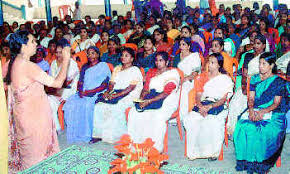
Mumbai’s bais, domestic workers, received a modicum of recognition when the state of Maharastra passed the Domestic Workers’ Welfare Board Bill at the end of December. Maharastra is the seventh state to pass a domestic workers’ bill. There are an estimated 500,000 domestic workers, mainly women, in Mumbai alone, and over a million across the state, according to government estimates. Domestic worker unions and associations, who have been lobbying for such a bill for twenty years, are supportive. Meanwhile, “State labour minister Nawab Malik, though, has termed this a “welfare measure”, adding that enforcement (punishment for violation) would not be considered at this stage.”  When it comes to domestic workers, the rule of law always translates them into recipients, or worse clients, of welfare.  The legislation emerged from women domestic workers’ decades long sustained campaigns.

There’s the rule of law and there’s the rule of household. Togo has confiage, or entrustment. Rural families send their daughters to live with urban relatives. The girls are supposed to get education, and in exchange they are to `perform’ domestic chores. Here’s what’s been documented: beatings, deprivation, rape. Guess what? The conditions of adult domestic workers, all women, is just as bad. In 2007 the Togolese government categorized domestic labor as one of the worst forms of labor. So, CARE International worked with a recruitment agency to help them improve their working conditions. Then the agency helped the domestic workers to organize a domestic workers’ union. Workers complain to the agency, and the agency places them in a different household. The offending household loses a domestic, for two seconds. No negotiations, no consultations, no strikes, no change in dominant order. No unions.

In the United States: “Employed mostly in private homes, domestic workers experience levels of exploitation and physical abuse rarely seen elsewhere. Mostly women and of color, they face those conditions without the protection of collective bargaining or other union tactics. As nannies, caregivers for the elderly, and housekeepers, they have remained almost invisible, their lives often akin to modern-day slavery. An estimated 1.5 million (U.S. Census Bureau) face these conditions.” As in Togo, as in India, domestic workers, mostly women, are organizing. In the U.S., the National Domestic Workers Alliance, the National Domestic Workers Congress, a myriad of local and regional organizations are women pulling women together. Mujeres unidas y activas.

In India, Togo, the United States, in recent decades, domestic labor has become a key of neoliberal economic `development.’ In Sweden, the neoliberal assault on women involved pigavdrag, maid deductions, and vårdnadsbidrag, care support. The state subsidizes private, individual childcare. Who suffers? Working class and low income women. What is under assault? Feminist political economy: “Vårdnadsbidraget delivers the final blow meant to send women back into the household. After the long struggle to free women from their homes, women are now offered 3000 Swedish crowns (ca 320 ) per month to stay at home with their children. This is obviously not an offer aimed at single mothers: it is impossible to survive on this sum in Sweden. Those lucky women who have a real man who brings home a big salary, however, can contentedly stay at home and accept the pocket money. And so women are again made financially dependent on men. The pigavdrag and the vårdnadsbidrag are both solutions only for the upper classes, who don’t want to pay the real price for a maid or send their children to a kindergarten. They represent the government’s mobilization of several types of oppression, which they have the guts to call a new `gender equality politics’.”

When it comes to domestic workers, the State translates labor law into welfare or goes on the attack. In India, Togo, the United States, Sweden, and everywhere else, women domestic workers are organizing their own structures.

(Photo Credit: The Hindu)