The English of Domestic Violence, and The Domestic Violence of English

The English of Domestic Violence, and The Domestic Violence of English

We split infinitives
We split the atom
We split a skull

What wonderful beings
we are (we men)
we who are superior
to all things

We crack a walnut
We crack a joke
We crack a (spare) rib

We blow out a candle
We blow into our hands for warmth
Those same hands that 
strike a blow

We strike a match
We go on strike – 
and come home to strike
a woman and (girl) child
(in the quiet and dark 
of family life away
from the glare of the public)

We build confidence
We build houses (albeit matchbox ones)
We build relationships, which we
then break down like they are
our matchbox houses

We march, against apartheid
(of the statute book and the mind)
Sometimes we even march against 
capitalism and woman and child abuse

We name our children
We name hurricanes
We call women names

We take up burning issues
and bride-burning continues

We arrange our furniture
and we arrange marriages

What wonderful beings
we are (we men)
we who are superior
to all things

(Penned Saturday, October 08, 2005)


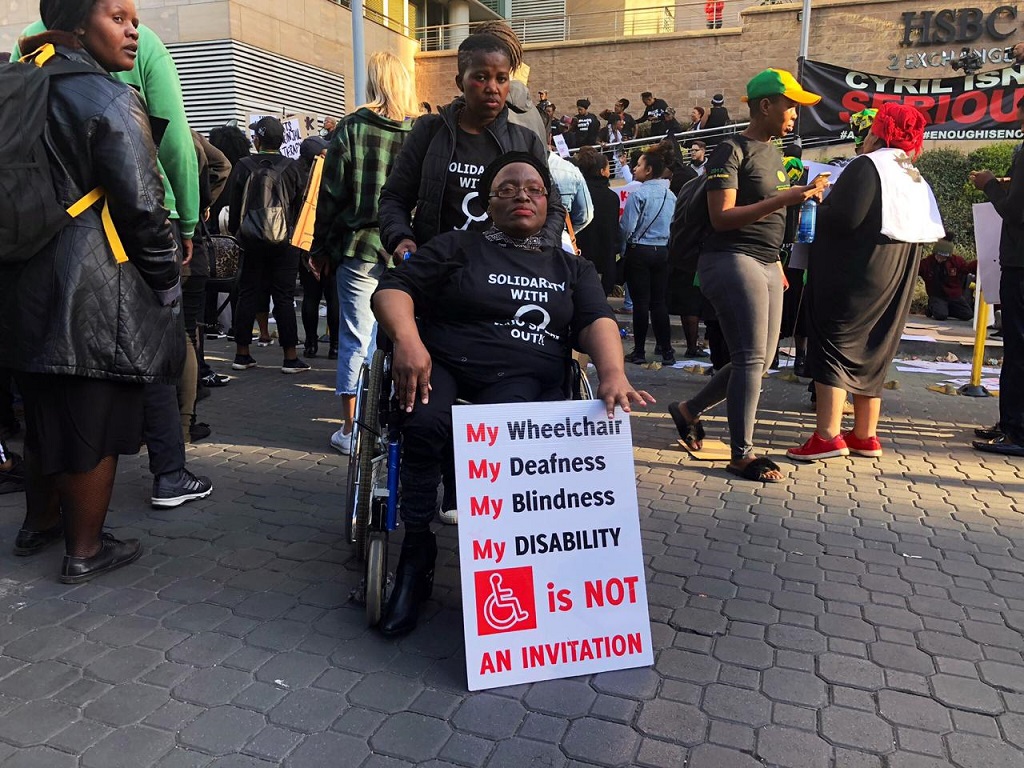
Photo Credit: Silindelo Masikane / enca)

What happened to Cheryl Weimar? The routine torture of women in Florida’s Lowell Correctional Institution. Shut it down!

Cheryl Weimar is 51 years old. She lives with mental illness as well as a physical disability, a hip condition that limits her mobility. Cheryl Weimar is also a `guest’ of Florida’s largest women’s prison, Lowell Correctional Institution. On August 21, a prison staff member directed Cheryl Weimar to clean the toilets. She explained that she could not, due to her hip condition, and asked for another assignment. Four `officers’ then threw Cheryl Weimar to the concrete floor and proceeded to beat her. Realizing they were in sight of a video camera, the four dragged Cheryl Weimar out of camera sight, and beat her to `within an inch of her life’. She is now in hospital, paralyzed from the neck down. Her neck is broken. She breathes through a tracheotomy and takes food in through a tube. This is Cheryl Weimar’s condition until the day she dies. While in hospital, Cheryl Weimar is `guarded’ by precisely the staff that put her in this condition. Cheryl Weimar is the embodiment of the phrase, “paying the price for one’s misdeeds”. Cheryl Weimar is the what justice looks like in Florida’s Lowell Correctional Institution. Cheryl Weimar was set to leave Lowell Correctional, February 2021. Now, she’ll never leave. Justice is served.

Cheryl Weimar is suing Florida. Former residents of Lowell Correctional have rallied in her name and called on Florida to fix this hellhole. Jordyn Gilley-Nixon, also living with disabilities and a former Lowell Correctional inmate, released a video describing in detail the sexual violence she suffered at the hands of Lowell Correctional staff. Former Lowell Correctional prisoners and supporters demonstrated last week. They showed up with their mouths taped. Latangela McCall showed up with her six-year old daughter and a sign that read, “Change is now, tired of talking, no one listens”. Other signs showed photographs of hundreds of former prisoners with their mouths taped. Debra Bennett, former prisoner and organizer of the protest, explained, “Weimar’s beating is alarming but not surprising …  Silence got everybody’s attention – nobody ever listens to us convicts. We’re here to prove a point … We’ve been talking long enough. I’m tired of talking. We want action … It keeps getting worse. There’s going to be somebody else beaten.”

Cheryl Weimar’s story, Jordyn Gilley-Nixon’s story, and all the currently circulating stories were preceded by those of Michelle Tierney, 48; Latandra Ellington, 48; Regina A. Cooper, 50; Affricka G. Jean, 30, all four of whom `died’ under `mysterious circumstances’ in 2014. As we noted at the time, “they did not `die. They were killed.” Now, five years later, the world again `discovers’ the hellhole that is Lowell Correctional Institution. Yet again, the State, both Florida and federal, will `investigate’, and yet again worse than absolutely nothing will happen. This is our gulag, writ both large and small; our internal necro-colony, where not being able to clean a toilet is a death sentence. It’s too late to `fix’ Lowell Correctional Institution. Shut it down. Shut it down today. Shut it down now. There’s going to be somebody else beaten. It keeps getting worse.


(Photo Credit: Dana Cassidy / WUFT)

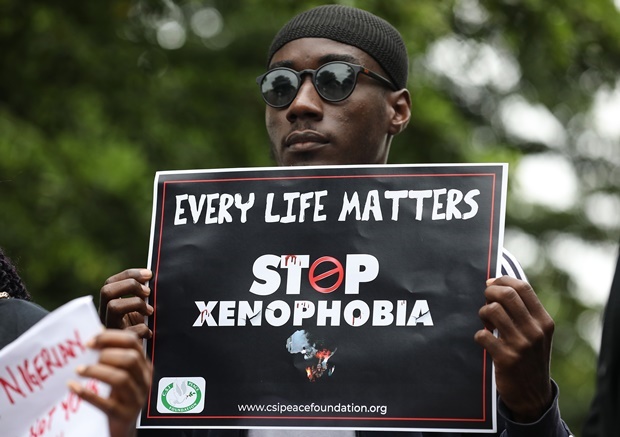
On xenophobic violence: Press Release by Pan African Network in Defense of Migrant Rights

10 -September -2019

The entire continent is watching in pain, confusion and anger as South Africa struggles to contain massive social implosion  and manifestations of profound  contradictions. The loss of all life and disunity among Afrikans is everything that progressive formations including the Pan African Network in Defense of  Migrant Rights (PANiDMR) stand against. The symptoms of these contradictions have most recently  leaked into  attacks among  the marginalised and  neglected underclasses, where precarity and desperation co-exist.  State responses include deploying ‘social cohesion’ programmes as a catch all attempt to mop up these violent social conditions.  

The recent attacks  on 13 Africans in South Africa form part of an undercurrent of historical fissures. The nature of  violent  interstate, attacks that have been witnessed in the past seven days pre-date the end of the colonial apartheid  dispensation. In the 1980s what is  now often described as Afrophobia or Xenophobia was mischaracterized  under a blanket of  political violence.

The historical DNA of South African political contestation is embedded in ways of addressing difference that  is situated in the theatre of vanquish and  party political extremism. The bloodshed across urban South Africa in the 1980s and 1990s pre-1994 was partly stoked by various political interests, played out on Black bodies. The necklacing in African communities was the most vivid and vicious instrument to enforce political discipline of real or imagined infractions and betrayals. It was also a marker of deep inter-community distrust primarily among political and ethnic communities. The specter of being labeled as  ‘other’ was sometimes  sufficient cause for comrades to sell each other’s lives in return for their own. The inherent trauma that communities are still carrying with them was largely airbrushed by the  ‘Rainbow’ narrative even though it is clear that centuries of dehumanizing behavior was not going to go away as  new flag was raised.

This occurred in the context of the South African state machinery that  systemically dehumanized and brutalized African people in this country. The colonial imagination legislated and constantly enforced the idea that African people are sub-human interlopers in a racialised and privileged ‘White’ world. This was prescribed through structural enablers like labour, education and land legislation all of which created an intergenerational cohort of African people who would always  be  a marginal , sub class of work horses. In the era of growing unemployment , this too has created a subaltern formation that are fully disposable and for whom the State has no tangible plans beyond ‘social cohesion’ to bring from the margins. 

There are further problems emerging from this. Firstly, South Africa has done very little to alter the social and economic  pathways made available to the African majority in this country. White priviledge through land, economic ownership patterns, social relations and life outcomes has been left virtually intact.  In tandem to this , multiple countries in the global South and across Africa were virtually disemboweled by structural adjustment and ongoing incursion of capital into State power. Instances of civil war and ongoing wars that some States wage against their nations – both often with the ‘ invisible hand’ of Western interests – have resulted in weakened States and limited economic opportunities. 

There are other issues that include the expectation by locals to  have first preference for jobs while many companies choose to employ vulnerable migrants for lower wages, creating working toxic and inevitable class resentment. In addition to this, porous borders with weak and often corrupted border controls, sloppy and complicit police are adding stress to a difficult situation.  Well documented reports of criminal rings run by a section of  African compatriots were a large cause of  the attacks in Tshwane (Pretoria) last week. In many areas including there, police have failed to investigate allegations or make arrests, which contributes to the ‘those people’ narrative rather than situating this within a failed and compromised criminal justice system.

Naturally, there will be movement in search of better lives and perhaps naturally, to  countries that appear to offer the most hope, possibility and for some refuge from political repression.

Tragically for all these periphalised people, the South African state has not deconstructed the machinery of ‘othering’  the most vulnerable and as the Marikana massacre showed, is well able to unleash brutal force against Black bodies, many of whom were migrant workers.  The exodus  of millions of people to South Africa from across the world illustrates a  shared aspiration that they have towards the victory over political apartheid that South Africa still represents. 

And yet co-ordinated and periodic combustions related to inadequate public service delivery, organised labour strikes, student uprisings, and other demonstrations of public anger are a huge part of the character of modern South African politics. A politics steeped in historical trauma, ongoing dispossession, a breakdown in state institutions and frenzied attempts by the government to ‘act normal’ for the benefit of international investors while the underclass of all nationalities battle for scarce resources in the most brutal ways. Local and migrant Africans across the African continent are exhausted by the wait for something more from our governments. 

Self-serving elites have driven many African compatriots to South Africa only to find that many South African political actors have fallen into a similar abyss of myopic disregard for the masses. The statements issued  by President Ramaphosa in recent days lacked empathy, class analysis and any semblance of a Pan African understanding of how deeply embedded our fates are tied together as African countries. This is an opportunity to raise a challenge to our African leaders to create nations that are nourishing and  accountable. Nations that appreciate the talents at their disposal, create environments where all Africans can thrive and contribute. The retaliatory attacks on South African businesses across the continent ultimately hurt the marginal and working classes yet again and though this may be a  temporary ‘blue eye’ for White owned corporations, it only fuels more resentments while eroding authentic African  economic and political agendas. 

 At the time of writing, 13 Africans are reported dead, 8 of whom are  thought to be South Africans. Most regrettably, attempts by formations such as PANiDMR and Trade Collective to obtain the names and countries of origin from relevant  authorities have so far yielded no results. Beyond dying a dehumanising death, our family members have died namelessly. So emblematic of the State’s careless, dispassionate relationship with the underclass. PANiDMR sends heartfelt condolences to the families, friends, communities of the Africans killed over the past week and all the years before. We pray that the death toll of 13 will not rise further and renew our commitment to building a Pan African vision that affirms and valorises African lives and Black lives in and out of the Diaspora.

(Photo Credit: News24 / Kola Sulaimon / AFP)

So you think you know what teachers do? Right?

So you think you know what teachers do? Right? 
Wrong! You dont!!

You went to school so you think you know what teachers do? 

We all know what teachers do, right? After all, we were all learners, students pupils at one stage. Each one of us, each a product of public education. We each sat in class after class for years. We encountered many teachers. 

We had our Sub A teachers and our primary school teachers and our history teachers and our art teachers and our music teachers. We had our science teachers and our handwriting teachers and our English teachers and our math teachers. And we had gesondheidsleer teachers. And we had guidance teachers. 

And we had principals. 

And so you think you know teachers? 
You get what teachers do? 
You know what happens in classrooms? 
You know which teachers are effective, you know which teachers left lasting impressions, you know which teachers changed lives, and you know which teachers were just the qaqqest teachers ever. 

We know. 
We know which teachers changed lives for the better. We know which teachers changed lives for the worse.

Teaching as a profession has no mystery. It has no mystique. It has no respect.

We were all students once, and therefore we know teachers. 
We denigrate teachers. 
We criticize teachers. 
We can do better than teachers. 
After all: 
We know. 
They teach.

We are wrong!!!!
We do not know what teachers do if we never walked a mile in a teacher’s shoes!!

We need to honour teachers. 
We need to respect teachers. 
We need to listen to teachers. 
We need to stop reducing teachers to arbitrary measurements of student growth and performance in exams.

Most of all, we need to stop thinking that we know anything about teaching merely by virtue of having once been students ourselves. 

We don’t know.

I spent twenty years of my life in mainstream, poor public schools as a teacher. Then I spent twelve years as a curriculum advisor in the education department, working at district, provincial and national levels. For the last 9 years I’d been teaching on continuing teacher professional learning programmes in the Centre for Pedagogy in the Ed Fac at Stellenbosch University. In addition, I did a host of other things in education at various levels and institutions. When my grandbaby came along in 2018, I took a decision to scale down and cut the travelling. I needed to spend time with KnoxCooper and besides, the travelling was tiresome. 

I now had so much time on my hands. During the first term of this year I started itching. My Mondays to Fridays were free and most of what I did in the teacher professional learning programme happened during school holidays and over some weekends. 

I literally came to a standstill and had lots of time to reflect. 

And then I started itching. 
I knew what the itch was about. 
I knew I could not sit still.
I had to teach. 
I had to teach children. 
I knew I was made for this. When God wove me in my mother’s womb, He planned for me to be a teacher. 

And then the universe conspired and placed me right back into a school, teaching 160 grade sixes!!
How blessed I am!
And I’m simply loving it. 

I missed managing a classroom. I missed reaching learners. I missed inspiring a love of learning. I missed inspiring a love for reading. 

I wanted to inspire children again. I wanted to reach children again. I wanted to make a difference where it matters again. 

I realised that I was respected more as a curriculum advisor and a lecturer and all the other hoity-toity profiles I held over the last 20 years, than how I was respected as an ordinary post level one public school teacher. 

If you have never been a teacher, you simply have no idea. 

You did not design curricula, plan lessons, attend parent meetings, assess projects and exams, design rubrics, set exams, prepare reports for parents or monitor learner attendance. You did not tutor learners, review their rough essays, or create study questions. 
You did not assign homework. 
You did not write daily lesson outcomes. 
You did not teach poems or new words. 
You did not mark homework. 
You did not learn to write legibly on the black board while simultaneously making sure that none of your learners get killed behind your back, considering the low tolerance levels and high anger levels that learners come to school with. 
You are not used to being told “Jou ma se poes”, up to three times in one week by 12-and 13-year olds, because you’re an old-school teacher and a strict disciplinarian.

You did not design lesson plans that succeeded. 
You did not design lesson plans that failed.

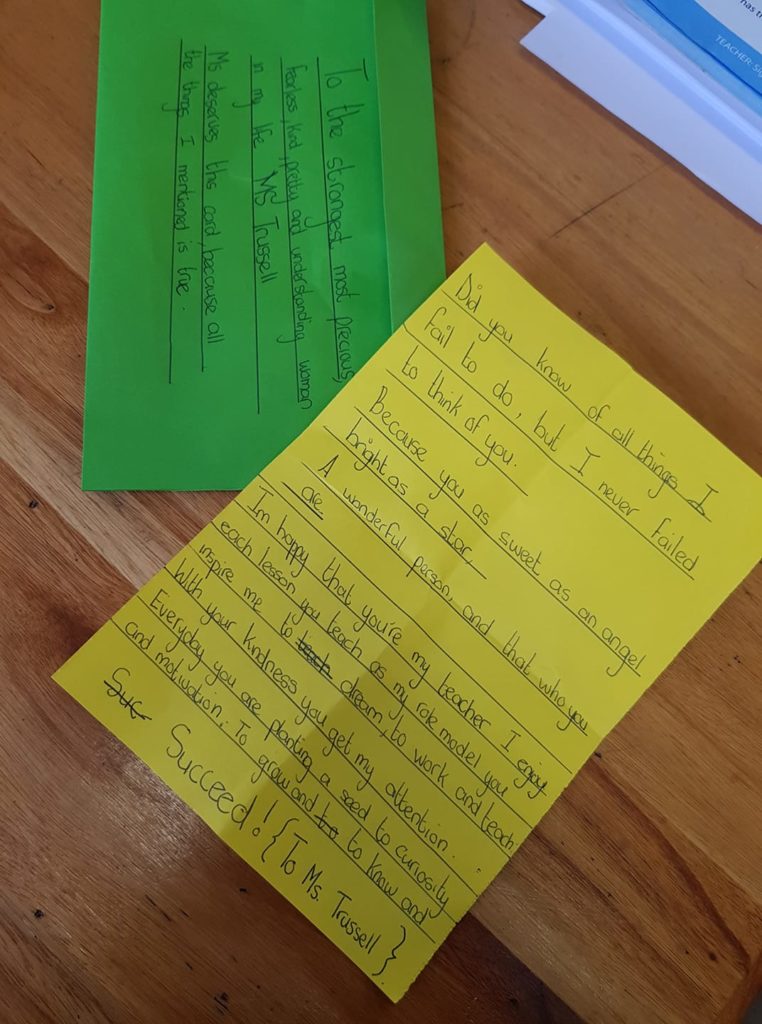
You have never received the most endearing love letters from learners that wanna make you cry. (Like the one in the pic I received yesterday.)

You did not have to keep your learners quiet because the inspector is in the principal’s office. (I prefer a buzz of activity in my classes.) 

You did not learn how to teach functionally illiterate learners to appreciate great poems. 
You did not design lessons to teach learners tight reading skills by starting with the lyrics to songs that they like. 
You did not miserably fail some of the children you taught, because you had no books to give them. 
You did not struggle to teach your learners how to develop a focal point for their essays, or bask in the joy of having taught a successful lesson, of having gotten through to them, even for five minutes. 
You did not struggle with trying to make science vocabulary relevant to learners who did not have a single university or college, or even a library close to where they live. 

You did not laugh, because you so desperately wanted to cry, when you read some of the qaq they write in their exams. 
You did not struggle to reach children who proudly announce that they only came to school to make sure that their mothers don’t lose their SASSA grants. 

You have never spent all of New Years’ Day crying five years after you’d left the classroom. 

You did not. 
And you don’t know. You observed. Maybe you learned. But you didn’t teach.

Let’s show teachers just a little more respect. They are human too. They also have lives, and husbands and wives and sick babies and cats and dogs too. 

The problem with teaching as a profession is that everyone everywhere in the world thinks they know what teachers do. And they don’t. 

So they prescribe solutions, and they develop policies, and they editorialize, and they politicize. 

And they don’t listen to those who know best. Those who can teach. 

The teachers.

Hope lies here, in the roots of this our land

Hope lies here, in the roots of this our land. 

Last night two activists spent the night with me. They have been beaten by police, fabricated cases filed on them, jailed, their colleagues killed by so called Maoist ultras funded by Coal companies, police fired on their people killing three etc etc

They asked me:
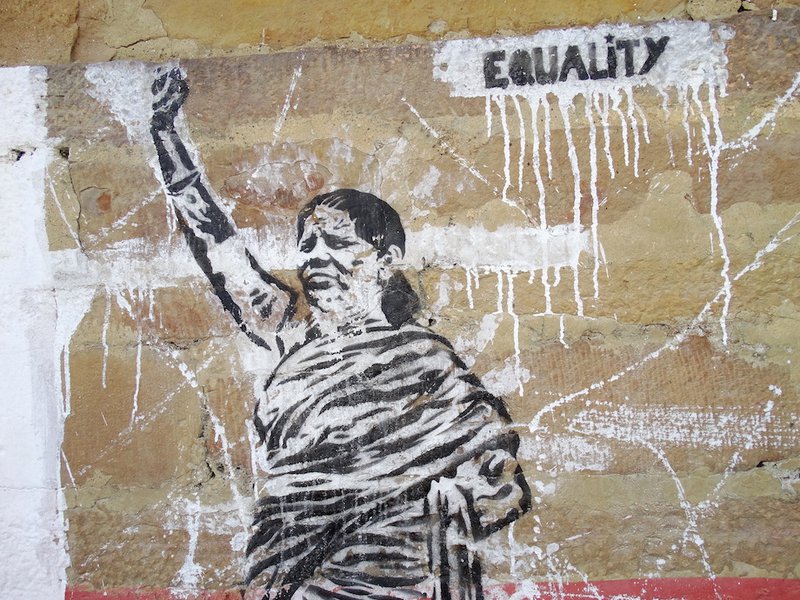
“Brother What is happening in England regarding democracy?”. “Whats happened in our Amazon with our Adivasi relatives” 

The conversation then went to the Indian economy.
They already knew about the loot of RBI reserve funds and unemployment surge.
-The other WhatsUp University guys.

Then one of them said
“What ever is to happen, it cannot be worse than what we and our people have gone through ever since our birth.”
“We are ready/prepared, we will fight, jail is a better place, at least we get food and will not be hungry” 
“We are not Chintabarams or Vijay Malayas” they said.

Both were off to a workshop on the Indian Constitution, both had copies of it! (funny I do not)
Both are Dalit farmers fathers of school going children.

Hearing them I can say there is hope for India!


(Image Credit: Adam Jones / Open Democracy)

Disinterring Women’s Words (Mots Ecrits)

In France, on August 12, she was the 88th or maybe the 89th victim. She was 71 years old. There is no age limit to being killed by your partner, husband or ex. There are now 101 women victims of feminicide since January and the death toll will continue to grow. The epidemic is worldwide and almost permanently active. In France the government declared its intention to organize a conference in September to address the issue widely but failed to announce more funding. Compared to the 200 million euros Spain devoted for a national pact against domestic violence that is also called machismo terrorism, France scores poorly with its promised 79 million euros. It is time to face the reality of feminicide in France, and elsewhere.

The theatrical project Mots Ecrits, conceptualized by the actress Sophie Bourel from a collection of archives on women’s lives, makes visible invisibilized violence against women. Bourel decided that the first part of her project will concern the issue of feminicides, an issue that brings the everlasting danger for women of being killed as well as a sense of urgency.  For Mots Ecrits, Bourel collects a corpus of archives on feminicides and creates a theatrical performance based on these written words. With a wide variety of documents, what she calls “de la matière” (raw material), she is able to give life to the words to make the performance live fully and independently.

Sophie Bourel feels that she has an enormous responsibility since feminicide still ravages society. When we met her one morning, she was all excited because she received documents from the archives of a French department. She welcomed us with “Hello I am so happy,” as if she had found a treasure. In fact, for her it was a treasure, since finding anything about women including about their assassination by partners, lovers etc. is so difficult. The invisibility of women is multifaceted and the invisibility of their elimination is at the source of their absence in public space. The files she received that morning concerned a crime that occurred January 16, 1975 in a French town on the Loire river. The woman killed that day first appeared in police records in July 1968. She went to the police station to report violence in her home and her son had a head injury; her neighbor also testified. This ended up in a murder attempt in June 1975, when the perpetrator raped and locked her up. She filed a complaint and got an apartment to which she moved with her children. But she was not safe. At the end of 1975, he visited her. She went to the police station to say that she was scared. On January 16, 1976, he waited outside her apartment building, grabbed her, dragged her to the riverbank and shot her twice.

Sophie Bourel doesn’t see this as an isolated case. She created a list of 78 and then 80 graves. She says, “If I look at my list, I am going to find a woman who has been killed in a similar way: 2 pistol or gun shots! I am going to put the two women in contact with one another to create a sort of echo, the one who died 50 years ago with the one who died in 2019. Killed in the same manner. It is as if one opened her casket to welcome the newly killed.” She adds that it is also a way to fight because we must fight, for if we don’t, nothing will happen to save women. Men should be afraid of killing women.

Within the archive she received, there was also a petition sent to Francoise Giroud, Secretary of State in charge of the condition of women from 1974 to 1976, the first ever ministry established in France that concerned women’s issues The text said:

Reasons for the choice of this type of petition:

The Judicial procedures and the possibilities of intervention of the bodies in charge of people’s safety seem to be able to work only after the crime has been committed. This procedure has the inconvenience of requiring the death of the person first before being able to activate the wheels of law. On the other hand, it has the advantage of not forcing the judges to make preventative decisions (that can be traumatic for the perpetrators).

This petition clearly shows the objectification of women and sadly points to the State as engendering such a view. Representation of human beings in the State means visibility and therefore the opportunity to be heard and seen. It means conferring the person or group with an identity, or a face. If a human being is not recognized by the State, that person is an object and can be killed. As Hannah Arendt points out, when people are objectified, they can be eliminated. Objectification of humans or the environment is the precondition to destruction. Conscience or ethical responsibility is tossed. 

When Pramila’s mother, disabled and sick, was threatened by a family member, she had to get the help of police and lawyers. In one instance, the police said that she could be left alone with the violent family member. When Pramila objected that her mother is in danger of being hurt or even killed, the police responded, “Then we can bring a case against the perpetrator. No problem.” She was aghast. To even suggest that an old, ill and disabled woman should be killed in order to bring her perpetrator to justice is unconscionable.

When Nirbhaya’s rape, known as the Delhi rape case in 2012 led to mass movement for justice for women, a British journalist interviewed the rapists for the BBC. Recounting the incident in which Nirbhaya was sexually assaulted, one of the rapists, Singh, said “While being raped, she shouldn’t have fought back. She should have remained silent and allowed the rape.”  We know that passivity would not have saved Nirbhaya’s life. 

Worse yet is the law’s weakness when it comes to justice for women. Nirbhaya had to die after the gruesome mauling of her body in order for her case to go to the fast-track court! Alive, she had no protection against her assaulters. 

French law has evolved very slowly, and has repeatedly failed to protect women. In March 1994, France introduced a series of laws against violence (in general), but it is only in 2003 that domestic violence is seen as an aggravating circumstance by the law. Since then, almost every year, a new amendment was passed in the desperate attempt to tackle the number of women killed by their partners and exes, but to no avail (articles 221-4222-12 and 222-13 of the French criminal code). 

In comparison, in 2004 Spain reformed its criminal court system to bring down domestic violence, creating 106 specialized courts and an adapted prosecution bringing the rate of Spanish women killed by their husbands from 71 to 43. In Canada, because of the nature of the harm of domestic violence, the judges can provide for release conditions such as “no contact” until the trial or appeal even where no offence has been committed. Yet, where personal injury or damage is feared, courts can also order “peace bonds or recognizances.” The French Criminal laws also contain a number of special provisions that serve to protect victims, but these means are almost never used by the judges and the police. 

How many women have to die in order to change the mentality about the role and rights of women? How many women have to show the scars, the badges of abuse, in order to be heard, and in order for the law to be comprehensively enforced? Laws regarding “national” security are immediately carried out and enforced! The urgency of the situation should have forced us to act a long time ago. Meanwhile, in France, 93 women have died since January 1st. Every week, 3 women are killed by their respective partners. For 3000 years women have been abused by men. In many countries, our laws have been written by men and (un)enforced by men. This is not acceptable.


(Photo Credit 1: France Culture / Denis Meyer / Hans Lucas / AFP)

In Brazil’s burning rainforest, Indigenous women lead the battle against ecocide, genocide

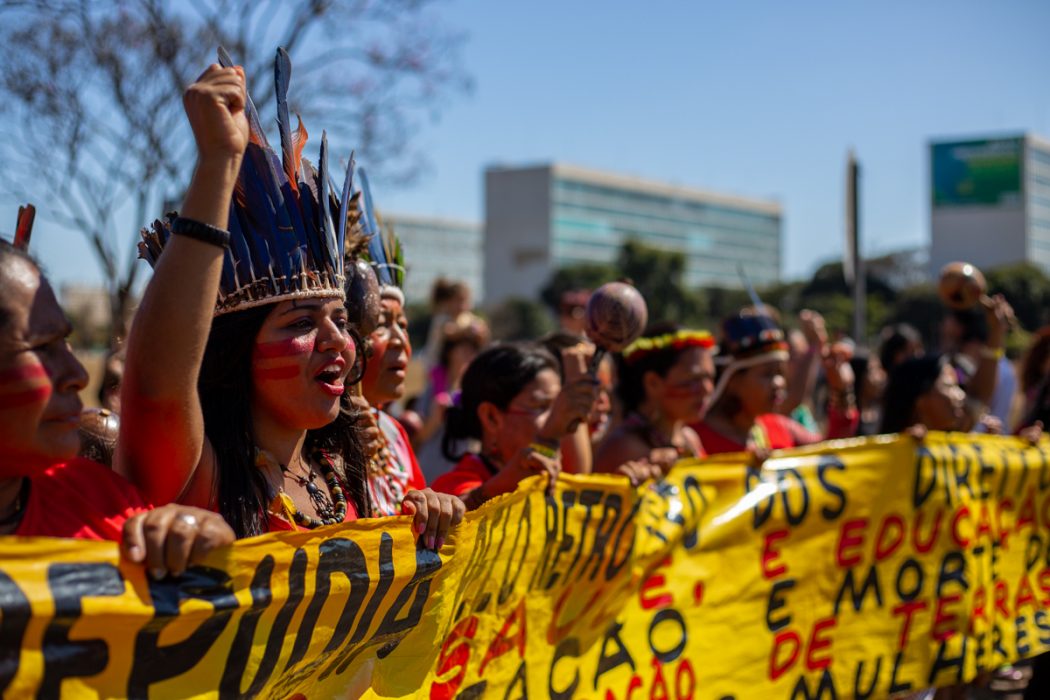
The Indigenous Women’s March

It only took three weeks or so for the world to take note that Brazil’s Amazonian rainforest is on fire, a fire whose smoke turned Sao Paola’s midday to midnight, a fire that from deep space portends an immediate threat to all living beings on the planet Earth. According to those watching the Amazon, the rainforest has suffered close to 73,000 fires this year alone. In the past week, around 10,000 fires have erupted. This represents a 70% increase in fires since January 2018. This sudden peak in rainforest fires is directly attributable to the policies of the Bolsonaro government. The Amazon is on fire, the Earth is on fire. Amazonian Indigenous peoples warned us that Bolsonaro, and the system of which he is a part, would do this to the forests and to the Earth. Few listened. In this struggle, Indigenous women lead the effort to liberate the Americas and the world. From the outset, they argued the struggle for Indigenous and environmental autonomy was and is a liberation struggle. Maybe now, maybe, more of us will listen. 

On August 13, 2019, Indigenous women converged on Brasilia for the first Indigenous Women’s March. Under the banner “Territory: our body, our spirits”, thousands of Indigenous women from hundreds of different Indigenous populations gathered and filled the streets for days. Sônia Guajajara, leader of the Articulação dos Povos Indígenas do Brasil (Brazil’s Indigenous People Articulation), APIB, explained, “We came to denounce the president’s hateful discourse, which has increased violence and destruction in our territories, which directly impacts us, women. We are counting on international solidarity to advance this movement for our future.” Her colleague, Célia Xacriabá added, ““For the first time in history, the indigenous women’s march convenes more than 100 different peoples in Brasilia with more than 2,000 women present. This is a movement that is not only symbolically important but also historically and politically significant. When they try to take away our rights, it’s not enough to only defend our territories. We also need to occupy spaces beyond our villages, such as institutional spaces and political representativity. We call on the international community to support us, to amplify our voices and our struggle against today’s legislative genocide, where our own government is authorizing the slaughter and ethnocide of indigenous peoples. This is also an opportunity to join our voices to denounce this government’s ecocide, where the killing of mother nature is our collective concern.”

At one level, as in the past, the real tragedy in Brazil is that there is no tragedy. There is only redundancy, murmurs of complicity, and, then, as in Gabriel Garcia Marquez’s Chronicle of a Death Foretold, the inconceivable: “It was inconceivable that they would suddenly abandon their pastoral spirit to avenge a death for which we all could have been to blame.” However, today, as in the past, Indigenous women are organizing, refusing to accept that script that renders them abject and renders the world as empty and farcical. They are demanding that we, all of us, recognize we have the possibility of liberation. As Tamikua Faustino explained, “Deforestation is a killer. If we don’t stick together, in the near future we’ll be eliminated.” It’s time to reject those who would impose a death sentence on all living beings, to refuse the vampire thirst for the blood of all living creatures. It’s time to see the sun at midday, the moon at midnight. Eight years ago, in a different environment crisis in Brazil, Indigenous woman organizer Juma Xipaia declared, “We will not be silent. We will shout out loud and we will do it now.” Another world is possible. Shout out loud, do it now.


(Photo Credit: CIMI / Tiago Miotto)

Where is the global outrage at the destruction of Kashmir and the assault on Kashmiri women?

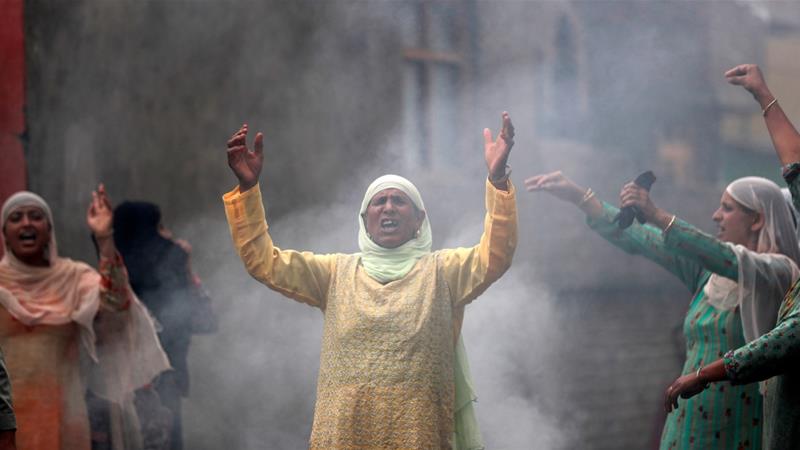
Women in Kashmir protest, August 2019

There is a long row of women, who have given birth in the midst of destruction, their babies, a new generation, are tied securely to their bodies with a duppatta. I see them as they walk, slowly, cautiously, confidently, across the broken embankment, past seething waters, to the safety of their community and their people. Once more, they shine.

Freny Manecksha. Behold, I Shine: Narratives of Kashmir’s Women and Children


In early August, the Indian state suspended Article 370 of India’s Constitution. Article 370 gave special status to the state of Jammu and Kashmir. This special status included a separate constitution and administrative autonomy. In suspending the Article, and effectively India’s Constitution, Narendra Modi offered economic development and his version of a War on (Islamic) Terror as justification. The lynchpin of this claim was the protection of Kashmiri Muslim women. In this scenario, Modi is the great liberator savior of Indian Muslim women. Kashmiri women know better: “Who will liberate us? The BJP leaders who are saying men in UP or Haryana (where the sex ratio is low) can now source fair brides from Kashmir? Are we apples or peaches of Kashmir — goods to be looted by our conquerors?” The women of Kashmir are accustomed to these claims of liberation, empowerment, freedom, and have consistently rejected them as false and empty. For decades, and centuries, women of Kashmir have organized to dispel the night and fog of various modes of patriarchal sexual violence against women and girls.

Since the declaration, India’s Prime Minister has continued to claim that the erasure of semi-autonomous Kashmir  is part of the program of women’s liberation, which begins with `protecting’ Indian Muslim women … from themselves. Since the declaration, Indian social media has recorded public officials and just plain menfolk boasting that now they can go to Kashmir and pick up “fair Kashmiri women” as wives.

Kashmiri women know better. They know that “protection” means intensified occupation, unparalleled communications and information blackouts, ramped up harassment of women and girls. They know that protection means the most vulnerable, such as women in childbirth, will be the most exposed to violence and danger. They know that armies that march under the banner, “Save Muslim Women!”, are never to be trusted. They know this, and their knowledge of such has been well documented again and again and again.

Despite the documentation of Kashmiri women’s decades and centuries long histories of self-organizing, the world more or less stands by and watches the new phase of protective torture of women and girls with a muffled cough of disapproval. Where is the global outrage at the intensified assault on Kashmir, and particularly on Kashmiri women? Where are the mass demonstrations in support, the teach-ins, the calls to action, other than polite invocations of solidarity? Where are the comrades, the militants, the feminists? Where is Kashmir? Nowhere. Who are the women of Kashmir? As far as the world at large is concerned, no one. Less than no one. Poor blighted beings in need of salvation. “But, hell, let’s just ‘Save Muslim Women’!”

For the world that abandons children, the future is the house of the dead

“Tyranny is a habit, it has its own organic life, it develops finally into a disease.”   Fyodor Dostoevsky

“I stay stuck on this point. There is a new outrage every day, but I try to remember children. If I were one of them, away in a strange place, all alone, surrounded by strangers, and my mother or father or both were taken away, how could I possibly cope? If I were the father of a child taken away from me to who knows where, and I had no idea if I would see my child again, how could I continue to function?” Charles Blow

Welcome to the horror show of contemporary “life”. Around the world, reports indicate that nation-States, so-called democratic nation-States, have formally, finally, and once again decided it’s time to abandon children, to criminalize their childhood, and to turn the future into so much rotted carnage. In Loiret, the government plans to “release” 150 unacccompanied migrant teenagers from State servicesThe plan is no plan. Put them out and let them fend for themselves. Australia anticipates “removing” triple the number of Aboriginal children within 20 years.Over thirty children are being forced to suffer “searing temperatures” on board a ship in the Mediterranean because Italy and Malta refuse to let them disembark. Yesterday, U.S. Immigration and Customs Enforcement arrested 680 people, workers in various plants in Mississippi. Hundreds of children of all ages were left behind, without a moment’s notice or concern. Children are not the concern of the State. Families are scared to death. Story after story appears of children of immigrant workers in Mississippi left at school with no one knowing what to do; children on board a boat in the Mediterranean with no one knowing what to do; Aboriginal children in Australia being removed from families with absolutely no consultation with the community and, again, no one knowing what to do; already precarious, isolated children in France being thrown into the streets and no one knowing what to do. This is our knowledge, the knowledge of no one knowing what to do. This is the future. Cover the mirrors with black sheets. Turn off the lights. Close the door. But first, remember to devastate the children. 

(Photo Credit: Rogelio V. Solis / Associated Press / New York Times)

Mass shootings in the U.S.: Rooting out white nationalists and misogynists is necessary

Mental illness keeps being raised as a factor in mass shootings. But we need to stop using mental illness as a scapegoat. 

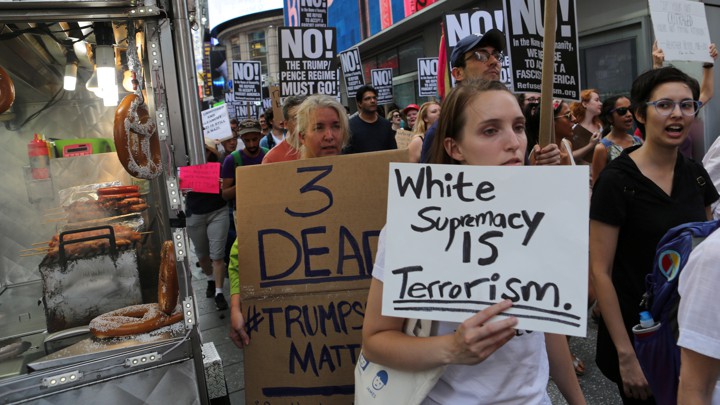
Mass shootings in the U.S. are a specific phenomenon highly correlated with misogynist violence against women — as fantasy or as reality — and with racism, specifically white nationalism. The majority of mass shooters show one or both of these characteristics. They are not mentally ill; they have deeply warped political and social views that have long festered in our country. They are also not lone wolves, for each has been connected to like-minded groups, whether on the internet, in neo-nazi orgs, or other forums. There is even a forum where the shooters are heroes and wannabe shooters boast that they will have higher kill rates. These forums are also full of white nationalist talk and misogynistic talk.

Mental health care and gun control — as desperately needed as they are — will not adequately address the crisis of mass shootings. Rooting out these white nationalists and misogynists is necessary. Categorizing them as the violent and terrorist organizations that they are and treating them accordingly would be a step in the right direction.

What is stopping us other than our collective reluctance to face the ugly truth?

(Photo Credit: The Atlantic / Joe Penney / Reuters)