Making Women’s Charters in Egypt and South Africa – part 2

August is Women’s Month in South Africa. The biggest non-scandal that escaped mention in both the Women’s Day speeches of the president and the deputy president is not simply the oppressive social conditions imposed on women, but the fact that it is getting worse. The Tshwaranang Legal Advocacy Centre to End Violence Against Women reports that this year, while gender based violence rises steadily, just 8% of monitored police stations complied with their obligations under the Domestic Violence Act. In 2007 compliance had stood at 57%. Maternal deaths during childbirth now stand at 625 per 100,000 – four times the number it was at in 1990; during the same period the much poorer Sub-Saharan African region as a whole reduced maternal mortality rates by a quarter!

Two recent comprehensive assessments of gender inequality bear out this picture. The United Nations Committee on the   Convention on the Elimination of all Forms of Discrimination Against Women (CEDAW) had its 48thsession from 17 January to 4 February this year. Three organisations – People Opposing Women Abuse, Centre for the Study of Violence and Reconciliation and the Western Cape Network on Violence Against Women – together submitted a shadow report on the implementation of CEDAW. The authors of the report assess South Africa’s performance by systematically measuring the social position of women against all the articles of CEDAW using the latest data. Their findings cannot be ignored, except by presidents and deputies with selfish agendas. On legal equality the shadow report says, ‘Whilst the State has embedded the right to gender equality in the Constitution, the legislature and executive have failed to fully honour their resultant constitutional obligations.’ But the main failure is with regard to the central demand of the Women’s Charter for real, effective equality. The report laments that ‘there is a systemic failure to effectively translate these laws into meaningful change in women’s lives.’ It then identifies a strong trend towards ‘a consistent failure to move effectively from de jure to de facto enjoyment and realisation of the rights in question.’

The second comprehensive assessment was released last year by the statutory Commission for Gender Equality (CGE) as a report entitled ‘What gets measured, gets done’ – A gendered review of South Africa’s implementation of the Millennium Development Goals. It should be more difficult to ignore watchdog bodies appointed by the constitution rather than civil society ones, but so far the government has done so with ease. Their motivation must be that, if anything, the CGE report is even more scathing than that of the three civil society groups. After documenting in detail how spectacularly South Africa is failing to come even close to achieving the Millennium Development Goals for women, the commissioner overseeing this review writes, ‘Despite Constitutional guarantees underpinned by groundbreaking legislative provisions, and gains on the front of political representation, access to equality and justice, and freedom from discrimination remain a pipe dream for the majority of women.’ Both the stipulations of CEDAW and the Millennium Development Goals are much more moderate than the demands of the Women’s Charter for Effective Equality and the manner in which this society is not making progress on achieving the first two means it is moving away rather than towards effective equality.

So, yes, this is where South Africa is at. For the majority of women, freedom, justice, equality or just some peace is a ‘pipe dream,’ which the Merriam-Webster dictionary defines as an ‘illusory or fantastic plan, hope or story.’ Why?


(This post originally appeared here. Thanks to Ronald for the collaboration!)

(Photo Credit: Commission for Gender Equality)
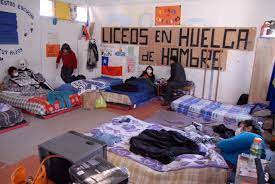
Indignant women and girls ignite the Chilean Winter


Hunger strikers at a secondary school in Buin, near Santiago.

For two days this week, the streets of Chile filled with indignation … and indignados. These protests are the latest event in a movement that began over three months ago, with a scattered series of classroom boycotts and protests. Since then, students from secondary and tertiary institutions have led teachers and professors, parents and custodians, trade unionists and government workers in protest, in action, in song and dance, in hunger strike, in organizing. The State has responded by arresting 14,000. Already one 16-year-old has been shot and killed. And now, after waves of protest, after State-sponsored bloodshed and belligerence, the State claims it wants a dialogue.

The students began their protests to challenge and change the inequalities within the educational systems and structures, inequalities that are funded, or better de-funded, by mass privatization, on one hand, and a tax structure that sends relatively little money into the schools. Most students attend grossly underfunded public universities while the wealthy few attend the very few exclusive and exclusionary private universities. At present, Chilean university education is one of the most expensive in the world. Students assume extraordinarily high debts, with 50% of them considered heavily indebted. The schools are both expensive and lousy.

As inequality has grown in Chile, so has segregation. According to some, Chile is the second most socially segregated country in the world. The rich study – and play and live — only with the rich, the poor with the poor.

Students began to see the inequality gap as well as the increasing barriers and increasingly high walls as the State condemning them to a slow death sentence. Rather than roll over, they responded with outrage.

Women and girls lead the student movement. 23-year-old Camila Vallejo, for example, is the president of the University of Chile’s student union and the principal spokesperson for the Confederation of Chilean University Students. 18-year-old Francia Gárate is on hunger strike. So are 17-year-olds Johanna Choapa and Maura Roque. María José Zúñiga is spokeswoman for secondary school students at Liceo A-131, high school in Buin next to the capital, Santiago. Pictures and articles show innumerable unnamed women and girls on the front lines, at the bullhorns, on the various stages, in the hunger strikes.

Why are women leading the charge? For almost four decades, Chile has “manufactured modernity” by relentlessly pursuing a neoliberal economic policy: privatization, free trade, the works. And who “bears the brunt” and who literally does “the dirty work of neoliberalism” in Chile? Women. Who looks at the promises of an `emerging’ first world national economy and sees that the money goes for teargas canisters rather than books, for corporate palaces and hotels rather than classrooms? Who looks at the gap and sees who’s making those decisions? Women.

Indignant, insightful women and girls are igniting the Chilean Winter with their outrage.


(Photo Credit: Fernando Fiedler / IPS)


Women farmworkers haunt South Africa’s fruit and wine industries

Farm work is hard work, and farm workers around the world suffer abuse and exploitation that often seems to marry predation to sadism. A most recent, and vivid, picture of this emerges in this week’s Human Rights Watch report, Ripe with Abuse Human Rights Conditions in South Africa’s Fruit and Wine Industries. The report focuses on the fruit and wine industries of the “wealthy and fertile” Western Cape, where the greatest number of farmworkers, around 121,000, live. The report documents the active abuse, and worse, of farm owners and farm managers, and the often active failure of the State to live up to its Constitutional obligations to protect workers, families, citizens, people, women.

In South Africa, the report was picked up by the Mail & Guardian, the Sowetan, the City Press, The Times, The Cape Times, to name a few. Internationally, the BBC, the Guardian, and the Telegraph commented. In a number of reports, women farm workers or farm dwellers appeared.

For example, farmworker Sinah B struggled against forced eviction. Her employers cut off her electricity and running water, in the middle of winter, while farm security guards harassed and persecuted Sinah B and her two children morning, noon, and night.

Johanna Flippies and her family have been forcibly evicted from three farms in the last ten years, because her husband is a union shop steward. For Flippies, life on the farm is hell, life off the farm is … hell.

For workers on Western Cape farms, life is dismal, misery.

The news coverage of the Human Rights Watch report universally avoided the gender of misery. In the farmlands of the Western Cape, hell and misery have a face, and it is a woman’s face.

Farmworkers are divided into two large categories, permanent and casual or seasonal. Permanent farmworkers are in the main men. Women are seasonal. Even if they work year round. On the same farm. For the same employer. For years. Non-permanent farmworkers are the most abused, the most exploited, the most vulnerable, the most precarious, the under assault. They have fewer State-sponsored protections, for what they’re worth. Very few are organized in unions. As women, they’re paid less than men farmworkers, who are themselves paid, by law, less than domestic workers. Occupational health violations, such as lack of protection around pesticides, targets women. For women living on the farms, workplace sexual violence flows into domestic violence.

Human Rights Watch, in its report, explicated the gender dynamics of farmworker abuse and exploitation. Why have the news outlets avoided the women? Farmworkers around the world suffer abuse and exploitation. In the Western Cape of South Africa, farmworkers generally have it hard. But women farmworkers are the heart and soul, and target, of abuse and exploitation. Women farmworkers haunt South Africa’s wine and fruit industries … and silence about women farmworkers haunts the news.


(Photo Credit: Marcus Bleasdale/VII for Human Rights Watch)

Making Women’s Charters in Egypt and South Africa – part 1

On the 4th of June this year Egypt’s first National Convention of Women took place. Women (and some men who support them) were gathering to make their voices heard. After playing a leading role in the January 25th revolution that ended the dictatorship of Hosni Mubarak, they were worried about the signs that the process of transition to a new constitutional system would sideline them. The Alliance for Arab Women and the Egyptian Women Coalitions therefore embarked on a process of drafting a Women’s Charter that spells out the things the women of Egypt need to see in the country’s new constitution. The process included discussions in 27 of Egypt’s governorates and a signature campaign that collected half a million signatures by June.

The process and content of the Egyptian Women’s Charter shows a striking similarity to that of the Women’s Charter for Effective Equality adopted by the National Convention of the Women’s National Coalition in February, 1994 in South Africa. The South African Charter came out of similarly motivated concerns, was drafted through public discussions, supported by millions of signatures and spelt out what women needed in the constitution South Africa was in the process of creating.

The similarity of the two Charter processes allow for the drawing of useful lessons for Egyptian ‘charterists’ from the earlier South African experiences and specifically from the outcomes of the South African charter. What is the situation for women in South Africa today? What does this say about the success of the Women’s Charter? What lessons can the supporters of the Egyptian Women’s Charter learn from the experiences of their South African counterparts?

(This post appeared originally here: http://permanentrebel.blogspot.com/2011/08/making-womens-charters-in-egypt-and.html. Thanks to Ronald for the collaboration!)

(Photo Credit: PeaceWomen)

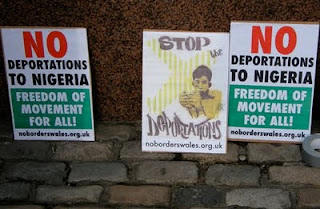
The blood and distress of Olayinka Ijaware and her two children

Olayinka Ijaware is a young Nigerian woman who has been living in County Waterford, in Ireland, for the last four years. She is the mother of two children, aged five and seven. Until quite recently, Ijaware was pregnant with a third child. Then she suffered a miscarriage.

Early Tuesday morning, August 16, the Gardaí, or Irish national police, showed up and `escorted’ Ms. Ijaware and her two young children to the Dublin airport, where she was `prepared for deportation.’ Olayinka Ijaware is an asylum seeker. According to the State, she is a failed asylum seeker. According to her, her attorneys, and her friends and supporters, she is in the process appealing the decision, and so is still an asylum seeker.

As she was being `prepared’, Ms. Ijaware complained of pains and bleeding, the result, she explained, of her recent miscarriage. She was taken to hospital. She was seen by doctors. The doctors said she should not fly if she was suffering vaginal bleeding. Witnesses say she was bleeding and in deep distress. The Gardaí disagree. And so, Olayinka Ijaware and her two children, two children who basically know only Ireland, were shipped back to the airport, to `prepare’ for deportation.

Magically, and without explanation, the flight was cancelled. Ijaware was told to report to the Gardaí next week, for deportation.

The date and time of Ms. Ijaware’s miscarriage is being debated. That she was bleeding at some point that night is not debated. That she and her children were taken in the very early hours of the morning, without warning, is not debated. That currently the Irish government is conducting a mass deportation of so-called asylum seekers is not debated.

The full name of Ireland’s national police force is An Garda Síochána na hÉireann. That means “Guard of the Peace of Ireland.” The Gardaí are the Guardians, and Ireland is Ireland. But what is the peace? What is the peace when women’s blood and distress count for nothing, for less than nothing if the women are Black?

What is the peace of Ireland? Ask Olayinka Ijaware. Ask the children of Olayinka Ijaware. They know.


(Photo Credit: http://victorikoli.blogspot.com)

Instead of Women’s Day, What About Women’s Enjoyment of Freedom Day?


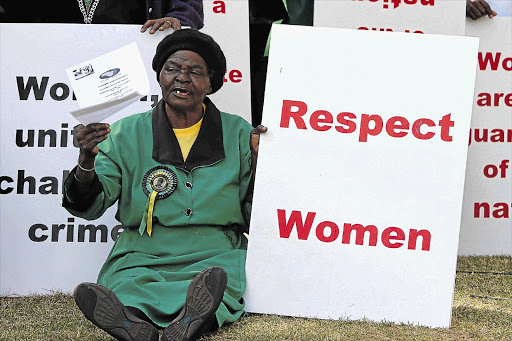
In South Africa, August 9 is National Women’s Day, and August is Women’s Month. This August, the Tshwaranang Legal Advocacy Centre, a South African women’s rights and well-being organization has a simple and direct question for everyone, “So just how real are women’s rights?”

They began, publically, to answer that question yesterday, August 11, with a new report, “The Right & The Real: A Shadow Report Analysing Selected Government Departments’ Implementation of the 1998 Domestic Violence Act and 2007 Sexual Offences Act”. On one hand, the answer paints a dismal picture. Only 8% of police stations meet their obligations under the Domestic Violence Act. Compliance would include helping a victim to find shelter and obtain medical assistance, serving notice on an abuser to appear in court, arresting an abuser who breaks a protection order, and, critically, keeping records of domestic violence. Failure to comply means misconduct, and should result in various forms of sanction and punishment. It hasn’t. Police stations ignore their responsibilities with impunity.

In 2007, 57% of police stations were compliant. Now … less than 8%. That’s not a drop, not even a steep drop. That’s a nose dive.

The report focuses on the failure of the South African Police Services and the Department of Justice and Constitutional Development (which includes National Prosecuting Authority), as well as the Departments of Health, Social Development and Correctional Services. The press has covered this failure as a failure to protect women and women’s rights, which it certainly is.

But Tshwaranang’s analysis goes far beyond the failure to protect.

The real of women’s rights is more than, bigger than, and more profound than “protection”. The real of women’s rights is freedom, and specifically the enjoyment of freedom:

“South Africa’s Constitutional Court makes it clear that, `few things can be more important to women than freedom from the threat of sexual violence.’ So important is this right to be free from all forms of violence that, along with the rights to life and dignity, it imposes two sorts of duties on the state: the first obliging the state to refrain from acting in ways that infringe on these rights, and the second compelling it to develop legislation and structures guaranteeing those rights….It is not only sexual violence that constitutes a rights violation of the sort requiring state intervention: `Indeed, the state is under a series of constitutional mandates which include the obligation to deal with domestic violence: to protect both the rights of everyone to enjoy freedom and security of the person and to bodily and psychological integrity, and the right to have their dignity respected and protected, as well as the defensive rights of everyone not to be subjected to torture in any way and not to be treated or punished in a cruel, inhuman or degrading way.”

Imagine a South Africa in which all women are free to move around as they please, dressed as they please. Imagine a world in which all women are free to move around as they please, dressed as they please. Imagine a world in which democracy means the enjoyment of freedom. Instead of celebrating Women’s Day, what about Women’s Enjoyment of Freedom Day?


(Photo credit: Halden Krog / Times Live)

Violence against women haunts independence


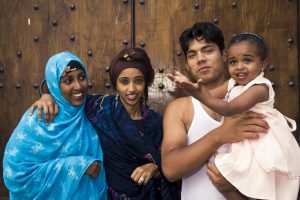
Egyptian men and women in one hand

“After the revolution”. In Egypt and Tunisia, women who made the revolution, women who pushed Mubarak out, are now facing the struggle for more rights, autonomy, and physical safety. This should come as no surprise to the rest of the so-called independent world.

Yesterday, August 6, Jamaica celebrated 49 years of independence from the United Kingdom. There were celebrations. At the same time, sexual violence against girls is both increasing and intensifying.

Across the African continent, August is celebrated as Women’s Month. August was chosen to commemorate the August 9, 1956, women’s march in Pretoria, in protest of the infamous pass laws. The women chanted, shouted, screamed: “Wathint’Abafazi Wathint’imbokodo!”. “Now you have touched the women, you have struck a rock!”

That was 55 years ago. Today, the women are still being `touched’, and in the most violent ways. Across the nation, campaigns, such as the One in Nine Campaign, and organizations, such as the Rape Crisis Cape Town Trust, struggle to address and end violence agains women. Organizations such as Free Gender struggle to address and end violence against lesbian, and in particular Black lesbian, women. All of these women’s organizations, all of these women, all of these feminists, struggle to address and end the hatred that is rape.

In many places, such as in the United States, that hatred often takes the form of legislation. For example, in 2005 Wisconsin passed a law that barred access to hormone therapy or sex reassignment surgery for prison inmates and others in state custody. Three transgender women prisoners, Andrea Fields, Jessica Davison, Vankemah Moaton, challenged the law, and this week, after six years, won their case in a federal appeals court.

Meanwhile, in Washington, DC, the nation’s capital, transgender women are hunted, attacked, often killed. For the crime of being transgender women. For the crime of being women.

What is independence? What is a revolution? Across the globe, women continue to struggle for the basics of independence, of autonomy. That begins with real recognition, that begins with the State as well as the citizenry and the population ensuring women’s safety. Women are not specters and are not promises to be met. Until women’s simple physical integrity is ensured, rather than promised, violence against women will continue to haunt independence.


(Photo Credit: NPR / STR / AP)

Ashley Smith: a death somewhere between tragedy and travesty

Ashley Smith

Ashley Smith was 19 years when she was allowed, or encouraged, to die, alone in a fully monitored prison cell. On October 19, 2007, Smith was a prisoner of the Grand Valley Institution for Women, in Kitchener, Ontario, Canada. Seven guards watched her die, and did nothing. Or rather, seven guards followed orders, and did nothing. Then, when they were sure she was dead, they rushed in.

Some called her death inhumane. Others said, or hoped, that Ms. Smith’s death would haunt Canada. In fact, her death is the common death of the prisoner, and so it was human all too human.

In May 2011, almost four years after Ashley Smith’s death, which was not a suicide but a call for help, the State coroner’s court finally, finally began its inquest.

This week, two months later, the Ontario Health Professions Appeal and Review Board finally rendered something like an opinion.

First, the Board cleared two doctors of wrongdoing in the “care” they provided.

Second, it asked the key, critical and painfully obvious question: “From our perspective, it is difficult to understand how the resources of Correctional Services Canada and the numerous health professionals who were involved with (Smith), particularly in the last year of her life, could not have, somehow, appropriately treated her admittedly severe behavioural problems.”

In other words, “How was an obviously troubled 19-year-old inmate left so long without proper treatment?

Third, it rendered a genre decision: The Smith case “lies somewhere in the spectrum between a travesty and a tragedy.” What’s that you said about history repeating itself, the first time as tragedy, and thereafter as farce?

Wherein lies the travesty? In the redundancy. “Ashley Smith” is produced every day in prisons across Canada, across the United States, across the United Kingdom. Every day, prisoners, and women prisoners in particular, are “somehow” denied access to life saving health services. How many times must Ashley Smith “commit suicide” while actually asking for help?

Meanwhile, the coroner’s inquest was postponed yet again, and won’t begin again until September. Some describe the inquest as delay-plagued. They’ve never been to prison. This inquest isn’t delay-plagued. It’s just doing time as it always does.


(Photo Credit: topnews.in)

Women haunt the `crime’ of seeking haven

A group of migrants welcomed in Riace.

When did haven become a crime? How did seeking shelter or asylum come to identify a person as a criminal? Since women and children are the face, and multitudinous faces, of today’s refugee, when did the State choose to identify those seeking haven, women and children, as criminals?

In 1999, Nell Toussaint, a Grenadan, entered Canada on a tourist visa, and stayed. She lived in Toronto, apparently without disturbing anyone’s peace. Then in 2006, Toussaint developed a kidney ailment. This involved blood clots, diabetes, tumors. Faced with mounting health debt, and with death, in 2008 Toussaint applied for permanent residency. She applied, but did not pay the fees. So, she was not considered for application.

She applied for health care coverage, and was turned down. She went to court. Last Friday, the Federal Court of Appeal unanimously rejected her application. The Court decided that as an undocumented resident, Toussaint did not qualify for coverage … even though it agreed that her medical condition could result in death if not treated.

But there is a principle higher than that of life and death: “If the appellant were to prevail in this case and receive medical coverage under the Order in Council without complying with Canada’s immigration laws, others could be expected to come to Canada and do the same. Soon … Canada could become a health care safe haven, its immigration laws undermined.”

Canada could become a health care safe haven. Haven is the menace, and haven is the crime committed by Nell Toussaint. If Nell Toussaint dies for the cause of eliminating the Caduceus Crime of health care safe haven, that’s fine.

But that’s not fine.

Riace, a town in the south of Italy, was suffering population loss. Maybe that’s the reason it opened its doors, “huge heart”, and more, to refugees like Helen, an Ethiopian who arrived two years ago. But Riace did more than just allow refugees to settle. The townspeople created opportunities, economic and cultural, for mutual integration. When the national government was too slow in providing funds for the refugees, Riace invented its own local currency, the Euro-Riace, acceptable at all the finest, and funkiest, local shops.

Riace is not heaven, and its motives are in no way pure or angelic. Indeed, they’re pragmatic. No matter. The town, together, agreed to the policy and practice of haven. The town, together, now supports Città Futura, the City of the Future, the single largest employer in Riace.

The State can opt to become a haven. People can choose to embrace and live courageously, with huge heart, with the vulnerable and the stranger. Right now, the world lives with the highest number of refugees and displaced persons in decades. The majority of refugees are women and girls. Haven is more than a women’s issue. Haven is a women’s world. Women haunt the `crime’ of seeking haven.


(Photo Credit: http://urbanpollinators.co.uk)

Do nothing (for 67 minutes)

Do nothing (for 67 minutes)

Do nothing
for 67 minutes
in defiance
of the call

Do nothing
for 67 minutes
out of the glare
of the public eye

Don’t abuse
your partner
or even your pet

67 minutes
of doing good
in honour of an icon
(there are but a few)

Do nothing
for 67 minutes
around and about
your usual everyday

Don’t smoke
cuss and curse
or spit in public
(be soft and gentle too)

(Might you apologize
for the inconvenience)

Do nothing
for 67 minutes
nobody will know
but it might tell

It might be an end
to woman and child abuse

Now go and do nothing

We are asked to give of ourselves for 67 minutes.


(Image Credit: O-blog-dee-o-blog-da)