Public or private, prisons are violent, especially for women

If the State determines that you have committed a crime in Washington, D.C., you are sent to prison or jail.  A felony means federal prison, which can be as far away as California.  For everything else, there’s jail.

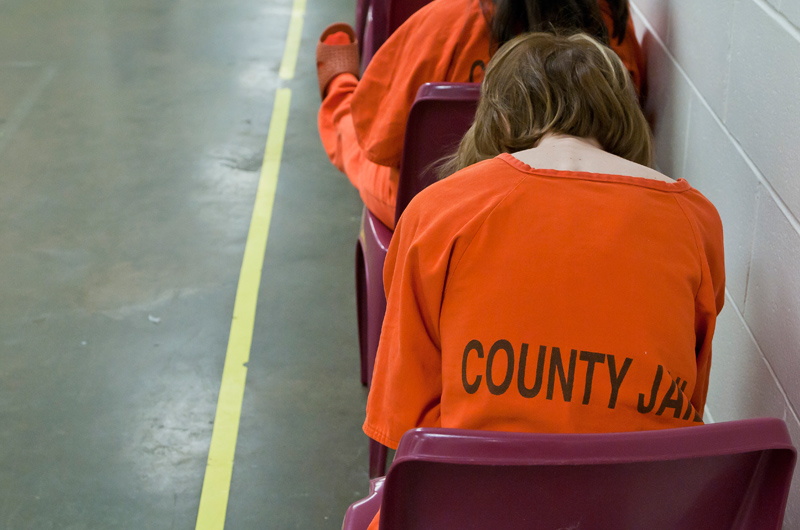
D.C. has two jails, located adjacent to each other in the Southeast part of the city.  The Central Detention Facility (or DC Jail) is publicly run, while the Correctional Treatment Facility (CTF) is privately run by the Corrections Corporation of America.  DC Jail houses men, and the CTF houses women and men.

Many people distrust private prisons. They think privatization leads to more violent facilities.  Does the amount of violence in a prison depend on whether it is public or private?  Let’s compare DC Jail and the CTF.

Let’s look first at public DC Jail.  One prisoner reported that spending nine years in DC Jail is like doing twenty years in a federal prison.  What kind of conditions lead to this doubling of time?  It could it be the rampant stabbings allowed to take place.  Time drags for those whose painful wounds the State calls “not life-threatening.”   Maybe it is the DC Jail’s shoddy conditions.  The walls are covered in mold, the facilities are overcrowded, the medical care is deplorable, and often there are no windows.  Widespread broken locks leave prisoners vulnerable to further violence.  None of this is good for human beings.

Prisoners commit suicide in the jail.  Mentally ill prisoners also commit suicide, but with the added bonus of their families being told that the State was “extremely concerned” about their well being.  All of this is facilitated by the violence of the prison guards, who assault inmates, especially LGBT ones.  DC Jail, a public facility, is a center of State violence.

Now, let’s look at the private CTF.  Like the DC Jail, the CTF is an awful place for prisoners to live, for many of the same reasons: overcrowding, deplorable facilities, terrible medical care, broken locks, and rampant violence.  But there is one key difference about the CTF—it houses women prisoners.  What do the women report about their conditions at the CTF?   The guards cram women, even ones with medical conditions, into elevators.  Pregnant women are shackled as they give birth.  Guards yell at the women, threaten the women, steal the women’s packages, parcels, and money, refuse to deliver reading materials, and sexually assault the women.  Like the DC Jail, the CTF is a center of State violence.  The difference is that the State has contracted out the violence to the Corrections Corporation of America until the year 2017.

But the difference is also women.  Women are the fastest-growing prison population in the United States.  The gendered violence they face both outside and inside prison constitutes a crisis for the State, which “signals systemic change whose outcome is determined through struggle.”  In the District of Columbia’s case, the struggle resulted in privatization.

Women are the fastest-growing population of test subjects for the State’s violent regime of incarceration.  It is violent regardless of public or private.  Ending the violence of prisons means ending the use of prisons, period.


(Photo Credit: Armando Trull/WAMU)
The short and terrible life of Pennsylvania SCI-Muncy Prisoner #6

Last Monday, the Disability Rights Network of Pennsylvania filed a lawsuit against Pennsylvania for abuse of prisoners diagnosed as “seriously mentally ill.” DRNP claims that over 800 prisoners deemed seriously mentally ill are dumped, for long periods of time, into Restricted Housing Units, basically solitary confinement, where they are kept for 23 hours a day, during the week, and 24 hours a day, during weekends and holidays. No contact with others, no work or education or religious services or rehabilitative programs, and of course little to no mental health care. But the lights are left on in the cells 24 a days. So …

It’s a vicious, even criminal, cycle. People deemed seriously mentally ill end up in solitary, which then results in parole denial, which sends them back to the hole. If it weren’t so dreadful, it would be considered elegant.

The suit profiles twelve prisoners, 11 men and one woman. The woman prisoner is in SCI-Muncy. Pennsylvania has two women’s prisons, Muncy and Cambridge Springs. Muncy is both maximum security and the intake prison for all women prisoners in Pennsylvania. Muncy also houses Pennsylvania’s death row for women. Every woman prisoner in Pennsylvania first comes to Muncy, where her `security level’ is assigned, based on an assessment of criminal record, medical, mental health, and substance abuse. Lower security prisoners are sent to Cambridge Springs; the rest stay at Muncy. Guess where those with serious mental health issues go?

Muncy has a death row, but it doesn’t have a Secure Special Needs Unit, or SSNU. The profile of the one woman prisoner suggests why that matters.

Prisoner #6

Prisoner #6 is a 39-year-old female prisoner in SCI-Muncy. She has a long history of serious mental illness, including at least one suicide attempt and multiple admissions to state psychiatric hospitals, prior to her incarceration. Prisoner #6 has a “D” stability rating and has been diagnosed with schizoaffective disorder, bipolar type, low normal intelligence (86 I.Q.), and a personality disorder. Prisoner #6 has been charged with disciplinary infractions and sentenced to disciplinary sanction in solitary confinement in the RHU based on behaviors directly attributable to her serious mental illness, such as throwing liquids, covering her cell window with paper, sticking her arms through her cell door food slot, harming herself and demanding to be placed in restraints, and flooding her cell.

“Between May 6, 2001, and January 14, 2012, Prisoner #6 received 115 misconduct reports, mostly occurring in the RHU. Her mental condition has deteriorated in the RHU. Although SCI-Muncy has no SSNU, according to the DOC website, prison records state she has been assigned to the SCI-Muncy “SSNU.” However, she has been returned to the RHU as a “time out” from this “virtual” SSNU for weeks or months at a time.

“Prisoner #6 received a negative psychological evaluation for parole purposes in July 2010 because of the behavior described in her numerous misconduct reports, most if not all of which arose from conduct directly attributable to her mental illness. An independent psychiatrist has recommended that Prisoner #6 receive psychosocial rehabilitative treatment, which cannot be provided in an RHU.”

The story of Prisoner #6 is in many respects like that of her eleven male counterparts, except for the phantom SSNU. Somehow, Prisoner #6 was sent to a “special needs unit” that doesn’t exist. After that, she was returned to solitary. If it weren’t so dreadful, it would be ironic.

Women prisoners, even those at maximum-security Muncy, report lower rates of recidivism than male prisoners, but “they are also all women.” Women prisoners also report much higher rates of mental health illness, much higher rates of abuse, much higher rates of needing help. Higher than whom? Higher than everyone. Higher than men prisoners. Higher than women in `the free world.’ And how does the State respond? It dumps their bodies, for months and years on end, in ferociously well-lit pits where their conditions can only worsen. That is the short and terrible life of Prisoner #6, designed, directed and produced by the State of Pennsylvania. Living with serious mental illness? Welcome to hell.


(Photo credit: SayNoToStigma.com/Menninger Clinic)

Beatrice Mtetwa is the course of justice

Beatrice Mtetwa, leading human rights lawyer and Board member of the Zimbabwe Lawyers for Human Rights, recently noted, “People who go to do things under the cover of darkness are afraid of light. So, if you come at midnight, I’ll be there with my headlights glaring.”

The smoke, fog and dust of Zimbabwe’s Constitutional referendum had not yet dissipated or settled when the news circulated that Beatrice Mtetwa had been arrested. Her crime was asking the whereabouts of a client. The State refers to that as “obstructing or defeating the course of justice.” The truth is that Beatrice Mtetwa is the actual course of justice.

Mtetwa is a fearless and tireless defender of human and civil rights and a remarkably persistent proponent of the law as an instrument of change, in Zimbabwe and everywhere. Some call that `the rule of law’, but it’s more than that. It’s the rule of transformation, of always struggling to become more fully human.

Mtetwa has consistently, openly and formally challenged police, judges, even fellow lawyers to act according to oaths and promises taken. After being beaten by police, in 2003, the moment Mtetwa sufficiently regained her capacities, she went straight to the police station, and to the very police who had injured her, and filed charges. When she defended Jestina Mukoko, she did more than protest Mukoko’s innocence. Again, she filed charges against the State. Each time, Mtetwa understood that the Supreme Court of Zimbabwe, if it heard the case, would find against her. And each time she said, history will be the judge … not these corrupt men and women who sit on a high bench and act despicably.

She has asked, repeatedly, what is law in a nation-State in which the Constitution has been mutilated? What is freedom in a nation-State built on ever deepening cycles of violence and ever multiplying and intensifying violations of persons and communities, and especially those of women? For example, according to Mtetwa, during the 2006 round of pogroms, “The most brutal assault against opposition activists occurred on 11 March, when members of the Women’s League were attacked, some of them with batons, as they attempted to attend a prayer meeting organised by the Save Zimbabwe Campaign. The League’s president and secretary-general were among the injured, and there were many reports of injuries such as broken limbs, torn ears and severe bruises.”

Maybe something good, or at least not altogether bad, will come of Saturday’s referendum. Maybe Presidential powers will be curtailed. Maybe women will have more presence in matters of State. Maybe.

But the real referendum is taking place in the prisons and police stations, where people are being held without charges or with trumped up charges. Where people have been abused and tortured in so many ways, there sits Beatrice Mtetwa, and she says, “I’ll keep trying, and I’m not going to stop.” `Releasing’ Beatrice Mtetwa into yet another cycle of violence is not enough. The State is guilty of obstructing and defeating the course of justice, not Beatrice Mtetwa. Who’s afraid of the light? Not Beatrice Mtetwa. Shine the light; make sure it’s glaring.


(Video Credit: Vimeo)

Susan Sontag haunts Mumbai?

Susan Sontag showed up in Mumbai this week. Mumbai is hosting its first ever photography festival, the FOCUS Photography Festival. The Festival has two key exhibitions: `A Fantastic Legacy: Early Bombay Photography, from 1840 to 1900’; and `A Photograph is Not an Opinion – Contemporary Photography by Women’. The title of the latter exhibition “borrows its title from Susan Sontag’s essay `A Photograph Is Not an Opinion. Or Is It?’ from the book Women.” As one of the curators explained, “The book implies that while men are under pressure to produce one strong opinion, the strength of the women’s point of view it accommodates many viewpoints. What I am trying to say in the title is that there are variations of the truth being presented in this exhibition.’”

What was the truth of women that Sontag was trying to understand in her 1999 essay, which introduced Annie Leibovitz’s book, entitled simply, and impossibly, Women, and how does that truth ring today?

Sontag’s essay opens wondering about “a book of photographs of people with nothing more in common than that they are women (and living in America at the end of the twentieth century)… A large number of pictures of what is, nominally, a single subject will inevitably be felt to be representative in some sense. How much more so with this subject, with this book, an anthology of destinies and disabilities and new possibilities; a book that invites the sympathetic responses we bring to the depiction of a minority (for that is what women are, by every criterion except the numerical), featuring many portraits of those who are a credit to their sex. Such a book has to feel instructive, even if it tells us what we think we already know about the overcoming of perennial impediments and prejudices and cultural handicaps, the conquest of new zones of achievement. Of course, such a book would be misleading if it did not touch on the bad news as well: the continuing authority of demeaning stereotypes, the continuing violence (domestic assault is the leading cause of injuries to American women) belongs to the ongoing story of how women are presented, and how they are invited to think of themselves. A book of photographs of women must, whether it intends to or not, raise the question of women— there is no equivalent `question of men.’ Men, unlike women, are not a work in progress.”

The rest of the essay attempts to think historically, aesthetically and politically about a book that photographs only women, about a book of photographs of women. Sontag concludes: “A book of photographs; a book about women; a very American project … It’s for us to decide what to make of these pictures. A photograph is not an opinion. Or is it?”

A very American project in 1999 becomes … a very metropolitan, Indian, transnational, global project in 2013? What does that mean? What happens when the subject of women moves from women as the object and objects of `our’ gaze(s), a crisis of representation, to women as the makers, and specifically as the makers of vision? What happens when a book of photographs `about women’ becomes a space of women?

In her last book, Regarding the Pain of Others, Sontag noted, “Narratives can make us understand. Photographs do something else: they haunt us.” Women photographers do not haunt the galleries of Mumbai this week, but their photographs might. As we have seen recently in debates about domestic violence in India, South Africa, the United States, and beyond, there is perhaps the beginning of a question of men. Meanwhile, Susan Sontag haunts the FOCUS galleries as she asks, “Is there still only a question of women?”


(Photo Credit: Mohini Chandra)

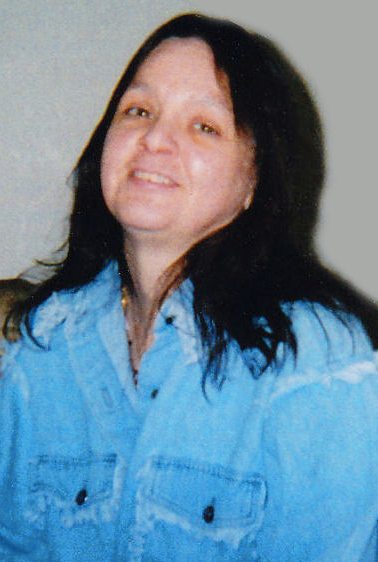
Jackie Nanyonjo died last Friday

Jackie Nanyonjo

My grandmother did not die of uremic poisoning. She died because she was in hiding, in Nazi-occupied Brussels, and could not get the medical care she needed. And so she died and was buried in an unmarked grave in a potter’s field `somewhere in Brussels’.

Jackie Nanyonjo died in Kampala, Uganda, last Friday. Jackie Nanyonjo was a lesbian who fled Uganda, made it to England, and applied for asylum. In so doing, she joined women like Betty Tibikawa, Linda Nakibuuka and so many other Ugandan lesbians who, having asked for safe haven, trade one rung of hell for another.

Jackie Nanyonjo fought for the rights, power and dignity of women, LGBTI individuals and communities, lesbians, asylum seekers. She fought for those rights on the streets; in the cells and corridors of Yarl’s Wood; and in the airplane that took her, abducted her more accurately, to Kampala two months ago. When she arrived in Kampala, she went into hiding. She didn’t contact members of the organized LGBT rights communities, most likely because of the current pogroms against lesbians and gays and their organizations. And so, on Friday, March 8, 2013, International Women’s Day, Jackie Nanyonjo died, in hiding, in Kampala.

Friends report that she was in poor health in the United Kingdom and in very poor health when she arrived in Kampala.

My grandmother did not die of uremic poisoning. Jackie Nanyonjo did not die of poor health. They were both killed. May they both rest in peace. May we do better than merely remember and intone their names.


(Photo Credit: PinkNews)


In Italy, prison is a death sentence … and no one knows?

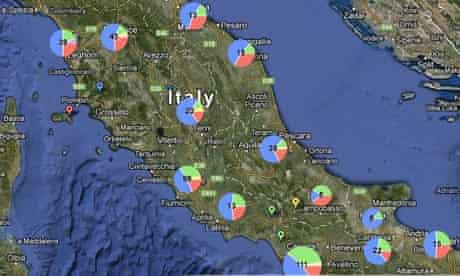
Deaths in Italian prisons from 2002 to 2012

The death sentence comes in many shapes and sizes. In too many countries, capital punishment is a State function. In Europe, France was the first country to abolish capital punishment. In 1994, Italy became only the second `abolitionist’ nation-State in Europe. But that doesn’t mean Italy doesn’t execute its prisoners.

Italian prisons are notoriously overcrowded, and the life inside is famously harsh. A 2008 Council of Europe report found the prisons “severely overcrowded”: “For prisoners, an overcrowded prison often entails cramped and unhygienic accommodation, a constant lack of privacy, reduced opportunities in terms of employment, education and other out-of-cell activities, overburdened health-care services, and increased tension – and hence more violence – between prisoners and between prisoners and staff. In addition, due to lack of adequate living space, a number of prisoners were transferred to prisons far away from their families.”

Who are the prisoners? Undocumented immigrants, drug users, remand prisoners figure prominently. Italy has one of the worst records on alternative sentencing. In Italy, you do the time, even when you’re awaiting judgment as to whether or not you’ve committed the crime.

The prisons are not just overcrowded. They are severely, even criminally, overcrowded. In January of this year, in the case of Torreggiani and Others v. Italy, the European Court of Human Rights held, unanimously “that there had been: A violation of Article 3 (prohibition of torture and inhuman or degrading treatment) of the European Convention on Human Rights. The Court’s judgment is a “pilot judgment” concerning the issue of overcrowding in Italian prisons. This structural problem has now been acknowledged at national level. The Court called on the authorities to put in place, within one year, a remedy or combination of remedies providing redress in respect of violations of the Convention resulting from overcrowding in prison.”

The prisons are not just severely and criminally overcrowded. They are fatally, toxically overcrowded. From January 2002 up to May 2012, 915 prisoners died in Italian prisons. Of that group, a whopping 518 committed suicide. That’s 56% “killed themselves.” That’s astronomical, by any standards, whether compared to the rate of the Italian general population or to other national prison populations. [The 56% suicide rate does not include death by drug overdose (26) or death “under unclear circumstances” (177). If half of those two groups, put together, actually committed suicide, then the suicide rate becomes 61%.]

Imagine a place in which, basically, 6 out of every 10 persons commits suicide. That place is the prison system of Italy. In individual prisons, the situation is actually more lethal. A map of the prison deaths reveals a great deal: “Many stories can be found by viewing the map. Most of them did not find coverage in the mainstream media. For instance, almost nobody was fully aware about the almost forty deaths of those detained in mental hospitals; or about prisoners who took a drug overdose behind bars. Some stories clash with our perceived stereotypes: nobody normally imagines that those who die in jail may be women, such as Manuela Contu and Franca Fiorini, 42-year and 37-year respectively, died of overdose in Civitavecchia in 2003. Or like Francesca Caponnetto, deceased in Messina in 2004, aged 40. Other prisoners died very young, such as a 17-year old boy, who committed suicide in Firenze, in 2009. No one knows about 50 young prisoners who died aged under 20.”

No one knows. Historically, in Italy, as elsewhere, when it comes to women in prison, the story has always been no one knows, from the first days of the independent so-called liberal nation-State to today. At the outset, women prisoners were relegated to obscure and never-discussed prisons run by nuns. No one knew. And today, when it comes to women prisoners, and especially the recently criminalized immigrant women prisoners, nobody normally imagines.

In Italy today, there is no `life inside’. Prison is a death sentence, administered through a policy of mass and collective suicide. And no one knows?

(Image Credit: The Guardian)

Texas’ Minimum Security Death Row for Women


Pamela Weatherby

The Jesse R. Dawson State Jail, in Dallas, Texas, is a minimum-security prison for women. Corrections Corporation of America, CCA, runs the jail and turns a tidy profit doing so. Actually, the profit is messy and bloody. Dawson State Jail is a hellhole, literally a death trap for women.

Wendy King spent a year at Dawson. She knew that she and her sisters and her mother all have uterine problems. When she started bleeding, she called immediately for a doctor. None ever came. Ever. She bled continuously for nine months. No doctor ever came.

And Wendy King is one of the `lucky ones.’

Ashleigh Shae Parks, 30 years old, died of pneumonia. Her family, and others, say she was denied medication until way too late. Pamela Weatherby, 45 years old, died. Weatherby was taken off her prescribed insulin injections, and repeatedly went into diabetic coma. Until finally she died. Sheeba Green, 50 years old, suffered from diarrhea and difficulty breathing. Nobody did anything for a full three days. When she was finally allowed to go to the medical unit at Dawson, she lay for a full three hours before anyone even looked at her. Seven hours later, a doctor finally called an ambulance. The next day, Sheeba Green died of complications due to pneumonia.

Autumn Miller was in Dawson for a probation violation. She was in for a year. Miller knew something was wrong. She asked for a PAP smear and for a pregnancy test. She was denied. As time wore on, cramps and pain increased. Finally, one night, her pains became too intense for guards to ignore, and they took Miller down to the `medical unit’. Of course, there are no doctors at Dawson overnight, and so guards `took care’ of Miller, or, better put, took care of business.

The guards said Miller merely had to go to the bathroom, and so they gave her a menstrual pad and locked her in a holding cell. Despite Miller’s pleas, nobody came in to check, and so Autumn Miller gave birth to Gracie Miller, in the holding cell toilet. Guards then came in, shackled and handcuffed the mother, and took mother and daughter to the hospital. Gracie died four days later, in her shackled mother’s handcuffed arms.

Autumn Miller’s story is one of love and grief: “I kissed the baby and told her I loved her, and then I had to get back in the van and go to Dawson…. It’s unfortunate that it had to go this far for us to get to the point that someone noticed that something is wrong.” Her attorneys are more direct: “Autumn is traumatized and Gracie is dead.”

On Friday, Autumn Miller joined the ranks of women survivors and of families of women who died currently suing CCA and the State of Texas.

Advocates, prisoners current and former, politicians and just plain folk are campaigning to close Dawson. Others wonder, “Why is Texas’ worst state jail still open?” Why? Because the lives of women literally count for less than nothing.

Gracie Miller, Autumn Miller, Sheeba Green, Pamela Weatherby, Ashleigh Parks, Wendy King are the visible tip of an underground volcano that stretches across the United States, from sea to shining sea and beyond. These women were never meant to survive, and in many instances they did not.

Their deaths were planned. Their deaths, the harm done, the suffering were planned. Look at the books, look at the budgets, follow the money. You’ll see. Gracie Miller was never meant to survive. And she did not.


(Image Credit: Texas Observer)


Never so (few)

Never so (few)

Never so (few)
says our emperor
on the very same earth
(no second one yet)

Never so (few)
giving the country
a bad name through
their violent acts

It’s a minority
the majority is not
(we are peace-loving people)
(is poverty not the worst
form of violence in your town)

We are peace-loving people
apartheid was sustained
through entrenched violence
(we have the moral high now)

We are peace-loving people
a woman or girl is raped
every 25 seconds down here

(Was the brutal gang-rape and murder
of a 17-year old Bredasdorp girl
an extreme example of ourselves)

Femicide is the order
women brow-beaten and besieged
sexual assault the daily custom
(though this seems not to count)

At least our emperor did not
resort to the dodgy tradition
of we are all so pious
and even religious too

Never so (few)
Never so
Never

An Editor on SAFM’s Sunday morning The Editors programme wonders what planet our president inhabits: “Most South Africans peace-loving, Zuma tells opening of house” (Cape Times, March 8 2013). The said “house” is the National House of Traditional Leaders in Parliament.


(Photo Credit: Zaheer Cassim / DW)

Revealing the code of silence that rules reproductive rights

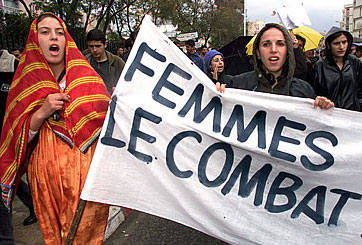
In Algeria abortion is simply illegal. A woman can be punished by six months to two years in prison and a fine. The abortionist is subject to one to five years in prison and a hefty fine.

According to the president of a women’s rights association, as reported in the Algerian newspaper L’Expression, there are about 80 000 abortions a year for 775 000 pregnancies in Algeria. The police reported only 27 cases in 2012. So what is happening in Algeria?

The code of silence is the rule.

Women who seek help with unwanted pregnancies have few options and they all imply a sense of shame and fear. The rule is to use word of mouth information and have enough money, on average $400, which is high price in Algeria.

The journalist of L’Expression follows the same principle of word of mouth to investigate the providers’ identities, how women get information and how the procedure is performed. It leads him and his partner to doctors who are militant and outraged by the situation as well as to charlatans who take advantage of women’s desperate search for relief. In any case, women are ashamed, isolated and have no protection and no recourse as they face horrendous medical consequences.

The article sends a clear message that this situation is shameful for society and that it has to change. As the reporters note, there have been changes, especially with the advent of the Internet. Women in Algeria have begun to engage in a public forum to break the rule of silence. We have seen the possibilities of these strong women’s voices in neighboring countries.

The code of silence has become the rule as well for many women in the United States seeking reproductive services where, law after law, women’s right are being restricted, putting many women to precarious situations. In 42 states restrictions on abortion rights have already been anticipated under the Patient Protection and Affordable Care Act, which will be enacted in 2014.

2012 has been the second year with the greatest number of new legislation to restrict access to reproductive services such as abortion, with about 122 provisions related to restrict access to reproductive health. Being a woman at the age of reproduction is a risky condition … in the United States as in Algeria.

Stop the code of silence, let’s hear women’s voices and respect their right to be.


(Photo Credit: Reuters / Zohra Bensemra)


Women continue to fall (victim)

Women continue to fall (victim)

Women continue to fall victim
conceivably a Freudian slip-up
that menfolk typically make
on our toiling earth-planet

Women continue to fall
victim to their males usually
as is expected out here
(femicide is the order)

Women continue
to fall victim
to a force inefficient
and a service often inept

(are they keeping you
safe from blind faith
sex and colour TV)

Women continue to fall
victim to the savagery that is
human and everyday-familiar
(boys wear blue girls pink)

Women continue
as the girl child falls
socialized and programmed
afore the cradle on
(know your place)

Women
continue
to fall
victim

(And will continue
to observe and celebrate
International Women’s Day
come every March 8)

A veteran anti-apartheid journalist articulates “An efficient police force is the first step to curbing rape, violence” (Cape Times, March 5 2013); whilst a local civic-minded person’s Letter, “Men, change your views”, does the Freudian bit (People’s Post Athlone, March 5 2013).