So we were sitting around

So we were sitting around, chatting about stuff, and the conversation turned to crime, as it does, and my colleague mentioned a rape involving a number of policemen which had apparently taken place recently. She couldn’t recall how many policemen had been involved so I googled for more information, as one does, using “policeman rape za” as my search terms.

Well, I had to read quite a bit to get to the one my colleague meant, as the search threw up several news media links, hours or days old. There was one article on timeslive.co.za by journalist Philani Nombembe, which usefully summarized the most current cases – a 28-year-old constable based at Touwsriver police station was charged with rape 3 days ago. Last week a 41-year-old policeman appeared in the Paarl Magistrate’s Court charged with raping a 14-year-old girl on a number of occasions in April. The warrant officer is said to be a priest.In Gauteng, a 30-year-old constable was arrested in Vereeniging for allegedly kidnapping and raping a 13-year-old girl on July 2.A 46-year-old police captain appeared in the Worcester Magistrate’s Court charged with raping a woman in a police vehicle in June.Another policeman appeared yesterday in the Randburg Regional Court, in Johannesburg, to be charge for a string of crimes, including 14 of rape.In addition to the reports in the timeslive article, a former Melkbos police station commander was found guilty a month ago of raping a woman and sexually assaulting another while both were in custody.

Did I miss something? Was there some kind of order that was misconstrued? Has the police force lost its collective mind? Did some important politician say something about rape being ok? (OK, never mind that one.) Do their communications people not realize that after Marikana the SAPS have what might be termed ‘reputational issues’? Which can only be exacerbated by the apparent silence of the cops on this phenomenon?

The SAPS Twitter feed is silent on the issue for the last three days, and doesn’t mention these cases either in that time. An oversight? In terms of media releases, the Minister did commend the police for catching a rape suspect in KZN two days ago, who is described as someone ‘who has been committing various murder and rape crimes around the Tongaat area.’ I assume the suspect isn’t a cop, as nothing is mentioned about this plague of biblical proportions which has hit our police services. Can someone comment on these startling events? Or is my worst suspicion true – there’s no comment because it isn’t news, just business as usual?


(Photo Credit: Gallo Images / Thinkstock /Times)
Auriol Cloete, the Tiresias of Hangberg

Auriol Cloete

Sometimes a dune is a dune is a dune (thank you, Gertrude Stein). And sometimes … it’s not.

The Cape Times reports: “The city council has created a Frankenstein’s monster by planting grass on the Hout Bay dunes to stabilise them.” Here’s the story, in a nutshell. Until the 1940s, the winds between Hout Bay and Sandy Bay created a mobile sand dune. Then, people built houses. Then, homeowners demanded the dunes be stopped. And so the City started grassing the dunes. Now, Sandy Beach is just about disappeared, and Hout Bay has a second dune that is literally devouring roads, houses, and more. And there’s more to come. It’s the urban development eggplant that ate … Hout Bay.

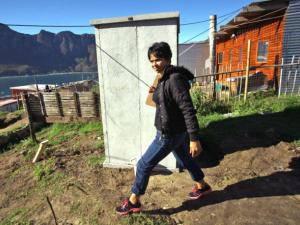
This would be a laughable parable of urban `development’ if it weren’t for other recent Hout Bay news: toilets. A little while ago, 14 new toilets were installed in the Hangberg informal settlement. In 2010, Hangberg was the site of ferocious engagements, as the City Council, the same one that has created the second dune, did its best, or worst, to pound the location into smithereens. That resulted in the uprising of Hangberg.

Since the Hangberg Peace Accord, according to Auriol Cloete, the number of folks living in Hangberg has tripled. Who’s Auriol Cloete? Here’s a report from 2010: “Hangberg resident Auriol Cloete made breakfast for her children, saw two of them off to school and felt proud as she sat in the house she had built for them. Hours later the mother of four was partially blind, cowering on her bed, bleeding from the left eye, and screaming at her children to keep lying flat on the floor as police and residents clashed outside…. She was injured…when violence broke out between residents and police who had entered the settlement to escort workers contracted by the City of Cape Town to demolish about 20 unoccupied dwellings erected illegally on a firebreak. Residents threw rocks and petrol bombs and fired distress flares at officers who used rubber bullets in retaliation. A rubber bullet hit Cloete in the left eye… Cloete ran back into her house as it was too dangerous to try to get to an ambulance… Later, she was taken to hospital with another resident, who was apparently also shot in the left eye, and who is now unable to see because his right eye has become infected… Cloete, who worked whenever she could secure a job, has lived in Hangberg all her life and had spent more than R60 000 on a home for her children.”

Auriol Cloete is the Tiresias of Hangberg, and what she sees today are 14 toilets that, after three years and untold injuries, somehow signify welcome.

Here’s what Cloete might see in the future. Sometimes a dune is a dune. And sometimes a toilet is a toilet. And sometimes, urban development isn’t development at all. When nature and populations are seen as problems to be controlled, when – in the name of well being and prosperity – the histories of shifting sands and populations on the move are ignored or worse, expect the worst.


(Photo Credit: Thomas Holder / Independent Newspapers)

Make way for Alice Nkom

Alice Nkom

Last year was a busy year for Cameroonian lawyer Alice Nkom, but then again … it was a busy year for the Cameroonian government, and its various allies, persecuting and prosecuting anyone it suspects of being gay, lesbian, transgender, of a sexuality, feminine, or different.

This year promises, or threatens, to be equally busy. This week, leading Cameroonian LGBT rights activist Eric Ohena Lembembe was found tortured and murdered. These are urgent times in Cameroon, as noted today at Africa Is a Country, and Alice Nkom, as ever, is in the thick of the urgencies.

Alice Nkom was the first woman to become a lawyer in Cameroon. That was in 1969, and she was then 24 years old, and she’s been kicking through ever since. Over the last four decades, Nkom has been a leading civil rights and women’s rights activist and advocate in Cameroon, and for the last decade or so has become famous, or infamous, for her defense of LGBTIQ persons, communities and rights.

In February 2003, Nkom established ADEFHO, L’association pour la défense des droits des homosexuel(le)s. The Association for the Defence of Homosexuals has suffered threats, attacks, intimidation. Nkom has received death threats. She has been imprisoned. She has been threatened with being disbarred. And she persists and returns to court again and again.

In December of last year, Alice Nkom once again was in the news when an appeals court upheld the three-year sentence of her client Jean-Claude Roger Mbédé, whose crime was sending another man a text message that read, “I’m very much in love with you.” In July, Mbédé was released provisionally, and so this sends him back to jail, to the harassment and assaults “at the hands of fellow inmates and prison authorities on account of … perceived and unproven sexual orientation”. He goes back as well to the general hellhole of Yaounde incarceration, a prison originally built for 600 that now houses 4,000.

In February 2012, 10 women were arrested on suspicion of being lesbians. No proof was given. No proof was needed. Suspicion is enough, when it comes to protecting the nation. Men have been arrested and imprisoned for hairstyle and for drinking Bailey’s Irish Cream. These crimes of fashion proved the men were feminine and thus gay and therefore worthy of incarceration. Perception is everything.

All of this is happening, as Alice Nkom has argued repeatedly and to varying degrees of success, in a country that has a modicum of respect for the rule of law, to the extent that it has codified due process. The law that authorizes the current abuses is Article 347, which, somewhat ironically, may not even exist. Again repeatedly and to varying degrees of success, Nkom has argued that the law never passed through the appropriate committees and procedures in the National Assembly.

No matter. Somehow this non-law law has authorized the State disruption of a seminar on HIV/AIDS education and prevention, because there was something in the air about empowering sexual minorities. Perception is everything.

It’s not easy taking the high human rights road to attack the State. In Cameroon those organizations that have argued and mobilized around health issues pertinent to same-sex relationships, and particularly to MSM communities, have fared better in the international sphere, vis a vis funding, and have even received some support from the Cameroonian government. But when Nkom received funding from the European Union, “she was immediately threatened with arrest and a fatwa by pro-government youth groups.”

Last year, when her own arrest seemed imminent, Nkom wrote to leading Cameroonian LGBT activists: “Do not worry for me. I believe I will be arrested in the coming days, but I will not lose sleep over this or, especially, abandon what we have begun together.” It’s been a busy year for Alice Nkom, a year of pushing on, pushing back, pushing forward. Nkom has heard the rumble of violence, menace and threat, and has a direct response: “Threats like these show us that the fight must continue”

(A different version of this was originally published at Africa Is a Country. Thanks to Sean, Tom and the collective for the collaboration and support.)

(Photo Credit: Journal du Cameroun)

To present to the dead friend within oneself the gift of his innocence

The names. The names of places: Armadale, Marikana. The names of sectors: the garment industry. The names of those individuals whose names cannot be shared: Laura S. The names of the men: Jimmy Mubenga. The names of the women: Ishrat Jahan, Jackie Nanyonjo, Savita Halappanavar. The names of the children: Ashley Smith, Trayvon Martin.

These are but some of the names of the innocents, slaughtered by State policy and practice. These are but some of the people we have tried to describe over the last little time. These are the names of those whose tragedies have opened too many doors to the work of mourning.

We have written, others have written, to what end?

To write, to him – present to the dead friend within oneself the gift of his innocence. For him, I would have wanted to avoid, and thus spare him, the double wound of speaking of him, here and now, as one speaks of one of the living or one of the dead. In both cases, I disfigure, I wound, I put to sleep, or I kill. But whom? Him? No. Him in me? In us? In you? But what does this mean? That we remain among ourselves? This is true but still a bit too simple.”

After the silence, after the too-simple truths, what is there? If we are to present to the dead friends within oneself the gifts of their innocence, we must earn the gift. We must organize the State of peace, justice, mutuality, love. All else is … words.

And Trayvon Martin is dead.


(Photo Credit: Livemint.com/Gauri Gill)

How not to study sexualized violence in the DRC

“Soldiers and militiamen have raped women around Bukavu.” New York Times

Judging by the volumes of media productions and the increasing attention devoted to the topic by various organizations, interest in and awareness of sexualized violence that rages armed conflicts have amplified these past few years. The narrative of sexualized violence has also evolved. At first, ‘rape as a weapon of war’ used to dominate popular understandings of sexualized violence in conflict. That was later criticized for being reductionist in emphasizing the assumed psychological strategy of humiliating the enemy. Understanding rapes that occur in war zones as exclusively underpinned by a particular combatant motive now seems to offer little. However, thanks to many studies and reports, we know that armed conflicts alter and intensify a society’s patterns of rape. The civil wars in Spain and Sri Lanka, Second World War Japan, Afghanistan, Iraq, the former Yugoslavia, Nazi Germany: the list goes on and on and on….

Despite the overabundance of examples, many today associate wartime rape primarily or exclusively with the DRC. Depending on international media to shape our grasp of worldwide human rights violations, many of us have learned to identify wartime sexualized violence with women in the DRC’s North Kivu region.

Two women who played a major role in bringing the systematic rape of Congolese women by soldiers into the world’s conscience are the former U.S Secretary of State Hillary Clinton, who pushed the topic on the US’s foreign policy agenda in 2009, and Margaret Wallström, who, during her term as the UN’s Special Representative on Sexual Violence in Conflict, coined the now famous term ‘Rape Capital of the World’ in reference to the DRC in April 2010. Former UN Special Envoy and current co-director of AIDS-Free World Stephen Lewis also argued that “there is no precedent for the intense brutality of the war on women in Congo” and that “the world has never dealt with such a twisted and blistering phenomenon”.

War, sadistic gang rape, vicious killing, violence deserve prioritization across the social, political and legislative agendas. Two spaces in which these issues are focused on are development and postgraduate gender and development programs, both of which are largely occupied by those privileged with access to universities, travel grants, research positions, international development jobs. In reality, we’re talking about white middle-class European and American women with a strong sense of idealism and a soft spot for difference and `the other’. Not surprisingly, when the realities of sexualized rape in eastern DRC began to emerge, more than a few were drawn to the topic.

In a world where violations of women’s rights continue to be marginalized, normalized and invisibilized, demanding attention for the brutalities women face is a good thing. After all, it takes exposure, shock, outrage, solidarity and a sense of urgency to mobilize resources and political will to investigate the crisis and take action. However, when one particular group of Western women comes to study and define the `truth’ of a less privileged group of `other’ women, how does their positionality and their inevitably chalenged grasp of context `on the ground’ affect the subject women, the women are being studied, `empowered’, `supported

In what ways ways is their interest connected to the longstanding colonial fascination with subaltern brutalities and Black rapists? Such questions might seem like a futile, even galling exercise in the face of the high rape estimates and the urgency with which the crisis must be addressed. Surely the fear for racially stereotyping certain groups by researching their perpetration shouldn’t lead to a neglect of massive human suffering? That’s right; it shouldn’t.

However, not all research carried out is actually helpful or constructive in reducing the violence, as Marsha Henry, points out, in her piece, `Ten Reasons not To Write your Masters Dissertation on Sexual Violence in War’: “Here’s another important reason not to write a dissertation on sexual violence as a weapon of war in the DRC. It’s been done already! Students continually ask me ‘can you suggest a couple of books on the subject?’. Where to start? There is so much to be said about gender and violence in militarised contexts more generally, but there has also been a great deal written about by a number of scholars. And it is precisely this body of knowledge that has sometimes been misanalysed by students. That is, although much of this writing has politically exposed the issue, students often read it as a holistic canon on the subject, interpreting the text as they wish. Dissertations often become regurgitated and simplistic snapshots of other work, reinforcing particular perspectives and portrayals and therefore contributing to the reification of the subject (missing a cogent assessment of narrative forms). A rhetorical stasis is created, where certain material and citations are circulated and re-circulated, with little new insight or critical perspective provided”.

One explanation for the disproportionately large interest in the DRC, compared to other conflicts, is the horror at the brutalities women have faced. If indeed this horror plays a key role in igniting students’ interest, how does that shape the findings and value of the final work? According to Henry, it does so in a troubling way: “Honing in on the bodily experience of rape, for example, can remove rape in war from the wider social, cultural, economic and political context in which it always takes place. It can be an abstraction of the total experience. The affective impact is that readers of these dissertations distance themselves from subjects in the studies”.

Is the topic compelling because of the opportunity to contribute towards understanding and ending the violence? At what point is this opportunity compromised by sensationalizing thick descriptions? If this type of research adds neither value nor insight, what might be its negative effects? For example, imagine a future generation of students googling ‘rape and war in the early 2000s’ and being bombarded by references to the DRC, while reading little about all the other conflicts where similar violence occurred. Wouldn’t that tell them rape-and-war was unique to the DRC? To Africa? Wouldn’t that particular type of disproportional interest inevitably lead to a distorted, and racist, version of the truth? The point is not for students to ignore the topic, but to critically check the roots, aim and fruitfulness of its appeal and to consider the effects it may have.


(Image Credit: The New York Times)

A specter haunts California


At some point California dreamin’ and going back to California turned into Golden Gulag California. One day, the gulag too shall pass. After the gulag, what will emerge, and who shall write that history? Today marks the second day of the California prisoners’ hunger strike. Some 30,000 prisoners have laid down their tools, in this instance their bodies, in what is reported to be the largest hunger strike in state history. Prisoners across the state have put their lives on the line.

The core demands are straightforward and eminently reasonable: end group punishments; abolish the whole gang identification and `debriefing’ apparatus; end long term isolation; provide adequate and nutritious food; expand and provide constructive programs and privileges for those placed in indefinite solitary confinement in what California calls “secure housing units”. A secure housing unit is a warehouse of pain, suffering and slow death.

Indefinite solitary confinement is torture. Being buried alive is torture. But this hunger strike is about more than that. It’s about the future as well as the present. It’s about who will write the history, and what master narrative will rule that roost. It’s about being human

Solitary cells of America are filled with people living with disabilities. Prisoners, like Prisoner #6 in Pennsylvania SCI-Muncy, are depressed, live with mental disabilities, act out, try to commit suicide, and they are thrown into the hole and abandoned there. And then die horrible deaths.

But that’s not good enough for California. California has Secure Housing Units in which “security” means indefinite and long term isolation, and debriefing means coerced reporting on gangs, even if one is not in a gang.

Meanwhile, in the ordinary and everyday world of California prisons, until fairly recently, women prisoners were tricked or coerced into sterilization. 66% of the guards inside women prisons are male; most of the rapes inside women’s prisons are at the hands of male prison staff.

When the Valley State Prison for Women, VSPW, was closed, to turn it into a men’s “facility”, and the women were shipped to the already crowded Central California Women’s Facility, CCWF, what happened? Overcrowding, antagonism, tension, violence … and segregation and isolation. Take the case of Prisoner T: “T. has been incarcerated for 30 years, with a parole date in late 2014, and was among the women transferred from VSPW after 25 years of violation-free programming.” Twenty-five years without a violation. Because of CCWF circumstances beyond T’s control, T is segregated and will probably stay in segregation for the entire year, until she’s paroled. According to T., “It’s disheartening to be in Ad Seg as I am locked up in a cell 24 hours a day. I only receive six hours of exercise a week, which consists of a small fenced in cement yard that has no place to sit except on the cement floor. I just go out for the fresh air.” Fresh air. To get fresh air, T. is stripped naked and spends her hour in that cement yard completely naked and completely alone. When she returns, she is strip-searched. When she goes to shower, she is handcuffed behind the back. She is allowed to shower three times a week. T. is not in segregation for disciplinary reasons, and yet she is treated as if she were.

Meanwhile, in the “free world”, in California developmental centers, the in-house police do less than nothing to protect residents and patient, or to investigate incidents of abuse. According to a report today, “dozens of women were sexually assaulted inside state centers, but police investigators didn’t order `rape kits’ to collect evidence. Police waited so long to investigate one sexual assault that the staff janitor accused of rape fled the country. The police force’s inaction also allowed abusive caregivers to continue molesting patients – even after the department had evidence that could have stopped future assaults.”

The California prison hunger strike is about being-human. Across the state of California, people in prison are regularly abused, humiliated, tortured, and worse. Women are regularly attacked as women. Indefinite solitary confinement, “debriefing”, group punishments, toxic food regimens, denial of basic services and programs, forced sterilization, routine sexual violence, these are all public policies. They are not incidental nor accidental. The struggle taking place right now in California is for the soul of humanity, for that remote possibility that after the Golden Gulag, something human will emerge. A specter haunts California.


(Photo Credit: The Examiner)

Casual Rape: Who prosecutes the abusers that endanger women’s health?

In a consultation with her gynecologist a woman reports informally that she needs confirmation that she is free of all sexually transmitted diseases. It wasn’t really rape she pleads with a mix of fear and shame. She should not have been there, but he said she was pretty. It all happened so quickly, in a split second. Then she screamed, and he stopped. He is an administrative supervisor of 30 years; she is an employee of only 6 months. Elusive statistics on casual rape show 90% remain unreported. The data implies the existence of many fellow victims at her work place. This information, along with her negative test result, did little to assuage the permanent violation of body and mind that she carries each day back to the work place. Fear of exposure, retaliation, loss of job and personal safety becomes her new mode of existence. The physician bound by the limits of health privacy and absence of appropriate resources to help becomes an impotent appendage of the system, unable to address the social pariah, a system that traps the victim and the health care professional in a prison of secret public health epidemics of rape.

Here the prison isn’t a figure of speech. The two work in prison, and she is an inmate.

As mandated by the Prison Rape Elimination Act of 2003, the Bureau of Justice Statistics publishes regular statistical reviews and analyses of incidents and effects of prison “sexual victimization.” In its 2011-2012 report, sexual abuse rates remained fairly constant, with 4% in prisons, down from 4.5% in 2007; and 3.2% in jails, which is the same as 2007. Since incidents of sexual abuse are notoriously under reported and because the high volume of admissions in local jails making these detainees invisible to BJS surveyors, the statistics represent only a small percentage of prisoners’ abuses.

There is a need for a different kind of dialogue that would expose the marginalization of people that allows, and promotes, sexual abuses to go on behind closed doors. The important confidentiality of the physician’s office contrasts with the dearth of instances for sexual abuses to be rendered public without fear and shame. As we recall, pregnant women may be prosecuted and sent to jail for supposedly endangering their fetus, but who prosecutes the abusers that endanger women’s health?

We need to start a change in the paradigm of power that makes so many suffer.

(Photo Credit: ThinkProgress / Just Detention)

Perception matters. Ask Australia’s women asylum seekers.


Recently, Geena Davis noted, “We just heard a fascinating and disturbing study where they looked at the ratio of men and women in groups. And they found that if there’s 17 percent women, the men in the group think it’s 50-50. And if there’s 33 percent women, the men perceive that as there being more women in the room than men.”

Perceptions matter, and perceptions of those in control are typically sexist and racist, especially when the `tipping point’ is involved, when those in power feel the threat of a `new majority’. That’s why perception can’t be the motor for public policy and, even less, for the pursuit of justice, Take Australia … please.

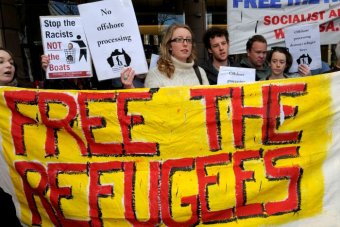
A key plank of Australia’s asylum policy has been deterrence. This has resulted in brutality, torture, horror, despair … and big profits for the private security corporations, most infamously Serco, who run the immigrant `detention’ and `transfer’ installations. With the shift in government over the past week, some wonder if anything will change in terms of Australia’s racist and sexist asylum policies.

If anything, it looks like they will get worse. Within hours of the new government’s installation, the new “de facto Immigration Minister” declared that most refugee applicants are “economic refugees”. There’s no evidence for that statement, but who needs evidence when `perception’ is on your side?

And what is the perception? The boats. The boats keep coming, and sinking. The refugees keep `swarming’. It’s a human tsunami bearing down on Australia. These images are merely part of the `ferocity’ of the anti-refugee anti-asylum-seeker discourse. Meanwhile, the women and children pile up in the `detention centers’. They’re prisons. Detention is too fine a word. Ask the children who go on hunger strike. Ask the 16-year-old Afghan boy who ended a five-day hunger strike yesterday. Why was he barreling towards his own death? He’s an unaccompanied child, in prison, in the middle of nowhere, surrounded by every form of hostility, with no visible end in sight to his torment. Perhaps that’s the reason.

The treatment of asylum seekers, and in particular of women and children asylum seekers, has been a mounting succession of cruel jokes. Each step of the way, the asylum seeker’s vulnerability and precariousness are intensified.

But here’s the thing: Australia is not drowning in asylum-seekers. Pesky numbers keep denying the `perception’. Yes, the numbers of refugees and asylum-seekers are rising. Yes, the numbers coming by boat are, for the first time, exceeding those coming by plane. BUT Australia takes a very small percentage of the world’s refugees, around 3 percent. Officially, there are 30,083 refugees currently living in Australia. That means, if you consider the size of the country, Australia has one of the lowest rates in the industrialized world. Australia has 1.4 refugees per 1,000 people. Germany has 7.3; Canada has 4.7; the United Kingdom has 2.4. (The United States has .8.)

There is no flood. Australia can stop building sea walls, prison colonies, and worse. It can. But it won’t. Rather, the new government will opt to continue, and probably fortify, the “`hard bastard’ approach.” Perception matters, as does patriarchy.


(Photo Credit: AAP / Julian Smith)

Casual rape in prison work places

What is considered rape? Often, the definition of rape depends on who holds the power to define it.  For example, what is happening in places where women are confined, dependent and supervised?

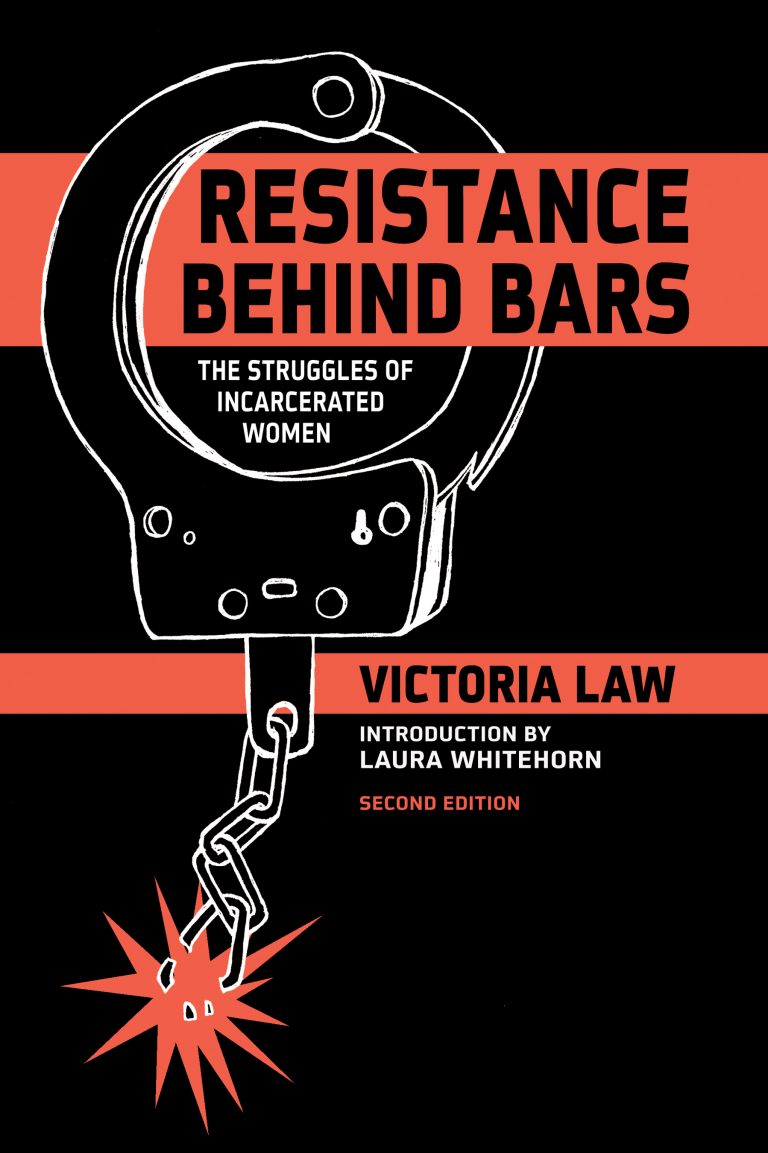
In Resistance Behind Bars, Victoria Law devotes one chapter to sexual abuse in prisons. Women like Gina are forced into having sex with male wardens or supervisors. Gina worked in a correctional coffee shop in Oregon as a prisoner. Everyday she would work with the food coordinator who was a male prison employee. She loved her job and thought that her relationship with the food coordinator was friendly, and then he ordered her to have sex with him, “Scared Gina complied.” Casually, sex was part of her everyday work life. As Victoria Law explains, “She did not know if it was rape. All she knew was that she felt alone, afraid and unsure of herself.” (59)

As at many workplaces, women in prison don’t feel secure reporting abuse. Prisoners fear that reporting to internal affairs will result in retaliation from prison personnel and sometimes from prisoners who trade sex for favors. Retaliation in prison may take different forms, including more harassment, delays for release, visiting rights compromised, and worse.

Rape threatens women prisoners and renders them vulnerable as prisoners and as subordinates. In that context, sex becomes a illusory bargaining chip that ultimately generates feelings of being trapped. The ticket out buys the women prisoner another day or more in solitary confinement. Consent or its absence is not the question when women are already condemned, and damned, by incarceration and structures of dependency.  For many women prisoners, the only issue, the only ethical existential issue, is survival, paying the bills, and managing life in a brutal penal system.

(Image Credit: PM Press)

Women demand cities that value women

In this season of mass protests and demonstrations, much of the news media has decided that this global phenomenon is an expression of `middle-class rage’. It’s not. The waves of mass protests are a creative response to the form of urbanization that now covers the globe. Remember, already more than half the world population lives in urban zones, and, according to the United Nations, soon more than half the world population will live in urban slums. This means the urban local is global. That’s the lesson that protesters, and in particular women protesters, are once again bringing to the streets and beyond.

The march of protests is a global urban uprising. Ask the women, and their colleagues and friends, who, through policy brutality, have become icons of the protest movements.

When Ceyda Sungur, Gezi Park’s `woman in the red dress’, was interviewed, after the police pepper sprayed her in the face, she deflected personal attention: “A lot of people no different from me were out protecting the park, defending their rights, defending democracy. They also got gassed.”

How does protecting a park equal defending rights equal defending democracy? On one hand, in the specifics of the moment, the equation is part of the pro-democracy rhetoric. On the other, more pertinent hand, Ceyda Sungur is an urban planner. When Sungur says, “For me this is about freedom of speech and the power of the people”, she means the struggle for the park, rights, democracy, freedom, power, is an urban struggle, a struggle against authoritarian, anti-human, anti-woman urban development.

Then there’s Liv Nicolsky Lagerblad de Oliveira. She lives in Rio. One night, she was standing alone on a street corner where there had been demonstrations earlier. Hours earlier, the riot police had forcefully removed all the protesters, but they were still hungry. They descended upon Oliveira, alone, late at night, just standing, and pepper sprayed her full in the face at close range. Yet again, the riot police created a new icon, yet again a woman.

And yet again the message, this time Oliveira’s, was urban: “The city is being gentrified. The poor can no longer afford to live in some favelas and the elite is taking their place. The cost of life is increasing and the increase in bus fare was just the last straw.”

Around the world, thanks to `urban development’, the working poor can’t afford to live in the slums. Women know this story, because they’re the central, disallowed subjects.

Repeatedly, protestors argue the City has become the epicenter of debt-and-death. Worldwide women are protesting the designed hostility of `the new Jerusalem’ to women and girls. Women, like Ellen Woodsworth, the founder of Women Transforming Cities, are organizing with women to address the complete and systemic lack of gender equity lens that marks city planning and governance. Urban public lighting, transportation, access to medical care, access to police, affordable housing, green common spaces, toilets, living wages, decent working conditions, violence, crime, peace, well being, inequality, equality are all particular to women and are all feminist issues. For example, in Japan, the environmental recycling movement had to rethink everything when women challenged the assumptions of their mandated unpaid, unrecognized, `informal’ labor … in the name of a green economy. The women in Japan said, “No gender equity, no peace.” The women in Istanbul, Ankara, Dhaka, Rio, São Paolo, Vancouver, Cape Town, Barcelona, Buenos Aires, and beyond, are saying so as well.

The last green space in Istanbul is an urban women’s issue, and a feminist crisis. The rise in public transport fares and the pricing of slums out of the reach of the working poor in Rio de Janeiro is an urban women’s issue, and a feminist crisis. Thais Gomes, Brazilian `shantytown dweller’, understands that. It’s not “middle class rage”. It’s urban.

Around the world, women are saying “Hell no!” to the “gift” of global hyper-urbanization and “Hell yes!” to cities that respect all living beings as valuable, to city administrators and planners who see value in the social, to those who value women as humans, neighbors, partners.


(Photo Credit: Bianet)