Hope in a time of choler: A South African court shall not shut the mouth of the media


In 2010, a new South African investigative journalist project, amaBhungane, was founded. In isiZulu, amaBhungane means dung beetle. Their slogan is DIGGING DUNG, FERTILISING DEMOCRACY. This week the High Court of South Africa, Gauteng Division, confirmed not only the work of amaBhungane but also the importance of investigative journalism to the work of democracy. The case involves amaBhungane and its reporting on the Moti Group, a South African conglomerate with extensive international holdings.

The story in a nutshell: amaBhungane received files concerning the Moti Group. In late April and early May, amaBhungane published three articles exposing attempts by the Moti Group and its owner, Zunaid Moti, to cozy up to the leadership in Zimbabwe as well as to surreptitiously influence an employee at Investec who was charged with protecting the bank against the Moti Group’s quickly expanding debt. The Moti Group immediately launched a campaign to silence, and ultimately crush, amaBhungane. On June 1, the Moti Group went to court, on an ex parte and in camera basis, meaning the proceedings were behind closed doors and amaBhungane was not allowed to attend. The judge issued a gag order and told amaBhungane to return all leaked documents, by this time known as the #MotiFile. On June 3, amaBhungane went to court. They were allowed to retain the documents, which, by the way, they did not actually have possession of, but the gag order remained until a further court hearing. That hearing occurred June 27, in the High Court of South Africa, Gauteng Division, with Judge Roland Sutherland. Judge Sutherland issued his ruling yesterday, “a scathing rebuke for the Moti Group and its lawyers” as well as for the lower court.

Judge Sutherland decreed that there was no compelling reason for an ex parte and in camera hearing. He went further and declared that holding such a proceeding was a violation of all juridical procedure as well as an assault on judicial integrity, journalistic freedom, justice and democracy. The decision has been hailed far and wide. Needless to say, the Moti Group continues to spin the results and promises to continue its campaign against amaBhungane.

While many note Judge Sutherland’s step by step evisceration of the Moti Group’s arguments for secrecy, Judge Sutherland was clear to explain that the role of the media is critical to the functioning of democracy: “A South African court shall not shut the mouth of the media unless the fact specific circumstances convincingly demonstrate that the public interest is not served by such publication. This is likely to be rare.”

In 2010, amaBhungane chose as its slogan, DIGGING DUNG, FERTILISING DEMOCRACY. In February 2017, the Washington Post started using that line, “Democracy Dies in Darkness” as its slogan, its first slogan in its then 140-year existence. The Post credited Bob Woodward with the line, and Woodward credited Judge Damon J. Keith, who had presided over a First Amendment case in 2002, Detroit Free Press v. Ashcroft. In 2021, that decision was cited in South Africa, in a decision by the High Court of South Africa, Gauteng Division, in which the Open Secrets and the Unpaid Benefits Campaign sued the government for cancelling pensions and withholding access to information: “In Detroit Free Press v John Ashcroft, the United States Court of Appeal for the Sixth Circuit held that: `Democracies die behind closed doors. The First Amendment, through a free press, protects the people’s right to know that their government acts fairly, lawfully, and accurately …When government begins closing doors, it selectively controls information rightfully belonging to the people. Selective information is misinformation.’ The reason being is that `in darkness of secrecy, sinister interest and evil in every shape have full swing.’  It is for that reason that the Constitutional Court has stated that openness is the default position, and it refuted an approach that proceeded from a position of secrecy. The principle of open justice is an incident of the values of openness, accountability, and the rule of law. Included in this is the notion of a participatory democracy. These are the foundational values upon which our Constitution is based, and which are entrenched therein.” The lessons of democracy, of preserving and strengthening democracy, travel, quickly. This week, the courts of South Africa are teaching the world a thing or two about keeping the lights of democracy on and bright.

(by Dan Moshenberg)

(Image Credit 1: Smithsonian) (Image Credit 2: amaBhungane)
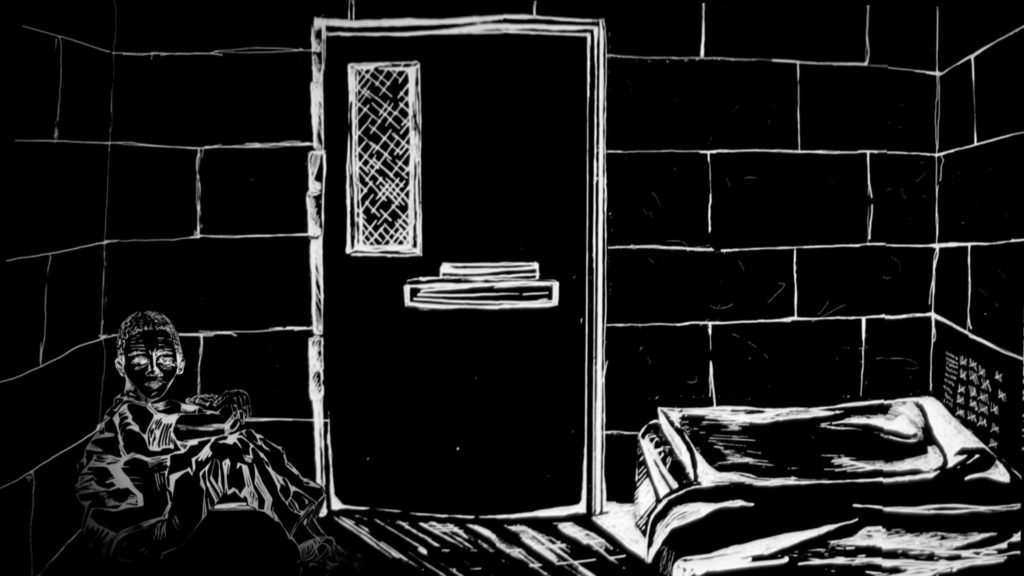
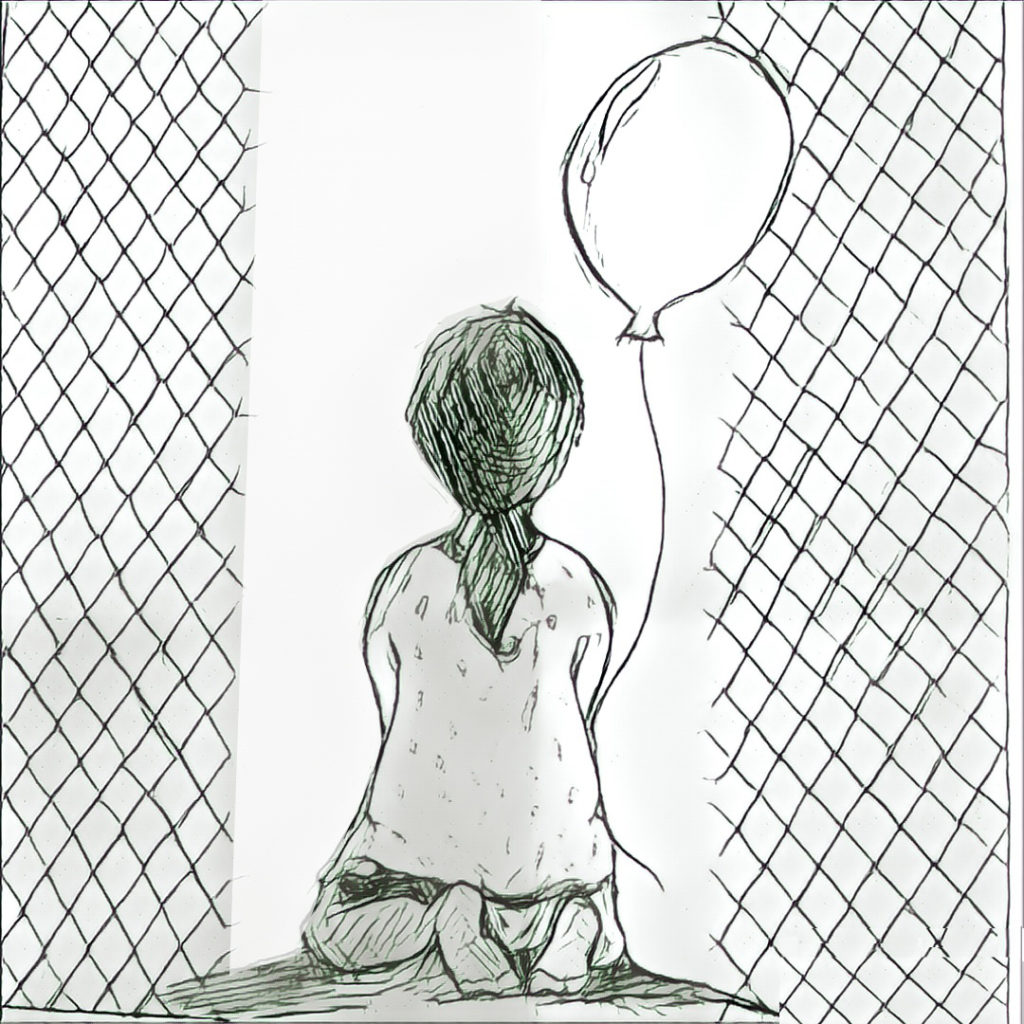
We do it for the children … prison, solitary, torture, trauma, and beyond

“In a democracy, we do not put children in cages. Period. There is no debating it. Nothing you can say to me will justify putting children in cages.”             Patricia Okoumou

Ethan Weinstein, a reporter for the VTDigger, covers southeastern Vermont. Of late, he’s had reason to cover the Vermont Department of Corrections. In a recent interview, speaking of the high and rising number of deaths, and particularly suicides, in Vermont’s prisons and jails, Weinstein noted, “There’s a belief that things are going to be messed up there, that you’re not going to be receiving adequate care. And so it has felt like, in order for something to be a story, someone has to die. You know, it’s not enough to hear that a person has a concussion, and they can’t see a doctor, or a person has been prescribed a medication their whole life and has been refused it once they’ve been incarcerated. It just seems as though our tolerance for issues within our prisons is so high that it can be hard to get people to care about this.” What if that person is a child? Does that matter? Does it matter to you? Recent news reports would suggest the answer is No.

For years, the United States has `struggled’ with an epidemic of seclusion rooms and physical restraints in schools. Time and again, one district or another has been forced to `discover’ its own alarming propensity for torture of children in the name of schooling. This past week, Alabama put a new twist on an old story by … doing absolutely nothing. Last week, Al.com, Alabama’s largest news site, reported that, after six years waiting, the state had still not provided any requested data on school seclusion and restraint incidents. In March 2017, Al.com requested data. Nothing came. In 2020, they tried again, and, again, no response. In June 2022, they tried again, and again received nothing. Public school districts are required to turn over information to the U.S. Department of Education every year. The last year Alabama reported on was 2017 – 2018. As far as Al.com can tell, Alabama’s state department doesn’t seem to care. The Alabama state department is supposed to collect information from every school district every year. It doesn’t, and what it does manage to get doesn’t seem to undergo any review.

In 2017 – 2018, Alabama reported nearly 600 incidents of seclusion, of putting a child in a locked room often for hours, and often for days, on end. The use of seclusion rooms in schools was outlawed by the Alabama legislature in 2011, but it’s not significant enough to warrant enforcement.

In 2021, an Aboriginal youth, Michael, was `referred’ to Cleveland Youth Detention Centre, in Queensland, Australia. Cleveland is almost always described as “troubled.” Michael, who lives with intellectual disability, was charged with a violent assault. He spent 744 days in detention, awaiting trial. On Friday, at trial, it was `discovered’ that Michael had spent 500 days in solitary confinement, “regularly locked in his cell for more than 20 hours a day.” The explanation for this was “staffing issues”. Rodney Dillon, a Palawa man and Indigenous rights advocate, has a better explanation, “This system is not about looking after human beings, this is about torture. It’s a torture chamber, that’s what it is. The effect this will have on this kid’s life is irreparable. That kid will be damaged for the rest of his life; that kid will never, ever move on from what’s happened. That is the worst thing you can do to any human being, is put them in solitary confinement … We need to change this system, the racism that’s in this system, and the hatred.”

What exactly are children meant to learn, the ones thrown into solitary, the ones watching their friends go into solitary? Why are we so invested in seclusion and restraint of children, generally, and of children living with disabilities, particularly? What terrible crime have these children committed that entire systems invest so much in maintaining practices that constitute torture?

What terrible crime have these children committed? Must they die to be a story, for us to care? Remember Alan Kurdi, the two-year child who drowned September 2015 and was famously photographed, dead, on the beach? Remember? In England, in 2018, ten-year-old Muhammad Amin entered and won a youth poetry contest. Rather than throwing children into solitary, rather than torturing them, rather than only hearing (of) them when they’ve died, we should listen to them. Listen to Muhammad Amin listening to Alan Kurdi:

Alan Kurdi
by Muhammad Amin

Alan Kurdi lies on the beach
Like autumn’s fallen leaf
Seagulls soar in the sky
Singing a song of grief

His eyes are bright pools
Swimming in the deep
Are forgotten faces full
Of pain, faces that weep

Alan Kurdi doesn’t breakfast
No sugar puffs or corn flakes
Snap, crackle and pop. Bombs
Fall like little earthquakes

He has never played nintendo
Nor xbox, truth or dare
Only hide-and-seek with IED’s
Landmines and the snipers stare

The water lapping at his feet
His body lies on the sand
Still, silent, frozen, frail
A ragdoll from another land

Alan Kurdi’s voice reaches me
“Amin, Amin listen to me
I was put into the sea
Like Moses. Don’t you see?”


(By Dan Moshenberg)

(Image Credit: Anna Vignet)

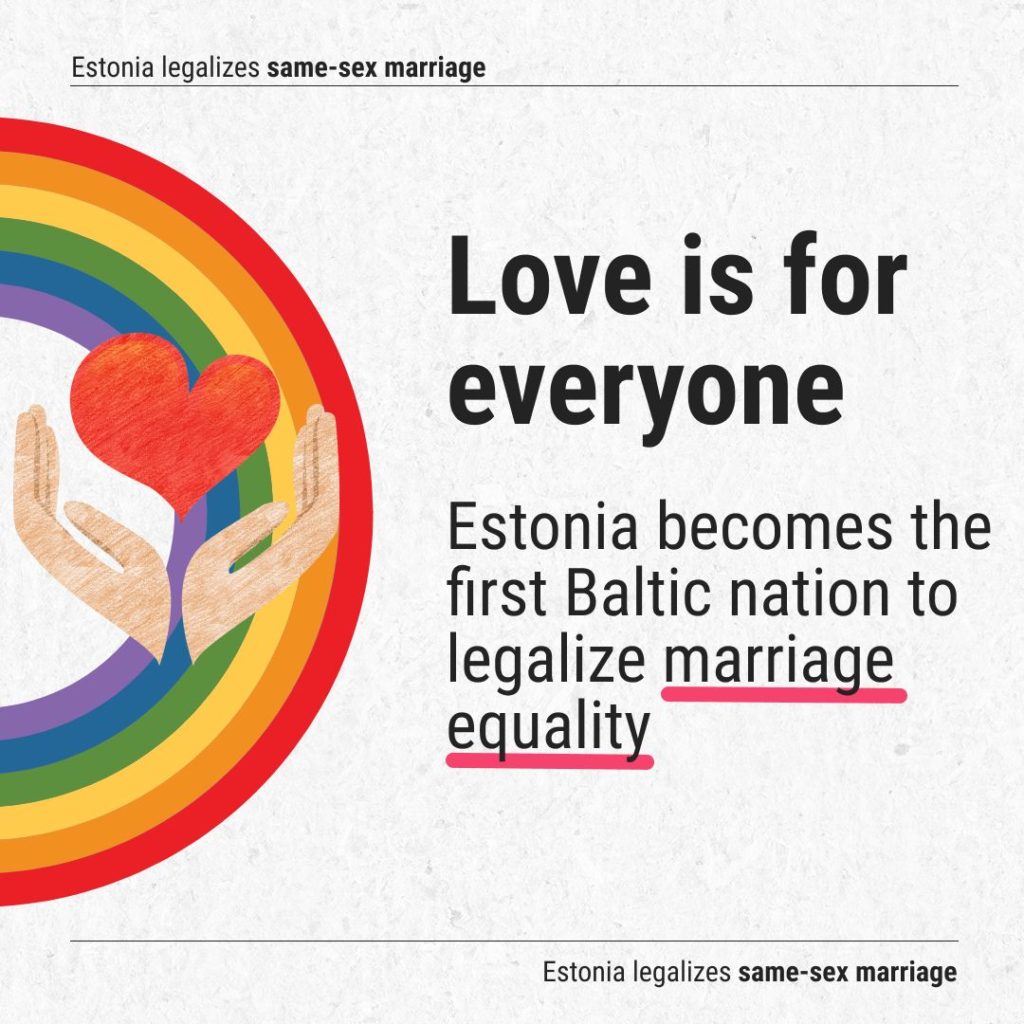
Hope in a time of choler: Estonia legalizes same-sex marriage!

The news these days is daunting: hundreds migrants, refugees, asylum seekers forced to drown in the Mediterranean and scores in the Atlantic Ocean; women hacked and burned to death in a Honduran prison; the ongoing assault on reproductive justice and women’s autonomy across the United States; the ongoing anti LGBTQI+ pogrom in Uganda; the `discovery’ of the Japanese policy of forced sterilization having been applied to children; the abandonment of asylum seekers living with disabilities in unprepared hotels in England, and the list goes on. A toxic stew of State sponsored cruelty. Legislators in Kenya, Tanzania and South Sudan are pushing for passage of laws modeled on Uganda’s anti-gay laws. But there are glimmers of hope. For example, on Tuesday, June 20, Estonia’s Parliament voted to legalize same-sex marriage. Estonia’s Prime Minister Kaja Kallas responded to the vote: “Everyone should have the right to marry the person they love and want to commit to. With this decision we are finally stepping among other Nordic countries as well as all the rest of the democratic countries in the world where marriage equality has been granted. This is a decision that does not take anything away from anyone but gives something important to many. It also shows that our society is caring and respectful towards each other. I am proud of Estonia.”

The vote in the 101-seat Parliament was 55 – 34. In May, the Estonian Human Rights Centre released a survey that showed that 53% of Estonian people support marriage equality. In 2012, a survey suggested that 60% of Estonian people were opposed to marriage equality. What a difference a decade of continued organizing makes. 75% of Estonians between the age of 20 and 29 support marriage equality. More than half of the Estonian population believe that a same-sex partner should be able to adopt their partner’s child. With the recent passage of marriage equality legislation, LGBTQI+ couples will have adoption rights and parental recognition, which was previously denied to same-sex civil unions.

Last year, on July 8, Slovenia’s Constitutional Court ruled that bans on same-sex marriage and adoption are unconstitutional. The Court ruled that discrimination is discrimination, and that discrimination against same-sex couples “cannot be justified with the traditional meaning of marriage as a union between a man and a woman, nor with special protection of family”. The Court ordered the Parliament to amend the law within six months. In October, Slovenia’s National Assembly amended the Family Code, and now same-sex marriage is legal. While there are rumbling sounds that a referendum would overturn the law, for now it stands.

On January 1, 2024, the new Family Code in Estonia will go into effect. Since 2005, political parties, government agencies and just plain people have been discussing, debating, and organizing for this day. Organizing teaches and organizing works. Pride is pride. Discrimination is discrimination. Family is family. Love is love. To those in Estonia who made this happen through decades of dedicated struggle, happy new year and thank you!


(by Dan Moshenberg)

(Image Credit: DW.com / Twitter)

Hope in a time of choler: In Canada, provinces end immigrant detention in their jails

On Friday, June 16, Ontario announced it would no longer allow the federal government to hold immigrant detainees in local jails. At any given moment, Ontario houses around half of all immigrant detainees in Canada, and it has kept them in maximum-security regional jails. Ontario is the eighth province to end the practice of jailing immigrant detainees. Last summer, British Columbia announced it would suspend its contract. After that, Alberta, Nova Scotia, Manitoba and Saskatchewan followed suit. Two weeks ago, Quebec and New Brunswick announced their intention to cancel the contracts. The actual cancellation of contract takes a year. At this point, only Newfoundland and Labrador, P.E.I. and the territories have not announced an intention to cancel their contract. Taken together, these remaining provinces account for less than 1% of immigrant detentions.

For the past two years, Human Rights Watch and Amnesty International have campaigned, lobbied and pushed for provinces to act. The campaign is known as #WelcomeToCanada. Two years ago, to the day, they released a report, “I Didn’t Feel Like a Human in There”: Immigration Detention in Canada and its Impact on Mental Health”, which lays out the brutality, cruelty and devastating impact of immigrant detention in Canada. Part of the mental health issue is that Canada allows for indefinite detention of immigrants: “For many detainees, not knowing how long they will be detained causes trauma, distress, and a sense of powerlessness.” Canadian provincial prisons are “notorious for their poor conditions.”   As Hannah Gross, Human Rights Watch researcher, noted, “This is an incredible victory. It’s a monumental win for human rights, for migrant and refugee rights.”

And so now the struggle moves to the federal level. First, the Canada Border Services Agency, CBSA, is largely a law unto itself: “The CBSA has sweeping powers including arrest, detention and search-and-seizure without a warrant. It is the only major law enforcement agency without independent civilian oversight to review policies and investigate misconduct.” Year in year out, CBSA incarcerates greater numbers of immigrants. In violation of international law, CBSA separates children from their parents and, further, keeps no record of how many children. CBSA has been found guilty of racial profiling, especially of Black immigrants. As mentioned, Canadian law allows for indefinite detention of immigrants. Teresa Gratton, for example, died October 30, 2017, in immigrant detention, far from her family who had no idea where she was. There was an uproar, momentarily. Six years later, indefinite detention continues. Glory Anawa, several months pregnant, was placed in indefinite detention. Her son, Alpha, was born behind bars. It is reported that his first words were “radio check”. “I don’t even have words to express how I feel. It makes me speechless. I’ve been robbed of my life,” said Glory Anawa. Glory Anawa was imprisoned in 2013. There was an uproar, momentarily. Ten years later, indefinite detention continues.

On March 24, 2023, the so-called Safe Third Country Agreement between Canada and the United States came into effect. Under this agreement, “People entering Canada from the US along the land border are still not eligible to make a refugee claim; will be returned to the US.” These terms “make it more dangerous for people to cross and increase the risk of being detained.” On Friday, June 16, the same day Ontario announced its cancellation of contract with the CBSA, the Supreme Court of Canada upheld the Safe Third Country Agreement, while sending it back to lower courts for some clarifications. While the cancellation of provincial contracts with the Canada Border Services Agency is indeed an incredible victory, one to be celebrated, it also casts a light into the ongoing darkness of persecution of immigrants in Canada and beyond. The struggle continues.

(By Dan Moshenberg)

(Image Credit: Canadian Council for Refugees) (Photo Credit: The Conversation / Prisoners’ Justice Day Committee Vancouver)

Hope in a time of choler: Malaysia takes beginning steps away from necropolitics

“I have put forward the notion of necropolitics and necropower to account for the various ways in which, in our contemporary world, weapons are deployed in the interest of maximum destruction of persons and the creation of death-worlds, new and unique forms of social existence in which vast populations are subjected to conditions of life conferring upon them the status of living dead … Under conditions of necropower, the lines between resistance and suicide, sacrifice and redemption, martyrdom and freedom are blurred.”

                                                                        Achille Mbembe, “Necropolitics

Twenty years ago, Achille Mbembe’s seminal article, “Necropolitics”, was published. In the intervening two decades, the world has committed itself to the various ways of destruction of persons and the creation of death-worlds. From environmental devastation to mass eviction to brutal warfare to brutality against vulnerable populations seeking assistance to brutality against those deemed destined for vulnerability and beyond, cruelty, suffering, misery followed intentionally miserable deaths has been the script. But in the past few months, Malaysia, no great bastion of either civil or human rights, decided enough is enough, and it’s time, way past time, to put a pause and perhaps even step away from the necropolitical order.

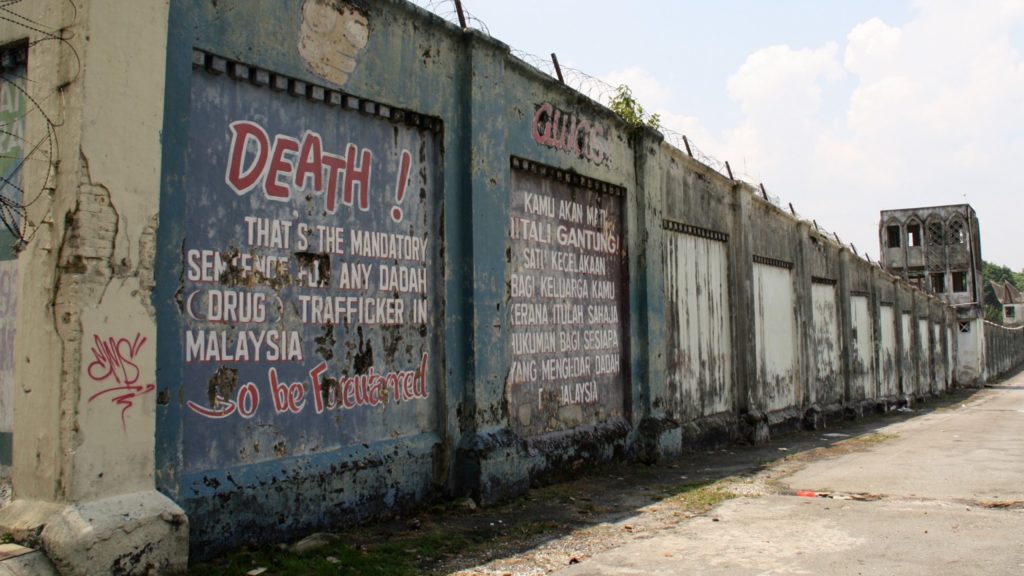
On April 3, Dewan Rakyat, or lower house, of Malaysia’s Parliament, voted for legal reforms that would abolish the mandatory death sentence for 11 offences. The full reforms called for the suspension of the death penalty for 34 offences, including kidnapping. While Malaysia has had a moratorium on death sentences since 2018, they did not close death row, and so judges have continued to send people convicted of these acts to death row, all in the name of rule of law. Executions would be replaced with whipping and imprisonment for as much as 40 years. This is in direct contrast to Malaysia’s neighbors, especially Singapore and Myanmar, who have returned to executions in recent years. The reforms also do away with imprisonment for a person’s natural life. On April 11, the Dewan Negara, or upper house of parliament, passed the reforms. They’re not perfect and they’re not all-encompassing (the death penalty can still be applied to those convicted of drug trafficking, but it’s no longer mandatory), but they are a step in the right direction.

Then, on May 22, the Dewan Rakyat passed a bill removing Section 309 of the Penal Code, a clause that punished suicide attempts with up to 1 year in jail, a fine, or both. Between 2014 and 2018, 11% of people who attempted suicide were prosecuted, again all in the name of the rule of law. Deputy Minister Ramkarpal Singh explained, “We are taking the approach to do away with punitive action and move towards rehabilitative measures. We hope that more people who are in need of help will come forward and seek treatment, and, at the same time, we will be able to reduce the number of suicide cases in future”. With suicide rates and rates of depression rising generally, and in particular among adolescents and young adults, the campaign to decriminalize suicide began with a youth campaign, launched in 2020.

Malaysia’s prisons are massively overcrowded, with as many as almost 42% of those incarcerated awaiting trial. Malaysia’s immigration detention centers are notoriously opaque, but we do know that 150 detained persons, included children, died in those centers last year alone. The detention centers are overcrowded as well, and those who resist deportation are sentenced to indefinite detention. In March, organizers of a Women’s Day rally were called into the police for questioning because of allegedly pro-LGBTQ+ posters. Malaysia is no bastion of human or civil rights. But it has taken important steps recently that could lead to other positive steps. Another world, one in which redemption and freedom grow, is possible.

(By Dan Moshenberg)

(Photo Credit: New Naratif)

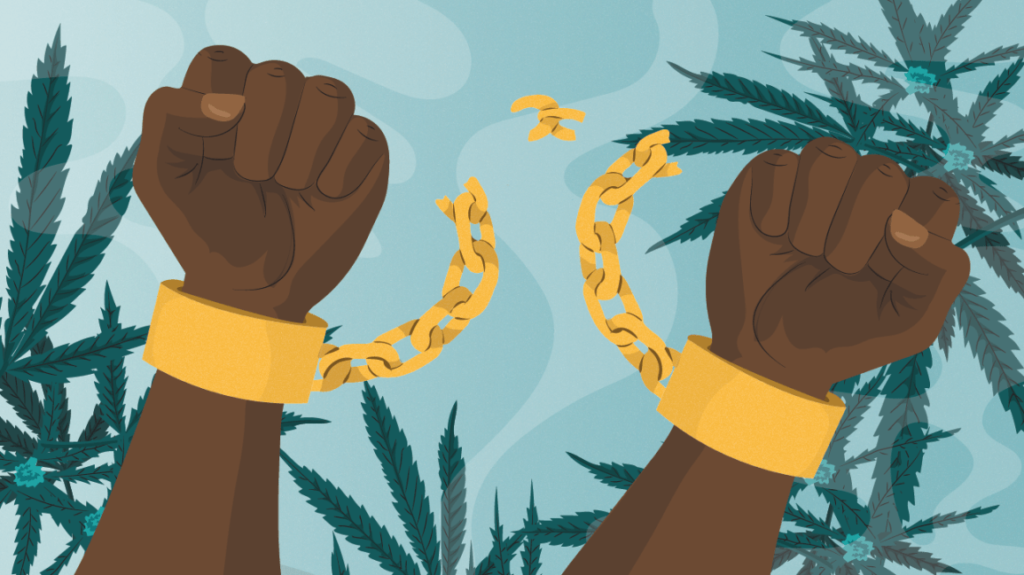
Centering Black Women in the Push for Cannabis Equity

The national campaign for the legalization of cannabis has gained momentum in the past two years with the introduction of bills in Congress such as the MORE Act and the PREPARE Act. Yet, more movement has been taking place on the state level; 21 states have fully legalized recreational cannabis sales, and 18 states have legalized medicinal sales. Early adopters of recreational cannabis, for example, Colorado have been able to make hundreds of millions of dollars a year from recreational cannabis sales from sales tax alone.

While it seems like some progression against prohibition is taking place, the story becomes more complicated when using a gendered lens. Historically, men of color, particularly Black, Indigenous, and Latino men, have been overrepresented in the US’s prison population for drug-related crimes, despite somewhat equal substance use rates across racial groups. Since the Nixon and Reagan Eras of prohibition, men of color have also been more likely to be arrested and imprisoned for drug-related crimes than their female counterparts.

However, this imbalance is starting to change in the 21st century. Despite the push for de-carceration in the past 20 years, women’s prison populations have increased. Between 2000 and 2019, drug arrests for women in the US increased by 56.2%, while drug arrests for men have gone down by 0.01%. Similarly, incarceration rates differ by race; Black women are about 200% more likely and Latinas are 20% more likely to be incarcerated than white women. Native American women are incarcerated at six times the rate of white women.

The racialization and gendering of the War on Drugs is especially apparent when talking about mothers. About 60% of women in state and federal prisons are mothers to children under the age of 18, with many of these women being sole caregivers. The sheer cost of incarcerating a woman for one year can be upwards of $100,000 in states like California. This does not take into account the billions of dollars spent across the country to construct new prisons, nor does it account for the social cost of separating families. These social costs include the effect of the parent’s incarceration on their children and on those who become their subsequent guardians. Due to the disproportionate representation of women of color in our prison system, these costs are borne primarily by Black, Latina, and Indigenous women, further deepening an already existent gap in inequality, opportunity, and net worth.

The fight for legalization is not just a personal freedom issue: it is an equity issue. States like New York have taken special care to make sure that dispensary licenses are awarded to people who have been negatively impacted by the War on Drugs, namely Black and Latino men.

While cannabis equity laws are necessary to prevent a venture-capital takeover of an industry in its infancy, it has unintentionally ignored the struggles of women. In the first round of applications for dispensary licensure, only 7% of license awardees were women. New York State’s system first prioritizes those who have had an arrest of their own, and then subsequently prioritizes those who have had a family member arrested. “I understand that the person who actually went through [the arrest and conviction] should be awarded more points,” said license applicant Venus Rodriguez to Politico. “But what’s that scale? And how do we measure suffering? We’ve all suffered.”

It is likely nearly impossible to quantify the harmful impacts of the War on Drugs, beyond simple arrest and conviction numbers. However, it is undeniable that women are not only the fastest-growing prison population group in general but also represent an increasing number of drug arrests and convictions.

As more and more states have legalized cannabis sales, women’s involvement in the industry is actually decreasing. In 2019, 36.8% of cannabis executives were women, yet that number dropped to 22.1% in 2021. For reference, the national average percentage of executive roles filled by women is 29.8%. The number of minority executives in the cannabis industry also decreased, from 28% in 2019 to 13.1% in 2021. Licensure cannot be the only measure of equity in the cannabis industry for women and women of color; we need concerted efforts to ensure that women do not face additional gaps in opportunity in the legalization movement.

The racial facet of the War on Drugs still continues, despite the country’s effort to pass more sensible drug legislation. Thus, on top of existing equity movements such as dispensary licensure, it is imperative that women of color, in particular Black women, are centered in the narrative of equity moving forward. In redressing the wrongs of Nixon and Reagan-era policies, we must also keep an eye on current trends in the enforcement of drug prohibition in order to prevent a new generation of women behind bars.


(By Laura Goodfield)

(Image Credit: Maya Chastain / healthline)

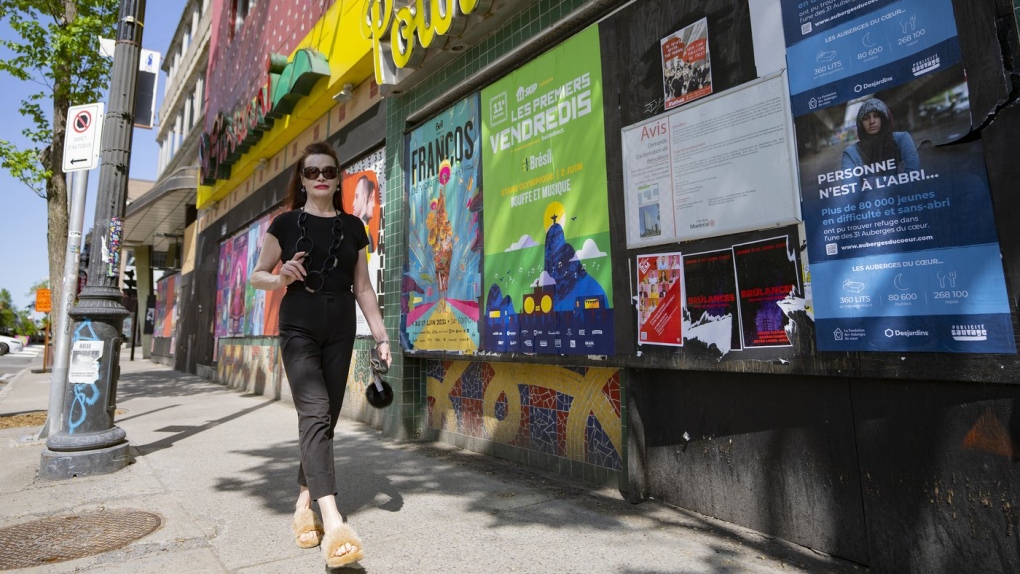
In Montreal, Carla White re-writes the David-and-Goliath script

Carla White outside her apartment building

“And there went out a champion out of the camp of the Philistines, named Goliath, of Gath, whose height was six cubits and a span. And he had a helmet of brass upon his head, and he was armed with a coat of mail; and the weight of the coat was five thousand shekels of brass. And he had greaves of brass upon his legs, and a target of brass between his shoulders. And the staff of his spear was like a weaver’s beam; and his spear’s head weighed six hundred shekels of iron: and one bearing a shield went before him.”  King James Bible

 According to contemporary scholars, it was not David who killed the “champion” Goliath but rather Elhanan, son of Jair. Later, the story was revised by “supporters of the Davidic dynasty.” But what really matters, to these scholars, is the detailed representation of Goliath’s armor. In Montreal right now, a single tenant, Carla White, is resisting attempts by a major developer, Mondev, and she, like David or Elhanan, is undeterred by flashy armor and massive size. By accurately assessing the housing situation and her own position, Carla White has held up a luxury condo development for three years. Here’s her story.

After a series of eviction, Carla White finally found a place she could afford. That was ten years ago. The apartment is one room, has no working stove, and mostly filled with a bed and a small desk, and loads of plants. But, and importantly, Carla White pays $400, Canadian, a month. By law, the rent can’t be raised, and so Carla White has a secure and stable place, however diminutive, in which to live. Or she had one, until Mondev showed up, a few years ago. Mondev wants to demolish the building and build 176 luxury condos. They made offers to other tenants, who accepted. Others simply moved. But Carla White looked at the new skyscrapers in her neighborhood, looked at the apartment listings as well, and asked, “I look out there and say, where am I going now?” Rather than succumb to the inevitability of nowhere-to-go, Carla White stood her ground and entered into negotiations.

According to Mondev, they have made offers, which they describe as more than generous, for the past three years. The last offer was $20,000, Canadian. Mondev is portraying this as a more than reasonable offer, one that would ensure housing for Carla White for some time to come. Carla White responded, “How far will $20,000 go (at) $1,600 a month? I will be evicted within a year. I will be out on the roads.” Carla White’s attorney, Manuel Johnson, added: “She’s not trying to save the building. She knows it needs to be renovated. She just wants somewhere safe and affordable to live …. Whatever reasonable settlement Ms White needs for housing stability in no way will endanger the financial viability of their project. They don’t have any cash-flow problems, they’re going to be making millions of dollars on this development.” In other words, their armor is coated with mail.

Canada is in the throes of an affordable housing crisis, as it is in the midst of an eviction boom. British Columbia leads the race to the bottom, while Quebec, led by Montreal, has seen an explosion of `renovictions’. In the United States, starting in the late 1940s, blight and `urban renewal’ became the excuse to displace entire working-class communities of color. Contemporary Canada’s equivalent to `blight’ is `renovation’. Across Canada, tenants are forming tenant unions and engaging in rent strikes. As corporate landlords consume increasing portions of urban residential space and push for higher and higher rent increases, the number of rent strikes are expected to rise. From organized collective action to organized individual actions, everyone is asking the question Carla White is asking, “I look out there and say, where am I going now?”

(By Dan Moshenberg)

(Photo Credit: CTV Montreal News / La Presse Canadienne / Christinne Muschi)

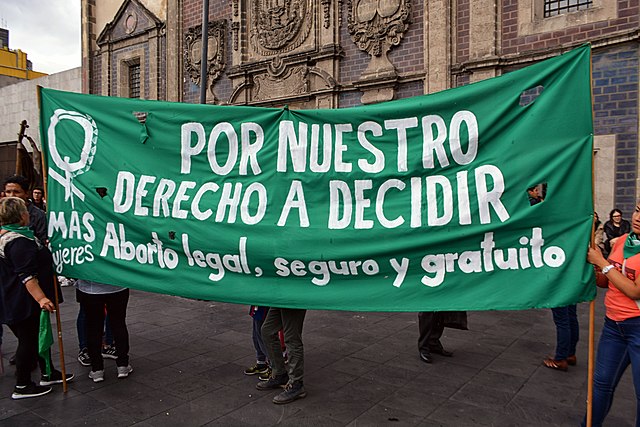
Hope in a time of choler: In Argentina, emergency contraception is available without a prescription

On Tuesday, May 30, 2023, Argentina’s Minister of Health, Carla Vizzotti, issued Resolution 1062/2023, concerning access to emergency contraception. As of Wednesday, the so-called morning after pill became available over the counter, without a prescription. This major step forward resulted from decades of intense organizing by women’s groups, feminists, and allies. While much of the United States threatens the rights, autonomy, well-being, and safety of women and girls, Argentina leads the world in a better, safer, and more just direction.

After some preliminary considerations, the Resolution states, “That the right to access contraception in all its forms is part of sexual and reproductive rights, recognized as basic human rights enshrined in human rights treaties that have constitutional status. Likewise, the State has committed itself to the reduction of unintended pregnancies, in successive platforms since the signing of the Program of Action of the International Conference on Population and Development (CIPD, 1994) in which it was recognized that empowerment, full equality and empowerment of women were essential for social and economic progress. To this end, it has committed to promoting the 2030 agenda for Sustainable Development, which explicitly recognizes the key role of sexual and reproductive health and gender equality and establishes goals linked to the capacity of women, adolescents and all people with the ability to gestate to make informed decisions about sexual relations, timely access to the use of contraceptives and comprehensive sexual and reproductive health care.”

The Resolution concludes, “Every person of childbearing age must have timely access and without regulatory restrictions to emergency hormonal contraception (AHE), knowing that this is the last chance for contraception after sexual intercourse and thereby reducing maternal mortality and morbidity caused by unsafe abortions.”

Every person of childbearing age. Not only those who can afford to travel somewhere else. Not only those who are connected to various networks, of class or ethne/race or other affiliation. Every person of childbearing age. This is part of sexual and reproductive rights, recognized as basic human rights.

In Argentina, women’s and feminist movements have been organizing around just this point since at least the 1970s. In 1973, for example, a flyer created and distributed by la Unión Feminista Argentina, UFA, proclaimed: ““El embarazo no deseado es un modo de esclavitud / Basta de abortos clandestinos / Por la legalidad del aborto / Feminismo en marcha”. “”Unwanted pregnancy is a form of slavery / Enough of clandestine abortions / For the legality of abortion / Feminism on the march”. Fifty years later, almost to the day, that march is still ongoing, intensifying, expanding, succeeding.

In 2018, the lower legislative house, la Cámara de los Diputados, after long and intensive debate, voted to decriminalize abortion. The Senate rejected the bill. Undeterred, women’s groups, feminist movements and allies persisted. In the waning days of 2020, both houses of the legislature legalized abortion, which was signed into law January 14, 2021. Two years later, the organizing continues. The struggle for sexual and reproductive rights, understood and enforced as integral to human and civil rights, continues.

(By Dan Moshenberg)

(Photo Credit: Nursing Clio)

Uganda’s pogrom: Arise and go now to the Nation of Slaughter. Do you not hear?

Terror floating near the rafters, terror
Against the walls in darkness hiding,
Terror through the silence sliding.
Did you not hear beneath the heap of wheels
A stirring of crushed limbs?

            Hayyim Nachman Bialik, “In the City of Slaughter

On March 21, Uganda’s Parliament passed, by an overwhelmingly majority, an anti-LGBTQ+ which “make homosexual acts punishable by death”. President Museveni sent it back to the legislature, asking for reconsideration. This bill was already a `reconsideration’ of an earlier bill, which had been struck down by the Constitutional Court on procedural grounds. That was 2014. The 2014 bill was a reconsideration of a bill first proposed in 2009. It’s now 2023, and for the past nine years, legislators have been pushing various versions of this bill. Today, May 29, it was announced that the President had signed the bill into law. To be clear, “making homosexual acts punishable by death” is to make love punishable by death. Equally, it is to declare not only a war on those deemed vulnerable but a reign of terror on the LGBTQ+ communities and on the population at large. The death penalty is reserved for those convicted of “aggravated homosexuality,” a term loosely defined … intentionally. This is what a pogrom looks like because this is a pogrom.

Activists – including Sylvia Tamale, Frank Mugisha, Jacqueline Nabagasera Kasha and others – have petitioned the Constitutional Court to halt the law’s implementation. The United States revoked the visa of the Speaker of Parliament, Anita Among. Otherwise there’s been what’s referred to as an `outcry’ and `outrage’ against the legislation, but not much substantive action. Again, this law has been coming, in plain sight, since 2009. The only question has been the exact form it might take. No one and no country can claim surprise. So, where is the international community?

Chișinău is the capital and largest city of the Republic of Moldova. Moldova was once Bessarabia, a part of the Russian Empire. At that time, Chișinău was called Kishinev. While Bessarabia was part of the Russian Empire, its culture and economies were more open than much of the empire, and so it became a place to which Jews migrated. By 1897, 46% of those living in Kishinev were Jewish. Meanwhile, the Russian Empire was organizing pogroms across its expanse. In April 1903, the infamous Kishinev Pogrom occurred. In 1905, another pogrom.

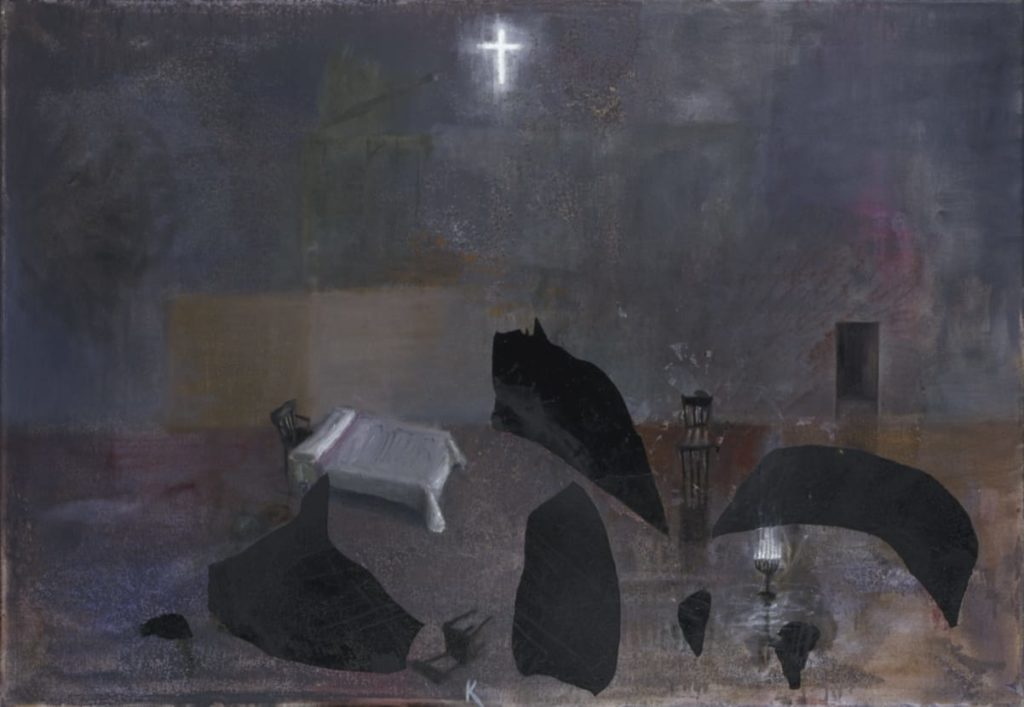
In 1904, Hayyim Nachman Bialik wrote a poem, translated as “In the City of Slaughter,” in which he imagines the events and meaning of the 1904 Kishinev Pogrom. The poem begins, “Arise and go now to the city of slaughter”. The poem is instructive, in many ways, one of which is how to respond to pogrom taking place today in Uganda. Bialik understood the horrors and atrocities of the pogrom and understand as well that the reader must understand their own responsibility. Arise and go now to the city of slaughter. Did you not hear beneath the heap of wheels a stirring of crushed limbs? Outrage and outcry will not do, especially when this pogrom, like all pogroms, did not come out of the blue but rather took shape in public over years. Arise and go now to the nation of slaughter. Did you not hear … ? Do you not hear … terror floating near the rafters, terror against the walls in darkness hiding, terror through the silence sliding?

(By Dan Moshenberg)

(Image Credit: Guillermo Kuitca, “Untitled” / Jewish Museum)

Kobiety Są Zagrożeniem Dla Społeczeństwa? Women Are A Threat to Society?


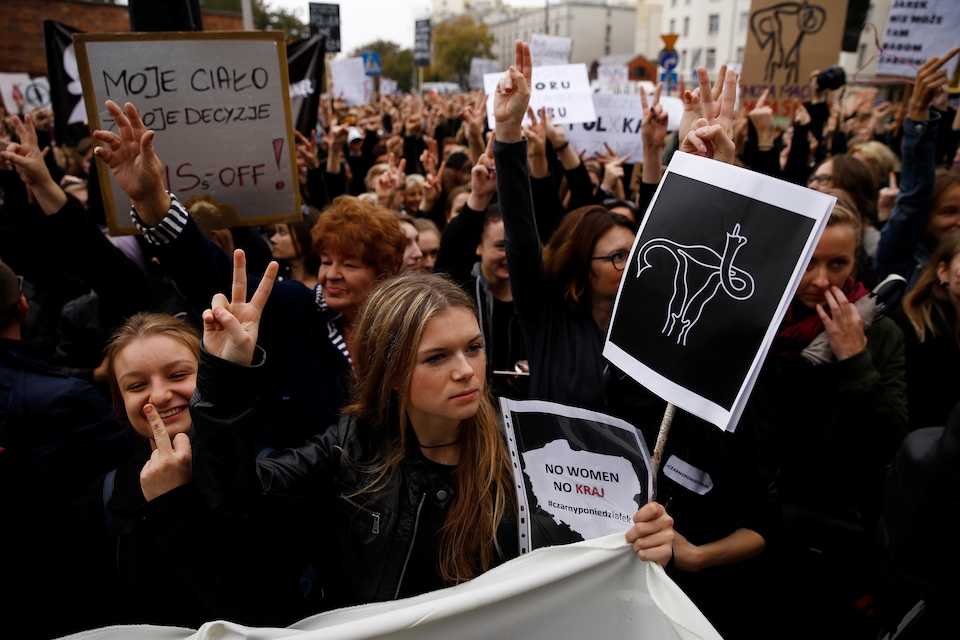
“Police violence against protestors” sounds like yet another headline we would see featured in the daily New York Timesor Washington Post. Instead, it references a place about a six hour flight east of the United States eastern seaboard; Poland. On October 22nd, 2020, the Constitutional Tribunal in Poland approved a “near-total ban on legal abortion”. Fast forward to May 2023 we see the detrimental effects that come with the criminalization of abortion, the criminalization of women’s rights in Poland. Since the tribunal decision, the female incarceration population increased from 4.4% (of the prison population) in 2020 to 10.9% (of the prison population) in 2023.

Criminalizing women and restricting their rights to protect their bodies did not result in the elimination of abortions nor did it result in a decrease in support for abortion. Instead, it resulted in more women being incarcerated, more women seeking unsafe abortions, more women dying, all while the state looked towards the prison industrial complex as an opportunity for profit. An increase in incarceration rates gives the state the fuel they need to create more prisons to hold more beds and more individuals, essentially creating a surplus. As happened in the United States, the carceral explosion in Poland responded to four main surpluses: state capacity, labor, land, finance capacity. Building prisons was a political, economic solution to these crises.

Women in Poland being criminalized for their rights, for protesting their rights, or for acting upon their needs for abortion and health purposes, have become the surplus in the prison population and are seen as dollar signs to make profit from. By banning abortions, women are either forced to have the baby or they are forced to seek outside help. Both options come at a cost: the cost of sacrificing one’s needs, health, income, and even freedom all by criminalizing the female anatomy and implementing thousands of roadblocks, as if Polish women didn’t already have to go through enough. Prisons have been and will continue to be opportunistic for any country to take advantage of as the argument is always to contain the body of those deemed a danger to society in any capacity. There is no surplus of crime, there is no surplus in criminals or dangerous people, but there IS a surplus in power hungry governments that see women taking control of their bodies and deeming them as a threat. Women’s bodies are always wanting to be controlled, whether it’s abortion rights or rights to autonomy or basic human rights, there is always a type of control over women’s bodies by forcing them to conform to man made decisions.

These concepts are globalized, for every stride forward women take towards achieving equality, there is one stride backwards. When Roe v. Wade was a major stride in women taking control of their bodily autonomy. When Roe v. Wadewas overturned, some thought women would give up all resistance to governmental control. The opposite occurred, women across the United States joined together to rally, peacefully protesting, and ‘rebelling’ against the control of the government. In Poland women have done the same since the October 22nd, 2020 decision banning abortion as the supposed Tribunal deemed that women should not be able to control their bodies because then the government would not be able to commodify them. Are women who take control of their bodies and their rights, while fighting against the government, considered dangers to society or dangers to the government’s money?

If the government wants control, if they want money, if they want to uphold the patriarchy by taking away women’s bodily autonomy, if they want to keep the prison industrial complex alive and maintain the surplus, they will need to try harder because nie poddajemy się i nigdy się nie poddamy! We have not given up and will never give up!

(By Nicole Nowak)

(Photo Credit: Washington Post / Reuters / Kacper Pempel)