When it comes to affordable housing, Alexandria continues its race to the bottom


Since 2000, the very small city of Alexandria, Virginia, outside of Washington, DC, has “lost” 12,000 affordable apartments, most of whose residents were African American, Latino, and then African immigrants. In the past, the alibi was “development.” In the most recent episode, that of Ramsey Homes, it’s “heritage”. Either way, the result is the same.

Ramsey Homes is 74 years old and in terrible shape. It was originally built for African American defense workers, and so was always “very Spartan”. It has no air conditioning, inadequate heating and electricity, deteriorating plumbing, and the list goes on.

The residents want and deserve better. Many want to tear down the buildings and start anew, with promises that they will be among the new. They know the history of `urban renewal’ in Alexandria, and they know it hasn’t included them. But they believed that if they could make their case, this time the City would act differently.

It didn’t. Along with much bungling among city agencies responsible for housing, the City Council couldn’t move forward because some of its members listened to a call for `historic preservation.’

Charkenia Walker, a resident of Ramsey Homes, has tried to get the City Council and other city agencies to understand the situation: “It’s hard to believe the historic significance and relevance outweighs the standard of living in 2015. I just want neighbors to understand the construction of new units will benefit us as a whole. There are working-class citizens who cannot afford to live in the neighborhood in which they have grown, me included … The units are old. Think of an aging person. When you get old, you don’t walk as good as you used to, you don’t climb stairs as good as you used to, your mechanisms begin to change. The same thing is happening inside of these units, they are falling apart.”

Ramsey Homes is the architecture of affordable housing in Alexandria: disregarded by public officials and public policy for decades, crumbling, and toxic. The residents have struggled to secure decent housing, here and now, here where they live and have roots and commitments, and now. The residence may be Spartan, but the neighborhood is home.

Once again, the City has failed them, and this failure is nothing new. It’s systemic, longstanding and part of the plan. It’s time, it’s way past time, to reverse the past two decades of loss and violence.


(Photo Credit: Alexandria Times)
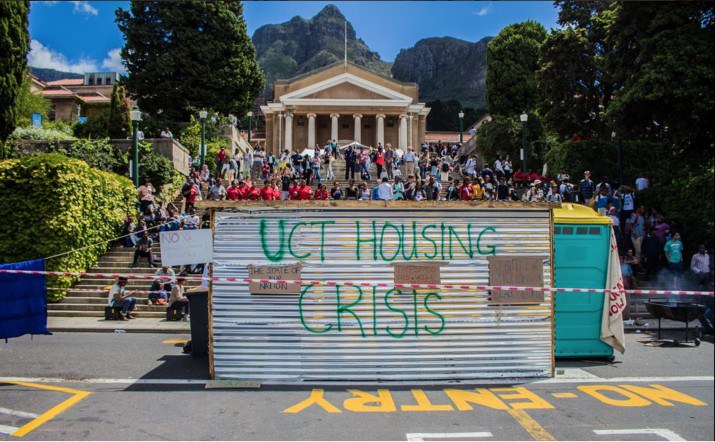
#Shackville: This is what it looks like to be at an institution so resistant to change

Last night on lower campus. Fire, police vans and screaming students – this is what it looks like to be at an institution so resistant to change that it would rather eat itself from within.

I’ve been here 6 years and every year brings the same stories of heartlessness from student housing: of students sleeping on campus because they have no where to go, of students from rural KZN, Limpopo etc getting off busses with nothing but a plastic bag and being told they don’t have the bed and food they were promised.

Last night the police were grabbing students at random on Rondebosch main so the argument that they were dealing with specific aggressors isn’t true. I had a gun pointed me while literally standing on the sidewalk and tweeting.

I honestly wish people would stop clogging up social media with so called social commentary and just be honest about the fact that they’d rather everything remain the same. They’d rather not know about the countless stories of dispossession and desperation because it makes them uncomfortable and it makes them complicit for saying nothing. I grew up middle class – I know that we are socialised into ignoring the struggles of the poor – things are going to have to change whether you want them to or not. ‪#‎HomelessAtUCT‬ ‪#‎Shackville‬

(Photo Credit 1: Okay Africa) (Photo Credit 2: Mail & Guardian / Lerato Maduna / Gallo)

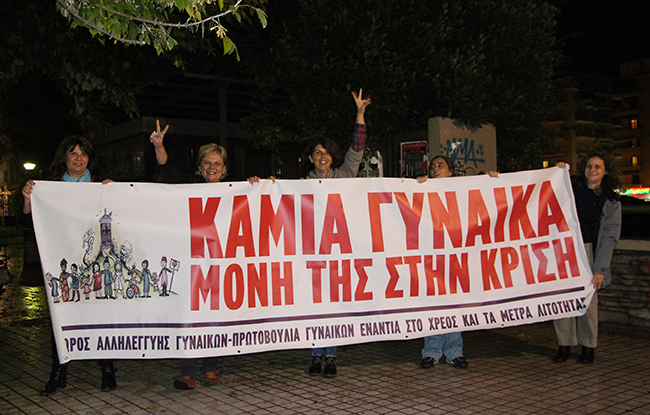
In Greece women’s solidarity faces and resists cynicism: Areti Karatasiou

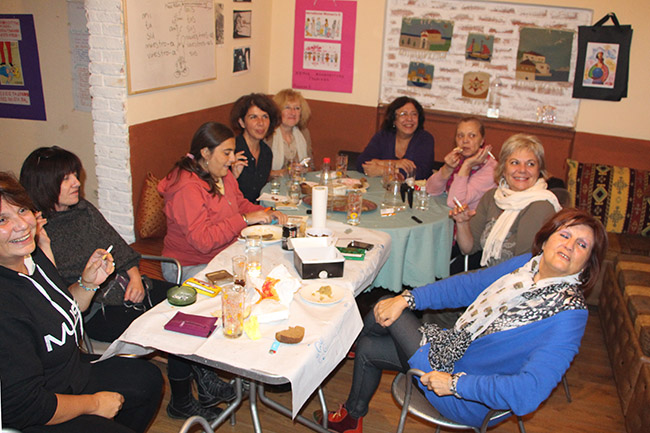
A meeting at the Women’s Solidarity House

In Greece, in July 2015 the third memorandum imposed on its leftist government, elected in January 2015, has precipitated its dissolution. This change of government was also perceived as capitulating. The measures are now being implemented, devaluating pensions, especially the lowest, and dispossessing the country of its assets.

After having opened public spaces and institutions to the wrath of the private market, the Troika and especially the IMF has succeeded in conveying the message that the “very generous” pensions of the Greek people must be reduced drastically to “save” the Greek’s economy. It is worth noting that beside unsustainable cycles of austerity measures producing higher unemployment and pension reduction, 45% of the pensioners live under the poverty line.

We met Areti Karatasiou at the Women’s Solidarity House in Thessaloniki, commonly referred to as “the venue.”

As a teacher in the public school system, she knows the meaning of the Troika/IMF’s discourse: it demands people to work longer time in order to collect retirement, while many are being laid off or forced to retirement. This seems contradictory, but it is not. The result is well known: increased precariousness for a majority of people while reducing the social fabric of the society and its safety net to its bare minimum. It’s a clear example of necropolitics.

Areti mentions that the pension she receives amounts, at the moment, to only 700 Euros (about $700), after 30 years of teaching and contributing to the social safety net.

For many women like Areti in Thessaloniki it is a struggle to keep decent conditions of life. Areti explains here what it means to be part of the Women’s Solidarity House.


No women alone during the crisis!


(Photo Credits: Marie-Hélène Le Ny)

The women of Zomba Central Prison want more than a Grammy

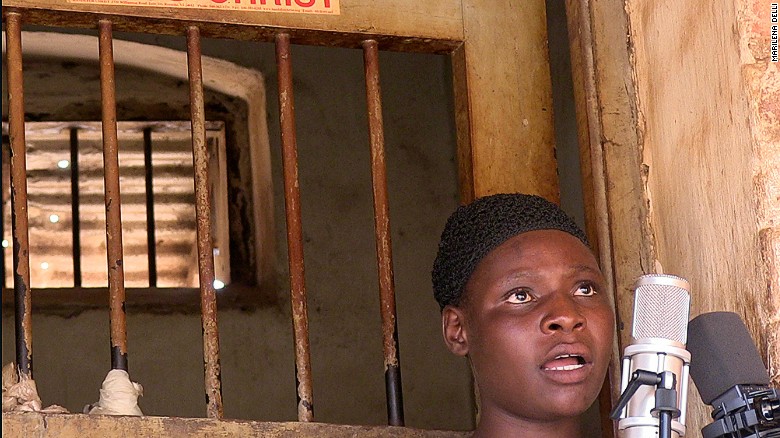
The Grammy Awards ceremony is tonight, and all, or at least more than some, eyes are on The Zomba Prison Project’s I Have No Everything Here, nominated in the Best World Music Category. The Project involves men and women prisoners in Malawi’s Zomba Central Prison. The cd comprises 20 songs, most of them sung by men, most of them written by women. From the outset, people wondered about the “mysteriously brief” presence of women on the album and, even more, about the missing women in the attention paid to the Zomba Prison Project. People wondered where are the women in the music and in the press, but omitted to ask, more directly, where are the women? They’re in prison, and in Malawi, that’s not a good place to be.

In Malawi, women prisoners end up in three main prisons: Chirichiri, Maula, and Zomba. Two years ago, the Malawi Human Rights Commission reported prisoners had died of hunger at Maula Prison, in Lilongwe. While the government claimed no prisoner had died, it had to admit that prisoners had gone without any food for three days, and that more “food shortages” were probably on the horizon.

That’s par for the course at Maula. Built for a maximum of 800 prisoners, it now houses over 2600 prisoners. Maula Prison has been built on overcrowding, malnutrition, poor to no sanitation, and rampant diseases and viral infection. Most of the scholarship on Malawian prisons concerns astronomical rates of HIV, AIDS, and hepatitis. Malawian prisons have been toxic for a long time, and they just got worse.

Recently, Malawi “cracked down” on migrants, mostly Ethiopian migrants, attempting to cross the continent in order to reach South Africa. Hundreds of migrants have ended up in Maula Prison, where they sit, in remand sections, indefinitely. Last June, Doctors Without Borders treated 18 prisoners for moderate to severe malnutrition.

In December, Malawian civil society expressed concern at the rising number of “prison babies”, infants and children in prison with their incarcerated mothers, some of whom are awaiting trial. Just last week, it was revealed that the Dowa First Grade Magistrate Court had written to the Prison Inspectorate Committee, urging the State to address systemic abuse, in particular dire overcrowding and inadequate food provision.

According to the most recent U.S. Department of State report on human rights in Malawi, “The most significant human rights issues in the country included excessive use of force by security officers, harsh and life-threatening prison and detention center conditions, and official corruption … Prison and detention center conditions remained harsh and potentially life threatening … The Zomba Central Prison was condemned as unfit for human habitation by the Prisons Inspectorate in 1997 but remained in use, holding more than 1,950 inmates in a facility built to hold 800.”

That’s the Zomba Prison Project: condemned as unfit 19 years ago and still in use; designed for 800, and housing almost 2000. That’s where the women are. Let’s hope that some day the Best World-Music Award is replaced with the Best-World Music Award, and on that day, there will be no Zomba Central Prison.


(Photo Credit: CNN) (Video Credit: You Tube / Six Degrees Records)

The Topo Chico massacre, Mexico’s fire this time

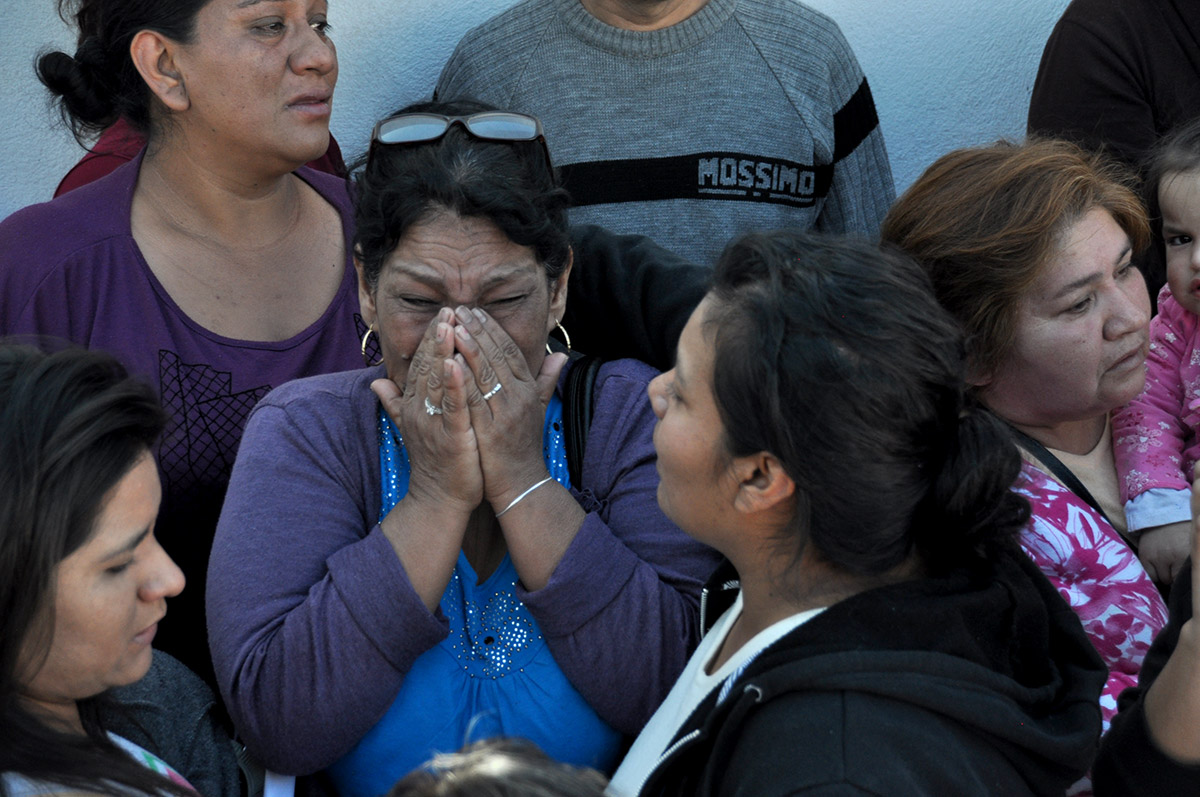
Yet again, women gather outside prison gates to find out if their loved ones are still alive. This time, it’s the Topo Chico prison, in Nuevo León, in northern Mexico.

Yesterday, something happened that left at least 49 prisoners dead and 12 injured. That `something’ has been variously described as a battle, riot, clash, brawl, fight, pitched battle, and gang war. It was all of those, and it was more. It was a predicted event, and to that extent, irrespective of the violent histories of the individual prisoners involved, it was a planned massacre.

In 2014, the United Nations Special Rapporteur on torture and other cruel, inhuman or degrading treatment or punishment, Juan E. Méndez, visited Mexico’s prisons, including Topo Chico: “Overcrowding … is a serious problem … The Government reported a total prison population of 248,487 men and women, distributed among centres with a total capacity of 197,993 persons … Overcrowding is … caused by a failure to use alternatives to prison and by abuse of pretrial detention, especially its mandatory application. Of the total prison population of 248,487 detainees, 104,763 have been charged … In … Topo Chico … inmates have excessive control over services, benefits and the functioning of the prison (inmate “self-rule”), which gives rise to disparities in the exercise of rights, corruption and situations of violence and intimidation among inmates, all of which the State has a responsibility to prevent. The Special Rapporteur accepts that protective measures must sometimes be taken and that it is often inmates who request them, but such measures cannot involve cruel, inhuman or degrading conditions. He draws attention to the conditions observed in the Topo Chico prison “doghouse”, a small enclosure where over 40 detainees allegedly in need of protection are living in unacceptably cramped and insanitary conditions … In …Topo Chico … inmates generally had no water, light or ventilation in their cells. Health conditions were usually grim and many inmates had to sleep on the floor or in shifts … Solitary confinement generally involves critical overcrowding in small cells and appalling conditions, particularly in … Topo Chico.”

In the same year, Mexico’s National Commission of Human Rights assessed all the prisons in Mexico, and rated Topo Chico a 5.72 on a scale of 10. The Commission reported that Topo Chico was designed for a maximum of 3635 prisoners, and held 4585. The Commission found that, in 2013, the male wing of Topo Chico was 55% over its limits, and the women’s section was 56% overpopulated.

None of this is new. Topo Chico was a well known bomb set to go off, and it did. That the pieces of that bomb are gang members or have violent pasts, or not, is a distraction. The real violence is the cramming of more and more bodies into less and less space that is itself less and less livable.

James Baldwin wrote, “There is a limit to the number of people any government can put in prison, and a rigid limit indeed to the practicality of such a course. A bill is coming in that I fear America is not prepared to pay.”

For Mexico, this Topo Chico massacre is the fire this time. The bill came in, and now, as so often, the women stand at the gates calling, weeping, mourning.


(Photo Credit: Juan Cedilla / Proceso)

The global patriarchal market and violence against women

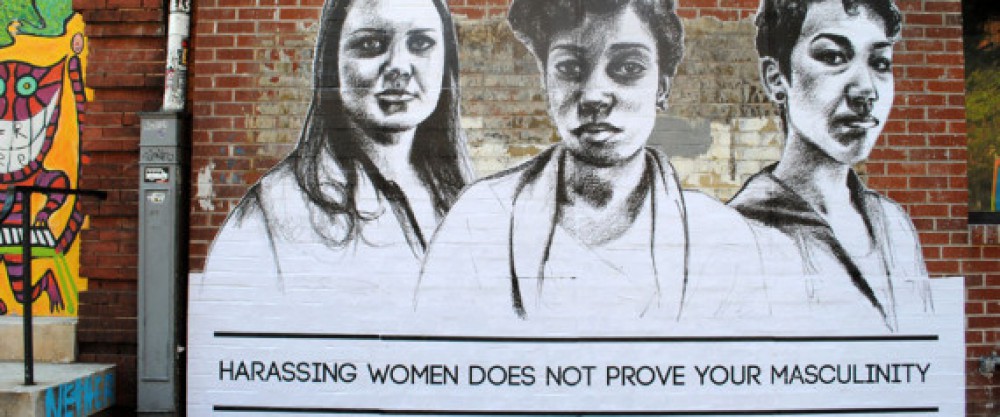
Being a woman today is marked by violence.

On New Year’s Eve in Cologne, on a square between the cathedral and the train station, about 200 women were sexually assaulted and robbed after about thousand men circled them to isolate them from the rest of the crowd. This type of assault has been reported else where in Europe: Helsinki, Zurich, and others. It has also occurred in Cairo and Tunis.

On Tahrir Square in Egypt, in 2013, during demonstrations against the government, women who were present wielding their right to be in public spaces would be circled by hundreds of men and then undressed and raped. These attacks were constant. Women and men organized and formed groups wearing fluorescent yellow jackets and helmets, to liberate the women under attack. They knew that they could not rely on the authorities or the police. The military government also used violence against women.

The same occurred in Tunisia when women took to the streets of Tunis in support of a positive transformation of the society. Since then, they have been organizing and fighting to defend their rights to public spaces.

This violence belongs to a trend that has been ignored for too long. In Cologne, the police did not intervene right away despite the system of video surveillance that is part of the globalized economies with their security market. The assaults were publicly reported only five or six days after the fact.

The fact that in Cologne most of the aggressors were North Africans and/or asylum seekers blurred the big picture and fueled resentment against immigrants and refugees, thereby encouraging racist violence. German feminists have responded: no excuse for sexual predators or for racists. Other European feminists have simplistically associated this event with the rise of fundamentalist Islam.

That presentation is limited and ignores the globalized neoliberal economy’s reliance on various strains of neo-conservatism and religious fundamentalism including Islamic fundamentalism to increase its hold on society.

One could remember, how in 1936, the phalanges, Franco supporters, whose slogan was “viva la muerte” dispersed their cruelty against women and men. They violently commanded women to stay away from public spaces, to reproduce and take care of the household. All of that was supported and encouraged by capitalists.

Clearly, women’s emancipation is one of the biggest stakes of an oppressive society.

Today, the European militarization of its borders along with austerity measures within the context of fear of “terrorism” opens the temptation of a constant state of emergency. The ordeal of women in migration facing infinite sexual violence and death during their journey is rendered invisible. What is left is the growing rhetoric for more policing and more appearance-based prejudices, which allow security markets to develop. The current paradoxical protective and aggressive discourse of the authorities puts some women under surveillance, hidden behind security forces and at the same time normalizes the position of other women as victims of sexual violence, according to race and geographical locations and conflicts.

Similarly women’s reproductive bodies, again racially defined, are under surveillance in the United States, with the incarceration of women for miscarrying or having an abortion where it is more and more difficult to get one. These signs of patriarchal essence that justifies violence against women correlate with the expansion of the neoliberal economic order that disadvantages women and minorities and throws them into precarious situations, again rendered largely invisible.

The code of silence that covers the attacks against women in Europe is troubling. In France, a recent study on sexual harassment in public transportation revealed that 100% of the women’s answers indicated various levels of harassment. Generally in Europe sexual assaults have been reported around football games, and other public events. In Cologne few days ago, a journalist of the Belgian RTBF was reporting on the beginning of Carnival and the security measures to protect women participants, when a group of white men sexually assaulted her, all this in front of the cameras.

Without a broader transnational understanding of the causes for the regression of women’s social and political right to be in public spaces, the prospect for better women’s social and political equality with men are slim.

A large transnational solidarity movement, beyond judgment, must be the force against the current trend of violence against women, the basis of all violence that is fueled by the devastating unfettered market forces that consume bodies.


(Image Credit 1: Osez le féminisme 69) (Image Credit 2: Osez le féminisme)

We are the mothers, victims of the raids

Susana Arévalo Hernández and her two children have left the South Texas Family Residential Center, that special hell the United States paid Texas to build in Dilley. Arévalo was one of a number of women and children picked up in raids in early January, picked up, thrown around, and dumped into cages like so much trash. Since her imprisonment, Arévalo has suffered seven epileptic seizures. Her six-year-old son lives with a learning disability. What happened to Susana Arévalo Hernández is the ordinary torture of women who seek asylum.

Susana Arévalo Hernández fled gang violence in El Salvador to run straight into State violence in the United States. According to various reports, ICE agents lied to gain access to her home, and herself and her children. Doctors report that her condition in detention imperils her health and life. Lawyers report that every day in prison is a further violation of her and her children’s human rights and rights to due process. None of this matters. While Arévalo walked, other women and children remain in Dilley detention.

Here’s what should matter: “Every time I have a seizure, I think I’m not coming back. I don’t want my children to see that.” A mother’s concern for her children should matter. It doesn’t.

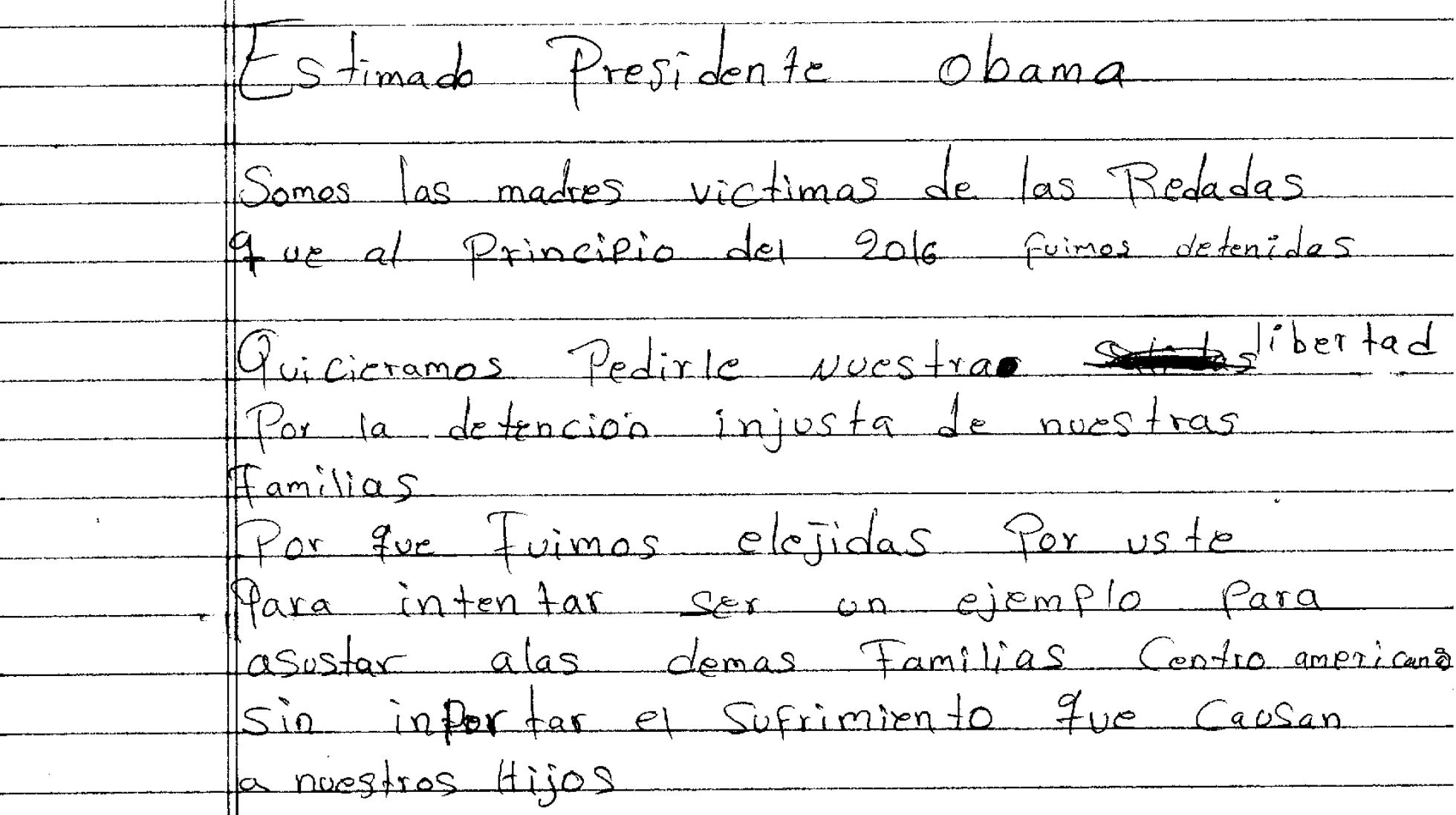
Susana Arévalo Hernández was one of seven women who wrote a letter to President Obama, which reads, in part: “We are the mothers, victims of the raids … We would like to ask you for our freedom from this unjust detention … We complied with everything that was asked of us, but the system that failed us, just because we came to this country to seek protection, because we couldn’t go back to our countries of origin due to being exposed to so much violence and threats against us and our children. That’s why we came to this country to request asylum … We are not criminals who you have to keep locked up. We have not committed any crime and it is unjust that our children, at such an early age, know what it’s like to be in a jail under guard 24 hours, when at this moment they should be in school living life with dignity like every child deserves to … We need to be free as human beings to be able to fight our cases outside with dignity.”

Ana Silvia Orellana, Dominga Rivas, Elsy Monge López, Gloria Díaz Rivas, Isamar Sanchez Chicas, Marta María Hernández and Susana Arévalo Hernández signed that letter. They represented 12 families imprisoned in Dilley and Berks County, in Pennsylvania. The twelve families add up to 33 women and children. This is the arithmetics of asylum in the United States today: lies, violence, indignity, criminalization, and more intense violence. Why must a Central American woman be on death’s door to get a hearing? Why must Central American children and their mothers live in an atmosphere of fear and a reign of terror? What sort of democracy is that?

Dear President Obama … We are the mothers

(Image Credit: El Pais)

What happened to Sarah Reed? The routine torture of Black women in prison

Sarah Reed

On January 11, Sarah Reed, 32 years old, Black, living with mental health issues and drug addiction, the victim of a famous police brutality case, was “found dead” in her cell at Holloway Prison, north of London. Her death went relatively unreported for almost a month, until the family managed to contact Black activist, Lee Jasper, and so now the reports of “failings” begin. There was no failure. The State got what it wanted: Sarah Reed is dead.

In 2012, Sarah Reed was viciously attacked by a Metropolitan Police officer. The attack was caught on camera, and, in 2014, the officer was dismissed from the force.

In October 2014, Sarah Reed was in a mental health hospital when she allegedly attacked someone. Her family says she wrote to them saying she had acted in self-defense. On January 4, Sarah Reed was shipped over to Holloway Prison, to await trial. While there, according to her family, she received no mental health treatment.

Prison authorities have claimed that Sarah Reed “strangled herself” while in her bed. Her family doubts that narrative. Further, they say they were called to the prison to identify Sarah Reed and then were prevented from seeing her body and were treated “in a hostile and aggressive manner.”

None of this is new, and none of it is surprising. Holloway Prison, the largest women’s prison in western Europe, is slated to be closed, precisely because it is unfit for human habitation. As outgoing Chief Inspector of Prisons, Nick Hardwick, noted, “Holloway has a fearsome reputation.” When Holloway’s imminent closure was announced, some hoped that the closure would begin a “prison revolution”, but they had forgotten that Holloway had already undergone its revolution. From 1971 to 1985, it had been “completely rebuilt”, and yet it remained a fearsome, loathsome place.

That’s where the State sent Sarah Reed. There was no failure. The State wanted Sarah Reed dead, and Sarah Reed is dead. What happened to Sarah Reed happened to Sandra Bland happened to Natasha McKenna happened to Kindra Chapman happens. Rebuilding the prison never ends, or even diminishes, State torture of Black women. Shut it down.


(Photo Credit: Lee Jasper / Vice)

Australia is proud of its routine torture of women and children asylum seekers


Yesterday, Australia’s high court ruled that `offshore’ detention of asylum seekers, including new born infants and children, is fine. Australia is no longer `shocked’ at the routine torture of women and children asylum seekers. Instead, Australia is now fine with the routine torture of women and children asylum seekers, from sea to shining sea and beyond. Australia routinely throws asylum seekers into prisons, mostly in remote areas or, even better, on islands, “an enforcement archipelago of detention … an archipelago of exclusion.” Australia has proudly refashioned the gulag archipelago for modern times, that is, for asylum seekers and refugees. Australia was once “shocked” by reports that children represent the greatest percentage of self-harm and suicidal behavior. Then Australia was “shocked” but not ashamed to find that sexual violence against women asylum seekers and refugees occurs regularly. The days of shock are over, and now it’s glory times of pride in State torture. Immigration Minister Peter Dutton says he’s ready to ship 162 adults, 33 babies and 72 children to Nauru. The Australian archipelago of exclusion produces its own Voyage of the Damned.

The case involved a Bangladeshi woman, known as M68, who claimed that her incarceration at Nauru violated Australian law. In the past year, since that case was filed, Australia has performed all sorts of shenanigans, including passing retroactive laws, to avoid any dilution of its sovereign right to torture those who come seeking asylum or help of any sort. Whatever the high court decided, Australia’s actions are indefensible.

More significant than any violation of law is the reign of terror. M68’s real plea was that, having lived on Nauru, she was terrified to return, terrified for herself and for her one-year-old child. Another woman facing deportation to Nauru explained, “It’s like dying. It’s waiting for dying.” A woman known as Durga added, “I am too scared to go back to that place, my life will not be safe. If I am sent back to Nauru, I will commit suicide.”

The State response to expressions of terror, death-in-life, and suicidal despair is succinct: Good. This is democracy in the current world order. To ask for help is to give up citizenship. If you are a woman and you ask for help, you give up your humanity. The gulag archipelago never left. It became the democratically elected global archipelago of exclusion and erasure, and now, thanks to Australia’s high court, we know it’s perfectly legal.


(Drawing credit: abc.net.au)

In France, Christiane Taubira steps up by stepping down


Wednesday January 27th, instead of going to Parliament to defend reforms to the Constitution, France’s Minister of Justice, Christiane Taubira, tendered her resignation to President Francois Hollande. She was immediately replaced by a man in line with Prime Minister Manuel Valls’ ideas. The bill under discussion contains many questionable articles, but the one that will allow deprivation of nationality for French born citizens with dual citizenship convicted of act of terrorism is emblematic of the current trend personified by Prime Minister Valls, to curtail rights in the name of security.

This is the trend that Christiane Taubira has opposed particularly since the first attacks in Paris in January 2015. Her approach was to understand why some young French were attracted by DAESH and violent actions, while for Manuel Valls to find explanation to terrorist acts “is already an attempt to excuse them.” He takes an opposite direction: no explanation or understanding needed, just security measures.

Since her nomination in 2012, Christiane Taubira has committed herself to induce a turn toward restorative justice in France, a real shift from the Sarkozy years of repression and development of the prison industrial complex. She tried to instill a change in mentalities, from crude punishment to create means for rehabilitation and reinsertion, beginning by revoking mandatory minimum sentencing. Her unfinished project is the reform of the juvenile justice system and the elimination of the correctional juvenile courts. Many legal scholars and even magistrates supported her action and expressed their concerns after her departure. For many, she represented a change with her approach and her discourse from the previous administration. The latter endlessly tried to reduce the role of the judiciary to favor harsh policing and blind punishment for civil society, encouraging profiling and at the same time discouraging the judiciary from investigating financial arrangements of the elite.

Nonetheless, Taubira’s initiatives were often at odd with and even opposed by many in her own government, notably the Minister of the Interior and Manuel Valls. She was the target of racial and gendered attacks from an unfettered right and extreme right, especially at the time she defended equal rights for LGBT with the Marriage For All bill. Not to forget that one of the last cases of loss of citizenship was a gay man who married in the Netherlands in 2007. Now he can be French again thanks to Taubira’s bill on gay marriage.

Christiane Taubira’s departure is another blow for those who have cautioned against the excess of state violence and policing that this reform of the Constitution may produce. Last weekend many demonstrations were organized to oppose the reform of the Constitution. Taubira has described these articles as “absolutely pathetic inefficiency.” She is not isolated, Anne Hidalgo, the Mayor of Paris, has declared on Radio France that what infuriated her was national politics especially the issue of loss of nationality and précised that it makes her fly off the handle. She concluded, “It is time to change radically the logic of politics in France.” Similar opinions and support have been expressed by former members of the government as well as many from the center to the left.

Despite heavy rains, thousands of people went to the streets, responding to the call of 123 civil associations and 19 unions, to oppose these reforms, the prolongation of the state of emergency, to demand justice, to defend rights for all including the more vulnerable rendered even more vulnerable at the time of increased economic gaps between classes and ethnicities, and to affirm that a just world is possible!

In the wake of the attacks a certain consensus appeared among various sectors of the society. This consensus against these security measures has upheld, with the president of the Observatory of the “Laicity” signing along with many Muslim organizations, women’s rights organizations, the collective against islamophobia, a declaration released in the newspaper Liberation.

Still Manuel Valls railed against this consensus, accusing some to be irresponsible and others to be undemocratic. In resigning, Taubira has shown her support for this consensus. Her method is to listen, to understand the struggle of the second generation French youth in “les cités”, in the suburbs.

In the United States, we have seen the effect of the ‘tough on crime’ approach linked to security measures in the so-called Patriot Act. The two curtail rights and bring impoverishment and violence. Maybe this is the real purpose of these measures. For Taubira to resist is to give “the last word to ethics and rights”. Let’s have the last word!

Meanwhile, in the past few days, Christiane Taubira wrote a book, “Murmures à la Jeunesse”, explaining her position. It was published today.

(Photo Credit: Slate / AFP / Alain Jocard)