Faysal Ishak Ahmed’s blood flows over all of us


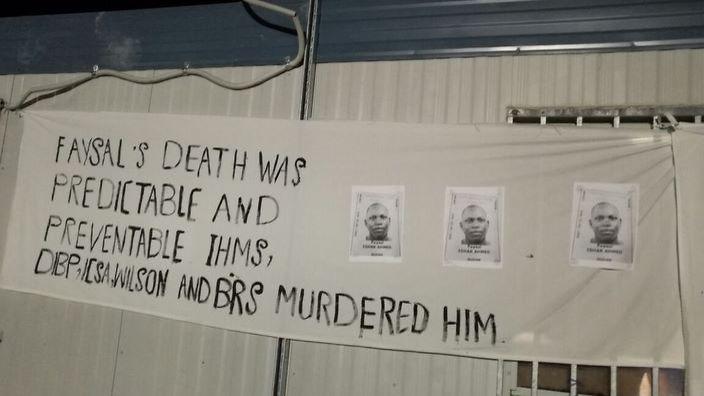
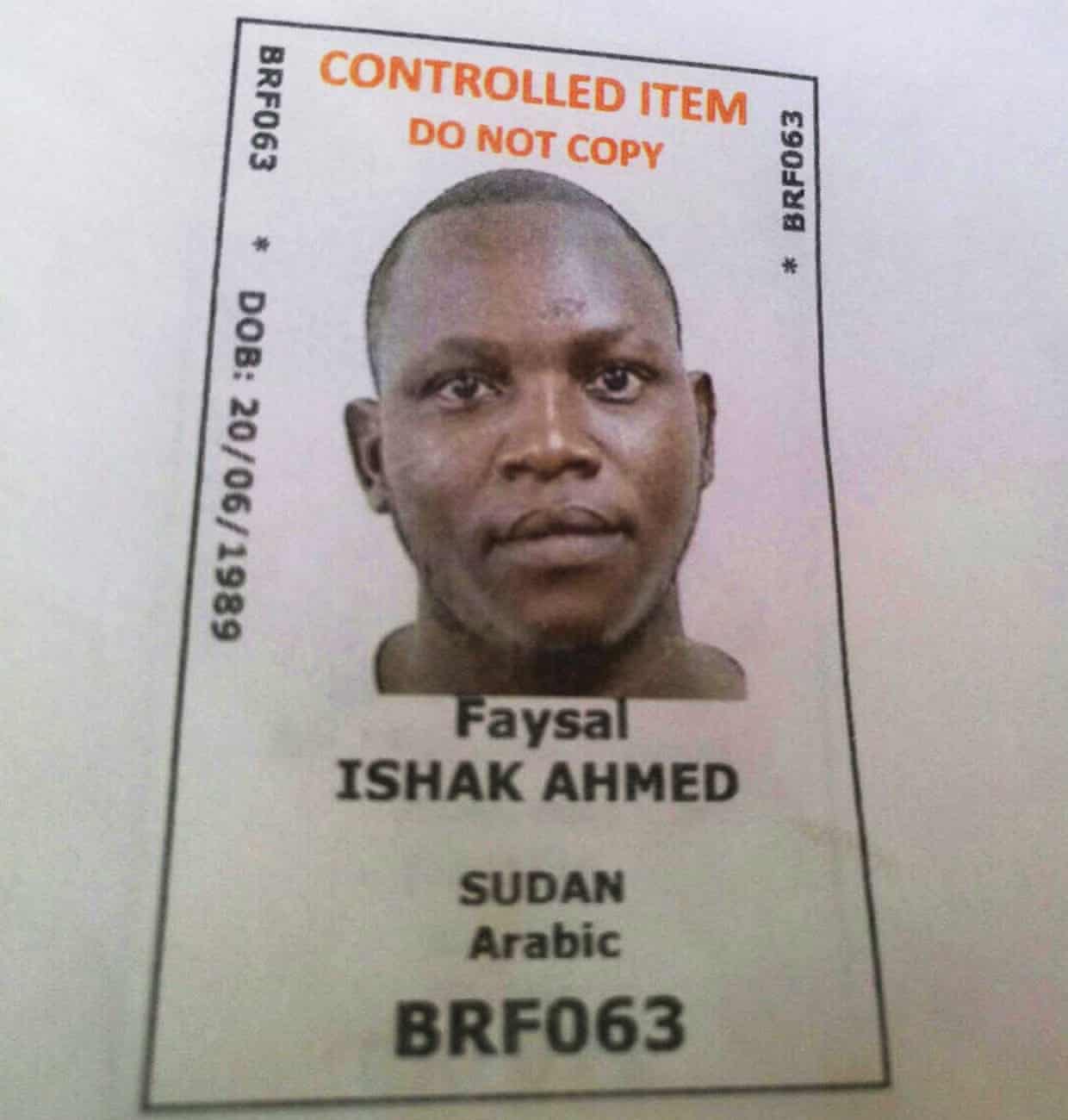
Faysal Ishak Ahmed died on Saturday or was it yesterday … or was it six months ago. Faysal Ishak Ahmed, 27-year-old Sudanese asylum seeker, collapsed inside the detention center on Manus Island, the dumping grounds for those refugees and asylum seekers who seek haven in Australia. This is the same Manus Island where 24-year-old Iranian asylum seeker Reza Barati was killed two years ago. Eight months ago, the Supreme Court of Papua New Guinea declared the detention center illegal. Papua New Guinea and Australia have “agreed” to close the center, but, to no one’s surprise, no time frame has been set. Faysal Ishak Ahmed did not collapse nor did he suffer a seizure. He was killed, and his blood joins the blood of Reza Barati; their blood flows everywhere.

Faysal Ishak Ahmed’s story is all too familiar. For at least six months Faysal Ishak Ahmed complained of chest pains, swollen arms and fingers, high blood pressure and a pain at the back of his head, seizures, blackouts and breathing difficulties. He begged and pleaded for medical care. Fellow prisoners begged and pleaded on his behalf. He wrote letters; fellow prisoners wrote letters. He deteriorated; he received no medical care. When he finally died, the Department of Immigration and Border Protection stated a refugee “has sadly died today from injuries suffered after a fall and seizure at the Manus Regional Processing Centre”. There is no sadness like sadness. Jesus wept, the State shrugged.

The story continues. Manus Island prisoners rebel for a while. Letters are written, protests are lodged, pictures and drawings emerge. In Sudan, Faysal Ishak Ahmed’s parents say they want their body returned to them. They also say that they have not been formally informed of his death by anyone from the Australian or the Papua New Guinean governments. The State’s great and deep sadness continues to oppress the vulnerable and the hurting.

Faysal Ishak Ahmed is just another name, just another death, in the litany of neoliberal global ethics in which he must bear full responsibility for the site of his birth, the color of his skin, and the nature of his faith. It’s Faysal Ishak Ahmed’s fault that he spent three years in prison on Manus Island. It’s Faysal Ishak Ahmed’s fault that he ever asked anyone for help, safety, or haven. It’s Faysal Ishak Ahmed’s fault that he begged for six excruciating, agonizing months without any attention. It’s Faysal Ishak Ahmed’s fault that the medical staff consistently claimed he was malingering and returned to his bed. It’s his fault, it’s altogether Faysal Ishak Ahmed’s fault that his blood flows over all of us. We are innocent, we never saw him, we never knew. It’s Faysal Ishak Ahmed’s fault.
 

(Photo Credit 1: SBS Australia) (Photo Credit 2: The Guardian)
Woke in progress

Hello, I’m a feminist—actually, scratch that, I’m an intersectional feminist. Wait, no, hold on. Hello, my name is Lilly, my pronouns are she/her/hers, and I’m an intersectional feminist with Socialist leanings. Okay, that was almost perfect, but I forgot to add in that I’m white, bisexual, cisgendered, and able-bodied. Should I mention my relative income privilege? What about my personal connection to gun violence? Does it matter whether or not I justify my use of the word “bitch”? Let’s try this one more time.

Hello, my name is Lilly and I’m a human, woman, and feminist in progress. Using the word progress, of course, implies that I’m working towards a foreseeable end, perfection, an epitome. I should clarify that I’m not. Feminism is a process, and there are certainly ways for the movement and the people who are involved in it to improve their actions, but there is not one right way to be a feminist. Furthermore, there isn’t an absolute value, a pure and distilled version of feminism that is the absolute ideal version of the movement.

Everyone involved in the feminist movement, whether they choose to label themselves or not, will expand and improve the ways in which they practice their activism. As we grow older and wiser, so too do we grow more inclusive. For some of us, it will take years to incorporate intersectional identity politics into our doctrines. For others, we may be marrying diverse ideas when we are still young and fresh and inexperienced. Everyone grows at a different rate and in a different way.

When we reach a new intangible step up the feminist ladder, we are usually tempted to criticize those who are below us on the invisible path to enlightened activism. Maybe we want to do this to mark our own progress. After all, if we’re able to point out the problematic elements of other people, doesn’t that prove our own social consciousness? Constructive criticism is certainly important. Pointing out the harmful or problematic ideas of another person may very well be a valuable learning experience. At the same time, however, we should also remember that we were once in their spot. They’re still growing, and so are you. As feminists, our potential to hone our activism is limitless. We’ll never be the best versions of ourselves, but we can certainly take some steps in the right direction.

(Image Credit: Everyday Feminism / VAL3NTEA)

The day 15-year-old Jacques Craig learned “how to sit in a police car”


Earlier this week in Fort Worth, Texas, Jacqueline Craig and her daughters, Brea and Jacques, were arrested, in yet another “incident” of police abuse against a Black woman and her children. Brea is 19 years old, and Jacques is 15. The whole thing was caught on video, posted to Facebook, and now the police officer is on restricted duty, the Fort Worth Police Department is scrambling to “keep the calm”, many are expressing “outrage”, and Black folk in Fort Worth can’t see much for the fog of quotation marks that these events raise these days, but they can see that this story would never happened if Jacqueline, Brea and Jacques Craig were White. Meanwhile, there’s Jacques Craig. What has she learned this week? “I didn’t know how to sit in a police car, I’ve never done it before. I was just crying and worried and thinking about how to get out.

Jacqueline Craig called the police to complain about a White neighbor who she said had grabbed her son by the throat, allegedly for having dropped some paper on the ground. Jacqueline Craig told the officer, “My daughter and son came home, saying that this man grabbed him and choked him.” The officer responded, “Why don’t you teach your son not to litter?” Jacqueline Craig answered, “He can’t prove to me that my son littered, but it doesn’t matter if he did or didn’t, it doesn’t give him the right to put his hands on him.” The officer answered, “Why not?”

Why not?

At this point, Jacqueline Craig and the officer are clearly tense, and Jacques Craig, the 15-year-old girl child, stepped forward and between the two, to help defuse the situation: “I am 15 years old. How was I supposed to know I wasn’t supposed to interfere? I was just trying to protect my mom.” Next thing, the officer pulls out his Taser, wrestles the 15-year-old Black girl to the ground, and …

By the end, Jacqueline Craig, Jacques Craig, and Brea Craig were all taken to the police station and processed. The Fort Worth Police Department quickly launched an investigation and released a statement, which read, in part, “The Fort Worth Police Department enjoys a close and cooperative relationship with our citizens; one of transparency, mutual trust and respect. The Fort Worth Police Department expects every officer to treat persons they encounter with that same trust, respect and courtesy. We acknowledge that the initial appearance of the video may raise serious questions. We ask that our investigators are given the time and opportunity to thoroughly examine this incident and to submit their findings. This process may take time, but the integrity of the investigation rests upon the ability of the investigators to document facts and to accurately evaluate the size and scope of what transpired. We ask our community for patience and calm during this investigation process.”

There’s a demonstration tonight in Fort Worth demanding justice and calling for an end to police brutality.

Across the country, from sea to shining sea, Black girls and young Black women face this form of State intimidation every single day. So do Latinx girls and young Latinx women and Native girls and young Native women. This particular officer may be one in Fort Worth, but there’s another in Galveston and another in Phoenix and another in Baltimore and another in Winslow and another in Auburn and another in Frederick County and another one somewhere right around the corner. Think of all those “rogue” police officers as the front line of secondary and tertiary public education for girls and women of color in the United States. What was this week’s lesson plan Jacques Craig? How to sit in a police car. Let’s hope she learns a better lesson.

(Photo Credit: Colorlines)

Elizabeth Seitz, Mersiha Tuzlic, Riva Depasse, Jill Hendricks, Kiari Day say NO! to being tortured

“The system here, is rigid, strict, and hopeless solitary confinement. I believe it, in its effects, to be cruel and wrong.” Charles Dickens

Allegheny County Jail, in Pittsburgh, Pennsylvania, routinely throws pregnant women into solitary confinement, for days on end, for minor offenses and less. Five women – Elizabeth Seitz, Mersiha Tuzlic, Riva Depasse, Jill Hendricks, Kiari Day – have refused to accept the injustice and  indignity. Yesterday, December 19, their attorneys went to Federal Court to sue the Allegheny County Jail. This is Mersiha Tuzlic’s story, and it’s happening in jails across the country.

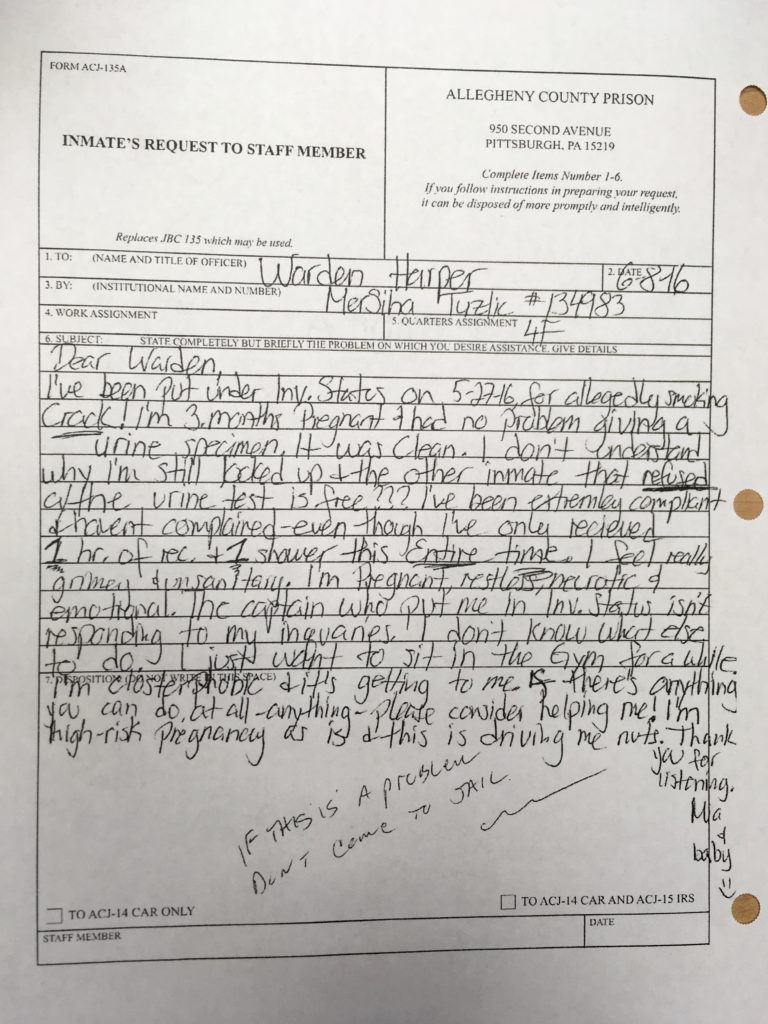
On May 27, 2016, Mersiha Tuzlic, was thrown into solitary. On June 18, she wrote a handwritten request to the warden, Orlando Harper, dated 6 -18 -16, which reads:

“Dear Warden,

I’ve been put under Inv. Status on 5-27-16 for allegedly smoking crack! I’m 3 months pregnant and hand no problem giving a urine specimen. It was clean. I don’t understand why I’m still locked up and the other inmate that refused the urine test is free??? I’ve been extremely compliant and haven’t complained – even though I’ve only received 1 hour of rec and 1 shower this Entire time. I feel really grimy and unsanitary. I’m pregnant, restless, neurotic and emotional. The captain who put me in inv status isn’t responding to my inquiries. I don’t know what else to do. I just want to sit in the gym for a while. I’m claustrophobic, and it’s getting to me. If there’s anything you can do at all — anything — please consider helping me! I’m high-risk pregnancy as is, and this is driving me nuts. Thank you for listening.

Ma and baby 🙂 “

The Warden responded to the plea for help: “IF THIS IS A PROBLEM, DON’T COME TO JAIL”

Welcome to the Commonwealth of Petty Dictators, where throwing pregnant women into solitary confinement for no reason at all isn’t enough of an assault on their dignity. When they ask for help, find ways to further diminish them. Show these women how really powerful you are. The god of small things battles the devil of small men, and in Allegheny County, for too long, the devil has been winning.

In 1842, Charles Dickens visited Pennsylvania, saw the new system of solitary confinement, and called it out: “Very few … are capable of estimating the immense amount of torture and agony which this dreadful punishment, prolonged for years, inflicts upon the sufferers; and in guessing at it myself, and in reasoning from what I have seen written upon their faces, and what to my certain knowledge they feel within, I am only the more convinced that there is a depth of terrible endurance in it which none but the sufferers themselves can fathom, and which no man has a right to inflict upon his fellow-creature. I hold this slow and daily tampering with the mysteries of the brain, to be immeasurably worse than any torture of the body: and because its ghastly signs and tokens are not so palpable to the eye and sense of touch as scars upon the flesh; because its wounds are not upon the surface, and it extorts few cries that human ears can hear; therefore I the more denounce it, as a secret punishment which slumbering humanity is not roused up to stay. I hesitated once, debating with myself, whether, if I had the power of saying ‘Yes’ or ‘No,’ I would allow it to be tried in certain cases, where the terms of imprisonment were short; but now, I solemnly declare, that with no rewards or honours could I walk a happy man beneath the open sky by day, or lie me down upon my bed at night, with the consciousness that one human creature, for any length of time, no matter what, lay suffering this unknown punishment in his silent cell, and I the cause, or I consenting to it in the least degree.”

Tell the warden of Allegheny County Jail that torturing women is no joke. Write to the Allegheny County Jail here or call them at 412-350-2000. Stop the torture of women in jails.

(Photo Credit: ACLU of Pennsylvania)

Organizing one-on-one is essential, but what is organizing one-on-one?

Organizing one-on-one works, but what is one-on-one organizing? In fact, what is a one-on-one? A one-on-one is a conversation that one person schedules with one other person in an organizing context. 30 minutes to an hour, in the other person’s home, a coffee shop, etc. The Midwest Academy defines six parts of a one-on-one:

  1. Be Prepared: Think about what you know about the person, run through the next five steps. Take some notes. Call/text to confirm–getting stood up sucks.
  1. Legitimize Yourself: A one-on-one flips the script. After some casual conversation, set the tone that this isn’t just two people hanging out.

If you don’t know them: “Thank you so much for taking time today. As I said on the phone, I’m Anne and I’ve lived in Louisville since 2013 working with faith congregations. Recently, I’ve been meeting with folks to talk about our personal experiences with healthcare, especially with all the changes coming. I had a great talk with [mutual friend] Donna last week, and she suggested I talk to you because you’ve been a nurse. I’d love to hear about how you decided to become a nurse!”

If you know them: “I know this is different from our usual thing, but I was really shaken up by the election, especially with my health and the healthcare changes coming. So I’m talking to friends like you who are affected, too, about what’s going on and what we’re doing next. So, how are you holding up?”

  1. Listen: “Draw people out, identify their self-interest, clarify their concerns, establish rapport. If you are whizzing along telling your story, you won’t be able to do any of this.” –Midwest Academy.

Ask why questions, ask for stories, share of yourself (⅓ sharing, ⅔ listening). Pay attention to what motivates them: their “self-interest.” Here are four categories of self-interest:

“I want,” what they want/don’t want for a good quality of life: “I have 60K in student loans.” “My mom has Alzheimer’s and it’s been hard.” “I don’t feel safe when I walk home at night.”

“I believe,” a value that drives them: “Everyone deserves a second chance.” “God calls me to love my neighbor.” (Ask: Where does that belief come from?)

“I am/want to be,” an identity: “I’m a leader,” “I’m someone people can count on” (You may infer this. If they told 8 stories about their kids, is being a parent is an important identity? Yep!)

“I love/respect,” a key relationship: family, a group, a role model

  1. Agitate: Many people won’t describe their feelings about a sick parent as anger. But should they feel angry if their parent lives in a nursing home with crappy facilities because the good facilities cost too much? Yes! Here’s your job:
    1. Connect those self-interests, the way they want the world to be: (I want to be debt-free, I want everyone to have a second-chance, I want to be independent, I want my kids to be okay)
    2. …with all the things in the world that purposely make that hard: (student loan companies, the prison system, not getting paid enough, unsafe schools, etc.)
  1. Get a Commitment: So, here’s what we’ve learned:
    1. We want things.
    2. Systems are set up to make getting those things hard, and we’re angry about that.
    3. What now? Let’s go home feeling fatalistic! Nope.

This is the moment of hope! “This problem is real. It hurts both of us. So we’re going to solve it. Here’s the first step: are you in?” Join a committee, come to an action, get together Saturday to plan next steps. (Have an ask in mind ahead of time!)

  1. Follow-Up: Call them, remind them about the next thing, check in on how they’re doing. Encouraging people to share their pain, connecting it to a giant system of exploitation, promising them that you’ll fight together to end it, and never calling back is a shitty thing to do.

That’s the outline. Getting good means practicing. I have a great job that makes me do 10 a week and I still have surface-level one-on-ones. I still chicken out on asks. But I’m way better than I used to be. So here’s my advice: pick 5 interesting people and do a one-on-one with them, and go from there.

There is nothing in the one-on-one outline about privilege. White people, men, cis people, etc. have privilege. But organizing around privilege is lower-hanging fruit organizing. If we help a white person recognize the extent of their privilege, they will feel guilt that may push them out the door to a protest, or to their checkbook, to the verses in Scripture about feeding the hungry. All of these actions are good.

Real higher-hanging fruit organizing pushes people who already see themselves as privileged to see themselves as harmed. This works whether they articulate privilege by saying “I benefit from the harmful forces of white supremacy,” “I’m #blessed,” “I pulled myself up by my bootstraps,” or “I am white and proud.”

It starts with agitation! What do you want your life to look like; what systems are stopping you right now? A bad healthcare system? A culture that teaches you to be afraid of people of color all the time? The privilege conversation doesn’t allow room to say what you want. Only when you do that do you recognize how comparatively little you give up when you check your privilege and enter into movement work.

To have good relationships with Black leaders here in Louisville, I have to give up some privileges that I really like, like dominating meetings and bossing people around. But that’s peanuts compared to what I gain: relationships that reflect my values and who I want to be–a friend and support, not a white lady on the bus clutching her purse.

If acknowledging privilege pushes us to read the world differently, good agitation pushes us to imagine the world anew: to envision what we, individually and collectively, want our lives to look like. It doesn’t encourage guilt. It doesn’t encourage racism and scapegoating. It encourages anger: anger at systems, not people of color.

Guilt fades, anger doesn’t. Here’s how to get to anger: admit that you want your life to be different. Admit that you want your mother not to have Alzheimer’s. Admit that you want to feel more when you walk into church on Sunday. Admit that you want respect. Look hard at what system stands in your way. Start there.

(Photo Credit: Resilience Circles)

From Louisville and beyond, organizing one-on-one is essential


Organizing one-on-one – a conversation that one person schedules with one other person in an organizing context – works, but, as Mariame Kaba says, if you’re preaching organizing, show the receipts from when it worked. So here goes:

Receipt #1: Last week, I had a 1-1 with a white leader to talk about my organization’s new healthcare issue. First, I asked her about what privilege she had related to healthcare, and she had this eloquent statement about having good insurance because of having education and a job with good benefits, “but so many aren’t so lucky.” All 100% true, all coming from a 100% good place. 0% new information.

I wasn’t going to motivate her to step up more based on something she already knew: I needed to push her to see herself in a new way. So after the privilege thing, I asked how she is harmed by our healthcare system, and she had no idea what to say. No idea. I will not tell the details of this 1-1 to respect her privacy, but here’s the spoiler: she is harmed. She is a victim of a crappy healthcare system just like the rest of us. But it was hard for her to say that, because no one likes seeing themselves as a victim.

I have tried this on myself, family, friends, and other organizers. All of us easily talked about the advantages we’ve had, and all of us tried every trick in the book to get out of telling stories about when we felt like a victim, when we feel scared and angry and hopeless.

NO SHIT. Who likes talking about when you were a victim? I like talking about when I’m awesome and productive and #blessed. Isn’t it just easier for us white people to let the people of color do the work of being victims and send them a check?

Receipt #2: Last year in Louisville, we started challenging people in 1-1s about their own stories around affordable housing, not just how sad homelessness is. That was work. At first, no one – black or white – wanted to talk about their housing problems: embarrassing stuff about their adult kids living in their basements, affording assisted living, crime in the neighborhoods that they had lived in their whole lives.

As of today, we’ve collected 500 stories about affordable housing from across the county. All of a sudden, if you had an adult kid in your basement, you knew a dozen other people who did, too. So that experience of telling your story wasn’t one of complacent privilege, and it wasn’t one of embarrassment. It was one of anger: at a city who would let an affordable housing crisis spiral this far out of control.

We told those stories, over and over again, at our congregations, to our public officials, to the media, and we won $2.5 million for our Affordable Housing Trust Fund. And we’re going back this year for $10 million annually, because our people – black and white – were in no way satisfied with $2.5 million. They had too much skin in the game.


(Editor’s note: With this, Anne joins other organizers to launch a series on organizing by organizers, where we will collect and share organizing and organizers’ experiences as well as skills. In her next intervention, Anne will explain what exactly a one-on-one is. If you want to share your experiences as an organizer or explain a key organizing skill, contact Dan Moshenberg)

(Photo Credit: Center for Community Change)

Yvonne Musarurwa smiles, saying NO! to the tyrants of Zimbabwe

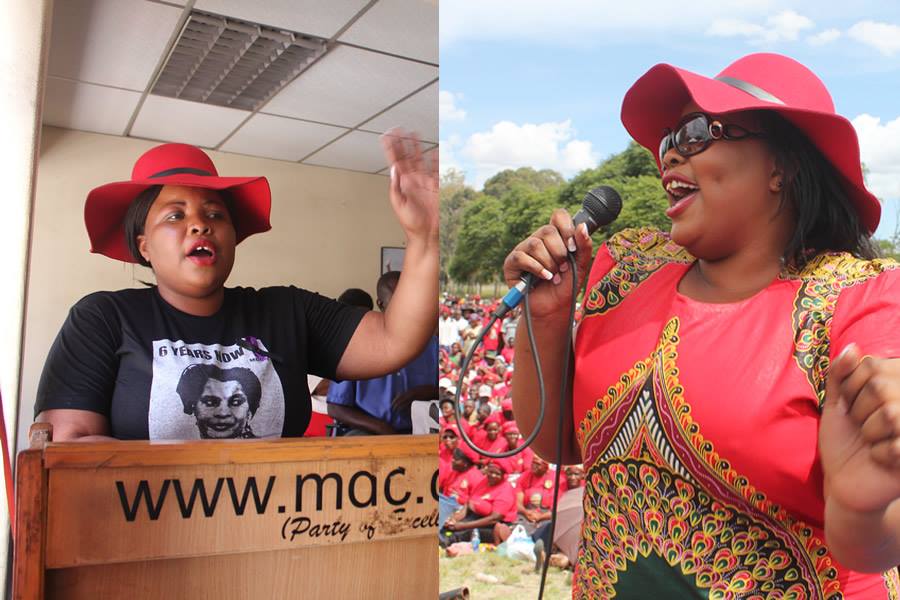
On Monday, in Harare, Yvonne Musarurwa and two comrades were sentenced to twenty years in prison. Photos show Yvonne Musarurwa immediately after the sentencing, and she’s smiling, perhaps laughing. As it was in Hades and then Algeria, so in Zimbabwe today, “The struggle itself towards the heights is enough to fill a woman’s heart. One must imagine Yvonne Musarurwa happy.”

In 2011, 29 MDC-T supporters were arrested on suspicion of having killed a police officer. In 2013, 21 were acquitted because of lack of evidence. There was no evidence, and yet they remained behind bars, in Chikurubi, some for more than two years. The High Court Judge Chinembiri Bhunu took great pains to discuss the case of human rights activist Cynthia Manjoro. Manjoro had been released on bail in 2012, after a State witness testified that Manjoro had been arrested “as bait” to lure her boyfriend into a trap. Cynthia Manjoro spent May 2011 to October 2012 in prison. That left eight in the hellhole of Chikurubi. In August 2013, Rebecca Mafukeni died … or was killed. Rebecca Mafukeni had meningitis, she was clearly deteriorating quickly when the judge repeatedly refused bail and all appeals for medical attention were rejected.

Yvonne Musarurwa was with Rebecca Mafukeni in Chikurubi Prison and recalled the ordeal: “The first weeks in police custody were the toughest. We were being interrogated, beaten and tortured. I’ve never felt so much pain in life before. I sustained a broken hand; lacerations all over the body and the only thing I got for all that were a few tablets of paracetamol. They said we were MDC and that there was every chance we would influence the other prisoners and clash with others from ZANU PF. This is why they kept us in solitary confinement. The conditions though were very bad. We stayed in cells that had raw sewage passing through and we cleaned that up using our bare hands. That was the most difficult part and I told myself the day Zimbabwe is free from tyranny, I will personally go to the Minister of Justice and those in charge of prisons to tell them exactly what needs to be done.”

That was 2013. This week, three years later, Yvonne Musarurwa, Tungamirai Madzokere, and Last Maengahama were sentenced to 20 years, despite eyewitnesses stating in court that the three were innocent, despite a complete lack of evidence, despite video evidence that Last Maengahama was in a church miles away when the officer was killed. According to Beatrice Mtetwa, who leads the defense team, the three were convicted based on the doctrine of common purpose, an archaic doctrine by which one may be found guilty of another’s crime. The State went to great lengths to convict Yvonne Musarurwa and her colleagues.

Yvonne Musarurwa is 29 years old. She has spent the last five years in the clutches of the State for a crime she never committed. How many more years until Yvonne Musarurwa, and the rest of Zimbabwe, are freed from prison for a crime they never committed? In Zimbabwe, the State is the crime. For now we must continue to imagine, and see, Yvonne Musarurwa smiling, knowing exactly what needs to be done.

(Photo Credit 1: Nehanda Radio) (Photo Credit 2: Nehanda Radio)

Daphne Banai: “From an oppressed people we’ve turned into an oppressive people”

The MachsomWatch is a group of Israeli women volunteers who oppose the Israeli occupation of Palestinian lands as well as the denial of Palestinian rights. They are women taking notes, documenting all the actions that eliminate the humanity of the Palestinians, and advocating for them, calling politicians for support. With their eyes and their voices, they reshape the checkpoints; they show the soldiers the compassion they have lost. The checkpoints are part of the surveillance of a system of separation based on militaristic power.

These women are transnational from within. Their connection with the people who are isolated by a system of separation is the gist of their action. They demand explanation from the blind “kids” (soldiers) who humiliate Palestinians who are just returning home or going to their fields. The Machsom Watch women create a free space that the militaristic state cannot see since the goal is to close up all spaces. But their very presence at the checkpoints forces the Netanyahu government to “see” them; the resisters are acting in the face of oppressive rule, despite their physical vulnerability.

The reality of the checkpoints (Machsom) and the occupation appeared to Daphne Banai, an activist of MachsomWatch, as an impossibility for her enjoyment of life. 70% of the checkpoints are deep inside the territories and so are materially violent disruptors of everyday life. Meanwhile, the justification given to the Israeli public for the presence of checkpoints is precisely to avoid disruption of life because of terrorist attacks.

Daphne Banai explains that when her daughter could have lost her life because of a terrorist attack, she realized that she was on the same side as the Palestinians. All kind of mythologies have created this impossibility to receive the other. Daphne talks about her own mother, a far-right woman who never saw the other side of the story: “She never talked to an Arab person. At her funeral, there were many of my Arab friends.”

Daphne Banai sees the absurdity of the situation for Palestinian refugees to live sometimes just a mile away from their original village. She recalls the time she encountered an old man returning to his home in Palestine from Jordan with a big suitcase. She and her friend offered to drive him to his village, but a curfew had just been established that the old man was unaware of. They arrived at another checkpoint, where despite the old man having all his papers in order, the soldier didn’t want to let him through. They could see his house from the checkpoint. The two women argued with the soldiers for hours, she said. Daphne remembers the conversation, particularly the soldier’s response that he was following orders and he would shoot her if those were the orders. The old man was 80 and that night she was invited to her uncle’s 80th birthday. The old man was now crying; he had no place to spend the night. They managed to go to another village, explained to a family the situation and dropped him off for the night. Then she drove to her uncle’s birthday party and couldn’t stop thinking about the old man crying. The checkpoints are not there for protection; they are there to assert a position of domination guarded by dehumanized robot-type soldiers.

Women’s bodies at the checkpoints brings up layers of meanings, such as the domination over them, their surveillance, and the violence done to them. Their exposure to the ammunition targeting them accentuates the vulnerability of the Palestinian women and children who are humiliated and violated daily. MachsomWatch defies the sexual and economic exploitation that is the basis of surveillance, as it challenges the formation of memorial historical righteousness that make the ethical relation between the self and the other an impossible story. As historian Shlomo Sand asserts, no history is superior to another.


(Photo Credit 1: Palestine Primer) (Photo Credit 2:  Flickr / Michael Rose)

The Empire strikes back

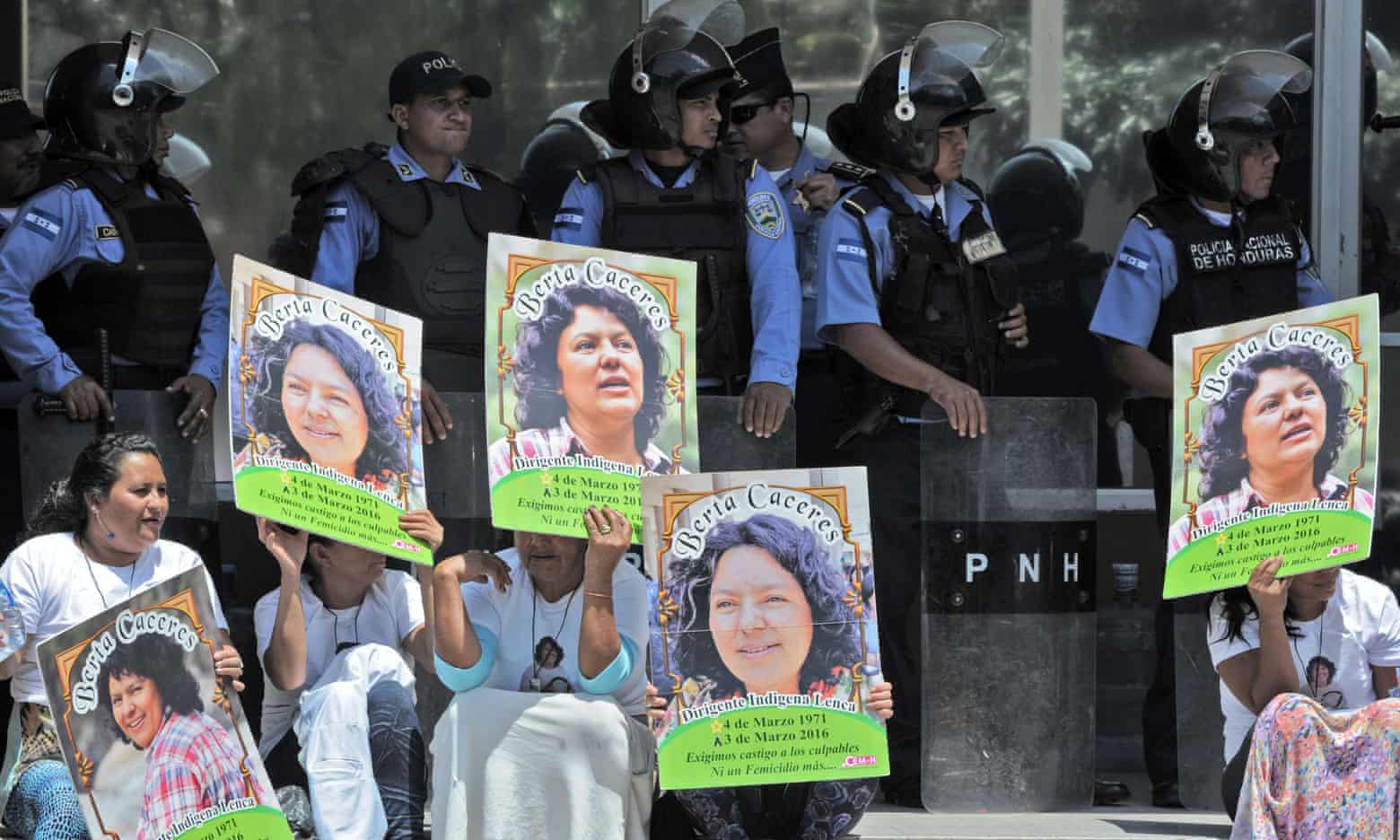
The U.S. government in collusion with the Honduran government killed Berta Cáceres on March 3, 2016. Cáceres, Coordinator of the Civic Council of Popular and Indigenous Organizations, was awarded the 2015 Goldman Prize for her efforts in organizing indigenous resistance in Lenca, Honduras, against the Agua Zarca Dam. In 2009, a U.S. backed military coup in Honduras paved the way for massive deregulation, furthering opening the country’s resources to exploitation from multinational corporations. The flow of capital out of the country coincided with a massive expansion in environmentally destructive megaprojects, including the Agua Zarca Dam, that were forced through with assistance from militarized private security firms and the Honduran military. According to SOA Watch, “The Associated Press has repeatedly exposed ties between the Honduran police and death squads, while U.S. military training and aid for the Honduran security forces continues.” In a 2015 interview, ousted democratically elected President Manuel Zalaya remarked, “Recall the human trafficking, trafficking of children, trafficking of women who go to the United States and pressure the U.S. borders, indeed bringing pressure to bear on the stability of the United States, precisely because of the failure of the policies here in Honduras. I could say the same of the new initiative of President Obama, who is talking about $1 billion in financing for the northern triangle, for Guatemala, El Salvador and Honduras. In this regard, measures of repression have been adopted—that is, closing the borders, militarizing the borders, preventing persons from exercising their right to migrate. Because migrating is a right. It is a human right. All of our countries emerged from migration, the United States itself from European migration.” Millions are fleeing the violence stoked by the United States acting on behalf of the interests of capital. To understand the rise of the far right reaction in the era of neoliberal globalization, we must understand the violence abroad and at home within our own borders.

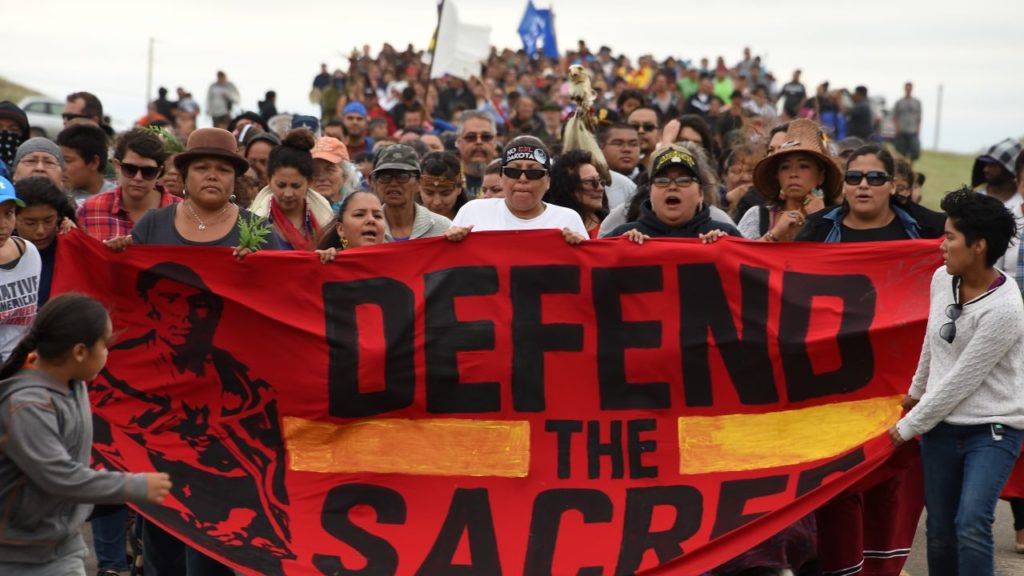
In North Dakota, as the U.S. lays the infrastructure for its role in consuming and shipping evermore toxic fossil fuels, a war between indigenous peoples and the state, in cahoots with capital, is being waged. Thousands of indigenous Water Protectors have congregated at the Lakota Pine Ridge Indian Reservation to demand the immediate end of all construction of the Dakota Access Pipeline, which would carry hydrofracked crude oil over 1,100 miles, endangering the environment and access to clean drinking water every step of the way. Since April of 2016, with the establishment of the Sacred Stone Camp, indigenous peoples have been engaged in peaceful protection of their lands and their water, protection for the generations with us now and those yet to come. While the people of Flint, Michigan are dying from the toxic water they drink, Water Protectors are being shot with rubber bullets, blasted with water cannons, attacked by tanks and grenades. Waves of resistance emanating out from the Sacred Stone Camp have followed – protestors shutting down local and national branches of many of the banks funding the $3.7 billion project, marching in the streets – which in addition to the numerous other mass movements for dignity and respect in the United States confronting injustices with direct action have led to the created perception of lawlessness and disorder. The same “law and order rhetoric” spanning generations has been deployed in the U.S. and abroad to legitimize the right’s rise by pointing to symptoms, while diverting attention from the structural diseases. As Howard Zinn wrote, “There is some truth, however, to the notion that acts of civil disobedience have a proliferating effect. Such acts, aimed at certain laws or conditions, may encourage others to similar acts, aimed at other evils. For instance, the sit-ins of 1960 probably helped lead to the Freedom Rides of the spring of 1961, and these in turn may have helped stimulate the civil rights demonstrations of late 1961, 1962, and 1963. And all the civil disobedience in the civil rights campaigns may well have had a stimulating effect on the tactics of the movement against the war in Vietnam. But that is not a general breakdown of law and order; that is a spread of organized protest against wrong. And such an effect is to be welcomed by a country seeking improvement.”

In Syria and beyond, the millions of nameless faces that would sooner drown in the Mediterranean than continue living in a state of perpetual trauma and violence pour into the heartlands of the great European democracies, built on the resources and wealth stolen from centuries of empire. In Poland, a far right government has risen to power riding a wave of xenophobia. In Britain, lawmakers make plans for Brexit as the European Union crumbles at the edges. In France, the leader of the French National Front party Marine Le Pen surges to the top of the polls running on a platform of law and order, opposition to immigration, and white nationalism. These phenomena are as global as the world financial order, and to understand them our analyses must re-center the global. In order to understand the success of Brexit and the recent election of Donald Trump, we must return our attention to the global to understand the role of empire, exploitation, and capitalism in leading us to where we find ourselves today.

(Photo Credit 1: The Guardian /Orlando Sierra/AFP/Getty) (Photo Credit 2: Bill Moyers /Robyn Beck/ AFP/Getty)

Why does Australia criminalize psychiatric and cognitive impairment? Ask Rosie Ann Fulton

Rosie Ann Fulton

Rosie Ann Fulton, an Aboriginal woman living with fetal alcohol syndrome, lives in Alice Springs, in the Northern Territory of Australia. In many ways, she is the embodiment of the State’s criminalization of psychiatric and cognitive impairment. This abuse is particularly addressed to women, and even more intensely so Aboriginal women. Rosie Anne Fulton has spent much of her adult life in jail for no reason other than her intellectual disability. After a mighty campaign was waged, she was released and agreements were made. Today, her custodian says the support, such as it was, has collapsed and Rosie Anne Fulton is “back on the streets, taking drugs, being exploited and is at serious risk.” This is what the State of Abandonment looks like. At the end of November, a Senate committee issued its report, “Indefinite detention of people with cognitive and psychiatric impairment in Australia.” Rosie Anne Fulton is typical of hundreds.

In March 2014, media uncovered that then 23-year-old Rosie Anne Fulton had spent 18 months in Kalgoorlie Jail without a trial or conviction: “The magistrate in her case declared her unfit to plead because she is intellectually impaired – a victim of foetal alcohol syndrome – and has the mental capacity of a young child. Her legal guardian, former police officer Ian McKinlay, says Ms Fulton ended up on a prison-based supervision order because there were no alternatives in the area at the time. `At the moment this outcome is almost entirely reserved for Aboriginal, Indigenous Australians,’ he said.” The State “explained” that no other options existed. Three options were available: first, a “declared place”, designed for precisely this kind of case; second, an authorized hospital; third, prison or juvenile detention center. Although the Act authorizing “declared places” had passed 15 years earlier, none actually existed. Hospitals could only admit someone who has a “treatable” mental illness, which did not fit Rosie Anne Fulton. And so the only available option was prison … according to the State.

That was 2014. In 2016, Ian McKinlay reported to the Senate Committee on Rosie Anne Fulton’s condition: “[Rosie Anne Fulton] was born with fetal alcohol brain damage, and this was compounded by a life of abuse. She was dumped by NT health after she ended up in indefinite prison-based supervision in Kalgoorlie. She was forced back into the NT health domain by a media and public outcry. This clearly caused resentment. It was reflected in the denial of a transitional support plan earlier discussed. Instead, she was placed under a clearly designed-to-fail support plan, which has seen her under conviction for 70 per cent of the time since her return to the Northern Territory. She has now lapsed into full-blown chemical addiction, and to all intents and purposes she is back on the streets and at serious risk. Yesterday I found her drunk with facial injuries; she was again bashed overnight and she appeared in court today. This support hides behind a pretence of freedom of choice values that contradicts repeated guardianship court findings that she lacks decision-making capacity. The external pressure needed to compel NT Health to accept responsibility for Rosie Anne has also been needed to maintain even tokenistic levels of commitment, the latest re-engagement prompted by monitoring by the Office of the Prime Minister and Cabinet plus the current Don Dale media coverage.”

What crime did Rosie Ann Fulton commit? She has committed the crime of survival, a crime she commits every second of every day, and so she, and all her kind, must be punished. Do not build a “declared space” where she might live with dignity. Do not open a mental health institution that might accommodate her not so unusual circumstances. Build more prisons, fill them up with Rosie Ann Fulton and her sisters, then throw away the keys, and call it democracy in an indefinitely austere world.


(Photo Credit: ABC Australia)