Self-care isn’t enough!

Take a nap, do a face mask, order a lot of food on UberEats – all elements of the self-care prescription you can find anywhere on the Internet. The meaning of self-care is evident in its name, but the repercussions of its incorrect use are deeper seated than many of us realize. 

Twitter (and other social media platforms) have normalized discussions of mental health and self-care. Twitter is a breeding ground for information and online community, which I have felt and been moved by many times. I am inspired by the way online communities can make a home for those who may have none. The baby-boomer era despises technology and social media as a destructive force – it kills our everyday social interaction, makes us “obsessed” with our phones. Social media’s impact on the younger generations of those who use it is quite the contrary – it has taught us how to build community, how to organize, and how to support one another. It creates a shared feeling of connection between distant strangers and can even save lives. Twitter is a fun way to pass the time when procrastinating, but its ramifications on concepts of community are powerful. 

The community Twitter has created is not exempt from the deeply embedded neoliberal individualism that the world suffers from today. Even within online communities, “self-care” has transformed into many things and almost none of them are what it should be. You’re a narcissist, you’re problematic, or you’re asking others to perform too much “emotional labor” for you. Self-care is purported to look easy when in reality it should be hard, as it requires the inner dismantling of the oppressive structure of individualism that permeates all aspects of life. Self-care should create community, not isolate those who may be struggling. Self-care can be interpreted in so many different ways that we have lost touch with what it should really look like, and thereby have negatively impacted the community we have worked so hard to create.

What does it mean to perform emotional labor? Twitter may tell you that a friend asking to talk about their hardships requires monetary compensation. Or, Twitter may tell you that setting appropriate boundaries between yourself and others is okay, even encouraged, within the self-care movement. The (mis)use of self-care has led us to unknowingly devalue our own community that Twitter has created. It is exactly through the Internet community that neoliberalism has penetrated, harming the way we view ourselves and others. Self-care and community are intertwined, but the transformation of both their meanings results in a cognitive dissonance that many, including myself, struggle to reconcile. 

Self-care is not enough. Even in its purest form, it is accompanied by radical, shared care and trust in one another. We are only as strong together as we are apart. True self care is not selfish, nor is it simple, nor is it individualized. It is a radical feminist practice, allowing us to strengthen ourselves and thereby the movement. As Audre Lorde so eloquently stated, “Caring for myself is not self-indulgence, it is self-preservation, and that is an act of political warfare.”

(Image Credit: The Mindfulness Journal)

Mourning all that is human, once again, drowned in the sea, once again

“one cannot speak of generations of skulls or spirits except on the condition of language – and the voice, in any case of that which marks the name or takes its place (“Hamlet: That Scull had a tongue in it, and could sing once”).
Jacques Derrida. Specters of Marx

Once again, the year ends with the surface of the Mediterranean concealing thousands of humans lost. According to the International Organization of Migration, 1246 people – women, children, men – drowned in the Mediterranean while trying flee certain death. In certain circles, this number, 1246, is being celebrated as a mark of success. The numbers of dead have declined. Fortress Europe, like Fortress Australia and Fortress USA, is working. This is the mathematics of success in our contemporary world. 2019: 1246 dead: “the fifth straight year of at least 1,000 deaths on the Mediterranean”. 2018: 2299 dead. 2017: 3139 dead. 2016: 5143 dead. 2015: 4054 dead. 2014: 3283 dead.  From 2014 to today, 19,164 souls – women, children, men – thrown into the deep waters of unmourning. No language, no marking of names, no taking of place. No singing. Only the silence of “success”.

According to UNITED, United Against Refugee Deaths, “In the period 1993-2019 more than 36,570 deaths can be put down to border militarisation, asylum laws, detention policies and deportations. Most probably thousands more are never found.” UNITED compiles a list of documented deaths of refugees. The overwhelming majority of the deceased are identified as “N.N.”, “Nomen Nescio: I don’t know the name”. This is success today. Tens of thousands dead; tens of thousands rendered nameless. Tens of thousands languishing, tortured, in confinement in north Africa, especially in Libya

In 2016, the deadliest year ever for migrants trying to reach Europe, the year’s epitaph was simple: “2016: The year the world stopped caring about refugees”. This year, the epitaph is equally simple: “2019: The year refugees were urged to return”. Refugees and asylum seekers were “urged” at the end of a gun, in the festering conditions of camps, by policies of hostility, by enforced freezing, starvation, and other forms of violence. In today’s world, these forms of violence are called urging, invitation.

We have turned the sea into a graveyard. It’s December 31, 2019, and the Person of the Decade is a woman, child, man lying on the bottom of the Mediterranean; we do not know their names, and we do not much care. If we did, they would be alive today.

To “honor” the decade, here is a poem for the refugees who lie in the cemetery that we have made of the Mediterranean and for those who continue to seek shelter, haven, community, work, humanity. See you next year.

Mourning
By Carolyn Forché 

A peacock on an olive branch looks beyond
the grove to the road, beyond the road to the sea,
blank-lit, where a sailboat anchors to a cove.
As it is morning, below deck a man is pouring water into a cup,
listening to the radio-talk of the ships: barges dead
in the calms awaiting port call, pleasure boats whose lights
hours ago went out, fishermen setting their nets for mullet,
as summer tavernas hang octopus to dry on their lines,
whisper smoke into wood ovens, sweep the terraces
clear of night, putting the music out with morning
light, and for the breath of an hour it is possible
to consider the waters of this sea wine-dark, to remember
that there was no word for blue among the ancients,
but there was the whirring sound before the oars
of the great triremes sang out of the seam of world,
through pine-sieved winds silvered by salt flats until
they were light enough to pass for breath from the heavens,
troubled enough to fell ships and darken thought — 
then as now the clouds pass, roosters sleep in their huts,
the sea flattens under glass air, but there is nothing to hold us there:
not the quiet of marble nor the luff of sail, fields of thyme,
a vineyard at harvest, and the sea filled with the bones of those
in flight from wars east and south, our wars, their remains
scavenged on the seafloor and in its caves, belongings now
a flotsam washed to the rocks. Stand here and look
into the distant haze, there where the holy mountain
with its thousand monks wraps itself in shawls of rain,
then look to the west, where the rubber boats tipped
into the tough waves. Rest your eyes there, remembering the words
of Anacreon, himself a refugee of war, who appears
in the writings of Herodotus:
I love and do not love, I am mad and I am not mad.
Like you he thought himself not better,
nor worse than anyone else.


(Photo Credit: Electronic Intifada /Oren Ziv/Active Stills)

The heartless in power: Making it impossible to seek refuge in the United States

We are living in a modern time. The president of the United States has been impeached by the House of Representatives. Two articles of impeachment accusing Trump of abuse of power and obstruction of Congress were adopted. He was not impeached for having separated families of asylum seekers, sending children away from their parents, leading to child deaths and missing children. He received no official reproof for all kinds of suggestions he made to make the southern frontier of the United States a place of cruelty. When he suggested to shut down the border, his advisers, reportedly astonished, told him that this decision would trap American tourists in Mexico and would affect the precious asymmetrical NAFTA trade agreement and therefore the economy. The president made many other cruel suggestions, for instance, building an electrified wall with spikes to pierce human flesh (the precision is important), fortifying the wall with a water-filled trench, stocked with snakes or alligators. He also had the idea of shooting the legs of people, of the wretched of the earth to use Franz Fanon’s terms, who are crossing the border without proper documentation.

This is the same president who ordered the veto of UN resolution 2467 on ending sexual violence in war unless the health section including sexual and reproductive health was removed. These decisions are real: they show the schism between rights and laws and rights, between precaritized women, children and men, and the laws of men of power. 

The heartless reveal themselves in their hypocritical policies, flouting basic ethical principles. The Trump administration has shaped a new level of cruelty with its immigration policies. The president explained in the simplistic and shallow language of his policy: “Our country is full—can’t take anymore—so turn around that’s the way it is.” They even came up with a senseless title for this policy, “Migrant Protection Protocols” (MPP), which forces asylum seekers reaching the southern border of the United States to return to hazardous and dangerous areas in Mexico. There have been numerous reports of rape, kidnapping, and torture of asylum seekers stuck in Mexico. 

To prove the insensitive character of this policy, the acting commissioner Department of Homeland Security justified it as an alternative to family separation; communication is key in pushing heartless policies.  Alternative is a big word in neoliberal language, either we don’t have any and public systems have to be dismantled or the alternative is to dismantle the asylum system, claiming to “restore integrity in the immigration system.” Meanwhile Mark Morgan, the acting commissioner of US Customs and Border Protection (CBP), dismissed the numerous public reports (about 636) of rape, torture, kidnapping as “anecdotal stuff.” 

Meanwhile, asylum seekers have no chance to get a hearing that lasts more than a few minutes in the tent courts making it practically impossible to pass these screenings, according to US senator Jeff Merkley’s office. In the spirit of unfairness, fake hearing notices have been sent to asylum seekers. MPP combined with two other immigration policies will bar the asylum process, making it impossible to seek refuge in the United States, a country fully in the hands of white supremacist and heartless people. 


(Photo Credit 1: Loren Elliott / Reuters / Washington Post) (Photo Credit 2: Time)

Kashmir caged: Where is the global outrage?

Beyond cruelty lies immigrant detention and family separation: Maria, Flor, Eloy

Maria and Flor crossed the U.S. – Mexico border in March 2019 and applied for asylum. Technically, Maria, 23 years old, filed for asylum for herself and her six-year-old niece. Maria and Flor had travelled north from Guatemala, where Flor’s entire family was murdered when Flor was a baby. Maria was, and is, her only living relative. Maria took Flor in and has raised her as her daughter. Maria is the only mother Flor has ever known. Maria’s family was killed this year, and that precipitated the flight north. Maria brought all the formal papers she could lay her hands on. ICE, Immigration and Customs Enforcement, rejected the papers, rejected Maria and Flor as well. Maria was dumped into Eloy Detention Center, in Arizona. Flor was taken to a shelter … in New York City, thousands of miles away. Anita, a woman living in New York, has volunteered to provide a home for Maria and Flor. Volunteers have provided assistance, clergy and faith community members have joined with activists to raise a hue and cry, attorneys both in Arizona and New York have actively represented both Maria and Flor. Despite all this support, Maria was recently again denied parole. ICE provides no reason. Deeper into the landscape of no-reason, were Maria or Maria and Flor to be deported, there are no assurances that Maria would know Flor’s whereabouts. Again, Maria is 23 years old; Flor is 6 years old. Find a six-year and just look at her, and you’ll understand what this theater of cruelty is all about. As one local reverend said, “It is beyond cruel.” What is beyond cruel? This.

Maria sits, waits, tries to organize her life and Flor’s life, in Eloy Detention, the place where Raquel Calderon de Hildago, also Guatemalan, hanged herself … or was sentenced to hang herself; Eloy, the detention center that often has had both more deaths in custody and more suicide and suicide attempts than any other detention facilityEloy, the site of repeated women’s hunger strikes. Why is Maria in Eloy, rather than `out in the world’ with her daughter-niece Flor? Why is anyone in Eloy?

Despite the State of Abandonment, Maria insists that she does not feel abandoned, because, she says, “I have the support of lots of people. I’m not alone”. Abandonment is the obverse of democracy. Maria’s understanding of community, solidarity, hope, that is what democracy looks like. 

#FamiliesBelongTogether #FreeMaria

(Image Credit: Franziska Barczyk / The Guardian)

A woman was forced to give birth alone in a cell: Diana Sanchez, Tianna Laboy, Kenzi Dunn

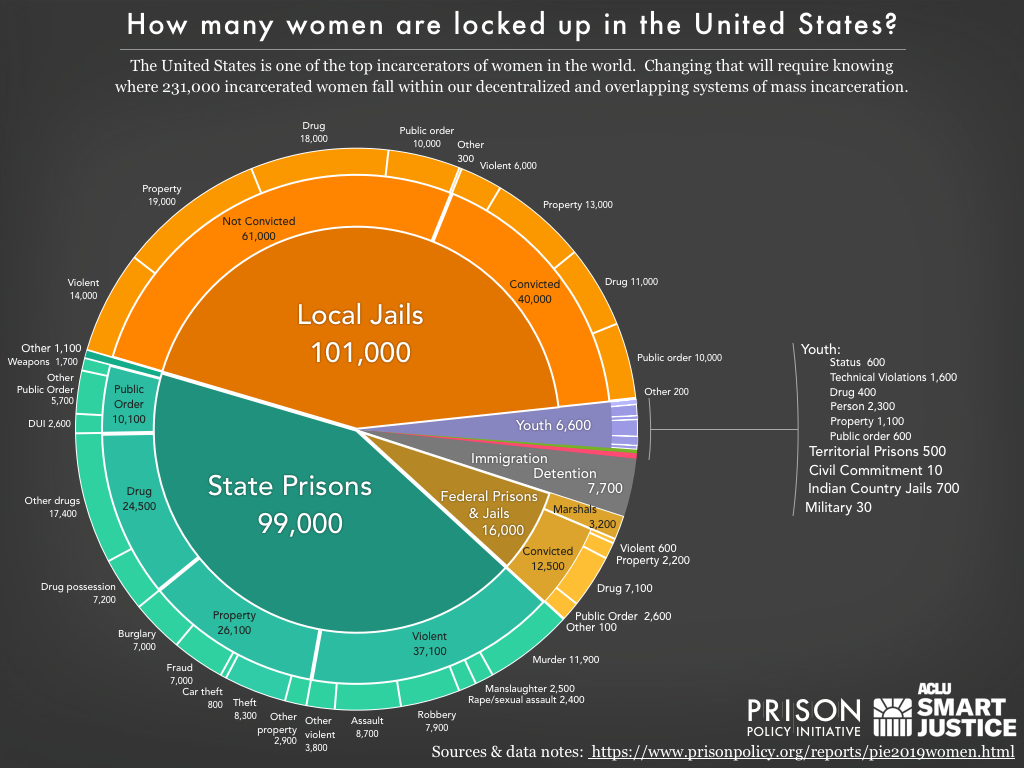
In one week in December, two stories of women being forced to give birth alone in prison or jail cells collided. In Connecticut, a court decided that the case of Tianna Laboy, who, while held at the York Correctional Institution, was forced to give birth to her baby in the toilet of her prison cell. That occurred February 13, 2018. In the same week the Connecticut court made the decision concerning Tianna Laboy’s case, another court, in Florida, heard the case of Kenzi Dunn, who was forced to give birth alone in a cell in the Osceola County Jail.  Tianna Laboy’s baby survived. Kenzi Dunn miscarried. This is how the year ends; this is how the decade ends. Across the United States, pregnant women in prison and jails routinely suffer programmatic neglect and abuse. Diana Sanchez was forced to give birth, alone, in the Denver County Jail, July 2018. The list goes on: Tammy Jackson, Broward County, Florida; Jessica Preston, Macomb County, Michigan. Nicole Guerrero, Wichita County, TexasAutumn Miller, Dawson State Jail, Dallas, Texas. These are only the names we know. There is no national data base concerning prison or jail births … because, really, who cares?

When Diana Sanchez was booked, she was eight months pregnant, in early stages of labor, and had a history that suggested high-risk pregnancy and a good chance of early delivery. Diana Sanchez went into hours long labor, screamed for help, and no one cameStaff stood outside her cell, nurses watched on video and refused to help. Diana Sanchez reflected, “That pain was indescribable, and what hurts me more though is the fact that nobody cared.” What hurts me more is the fact that nobody cared.

Tianna Laboy’s experience echoes that of Diana Sanchez. She informed authorities she was pregnant. Staff did nothing or less than nothing. Tianna Laboy walked the halls in pain, begged for help, cried out in pain. No one came. Sitting on a toilet in her cell, she gave birth to a child. The child hit her head on the toilet. Tianna Laboy pulled the infant out. Her cellmate told her to pat the child on the back. She did and her daughter started breathing. Other than her cellmate, Tianna Laboy received less than no care. That was last year. It’s not clear if anything has been done at the prison to correct this situation … because, really, who cares?

Kenzi Dunn’s story is basically the same. When she was booked into the Osceola County Jail in October, Kenzi Dunn discovered she was pregnant. On Wednesday, December 4, Kenzi Dunn started bleeding, asked for help, begged for help, screamed for help, and none came. Kenzi Dunn continued to bleed. She didn’t see a doctor until Friday. On Saturday, bleeding and suffering cramps, Kenzi Dunn miscarried. On Monday, she was taken to the hospital. Upon release from the hospital, Kenzi Dunn was taken back to the same cell and had a day added to her sentence, to make up for the day she spent in the hospital. The following week, Kenzi Dunn was released two weeks “early”. Kenzi Dunn summed her experiences succinctly, “It was torture”.

Across the United States, in the name of justice and security, women are being forced to give birth alone in prison and jail cells. Women are being forced to bear their children into toilets or onto floors. Women are being forced to bleed for days on end, while assistance stands inches away and refuses to budge. Nobody cares. It’s torture. 


(Infographic Credit: Prison Policy)

His hands were up

His hands were up

His hands were up
He was reaching out

So remarks the presenter 
interviewing Section 27
on morning SAFM radio

His hands were up
five year-old Michael Komape’s 
he drowning in a pit toilet

(learners and teachers
forced to learn and teach
in the state we are in)

His hands were up
He was reaching out

Now there is justice
some 5 years later
his family awarded 
damages for emotional
shock and grief

A most appalling
and undignified death
says the judgement
(Supreme Court of Appeal)

The SAFM interview also
tells us of the insensitivity
and callousness of officialdom
in this regard

(have we lost our principles
along with so much else)

His hands were up
He was reaching out 

How many more

See “Michael Komape’s family awarded R1.4 million in damages by appeal court” (Franny Rabkin, Mail & Guardian, 18 December 2019), and “Komape family awarded R1.4 million for emotional shock and grief” (Ciaran Ryan, 18 December 2019 © 2019 GroundUp).

The Komape family was represented by public interest law firm SECTION27


(Image Credit: Daily Maverick)

South Africa confirms the rights of all children to education!

It’s the end of the year and decade, and we need some good news, right? As the United States continues to throw migrant children into the abyss of immigrant detention and India throws millions under the bus of lost citizenship, last week a court in the Eastern Cape province of South Africa came through. In a case concerning the rights of 37 undocumented children to attend school, the Judge President of the Eastern Cape Selby Mbenenge, writing for the Makhanda High Court, emphatically declared that the Constitution of South Africa enshrines the right of all children to access to education. Judge Mbenenge opened his decision: “Central to this application is the right to basic education enshrined, without any qualification, in section 29 of the Constitution … Education is a mighty tool in the hands of the possessor. Its efficacy depends largely on the bulwark that surrounds it – the right to education … In our constitutional dispensation basic education is a pivot of transformation.” Children matter, democracy matters, education matters, rights matter, the Constitution matters, courts matter, judges matter, decency matters, compassion matters, transformation matters … without any qualification. Amen.

Who are the undocumented children of South Africa? According to the Department of Basic Education, of the 998,433 undocumented children currently enrolled in public schools, 880,968 are South African citizens. A little over 88% of those children are South African. Of the 37 children represented in the Eastern Cape case, 23, or a bit more than 60%, are South African citizens. South African children born at home often don’t have birth certificates. There are other barriers. Eight of the children live in a safe house for abandoned and orphaned children. Their situation didn’t matter. Without proper papers, they were expelled. Who are the undocumented children of South Africa? Poor. Black. Vulnerable. But first, they are children.

The Makhanda High Court has said that children’s situation does not matter, because they are children and thus are due an education, and that obligation is without qualification. Section 29 of the Constitution of South Africa reads:

“Section 29 Education

 (1) Everyone has the right –

(a) to a basic education, including adult basic education; and

(b) to further education, which the state, through reasonable measures, must make progressively available and accessible.

(2) Everyone has the right to receive education in the official language or languages of their choice in public educational institutions where that education is reasonably practicable. In order to ensure the effective access to, and implementation of, this right, the state must consider all reasonable educational alternatives, including single medium institutions, taking into account –

(a) equity;

(b) practicability; and

(c) the need to redress the results of past racially discriminatory laws and practices.

(3) Everyone has the right to establish and maintain, at their own expense, independent educational institutions that –

(a) do not discriminate on the basis of race;

(b) are registered with the state; and

(c) maintain standards that are not inferior to standards at comparable public educational institutions.”

Everyone means everyone. Tell that to the governments of the United States and India, and all those fortress nations in between and beyond. This is a victory for vulnerable children as it is a victory for inalienable rights without qualification. Transformation is still possible. 


(Photo credit: Daily Maverick)

To disconnect ourselves from our bodies is death

Misinformation runs rampant in anti-abortion legislation, from the belief that fetal heartbeat is indicative of the personhood of a fetus; to the belief that a “legitimate rape” can effectively shut down a pregnancy; to the newest dishonest argument that ectopic pregnancies – pregnancies where the embryo implants onto the fallopian tube or another place besides the uterus – can be re-implanted to save the fetus. I have watched in disbelief as antiabortion politicians sound off on these ridiculous claims in order to further push anti-choice agendas, and have seen even the most sound minded make a comment that is beyond the realm of reason when it comes to sex, fertilization and termination of a pregnancy, but how did we get here?

How did it come to pass that we are so ill informed about the basic functions of our body? 

Capitalism feeds off this disconnect. We don’t understand the cycle of our reproduction any more than we understand thermodynamics. Women and non-binary people fear the aspects of our own functions becoming something that is undesirable, shameful even. We know that a good portion of the population bleeds, sheds the lining of our uterus, yet in most circles we don’t discuss it. We know that people are regularly engaging in sex, but when the most neutral and curious questions are asked, we turn away in proper disgust. Meanwhile, people will continue to consume vast amounts of PornHub, of goods that are marketed in an overtly sexualized way. We pay to get parts of our body fatter, skinnier, shinier, darker, lighter, the list goes on and on. 

To disconnect us from our bodies (ourselves, because there is no difference between my conscious self and the vessel that it resides in), capitalism works to extract the most value from us. We don’t know how long it takes to care for a child after labor. Some countries give us six months, others give us a year, some give us two weeks, and so we follow what capitalists say. We don’t know how to breastfeed or are shamed when we do it in public, so the capitalists sell us formula. We are too skinny or too fat according to the capitalists, who then sell us diet pills or protein shakes to find that right balance. We don’t know what normal even is, just the normal that the capitalists sells to us, that we are forced to consume, under the guise of choice and freedom. Did I know that it was normal to have extra fat and skin around my lower abdomens? NO! Why? Because to many, it is only disgusting fat that needs to be removed through constant diet and exercise, restriction and sweat. 

The alienation of our knowledge of ourselves works to extract our value and to kill us when we are no longer useful. To be pregnant means to enrich a capitalist society, to lose a pregnancy, prevent a pregnancy, or terminate a pregnancy takes away our profitability (when we are poor and pregnant, we are worked to the bone, when we are middle class and pregnant, we can be one step closer to being poor, when we are rich and pregnant we add another little capitalist ready for the spoils) and we must be punished. 30 years to make up for our mistakes, the death penalty because we are no longer valuable. How would we know that miscarriages happen in nearly 1 in 20 pregnancies? No one has taught us to destigmatize spontaneous abortions. No one knows how we function to take care of ourselves when a pregnancy could be nonviable or dangerous. 

Then, imagine the rate of maternal deaths in the United States: highest in the developed world, lower for white women, astronomical for black women. Black women who don’t know that their pain is cause for concern, because their concepts of pregnancy and pain is limited, and society has dictated that they can withstand more than white women. Even the men and women in charge of their care believe that to be so; their pains and abnormalities are ignored or explicitly denied to their face, theirs is a dangerous peril when they enter the delivery room. 

With the onslaught of dangerous anti-choice legislation, the very latest is the demand to re-implant an ectopic pregnancy into a person’s womb (and many will firmly believe this can be done, despite specialists’ warnings). We must begin the reclamation of ourselves, of the dynamic vessels of our conscious selves. I am not separate from my body, it is not separate from me. Our rolls and lines, muscles and fat all work in tandem to make us who we are. Our sexual desires are not a separate, shameful part; the work of our systems are normal and natural, and need to be reclaimed, otherwise we face a most certain death. 


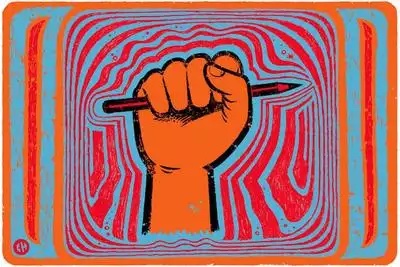
(Image Credit: Just Seeds)

He has become sacred in all that he has lost and yet endures

On the northwest corner of 19th and F, the building goes in at a ninety-degree angle, providing a covered patio space for the Korean owned, Latinx staffed cafe that fuels George Washington University students and office workers from nearby US government agencies and the World Bank.

An unhoused man has made a nook for himself inside that angle. He wheels his little cart into the corner, between a square pillar that holds up the building and the wall, and lies down in front of it, swathed in a beige down jacket and a bright blue sleeping bag that must be Everest-rated, because sometimes on cold nights he has it partly unzipped. He has a gray wool hat, and a beige scarf with a red zigzag pattern, and he uses long beige socks for gloves. 

He is not always there, but often. He is there today. He has chosen his shelter well. While the tile is hard, it is dry, and the building angles stop the wind cold. The only shrubbery is twenty feet away, and in waist high concrete planters, so rats are not particularly attracted to the area. It is lit 24 hours a day, with many passersby during working hours. At night, he is under the watchful eye of the Passport Office security cameras, which are staffed by 24-hour security guards who are visible through the plate glass of the building’s first floor, further up 19th Street. They also patrol around the building throughout the night, checking that all the street-facing doors of the local businesses are locked.

People have started leaving offerings for him. Today, while he sleeps, someone has laid a white paper napkin on the ground like a fresh tablecloth, under some kind of sandwich in a plastic shell, and a bright red apple. Others leave grocery bags full of single serving cereal and shelf-stable milk and towelettes, evidence of a special trip to the 7-Eleven down the street. People even leave things when he isn’t there. Last night a tub of yogurt and a bottle of water awaited his midnight arrival. 

He has become sacred in all that he has lost and yet endures. His need has made him holy to some. Clearly, there are sufficient among us who heed the call for compassion and generosity without question or the need for some kind of justification for why he is worthy of attention, small sacrifices, and offerings. No one is demanding he “tell his story” before paying for it with a sandwich, or a bottle of water. His need is obvious without a single word needing to be spoken. It is met in equal silence and anonymity. I imagine each decision to buy an extra sandwich or a pair of socks growing from an internal dialogue — “I wonder if he would like…I wonder if this would make him more comfortable/warmer/safer…” — and then paid for without fanfare, and delivered with respect for all that is human and holy. 

Can we imagine this recognition, and the actions that flow from it, of the sacredness of need and what giving gives to the giver — anonymous cubicle dweller remembers purpose, lonely student less lonely, alienation overcome by connection — expanded in its ancient honesty to the city, and beyond that, and beyond that?

(Image Credit: Hilma af Klimt, “Group IV, The Ten Largest, No. 7, Adulthood”)