“Why can’t I quit you?”

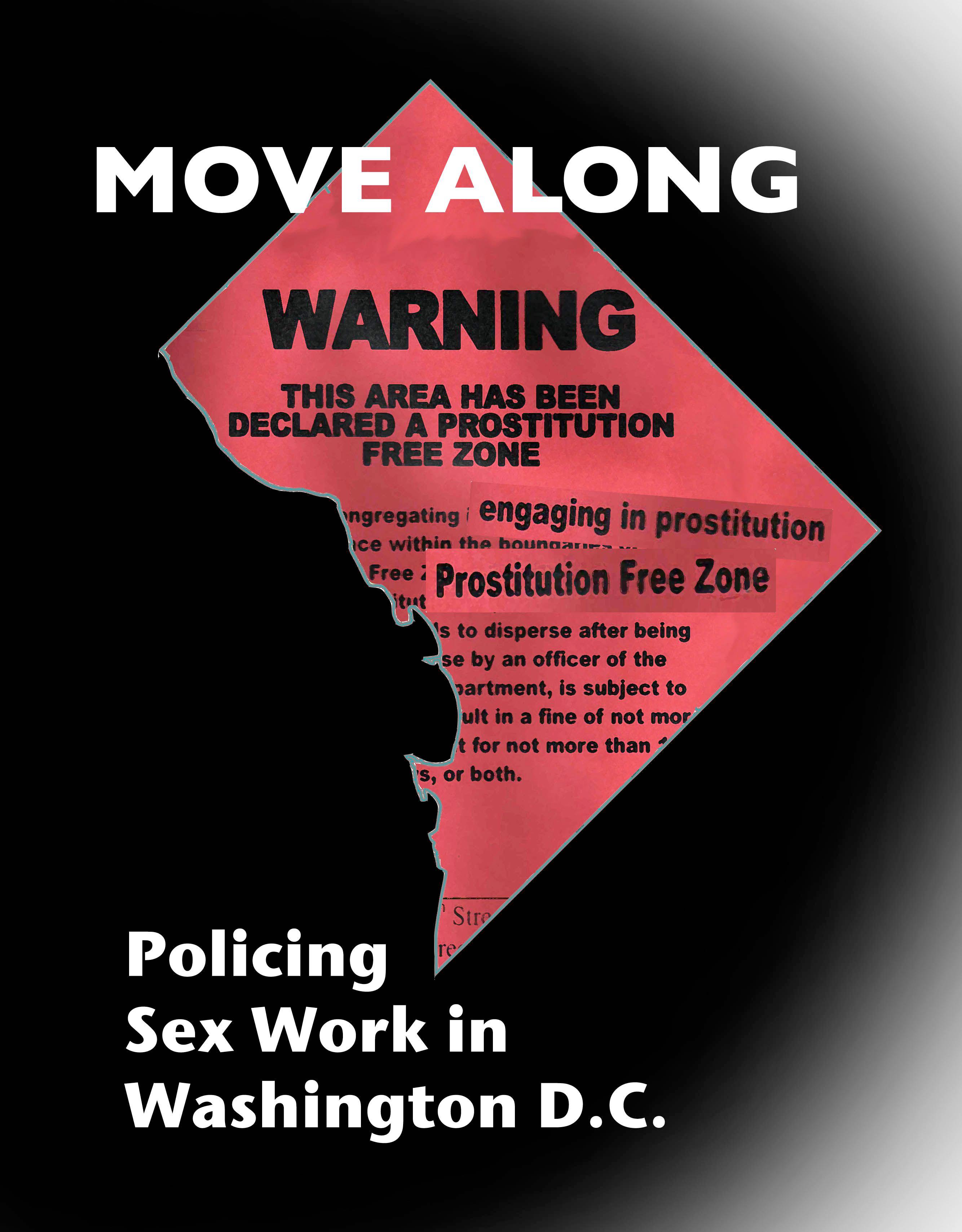
In March, the Metro Police Department had a minor publicity issue when one of its own was arrested in an anti-prostitution sting targeting clients.  Officer Robert A. Schmidt was charged with solicitation after agreeing to pay an undercover female officer $80 for sex.  Solicitation is a misdemeanor in the District, however, solicitation tends to be treated completely differently within both the police department and the courts.   Like in most other U.S. cities with anti-john laws, D.C. still tends to focus most of its resources on policing the sex workers themselves.  Since most workers are woman-identified, these sort of tactics have been declared to be discriminatory on a few select occasions, though not most.  Women are the largest group arrested on charges of prostitution with transgender workers being the second largest groups.  Male workers and clients only make up about 2-3 arrests per night.  In recent years, a few U.S. cities, most notably San Francisco, have instituted reforms targeting clients in order to cut off demand for sex work altogether.  In Sweden, authorities have even gone so far as to decriminalize sex work itself, while criminalizing the act of solicitation.  The intent, however, remains the same: abolition.  Even when tactics target male clients and not workers explicitly, abolition still sends the statement that sex work is wrong and inherently exploitative; workers are victims worthy of pity rather than a safe and fair wage.

With the intent of seeming more even handed in enforcing the law against engaging in and soliciting prostitution, D.C. utilizes “rehabilitation” programs for individuals charged as clients of prostitution called “john schools” as a means of teach clients about the ‘inherent’ harms of prostitution like “crime, fear, and health disorders”. School is one day long and consists of testimony from “a psychologist, survivors of prostitution, prosecutors, police, health professionals, local residents, and business owners”.  The finger is pointed at these clients instead of pimps, police, and other abusers; it also virtually ignores systems, which not only perpetuate the practice but make it dangerous. These schools, with a fine, are offered in lieu of the typical penalties for first time offenders.  Officer Schmidt’s charge was dismissed after he completed “john school” and his record is clean.  It is a safe bet that workers arrested that same night had a different experience.

Despite the fact that the law itself is written indiscriminately, policing practices and the ability to expunge one’s record and avoid jail time through “john schools” signify that anti-prostitution policy remains discriminatory in practice.  Authorities have acknowledged a legitimate interest in keeping clients, especially middle-class white men, out of jail and their records clean, yet, the state seems disinterested in considering that the lives of workers would also be improved by not having convictions, police harassment or their daily lives disrupted by jail time or fines.  The practice of the law quite literally values the lives of men over women.  Low arrest rates of clients, likewise, means that there are generally low recidivism rates compared to workers and recidivism often leads to harsher sentencing.  Workers who are unable to pay increasingly high fines are more likely to spend as many as 180 days in jail.  Street workers often come from poorer socio-economic backgrounds and often are parents or are supporting others.  The criminal justice system tries to see these individuals apart from their relationship to the larger community and fails to acknowledge that jail time is an unpaid absence from work.  It’s a loss of income for the worker and often for their families that is further complicated by court fees and fines, which require them to work more.  Separation from family, especially children, has problematic short and long-term complications. Children whose parents serve time in prison are often left vulnerable to higher incidences of abuse, neglect and rape; if unable to stay with extended family they are placed in state care not because their parents are necessarily unfit but because they were working.  How can advocates of criminalization claim that these practices are in the best interest of women?

Imprisonment is especially complicated in regards to transgender workers, a group, which has been disproportionately targeted for harassment and arrest in D.C.  With the passage of the amendment adding gender identity and expression to the D.C. Human Rights Act in 2007, the Department of Corrections has had to change its intake and housing policy.  Previously there was no system in place to change a person’s gender in the criminal records database, even if they had undergone transitional surgery and/or had their name and gender legally changed.  This caused many women to be automatically placed into holding cells with males and led to high incidences of sexual assault.  The new policy ostensibly would allow for transgender persons to be housed in either the general population or protective custody of the gender they are deemed by the Transgender Committee. Transgender inmates must also be allowed access to hormone treatment under the new policy even if they had not started prior to arrest.  The new policy also requires strict nondiscrimination.  It has yet to be seen, however, how the policy will be carried out and though seemingly benign, the daily reality of imprisonment poses its own dangers.  Genitalia are still the primary indicator used for determining housing and it is unlikely that many transwomen would be housed with biological women or that they would even choose to be.  Likewise, protective custody is simply euphemistic for solitary confinement; these inmates are placed in single-person cells and only given two hours outside of these cells a day to shower and exercise.  Because of this, few knowingly choose protective custody even when they fear violence among the general population.  Transgender men and women are not passive victims of a system which hasn’t yet ‘caught up’, but they have been targets of a system which bent on eliminating them.  Disproportionate and violent targeting of transgender workers, as well as all woman-identified workers, sends precisely the signal it intends: abolition.

(Image Credit: DC Trans Coalition)
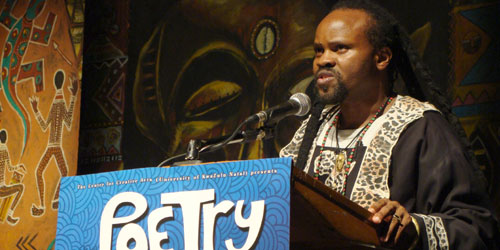
Some words about Bantu’s work with prisons

Bantu Mwauru

I wish to say a few words about Bantu. Specifically on Bantu’s, Ndungi Githuku’s and their dedicated team’s role in drama therapy at Langata womens prison. Bantu and team embraced the open door policy of the prisons by pioneering the use of drama therapy to bring the prisoners and staff to a level where they could live together by accepting that in addressing their pasts and presents they could see in each other not just prisoners and prison officers but women whose only difference was the colour of the uniform they wore.

The drama therapy involved a process of walking the prisoners through an examination and acceptance of the crimes that brought them to prison, a critical look at the shortcomings of the criminal justice system in Kenya, a reflection on how they were received into prison – the beatings by the staff and the bullying by the other prisoners – an assessment of what the prison reforms and open door policy meant for them and how best to safeguard the gains of the prison reform programmes. 


The prison officers in turn went through a similar process – they examined the reasons they joined the prisons as staff, how they were received and inducted into the prison – the bullying by the older staff and the induction that a prisoner was subhuman and should be treated as such – an assessment of the prison reforms and why the staff resented the open door policy and felt the prisoners were getting all the “attention” from Moody.

Bantu and Ndungi were a sight to behold – in a women’s prison which men previously men could not access were these dreadlocked men animatedly drawing out the prisons dark secrets that no one had talked about before; all the hate, malice, injustice, the occasional flashes of a humane touch,mercy, empathy. Bantu crafted the stories into a script as Ndungi recorded the documentary with his multiple cameras. When the actresses, who were, in the real sense playing themselves got onto stage and acted out their roles the prison began to heal and emotion flowed. Prisoners were able to walk up to officers and tell them you did not have to do that to me and officers told prisoners how difficult it was to show humanity when they themselves felt undignified in the shacks that they shared. It was not all hugs and kisses all round though. Some of the staff were genuinely angry at the project and the painful processes involved.


Wanini Kireri was then officer in charge of Langata. ( she is now in in charge of the Shimo la tewa maximum mens prison) Many prison officers warned her that she would not be able to handle what Bantu, Ndungi and team left behind in terms of ” living happily ever after” expectations of the staff and prisoners. After all nothing had changed, no new staff houses or lessened sentences for the prisoners. But the psychological and emotional barriers had been broken; it worked and Langata became a role model for reform through coordinated prisoner and staff teamwork. The prisoners and staff were to act out this script for many different audiences, including lots of people from civil society and faith based organizations, Maina Kiai then Chair KNCHR and Tirop then Commissioner KNCHR, Rebecca Nabutola, Koigi Wamwere and of course Moody Awori. The then Commissioner Kamakil shed tears when he watched it – it was that real.

Just before Moody left we organized ( then as KNCHR) a meeting for all senior officers in the Prisons to assess the impact of the prison reforms from a human rights perspective with a team from IED, LRF, RWI and Bantu. Our evaluation was based on what impact we had from a knowledge, skills and attitude change perspective. When Bantu rose to speak he asked them to admit him as a prisoner and through this process addressed their biases towards prisoners based on their looks and poor backgrounds. They told him they would treat him badly because of his dreadlocks, strange name, funny shirt and dusty sandals. They were shocked when we told them he had a PHD – he used his own example to explain how so much of what is needed in prison reform was about attitude change and that it costed nothing. 


The last time I met Bantu at the National theatre I teased him that his “fans”at the prison were missing him and we talked about the possibility of creating more “fan bases” particularly in the mens prisons. We left it at that. Wanini called me on Monday – telling me that Bantu had passed on and that she had asked the staff in Langata to break the news to the prisoners gently. This morning I told her I was going to send in something to this listserv and she said “tell them that Bantu gave us hope – he let us tell our story and he achieved so much change. He never made us feel that he was imposing his own ideas, he was so humble. As a result of the drama therapy It became really ‘uncool’ for officers to beat prisoners or for prisoners to treat staff with disrespect. He made us realise how much we needed each other as staff and prisoners – how we completed each other. I personally will always be grateful to Bantu and his team for making all of us in Langata realize that we can be the change we want to see in the prison”

[Editors’ note: Bantu Mwauru, Kenyan artist, activist, academic, died April 26. Pambazuka this week published Shailja Patel’s “The Man With the Mau Mau Spirit: Remembering Bantu Mwauru”, http://pambazuka.org/en/category/comment/55979, and Alice Nderitu’s reminiscence of Bantu and Ndungi Githuku’s work at Langata women’s prison. Alice Nderitu is Director of Fahamu’s Education for Social Justice programme. Thanks to Pambazuka for their great work and labor, and for sharing this piece with us.]

(Photo Credit: CapitalFM)


“We have voted but our governments have not delivered”: sex workers speak out and organize

On Wednesday, 22 April 2009, South Africans will head for the polls to cast their democratic vote for the fourth time. With a flurry of pre-election activities: from increased campaigning and media coverage to some comic relief from the likes of Evita Bezuidenhout’s Elections and Erections. Of course when raising the issue of elections and sex work one can expect sexual innuendos like this to flourish. However sex workers across the world have engaged with election processes.

In the run up to elections in the USA last year, sex workers started an election awareness campaign called: “Grind the vote”. This campaign was spearheaded by SPREAD, a magazine by sex workers for sex workers. It raised a list of issues, concerns and demands by sex workers, analysed various political parties’ manifestoes and embarked on extensive voter education with sex workers across the country.

Similarly Indonesia held their elections on 9 April.  According to an AFP article, Indonesia has about 170 million voters eligible and over 38 parties to choose from. What has all of this got to do with sex work? Approximately 50 sex workers were trained by election officials to do voter education with other sex workers and clients. This was in an attempt to engage hard to reach groups in the election process. Interestingly no mention was made of sex workers’ rights or the various political parties’ position on sex work.

In Kolkata, India sex workers attempted to respond to the elections holistically. They lobbied for sex workers to be involved in the election process and they used the opportunity to highlight sex worker demands to political parties and society at large. Durbar Mahila Samanya Committee (DMSC), boasting a membership of 65000 sex workers, approached the chief electoral officer to create the space for sex worker involvement.  Six sex workers in this region will be working at polling booths during the elections. The DMSC heralds this as a step in the right direction in recognising sex workers as equal citizens. In addition the DSMC have been demanding, from political parties, that sex work be seen as work. Sex workers have placed a charter of demands before each political party in the region.

Meanwhile in South Africa earlier this year 153 sex workers from 10 African countries converged at a sex worker conference held in Johannesburg. They released a statement demanding their governments honour the rights of sex workers.

When our governments are campaigning for our votes they say “vote for us and we will deliver “. We have voted but our governments have not delivered. We try to raise our voices about human rights violations that we face on a daily basis, no one listens.  Once we have voted they forget us. From our government we need law reform and the decriminalisation of sex work so that we have the spaces to access our rights. We demand rights and not rescue. 

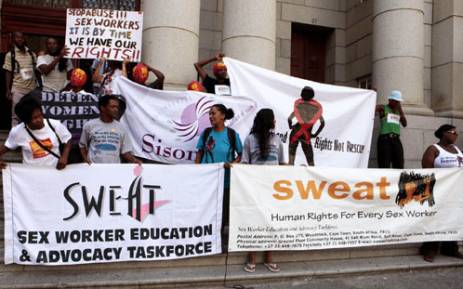
In Cape Town, sex workers interrogated three of the main political parties on their position on decriminalising sex work. This took place at an event organised by the African Gender Institute of the University of Cape Town, The International Labour Research and Information Group (ILRIG) and the Gender Equity Unit of the University of the Western Cape. The focus of this event was to have an interactive discussion with different political parties on women’s rights, gender justice and their political manifestos. In preparing for this event sex workers met and agreed that they really would like political parties to be clear on their position on decriminalising sex work. Sex workers asked SWEAT to table their question at the event. The ANC representative stated that the ANC does not support sex work and seemed surprised by the audience’s negative response to her comments. The DA implied that they would support the criminalisation of the client. It was not clear if they would support the decriminalisation of the sex worker. The ID clearly stated that they support the decriminalisation of sex work.


(Photo Credit: EWN / Nardus Engelbrecht / SAPA)

The Security of Sex: The (South) Africa Problem

On April 22nd, South Africa will hold its latest round of elections and for the first time in the last 15 years, the African National Congress (ANC) has serious competition.  The upstart Congress of the People, headed by former ANC leader Thabo Mbeki, was created in December to address concerns over corruption in and the direction of the ANC.

Though the ANC is expected to win by large margins, it is clear that South Africa is changing and the extreme violence and poverty are taking their toll on the stance of the historic party.  But what is the actual difference between the parties?  And what would all of this mean for women, sex workers in particular?  With the looming 2010 FIFA World Cup, South Africa continues to be plagued by infrastructural issues as well as climbing rates of violent crime, particularly crime related to violence against women and children.

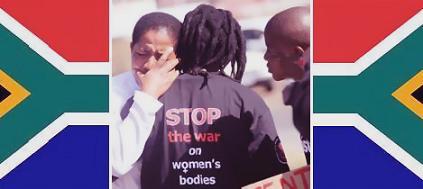
Over the past year, specifically, there has been a large pattern of “corrective rapes” committed against lesbians; the majority of these acts are committed by gangs of men rather than a single person.  The most notorious of these rapes was committed against one of the most famous female soccer players in South Africa, Eudy Simelane, last April.  She was gang raped and left in a ditch after being stabbed 25 times in the face, chest and legs.  While some focus on homophobia as an explanation for these acts, the brutality and pervasiveness of these acts implies larger underlying issues related to violence and gender. Women of all backgrounds and orientations are being affected by rising violence, which is more and more being attributed to an “increasingly macho culture, which seeks to oppress women and sees them as merely sexual beings.” Lesbians are being targeted in particular because their orientation is seen as antithetical to these gender roles in which women are expected to be more and more diminutive to men.  Attacks such as these are then not specific to sexual orientation but signify a larger social policing of women.

Likewise, trafficking has become a growing specter within South Africa.  Unlike in the U.S., the state is primarily confronted with trafficking occurring between different regions of the country itself. It involves primarily women and children from rural provinces like KwaZulu-Natal and the Transkei into urban areas primarily around Cape Town and Johannesburg.  Trafficking of different populations has risen in recent years for a variety of reasons.  In this instance, I am referring to the trafficking in persons for body parts as well as for the purpose of slavery.  Demand for human potions made from human body parts and progressively younger girls for sexual purposes has risen recently as they have become associated with ‘traditional’ cures for HIV.  Likewise, increases in refugees within South Africa and neighboring countries have made more individuals, children especially, vulnerable to slavery.  Demand for young girls for sexual slavery is expected to rise exponentially for the Cup.  However, focus on trafficking for the Cup ignores the existing gender issues embedded within South Africa itself, while also refusing to distinguish between those migrating to meet the demand and those being violently exploited.  The idea of legalizing prostitution for the duration of the Cup was floated in Parliament in an attempt to regulate sex work and protect workers.  The issue, however, was never meaningfully discussed and limiting legalization to just the Cup would ensure no meaningful change.  Without these things in mind, it is impossible to truly address the issue.

When one considers the platforms of the two major political parties in South Africa, however, it seems as if no attention is being given to violence against women at all.  The ANC mentions women only in passing within their official platform claiming only that they will “combat violence and crimes against women and children by increasing the capacity of the criminal justice system to deal with such violence.”  Does that mean building more prisons or increasing sentences and police?  While the actual meaning of the statement is unclear, the disinterest of the ruling party is quite apparent.  On the other hand, COPE gives a great deal more detail first saying that “workers have rights” and that “workers should have social protection to safeguard income,” which is promising for trafficked workers, and going on to “consider legislation that will make it difficult to withdraw charges on violent crimes and specifically crimes against women and children” and  “establish specialised units to combat identified priority crimes and crime areas in each of the provinces, including crimes committed against women and children”.

Though COPE vaguely mentions the issue more often, neither party acknowledges the growing trend of violence or prioritizes addressing it.  Jacob Zuma, head of the ANC, was even accused of rape himself and the woman was degraded in the courtroom.  Political meetings and platforms deal with women’s issues only nominally, if at all, and certainly do not address issues of violence.  Lisa Vetten, a gender rights activist within South Africa, points out that the system has even gone backwards in recent years with specialized sexual violence and family units being disbanded as well as an increasingly unfriendly court that is more focused on procedure than a victim-friendly orientation.  Likewise, sex work remains unaddressed beyond larger hyperbolic discussions of trafficking and slavery by NGOs and within the larger media.  It is then apparent that women’s safety and work remain on the margins and outside of politics.

(Photo Credit: Gays Without Borders)

Bordering on: citizens, prisoners, exceptions, women

I used to think that all prisoners are political prisoners because they’re `guests of the State’, housed and held in total institutions in which the very least the State was obliged to do was acknowledge the prisoners’ existence and maybe keep them alive. Given the convergent news of this past week, I have had to rethink that a bit.

Four names: Edwina Nowlin, Alberto Fujimori, Jacob Zuma, Gladys Monterroso. Four countries: the United States, Peru, South Africa, Guatemala. If your country isn’t on this list, that’s accidental good fortune. Trust me, it should be. In fact, it is.

A girl is flogged in Pakistan, a video captures the moment and circulates and suddenly everyone is concerned about gender and punishment in Pakistan. Even the Pakistani courts perform concern: “Pakistan’s newly reinstated chief justice has ordered a police committee to investigate the controversial flogging of a teenage girl. Ayesha Siddiqa wonders about the innocence of the sudden gaze, “As the entire Pakistani nation watches video footage of a 17-years-old girl screaming on their television screens during the process of her torture at the hands of the brutal Taliban in Swat, one wonders if the mothers, sisters, daughters and the male members of this nation will ever take time out to think about this system of justice advocated by these men who are not even qualified to interpret the Quran and Sunnah.” She lays the system of Hudood laws squarely on the shoulders of the Zia regime: “In Pakistan in particular where the Hudood laws were formulated under the Zia regime, the objective was not to bring justice in the society but to throttle all forms of justice. In this respect, the Taliban in Swat and those who ruled Afghanistan for some time are Zia’children. They use force arbitrarily and apply laws without the real context to enhance their own power.” Flogging is never `spontaneous’ , never `organic’, and never `gender neutral.’

In the United States, there’s the tale of Edwina Nowlin: “Edwina Nowlin, a poor Michigan resident, was ordered to reimburse a juvenile detention center $104 a month for holding her 16-year-old son. When she explained to the court that she could not afford to pay, Ms. Nowlin was sent to prison. The American Civil Liberties Union of Michigan, which helped get her out last week after she spent 28 days behind bars, says it is seeing more people being sent to jail because they cannot make various court-ordered payments. That is both barbaric and unconstitutional.”

This practice is going on all over the country: poor women, and men, who cannot pay the fines, and cannot be the additional fees to the companies that collect the fines, are thrown into jail: mothers, sisters, daughters, friends, strangers. Debt, the not so secret origin of primitive accumulation, built on the backs of the poors, largely people of color, largely women, haunts our world, from Pakistan to the United States and beyond.

Meanwhile, death stalks and storms the corridors and cells of Zimbabwe’s prisons, as demonstrated in a documentary shown this past week. Emaciated prisoners can’t bring the morsel of food to their lips, can’t stand and can’t fall. Hell hole. Death camp. These phrases are too elegant by far for what’s going on. George Nyathi, recently released from the torture of Hami maximum security prison outside of Bulawayo, looks into the mirror now, now that he is `free’, and sees Edwina Nowlin. The young woman in Pakistan looks into the mirror and sees …

I’ll tell you what they don’t see. They don’t see Jacob Zuma, who was exonerated of all corruption charges on Tuesday. They might see Alberto Fujimori, already in jail and sentenced, at almost the same instant that Zuma was released, to twenty-five years for having ordered kidnappings and killings when he was president. Fujimori may be in prison, but he’s powerful. His daughter says she may run for president of Peru, and would pardon her father. There’s no such daughter for that girl in Pakistan, for the prisoners in Zimbabwe, for Edwina Nowlin. There’s no powerful daughter coming to rescue those `suspected of terrorist activities’ being tortured in the prisons of Uganda, of the United States, of everywhere. No powerful kin or kith comes to the rescue of those mysteriously jumping from police vans or prison windows, such as Sidwel Mkwambi, beaten to death by police.

And when Gladys Monterroso, a prominent Guatemalan attorney and activist, was abducted last month, held for thirteen hours, burned, beaten, sexually and psychologically abused, there was no Great Man nor any of his family or cronies, to swoop down and save her. When Fujimori and Zuma and their gang look in the mirror, they see the State, they see State Power. When the rest look in, we see ourselves and those like us, call us citizens, of a nation, of the world, of whatever.

I used to think that prisons demonstrated the limit case of citizenship, that we had to ask why some people were in prison and why others were not. This week has me wondering. Perhaps it’s the other way around. Perhaps we have to wonder how it is that any of us, that anyone you or I meet on the street, is not in prison. Perhaps prison is the crucible of normative citizenship in the world we inhabit, and being-outside, what’s that called again, oh yeah, freedom, that’s the exceptional state. And that would go some distance in explaining why women are the fastest growing prison population and still don’t get counted, still are not recognized. Citizenship. Gladys Monteroso, Edwina Nowlin. Citizens, not exceptions.

CHII CHIRIKUITA : WHAT’S UP? Nine: Women Asking the Hard Questions

Now is the time to question the terms on which we organise our struggles and wage our battles.
Now is the time to claim our citizenship.
Now is the time to do the work that ensures our lasting freedom.
In this time of “transition” in Zimbabwe, we need to be asking the hard questions of ourselves and each other.  We need to organise, hold our structures accountable, make our demands and claim our visions and dreams.  Now.

For if not now, when?  

As women we have already lived through many empty promises and betrayals by men:  be they located within our homes, communities, nationalist movements, newly found states, emerging political parties or that unwieldy, amorphous civil society.  

Our lives as women have deteriorated dramatically in the last decade in Zimbabwe, by now we all know why.  This deterioration has impacted on how we organise.  It has made things harder and more chanllenging.  It has eroded our sense of humanity and community.  The regime has damaged us all, in one way or another.  

But now is the time to be creative in order to do the necessary radical change work. It’s difficult but not impossible. One starting point is articulating the vision of our struggle as women and finding ways to unite around its realisation.  This unity has to cut through the partisan politics, the suspicion, the political jockeying, the donor stangle hold and the organisational forms of this time.

For women in Zimbabwe, the horizon of liberation that was intimately connected to our early feminist agenda’s in the 1980’s and 1990’s was gradually left behind, as many of us started operating with a horizon of the law, policy, of governance and  gender.  Some argue that this was a strategic discursive move but it was at the expense of losing a destabilising power, and women’s organising losing its beating heart. 

Feminist consciousness refers to the political consciousness that the gender roles prescribed by societies all over the world for women are rooted in deep prejudices that put the women at social, political and economic disadvantages. It is the desire to counter and stamp out, through collective action and a broad ongoing cultural conversation, such restrictions imposed upon women. Feminist consciousness might have different roots for different women but the vision is the same.

Feminist consciousness challenges many of our deep-held assumptions which, if are not often noticed, is because they are pervasive like gravity.  Its complexity helps us understand other related oppressions based on race, class, age, sexual orientation, and disability amongst others.

Gender consciousness is the realization that gender is a socio-cultural construction and society has roles, not rooted in biology, specifically designed for those born into the male and female sexes.  But challenging and changing roles is not enough.

Ultimately, gender consciousness and feminist consciousness are related but different concepts.  (But I don’t want to get tangled in words.  Many women around Zimbabwe are engaging in acts of resistence that are feminist, even though they may have never heard of the word.  As long as we share the same commitment to our freedom, to confronting oppression wherever it may be found, let’s move ahead.)

Surely we, including our non-governmental organisations (NGOs) have learnt that gender policies alone ≠ an end to violence, to discrimination, to the bridging of the divides between the public and the private, to a redefinition of our relationships and re-organisation of society where all women can enjoy the fruits of freedom.  Almost always legislative, these policies have lacked financial resources and political will.  They have not altered the foundations of our oppression.  What they have done however, is help to conceal or assuage some of the most detrimental effects of our inequality.

What the so-called gender perspective hides is a total lack of perspective.  It’s a convenient myth that a depoliticised gender perspective will lead to equality and overcome sexism.

Now is the time to be critical.  To get to the heart of the matter.  To think differently.  To confront, unpick, challenge patriarchal and capitalist power in order to make lasting change real for women.

What vehicle is going to allow us to do this?  If our organizational forms are not going to allow us to get where we want to be, then we must be bold enough to say so.  To step out of the shell of the old and into the possibility of the new.

And of course it’s going to be dangerous.  You tamper with power, you feel the effects.

I know.  This is a rant.  It comes from the belief that the gender perspective is not going to get us as far as we need to go.

I don’t have all the answers but my experience tells me that women’s organising in Zimbabwe and the Southern African region needs to politicise.

Politicisation is the (im) pulse running through our organising. “The personal is the political” is a continuous process, a process of transformation which demands time and time again personal engagement, reflection and action.

To put it another way.  Opening spaces, to gather what I call feminist forces is a start.
This can be done anywhere and everywhere. 

It is literally the process of women getting together, telling each other the stories of the conditions of our lives, and crafting collective visions and practices of resistance out of them.  Channelling this into action. 

These autonomous dynamic spaces can ground our actions, visions and desires, thereby providing a basis to craft common ground, and create, rather than presume, a basis for collectivity and alliances. This is a start. 

The sustainability and radical democracy of this process relies precisely on creating new ways of relating to each other that undermine existing hierarchies and the depoliticisation of power inequalities. Also central to this strategy is the need to practice and nurture alliances between different struggles; the linking of scattered resistances cannot be underestimated. 

Much lip-service has been paid to these alliances, often skirting over the hard work they demand in practice. Alliances are about engaging with others, and hence also about dealing with positions invested with power.  These alliances are inevitably based on the involvement of our subjectivities; they are about working with differences and working through conflicts.  Perhaps they are about love. About humanism.  In any case, we cannot render them into abstract models.  But we can find words of inspiration for the yearnings that push us to engage in them. 

Feminism is about a shared engagement, in anger but more importantly in joy, in laughter, in desire, in solidarity. Right now with constitutionalism looming large in Zimbabwe, what we need to refuse, is performing “the woman’s question” within a larger civic or nationalist movement, that can be raised in certain moments of goodwill, only to be dropped later on when it’s time to get back to “the real business” or to have women’s rights relegated to a toothless policy. 

When Adrienne Rich asks women “to see from the centre”, she does so precisely in the context of refusing to be “the woman’s question” or the empty policy.  “We are not the ‘woman’s question’ asked by someone else” she comments, “we are the women who ask the questions.” 

Women need to ask the questions that disrupt, contaminate and create.  However we name them, our struggles are [should be] about nothing less.

(Photo Credit: Research and Advocacy Unit)

CHII CHIRIKUITA : WHAT’S UP? Eight: Where have all the Women Gone?

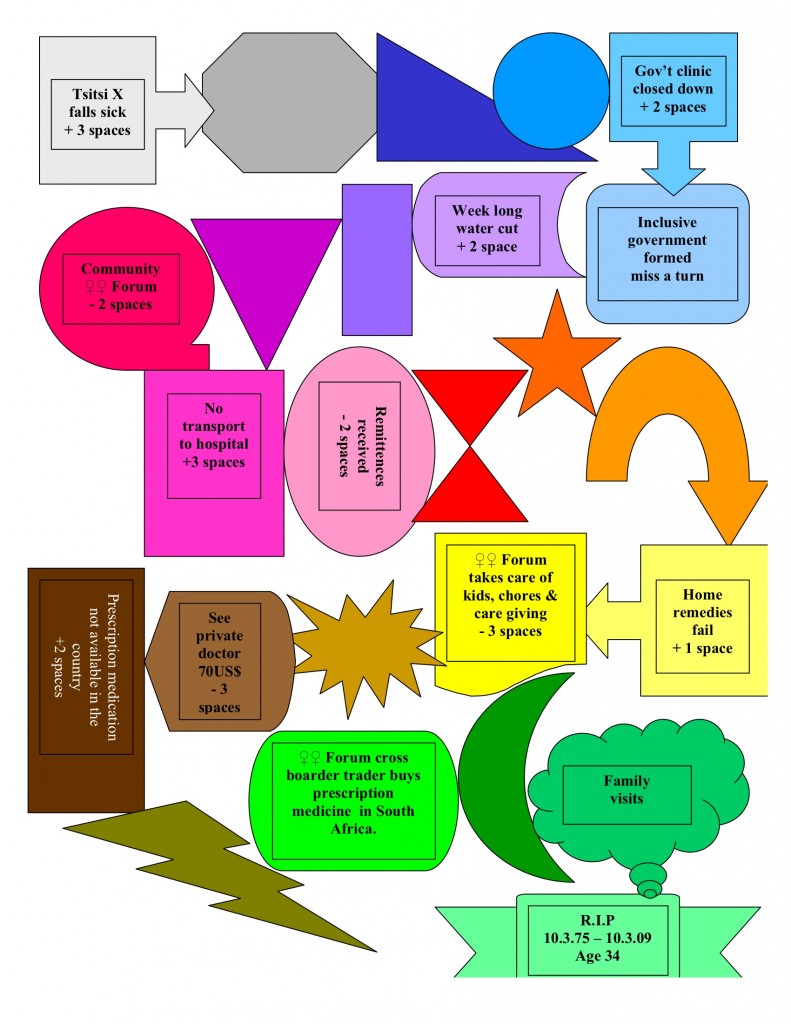
To play the game you will need: 

  • Dice
  • Minimum of two players
  • Tiddleywink for each player.
  • Roll 6 on the dice to start.
  • Move along the game board and follow the instructions
  • Try to avoid finishing

Inspired by the game “Alternatives to Globalisation” designed by RW.

7c3yyo

A rusted wire fence divides the old Zimbabwe from the new.

On the one side lies Effie Malamba, born in 1901 she was buried beneath a granite headstone 90 years later.

On the other is Sylvia Ncube, born in 1974 she was laid to rest just 35 years later.
The wire separates Bulawayo’s old Hyde Park cemetery from its extension.
Effie lies amid ordered ranks of stone epitaphs.
Sylvia lies in a chaos of churned earth. All around her the mounds of mud and stones, garlanded with plastic flowers, tell the story. 

Zimbabwe now has the lowest life expectancy for women anywhere in the world: 34.
A forest of black metal plates mark the mounting death toll and their hand-painted white numbers record the birth dates of a missing generation. Irene Phiri born 1972, Gugu Hlanbangana in 1971, Lulu Olomo in 1975, are just three of thousands.

This cull is not an act of God. It’s Zimbabwe’s game of health, of life, of death. 

The Security of Sex: Hi-Tech Sex

A detective `monitors’ Craigslist’s “Erotic Services” category

Earlier this month, a Chicago-area sheriff’s office sued Craigslist claiming that the website facilitates prostitution through its “Erotic Services” section which Sheriff Tom Dart claims to be “one the largest sources of prostitution in the country”.  The Cook County Sheriff’s Department is asking a federal judge to both force the site to close the offending section and repay the sheriff’s department $100,000 in funds that have been used over the years to police the website.  Dart goes on to claim that the site’s ads are often masks for pimps, child and forced prostitution.  He also claims that Craigslist is at fault for an increase in volume of workers that the force has had to battle and that it allows criminals to elude police more easily.  Craigslist may also be responsible for spikes in teen pregnancy, HIV/AIDS and global warming; but that’s for another day.

This suit has not only ignored the fact that Craigslist has been exceptionally cooperative with police in many cities by adding requirements such as payments and proper ID for the “erotic services” section, removal and reporting of illegal ads and supporting undercover officers placing ads with no legal requirement to do so, but that law enforcement seems to have an easier time policing the website because of the digital fingerprints as well as faces in photos posted, credit card and active phone numbers that can be traced.  Workers who are online are also less likely to use public strolls and are able to safely and discretely work indoors.  Likewise, Craigslist and workers on the site are potentially protected by certain legal loopholes.  Websites cannot be held liable for the postings of users, which is the entire basis of sites like Craigslist; they also post a number of legal warnings on the site itself.  Also, many workers utilizing the “erotic services” section have been to place disclaimers on their posts claiming “Money exchanged is intended for time/companionship services only. Anything else that may occur is a personal choice between two consenting adults of legal age and is not contracted for, nor is it requested to be contracted for any other matter. This is NOT an offer of prostitution!!! Contacting me constitutes acceptance of these terms”.

Despite this, the suit continues.  However, any more, most major cities have devoted staff, sometimes full time, to policing the site.  This is often done under the banner of searching for underage or trafficked children.  The FBI has also jumped on this bandwagon, starting a full-scale campaign against “child prostitution” in June 2003 called “Operation Cross Country”. The FBI also blames the internet for a growth in instances of child prostitution.  However, neither the FBI nor police seem to question whether or not it is actually more common or just more visible and identifiable by police because of the accessibility of the internet. An article from last October concerning the latest FBI push points to discrepancies in this discussion saving child workers.  The article celebrates the fact that 518 consenting adult workers were arrested while rescuing merely 47 children ages 13-17 and arresting only 73 pimps.  Such disproportionate numbers of adult arrests as well as an account from the Boston Globe about a sting by this team involving another 5 adult arrests (the FBI does not claim that they suspected any of the women to be minors) hints that there is a much larger mission being undertaken by the FBI.  Special Agent Robbie Burroughs comments on the arrests in western Washington state, that most will be charged by the state but only 3 of the 35 will be prosecuted for pimping children.  If getting children out of the sex trade is really the goal of “Operation Cross Country”, why are predominately adult women workers being targeted, abused and harassed so blatantly? The message is clear; either the rights of adult sex workers are not respected by lawn enforcement and are scene as a necessary and deserving casualty of this attempt to “save the children” or “saving the children” is merely a cover for a larger campaign against workers.  The harassment and targeting is justified because the police in this instance are simply claiming to be an extension of the larger “help industry”.

So what is gained by battling Craigslist and other sites of internet-based sex work?  It’s a symbolic victory most. The internet, it seems, is being as heavily gentrified and policed as downtown Washington. This policing is just as violent towards workers, taking away one of the safer modes of work.  Critics of the networking site fail to acknowledge why the site may be so popular for workers, the vast majority of whom are not underage and work for themselves.  Sites like Craigslist provide a safer means for workers to advertise and screen clients.  Workers on the streets have a much higher risk of being attacked or abused because strolls in D.C. and other major cities are being moved into progressively less established, less secure and poorly lit areas due also to heavy policing. Shutting down legitimate websites where workers can network and advertise simply pushes the industry further underground and back onto the streets. Advertising on the web allows workers to skip this traditional step of walking the streets where they are also more prone to manipulation from pimps and blackmail by police in exchange for petty protections.  Workers also need not rely on pimps or brothels for advertising and safety, allowing them to keep more of their own profits.  Stings are also highly disruptive with police claiming computers and cash (often several hundred dollars worth) as evidence while also imposing fines or jail sentences, disrupting business, and requiring the worker to pay for attorneys.  All of this pushes a worker with no labor protections potentially further into debt and further decreases their ability to have legal work, if they so choose, due to their arrest record.  Regulating and policing abuse and slavery within the industry is one thing, using that as an excuse to endanger women is another.

(Photo Credit: The New York Times / Kirk Condyles)

Who pays for the rule of law? Who will pay?

Birtukan Mideksa is currently being held in Kaliti Prison, in Ethiopia. Remember her name, Birtukan Midekas, and remember Kaliti Prison. There will be a test on prison geography and another on prisoners, with special attention to women prisoners. Women prisoners aren’t only in prison, however. Consider Mitmita. She’s an Ethiopian human rights activist. Mitmita is not her name. She can’t write in her own name. Reading Prespone Matawira’s series on Zimbabwe, I’ve been thinking of the anonymous and pseudonymous women, those one knows about, those completely obscured, in the shadows, disappeared. How many named and unnamed are there, officially or existentially political, imprisoned and confined women, in Ethiopia, on the continent, globally? Why do we know some names and not others? How many are hidden under or within, how many are blurred and waiting a proper reading, a proper enunciation? For every Prespone, for every Mitmita, for every Birtukan Mideksa, for every Jestina Mukoko, how many go unheeded, unrecognized? What becomes of their lives and stories? How much of silence, shadows, blurs is gendered? How do these women, and these women’s issues, mark a border between human rights and women’s rights? How is that border different from the militarized U.S. – Mexico borderlands, that actually extend across Central America, that home sweet home in which women are trapped in the transnational household, and how are they identical?

Recently, in Tanzania, the Minister of Justice and Constitutional Affairs suggested a review of the Sexual Offences Special Provisions Act, SOSPA, because the sentences were too severe. Women’s and feminist activists protested the statement and decried the incompetence underlying its reasoning. Between 2006 and 2007, Salma Maoulidi conducted a study of Zanzibari attitudes towards sexual violence: “sexual violence continues to be viewed more as a moral crime rather than as a legal crime. It is thus not surprising that about 34 per cent of respondents consider sexual crimes as private issues. Only 16 per cent think that it is a criminal offence…. only 50 per cent of functionaries interviewed indicated using the Penal Decree in matters concerning GBV, the remaining 31 per cent used religious laws, and 18 per cent used medical guidelines when dealing with GBV cases. The study found knowledge of laws related to GBV to be very low in communities. Over 65 per cent of individuals interviewed were not aware of any law related to GBV. Largely, local customs and religious law are used to solve GBV matters.”

Moral crime, Legal crime. Human rights. Women’s Rights. What does it mean to categorize, to differentiate and perhaps by so doing to make some offenses more equal than others?

In Norway, a Muslim woman police officer requests permission to wear her hijab as part of her uniform, and all hell breaks loose. Is this the hell of human rights or of women’s rights? In Nigeria, a bill is passing through parliament that would further criminalize same sex  relationships and associations. Is this moral criminalization or legal criminalization?In Dar es Salaam, a culture of silence prevails for lesbian women. Is this the silence of morality or of legality?

Women are imprisoned, jailed, confined. In the U.S. almost 3 million children have their parents in jail. This occurs at a period of escalating incarceration of women, most of whom are Black or Latina, two thirds of whom are mothers of young children. What happens to those children? Who cares? Not the State. The State cares about war, war on poverty, war on drugs, war on terror. They’re all wars on women. Women with names, women with pseudonyms. In Quito, Ecuador, as all over the world, women know that the war on drugs is a war on women.

In Tanzania, distinguishing between the moral and the legal is killing women. In the United States as well, where women immigrants in detention are dying for health care. Women are flat out denied or have to wait ridiculously long times for any sort of gynecological care, mammography and breast health care, any sort of prenatal or postnatal care. It’s a gruesome list, indeed, and women are targeted as women. And services for survivors of sexual and gender-based violence? “ICE policy fails to comprehensively address the needs of survivors of violence.” Au contraire. Inaction is a policy, non-policy is a policy. If rape during border crossing is `routine’ and routinely unreported, and if those, mostly women, who have suffered sexual violence during their journeys across borders and across streets, at work and at home, if there is no address, is that moral criminalization or legal criminalization?  Human rights or women’s rights? Which state actually cares? Not the United States, not if you’re an `immigrant woman’, certainly not if one recalls that “immigration detention is the fastest-growing form of incarceration in the United States.”

The U.S. immigration detention complex is a black hole. “Victoria Arellano, a 23-year-old transgender woman from Mexico, was detained at ICE’s San Pedro Facility in May 2007. Arellano was suffering from AIDS though not exhibiting symptoms. In detention, her condition deteriorated because she was not given access to the antibiotics she needed.  According to The Los Angeles Times, her requests to see a doctor were ignored by facility staff. Other detainees dampened towels to reduce her fever and created makeshift trash cans from cardboard boxes to collect her vomit. Only after a strike and civil disobedience by detainees in the facility did staff take her to the infirmary. Arellano died two days later, after two months in detention, due to an AIDS-related infection.” Women, and children, in shackles. Transgender women violated every which way.

Nomboniso Gasa says all political prisoners in Zimbabwe must be freed now. Furthermore, the situations and conditions, and dreams and dignity, of women must be addressed: “All of the crises affect women more severely. One important issue is the widespread use of rape as a political weapon. And there has recently been a noticeable change in the way security forces relate to women. When Jestina Mokoko was arrested she was in only a nightdress. She asked if she could get dressed before she was taken but security denied her the right to her dignity by not allowing her to change clothing or take her female medication with her. And of course widespread shortage of food affects women more because they are always the last to eat. Even though they forage more food, after the men and the children eat it is the women’s turn, but by then there is nothing left.” The conditions in Zimabwe’s prisons are dire.

Across the United States, states are relaxing sentencing guidelines and softening drug laws. When Tony Papa, a victim of the Rockefeller drug laws, was finally released, he co-founded Mothers of the NY Disappeared. Now he feels truly released, and can exhale freely, if with a lingering sense of disbelief. So, the 70s at last may be laid to rest: “Nearly 40 years after the Rockefeller laws launched America down the disastrous road to wholesale incarceration, a more sensible and nuanced approach to drug sentencing is starting to take centre stage.” Where are the women in this account, in this relief program?

The rule of law targets many: drug users, sex workers, lesbians, immigrants, Muslims, activists, women. Everywhere. These laws have driven the hyperincarceration rates of women, in the U.S. and everywhere. The rule of law is a war zone. The laws change, they may be gone, but nothing changes until women’s names, bodies, lives are brought into the light of day. How many more stories, how many more articles, are required before that action is taken, before the war on women is acknowledged and addressed? Who pays for the rule of law? Women. Who will pay? There’s the question.

(Photo Credit: Ethiopia Forums)

Home Sweet Home


Have you watched any mainstream news—CNN especially—in the past few days? Turn on the tv and you will see insanely histrionic coverage of the U.S.-Mexico border and the “drug war”: “narco killers”; “worst free trade imaginable”; “narco terrorists using guns most likely bought in the U.S.” And guess what they are NOT talking about: women (except for the the narco girl friends who buy guns for their boyfriends south of the border)!

Women are trapped in the border zone.  Although the U.S. and Mexican governments continue to militarize the U.S.-México border, it turns out the border zone is an elusive, flexible, dangerous space for people who migrate north and south, especially women and girls.  In fact, the most precarious, dangerous aspects of the border zone can be found in your neighborhood.

It is common knowledge that the militarization of the México-U.S. border intensifies through policies such as the Merida Initiative (aka Plan Mexico), despite continuing human rights abuses across México.  What is often difficult to pinpoint is the way in which national security programs to combat drugs and illegal migration trap women in homes—if not your home, then your neighbors’ home. On one hand, U.S. Secretary of State Hillary Clinton publicly acknowledged during her recent trip to México that “Our insatiable demand for illegal drugs fuels the drug trade”—an obvious and important acknowledgment that the U.S. is responsible for the war next door.  On the other hand, recent reporting suggests that critical discussions about the border zone require thinking about transnational households that depend on women’s unceasing yet invisible labor.

The New York Times recently reported, “Like many people in Juárez, Mayor Reyes has homes on both sides of the border, splitting his time between El Paso and Juárez.” Interestingly, the article’s rendering of an increasingly violent border landscape considers the lived experiences of a drug-saturated, hyper-militarized border life by drawing attention to the intimate space of the home, albeit that of a middle- to upper-class household. While Mayor Reyes and his family supposedly enjoy the luxury of crossing the border on a daily basis without violent repercussions, other families living in the border zone aren’t so lucky.

In contrast, the Gamboas, American citizens who own property in both the U.S. and México, continue to experience violence and insecurity of the border.  According to the San Antonio Express, a house in Nuevo Laredo, Mexico, was violently raided by hit men reportedly employed by Mexican narco-traffickers. Later, Alan Gamboa, the owner of the house who lives in Laredo, Texas, experienced more narco-related violence when the same paramilitary unit “torched his nearby communications and home-security shop and kidnapped his brother.” The article highlights the fear felt by the brothers’ wives and families who live on the purportedly safe side of the border—the U.S. side, of course. Reporters visited Veronica Gamboa, Alan’s sister-in-law, at her Laredo home where she sat in the dining room next to “photos of the couple’s two young daughters, 11 and 8, who practically worship their father — and vice versa.” The case of the Gamboas demonstrates that border zone militarization intensifies insecurity on both sides of the border, threatening the stability of the lives of undocumented migrants and middle-class U.S. families alike. 

In another example of a transnational household, the Times-Picayune (New Orleans) reported that a U.S. Immigration and Customs Enforcement agent in Texas and his mother harbored a Mexican woman and her children in their Metarie home in exchange for house cleaning services. In contrast to the Gamboas, the case of the Mireles family suggests that the maintenance of the legitimate U.S. household requires the exclusion of undesirable bodies of migrant women.

In all three instances, the proper household, imagined as an intimate space of protection for the heterosexual family, is threatened by the precariousness of the blurry, fluctuating border zone. While men play active roles in negotiating the movement through the border zone, women—as wives and workers firmly ensconced in the household—remain vulnerable to the forces of the national-security apparatuses of both México and the United States. From the hundreds of women violently killed in border towns to dutiful American housewives and domestic workers, women on both sides of the border, real and imagined, are trapped in transnational households.

(Photo Credit: New York Times / Eduardo Verdugo / AP)