Children of Incarcerated Mothers, or Albie Sachs haunts U.S. prisons!

Albie Sachs is a South African judge who haunts the U.S. prison system. Why? Because he is a decent human being, that’s why. He decided to listen to a woman colleague. He decided that primary caregivers of children should not be sent to jail. Here’s a version of the story:

“Albie Sachs…was fleetingly in the UK last week, primarily to tell the story behind the judgment he made in South Africa not to send a woman to prison because it would infringe the human rights of her three children.…

“Judges are the storytellers of the 21st century,” says 74-year-old Sachs….

At first sight, he had intended to throw out an appeal on behalf of Mrs M, who was facing four years in jail for up to 40 counts of credit card fraud that she had committed while under a suspended sentence for similar offences. “I remember drafting an extremely dismissive response. I said: ‘This doesn’t raise a constitutional question. She simply wants to avoid going to jail. She doesn’t make out a case, and her prospects of success are zero.’ “It was a female colleague…who insisted that the case be heard. She argued that the human rights of the accused woman’s children were not being looked at separately.

“She said: ‘There is something you are missing. What about the children? Mrs M has three teenage children. She lives in an area that we politely call fragile, an area of gangs, drug-peddling and a fair amount of violence. The indications are that she is a good mother, and the magistrate gave no attention to the children’s interests.’

“The minute my colleague spoke to me about the importance of the three teenage children of Mrs M, I started to see them not as three small citizens who had the right to grow up into big citizens but as three threatened, worrying, precarious, conflicted young boys who had a claim on the court, a claim on our society as individuals, as children, and a claim not to be treated solely as extensions of the rights of the mother, but in their own terms.”

As a result, Sachs created a legal precedent in 2007: a woman who otherwise would have gone to jail did not have to, because of her children’s rights. “We could have said the children’s rights must be considered but sent Mrs M to jail anyway, perhaps for a lesser term. But that would not have changed anything.”…

Although three judges dissented from the majority verdict, the precedent was set in South Africa that – at least in borderline cases – primary caregivers of children should not be sent to jail. And if the court decided to jail a primary caregiver, it had to take some responsibility for what happens to the children. “The court can’t simply say that she should have thought of that before she committed the offence, or that she can’t hide behind her children.”…

At the time he was drafting the judgment, Sachs did not know of any country that took the rights of offenders’ children into account, but he subsequently discovered that similar ideas were being framed in Scotland in a report by the then children’s commissioner, Kathleen Marshall. The report, Not Seen, Not Heard, Not Guilty, argues that the rights of offenders’ children to family life under the UN Convention on the Rights of the Child are systematically ignored by the court system. The report found that almost two-thirds of prisoners in the Cornton Vale women’s prison in Stirling had children under 18, but there was no provision to take their rights into account during sentencing.

“This was astonishing,” Sachs told the audience. “In a totally different legal system, in a totally different society, a conclusion was being reached that is almost identical. It showed that the time has come for new ways of thinking.””

Albie Sachs haunts the United States, home of “the incarceration generation”: “The chances of seeing a parent go to prison have never been greater, especially for poor black Americans, and new research is documenting the long-term harm to the children they leave behind. Recent studies indicate that having an incarcerated parent doubles the chance that a child will be at least temporarily homeless and measurably increases the likelihood of physically aggressive behavior, social isolation, depression and problems in school — all portending dimmer prospects in adulthood. “Parental imprisonment has emerged as a novel, and distinctly American, childhood risk that is concentrated among black children and children of low-education parents,” said Christopher Wildeman, a sociologist at the University of Michigan who is studying what some now call the “incarceration generation.” Incarceration rates in the United States have multiplied over the last three decades, in part because of stiffer sentencing rules. At any given moment, more than 1.5 million children have a parent, usually their father, in prison, according to federal data. But many more are affected over the course of childhood, especially if they are black, new studies show. Among those born in 1990, one in four black children, compared with one in 25 white children, had a father in prison by age 14. Risk is concentrated among black children whose parents are high-school dropouts; half of those children had a father in prison, compared with one in 14 white children with dropout parents, according to a report by Dr. Wildeman recently published in the journal Demography. For both blacks and whites, the chances of parental incarceration were far higher than they were for children born just 12 years earlier, in 1978.”

None of this is new, news or surprising. Cage the fathers, superexploit the mothers, forget the children. It’s simple. Put a nation of mothers behind bars, where too often there are no fathers or other guardians around and there is no public support, and you imprison the children. Where’s the surprise? Shackle pregnant women prisoners in labor and delivery, in the name of security. Are you surprised? This has all been said before. It’s common knowledge.

In South Africa, Albie Sachs acted. In Scotland, so did Kathleen Marshall. In the U.S., it’s time, it’s way past time, for similar action.
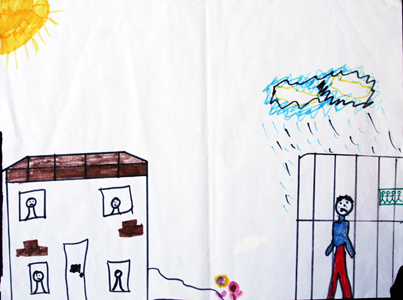
(Image Credit: http://childrenofprisoners.eu)
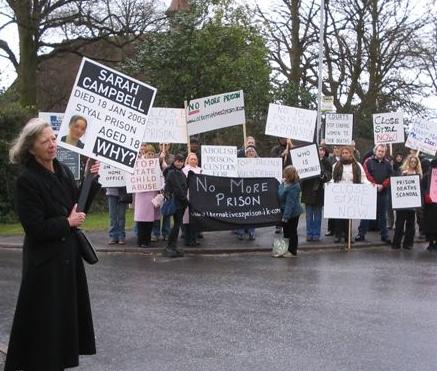
Harm’s Way – HMP Styal

An epidemic of self-harm is said to be sweeping the women’s prisons of the United Kingdom: “The number of women deliberately harming themselves in prison has almost doubled in five years…. Officials recorded 12,560 cases of women prisoners injuring themselves – mainly by cutting and burning – last year, equivalent to almost three incidents per inmate. In 2003, 6,437 instances of self-harm were recorded in English prisons, about 1.5 per inmate. Although women make up just five per cent of the prison population in England and Wales, they account for more than half of all self-harming incidents. Many of the women in prison have been convicted of minor crimes, but suffer high levels of mental illness and drug abuse…. A total of 4,291 women are currently in prison, a slight fall on last year, but still nearly double the number held just a decade ago. Research suggests that more women are sent to prison for shoplifting than any other crime. Forty per cent of sentenced women serve just three months or less. More than half of women in prison report they have suffered violence at home, and one in three has suffered sexual abuse. Two-thirds have a neurotic disorder, such as depression, anxiety and phobias.”

Harm does not sweep prisons. Harm overcrowds and chokes prisons. Harm organizes and rules prisons. Prisons are harmful, especially for women.

On Monday, June 22, twenty female prisoners were raped in a prison riot in the central prison of Goma, in the DRC. We are told the men were trying to escape; the men are militia members, in prison for murder, rape, and other major offenses; the prison is meant to hold at most 150 and currently houses 600 prisoners. We are told that rape of women and of men in prison is common. We are told a great deal. Of the women, we are told nothing.

On Tuesday, June 23, the U.S. National Prison Rape Elimination Commission finally released its report. The Executive Summary opens with the harm: “Rape is violent, destructive, and a crime—no less so when the victim is incarcerated. Until recently, however, the public viewed sexual abuse as an inevitable feature of confinement.” The Introduction opens with the haunting: “Sexual abuse is among the most destructive of crimes, brutal and devastating in the moment and carrying the potential to haunt victims forever.” The Commission emphasizes that rape in prison is not inevitable, but it might as well be in a national “culture that jokes about prison rape.”

Rape. Torture. Violence. Guantanamo. The Obama administration considers “issuing an executive order that would authorize the president to incarcerate some terrorism suspects indefinitely.” Not convicted felons. Suspects. Bagram. Twenty-seven former prisoners detailed this week the abuse and torture they suffered and endured in Bagram: “physical abuse, the use of stress positions, excessive heat or cold, unbearably loud noise, being forced to remove clothes in front of female soldiers”. Not one of the former prisoners was ever charged or tried. Suspects. Israel has its own private Guantanamo, Facility 1391, where who knows what goes on. But more generally Israeli security forces have been accused “of deliberately shackling Palestinian prisoners in a painful and dangerous manner, amounting to a form of torture.” Suspects abounding.

Rape. Torture. Violence. These are the Big Stories of the Horror. But hold on. In Arizona, for over a decade, male prisoners have been paraded in public in women’s pink underwear. In the U.S., women prisoners in childbirth are shackled. Casandra Brawley, a former prisoner at the Washington Corrections Center for Women, is taking Washington State to court for having shackled her during childbirth: “Brawley said she was shackled by a metal chain around her stomach during transportation to the hospital, then fastened by a leg iron to a hospital bed throughout several hours of labor. The suit alleges her restraints were removed during an emergency 
cesarean section only after a physician insisted, but then were 
replaced after the procedure.” Calling a woman in labor a security risk is a joke, right? Like prison rape, or making a man undress in front of a woman, or making a man dress like a woman.

In the United Kingdom, forty per cent of sentenced women serve three months or less, and yet somehow manage to `harm themselves’ at a rate of three incidents per inmate. Women prisoners’ self harm is neither epidemic nor outbreak. It’s life. It’s part of the harm of being a woman in a neoliberal political economy. The Corston Report: a review of women with particular vulnerabilities in the criminal justice system, a review of women with particular vulnerabilities in the U.K. criminal justice system, said as much in March, 2007.

Behind the Corston Commission Report sits HMP Styal, “one of the largest women’s prisons” in the U.K. Between August 2002 and August 2003, six women died at Styal. Anna Claire Baker, a 29-year-old mother of two, a remand prisoner, was found hanged in her cell in November 2002. Sarah Campbell, 18, took pills, informed the staff she had taken pills, and was promptly left alone in a cell, to stew for a bit. She didn’t stew. She died. So did Julie Walsh, in August 2003. Walsh, a 39-year-old mother-of-two, also died after taking pills. The tragic deaths of these six women at Styal was the impetus of the Corston Commission. According to Nicholas Rheinberg, the Cheshire Coroner who conducted the inquests into the deaths at Styal, “I saw a group of damaged individuals, committing for the most part petty crime for whom imprisonment represented a disproportionate response. That was what particularly struck me with Julie Walsh who had spent the majority of her adult life serving at regular intervals short periods of imprisonment for crimes which represented a social nuisance rather than anything that demanded the most extreme form of punishment. I was greatly saddened by the pathetic individuals who came before me as witnesses who no doubt mirrored the pathetic individuals who had died.” That was then.

This is now. February 27, 2009: “The chief inspector of prisons has warned of more deaths at Styal women’s prison if services for vulnerable inmates do not improve…. John Gunn, brother of Lisa Marley, who died at Styal in January last year, asked: “How many more women have to die before something is done?” What’s that you said about history repeating itself, the first time as tragedy, and thereafter as farce?

Harm is more than injury, it’s “Evil (physical or otherwise) as done to or suffered by some person or thing.” In a world in which women in labor are shackled and sick women are left alone to die, women prisoners’ self harm is simply a structural adjustment, another efficiency. The evil that men do lives after them. So does the harm.

(Photo Credit: https://www.indymedia.org.uk/en/)

Women haunt the Prison Generation

Women in shackles, women in prison, haunt accounts of prison.

In the U.S., some say it’s time to “Redeem the prison generation“: “The least popular constituency in America. People we’d rather forget. Last year, a record 1 in every 100 American adults was in prison. One in every 30 men aged 20 to 34. And among black males in that age group? One in 9. Why? Because America’s crime and punishment policies reflect an incoherent mix of motives: justice, retribution, vengeance, the illusion of expedience, the cruel bigotry of nonexistent expectations. And absent decent job training, counseling, and re-entry programs, the system only incites violence and invites recidivism. It’s past time to reconsider our approach to prisons, for practical reasons – and because it seriously undermines our effectiveness as a society and our moral authority with other nations. With just 5 percent of the world’s population, we cage almost a quarter of the world’s prisoners – a trend that has accelerated wildly since the 1970s. If the 2.3 million Americans now behind bars joined the 5 million on parole or probation to form a city of their own, you’d have a population nearly twice that of Los Angeles. Feeling safer yet? You shouldn’t.”

The prison generation. Not quite the Coke or Pepsi Generation, but then again, not quite not the Coke Generation. Are there any women in this account of the Prison Generation? Of course not.

But there are women in prison, some for their own `protection’, for their own `good’.

A woman is “jailed for her child’s own good?“: “A judge in Bangor, Maine — ignoring federal guidelines — has doubled the sentence of a Cameroonian woman charged with possession of false immigration documents. Was there something extra-heinous about the nature of her crime? No. Despite protests from the defense and the prosecution, U.S. District Judge John Woodcock sentenced Quinta Layin Tuleh, 28, to 238 days in prison — twice her time served, which would be standard sentencing practice here — because she is HIV-positive and pregnant. Her release date, in fact, is her due date. From today’s Bangor Daily News: “Woodcock said the sentence would ensure that Tuleh’s baby, due Aug. 29, has a good chance of being born free of the AIDS virus.”

“Woodcock reportedly informed Tuleh at her May 14 sentencing that he intended the longer term not as punishment for her, but as protection for her unborn child. He said that the defendant was more likely to receive medical treatment and follow a drug regimen in federal prison than out on her own or in the custody of immigration officials,” says the News, adding that his decision, he said, was based entirely on her HIV status; if she were pregnant but HIV-negative, he’d have left it at time served. (Some drug regimens have proven effective at preventing HIV transmission from mother to fetus.)….

“”My obligation is to protect the public from further crimes of the defendant,” Woodcock stated, “and that public, it seems to me at this point, should likely include that child she’s carrying. I don’t think that the transfer of HIV to an unborn child is a crime technically under the law, but it is as direct and as likely as an ongoing assault. If I were to know conclusively that upon release from imprisonment a defendant was going to assault another person, I would act in a fashion to prevent that, and similar to an assault, causing grievous injury to a wholly innocent person. And so I think I have the obligation to do what I can to protect that person, when that person is born, from permanent and ongoing harm.”

“If Tuleh’s child is indeed born here, he or she would be a U.S. citizen. But an immigration expert told the News that an infant would most likely be deported along with the mother.”

Tuleh is not in shackles, and yet she is. If her fetus comes to term, if the child is born, in the United States, that person will and will not be a U.S. citizen, and it, not he and not she but it, will be deported. The Prison Generation … a new line of U.S. exports. The Prison Generation, haunted by the women, and especially the women of color, who never get a mention.

(Image Credit: thebody.com / Project UNSHACKLE)

Women prisoners haunt the modern era

President Obama decided not to release all of the torture pictures, but that’s already old news. What was the big deal, anyway? We already knew that torture happened; in fact, we signed on to that program a long time ago. It’s the story of our modern era, a story haunted by women prisoners.

The Women Behind Bars website shows a picture of a smiling, healthy young woman: “Gina Muniz, in 1998, before she was incarcerated in the LA County Jail and the California state prison system for her first arrest, related to the theft of $200 related to a rapid onset of drug addiction-in the aftermath of her father’s death. The theft was bizarrely classified as a carjacking, although no one was harmed, and no car was stolen. Muniz received life in prison; her lawyer told her she was agreeing to seven years when she pled guilty.” Her mother, Grace Ortega, took the photo. It must have been a happy occasion. Six months after Muniz was arrested, she was dead: “Gina Muniz, September 2000, handcuffed to her deathbed and under 24-hour-guard in Modesto Community Hospital. Next to her is her daughter Amanda. Gina suffered horribly for six months from diagnosed but untreated cervical cancer. When it was diagnosed in L.A. County Jail, early and aggressive treatment would more than likely have saved Gina’s life. Grace Ortega, her mother, was finally able to win compassionate release for her daughter two days before her death, so that she could die at home”. Her mother, Grace Ortega, took the photo. Compassionate release.

Today is June 3, 2009. Yesterday, “Texas carried out its 200th execution under the eight-and-a-half year governorship of Richard Perry on Tuesday. Terry Lee Hankins, 34, was executed by lethal injection shortly after 6pm Texas time. He had been sentenced to death in 2002 for the murder of two of his wife’s children in 2001. Terry Hankins was the 16th person to be executed in Texas this year, out of a national total of 30. This was the 1,166th execution to be carried out in the USA since judicial killing resumed there in 1977, with Texas accounting for 439 of them. Another five men are currently scheduled to be put to death in Texas by mid-September….Texas is home to about seven per cent of the population of the USA and is where fewer than 10 per cent of the country’s murders occur. The state accounts for 37 per cent of the USA’s executions since 1977, and 41 per cent since 2001.”

In America, bad men wear pink underwear. In Texas, bad men are executed. Bad women, too, like Frances Newton. In 2005, “40-year-old Frances Newton became the third woman to be executed by the state of Texas since 1982 (and the first African American woman in the modern era) despite the strong possibility that she was innocent.” What exactly is this modern era? Francis Newton was “only the third woman executed by the state of Texas since 1982, and the first black woman executed since the Civil War. Unique in that historical sense, in other ways the Frances Newton case is painfully unexceptional.” Since the Civil War, since 1865? Francis Newton was the third woman executed in Texas since 1982, and the first Black woman since the mid 1800s. Francis Newton is the modern era, and the modern era goes way back.

On May 20, 2009, the New York State Legislature passed Bill S01290A, which “Provides for the care and custody of pregnant female inmates before, during and after delivery; prohibits the use of restraints of any kind from being used during the transport of such female prisoner to a hospital for the purpose of giving birth, unless such prisoner is a substantial flight risk whereupon handcuffs may be used; prohibits the use of any restraints during labor; requires the presence of corrections personnel during such prisoner’s transport to and from the hospital and during her stay at such hospital.” It’s called an anti-shackling measure: “the new law will make New York one of just  four states in the country that restrict the use of restraints on incarcerated women during pregnancy or childbirth. California and Illinois were the first to put any legal limits on the practice — in both cases, after a series of lawsuits forced the states to overhaul their disastrously inadequate prison healthcare systems. Before the restriction, in Illinois, it was standard practice to chain female inmates to their hospital beds before, during and after the births of their babies. As one advocate told the New York Times, “What was common was one wrist and one ankle.” (A policy that, frighteningly enough, looks positively benevolent compared to Kansas’s, North Carolina’s and Washington’s, which allow women to be locked in belly chains and leg irons while they’re in labor, according to a 2006 investigation by Amnesty International.)” Four states restrict shackles for women prisoners during childbirth. Four. That leaves 46 states to go.

Women prisoners haunt the modern era: some die of lethal neglect, others die by lethal injection, others in shackles bear children. We signed on to this program a long time ago.

(Photo Credit: California Coalition for Women Prisoners)

Who haunts May 25, 2009?

This April 1865 photo shows the graves of Union soldiers who died at the Race Course prison camp in Charleston, which would later become Hampton Park. On May 1, 1865, former slaves gave the fallen a daylong funeral

Today is May 25, 2009. In the United States, it’s Memorial Day, the last Monday of May, a day meant to honor those U.S. women and men who died in military service. Not all deaths are equal, and not all are equal in death.

Mary Clare Lindberg’s son, Benjamin Jon Miller, killed himself, as have many U.S. soldiers who have fought in Afghanistan and/or Iraq. Benjamin Jon Miller’s name is not on his unit’s Memorial Wall: “In March, Lindberg made a pilgrimage to Fort Campbell, Ky., to visit the post where her son served with the 101st Airborne Division. While it was comforting to meet with the soldiers with whom her son had served, Lindberg was upset when she saw the unit memorial. The names of two soldiers from her son’s brigade who were killed in combat were on the memorial, but Ben Miller’s name was not.”

Kyle Harper was engaged to Michael Hullender. Michael Hullender was killed in Iraq. Kyle receives no recognition, she finds “herself floating in legal limbo, with no rights to his effects or his name. Even in a bureaucracy as large as the Army, there is no form you can fill out to verify love, to explain the messy details of life; only the marriage certificate counts. As a result, the military had to treat Kyle the way it does all fiancees — as though she had no relationship with Michael. All the Army could offer were condolences. There would be no grief counseling, no casualty pay, no say in his burial….The military does not keep statistics on engaged soldiers or their partners.”

Walls without names, documents unsigned. Memorial Day.

Some say Memorial Day was begun by former slaves, 144 years ago, in Charleston, South Carolina: “Charleston was in ruins. The peninsula was nearly deserted, the fine houses empty, the streets littered with the debris of fighting and the ash of fires that had burned out weeks before. The Southern gentility was long gone, their cause lost. In the weeks after the Civil War ended, it was, some said, “a city of the dead.” On a Monday morning that spring, nearly 10,000 former slaves marched onto the grounds of the old Washington Race Course, where wealthy Charleston planters and socialites had gathered in old times. During the final year of the war, the track had been turned into a prison camp. Hundreds of Union soldiers died there. For two weeks in April, former slaves had worked to bury the soldiers. Now they would give them a proper funeral.”

Former slaves, Black women, men, children, descendants of Africans, marched and dug for the White prisoners who had died in the struggle to end slavery. Memorial Day was born out of the carnage of civil war, out of the labor and solidarity of emancipated slaves, out of the devastation of prison.  Memorial Day begins just past the crossroads of empire, slavery, capitalism, racism, civil war, nationalism, patriarchy, violence, sexism. That’s one hell of an intersection, but if Memorial Day started with African-derived formers slaves gathering, marching, and taking of care of business, it should be located at the intersection of truth and reconciliation. It should be. The slaves’ names will not appear on any wall, they will not be legitimated by any document. Today, May 25, 2009, is African Liberation Day. What would those former slaves, Black daughters and sons of Africa, say, and what would those White prisoners say in response?

(Photo Credit: Library of Congress / PostandCourier.com)

Haunts

Welcome to `Haunts’, a new series about prisons, police, women.

A specter is haunting the world, or so one could believe from reports and blogs. Consider these:

My Great Recession: Economic Downturn? When Was It Ever Up?”, RaceWire, May 21, 2009:
“Economic downturn? When was it ever up? I have been dealing with poverty and economics since I was a child in Guatemala- now as a young adult in this country its even harder for me to find a job, get housing or go to school. It makes me feel empty like a ghost, because I feel I have a lot to offer. I have survived gangs, drugs and migration. Im not sure how I will survive this.”

Spooks haunt our democracy”, Mail & Guardian, May 22, 2009

And then there’s “Quarto”, a poem by Adrienne Rich, in The Nation, which begins:
1.
Call me Sebastian, arrows sticking all over
The map of my battlefields. Marathon.
Wounded Knee. Vicksburg. Jericho.
Battle of the Overpass.
Victories turned inside out
But no surrender

Cemeteries of remorse
The beaten champion sobbing
Ghosts move in to shield his tears

There have been others in the past couple days. The world is indeed haunted by specters, ghosts, revenants (revenants means “literally that which comes back”), and for some, it was Jacques Derrida, in Spectres of Marx: The State of the Debt, the Work of Mourning, & the New International, who drew attention to ghosts around us as part of the new world economic order. Derrida noted that the first noun of the Communist Manifesto is specter. We note that the first verb, the first action, is haunting.

The home of specters, of ghosts, of revenants is prison. The place where people are and are not, visibly invisible, a zone of hyper-monitored abandonment. Say `recidivism’ to anyone, and they’ll know you’re talking about prison, about prisoners.

There are more people in jails and prisons today, globally, than ever before. There are more people in jails, prisons, detention centers in the U.S. than ever imaginable. There is more money being made out of prison than was ever conceivable. Early prison designers thought conscript labor might pay the bill. Ha! They never thought about private prisons, about the surplus value emanating from prisoners’ bodies, the aura. And at the center of all this new world global prison? Women. The fastest growing prison population, thanks largely to so-called wars on drugs and their mandatory sentencing programs. Women, mostly low income, mostly defined as members of racial minority and oppressed communities. Women constitute the haunting ghost in the prison machine. Women are not only prisoners, they are partners, spouses, mothers, friends, sisters, daughters, aunts, grandmothers, correspondents, visitors, re-visitors. They are the revenants who sustain … what? Women haunt from within, women haunt from without.

What is haunt? It’s a verb, it’s a noun; it’s an action, it’s a thing. Haunting, even etymologically, is all mixed up and messy and confusing. It mixes action and place:

haunt: From the uncertainty of the derivation, it is not clear whether the earliest sense in F. and Eng. was to practise habitually (an action, etc.) or to frequent habitually (a place). The order here is therefore provisional.”

In Fifty Secrets of Magic Craftsmanship (Dial Press, 1948) Salvador Dali described a way in which prison haunts the eye:

“After the two months which I spent in prison during my adolescence I was able to realize the truth of the phenomenon of the so-called “flying bars” of which all prisoners speak. For a long time after their incarceration, in the most unexpected circumstances and places, they often see the bars of their prison window appear before their eyes, sometimes fixed but more often as if in flight, now standing out dark against a light background and again–more frequently–appearing as negatives, even against very light background, like the sky, for instance, on which I often observed the bars of my prison in Gerona, appearing in a blue tonality even more luminous than the sky itself. These apparitions, which lasted about three months after my liberation, made me give a good deal of thought to the persistence of retinal impressions….Thus you realize that what I am advising, good inquisitor that I am, is that you should surround yourself with a prison for your eye. For nothing is more harmful to it than the freedom to see everything, to attempt to embrace everything, to want to admire everything all at once. But the prison which I advise for your eye must be mobile, transparent, and its flying bars aerial and tiny.” (61, 62)

Surround yourself with a prison for your eye. To do so, try to focus on the women in and beyond the global prison. Ghosts move in to shield his tears. Adrienne Rich knows, the ghosts are women, but the women, haunting, are not ghosts.

(Photo Credit: Ai Weiwei / Mary Boone Gallery)

`I still live in fear’

The borders are everywhere, especially for women. Audre Lorde and Gloria Anzaldua taught that lesson, the borders are not only geographically everywhere, but they are also everywhere in our bodies, in our selves. Every act of violence is another border establishment. Every act of border is another act of violence. Let’s talk about fear, violence, specters, justice.

A year ago, xenophobic pogroms swept across and dug into South Africa, dug into the landscape, dug into the consciousness, and some want to know if that violence dug into the very fabric of the country. Ramaphosaville, in the East Rand, was one of the places named, a place that “exploded into horrific and shameful violence”. “Places like Alexandra, Ramaphosaville and Khayelitsha have become the dumping grounds of the marginalised and alienated. Daily, poor people eke out an existence in the insalubrious warrens of congested squatter camps or the dilapidated prison-like hostels. These environs subject people to the most degrading conditions, resulting in poor fight against poor.”

And today? “I still live in fear” In Ramaphosaville, both the fear and anger, and the potential for more violence, do more than linger. They simmer: ““What do you do if people come and tell you they have more rights than you because you are a foreigner? I choose to give them what they want to save my life. “I still live in fear.”” But who is articulated in this statement? Miro Mavila and Benet Oguda, Mozambican nationals, express their fear of South African violence, Prince Mofokeng, a South African national, expresses his fear of living in “a little Maputo”.

This is not a case of the poors against the poors, although certainly class and poverty have been stirred into the pot. It is a case of the affect of border, the ways in which border breeds and intensifies the logic of fear as an alibi for `justifiable’ homicide, torture, violence. And patriarchy. Even in this article, only men are interviewed. Women? Silently walking away, carrying the daily water, carrying the remains of the day. Look at the picture that accompanies the article; what do you see?

“I still live in fear”. The South African government announced it is scrapping visas for Zimbabweans, in effect more or less opening the border. This should be good news, right? Yes and no. As long as the border exists, fear exists: “The news of the scrapping of visas for Zimbabweans entering South Africa has been received with mixed feelings by citizens of the two countries. Many of those from north of the Limpopo gave a sigh of relief with regard to the difficulties they had endured over the years whenever they wanted to cross the border into South Africa. On the other hand, many people in South Africa now fear a new influx of refugees who may not have entered the country because of the very restrictions that have just been lifted. This has heightened fears of the revival of the xenophobic attacks experienced last May when South African mobs turned on their neighbours, killing many.” Previously, the South African immigration policy towards Zimbabweans was “arguably the toughest visa regime in post-colonial Africa, especially between countries that were not at war.” It also was good business for those working the border, 5000 crossing legally every day and who knows how many crossing through `informal’ entry points: “a well-oiled corruption system has reportedly developed at the Beitbridge border, the main beneficiaries being the low-paid officials on both sides of the border who have to “assist” desperate Zimbabweans for a fee.”

What never gets mentioned, again? Women. Zimbabwean women are the principal cross border traders at Beitbridge. Zimbabwean women have suffered much of the greatest violence, State and `informal sector’, in Musina, in Lindela. When do women enter into the border picture? As long as borders define nation, define citizenship, define `the human’, that human will be man. Watch closely the agreements between the governments of South Africa and Zimbabwe over the next months, concerning the rights of migrant and immigrant populations.

But the border is not only between nations, it’s across nations. Xenophobic violence is not only `civilian’. It’s also State. A year ago, agents of State came into Postville, Iowa, and `swept’ the meatpacking plants of its `dangerous elements’, underpaid, abused workers without legal documents. Real danger there, I tell you. This week, 20 of those workers received U Visas: “Twenty undocumented workers arrested a year ago at a meatpacking plant have received visas through a law that protects victims of crime, reports La Opinión. The immigrants arrested 
last year at Agriprocessors Inc. received U visas from the U.S. Citizenship and Immigration Services (CIS), which allow them to stay and work legally in the country for four years. In their third year, they may apply for permanent residence. “A government agency is admitting that these women and children have been subjected to physical and emotional harm by Agriprocessors,” said attorney Sonia Parras-Konrad. “These people have been exploited, assaulted, humiliated, verbally and emotionally abused by this employer.””

Women and children have been subjected to harm by their employers and then by the State. Here are the faces of menace and danger. Look closely. What do you see?

They are still afraid. The borders are not the peripheries nor are they the margins. They are the core … of the nation and of every resident, and they define women as other-than-human and not worth discussing or representing. Borders must be opened, removed, and completely transformed. Until then, I still live in fear.

(Image Credits: Shubnum Khan / IOLS Commentary) (Photo Credit: https://durbanaction.wordpress.com)

El Salvador: Las Hermosas Factory Struggle – Background

[Editors’ note: Yesterday CISPES released an action alert concerning the struggle of workers at Las Hermosas maquila in El Salvador. We invited them to give us a background on the situation of women workers, who make up the majority of workers and of leaders in this struggle. They sent us the report below. Thanks to CISPES for its work, to Estelle Jamira Ramirez, and to the women workers at Las Hermosas, and do go to http://cispes.org/index.php?option=com_content&task=view&id=566&Itemid=27  for the action alert and things you can do in support.]

Beginning in 2005, a group of women workers at the Las Hermosas maquila, a factory that formerly produced university clothing for Nike, Adidas, and Russell, began to organize to change unjust working conditions, including forced overtime, verbal and sexual harassment, and wage violations. Immediately after the workers began to organize, the factory owner closed the factory, leaving over 60 worker organizers unemployed, blacklisted from neighboring maquilas, and owed over $825,000. This money accounts for legally-due severance pay, salaries, overtime, two years of vacation pay, bonus pay, disability pay, and compensation for maternity leave, as well as deductions that were taken from our paychecks for housing, bank credits, health care contributions, and pension funds. 

Since then, a determined group of 63 women workers have organized protests, participated in international speaking tours, and joined students in the US to pressure Adidas, Russell, Nike and the Salvadoran government to comply with Salvadoran labor law, to ensure payment of the outstanding wages, overtime payments and severance pay, and to respect the right to organize in a union. Despite international pressure, the brands have ignored these codes, refusing to compensate the Las Hermosas workers the money that they unjustly deducted from their paychecks. 

While the case has fallen from international attention, the workers are continuing to fight the factory owner in the Salvadoran court system for violations of Salvadoran labor law. Currently, the Las Hermosas organizers and allied organizations are preparing a socio-economic survey to compare the current living situations of the Las Hermosas workers with their economic and social experience prior to the factory´s closure.

Testimony from Estella Jamira Ramirez, Former Las Hermosas Factory Workers

On February 2005, a group of 10 women workers sought to organize. In November, 2003 the factory Hermosa had cut wages. Even before that conditions had been precarious. There were long hours. There was maltreatment physically and verbally. There were frequent incidents of sexual assault by the owner’s nephews and an open environment for the supervisors to do the same thing. There was little access to medical care. There was a clinic in the factory but the doctor would not allow us to get check-ups at the Social Security Hospital. Workers did not generally get care at the Social Security hospital. They punished pregnant workers saying that they were going to the bathroom more frequently, vomiting and therefore their production had fallen. Additionally, the company would take pregnant workers out and segregate them to work 7 a.m. to 5 p.m. The company would only bring them out when there were foreign visitors. 

One day, one of the workers who had been there for 9 years mentioned a union and was fired immediately. After November 19, they began to not even pay our salary. They insisted that we work Saturday and Sunday and did not pay us extra. In 2004, the Social Security Administration cut gynecological, neurological, and optical treatment. So the women who were pregnant could not go to that hospital and had to go to the national hospital, where they had to pay the expenses themselves. We would come to work but did not have enough money to eat. At our rest periods we would talk about what were we going to do.

In the summer of 2004, the majority of workers quit. Out of 600 workers, 250 stayed. These workers left with a promise that the owner would pay the salary, overtime and vacation that was owed. But to this time, none of those have been paid. In 2005, we were in deep debt. The company was taking out money from workers’ checks to pay their mortgages but was not paying their mortgages. Many were evicted including Norma. We went to FENASTRAS, the union that represented us.  

After the Peace Accords, the government had been able to buy off the heads of these unions. They organized us but then sold us out and negotiated with the owner of the factory. We had legal standing that we were the union. We made our demands against the company with the ministry of labor. We denounced all the things that Hermosa owed us and all the violations that had occurred. They scheduled two appointments but it was hard to get the company to come to them. It wasn’t until the last one that the company came. 

The Minister of Labor said that the company would have a month to pay us. In the same week, the company took out all of the materials from the factory. The owner had another maquila set up north of San Salvador. He completely closed the factory. On May 11, we stopped our work and took control of the factory. We were 14 women and one man. We divided into two groups. One went to the gates of the factory. The other went to the offices and began to demonstrate there. We were few people but very courageous. The police came. We said we are the ones who work this factory we decide who comes and leaves and at this moment nobody leaves. The police began to shake and said OK you run the factory just give me the key. 

We did everything so quickly and we took hold of the locks and we said to the women “Come and unite with us this man is trying to close the factory and has not complied with the agreement.” At this moment there was a big group of women – 64 women and seven men. The police came to kick us out and they accused us of taking private property. But we took the locks and put them in our pockets so they couldn’t see them. They said we were guerrillas and we kept screaming “We want them to pay us.” 

They went into their offices. There was a group that didn’t support us that told the police to take us out of there. We spoke to the police and said we haven’t done anything and there were no locks to begin with and what would you do if your children had nothing to eat. He finally left. We said to the owner “From this moment we are on strike and we are not going to work until you pay us.”

For a month, we cooked there, slept on the floor and had a committee to find resources. After a month the company asked for certification of the strike as a legal strike. The government ruled that the strike was not legal and ordered us back to work on June 19. We had to leave. We couldn’t risk going to jail for violating the order. They kicked us out but we stayed out on the street in front of the factory for five months. The owner hired a woman to follow us every day. FENASTRAS was saying that you already negotiated with the company. At first it didn’t matter, we were out on the streets making a huge ruckus. But we couldn’t get the press to cover us. From there, we started to look for other organizations and that is how we found the STS. 

We met a friend who was a journalist who helped us write letters to different social organizations and unions. That is how we found out about different organizations. They invited us to participate in the closing of a street in front of the Minister of Labor. There were 15 of us. We were there screaming “Minister of Labor – we are starving in the streets and you caused us to be starving in the street.” We saw a woman with green eyes. We came up to her and said “Are you here helping us?” She said “Why are you protesting?” We said “Because the Department of Labor doesn’t do anything for the workers.”  She was interested and went to look at the protest in front of the factory She asked a lot of questions about the brands we made. She came back with two compañeros – two real big guys. They did a whole video of us. They took us to eat at Mr. Donut which was nice because we hadn’t eaten for days. They said they were going to take our demands to Adidas which was really responsible.

They gave us $125 for food but asked for a receipt to show that we received the money. We asked what organizations they were with and they said Christian Romero in Germany and we said so you are not gringos. We felt a lot of fear because of the repression we had been through. When they asked us to sign the receipt, I thought “What if the owner had sent them to mess with us. We talked to them again on the phone and they said that Lauren from the Workers Rights Consortium was coming. This was the way our struggle moved to an international way. We continued marching in the streets but also had started judicial procedures.  The Germans helped us take the campaign internationally.

 Contact elsalvador@cispes.org for more information or call (202) 521-2510

Iowa: Gay man gets 25 years for one-time non-disclosure to a single complainant

Nick Clayton Rhoades speaks at the World AIDS Conference

Given the things I write about on this blog, I thought I was inured to outrage.

However, the 25 year jail sentence for a gay man in Iowa earlier this week for not disclosing his HIV status prior to one-time sex with a man he met online, reaches new lows in the history of criminalisation. This is a potential human rights violation almost on par with Willie Campbell’s 35 year prison sentence for spitting. (I’m thinking about the Eighth Amendment’s Cruel and Unusual Punishment Clause, a discussion of which can be found here.)

The Waterloo and Cedar Falls Courier reports that Judge Bradley Harris sentenced 34 year-old Nick Clayton Rhoades to 25 years in prison, the maximum punishment under Iowa’s draconian (and mistitled) “criminal HIV transmission” laws, following a guilty plea. There was no tranmission: the male complainant has not tested HIV-positive, and it is now almost a year since the encounter. (The subtlety seems lost on the headline writer, who erroneously states:‘Plainfield man gets 25 years for transmitting HIV’ )

Not only was there no sentence reduction due to Mr Rhoades’ plea (after all, he saved the court a lot of time and money; and let’s face it, it was one person’s word against the other, which could have gone either way with a jury), but Judge Harris additionally placed Mr Rhoades on lifetime parole and ordered him to pay court costs and restitution.

In addition, he ordered that must Mr Rhoades must:

  • not contact the complainant for five years
  • register as a sex offender
  • and undergo a sex offender treatment programme.

“Simply because it happens regularly that people don’t disclose, doesn’t mean it’s safe,” Harris said. Despite improved treatments, he told Rhoades, contracting human immunodeficiency virus” does change your life, and you more than anyone else should know that.”

[…]

“One thing that makes this case difficult is that you don’t look dangerous; you don’t look like most of our criminals that sit here,” said Harris. “But the risk is still there, just like if you would have shot a gun.”

According to the report, Mr Rhoades met the male complainant, “in an Internet chat room” on June 26th 2008, and then went to his home to have sex.

Although the contact was consensual, the victim, who has since tested negative for HIV, said Rhoades denied he had any sexually transmitted infections. “I should have had the right to choose whether to be intimate with someone who was HIV positive,” the victim read in statement to the court. “Instead, Nick was manipulative and denied me that right. … He lied online, and he also lied to me in person when I asked him directly if he was ‘clean.’”

Rhoades said he doesn’t remember discussing his HIV status with the victim. He drank heavily and took prescription pills before having sex, a combination that he said clouded his judgement. In addition to HIV, the defendant also was being treated for herpes and genital human papillomavirus at the time of the incident, said assistant county attorney Linda Fangman.

Rhoades, who was diagnosed with HIV in 1998, was arrested in September. Living with the virus is like “carrying a concealed weapon,” he told the court, saying he felt guilty for exposing an unknowing individual to the disease.

“I always wanted to be part of the solution, and not part of the problem,” said Rhoades, who had previously participated in AIDS education efforts. “Clearly, I’ve fallen short in this case.”

Mr Rhoades sounds like a genuinely remorseful man. He believes that he should have disclosed his status, and didn’t. Even if you agree with HIV disclosure laws in general – notwithstanding arguments supporting the concept of shared responsibility of both parties under these circumstances, or the unreliability of disclosure as a way of protecting yourself from sexually transmitted infections – there really is absolutely no justification for this outrageously long prison sentence.

To put this into perspective. A year ago I reported on a 12 year HIV exposure sentence in Arkansas (where the maximum penalty is 30 years) for a man who did not disclose to his girlfriend. At the time, it was the longest sentence I’d heard of for a single complainant. This is a single act!

Notwithstanding Johnson Aziga’s likely life sentence after recently being found guilty of murder, the previous longest-ever sentence in Canada was 18 years, and that was for Carl Leone, with 15 complainants, including five who tested positive.

The longest sentence that I’m aware of in Europe has been for Christer Aggett, sentenced to 14 years in prison in Sweden, with a dozen complainants, two of whom tested positive, and half of whom were under 15.

In 2006, the Iowa Supreme Court upheld the law after Adam Musser, 25, appealed his four convictions – and 25-year-prison sentences – for having unprotected sex with four different women in 2002 and not telling them he was HIV-positive.

And yet, in 2007, a woman who also pleaded guilty after not disclosing her status to a single complainant during a three month relationship, had her 25 year prison sentence suspended and received four years probation.

Since Judge Harris has also ruled that he can adjust the sentence any time within the next 12 months (and there is already a precedent to suspend sentencing), I suggest that anyone who feels as outraged as I do, contact either Judge Harris, or Mary Stegmeir (mary.stegmeir@wcfcourier.com), the journalist who reported the case at the Waterloo and Cedar Falls Courier.

About Judge Harris, from the Iowa Judicial Branch website:

District Court Judge, Bradley J. Harris: District 1B Judge Harris, Grundy Center, was appointed to the bench in 2007. He received his undergraduate degree from Loras College in 1976, and his law degree from the University of Iowa in 1980. Judge Harris is a member of the Iowa Bar Association, the Grundy County Bar Association, as well as the Iowa County Attorney Association. Prior to his appointment to the bench, he was a partner at the law firm of Kliebenstein, Heronimus, Schmidt, and Harris, and also served as the Assistant Grundy County Attorney from 1995 to 2003, and the Grundy County Attorney from 2003 to 2007. Judge Harris is married and has two children.

[Edwin J. Bernard’s blog, Criminal HIV Transmission, “focuses on prosecutions for sexual exposure to, or transmission of, HIV around the world”. HIV crimes. And where there’s crime, there’s prison. We thought the links might be interesting. Thanks to Edwin for his work, and for sharing it here.]

(Photo Credit: Frankfurter Allgemeine Gesellschaft / Peter-Philipp Schmitt)

Kenyan Women on a Sex Strike: Why They Did It

[Editors’ note: There’s been much talk and writing on the current `sex strike’ in Kenya. Here’s one version. Thanks to Kenyaimagine, www.kenyaimagine.com, and to the author, Nekessa Opoti, for permission to publish and for sharing.]

I must be getting wrong. Or maybe most people are missing the point of the sex strike.My first reaction when I heard about the sex strike was: how bold! what a statement! Still, I questioned their use of sex as a tool. And then I began to watch in dismay as the country reacted. Perhaps we all agree that Kenyan politicians need to get their act together. But sex is still a taboo; unspoken.

The backlash from Kenyans is not surprising. The chatter on social networking sites, and in email conversations, shows that many Kenyans do not believe that this was the right strategy.  But first let’s look at examples in recent history where women have gone on sex strikes to make political, human rights and economic statements.

In Naples last year, Neapolitan women sought to prevent their men from exploding fireworks at Christmas and New Year celebrations by denying them their conjugal rights. The campaign had the support of the local authorities as well as the Church; it seems to have succeeded.

In Colombia, there have been two serious attempts at the Lysistrata strategy.

In 1997 the BBC reported that, “Studies found that local gang members were drawn to criminality by the desire for status, power, and sexual attractiveness, not economic necessity, Colombian radio reported.”:

the chief of the Colombian army, appealed on national television to the wives and girlfriends of the Colombian left-wing guerrillas, drug traffickers, and paramilitaries. He urged them to deny sex to their menfolk until a cease fire was reached. At the same time, the mayor of Bogota, Antanas Mockus Civicas, declared the city a women-only zone for a night, suggesting men stay at home to reflect on violence. The Communists ridiculed these initiatives, pointing out that they numbered more than 2,000 females among their own ranks. Nonetheless, the measure, combined with democratic and diplomatic approaches, achieved a brief cease fire.

And in 2006,

…dozens of wives and girlfriends of gang members from Pereira (Colombia), started a sex strike called “La huelga de las piernas cruzadas” (the strike of crossed legs) to curb gang violence, in response to 480 deaths due to gang violence in that coffee region. According to spokesman Jennifer Bayer, the specific target was the strike was to force gang members to turn in their weapons in compliance with the law. According to them, many gang members were involved in violent crime for status and sexual attractiveness, and the strike sent the message that refusing to turn in the guns was not sexy.

In Poland in 1992:

….a newly elected Catholic prime minister made abortions illegal for the first time since the 1950s: since contraception was not widely available in the country, abortions had traditionally been the most prevalent method of birth control. When this became illegal, birth rates fell dramatically: Polish women refused sex for fear of getting pregnant. Since then, an anti-clerical government has replaced the Catholic one, at least in part as a result of the pro-choice backlash.

The following two cases have perhaps been the most effective.

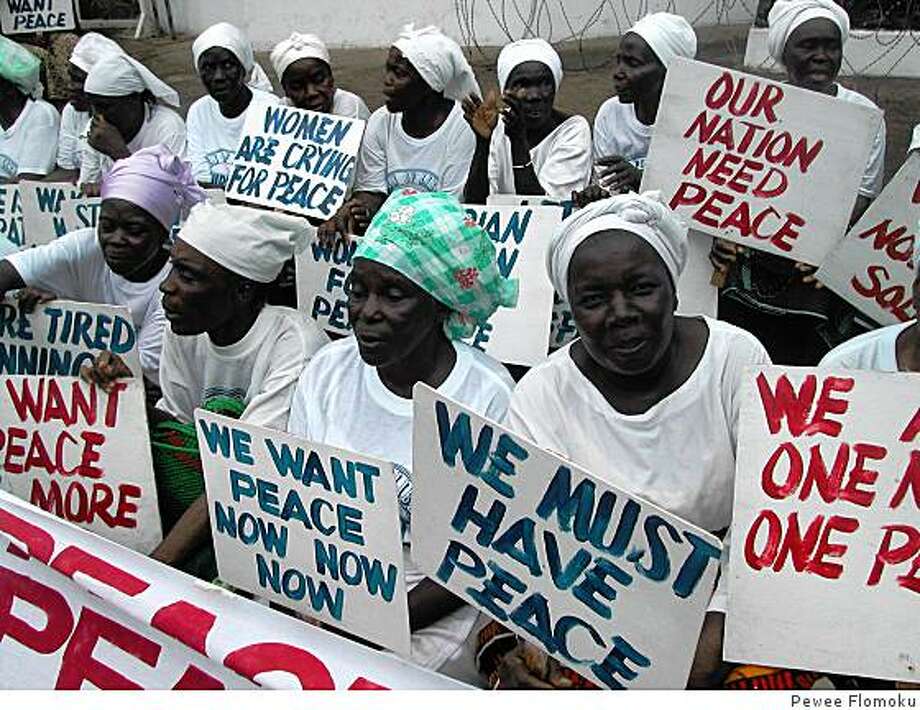
In Liberia while the peace talks that eventually ended the civil war were in progress, it became clear to a group of concerned women that Charles Taylor’s side wasn’t taking the talks with the seriousness they deserved. So the women camped outside the parties’ door and refused to leave until a deal was made. The Ghanaian president met with the women, assured them of his support for their initiative, and promised that he would do his best to ensure that the talks would be taken seriously. The women, then, had external support. Watch (video below) the documentary “Pray the Devil Back to Hell” where the women explain how their sex strike worked: pressures in personal relationships pushed men to action against rebel leaders and prayer. Atieno Demo makes a powerful case for why the personal is political.

Iceland’s movement in in 1975 also received national prominence resulting in one of the first equality legislation in the world. Known as the “Women’s Day Off “, this was more than a sex strike: women stayed home from work to protest discriminatory wages.

 Several women organizations in Kenya, including FIDA, have banded together in a week-long sex ban in protest over the infighting plaguing the national unity government. Other groups in the coalition are Caucus for Women’s Leadership and Maendeleo ya Wanawake. (You can read their press release here ). The following are the demands from these women’s groups:

  • President Kibaki and Mr Odinga respect the people and nation of Kenya by “ending forthwith the little power games” that undermine the dignity, safety and democratic spaces of our country;
  • The President and PM give respect, full intent, interpretation and observation to the spirit and letter of the National Accord and Reconciliation;
  • A responsive, sensitive and people-driven leadership and coalition government that is decisive, clear about the country’s priorities, willing to sacrifice individual ambition for the greater good of the nation, a leadership that inspires confidence amongst the country’s people;
  • Fast-tracking of the reforms agenda, and,
  • Resignation of Vice-President Kalonzo Musyoka and refusal by him to be used to defeat the National Accord.

In Kenya, the situation is not as extreme as in Liberia; the behaviour which they want to stop has no direct connection with sex, as it seems to have had in Colombia; and, unlike Iceland, Colombia, Poland and Italy, Kenyan women don’t already have the power that might make the threat a threat a plausible one. Still, all that is necessary for the strike to succeed is for it to have an impact. And that it certainly will. It has drawn attention to the difficulties which Kenyan women face, and it has shown that they will not hesitate to use what power they have to collectively improve their lot.

There’s an argument to be made that Kenyan men interact with women intimately only when having, or seeking, sex. Women are deliberately shut out of almost every other influential position: decisions in the home, and state, are not only not theirs to make, they cannot even significantly influence them. So it seems that a woman’s power is limited to her relationship(s). But not even always, since we know that many women do not have the right to say no to sex, with their husbands, boyfriends, or bosses.

The feminists of G10 want them to use it, since that’s a key part of the power that women are able to command. It could be argued that this choice plays directly into the hands of antifeminists who will take it as confirmation of the stereotype that women are wily, good for nothing and so on. On the other hand, women are entitled to use the weapons at their disposal, within reason. There is nothing wrong, of itself, in witholding sex. And the antifeminists would find reason to oppose conceding women their rights whether or not women chose this strategy.

So why think that the strike will be a success? And, if it isn’t a success, what’s the point of engaging in it?

A double-edged sword: sex and power. By forcing a national conversation on a taboo topic, these Kenyan women have turned the lens back to Kenyans.

A theme begins to resonate: that a woman’s power only lies in her sexuality. The Daily Nation runs this headline: “The Strength of a Woman,” casting women as sex objects, that even when they are denying men sex, they can essentially only give and take away sex.

But sex is not what the strike is about. The strike is calling to action a government that is  not serving people.

A white-haired man, interviewed on television the next day, proclaimed, with no shame or embarrassment, that a woman’s duty from birth is to serve God and her man. And because women were denying men their rights, well, they should be beaten up. Several other comments I have seen are unworthy of discussion. But I will mention them nonetheless. That feminists are breakers of homes. Yes, the very feminists who are on strike because they are afraid of a repeat of the post election violence. That they might be lesbians and have no husbands or boyfriends; a very tired and irrelevant argument. That Kenyan politicians only sleep with their wives once or twice a year: power displaced.

Many people have wondered why non-political men should be “punished” for the sins of Kenya’s political class. If we are to use this argument then teachers, nurses, doctors, policemen and other civil servants should never go on strike because their pupils, patients et al are not responsible for their grievances.  Sex, unlike medical treatment and education, is not even a right. But wouldn’t it be great if men supported this strike, and demanded more from their government? The beginning of the framing of a continuing national crisis: a self-serving political class. But this, I understand, is wishful thinking on my part.

It is not just men who have missed the point of the strike. Muslim women in Mombasa, and Kenyan churches, have called the strike a reckless pronouncement that would lead to men divorcing their wives. A shame isn’t it? That sex, the kind in which a woman has no choice, is the glue that holds our families together.

I am afraid the joke is on us.

In Nigeria, Ekiti women have taken to a more expressive strike: women took to the streets half-naked last week as they protested delayed election results hoping to shame them into action, afterall noone wants to see their mother, grandmother, or aunts naked.

(Photo Credit: Pewee Flomoku / SFGate)