The United States abandons Mexican migrant children to violence and despair

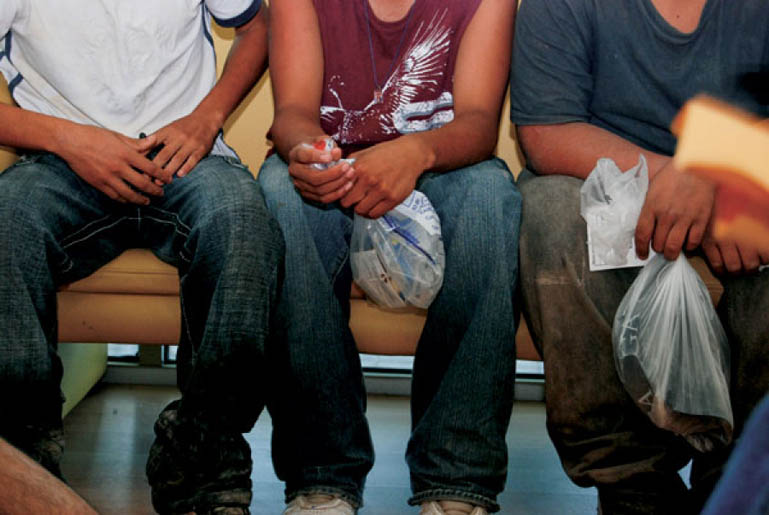
Children waiting in the Desarrollo Integral de la Familia in Reynosa, Mexico

Migration analysts talk about sending and receiving nations. Sending nations are those countries that send, or `export’, its citizens to other countries. Receiving nations are those nations that receive, or `import’ or `absorb’, them. The status of some nation States has changed in the last two or three decades. For example, Italy and Greece were once considered sending nations, and today they are thought of as receiving nations.

Certain countries, such as the United States, are thought of as receiving nations. But that is only the case if the transnational and global export-import business is thought to be one of labor brokerage of national citizens. What are we to call those countries that export non-citizens, those countries that have made a business, a big business at that, of exporting asylum seekers, migrants, children?

Every year, the United States exports tens of thousands of unaccompanied migrant children to Mexico. These children are sent to centers run by Mexico’s social services agency called the Desarrollo Integral de la Familia, or DIF. In 2008, a Mexican congressional committee reported that the United States had deported 90,000 children, of whom at least 13,500 were never claimed. “Never claimed”: that means the children were never reunited with their families.

Who are these children? They are Mexican children who are heading to the north, most often to be reunited with … their families, with their mothers and fathers: “With few exceptions they’ll cross again because their parents or loved ones are en el otro lado and on the other side of the Rio Grande there is hope. Hope to study, to work, or to just hug their mothers or fathers again.”

Susana is in many ways exceptional and in other ways typical of the 90,000 children. First, she’s a girl; 80% of the children are boys. Second, as she sits in a DIF shelter in Matamoros, she says she’s ready to give up, to go home: ““I don’t want to stay here. I’m tired of fighting.” Gender and the intent to return home make her exceptional.

On the other hand, Susana has tried to enter the United States five times, and on each of the five attempts has failed. Every time, she was returned, unaccompanied, to Mexico. Every time, she turned around and tried again. Her father works in Kansas. They haven’t seen each other in five years. He works, struggles, and pays to have his daughter brought over. Each time, the journey costs $2500. Again and again, he pays, again and again she tries. Just to hug her father again. This makes her typical.

The children are sent to centers in Reynosa and Matamoros, centers of the current drug cartel and War on Drugs violence. Reynosa is reported to be one of the most dangerous places in Mexico. Often the children are released to strangers or to distant relatives. Often, some say more often than not, they are returned to the mean streets, and in particular those of Reynosa. So, they then go North because they want to, to be reunited or to study or work, or they go North because they are forced to. Some girls, some boys, may be tired of fighting, but that doesn’t mean they are safe. That doesn’t mean the fighting has tired of them.

What do you call a nation that seizes children, sends them unaccompanied into a violence torn war zone, and then washes its hands of the whole affair, and closes its eyes and ears to the fate of the children? That is neither a sending nor a receiving nation. That is a state of abandonment.

Susana wants to go home, but it’s not that simple. The center wants one of her parents to come and get her. Her father is in Kansas, her mother has to take care of her younger brothers and sisters. And so Susana waits, and like the other 90,000 Mexican children the United States has abandoned to violence and despair, haunts more than the borderlands. Susana haunts citizenship.


(Photo Credit: Texas Observer / Eugenio del Bosque)


Their mothers haunt more than the future

Peace Musabi

Asylum seeker Jimmy Mubenga is dead, killed by G4S `escorts’ on a plane taking him from the UK to Angola. His wife, his widow, Makenda Kambana, weeps. Their five children weep. The State announces, a bit later, that the contract with G4S has not been renewed. The reason given? Cost efficiencies: “G4S is understood to have been paid tens of millions of pounds a year under the current deal, which expires in April. Removals between 2005 and April 2010 cost the Home Office almost £110m.” Apparently the rent is too damn high.

The cost is born by many, the dead and their intimate survivors first and perhaps last. Makenda Kambana is now a single mother of five children, alone, and still a political target. If children, as we are told so often, are our future, what are mothers?

Ask Irma Medrano, a 44 year old Salvadoran woman. In 1995, she fled an abusive husband. She was twenty nine years old at the time. She left her two children behind with relatives. In the subsequent fifteen years in the United States, Irma Medrano has given birth to two children. She is the mother of a twelve year old daughter, a nine year old son, both of whom are United States citizens.

Medrano’s family reports that her Salvadoran husband has heard that she is to be deported and has begun coming around, looking for her. The court decided to ignore this. Her US-born children are heartsick at their mother’s imminent disappearance. The court has decided that her children would not suffer extraordinary hardship if she were to be deported.

Finally, the court decided that Irma Medrano, despite her husband’s clear threats, faces no harm if returned to El Salvador. The court has decided that El Salvador is now safe for women, because there are more women in the legislature and judiciary, and the police are better trained. The court chose to ignore a US State Department report, in March 2010, “found rape remained widespread in El Salvador, rape laws were not effectively enforced, and domestic violence `was considered socially acceptable by a large portion of the population.’”

If Irma Medrano’s children are the future, what is Irma Medrano? In her flight to the United States, and if it happens, in her forced return to El Salvador, Irma Medrano will share a story with other asylum seeker mothers forced to leave their children behind in order to protect themselves and their children.

Women like Rahma Abukar Mohamed, Peace Musabi, Jeto Flaviah, Reetha Suppiah, Sakinat Bello.

Rahma Abukar Mohamed lived in Somalia, where she had been shot, threatened with rape, threatened with death, and injured. She fled, leaving behind her husband and child. She sought asylum in the United Kingdom, where she was summarily and `wrongly’ imprisoned, for having false papers. The reasons for her flight, the conditions of her life in Somalia, her desperate situation were all folded into her mistake of having had false papers, a mistake intensified by poor legal representation. She entered the United Kingdom on 9 August 2007. Last week, on 19 October 2010, her conviction was nullified, on procedural grounds. Rahma Abukar Mohamed was persecuted in Somalia for being a member of the wrong ethnic group. What was she persecuted, and prosecuted, for in England?

In 2003 Peace Musabi left Burundi, and left her three children, Samuel, Diana and Daniel, with a trusted friend. Musabi had to leave Burundi. Her husband had been kidnapped, her brother was beheaded in front of her, she was imprisoned, tortured, raped. She fled, pregnant from the rapes. Peace Musabi arrived in England in 2003, and, in 2007, was finally given exceptional leave to stay. She immediately began searching for her children. In 208, she was informed they had survived, amazingly, and were living in Uganda. She applied to have them come to England … and was denied, ironically enough, by the Home Office. Because of earlier procedural mistakes on the part of the Home Office and of her legal representation, Musabi was not officially a refugee but rather `exceptional’. And so she and her children had no right of family reunion. In the end, such as it is, “the immigration and asylum tribunal overturned the Home Office’s cruel refusal.” But that refusal, in the consciousness of the Home Office, was a home affirmation. What is Peace Musabi in that home?

Jeto Flaviah has a similar story. She fled Rwanda, after soldiers killed her husband, and raped and tortured her. She fled to the United Kingdom, seeking asylum. She won asylum but not the right to family reunion. Like Peace Musabi, she was `exceptional’. She still waits for her children, she still struggles and organizes everyday for reunion, she still mourns the time lost, the life together lost. What is Jeto Flaviah in the Home Office? What is asylum if she is denied forever the touch, the presence, the intimacies of living with her children?

Reetha Suppiah is from Malaysia, and Sakinat Bello is from Nigeria. They each fled to the United Kingdom, seeking asylum. The fled with their children. They were denied asylum, and immediately sent, with their children, to Yarl’s Wood, where, with their children, Reetha Suppiah spent 12 days, and Sakinat Bello 17 days. The children quickly became sick. Suppiah and Bello are suing the Home Office for the harm done to their children. That case was launched this week, Tuesday, October 26.

Children are the future. The daughters and sons of Makenda Kembana, Irma Medrano, Rahma Abukar Mohamed, Peace Musabi, Jeto Flaviah, Reetha Suppiah, and Sakinat Bello, they are the future. That future is born in asylum. That future is wrapped in death and violence and harm, all in the name and service of `asylum’. The children are the future . . . and their mothers? Their mothers haunt more than the future.

(Photo Credit: Camden New Journal)

Asylum-seeker Mandana Daneshnia and her daughter haunt democracy

Every day, The Wall Street Journal runs a feature called Photos of the Day. On Monday, October 18, the first photo was of a woman throwing confetti at Evo Morales. The second photo showed riot police hauling off a student demonstrator in Lyons. The third photo was of a mother and child. The mother looks away, the child looks directly at the camera. Here’s the caption: “SEWN SHUT: Iranian asylum-seeker Mandana Daneshnia, who had her mouth sewed shut for a hunger strike, sat with her daughter before a news conference in Athens Monday. A group of about 30 Iranians seeking asylum have been on a hunger strike in Athens for weeks.”

Here’s one version of the story.

Last year, around this time, on October 12, 2009, Human Rights Watch issued a report on the situation of asylum seekers in Greece. It was entitled Greece: Unsafe and Unwelcoming Shores. Here’s how HRW described the asylum system in Greece: “Greece effectively has no asylum system. It recognizes as few as 0.05 percent of asylum seekers as refugees at their first interview. A law adopted in July abolished a meaningful appeals procedure. The effect of the new law is that a person who is in need of international protection as a refugee in Greece is almost certain to be refused asylum at the first instance, and having been refused has little chance of obtaining it on appeal. The new law leaves asylum seekers with no remedy against risk of removal to inhuman or degrading treatment, as required by article 39 of the EU’s procedures directive and articles 13 and 3 of the European Convention on Human Rights. As a result of this legislative change, the United Nations High Commissioner for Refugees (UNHCR) withdrew from any formal role in Greece’s asylum procedure.”

According to the report, Greece acted abysmally, and both the European Union and the United Nations did nothing more than withdraw and withhold. They did nothing to protect asylum seekers, they did nothing to intervene in either a draconian legal system or a Dickensian prison system. Everyone was found guilty: Greece, Europe, the United Nations. The entire `civilized’ and `democratic world.’

A year later, on September 20, 2010, Human Rights Watch returned to Greece to review the situation. What happened in the intervening year? Delay after delay. The year may have intervened, but no one else did. Not the European Union, not the United Nations. No one. What happened? Less than zero. The world stepped backwards.

Meanwhile, on September 1, 2010, a group of Iranian asylum seekers set up camp in the city center of Athens, demanding an audience, pleading for asylum. They began a hunger strike.

On Monday, October 18, after weeks of belligerent non-response on the part of the Greek government, a new government that had come in on the promise of change, six protesters sewed their lips together.

Mandana Daneshnia is one of the six: “Mandana Daneshnia, a former newspaper reporter, said she fled the country after being harassed by authorities for writing about women’s issues. She was one of the seven protesters who sewed their lips. `Women have no rights in Iran. They can’t wear what they want, do what they want, or even watch sporting events. Their testimony in court counts only for half of the one given by a man,” Daneshnia said, writing a statement in Persian, as her husband and young daughter looked on. `I have sewn my mouth to show that women in Iran are strong,’ said Daneshnia, 29, with short dyed-blonde hair and red-framed designer glasses, holding her lips with her hand when occasionally tempted to smile.”

The women in Iran are strong, whether in Iran or in Greece or elsewhere. For those women, the women in Iran, the institutions of democracy, as exemplified by the conditions of asylum seekers, are neither strong nor weak. They are lethal, and they are inhuman. Mandana Daneshnia haunts democracy. Mandana Daneshnia haunts Iran, Greece, the European Union, the United Nations, and anyone who cares about women’s issues and the reporting of women’s issues. As Mandania Daneshia haunts the `freedom loving’, `democratic’ nations, her daughter sits on her lap. How many smiling daughters must sit on the laps of how many mothers with their lips sewn together before asylum is realized?


(Photo Credit: Louisa Gouliamaki/Agence France-Presse/Getty Images)

And Jimmy Mubenga is dead


Jimmy Mubenga came to England seeking asylum, seeking life. According to his wife, Makenda Kambana, he was on a government hit list, “They killed my father and they threatened to kill Jimmy. They were looking for him. We had no choice but to leave.” Earlier this week, on Tuesday, October 12, Mubenga boarded a plane for Angola, having lost his last battle for asylum in the UK. Within 50 minutes on the plane, he was dead.

Witnesses report that the guards, G4S private deportation `escorts’, jumped on Mubenga and throttled him to death.  Escort deportation has become big business. Most of the 11 immigration removal centers in the UK are run by private firms, in particular G4S, GEO Ltd or Serco.

MPs are calling for an investigation, the former chief inspector of prisons as well. Many informed will raise their voices and eyebrows and hands in surprise and dismay at the violence. Charges of `excessive force’ and `brutality’ are heard across the land.

But Jimmy Mubenga is dead. As are …

Kenyan asylum seeker Eliud Nyenze, who collapsed in April this year at Oakington detention center, run by G4S. Nyenze complained of intense pain, so bad he was reduced to crawling around on the floor, begged for painkillers, and was denied any sort of medical attention. He died in excruciating agony.

Manuel Bravo, an Angolan asylum seeker who in September 2005 was found dead, hanged, in Yarl’s Wood.

Joy Gardner, a Jamaican woman applying for compassionate leave to stay in Britain, killed in front of her five year old son and her mother, September 1993.

These are the prominent, the recorded, names that have come up in discussions of Jimmy Mubenga’s death. Their deaths, the manner of their deaths, the impunity of those who killed them, is said to haunt the story of Jimmy Mubenga. The passengers on that British Airways flight are described as “haunted by the last cries of a dying man.” Understandably. The nation is haunted.

But Jimmy Mubenga is dead, and will remain so. He is not haunted by the past, but his name, his death, is haunted by the future. He is haunted by those who continue to seek asylum.

On Wednesday, October 13, the day after Jimmy Mubenga was killed, Malawian Florence Mhango and her ten-year-old daughter Precious were again blocked from receiving asylum. Precious is seeking asylum because she and her mother fear that if returned to Malawi, by law her estranged father can force her into marriage.

On Thursday, October 14, it was announced that the four-year ban on repatriating Zimbabwean failed asylum applicants would be lifted. Why? Because the Unity Government of Zimbabwe has worked.  That many, including the Zimbabwean diasporic and overseas communities, believe that the situation is worsening, that a bloodbath may very well be imminent, is of no matter. That Robert Mugabe, on Friday, called for national elections whether or not the constitution has been passed, is of no matter.  That the violence continues is of no matter.

What is important is that the Zimbabweans be sent back, be sent out. Take EM, an MDC member raped and beaten by policemen in her own home, send her back, because she has failed the test of asylum. Take Pauline Enagbonma, an albino woman who fears for her safety as an albino in Zimbabwe, and send her and her three young children back, children who have spent the majority of their lives in the UK. Take Nokuthula Ngazana and her famous 18 year old daughter Gamu, and send them back. Nokuthula Ngazana came to the UK, with her daughter, to study. Home Office claims she filed for visa extension “out of time”, and since Gamu was listed as her dependent on the application, she too must leave. Send them all back, along with all those whose names go unrecorded.

Seize them and you shall seize the day.

Send them all back for they have failed the test of asylum. In the protection of the State, there is no excessive force, there is no brutality. Those notions, like Nokuthula Ngazana’s application, are out of time.

Precious Mhango haunts Jimmy Mubenga, Gamu Nhengu haunts Jimmy Mubenga. The tens of thousands of children, of women and men seeking asylum and those who in the future shall seek asylum in the United Kingdom, they haunt Jimmy Mubenga.

And Jimmy Mubenga is dead.


(Photo credit: irr.org.uk)

The children of Afghanistan haunt the modern democratic nation-State

Children of asylum seekers and children who are asylum seekers in prison. What is their crime? Seeking asylum. These are children fleeing violence, in their households, in their communities, in their countries of birth. And how do `we’ respond? Prison.

Australia is bracing for a serious uptick in children in detention mutilating themselves: “Self-mutilation in Australia’s detention centres is increasing with the number of recorded cases quadrupling in the past year and mental health experts bracing for worse to come as children begin cutting themselves.” Why are the children cutting themselves? The prisons are becoming more overcrowded, the time spent in prison is increasing, and government officials are `promising’ increased rates of deportation. Who are these scoundrel children? Afghans. Sri Lankans.

According to Harry Minas, director of the Centre for International Mental Health at the University of Melbourne, the conditions for imprisoned asylum seekers and immigrants is returning to the dark days of 2001 – 2003, “when children drank shampoo and detainees sewed their lips together.” All of this has happened before, and it is happening again. We are told the first time it was tragedy.

Why are children cutting themselves? There is no school, there are no sustaining structures, there is no home life, there is no community, there is no future, and, increasingly, there is no past. There is only prison. From the State, there is only the promise that the rate of deportation to Afghanistan will increase. For the children, there is only threat and more threat.

The children are cutting themselves, they are poisoning themselves, because they are children, and self-harm is the only electoral process allowed them by the modern democratic nation-State. There are currently around 700 children in immigrant detention `facilities’ in Australia.

These children of asylum-seekers, these children asylum seekers are viewed as budget targets, as opportunities for greater efficiency. In Britain, it was announced today that “thousands of child asylum-seekers are to be removed … under savage budget cuts being drawn up by the Home Office ahead of this week’s comprehensive spending review. A briefing document sent to ministers sets out detailed proposals to remove child refugees before they reach 17 years old, and recommends bearing down on benefits given to asylum seekers…. Of greatest concern will be a policy of mass removal of unaccompanied children before they reach 17 and a half, the age when they are deemed to be adult asylum-seekers. Under current rules unaccompanied child asylum-seekers are usually granted leave to remain in the UK until they can make a fresh asylum application as an adult. There are more than 4,200 unaccompanied child asylum-seekers in Britain, with most being supported in local authority social services homes.”

The opportunity for economy here, for efficiency, is great. It is so great that the United Kingdom is willing to invest £4m in a `re-integration center’ in Afghanistan. The children of Afghanistan have traveled far, to seek asylum, to seek haven, to escape the violence of the Big War and the myriad forms of violence of the more intimate wars of the everyday. These children shall be returned to Afghanistan, after having been subjected to the democratic rule of law and of due process.

The planes are waiting, the ministers are promising swift, increasing, and ever more efficient returns. The children who have come asking for help will be returned to Afghanistan because Afghanistan is a better place … for them. It must be. It has been democratically decided. Those children who have not been allowed to kill themselves shall be sent `home’. The modern democratic nation-State is bracing itself for mass removals, for bearing down, for the mutilation of children. The children who seek asylum and the children of those who seek asylum have been targeted. The children of Afghanistan haunt the modern democratic nation-State.


(Photo Credit: Australian Human Rights Commission)

Asylum haunts the modern democratic nation-state

Pagani detention center, Greece

Asylum haunts the modern democratic nation-state.  Asylum haunts the principle of democracy by positing a citizenship of higher order than that of the national variety. This asylum citizenship is based not in identity, not in birthright, not in lineage or kin, not in relationship to the nation-state. Instead, asylum citizenship is based in the conditions of life, in need, in a will to survive, in a demand for dignity. The asylum citizenship is the unknown and unknowable stranger who demands recognition as a familiar. Asylum citizenship is of a higher order because it has given up on the structures of power and the logic of the nation-State. It is neither a superior citizenship nor a more powerful one nor a wealthier one. Nor is the asylum citizen more privileged.  Asylum citizenship is of a higher order because it has always already been with us, and so precedes the noise of national sovereignty and of national due process, as it exceeds the furor and the hurly burly of the rule of law.

Asylum haunts the modern democratic nation-state because it puts the notion of demos in crisis. Asylum haunts the democratic nation-state because it preceded the nation-state. Asylum does not participate in the nation-state historical narratives of progress, those stories that make the invention and maintenance of the nation-state the pinnacle of civilization. For thousands of years women, men, children have sought, received or were denied asylum. They continue to do so today. This seeming eternal repetition of the same does not mean that those who seek asylum today are somehow `primitive’. Asylum as an aspect of the human condition is no more inevitable than torture or genocide, and no less historical or historically produced.

Women asylum seekers haunt the democratic nation-state because they demonstrate, forcefully, the violent patriarchy that reigns supreme. Children of asylum seekers haunt the democratic nation-state because they also demonstrate, forcefully, the violent patriarchy that reigns supreme.  They step out of the shadows, ask for help, and they are punished. For women asylum seekers and for their children, the modern democratic nation-state is a tight knit and tighter fisted brotherhood, and women asylum seekers and their children are not brothers.

How does the contemporary democratic nation-state respond to the asylum citizen? Prison. Yarl’s Wood, in the UK. T. Don Hutto, in the US. Villawood, in Australia. Lindela, in South Africa. Pagani, in Greece. Via Corelli, in Italy. Opbouw, in the Netherlands. Vottem, in Belgium. Glasmoor, in Germany.  The list goes on, the construction of new `reception centers’ continues, the cells continue to grow more intensely overcrowded. This is the way the modern democratic nation-state recognizes, understands, absorbs, responds to and resolves asylum. Sequestration. Intimidation. Torture, `if necessary’. Expulsion. The nation-state calls these reception centers, residential centers.  And so, this must be the architecture of reception and residence in the modern democratic nation-state.

Fifteen years ago, Jacques Derrida was asked to discuss the ways in which the French population was “taken by surprise” by immigration of the sans-papiers, the undocumented: “Immigration is no higher now than it was a half-century ago.  Yet today it takes people by surprise. It seems to have surprised the social body and the political class, and it seems that the discourses of both right and left, by refusing illegal immigrants (immigrés clandestins), have degenerated into xenophobia in an unexpected way.”

Derrida replied, in part, “A politics that does not maintain a reference to the principle of unconditional hospitality is a politics that loses its reference to justice.  It may retain its rights … but it loses justice. Along with the right to speak of justice in any credible way. …One would have to try to distinguish between a politics of immigration and the respect to the right of asylum.  In principle the right of asylum … is paradoxically less political because it is not modeled in principle on the interests of  the body proper of the nation-state that guarantees this right.  But … it is almost impossible to delimit the properly political nature of the motivations for exile – those that … justify a request for asylum. After all, unemployment in a foreign country is a dysfunction of democracy and a kind of political persecution. Moreover, the market plays a part in this; the rich countries always share in the responsibility (if only through foreign debt and everything it symbolizes) for the politico-economic situations that push people into exile or emigration. And here we touch on the limits of the political and juridical:…a right of asylum can be null or infinite.”

From the perspective of asylum, in the modern democratic nation-state, there is no right, there is no left. These niceties are irrelevant. Instead there is only unconditional hospitality … or there is none. And where there is none, there is injustice. More precisely, there is the loss of justice and the loss of the `right’, the capacity, to speak of justice credibly.  Xenophobia cannot credibly surprise anyone, it is the national democratic politics of false hospitality. The particular `indignities’ visited upon women asylum seekers  cannot surprise anyone. They are manifestations of the patriarchy that reigns supreme in the violent and violating absence of unconditional hospitality.


(Photo Credit: UNHCR / EU Observer)

The Nannies’ fervor of freedom


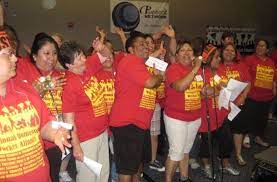
Many thousands of domestic workers are employed in New York state as housekeepers, nannies, and companions to the elderly. The labor of domestic workers is central to the ongoing prosperity that the state enjoys, and yet, despite the value of their work, domestic workers do not receive the same protection of many state laws as do workers in other industries. Domestic workers often labor under harsh conditions, work long hours for low wages without benefits or job security, are isolated in their workplaces, and are endangered by sexual harassment and assault, as well as verbal, emotional and psychological abuse. Moreover, many domestic workers the state of New York are women of color who, because of race and sex discrimination, are particularly vulnerable to unfair labor practices. Additionally, domestic workers are not afforded by law the right to organize labor unions for the purpose of collective bargaining. The legislature finds that because domestic workers care for the most important elements of their employers’ lives, their families and homes, it is in the interest of employees, employers, and the people of the state of New York to ensure that the rights of domestic workers are respected, protected, and enforced.”

Thus opens the New York Domestic Workers’ Bill of Rights, signed into law by Governor Paterson, August 31, 2010, after a six and some year mighty campaign waged by Domestic Workers United, or DWU, and their allies. This is the first such law to be passed in the United States, where domestic workers and farm workers have been excluded from labor laws. It is a historic moment. An unforgettable day.

Priscilla Gonzalez, DWU Executive Director and the U.S.-born daughter of an Ecuadoran woman who works as a housekeeper, said, “We’ve made history today, not just for us, but for generations to come to prove that change can happen when we stand for dignity, justice, & respect for all!”.

Patricia Francois, a DWU member and nanny originally from Trinidad, explained, “We work long hours, no overtime pay. My experience, after working six-and-a-half years, never had an increase in salary, as well as no overtime pay. At times, if you work on your vacation, if you don’t stand up for that vacation pay, you will not get it. You know, and it’s hard at times—when you stand up for yourself, that is the time the abuse comes in. You get a verbal abuse. You get threatened with immigration. And it’s wrong. It’s wrong.”

Nannies struggle for respect and recognition, and the New York Domestic Workers Bill of Right is an important first step in that struggle. It’s about emancipation, freedom. As DWU member and nanny Dolores Wright noted, it’s a struggle for emancipation from abuse and exploitation. As Bill sponsor Delegate Keith Wright proclaimed, “”President Lincoln signed the Emancipation Proclamation in 1865. Here we are in 2010.Governor Paterson will sign his version of the Emancipation Proclamation.”

Emancipation. For housekeepers, nannies, and companions to the elderly. What would nanny emancipation look like? What is a nanny?

For some, such as those who write dictionaries like the Oxford English Dictionary, a nanny is a “person, esp. a woman, employed by a family to look after a child or children; a children’s nursemaid. A grandmother.” For those people, nanny comes from Anne or Agnes.

But another river runs through the word, nanny, a river that betokens insurgency, militancy, national liberation. That’s the nanny of Jamaica’s Queen Nanny, the early eighteenth-century leader of the Windward Jamaican Maroons, a National Hero. According to historian Karla Gottlieb, Queen Nanny is the mother of us all, because “Nanny had at least two significant contributions that changed the direction of the modern world: first, she developed Guerrilla warfare and the tactics she used were later studied by military strategist in the Vietnam War and others. Second, because she and her people established the first independent black polity in the New World, she led the way for freedom struggles in Haiti, Brazil, the U.S., Guadelope, Surinam… – anywhere where there were enslaved Africans. Without the work of the Maroons under her leadership, I believe the world would be a different place.”

This is the Nanny that is kept out of the stories of domestic worker organizing and emancipation. The Nanny of shrewd and insightful guerilla warfare, the Nanny of coast-to-coast freedom struggle.

In the words of Jamaican dub dub poet Jean Binta Breeze, Nanny is the fervor of freedom, and it’s time to honor her name and life, in actions and deeds. Blow the trumpets, sound the abeng. Nanny emancipation includes and values a Domestic Workers’ Bill of Rights, it insists on employers treating workers with respect and dignity, and it also dreams of national liberation, of a nation-State and a world in which every Nanny shall govern.

so mek wi soun de abeng fi Nanny


(Photo Credit 1: Colorlines)

Because they are still human

James Kessler is a justice architect. That means he works in criminal justice architecture. He is a senior principal at Hellmuth, Obata + Kassebaum, Inc, better known as HOK, one of the largest architectural firms in the world. Here’s how they describe justice architecture: “As an integral part of society and a component of contemporary life in our cities and states, Justice Architecture is a powerful symbol that serves to define the image of justice in every community.”

In a profile this week, Kessler talked about women prisoners in the United States: “Incarcerated women, for example, are more likely to change, or want to change, Kessler said, noting “an incredibly high percentage – more than 50 percent – have been abused as children.” Statistically they also have more health issues than men, and 75 percent are mothers with the added burden of being away from their children, exacerbated by having been abandoned by their own parents in similar situations….In the past, and sometimes at present, Kessler said parity issues arise vis-à-vis men’s prisons, with fewer opportunities and programs available to women who comprise a much smaller percentage of the prison population.…One of the goals during incarceration, Kessler explained, is to ameliorate the anger that defines inmates. According to Kessler, because research has determined women have a much greater need for privacy than men, requiring them to live in open dormitories would very possibly build on that anger rather than helping to relieve it.”

Women prisoners’ anger, women’s anger, creates a different space and inhabits a different architecture than the anger of men.

The profile concludes with Kessler’s reflection: “As architects, we have social responsibilities and certain sensitivities, perceptions and skills to deal with unusual situations for the people that work in them, the people that visit them and for the people that are in them, because they are still human.”

Because they are still human. What determines the humanity of a prisoner? The architecture? The design elements? Such as shackles around the ankles and waists of women in labor and delivery?

In Rhode Island, pregnant prisoners are handcuffed and shackled. Earlier this month, the Rhode Island chapters of the National Organization for Women and the American Civil Liberties Union find this “troubling” and “unnecessary”. Rhode Island Department of Corrections officials see shackling as striking “a balance between the need for security and the interests of a pregnant inmate.” How is being shackled in the interests of a pregnant woman? She is still human, isn’t she?

In California, the ACLU is challenging the same “balanced” shackling of pregnant women: “In California, we currently shackle pregnant women. In jails and prisons, women are forced to walk with shackles around their swollen ankles, chains around their middles, and handcuffs behind their backs. They walk through downtown city blocks chained to one to another, trying their best not to lose balance”. The ACLU thinks this is cruel and unusual punishment, not a balance struck in the interests of pregnant women. But then, perhaps the interests of pregnant women and those of pregnant prisoners are not the same. Does “security” define reconstitute pregnant women prisoners as other than human? Is that the “balance”? What is the name of the different space created by shackled pregnant women walking, stumbling, falling?

In a couple weeks, the Governor of California will have the opportunity to strike a new balance, limiting the use of restraints on pregnant women who are prisoners.

In Texas this month, the ACLU and the Texas Jail Project have charged the Dallas County jail and others in the state with shackling prisoners during labor and delivery.

This week, the U.S. government submitted a report to the UN Human Rights Council. This is the first time the US has ever reported on its own human rights situation. Prison is included in the report. It appears in Chapter III, “A Commitment to Freedom, Equality, Dignity.” Prison is in the third section, Dignity. There are safeguards for dignity in law enforcement and criminal justice, dignity and incarceration, dignity and criminal sanctions, dignity and juvenile offenders. Dignity abounds. There is no mention of dignity and women. There is no mention of the shackling of pregnant women prisoners.

It is August in America. Pregnant women prisoners across the country are being shackled. Even though they do not appear in the report on human rights, they are still human, they are still women … aren’t they?


(Image Credit: RadicalDoula.com)

Azbaa’s anguish, Auden’s blues

Azbaa Dar

Pakistani born Azbaa Dar is being held in Yarl’s Wood. On Monday of this week she reported, dutifully, to the Liverpool office of the UK Border Agency. She has been applying for asylum for nine years, and as part of the process, she has to `visit’ the UKBA offices regularly. At this visit, she was given a letter denying her asylum. She was then taken to Yarl’s Wood and told she was to be returned to Pakistan.

Azbaa’s family had been turned down for asylum on Easter 2006, after a five year asylum process. Her father, Arif, a local high school governor, her mother, her four younger sisters were sent to Yarl’s Wood, and then shipped back to Pakistan. Since their return, Arif has been detained and tortured on a number of occasions, her mother is ill, her sisters have been threatened if they pursue formal education. And then of course there are the floods.

Azbaa escaped capture and lived clandestinely around Liverpool for close to four years. Finally, a deal was struck that if she turned herself in and came regularly to the office, she’d be fast tracked. She was. To Yarl’s Wood.

She was supposed to fall under a `legacy’ agreement, that would take into account the roots of the applicant in her new community. Azbaa has won Good Citizenship awards, has logged in 800 hours of volunteer, unpaid service at a local hospital, and is generally viewed as a model. She was supposed to be treated with some modicum of decency, recognition, appreciation. She was supposed to receive due process of some sort.

Instead, she has been treated as a dangerous criminal, a threat to society.

Azbaa Dar’s story, and that of her family for that matter, is all too common in the so-called advanced democracies. Pregnant Tamil asylum seekers are kept as prisoners in Canada. An Australian candidate for Prime Minister of Australia bases his campaign on severely limiting the number of asylum seekers who reach the nation’s golden shores.

It’s a common story. Seventy one years ago, 1939, on the verge of World War II, W.H. Auden wrote “Refugee Blues”. Here are some stanzas:

Say this city has ten million souls,
Some are living in mansions, some are living in holes:
Yet there’s no place for us, my dear, yet there’s no place for us….

The consul banged the table and said,
“If you’ve got no passport you’re officially dead”:
But we are still alive, my dear, but we are still alive.

Went to a committee; they offered me a chair;
Asked me politely to return next year:
But where shall we go to-day, my dear, but where shall we go to-day?

Came to a public meeting; the speaker got up and said;
“If we let them in, they will steal our daily bread”:
He was talking of you and me, my dear, he was talking of you and me….

Went down the harbour and stood upon the quay,
Saw the fish swimming as if they were free:
Only ten feet away, my dear, only ten feet away.

Walked through a wood, saw the birds in the trees;
They had no politicians and sang at their ease:
They weren’t the human race, my dear, they weren’t the human race.

Dreamed I saw a building with a thousand floors,
A thousand windows and a thousand doors:
Not one of them was ours, my dear, not one of them was ours.

Stood on a great plain in the falling snow;
Ten thousand soldiers marched to and fro:
Looking for you and me, my dear, looking for you and me.”

I dreamed I saw Azbaa Dar and W.H. Auden, walking down the road, smiling. But that didn’t happen. Instead, we live with the anguish of the asylum seekers, in the UK, in Canada, in Australia, in the US, in the great democracies of the world. Looking for you and me, my dear, looking for you and me.


(Photo Credit: http://www.liverpoolecho.co.uk)

Art South Africa: Who is your audience?

Who is your audience?
by Zanele Muholi

My audience is not here.

My audience is those people who look at two lesbian women in a photo and say that it is a shock: ‘Oh my God, don’t show that!’ That is my audience.

I don’t know who my audience is.

I know that I have brothers who give me a space to showcase my work, but then I don’t know how far or how safe other spaces can become. We are at a gallery here. My audience is at the station, at Gugs [Gugulethu] taxi rank, where a different mindset occupies that space. That’s the audience, or that’s the space that I’d like to penetrate.

You have different kinds of audiences in different spaces occupying different positions in this country, and I happen to interact with all those audiences.

The president is my audience. And a whole lot of other Zulu men who might not agree with my images, because Zulu men don’t dress up like that.

I’m still looking for my audience.

[ENDNOTE] This is an edited version of Zanele Muholi’s response to a question at a public talk hosted by Michael Stevenson Gallery, April 23, 2010 and originally appeared in Art South Africa magazine, Issue 8.4, June 2010. Thanks to the editors, publishers and author for this collaboration.


(Photo Credit: Michael Stevenson / Zanele Muholi)