The human faces of asylum seekers haunt Australia

Two months ago, it was reported that Australia was preparing for an uptick of children in detention mutilating themselves. At the time, there were around 700 children. These children `in detention’ are imprisoned asylum seekers and migrant children, and children of asylum seekers and migrants.

Two months later, almost to the day, on Wednesday, December 15, a wooden fishing vessel carrying an untold number of asylum seekers and refugees, thought to be Iranian and Iraqi Kurds, crashed off the shores of Christmas Island. The residents watched in horror, the nation watched in horror.

The dead were fished out of the rough seas. The survivors were either sent to hospital in Perth or sent to detention centers on Christmas Island.

Prime Minister Gilliard called the event a `terrible human tragedy’. The event is now commonly referred to, in the news media, as `the asylum-seeker boat tragedy.’ The Prime Minister said the full death toll may never be known. She was more right than she knew.

This is not the first time Australia has confronted an asylum-seeker boat tragedy. In 2001, there was the infamous Children Overboard affair.

On October 7, 2001, a fishing boat, the Olong, was filled with asylum seekers and headed for Christmas Island when it was caught by the HMAS Adelaide, north of Christmas Island. Under orders from the government, the warship fired warning shots, boarded several times, and finally forced the boat to turn back. The boat was old, battered, and overloaded, with over 200 people on board. The engines failed. The Adelaide took the boat in tow, and waited for instructions from the government. Then the boat literally began to fall apart and sink. Parents held their children in the air, to alert the navy of their presence on board. There were 53 children on board the Olong. The then Prime Minister John Howard claimed the parents were throwing their children overboard. They were not. The evidence from the Australian Navy showed, immediately, they were not throwing their children overboard. But the claim was out there, in the air. Refugees and asylum seekers were somehow less than human.

This most recent asylum-seeker boat tragedy is said to have put a human face on the `asylum issue’. Here’s how Nick Clegg, of the BBC, describes the situation: “Australia’s asylum seeker debate is often conducted as if the people heading for its shores were an abstraction, with the term “boat people” almost shorn of its human meaning. With such harrowing images from Christmas Island broadcast on early evening news shows – which only 24 hours earlier had dwelt more happily on the visit to Sydney of Oprah Winfrey – millions of Australians would have seen the anguished faces of those seeking to reach its shores, and witnessed the lengths to which they would go to get there. Put simply, it was shockingly real….Whatever its outcome, after the tragedy on Christmas Island the debate has a human face.”

Others had a similar response: “In Australia, perhaps for the first time, the disaster gave the asylum-seeker issue a human face. Not even those who dismiss boat people as “queue-jumpers” could have failed to be moved by footage of men, women and children screaming for help as their vessel was dashed to bits.”

The asylum-seeker debate, or situation, now has a human face. Prime Minister Gilliard says there will be no repeat of the children overboard affair in dealing with the situation. She says as well that the full death count will never be known. In a nation in a world in which human beings must sew their lips together, must mutilate themselves, must perish in the rough seas in order to be endowed with a human face, where does one begin to measure the full extent of the death count? The human faces of asylum seekers – not the asylum seeker debate nor the asylum seeker situation – haunt Australia and the world.


(Photo Credit: Australia Human Rights Commission)
Women and Water: Can You Own Water?

I have been recently working on a paper discussing the ownership of water, assuming for my argument that you can somehow lay claim to water.  Now that the paper is finished, I am free to ponder whether or not you can actually lay claim to water.

Water is not something static.  It is constantly moving, flowing, and changing.  It doesn’t stay in the same place at any time, regardless of whether you remove it from the river/stream/ocean or not.  It evaporates back into the sky and returns to the water cycle.

So how can someone lay a claim to water?

One way that people have done this is to create riparian rights – the rights to the land surrounding water.  Thus I can own land around a lake and have a claim on the water in the lake, but I still cannot own water.

Ownership implies some kind of control over the object that is owned – if I own something I can control access to it, or how it is maintained.  But is control over water really the goal? Controlling water does not guarantee the state in which water will be kept – it does not stop the water from becoming polluted.  Furthermore, control implies some kind of dominance over the object. What is forgotten, however, is that water cannot be controlled.  Tsunamis, hurricanes, and floods are all evidence as to how much more powerful water is than humans.  When people have attempted to constrain water, time and time again it has overpowered the constraints.

Frank Trelease uses the thought experiment that if you buy a watch, you have ownership of the watch. And if you have ownership of the watch, you can protect the watch and demand damages if it is broken.  To him, if I own water, then I can seek any damages for the pollution of that water.  And in order to own water, I must buy it.  Whether that buying is in the riparian sense, where one buys the land surrounding water and is given claim to the water, or in the infrastructure sense, where one buys the water that is pumped to one’s house, is hard to determine.  However, his conception of ownership implies that if one owns something, one can defend it. But what if the resource could defend itself?

Christopher Stone, in his essay ‘Should the Trees have Standing?’ discusses whether or not natural objects like trees and rivers should be allowed to have legal standing.  In the process, he says that if we are to view rivers as to be something that can be wronged, then we must also hold the rivers accountable for their impact on the earth: namely the impact of floods.  The river should be made to pay damages for its destruction (through the use of a legal guardian and a fund created in the name of the river).  Through this understand, rivers and streams would not be owned, couldn’t be owned, as ownership would deny them their rights as objects of legal standing.  Rather water would be borrowed from the river/stream and would have to be returned in good condition.

Furthermore, if water can be owned, than water can be sold.  J.H. Dales discusses the importance of acknowledging water ownership so that it can be priced effectively for the market.  His argument is that if water can be owned, than it can be treated as a material good with a fixed pricing system, rather than affixing an arbitrary price to water, as had been done previously.

But to return to the original question, how can someone lay claim to water, the answer is much more complicated than if ownership is justified.  If water can be owned, can it be bought? Or is the ownership in name only, meaning that I can own the water I pull from a stream? I think the answer is a bit of both.  When I pull water from a stream to use it, I own that water.  John Locke writes that ownership of a resource only requires the mixing of one’s labor with the resource – by Lockean understanding, I own whatever water I remove from the water cycle.


(Photo Credit 1: Water Ownership) (Image Credit 2: Public Services International)

Blacken our name

Gugulethu

Blacken our name

Blacken our name
with your doom and gloom
whether you be a visitor
from abroad or a local
from a village fenced-in

Blacken our name
darken our doorstep
with tales of murder
and mayhem too

Blacken our name
call us the black sheep
of the developing world
out in darkest Africa

Blacken our name
legendary publicist
(you are said to be)
amid the infamous

Blacken our name
spin-doctoring away
in your own image
for your clientele

Blacken our name
it is business as usual
for those who put up
with daily abuses
tourists or no tourists

Blacken our name
all our Gugulethus
all our Hanover Parks
all our Manenbergs
and our Khayelitshas too

Your business is as usual
as is the convenient truth
of our living out here

“Accused hired sultan of spin” we are told, in the aftermath of accusations that husband-honeymooner Shrien Dewani paid for his wife to be murdered (Argus, Wed, Dec 8 2010).


(Photo Credit: Carin Smuts Studio)

Black Looks: Women’s movement building and creating community in Haiti

Thousands of words have been written about Haiti in the past 12 months covering everything from the NGOisation of the country, the politics of humanitarian aid, endless questions and discussion on what happened to the $ millions donated by individuals and countries, the horrendous conditions in the camps where some 1.2 million IDP are forced to live and particularly for women and children hundreds of whom have been raped, trafficked to the Dominican Republic and forced into prostitution to survive.  In addition to the earthquake, Haitians have had to live through another devastating hurricane and now cholera which as of today has affected 30,000 people.  And to add to the frustration and anger, an election which by all independent accounts was fraudulent and farcical.    As I write, protests calling for the annulment of the elections are planned this afternoon.   If one is to judge from the many radio phone-ins, people are angry and concerned that the the much hated Preval will announce  his preferred candidate, Jude Celestine as the new leader despite the fact that so far the majority votes appear to be for “Micky” Matterly and Madam Manigat – but all of this can change in a moment.  For women organising in the community the elections are a distraction.   If the Preval candidate is declared the winner then there will be more violence.  If Matterly is declared the winner, it is

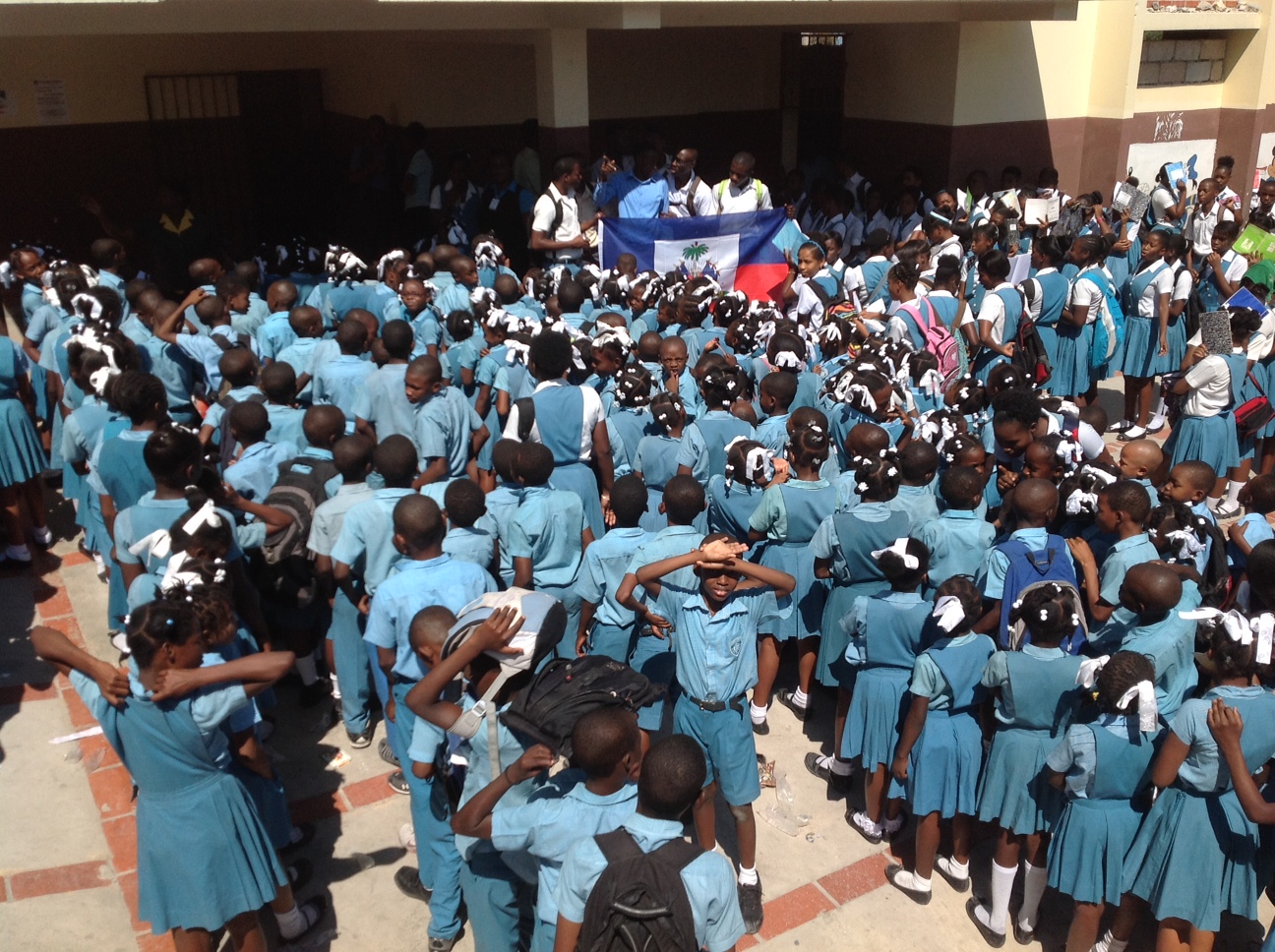
One of the stories least reported has been the one about Haitians organising for themselves, particularly stories presented within a framework of feminist organising and movement building.   This is one woman’s story of how she, her family and the people in the various communities in which she works, came together collectively to care for each other’s needs and how that struggle has become the foundation of a new movement  of the poor for  change in education and the material lives of women and men – a struggle for dignity.   Their personal and collective humanitarian response was completely off the radar of NGOs, international institutions and the Haitian government.  Even Save The Children, whose office is located right next to the school did nothing to help SOPUDEP.      However ultimately this was an aside for Rea.   What was important was that those who needed help of whatever kind, received it and beyond that the struggle for dignity and self-determination for the poor people of Haiti.

A mere five minutes passed between the death of one one of the school teachers and the life given to Rea and her teenage daughter – on of three children.

“I was in the school when it happened and I cannot describe the horror around me. The school was empty and did not fall, but the neighbourhood collapsed. Five people were crushed to death just meters from me when one of the outer walls of the school grounds collapsed. My first responsibility was to my family, so I had to get home, but the streets were chaotic. People were panicking and screaming. I had to run home ten kilometers through those streets to find my family. The phones weren’t working. It was horrible.”

Once it was established Rea’s family were all safe – a house just five minutes walk from Rea’s own home collapsed – she set about caring for the many in her community and where ever she was needed.   Everyone was in shock but there was no time to think about what had happened as people were injured.   Many people – students, families knowing about her community work, flocked to Rea’s home and at one point there were some 60 people in her home.  People feared to sleep indoors so they removed all the mattresses, blankets, pillows, whatever they could find and spread them outside.  It was January and freezing cold during the night but anything was preferable to being inside.  Rea said it took her months before she stopped waking up with nightmares of being crushed.  Even now one wakes up and gives thanks that you made it through the night.  I too find myself staring at the ceiling every night and wondering which part would collapse first and how I would get out.

The first day after the quake, Rea went to the shop were she usually bought the school supplies and asked if they would give her credit as she needed to buy food. They told her to take whatever she needed and not to worry.  As much food as possible was collected and everyone in the house, the children, students, guests neighbours, set about making food packs. They worked all night making the packs which they then distributed to anyone on the streets during the day.  As donations from friends of SOPUDEP and organisations such as the Haiti Emergency Relief Fund (HERF), the Haiti Action Committee, Sawatzky Family Foundation (SFF) began to arrive, Rea was able to buy more food and medical supplies and continue the distribution.    Food which was only being given to women and mostly bags of rice were available for those prepared to queue for up to 4 hours.   Rea said she did not have the time to queue for 25lbs of rice and preferred to go and buy it with whatever money she had to hand.   Besides, fights often broke out with people tired and hungry and everyone trying to push their way forward.  The military would then beat the women and children.    In total food and water were distributed to 31 centers by Rea’s team.

In addition to financial donations, SOPUDEP received a lot of medical supplies which were taken to the various mobile clinics which had been set up in camps and other locations.    Though the number of recipients decreased over time, the food collection and distribution last for three months.   At a point in time Rea realised this dependency created out of a crisis could not continue.   They would forever be in a state of oppression and remain in the clutches of NGOs, beggars in their own land.

No one ever knew when money would arrive which meant any kind of systematic planning was impossible. It was like waiting for the tooth fairy to arrive and besides what humanitarian aid was being distributed was not reaching Rea’s community.  It was all too ad hoc to be sustainable.

The next money she received was a sum of $3000 and she began to think of another way.  Instead of buying  food but she would deposit the money in the bank and start a small micro-credit-saving programme. It took courage and was a huge risk because people were hungry but determined to create some degree of sustainability and stability, in a moment she made up her mind.     A meeting was called and the idea  put to the 21 women with whom she had been working over the past months and though there were doubts  they trusted Rea.   The Micro-Credit scheme “Fanm SOPUDEP AN AKSYON” [SOPUDEP Women in Action] begun with $3000 and 21 women.

I was surprised when I heard Rea had started a Micro-Credit scheme as there were so many negative reports on schemes which rather than enhance and empower women, ended up impoverishing them even more.   So I was interested to find out more about the SOPUDEP scheme, whether it was working and why it worked and I will write about this later after meeting with the various women’s group.

Rea’s philosophy is that each individual has to take responsibility for themselves and the notion of something for free is neither healthy nor sustainable.   Both the school and the women’s project are framed within the idea of personal and collective responsibility.   Education in Haiti must be available for all and everyone encouraged to attend and no one is turned away from SOPUDEP because they cannot pay.   However everyone is asked to try to contribute something when they can, even if it is 5 gouds or helping in the school somehow [$1=40Gds appx].    The school operates two sessions – the main one in the morning and an afternoon session for those who have never attended schools both older children and adults.

The elections are a distraction.    Leaders have the power to bring change but no one believes any leader will do anything for the poor.  Everyone I asked about Aristide wanted him back because they believed he was one leader who could change their lives for the better.  Right now the only way is for communities to reach out to each other and create alliances which is what SOPUDEP is beginning to do.  Rea’s vision is one I share.  We cannot fix Haiti, but we can fix our community and help others fix theirs.  Eventually as all these communities build alliances amongst themselves, they will become strong and then maybe begin to fix Haiti.

Since the earthquake there has been an increase in the awarness that communities have to help each other and work together.  People are not only more determined to improve their lives and that of their community, they truly believe it is possible.  Two more schools for the poor have come under the umbrella of SOPUDEP.   One in Bobin with 250 students, children and adults and one in  Boucan Lapli with about 60 children.   The main school which started in 2002 with 182 children from Petion-Ville presently has 486 students.

I have spent two days at the school with the freedom to roam.  I came across a class whose teacher was absent and I ended up teaching English for 45 minutes followed by the students giving me a lesson in Kreyol.   Now I have been asked by them  to teach the same class for the next couple of weeks till they break uap for holidays.  The school is truly like  family. Since the Micro-credit scheme, parents and school staff have all been encouraged to open savings account.   The children are continuously greeting and kissing Madam Rea. Her office which she shares with the accountant / office manager, Billy Bataille, is a constant hive of activity with women coming to deposit their repayments, students wanting things fixed or asking advice from Madam Rea or Billy.  Outside the office, women clean beans and rice in preparation for tomorrow’s food – the door is always open. Yesterday Rea opened a suitcase of books she had bought with donations from a partner school in the US.  She now has some 15,000 books [mostly in French so more Kreyol and English books are needed] which have to be indexed and will form the school library.   A volunteer teacher from the US has promised to take on the task.

SOPUDEP nevertheless faces many challenges.   The building survived the earthquake but remains in disrepair.  All the external walls of the compound collapsed along with most of the surrounding buildings with the exception of the Save The Children building.  The building housing the school dates back to the Duvallier days and was always structurally superior to others in the neighbourhood.   All the classrooms are open to the elments as there are no windows.  There is no water and since the earthquake, no electricity.   Recenly a group of NGOs met to discuss how to  control the spread of cholera within the country’s 22,000 schools.  The idea is to hold training sessions for district heads and some school directors on precautions to take.  Many schools are already doing this but a more coordinated effort would improve the situation.  However as Rea pointed out, we can do all we can in the schools but what happens when the children return to their homes where they are reliant on standpipes and no santitary facilities?  The majority of people are unemployed yet there is masses of rubbish and rubble to clear – the solution seems quite simple really.

Through donations, SOPUDEP has purchased a piece of land in Delmas 83 and have so far managed to build the fencing wall. It will take six months to build but all that depends on how quick they can raise the money needed to complete the project.  I find it sad that an organisation like SOPUDEP which is real and which has a history has to rely on small donations from international friends and parents to survive.  If they are not deserving of more sustained support then I wonder who is.

Sokari Ekine writes and organizes at Black Looks. This post appeared originally here.


(Photo Credit: SOPUDEP)

Afghanistan’s women prisoners haunt WikiLeaks

Afghan women imprisoned for `moral crimes’

Afghanistan has been in the news of late.

WikiLeaks recently dumped a quarter million diplomatic cables. One of the earliest subjects to emerge from the swelter of data, information and gossip was … Afghanistan. In particular, the world press focused on `corruption’. The Guardian reported, “Rampant government corruption in Afghanistan – and the apparent powerlessness of the US do to anything about it – is laid bare by several classified diplomatic cables implicating members of the country’s elite.” The New York Times responded, “It is hardly news that predatory corruption, fueled by a booming illicit narcotics industry, is rampant at every level of Afghan society. Transparency International, an advocacy organization that tracks government corruption around the globe, ranks Afghanistan as the world’s third most corrupt country, behind Somalia and Myanmar.” National Public Radio’s All Things Considered opened an interview with the New York Times reporter Mark Mazzetti, “More now from the WikiLeaks release of U.S. diplomatic cables.  The New York Times has been poring over those cables, including some that document a particular problem in Afghanistan: corruption.”

What are the particularities of corruption, as narrated in these various accounts? On one hand, it seems that graft, bribe taking, fraud, embezzlement, coercion are rife in the corridors of the Afghan government. On the other hand, corruption seems to stop at the gates of the government. Outside, it’s fine.

What are the particularities of corruption, as narrated in the cables themselves? The Guardian has posted 58 cables referring to Afghanistan. Some concern prisoners, many concern government officials, some concern regional affairs, all are about `security’ and `the war effort’. None mention women. In the 58 cables thus far available, not a single conversation, not a single cable, talks about the condition of women in Afghanistan. Afghan women are fine; they are not part of any “particular problem in Afghanistan” that goes by the name of corruption.

Afghan women prisoners, however, are not so sanguine about corruption. According to the United Nations Afghanistan Human Development Report 2007, institutionalized corruption abounds, especially in the so-called justice system, and women are particularly hard hit. For example, this past week, in the Balkh Prison in northern Afghanistan, prisoners went on a hunger strike to protest unbearable overcrowding conditions.

The situation for women at Balkh Prison is particularly dire: “Fariba Majid, director of the government office for women’s affairs in Balkh, agreed that conditions for female prisoners was a concern. She voiced concern that women guilty of only minor offences were being held alongside hardened criminals…. In Afghanistan, women and girls can be imprisoned for up to a year for simply running away from the family home.”

Who are these women who are guilty of only minor offenses?

In Afghanistan, women and girls go to prison for running away: “Fawzia Nawabi, head of the women’s department at the national Human Rights Commission, said that on a recent tour of women’s prisons, she met 15 girls imprisoned for running away from home in Balkh province, 22 in Jowzjan, eight in Sar-i Pol province and four in Samangan. `All of them said they had been married off against their will,” she said. “Some of them had run away because they were beaten for no reason, and others because they had been given away as ‘baad’.’ `Baad’ is an Afghan custom where girls are given in marriage in exchange for debts owed to the other family, or as compensation for a death.”

Once in prison, women often remain in prison for longer than their allotted time: “Zarghoona* has completed her three-month sentence at a prison in Kandahar Province, southern Afghanistan, but she is not allowed home because no male relative has shown up to guarantee that she will not run away from home again.… Women’s rights activists and government officials confirmed that in many cases female prisoners could not be released due to the absence of a male relative. `This is illegal but it happens quite often in Afghanistan,’ said Suraya Subhrang, a women’s rights commissioner at the Afghanistan Independent Human Rights Commission (AIHRC) in Kabul. What should women without `Mahram’ [close relative such as father, brother, son or husband] do? Should they end their lives because there is no man to take care of them?’ she said.”

It is illegal but it happens quite often. Afghan women do not appear in the WikiLeaks cables on Afghanistan, nor do they appear in the narratives of Afghan `corruption’. What do you call the state of illegal-but-happens-quite-often? When women suffer that kind of corruption, it isn’t called anything. It’s business as usual, and it’s fine.


(Photo Credit: BBC News)


The very unfortunate decision

The very unfortunate decision

The very unfortunate decision
or words to that effect coming
from the intellect of a human
not from the non-leafy parts

The very unfortunate decision
(a newly-married couple visiting)
to go into an area where
700 murders occur a year

Not 700 rapes
Not 700 malnourished
Not 700 femicides
in your traditional calendar year

The very unfortunate decision
tourists going into Gugulethu
tourists going into a place
where people live their lives
(women and children are there)

The very unfortunate decision
not going into a leafy suburb
not going into the usual places
tourists get taken to in our name

The very unfortunate decision
apartheid-created ghettos still
casting a long shadow over all
but business is as it is usual

A very unfortunate decision, courtesy of an executive editor, on Sunday morning’s “The Editors” programme, 21 November 2010. The “700 murders a year in Gugulethu” came forth via another media person on the show.


(Photo Credit: West Cape News)

Women and Water: World Toilet Day

Friday, November 19th was World Toilet Day.  While this may not have the ring to it that World Water Day or World AIDS Day has, like those days it brings attention to a pressing problem: the lack of adequate sanitation through much of the world.

Approximately 2.6 billion people in the world do not have access to basic sanitation.  The problem of lack of santitation compounds the problem of clean water access – without sanitation measures, people defecate in the open which eventually will wash into streams and rivers.  Drinking that water without treating it first can be extremely hazardous to one’s health, creating problems like widespread, chronic diarrhea and other water bourne illnesses.  Lack of sanitation has caused more deaths than all the wars of the 20th century combined.

World Toilet Day is a day of awareness to bring attention to this issue.  While the problem may seem to be solvable by just placing toilets in strategic areas, dirty toilets are just as much a part of the problem as no toilets.  The problem with lack of sanitation is a health problem, first and foremost, and dirty toilets can cause just as much risk to health as no toilets.

Lack of sanitation also complicates the issues of women’s security.  ‘Taking care of business’ in the open can leave a woman vulnerable to attack.  Additionally, she must do so in the early morning or late at night in order to protect her privacy because being seen going to the bathroom is associated with shame in many cultures.  Again this leaves her vulnerable to sexual assault.

Without adequate sanitation methods, young girls leave their education earlier because there is nowhere for them to urinate at school in private: the only option is to do so in front of peers, again making the girls vulnerable to sexual and physical assault.  Added to this is the problem of managing menstruation without adequate sanitation.  Without clean sanitation facilities, girls drop out during puberty.

In the Western world, we do not think about what impact not having toilets would be.  It is another bit of basic survival that is provided for us – we become disconnected to how important sanitation is because we don’t have to worry about finding a safe place to relieve ourselves.

If you are like me, you probably missed that last Friday was even a day of awareness.  It does not get the attention it deserves because in the Western world, we do not talk of such things.  They are taboo.  It seems like sanitation is only allowed to come up in the toilet humor of popular comedies, which are aimed at the male population.  Because women are especially not allowed to talk about such issues; it is ‘unseemingly’ or ‘unladylike.’ Feminist blogger RMJ tackles some of this in her blog ‘Deeply Problematic.’ Sanitation is another thing that women are supposed to keep private.  But keeping quiet can cause more problems than speaking up about the lack of sanitation in the world.

Women need to start speaking up about this.  The problem of sanitation does not go away just because we missed the awareness day – it is a continual problem that is not getting the attention it deserves.  Africa World Water Week is this week (Nov 22-26).  The goal of this week is to bring attention to water and sanitation issues in Africa, and the Millennium Development Goal to half the number of people without access to clean water and sanitation.  This goal is still far from being met, but getting people to talk about this issue is a big step forward.  So this week, when listing what you are thankful for, be thankful that you have access to adequate sanitation and get that conversation started.

(Photo Credit: World Toilet Organization)

Women farmers wait for justice

In the Washington, DC, metro area, the local food banks are swamped. Loudoun County, a half hour away or so, is the wealthiest county in the United States, at least if measured by median income. For the first time ever, its food pantry is providing free food. It will feed some 2000 families this week. The same story goes for the other nearby wealthy counties, Montgomery in Maryland, Fairfax in Virginia. Food insecurity is on the rise here.

The past week’s news stories of people seeking food more often than not profile women. On the one hand, it’s the season. Thanksgiving is in a couple days. Winter is looming large, as are Christmas and other Festive Season holidays. This year, the stories are of women who had jobs, good jobs, well paying jobs, who break down into tears as they stand, for the first time, in food lines at soup kitchens, or at fast food emporia, seeking jobs that would have been unacceptable a few years ago. Readers and viewers shake our heads in sympathetic dismay, and we sigh.

The story of food security and food insecurity is more than a story of hunger, of lack. It’s a story of food from field to fork, as Raj Patel has argued. Where are women in the rising swamp that is our current food situation?

Women produce about half of the world’s food and own about two percent of all land. In the United States, women own 7% of all farms, their numbers doubled between 2000 and 2007. Women are the fastest growing demographic group among farmers in the United States.

Last Friday, the United States Senate voted to settle a claim by Black farmers against the United States Department of Agriculture. Those farmers, the ones still alive, will receive $1.5 billion. It sounds like a lot. It’s not. On one hand, this case started in 1997, when Timothy Pigford, a North Carolina Black farmer, sued the USDA for discrimination. In 1999, the Clinton administration came to a settlement. Then it was `discovered’ that thousands of Black farmers were left out of the initial deal. And so, eleven years and how many dead Black farmers later, we have a deal. Meanwhile, in 1910, Black farmers owned more than 15 million acres of farmland. In 2005, that number was 1 million.

A similar story holds for women farmers. In October 2001 Rosemary Love and nine other women farmers sued the USDA Farm Service Administration, FSA,  for discrimination, dating back to 1981, in loan making practice. That case is still pending. One of the stories of women denied loans begins in … Loudoun County:

Lind Bara-Weaver’s difficulties with FSA began in 1984 when she sought to obtain an FSA loan in order to purchase and operate a 16.5-acre farm where she planned to raise Welch ponies, holly trees and worms. Ms. Bara-Weaver was repeatedly refused loan applications by FSA staffat the Loudoun County, Virginia office. She was told that there were no loan application forms or loan funds available. Yet Ms. Bara-Weaver’s husband was able to obtain a loan application during this same time period by simply calling the FSA office and requesting that an application be mailed to him. She tried to obtain a farm loan from FSA again in 1988, but to no avail. After some difficulty, she was able to obtain an application, but was told by the FSA loan officer for Loudoun County that women could not run farms. The loan officer also called her patronizing names like “cutie” and “honey,” and made sexual advances toward her. While making a visit to her farm in order to appraise it during the loan review process, the loan officer again made sexual advances toward her, which she refused. Her loan application was subsequently denied. Ms. Bara-Weaver lodged a formal complaint with the FSA state office in Richmond, Virginia, and with the USDA Office of the Inspector General in Washington, D.C., but never received a response to either of her complaints. After her husband’s death, Ms. Bara-Weaver relocated to Florida and sought again to apply for a farm loan from FSA. She visited the Flagler County, Florida FSA office a number of times in 2000 before she was finally able to obtain an application form. When she submitted the completed application in person to the Flagler County office, the loan officer asked her how she expected to farm without a man around, and then he threw her application in the wastebasket right in front of her.”

Loudoun County is the wealthiest county in the United States. When you read about `food insecurity’, when you read about local food banks being swamped, remember Lind Bara-Weaver, of Loudoun County, and all the women farmers and Black farmers who have struggled for decades to provide us with food.


(Image credit: Oregon Tilth)


Feminist Networks, Feminist Assemblages, and Feminist Scales: Half the Sky is Only Half the Story

Half the Sky: Turning Oppression into Opportunity for Women by Nicholas Kristof and Sheryl WuDunn has received uncritical reception in the U.S.  Reviewers have praised it for exposing gendered violence—or “gendercide” as Kristof and Wudunn call it —women continue to face in third world countries. The book tells heinous yet compelling stories of violence against women and girls ranging from sexual slavery, trafficking for prostitution, dowry murders, rape, and acid attacks, to name a few. Each ends on a hopeful note: a microloan, education, or Kristof himself helps each woman. These reviews celebrate Half the Sky for exposing gendered violence and women’s struggles in places that are often discounted in everyday reporting. They also celebrate these stories because they are at once ordinary and spectacular.

This celebration raises feminist concerns about how first-world writers represent “3rd-world women.” Specifically, the book’s popularity raises  questions about the sorts of stories that speak to and move U.S. audiences who live in a country that is politically and economically a superpower that positions its citizens to do humanitarian outreach.

What are the political ramifications of Half the Sky’s representation of women needing to be saved by first-world men and women? What are the consequences of its uncritical reception? How can feminism offer a more complex analysis and political response to gendered violence?

Half the Sky’s reception has been so positive in North America because the book’s narrative framework relies on affective commonplace human-interest narratives. These narratives are written, circulated and read as what Rajeswari Sunder Rajan calls an unfolding serial: from mis-en-scene to disclosure of (gendered, racialized), oppression to progress through intervention (through a government grant or by Kristoff himself) to dénouement where individual woman move into a better future as an entrepreneur or as an economically independent woman. Invoking sympathy and compassion, the stories draw attention to gendered violence that individual women face. Once these stories are told, they quickly fade from view.

For us, Kristof and WuDunn’s book feels unsatisfactory and incomplete. After we read Half the Sky, we asked, now what?

This dissatisfaction has to do with its purpose: limited investment in the name of sympathy and compassion. A focus on individual women who manage to pull themselves up by their bootstraps suggests that poverty and lack of economic opportunity are local, domestic issues that can be addressed by changing cultural norms, external aid, and individual agency. But women don’t just live in families or small communities. Women live in nations and regions. Larger national and global decisions and events affect individual women and groups of women. For example, the economic and social restructuring of entire regions by IMF structural adjustment policies and events, such as war, contribute to women’s poverty and constrain their autonomy. Histories of ethnic strife that have roots in colonialism contribute to regional instability and to gendered violence.

Kristof and WuDunn never discuss the structural and historical relationship between women, poverty, national “development,” global economic policies, and regional policies. Nor do they address layers, or scales, of power in their discussion. For them, irresponsible, violent men and entrenched ideas about gender are the only obstacles to women’s economic success and empowerment.

Kristof and WuDunn’s stories resonate with several common “western” stories about how women are saved. Like the feminizing histories of the human interest story, with its roots in the 19th century novel, these stories were developed for a bourgeois class that sent white women out of the factories and into the interiors of the home. They also resonate with embedded colonial narratives where capitalism = the modern, and where westernization always trumps tradition. In this narrative, we (western women) save third world women from terrible fates, as capital saves the traditional backward third world from itself by contributing money, expertise, and commerce. In this narrative, money changes everything, empowering women so they feel better about themselves and are able to rise above the authority of men.

But does capital really save us/them all?

While Half the Sky pays attention to the micro-politics of the everyday, it doesn’t attend to larger systems and structures which shape the lives of women and which women must (and do) negotiate. It misses the larger processes that shape women’s lives and experiences.

Nor is any attention paid to how women actively engage larger processes and structures. Because there is no attention to larger structures and decisions, or to women’s efforts to negotiate those structures and decisions, the stories in Half the Sky only take us to the point where we are affected, or made aware, of the violence women face. We don’t know how to formulate a response that would talk about the situation of women in order to create meaningful action that would address women as a group or a class.

Half the Sky’s stories do not ask readers to understand broader contexts such as history, economy, patriarchy, and nation-state development, which influence women’s lives. This form of story telling ultimately hides the material and structural causes of women’s oppressions that transnational feminists demand we critically examine.

So what should be done? How can feminists reframe Half the Sky? How can feminists create ways to tell individual stories of gendered violence and link these stories to structures of violence? Of the police? The state? Within families?  Through structural adjustment? How can feminists write in support of individual women’s struggles while drawing attention to systemic gendered oppression and to structural gendered exploitation?

Those questions would lead to feminist writing emphasizing women’s activities in systems and structures. Naila Kabeer asks how women “as historically situated actors cope with, and seek to transform the conditions of their lives.” She asks feminists to pay attention to women’s lives and experiences in relation to multiple and interconnected scales of power.

It is important to look at how women live, struggle, negotiate, and work within political and economies structures and to ask how much voice women have in decisions that are made and how they negotiate systems where they have limited voice.

Rebecca Dingo, Rachel Riedner, and Jennifer Wingard


(Photo Credit: NYC Independent Media Center)

…And Ishrat Jahan is dead

President Barack Obama went to India last week. He declared that India is “not simply an emerging power but now it is a world power.” President Obama suggested that India’s emergence as a world power now gave it the authority to “promote peace, stability, prosperity.”  He embraced Prime Minister Manmohan Singh. He met with leaders of the business community and spoke to the Parliament. He met with university students, he danced with primary schools students.

The President of the United States of America met with many people of the Republic of India. He talked of peace between nations, in particular Pakistan and India. He announced that the United States would support India’s permanent membership on the United Nations Security Council.

Security is on the minds of many in India, and across South Asia. Many want to redefine security. National security. Personal security. Community security. Many of those who seek an alternative to security through military means and, even more, through the militarization of domestic spaces are women. President Obama did not meet with those people. He did not meet with those women who counsel nonviolent alternatives to security based on arms and force. Instead he talked about the Security Council

President Obama did not meet with Medha Patkar, the driving and visionary force behind the Narmada Bachao Andalan movement, a movement of tribal and aboriginal people, of farmers and peasants, of women, and of supporters. Narmada Bachao Andalan is a nonviolent direct action mass and popular movement that this year celebrates, in song and struggle, twenty-five years of organizing for real security. This began as a struggle to stop a big dam being erected on the Narmada River, and has evolved into an alternative vision of statehood, nationhood, security. President Obama did not meet with Medha Patkar, and no one is surprised.

President Obama did not meet with Irom Sharmila, who has been on a hunger strike for ten years now. In early November 2000, in the state of Manipur, insurgents attacked a battalion. The battalion retaliated, later, by mowing down ten innocents standing at a bus stop. Included among them was “a 62-year old woman, Leisangbam Ibetomi, and 18-year old Sinam Chandramani, a 1988 National Child Bravery Award winner.” A pregnant woman was also reported as being one of the dead.

The army knew it could act with impunity because it was covered by the Armed Forces Special Powers Act, or AFSPA. AFSPA was imposed in Manipur in 1961. Much of the rest of the Northeast has been under its rule since 1972. According to government reports, more than 20,000 people. By the government’s own statistics, tens of thousands of people, have been disappeared, tortured, beaten, abused. In Manipur, this began in 1961. By 2000, it had gone for almost four decades.

A young 28 year old woman, Irom Sharmila, decided enough was more than enough. She entered into an indefinite fast, a hunger strike that would continue until the Armed Forces Special Powers Act is rescinded, the soldiers withdrawn, the people restored. November 4 marked the tenth year of Sharmila’s fast. President Obama did not meet with Irom Sharmila, and again no one is surprised.

President Obama did not meet with these women of peace, considered by many to be the true Gandhians. Nor did he meet with Ishrat Jahan.

In 2004 there was a `police encounter’ in Ahmedabad, in the state of Gujarat. Police encounter is a delicate euphemism for extrajudicial killings. Extrajudicial killings is a discrete euphemism for police murder, assassination, torture, disappearance, terror.

In 2004 the police encountered Ishrat Jahan. She was nineteen years old, a college student. She and three others were gunned down. The police claimed they were part of a terrorist organization and were planning to kill the Gujarat Chief Minister Narendra Modi. Five years later, in 2009, a police investigation determined that Jahan and her three colleagues had absolutely no ties to any terrorist organization of any sort. It was further determined, by police, that assassinations had been planned and carried out by senior officials who wanted to impress the Chief Minister. In a word, they were seeking promotion. Through security.

Jahan’s family was relieved and demanded further inquiry. The Gujarat High Court appointed a Special Investigative Team to delve deeper. The State of Gujarat appealed to the Supreme Court to disband the SIT, saying the High Court had no power, had no standing, when another agency was already investigating. The Supreme Court decided against the State … and for due process, and perhaps the people. This has been described as “an embarrassment to Gujarat government.” The investigation will continue.

…And Ishrat Jahan is dead. As she lies with the tens and hundreds of thousands killed in the name of security, killed and tortured in the pursuit of prosperity, Ishrat Jahan haunts the peace of so-called world powers.


(Photo Credit: BBC.com/AFP)