California’s cruel and usual prisons: who cares?

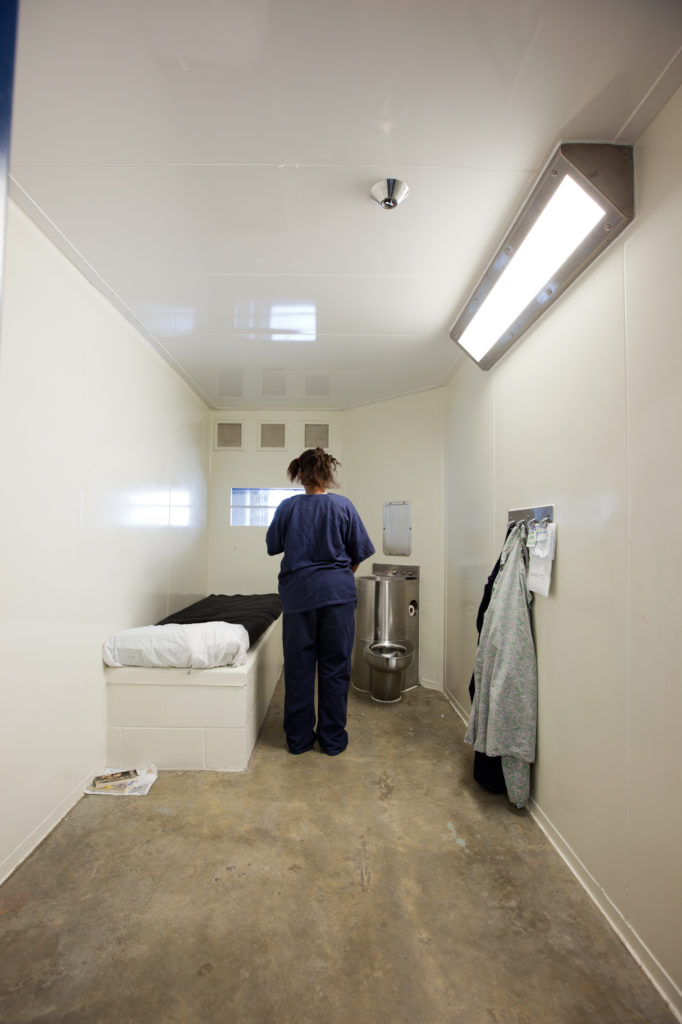
Exercise cages for prisoners at California State Prison, Corcoran

The Supreme Court handed down its decision this week on the California prison system. The decision, by Justice Anthony Kennedy, and the dissenting opinions, are riveting reading, from beginning to end.

The decision involves two cases. The first, Coleman v. Brown, concerns prisoners with serious mental disorders. The second, Plata v. Brown, concerns prisoners with serious medical conditions. The Supreme Court was asked to decide whether a lower court decision that mandated California reduce the size of its prison population should stand. By a 5 – 4 vote, the Court decided it should.

Many issues are engaged here. Is overcrowding the primary cause for the longstanding “needless suffering and death” that occurs in a system that has double the residents it is designed to hold? If California were not mandated to release prisoners, or otherwise reduce the prison population, would it do so on its own? Is the relief sufficiently `narrow’ to meet the legal requirements of `narrowly drawn’ and `no further than necessary’? Are the remedies imposed overly intrusive?

The public discussion has focused on overcrowding, but consider the grammar of Justice Kennedy’s argument. Here’s an example: “Because of a shortage of treatment beds, suicidal inmates may be held for prolonged periods in telephone-booth sized cages without toilets. A psychiatric expert reported observing an inmate who had been held in such a cage for nearly 24 hours, standing in a pool of his own urine, unresponsive and nearly catatonic.  Prison officials explained they had `no place to put him.’ Other inmates awaiting care may be held for months in administrative segregation, where they endure harsh and isolated conditions and receive only limited mental health services. Wait times for mental health care range as high as 12 months. In 2006, the suicide rate in California’s prisons was nearly 80% higher than the national average for prison populations; and a court-appointed Special Master found that 72.1% of suicides involved some measure of inadequate assessment, treatment, or intervention, and were therefore most probably foreseeable and/or preventable.’”

The situation for prisoners with serious medical illness is equally dire and cruel.

Overcrowding in California prisons has led to “serious constitutional violations”. But overcrowding is not the crisis. Overcrowding is the symptom. The two cases, Coleman v. Brown and Plata v. Brown, speak to the responsibility of the State to take care of the most vulnerable.

“A prison that deprives prisoners of basic sustenance, including adequate medical care, is incompatible with the concept of human dignity and has no place in civilized society. If government fails to fulfill this obligation, the courts have a responsibility to remedy the resulting Eighth Amendment violation.”

The California prison crisis is not overcrowding. The crisis is not the sum total and ratio of human bodies to square feet, of good and `bad’ beds to properly residential spaces, of toilets to hundreds of individuals, of medical care providers to mentally and medically ill. The crisis is human dignity. The crisis is sustenance. The crisis is responsibility. The prison crisis in California is a crisis of State and a crisis of society. It is a crisis of care. Care haunts the Plata v. Brown decision. Care haunts California. Care haunts us all.


(Photo Credit: James L’Etoile)


Who remembers the seven girls who died in Armadale?


The children of Jamaica are in crisis, especially the girls: “The Jamaican child is, more often than not, poor, barely educated, vulnerable to paedophiles, exposed to acts of crime and violence, at risk of being raped, trafficked, and of becoming pregnant. This, according to social workers and child rights activists who insist the State has failed its children.” Girls and boys share some of the crisis. The entire crisis and each part and element of the crisis targets girls.

Today is May 22, 2011, a mere two years since seven young girls were killed in a fire, on May 22, 2009, at Armadale Juvenile Correctional Centre, in Alexandria, St. Ann Parish, Jamaica. Seven girls were burned to death. Five died the night of the fire: Ann-Marie Samuels, Nerrissa King, and Rachael King, all 16 years old; and Kaychell Nelson and Shauna-Lee Kerr, both 15. Later, two more died from the fire: Georgina Saunders, 16, Stephanie Smith, 17. There were 23 girls in a small space. Sixteen managed to crawl through the fire, to the narrow windows, and out.

Armadale was shut down. An inquiry was launched. The Armadale Enquiry Commission met for over nine months. Its report roundly condemns the government. The fire was set by a spark from a tear gas canister, tossed in the room by a guard. The straw bedding ignited.

On March 2, 2010, Prime Minister Bruce Golding reported to Parliament. The Jamaican press reported then that the government “accepts `ultimate responsibility’ for Armadale.”

What qualifies as `acceptance’? What is `ultimate responsibility’?

In February of this year, the government accepted “financial liability.” This meant the State paid survivors. How much is a life worth? What is the value of pain and suffering? Who decides? Individual payment “is largely dependent on the extent of the injuries sustained by each girl.” The State says it is difficult `negotiating’ the settlement because many of the girls are in rural areas and because all of the girls are trying to put their lives together, are trying to live with dignity.

The payment is for the fire damage. Not for the inhumane conditions at Armadale at the time of the fire. The payment is for the event, the specific event, not for the situation. Nor for the `erosion of moral and ethical standards.” That remains intact.

The pain that continues is not only the pain of memory, of loss, of recognition. It also the pain that is administered by the State to children in prison every single day.

Children today are still in lock up, and often lockdowns, often in adult prisons. As of last month, more than 100 children were being held in adult cells.

Today is May 22, 2011, two years since the Armadale fire. There were no proclamations from the State, there were no memorials in the leading Jamaican papers. If there were ceremonies, they were private. The State has `accepted ultimate responsibility.’ It has washed its hands and declares them, and itself, clean. Who remembers the seven girls who burned to death in Armadale, and for how long will we remember?


(Photo Credit: The Jamaica Observer)

I’m a human. I know the fear

The governor of Texas recently declared a state of legislative emergency. The emergency is sanctuary. Cities in Texas are declaring themselves `sanctuary cities’ or are acting as such, and that somehow threatens Texas.

The Texas House of Representatives leapt to action and dutifully passed a bill, HB 12, that would effectively outlaw sanctuary zones. The moment the bill passed, House Representative Ana Hernandez Luna requested to speak to the body, as a matter of personal privilege.

Representative Luna explained that she, her sister, and her parents had come to Texas from Mexico. The family overstayed their visa and lived in the shadows until the 1986 amnesty was signed, by Ronald Reagan. In the intervening twenty-five years, Ana Hernandez Luna attended and successfully completed grade school, college, law school, and was elected to the House of Representatives at the age of 27.

Representative Luna began her remarks by articulating the new version of W.E.B. DuBois’ color-line: “I’m not an alien. I’m not a problem that must be handled. I’m a human.”

She then described the new, and not so new, world order: the politics of fear: “I remember the constant fear my family lived with each day.”

And then Ana Hernandez Luna found it difficult, impossible, to simply speak the words. Tears began to flow, as she struggled to speak: “The fear my parents experienced each day as their two little girls went to school – not knowing the there would an immigration raid that day – and they wouldn’t be able to pick up their daughters from school – and not knowing who would take care of them if that were to occur . . . . The daily task of going to the grocery store to buy groceries might seem a simple task to you, but to us it was a death sentence, that one of my parents may be deported. . . . I know the fear.”

The Texas Senate managed to gut the bill, but the fear persists. Twenty-five years after receiving amnesty, after twenty-five years of steady work and accomplishment, Ana Hernandez Luna still lives, immediately and viscerally, with the knowledge of the fear and with the fear itself.

The politics, and the politicians, of fear dream of a world without sanctuary. Some say that when it comes to prison reform, to addressing mass incarceration, money trumps civil rights. When it comes to children, whose access to `civil rights’ is already tenuous, fear trumps sanctuary. It’s a war zone.

Seven years ago, Else Temesgen and her daughter Betty, who was seven at the time, fled to the United Kingdom. Else was fleeing, first, an abusive husband and, second, a situation of certain separation. Else is Eritrean-born, and her daughter is Ethiopian-born, and so, if the two had returned to Ethiopia, the mother would have been deported. They arrived in England and immediately applied for asylum.

The two were detained in a variety of centers before, finally, receiving asylum. Else describes Yarl’s Wood as “very horrible.” Asylum only came because of the intervention of a prominent local politician. Otherwise, they would still be in the shadowlands of immigrant detention … or worse. They know the fear.

The politics of fear sows only tears. Twenty-five years after coming out of the shadows, Ana Hernandez Luna lives with the knowledge of fear, a shared knowledge, a knowledge whose borders are expanding, and weeps. Twenty-five years from now, how will Betty tell the story of her sojourn in Yarl’s Wood?

What exactly is the nation-State that would be threatened by sanctuary? Sanctuary is not an emergency. If anything, sanctuary is holy. Sanctuary is a time and space in which the human can be recognized and sustained. “I’m a human.”

Sanctuary haunts the State of fear.


(Video Credit: YouTube / Texas Impact)

Ashley Smith died while seven guards followed orders and watched


Ashley Smith

Ashley Smith was 19 years when she was allowed, or encouraged, to die. At the time, she was a prisoner of the Grand Valley Institution for Women, in Kitchener, Ontario, Canada.

According to the Canadian government, Grand Valley is in many ways a model women’s prison. Organized around cottages, allowing for maximal self-sufficiency, it fosters a sense of personhood and humanity through what might be called normative social contacts. Women prisoners are allowed a certain level of discretionary time, quiet time, social time, alone time.  According to a 2005 commission report, by HM Chief Inspector of Prisons for England and Wales, Grand Valley, or GVI, is a relatively open and `healthy’ prison, fostering “safety, respect, purposeful activity and reintegration”. It’s not perfect, it’s not ideal, but as prisons go, it’s pretty good.

When thinking of Ashley Smith’s story, remember that the place in which she was allowed, or encouraged, to die is one of the model women’s prisons in Canada and in the world at large. This is as good as it gets.

Ashley Smith was a `troubled’ youth, in and out of trouble for minor offenses. She needed help, and in New Brunswick, where her family lived, the public mental health system could not address her needs. And so, instead, she was allowed to go `into the system.’

In March 2002, at the age of 14, Smith was sentenced to one year of probation for harassing phone calls, assaulting strangers on the streets, insulting bus passengers and drivers. A year later she was ordered into a youth center for probation violations. There she underwent psychiatric evaluation that suggested borderline personality disorder, among other possibilities. She was released. Seven months later, while at home, Ashley Smith threw apples at a postal worker. For that she was returned to the youth center, where she spent most of her time in solitary. From then on, she stayed pretty continuously in prison.

In October 2006, Ashley Smith was moved to federal prison, for violations committed while in prison.  A year later, she hanged herself.

In less than a year, her last year on earth, Ashley Smith was transferred seventeen times, from Nova Scotia to Saskatchewan. Different prisons, same treatment.  Full body constraints. Shackles. Solitary confinement.

On August 30, 2007, Ashley Smith was returned to the Grand Valley Institution for Women.

During her time at GVI, Ashley Smith somehow made ligatures, strips of cloth clearly intended for self-harm. In a two-month span, fifty ligatures were confiscated. On September 24, 2007, Kim Pate, executive director of the Canadian Association of Elizabeth Fry Societies, visited Ashley.  At her request, Pate filed a grievance, pleading for release from segregation and transfer to a hospital.

Smith knew she needed help. She knew that segregation was a death sentence. She had spent almost the entire preceding eleven months in solitary confinement. That’s a cell 6 feet by 9 feet: no books, no mattress, no writing implements; often, no clothes. The prison calls it `therapeutic quiet.’ While in federal custody, Ashley Smith received much `therapeutic quiet’, but never a comprehensive psychological assessment.

Pate’s grievance was placed in a grievance box that is only checked once the box is full. The box never filled. In the meantime, Ashley Smith hanged herself.

Seven guards watched and did nothing. They did nothing because they had received orders, in September, to not intervene. Ashley Smith had attempted suicide on numerous occasions. If guards entered to stop her, their actions were considered `use of force’, and involved videotaping, paperwork, and hearings. Rather than waste resources, the prison instructed the guards to not enter as long as Smith was breathing. Once dead, it’s no longer use of force.

This week, almost four years later, the coroner’s court began its inquest. Psychologists argue that Ashley Smith did not commit suicide. She thought people would come to her. She was trying to get help.

Seven guards watched and did nothing, which is to say, they did a great deal. They followed orders.

And Ashley Smith struggled to get help.

There are `ghastly’ videotapes of Ashley Smith’s death. Some say, “Ms. Smith’s death should haunt Canada.” Indeed, it should. At the same time, it would be more apt to say that Ashley Smith haunts Canada and the world. Ashley Smith was sick, she needed help, tried to get help. How did the State respond? It condemned her to live in a box for her last year on earth in a box, preceded by an endless series of cages.

Seven guards watched and did nothing. They were not alone in doing nothing. Ashley Smith haunts everyone.


(Photo credit: UWaterloo.ca)

Where do the children live? Prison

I’ve been here for two weeks, and this is my third time in. I’m in the sixth grade. I was in placement but I ran away. They accused me of assault against my mom, but she scratched herself and said I did it. My dad lives in Atlanta and works in a barbershop. -E.Y., age 11 Juvenile Detention Center, Houston, Texas.

For the past forty years, the planet has been engaged in a global prison lockdown and a worldwide prison – building binge, which have resulted in the confinement of more women than ever before. This build up of lockdowns began in the United States in 1973, and has since blossomed, or mushroomed, into a global frenzy of incarceration of working class women of color and indigenous women.

The hyper-incarceration of women affects children, especially in those communities in which single women predominate as heads of households. The assault on children is more direct, however. At the same time that women, especially working class women of color and indigenous women, are being caged, their children are also being locked up as never before.

What is a child? A child is one’s offspring, a child is a minor. A child is a child, and tell me, where do the children live?

Given the prison boom, there are more offspring behind bars than ever before. Typically, the task and labor of maintaining social and sustaining contact is left to mothers, secondarily to female partners.  This is the lesson of Mothers Reclaiming Our Children, in California. When children are sent to prison, mothers are launched into a global reclamation and reconstruction project that, for many, never ends.

For example, Diana Montes-Walker’s son is an adult man in his 20s, living with bipolar disorder, complicated, predictably, by alcohol and drug dependencies. Equally predictably, her son `encountered’ the state criminal justice system, in this instance the California system. Ever since her son has been in prison, he has suffered one form or another of solitary confinement. Either he was in solitary in prison, or he was in solitary in so-called medical facilities that are actually prisons for inmates with `special needs’. In the latter, he is in solitary, but, according to his mother, with a little more freedom. He made it into the `better’ solitary confinement because his mother pushed, shoved, organized, shouted, wrote, met incessantly with everyone. And now, Diana Montes-Walker drives back and forth to scheduled meetings with doctors and social workers who don’t appear. And her son stays in solitary, and she has no idea how he’s doing.

Why is this happening to Diana Montes-Walker’s son, and so many others like him, young men and women living with mental disabilities and illnesses of one form or another? Why is he in prison? He is in prison because public mental health budgets have been shredded and then vaporized. Prisons are the new public mental health institutions. Meanwhile, Diana Montes-Walker, inhabits a State-sponsored hell, built because it’s more efficient to have her run around and take care of her son, more efficient and less costly.

Where do our children live? In prison.

In Turkey, close to 500 children live in prison with their mothers, who have been convicted. Why are they in prison? “Financial difficulties”.  For the children, three to six, there might be a kindergarten. For those under three years old, they spend the entire time in the cell with their mothers. These children are not in prison because of their mothers’ “financial difficulties”. They are in prison because of the moral and ethical bankruptcy of the State and because of the social structures that support that State.

Because of `financial difficulties’, Mississippi’s one juvenile detention center is run by a private corporation, the GEO Group. According to parents of the children being held there, the place is a horror, another State-sponsored hell. Fights break out, and the staff ignores calls for help and protection. Worse, the staff is accused of brutalizing children. Parents gaze upon their wounded and maimed children and feel a pain they describe as torturous. The lawyers describe the prison as barbaric and unconstitutional. The children describe the place as a war zone.

War zone is too nice a phrase for a place in which civilians are butchered for profit.  Child prisoners, children’s bodies and lives, bloat the coffers of private industry. They are an extractive resource whose market value continues to grow. Where do the children live? They live, and often die, in prison.

(Photo Credit: Richard Ross, Juvenile In Justice)

But tell me, where do the children live?

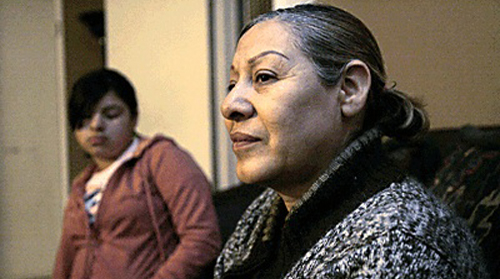
Maria Olvera with Valory, one of the two grandchildren she is raising in Altadena, Calif.

Where do children live?

Some children live at home. Sometimes, the families are their own extended families. Often they are their grandparents’ homes. Sometimes the parents have been taken by illness. Other times, the market has insisted that mothers and fathers travel extraordinary distances and stay away for long periods of time. And sometimes the parents have been deported.

Other children live in family homes that are worksites and worse. These children might be domestic workers, and they live as strangers in their own domiciles.

In Burkina Faso, for example, children, especially girls, work as street vendors, or hawkers, and as domestic workers.  Legally, domestic work is considered “light work”, and so children officially can begin working in households at the age of 15. In fact, children, mostly girls, begin as young as 7. Almost half of all children in Burkina Faso work, and proportionately the girls outnumber the boys.

The local Red Cross has a child labor project that is trying to help child domestic workers. Other local NGOs also are trying to help child domestic workers. How? The NGOs are offering girls training in cleaning and housekeeping, and, occasionally, reading, writing, and sewing.  The Red Cross is sending stern, `blunt’ text messages to government officials, employers, traditional leaders, teachers, business owners and housewives.  Here’s one example: ““Employers: domestics have the same rights as your children. Stop under-paying them; stop subjecting them to mistreatment, sexual violence, and long hours”.

Who are the children? They are typically described as children “from rural areas where there are few work opportunities”, and so they are sent, or some would say trafficked, to the cities, in this case Ouagadougou or Bobo-Dioulosso. They have the same rights as your children? Hardly. `Your children’ go to school. `Your children’ inhabit days and lives that aren’t measured by wage scales and work opportunities. `Your children’ are … your children, and their opportunities are the opportunities of childhood. These children are not `your children’. If they were, their situation would not be described in terms of lack of work but rather lack of school.

But tell me, where do the children live?

In the United States, one of every ten children lives with their grandparents. Close to three million children live with a grandparent or grandparents.  Close to three million grandparents are the primary caregivers to the children living with them.  Of the three million grandparents, 62%, or a little less then two million, are women. While the primary caregiver grandparents are disproportionately African American and Latina, the numbers are increasing, rapidly, among White grandparents as well. Of the primary caregiver grandparents, 65% are either poor or near-poor.

This development is considered a social trend. For Latina grandmothers, it is often complicated by another `social trend’: deportation. For example, Maria Olvera takes care of two of her grandchildren. Their mother, Maria Reyes, was deported, returned to Mexico, where she now lives, on the border in Tijuana. Their father died in 2008. Maria Reyes has four children. The other two stay with an aunt nearby. The four siblings come together daily, to encourage a sense of family.  Meanwhile, Maria Olvera is herself undocumented. A survivor of domestic abuse, she helped authorities locate and prosecute her abuser. Now she waits to see if she can obtain a U visa. Meanwhile, she has little or no formal rights or claims to the children.

And if Maria Olvera looks around, she will already know another `social trend’ that legal scholars are just beginning to discover and document: the deportation of grandparent caregivers, and in particular of grandmothers. Parents gone, grandparents under threat, where do you think the children live? Limbo.

The illegal but common child domestic workers of Burkina Faso, the grandchildren of undocumented grandparent primary caregivers in the United States, live formally, officially … nowhere. They are shadows. As nations design and implement so-called austerity programs, the world of shadow children expands as it grows more thickly populated. In the United Kingdom, for example, it is anticipated that, as a result of so-called austerity budget cuts, 300,000 children will be shoved into poverty. Like a bird, child poverty is set to soar.

But tell me, where will the children live?

(Photo Credit: Sarah Reingewirtz / San Gabriel Valley News Group /  El Nuevo Sol)

Let them eat pesticide

There are hunger strikes and there are hunger strikes.

For the past 37 days, six pro-democracy Iranian asylum seekers have been on a hunger strike outside the central headquarters of the United Kingdom Border Agency, in Croydon, in the south of London. Some had sewn their lips shut. Sewing one’s lips is minor compared to the torture all six had suffered in Iranian prisons. They had the medical evidence to prove the torture, and yet were initially denied asylum. Finally, today, after 37 days on hunger strike, the six refugees – Ahmad  Sadeghi Pour, Morteza Bayat, Keyvan Bahari, Kiarash Bahari, Mahyrar Meyari and Mehran Meyari – were assured their cases would be reopened and they would at least be able to apply once again. They ended the hunger strikes, and proclaimed the struggle continues.

Sometimes, hunger strikes save lives and secure at least the glimmering hope of something like justice.

Then there are the hunger strikes that are fatal and ferocious drone strikes, assaults on the body, community, and land. Globally, over 900 million people go hungry every day. That’s down from one billion the year before, but the prospects for the next year are gloomy. Food prices are on the rise everywhere. In fact, food prices are at a twenty-year high. In Asia and among Pacific island nations, food prices are skyrocketing and food `shortages’ loom large. For example, in the Philippines, thanks in large part to marketization and speculation, rice is suddenly both scarce and overly expensive.  Egypt is running out of food, as is the entire Middle East and North Africa.

But it’s not all bad news. Glencore, for example, is “a leading commodities producer and marketer.” Glencore is doing fine. Along with tons of mineral, literally, Glencore controls 10 percent of the world’s wheat, and 25% of the world’s barley, sunflower, and rape seed. Glencore takes, the world slakes. And then dies … again, literally.

Across the United States, two million men, women and children work on farms, picking by hand fresh fruits and vegetables. The US government estimates that every year 10,000 to 20,000 of those workers suffer acute pesticide poisoning.

In India, over the last sixteen years, 250,000 farmers have committed suicide. That’s one farmer every 30 minutes. And this number only includes the farmers who are acknowledged as such by the national government. Those who can’t hold title, they’re not included. Women farmers, Dalit farmers, Adivasi farmers: they don’t count in life, they don’t count in death. What killed these farmers? Indebtedness. Market liberalization. The invisible hand of the market, that hand which polished shining India, provided farmers with loans they could never pay but had to assume, with dwindling access to water, with impossible competitive demands. And so the farmers die.

And they leave behind notes, addressed to the Prime Minister, to the President, to all the lofty people who are nestled in the invisible hand that killed them.

And they leave loved ones behind. Widows. Children. Women like Nanda Bhandare, a farmer, a widow since 2008. When her husband killed himself, she had to pull her two young children out of school to work the farm. The money, if there was any, has gone to pay off the predators. The land, a small parcel, no longer provides sufficient harvest in the current economies to feed even a family of three. Who will be next to drink the pesticide in that household?

There are hunger strikes and there are hunger strikes. For every hunger strike that saves a life, even temporarily, such as that of the six Iranians in England, there are literally 900 million deadly hunger strikes. The planet is aflame with hunger strikes. Farmers are poisoned and are dying, women and children in particular are starving, and the response of the global market, and of the nation-States it supports and controls, is as it has always been. Let them eat pesticide.


(Photo Credit: http://indiatoday.intoday.in)


The State `honors’ mothers while abusing their children

Yesterday, Sunday, May 8, 2011, was Mother’s Day in many parts of the world. Mothers were celebrated and honored. How does the State `honor’ mothers?

According to a recent report by the Organisation for Economic Co-operation and Development, or OECD, inequality among OECD countries is rapidly growing. Starting in the 1980s, the United States and the United Kingdom led the way in growth-through-inequality. Then the movement spread. Today, it rules the vast majority of OECD countries. Those are countries identified as wealthy and developed. Growing structural inequality has come to mean developed.

How are women honored in this development model? “Since the mid-1980s, women’s employment has grown much more rapidly than that of men. But many women work part-time and earn less which explains part of widening earnings gaps among the workforce. On average across the OECD, the share of part-time employment in total employment increased from 11% in the mid-1990s to about 16% by the late 2000s”.

Women have entered or been forced, or some combination thereof, into the jobs market. Many countries have followed the United States model in which public assistance, or welfare, has been cut and limited. There’s less money and the restrictions, especially the time restrictions, are severe. This toxic storm strikes single mothers particularly hard. Remove all supports and then create a labor market in which those with low or limited educational qualifications must work part-time for practically nothing. Eliminate public services, such as childcare and extended school programs. Even out-of-school suspension policies assault all working mothers, and particularly low- and no-wage mothers, and particularly single mothers.

If the women complain or try to unionize, they are reminded that there’s no assistance out there, that all the jobs available for `people like them’ are pretty much the same, and that they are women, mothers especially, who have near catastrophic household, and community, responsibilities. They are not reminded that, in the United States, union women earn 34% more than nonunion women.  That information wouldn’t be prudent.

The same period, early 1980s to the present, has witnessed increased incarceration of children. In Australia, the immigrant and asylum detention centers have been  “factories for producing mental illness”, and have been broadly criticized for caging children of migrants, refugees and asylum seekers, sometimes for long periods. What is the State response? Cover-up. Privatize. Outsource.

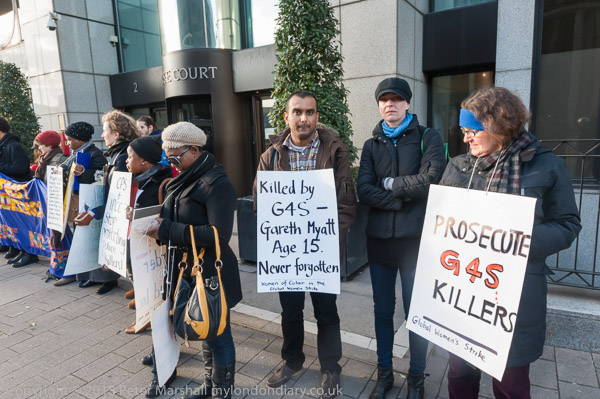
In the United Kingdom, children in custody die as a result of constraint methods.  One popular method is the tantrum hold, sure to result in injury 9 out of 10 times. In 2004, fifteen-year-old Gareth Myatt died of asphyxiation after being `tantrum held.’ Finally, an investigation into the constraint methods was conducted. That report was completed in May 2008 and presented to the government. What was the State response? Silence? Actually, it was worse in that it was more active. The State suppressed and hid the report. This Wednesday, three years later, the report will be made public.

In the United States, eleven states treat 17-year-olds charged with felonies as adults.  Illinois is one of the eleven states. A recent study of convictions in Illinois suggests that only 25% of the youths convicted with gun charges were ever actually identified as having the gun in question. In fact, of the cases studied, only 46% of them had any gun recovered.  Children were sent to adult prisons for gun possession in cases in which no gun was ever found, in cases in which the children in question were never identified as holding the gun in question. How does the State respond? The State legislature is debating a bill, right now, to reduce the age limit from 17 to 15 and 16, if convicted for gun possession. In Illinois, this is considered inclusion.

From Australia to the United Kingdom to the United States and beyond, the State incarceration of children and the State abuse of child prisoners is a direct assault on their adult guardians. Overwhelmingly, that assault targets women. Mothers. Grandmothers. Aunts. All of these women are mothers,  `a woman who undertakes the responsibility of a parent towards a child.”

Nation-States designed, or bought, economic development models that targeted vast numbers of women and children. The same States designed, or bought, justice programs that targeted vast numbers of women and children. Those State economic and justice models have devastated communities of color and low-income communities generally.

And yesterday those States honored women and celebrated mothers and motherhood? Rather call those State festivities `honor celebrations’, and invite them to sit at the same family table as honor killings. Mothers, and their children, can sit at other, better tables.


(Photo Credit: mylondondiary.co.uk)

In the steam room: 3 May 2011: Steamed and single but not rising to the top


The one thing you learn in the steam room, without the help of a teacher (an outdated word I know, but one which to my mind carries some sense of warmth and  responsibility, unlike educator which in South Africa, offers a cold and fictional professionalism- but that’s a whole other story), is that hot air rises. So if you are sitting on the top level, things can get awfully hot up there, an experience which can evoke untold overused metaphors of how hot it gets at the top. In linguistic kindness, I shall refrain. Few of us venture up there and when we do we tend to descend rapidly. So some weeks ago I was listening to a lecture (no not in the steam room, in the Senate Hall, a very prestigious place where everyone is dressed to the hilt so unlike the steam room) about African women and leadership. It was a brilliant piece of research, exceptionally researched and creatively presented. There were few surprises: there is very limited research in this area and that a minimal number of African women occupy positions of leadership and that these are primarily in the service sector.  And then the presenter threw in a seemingly small tidbit that perhaps I have intuitively known for some time: the majority of those women who do make it to leadership positions are either single or divorced. But having it said out loud to a huge hall full of people seemed to accord to it a sense of reality that I have hitherto avoided. Simply it meant that women who wanted to be executives had to make a choice: family or CEO? I have yet to read a story fictional or otherwise of a CEO breast feeding, taking kids to school, or even having husband and kids in the family portrait on the desk.  Nope, seems like this is not a possibility. Nor does it exist even in the realms of fiction or fairytale. Which means it is not even something we can create in our imagination. Nope, have not even dreamt this. So should we be bodacious and write our own “I have a dream…” story? Yep, I think so.

But then a few days later I was assaulted by another presentation which told me that 56% of South African households are single parent families, of course the majority of these are women headed households and that 79% of single parent homes are among African people and that more than half these families live in poverty. Ok so we have a huge number of single women, but they are going nowhere near the top. They would be lucky if they could simply keep their heads above the quagmire of unemployment, abuse and poverty. In the midst of all this bleakness I heard we are devising a Gender Equality Bill that may seek to enforce gender quotas with respect to positions of power in government and private companies. So how does this Bill live alongside the cultural anachronism of polygamy, the apparent reality that single women have a better chance of a successful career, that even if she is single and competent, the chance of being in leadership is small, that if she is married and has children, she can forget it, and the figures that show a huge number of South African women are bringing up their children without fathers. The mind boggles and the heart sinks!

In the hazy steam room I feel the heat but am bogged down by so many clammy forces that keep me from rising. There are many dreams we have yet to dream.

(Image Credit: David Guglielmo / Moneyweb)

Call them, simply, workers

Yesterday was May 1, 2011. Around the globe, millions marched. Among the workers marching were sex workers, domestic workers, other denizens of the informal economy. Today is May 2, 2011. What are those workers today? Are they considered, simply, workers or are they `workers’, part worker, part … casual, part … informal, part …shadow, part … contingent, part … guest? All woman, all precarious, all the time.

Categorizing workers as part of a somehow other-than-formal work force and work space naturalizes their exclusion and subordination. Why should they have full rights when they’re not full workers? Minimum wage? For `real’ workers, yes. For live-in domestic workers? Not yet.

Why should informal workers have full `protections’ when they’re not full partners in the social industrial contract? They didn’t sign on. They’re informal. How could they have? They were coerced, trafficked, seduced, forced into their current jobs. They must have been. Otherwise, how could they have accepted such abysmal working conditions? The logic is impeccable … and wrong.

Over the weekend, sex workers in South Africa and India brought the lie of the informal economy logic to light. In South Africa, three Cape Town sex workers are suing the State for harassment. They say they were repeatedly taken into custody and held for forty-eight hours, after which they were released without being charged. The three women argue that when they were arrested, they were not `on duty.’ They were not arrested as sex workers but rather as women who at some point or another have engaged in sex work.

This some-point-or-another is the main insight of The First Pan-India Survey of Sex Workers, a major study of sex workers in India, released on Saturday, April 30. Over the past two years, Rohini Shani & V Kalyan Shankar surveyed three thousand women sex workers from fourteen states.

They found that poverty and limited education matter, but not in the way many expect. Poverty and limited education push girls into labor markets early on, often at the age of six or so, but not into sex work. The largest principal employment sector for the very young was domestic labor. The majority of women waited until they were somewhere between 15 and 22 before entering into sex work. That means women had been wage earning workers, for nine to sixteen years before they entered into sex work.

Over seventy percent of the women said they entered sex work of their own volition. For the vast majority, income was the reason. Sex work pays better than domestic labor, agricultural work, daily wage earning or so-called petty services.

In other words, from the perspectives of the sex workers, sex work is one of a number of `livelihood’ options, as Shani and Shankar conclude: “Sex work cannot be considered as singular or isolated in its links with poverty, for there are other occupations as well which fit into the category of `possible livelihood options’ before sex work emerges as one of them. Sex work is not the only site of poor working conditions. For those coming from the labour markets, they have experienced equally harsh conditions of highly labour intensive work for very low incomes. It is from these background cases, that the significance of sex work as a site of higher incomes or livelihoods emerges.”

From South Africa to India and beyond, the sex worker story centers on the fluidity of identity. In South Africa, three women argue that sex work is a job. It’s not an identity, it’s not permanent. Like any other job, when the worker leaves work, she gets to become herself … again. As herself, she has rights, including the rights to dignity, security, and the preservation of freedom.

In India, the researchers learned that context counts. They had to accept women’s multiple work identities if they wanted to depict and understand women’s choices and situations. As women sex workers described their working lives, they moved fluidly among various occupations, often in the same time period. For Indian women struggling in an unforgiving economy, no occupation is an island entire unto itself.

South African sex workers suing the State, Indian sex workers discussing their lives have something to say to workers, trade unions, researchers, and allies everywhere. Sex workers are not like workers nor are they labor lite. They are workers. While it may be true that none of us is free until all of us are free, they tell us that none of us can talk about women workers’ freedom until all of us recognize the fluidity of women workers’ identities. But for now, as a start, call them, simply, workers.