Women bear the cost of federal prison overcrowding

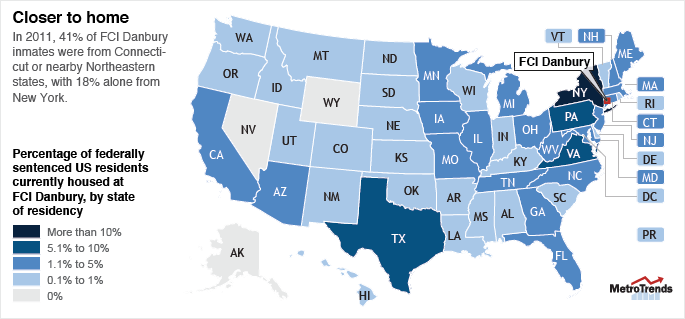
The Federal Correctional Institution (FCI) in Danbury houses low security female offenders and also has an adjacent satellite camp that houses minimum security female offenders…Mission Change: After nearly 20 years of housing a female inmate population, the Federal Correctional Institution is being converted back to a low security male facility.” Welcome to the Danbury Correctional Institution. Welcome to America.

This week it has been discovered that the United States Federal Prison system is dangerously overcrowded. According to Attorney General Eric Holder, “There’s been a tendency in the past to mete out sentences that frankly are excessive.” The Urban Institute released a terrific report, Stemming the Tide: Strategies to Reduce the Growth and Cut the Cost of the Federal Prison System, that argues forcefully for alternative sentencing, more judicial discretion in sentencing, shorter sentencing, and, generally, common and human sense, which is to say uncommon sense. Today, Charles E. Samuels, Jr., Director of the Federal Bureau of Prisons, asked the United States Congress for help: “We are facing significant challenges that are ultimately putting our staff at risk, putting prisoners at risk, and the community at risk.” What exactly is “the community”?

According to Samuels, “Most federal inmates (50 percent) are serving sentences for drug trafficking offenses.” The so-called War on Drugs has ballooned the Federal Prison population from around 25,000 in 1980 to 219,000 in 2012, which puts the United States in first place in the Amazing (Global Incarceration) Race. Despite some increase in federal prison spaces, the current overcrowding results, predictably, in impossible living situations, violence, and generally something between bedlam and mayhem. Plus, the exponentially growing prison population eats up more and more of the Federal budget. It’s a perfect vicious circle.

Missing from the week’s `discoveries’ of the dangers and risks and costs of prison overcrowding are women. So, here’s the story of the Danbury Correctional Institution.

In order to `meet the needs’ of prison overcrowding, the Bureau of Prisons decided to take all of the women in Danbury and ship them off to Alabama. The women are all “minimum and low-security offenders”. No matter. For the Bureau, it made sense to ship these women, and ship is the word, far from their families, communities, and support networks, to make room for the `real prisoners’. Men.

It took two months of heavy lifting by four U.S. Senators – Chris Murphy (D-Conn.), Kirsten Gillibrand (D-N.Y.), Patrick Leahy (D-Vt.), and Richard Blumenthal (D-Conn.) – and others to finally persuade the Bureau of Prisons to rethink the plan. Apart from the general social justice issue, Gillibrand and Leahy understood that closing Danbury as a women’s facility would have “nearly eliminated federal prison beds for women in the Northeastern United States”. It’s not a local Danbury issue or a Connecticut issue. Closing Danbury would have affected women, women’s families, women’s communities, across the entire northeastern United States. As Senator Murphy noted, “Being sentenced to federal prison is punishment enough. These women shouldn’t be punished again by being removed from their families.”

85 percent of the women in Danbury are not there because of violent or weapons-related `offenses’. 57 percent are drug offenders. They are low to minimum-security prisoners. Why punish them, specifically, doubly and so cruelly in this way? Because, for the State, women prisoners don’t count. The State traffics in women prisoners’ bodies. The value of those women’s bodies is their vulnerability, their collective and individual capacity to be treated like another sack of potatoes. Need more space? Take the women and ship them off. What difference does it or will it make?


(Infographic Credit: Urban Institute)
If faut arrêter d’enchainer les femmes!

Aux Etats Unis, dans le Wisconsin, en juin 2013, Alicia Beltran enceinte de 14 semaines ne pensait pas en se rendant à son rendez vous de suivi de grossesse que son cas servirait à lancer une action de justice pour enfin remettre en cause les lois fœticides et autres lois qui permettent d’envoyer en prison des femmes enceintes accusées de mettre en danger la vie du fœtus qu’elles portent.

Alicia Bretan s’étant sevrée d’une accoutumance médicamenteuse l’année passée, décide d’en parler à son docteur et son assistant pour plus de sureté. Au lieu de répondre à ses questions et inquiétudes, le cabinet de son docteur a appelé la police en vertu de ces lois qui donnent au fœtus le statut d’une personne, trahissant ainsi le secret médical et la confiance qui devrait être à la base de la relation patient – praticien.

Deux jours plus tard la police est venue l’arrêter à son domicile et a placé chaines et menottes sur poignets et chevilles. Elle fut ensuite conduite ainsi enchaînée au tribunal où une procédure expéditive l’attendait. Le fœtus était représenté par un avocat, mais Alicia Bretan n’avait droit à aucune assistance légale ou médicale. Le juge ordonna qu’elle suive un traitement de désintoxication, bien qu’aucune trace de drogue n’ait été trouvée dans les analyses réalisées après, bien qu’elle ait eu soin de veiller sur sa grossesse, bien qu’elle avait fait confiance à son docteur et à la société pour la respecter. A la suite de ce jugement les problèmes se sont accumulés pour Bretan et elle a finalement perdu son emploi, puisqu’il n’y a pas de garantie d’emploi pour les femmes enceintes aux Etats Unis. De plus, toute cette action en justice a sans aucun doute eu des effets néfastes sur sa santé et la santé du fœtus ainsi que sur son statut social et celui de sa famille présent et à venir.

Le Wisconsin comme le Maryland font partie des 38 états qui ont fait passer ces lois fœticides ; le Wisconsin, le Minnesota et le Dakota du sud se sont aussi dotés des lois dites “cocaïne mom“ qui expédient encore plus vite en prison les femmes enceintes qui auraient utilisé de la drogue. Enfin après toutes ces années ce cas a ouvert la voie à la première action en justice au niveau fédéral soutenue par deux ONG qui défendent les droits reproductifs des femmes  “The National Advocates For Pregnant Women et The Reproductive Justice Clinic ainsi que l’avocat de la plaignante Linda S. Vanden Heuvel. Il faut savoir que durant la dernière décennie le risque de se retrouver derrière les barreaux pour les femmes n’a fait qu’augmenter et en particulier pour les femmes enceintes.

Cette action en justice est la première du genre contre ces lois qui menacent les femmes et  les rendent légalement inferieures au fœtus qu’elles portent, tout particulièrement lorsque celles-ci sont des femmes de couleur, pauvres, bref socialement vulnérables.

L’an passé, une loi interdisant l’utilisation de chaines et autres moyens de contrôle sur les détenues enceintes a été proposée au vote durant la session de travail du parlement du Maryland. Etonnement cette loi a été rejetée.

Ces pratiques qui consistent à enchainer les femmes enceintes servent deux buts, d’abord elles rendent les femmes inferieures, les deshumanisant, et ensuite elles “déféminisent“ la société. L’année dernière le Maryland a abrogé la peine de mort, il serait temps pour cet état de joindre les 18 autres états qui interdisent cette pratique.

Espérons que cette affaire créera un précédent, Quoiqu’il en soit nous ne devrions pas oublier que l’argument pour ces lois fœticides était d’apporter une protection supplémentaire aux femmes enceintes ; en réalité en faisant du fœtus une personne elles avaient pour but de réduire et peut être même d’éliminer le droit à l’avortement  et le droit des femmes à contrôler leur corps. Les attaques constantes contre le corps de la femme sont une insulte au désir d’une société qui se voudrait plus juste et plus équilibrée.

Nous devons soutenir tous les efforts pour désenchaîner les femmes aux Etats Unis et ailleurs.

Stop sending children to prison!


In 2003, children started disappearing in Luzerne County, in northeastern Pennsylvania. By 2009, over 5000 had vanished, or more precisely had been disappeared. They were sold into juvenile prison system in what some call a kids-for-cash scam. In 2011, Judges Mark Ciaverella and Michael Conahan pled guilty to wire fraud and income tax fraud.

Over a period of five or six years, two private juvenile prisons, PA Child Care and Western PA Child Care, paid the judges to send over 5000 children to jail. Many were first time offenders. Some, like Edward Kenzakoski, committed suicide. Others, like Jamie Quinn, walked away. But all suffered harm. In 2009, the Pennsylvania Supreme Court voided almost all the juvenile convictions from 2003 on.

Recently, the two private detention companies settled a kids-for-cash civil suit, agreeing to pay $2.5 million in compensation. It’s estimated that the companies had paid the two judges $2.6 million, and so there’s a kind of tragic elegance to the number, except that there is nothing elegant in this story.

In 2011, the kids-for-cash story seemed like a horror, a nightmare. Now we know it’s the tip of a global iceberg. Across the United States, and beyond, nation-States have decided that the best place for children is prison. Often, that prison is one for adults.

For example, the City of New York Board of Corrections just released a report, entitled “Three Adolescents with Mental Illness in Punitive Segregation at Rikers Island.” The report follows three boys, Jimmy, Matthew and Carlos: “This report describes the life and jail experience of three mentally ill adolescents who were each sentenced to more than 200 days in punitive segregation at Rikers Island. Mentally ill adolescents in punitive segregation merit special attention because they are the most vulnerable prisoners in custody. New York State is one of only two states in the country where all 16‐ and 17‐ year‐olds are under the jurisdiction of the adult criminal justice system regardless of the offense. In New York City jails, all 16‐, 17‐, and 18‐year‐olds are deemed “adolescents” and are housed separately from adults. Adolescents make up approximately 5% of the average daily population of prisoners at Rikers Island. A recent one‐day snapshot of the jail population showed that almost 27% of the 586 adolescents at Rikers Island were in punitive segregation, and roughly 71% of those in punitive segregation were diagnosed as mentally ill.”

What was their crime? They were children living with mental illnesses. What was their treatment? 200 days in `the box’.

In Texas this week, reports emerged of staff violence against inmates in the Phoenix Program, which was designed to reduce the violence in juvenile facilities. The reports suggest that the violence is both widespread and extreme. How does the State respond? A few staff members are fired, a few `disciplined’, and then back to business as usual.

The private juvenile prison industry and the public juvenile prison industry expand, arm in arm in arm in arm. The State absolves itself of oversight, and children are maimed and broken, in so many ways. Across the country, the rate of girls being incarcerated rises precipitously, and little or nothing is done to attend to the particularities of girls behind bars.

This situation is spreading, and not only across the United States. In certain neighborhoods and communities, particularly communities of color, in the United Kingdom, a night, or more, in detention is a default response to pretty much any whiff of `a problem.’ According to a recent report: “Fifteen per cent of the total number of overnight detentions in 2010 and 2011 were of girls. This is a surprisingly high percentage as girls generally represent less than 5 per cent of criminal sentences.”

Stop sending children to prison. Stop sending children to `overnight detention.’ Stop sending children into solitary confinement. Stop the torture of children.


(Image Credit: Prison Culture)

Stop shackling pregnant women!

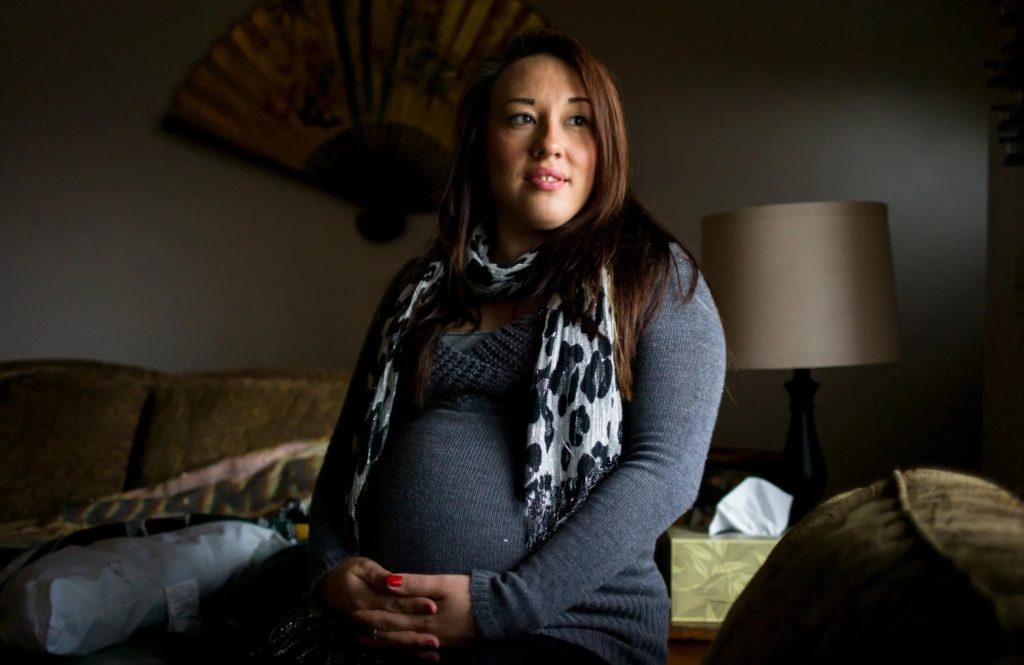
Alicia Beltran

In Wisconsin, Alicia Beltran, 14 weeks pregnant, went for a prenatal check up to make sure that everything was going to be well. She explained to the PA in her doctor’s office her concerns. One was a pill addiction that she had actually ended a year earlier. Instead of addressing her concerns, her doctor’s office betrayed her trust and the celebrated code of confidentiality between patients and doctors, supposedly the basis of medical practice. They called the police. Two days later, the police came to Beltran’s home and shackled her. She was rushed to court handcuffed and shackled, where she was denied access to a counsel but where a lawyer was already assigned to represent her fetus. Then, she was ordered into a drug treatment program although there was no trace of drug in her body, although she was taking care of herself, although she had trusted her doctor and society to respect her as a person. For Beltran, the consequences of this abusive treatment are dire. They include losing her job. In fact, the state has endangered her health, the health of her fetus, her social status and the well being of her family, current and future.

Wisconsin is one of 38 states, including Maryland, that has passed so-called feticide laws. Three states – Wisconsin, Minnesota, South Dakota – have passed “cocaine mom” laws, and that’s what happened to Alicia Beltran. Finally, the first federal lawsuit to challenge these laws has been filed by The National Advocates For Pregnant Women, the Reproductive Justice Clinic of New York University School of Law, and Linda S. Vanden Heuvel, Alicia Beltran’s lawyer. This threat to pregnant women has been on the rise as more women are thrown behind bars.

The lawsuit is the first to challenge these laws that are threatening women for being less than the fetus they carry, especially when they are women of color and/or poor, in brief socially vulnerable.

Last year, a bill was introduced in committee in the Maryland legislature. If passed, the bill would have put into law a ban on shackling pregnant inmates. Surprisingly, or not, the bill was defeated.

These practices of shackling pregnant women serve two purposes. They render women as less than human and they “de-womanize” society. Last year, Maryland repealed the death penalty. It is time for Maryland, and all states, to show real commitment to women’s rights and women’s equality.

Hopefully, Alicia Beltran’s case will set a precedent. Whatever comes out of the suit, we should not forget that feticide laws were presented to protect pregnant women. In reality, by creating the fetus as a full person separated from the woman’s body, feticide laws have one purpose:  to reduce, and ultimately eliminate, Roe v Wade and its guarantees of women’s right to decide for themselves. External control of a woman’s body is an assault on the dream and the possibilities of a society with more equality, better distribution of wealth, and richer harmony. We need to support all and any efforts to “de-shackle” women.


(Photo Credit: Feministing / The New York Times)

A right is a right: women have the right to contraception and abortion

The role of a government is to inform the population of its rights said Najat Vallaud-Belkacem, France’s Minister of Women’s Rights and Gender Equality, to a gathering at the Planning Familial center in Paris. Vallaud-Belkacem was there to unveil the new government information website on abortion. Since the passage of the Simone Veil bill in 1975, abortion has been a right in France.

Nonetheless, many in France, noting the shattering of reproductive rights in many countries throughout the world, don’t want to take any risk. Without much increase in their numbers, the anti IVG (anti abortion), as they are called in France, has managed to occupy a disproportionately large chunk of cyber space, by using deceptive sites that simulate abortion right sites. These sites mislead women in search of information concerning abortion procedures. They try to make women feel guilty as they spread rumors about the danger of abortion.

Isabelle Louis, the president of Planning Familial for Paris and its region, hosted Najat Vallaud-Belkacem.  Although only a few journalists showed up, Louis said, “the event went well. The Minister appreciates the work that we at Planning Familial do in support of women’s rights and she was clearly comfortable. At the same time, she delivered a crucial message for us, that is to say that abortion is not a service to women, it is a right; and that it was important to assert that this right is fully supported by the government.”

Control of the body is critical for women to fully participate in the society. Isabelle Louis emphasized that contraception and abortion are a real means of emancipation for women. She added, “In contrast, what tires me  a great deal are the journalists’ questions. Instead of problematizing this issue, they only carry out the discourse of the anti-IVG (anti-abortion) with stupid questions asking if this website is going to encourage abortion. It is worrisome to see that we are in a society that does not allow itself to think and reflect but is just good at peddling ideas as if they were equivalent. As if the ideological words of the anti (anti abortion groups) were equivalent to a state that affirms the rights of women.”

Every journalist present at the event asked that question, including journalists from leftist newspapers. Isabelle Louis reminded them that “women are not stupid. If they go to this site, it is because they want information about abortion. We must stop thinking that women are completely bewildered by what is happening to them.” Moreover, the woman who had written to the Minister to complain about the deceptive websites was present. Her alerts pushed the Minister to take action to clarify the situation. As the Minister explained, she does not want to encourage anything. Rather, the role of a government is to inform people of their rights. The Minister’s message was clear; she relocated the question of abortion and reproductive rights in its proper context: public rights and public service.

The control of the woman’s body is key to women’s full participation in the world. In the United States, Senator Elizabeth Warren recently denounced the blackmailing by Republicans who want to “change the law so that employers can deny women access to birth control coverage. In fact letting employers decide for the women if they can get birth control covered on their insurance plan is so important that the Republicans are willing to shut down the government.” At a time when the right to an abortion is threatened and denied in many states, we wish that reproductive rights would appear as a moral and governmental responsibility rather than as a political game.

The French Minister of Women’s Rights and Gender Equality is rightly defending those rights. A right is a right: women have the right to contraception and abortion.

(Written by Brigitte Marti, with Isabelle Louis, the President of Planning Familial Paris and its region)

Léonarda Dibrani: Not Kosovar enough either!

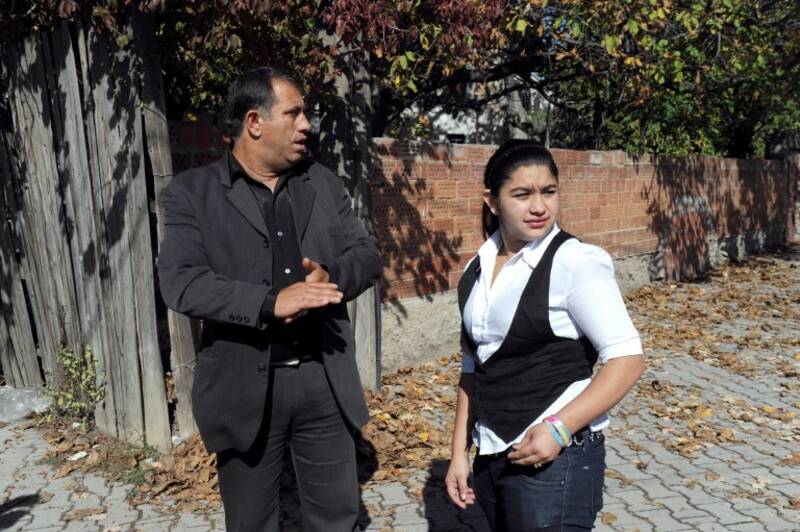
Léonarda Dibrani and her father in their temporary residence in Kosovo.

On October 16th, Léonarda Dibrani and her family were attacked in the street in Mitrovica in Kosovo, a week after their deportation from France on October 9th. Agence France Presse said that the Dibranis were walking in the streets of Mitrovica with their children when they were attacked by strangers. Then the story changed, and “they” were not strangers but people involved in a private dispute. Either way, a policeman who remained anonymous said “it demonstrates that the Dibranis are not safe in Kosovo.”

Actually, the Kosovar authorities are quite embarrassed since none of the Dibranis are from Kosovo, except for the father. The mother and most of the children were born in Italy. The younger girl was born in France.

The father admitted to having lied because he thought that declaring Kosovar origins would give them documentation to remain in France more easily.

This story brings to light the question of documentation, proper or not, that allows life with less stress and anxiety. For Léonarda and her brothers and sisters, life was going to school in France. Ever since her arrest and deportation, her teachers have been mobilized to denounce this particular situation, the end of her life in France.

Léonarda’s story is symbolic of asylum rights, say the high school French union and Reseau Education Sans Frontiere (Education Without Borders Network). Their demonstration in Paris numbered 7000 people, students and teachers who demanded that the socialist government respect the people who are in France and stop deporting undocumented students. The `Léonarda affair’ shows how the Roma population has been stigmatized at a time when borders have different meanings, whether we are talking about financial profits, military armaments, or people.

The demonstrations in Paris were supported by many personalities from the same party as the Minister of the Interior Manuel Valls, who is accused of continuing the inhuman immigration policies of the previous President Sarkozy.

President Hollande promised to overturn some Sarkozy’s policies. He did extend the right to work in France after having completed studies in France. He stopped to stop prosecuting people who help undocumented immigrants. He also said that his government is working to stop the imprisonment of asylum seekers. It is time to change all the policies and to defend the humanistic values that the socialists claim to have.

This debate should not be only about France, or Europe. It has to occur everywhere as the neoliberal free-market order works to destabilize populations throughout the world. Léonarda Dibrani: not French enough, not Kosovar enough? Human enough?


(Photo Credit: Liberation / AFP)

Léonarda Dibrani: Not French enough?

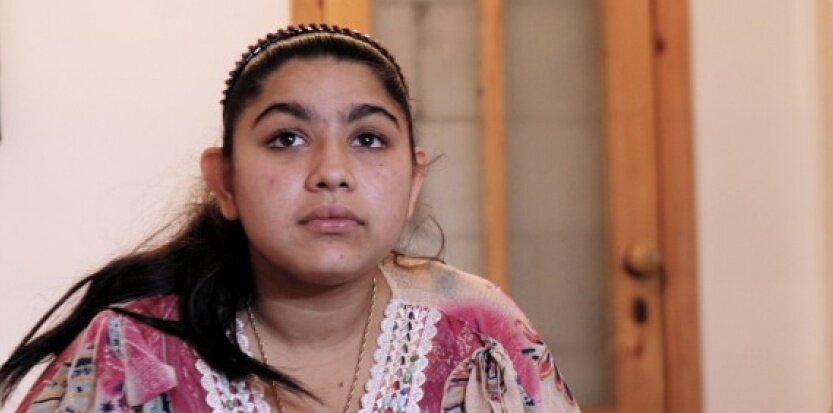
Léonarda Dibrani

A couple weeks ago, Léonarda Dibrani, a fifteen-year-old girl, was with her class on a field trip. Léonarda lived with her Kosovar Roma family in eastern France, in Levier. The Dibranis had applied for asylum years earlier. In the meantime, Léonarda went to school, grew up, made friends, and integrated herself into the community. Basically, Léonarda became French.

But not French enough. While on the field trip, police stopped the school bus, asked the fifteen-year-old to get down, and then took her away. With her family, she was immediately deported to Kosovo, a place she doesn’t know, a place whose languages she doesn’t speak.

And so now, Léonarda sits in Mitrovica, in Kosovo, gives interviews and pushes to return to Levier, to France, to her school, to her friends, to her community.

Meanwhile, as the adults dither about whether Léonarda was taken `properly’, because apparently there are strict rules for State abductions of minors; about whether the Interior Minister is still `of the Left’; about whether the Left is still … the Left, the high school students have taken to the streets in protest.

Across France yesterday, thousands of high school students marched, shouted, demonstrated, closed schools and boulevards. Their message? “Documented or undocumented, they are like us. They are students!” “They” are Léonarda and Khatchik Kachatryan, a 19-year-old Paris student who, on Saturday, was deported to Armenia.

High school students said clearly, “These deportations touch people just like us.” They argued that education is a universal human right, not merely a civil right bestowed by any particular nation-State. They look at Léonarda and Khatchik and, rightly, see themselves.

The high school students of France are arguing, and demonstrating, for the sake of humanity. As the story develops, more details will emerge that will serve to complicate and obfuscate the simple truth of the students’ message: We are all humans, and no human being is illegal.

Like so many other children, Léonarda Dibrani was abducted by the State. No list of rules followed will alter that. Let’s hope the State hears and listens to its schoolchildren and returns Léonarda, Khatchik, and so many other children to France, to their homes and to their friends … now.

Cleaning worker Julia Hidalgo is showing us the university-to-come

Julia Hidalgo

Every summer, workers clean the dormitories of George Washington University in Washington, DC, to prepare for the following school year.  This past summer, Julia Hidalgo was one of those workers.

Julia, along with other workers who employed by the company BRAVO! Building Services, contracted by GW, cleaned three of the largest dorms on campus.  One of these dorms, Thurston Hall, has a well-documented cleanliness problem due to GW administrative neglect: exposed pipes, dead bugs, and cramped quarters that repeatedly cause fire injuries to students.

Cleaning these dorms was surely no easy task for Julia and the other workers, who had to work 12-hour shifts for two weeks.  After putting in those hours, BRAVO! fired Julia and every single one of the GW cleaning workers they had hired in May.

After these many hours of labor—many of which were overtime—Julia and the rest of the GW cleaning workers waited for their paychecks, which never came.  Days turned into weeks, and still BRAVO! did not pay the workers their money.  Julia had wanted to spend her paycheck on childcare for her fifteen-month-old daughter, but could not.

Eventually, the GW cleaning workers took action.  Julia writes:

For weeks, we repeatedly showed up asking for our paychecks, but BRAVO! refused. Left with no other options, we took our story public. Many of us were afraid to speak out, worried that it would impact our chances at future employment. But we stuck together.  It was only after we held a public demonstration on GW’s campus that the company finally agreed to pay us for hours worked. In total, they made us wait six full weeks before offering us our paychecks.

Six weeks is a long time to wait for payment, and many workers had to take out loans to survive until they could get their checks.  Julia and the other GW cleaning workers (whom, as student organizers at the university point out, are mostly women) are leading a fight to get the money they deserve.  The workers are demanding the legally mandated compensation for the time they have spent without their back pay.  They are demanding that BRAVO! and GW respect and value them, their work, and their time.  In response to BRAVO! and GW ignoring them, the workers have started a petition demanding their proper compensation.

The fact that the GW cleaning workers are organizing to reclaim their wages matters, because women worker organizing matters, especially in universities.  Women workers in universities, many of them women of color, experience some of the worst working conditions, whether in cleaning, in food service, or in teaching.  Organizing against wage theft means building power for women workers in precarious job conditions.  This organizing also matters because corporate universities routinely hyper-exploit women in all areas of the university, including students who have survived sexual assault.  Organizing encourages coalition building among often-unlikely partners, especially students, faculty and custodial staff.

Julia Hidalgo and the GW cleaning workers are showing us the university-to-come, where education does not depend on exploitation.  The rest of us must do our best to make sure we keep that struggle moving forward.

Please sign Julia Hidalgo’s petition to demand that BRAVO! Building Services pays the GW cleaning workers the wages they are owed.  You can find the petition here: http://www.coworker.org/petitions/bravo-cleaners-pay-us-what-we-re-owed


(Photo Credit: GW Hatchet)

The Right to Know is the Right to Live … in a democracy


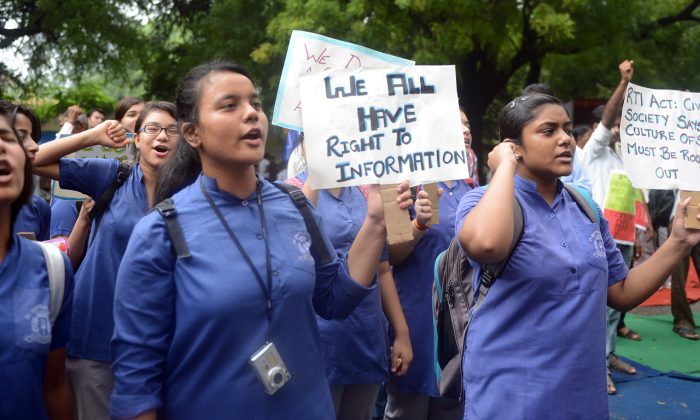
In the late 1980s, three activists – Aruna Roy, Shankar Singh and Nikhil Dey – moved to a village in Rajasthan, in the northwest of India, and set out to live by Gandhi’s precepts. The plan was simple, ie to live simply. Out of that simple plan emerged, first, the “people’s organization” Mazdoor Kisan Shakti Sangathan, “Movement for Workers’ and Peasants’ Power”, or MKSS. MKSS has been at the forefront of India’s Right to Information, Right to Work, and Right to Food movements, and they’ve had a stunning record of accomplishments, based broadly and deeply in the works and days of poor rural women.

What Roy, Singh and Dey found in Rajasthan is common enough. An agricultural zone, mostly single crop, relied on rain for survival. When the rains didn’t come, as happened often, the men went off to find work and the women stayed behind. The men sent money, but it was seldom enough and irregular. So, the women had to find work and wages where there was none.

And so the women of Rajasthan organized, with and across the MKSS, and with Aruna Roy pulling, pushing, leading, following, listening, talking, organizing. After a long and mighty struggle, they won. In 2005 the Indian government enacted the National Rural Employment Guarantee Act, or NREGA. NREGA assures rural workers 100 days of paid employment, at minimum wage, in every fiscal year.

It was a major victory, especially for rural women. The only problem was wage theft and general corruption on the part of employers, both private and State. Again, what happened in Rajasthan is a common enough story. The women rejected and rewrote the master narrative.

They understood that the Right to Know is the Right to Live. They understood that part of their suffering and super-exploitation came from the fog at the contracts’ end. And so, under the banner of MKSS and with the leadership of Aruna Roy, they pushed. They rejected their `destiny’ of ignorance and submission, and demanded to see village records. And, again, they won. They won the right to know and the right to live.

Today, across Rajasthan, the information is in plain sight … literally. Across hundreds of thousands of walls, village governments are required to paint all of their budgetary decisions and contractual arrangements. It’s some of the best and most exquisite graffiti in the world.

Aruna Roy and her colleagues didn’t stop there. Once the information was available, they pushed for social audits. According to the Indian government, “Social Audit is an independent evaluation of the performance of an organisation as it relates to the attainment of its social goals. It is an instrument of social accountability of an organisation. In other words, Social Audit may be defined as an in-depth scrutiny and analysis of the working of any public utility vis-a-vis its social relevance. Social Auditing is a process that enables an organisation to assess and demonstrate its social, economic and environmental benefits. It is a way of measuring the extent to which an organisation lives up to the shared values and objectives it has committed itself to. It provides an assessment of the impact of an organisation’s nonfinancial objectives through systematic and regular monitoring based on the views of its stakeholders. Stakeholders include employees, clients, volunteers, funders, contractors, suppliers and the general public affected by the organisation.”

Who are stakeholders? Everyone … equally. That’s the women’s point. 100 days of employment is neither charity nor welfare. It is part of shared values and objectives, and it’s not lodged in some impossibly complex cloud. It sits right in front of everyone, and everyone can and must evaluate its social relevance.

The social audit is, or can be, democracy in action. For MKSS, it involves obtaining information, through participatory research, and then holding meetings in which all stakeholders attend, and then finding out what’s going on and whose responsible. The State of Andhra Pradesh has led the way in social audits, training and sending out thousands of researchers to engage with millions of residents, often door-to-door. The program is now being considered for national implementation.

At some level, all of this began with three people moving to a village in order to follow Gandhian precepts. At another, it’s about the feminist Aruna Roy and the millions of rural women, first in Rajasthan and now across the country, who refused to be left out or written out, who organized, over decades, for a feminist understanding of democracy as a shared social engagement that is open and available to scrutiny and intervention. The Right to Information is the Right to Live … in a democracy.

(Photo Credit: RAVEENDRAN / AFP / Getty Images / The Epoch Times)

This State of Killing and Abandonment

Although I wrote this piece about three months ago, I would like to dedicate it to the memory of Miriam Carey, an unarmed, possibly depressed, Black woman who was killed by police in Washington, DC on October 3, 2013.  Investigators called her life “typical.”  As we mourn Miriam, let us organize to overcome the violence of ‘typical’ State-sponsored death.

The forty-eight hours of June 25 to June 26, 2013, were filled with killing and abandonment.

On the evening of June 26, Texas performed its 500th inmate execution since reinstating capital punishment in 1976.  Texas executed Kimberly McCarthy, a Black woman convicted of murdering her white neighbor, Dorothy Booth.  Though a judge originally delayed the execution due to evidence of racism in the court proceedings, eventually the judicial process played out, and now McCarthy is dead.  After McCarthy’s execution, Booth’s son was quoted as saying, “We’re just thinking about the justice that was promised to us by the state of Texas.”

What does it mean when the State promises justice?  It means that an exchange must take place.  The State will bestow justice onto a wronged person, and in exchange, the State wants blood.  The State promises justice, and justice comes in the form of the lifeless body of a Black woman.  Justice comes in the form of State violence against women of color.

Perhaps this view of how justice plays out in the United States—as an exchange that ends in State violence—sounds melodramatic.  But in the United States, women, especially women of color, make up the fastest-growing segment of the population being incarcerated.  Incarceration comes with violence.  It can be the violence of capital punishment, or just the daily violence of enduring imprisonment: solitary confinement, assault, lack of adequate health care, and unpaid or low-paid work, among other abuses.  Regardless of the specific violence, the American justice system is carceral, the violence is ordinary, and someone always has to pay, to do the work of payment.

Just a day before the State killed Kimberly McCarthy, the Supreme Court invalidated Section 4 of the Voting Rights Act.   This invalidation means that certain state governments (including Texas) that have histories of passing discriminatory voting rules would not be subject to federal government preclearance for any further changes to those rules.  What does this mean at the everyday level?  People will lose their right to vote—and have already lost their right to vote—simply for being themselves due to the enactment of voter ID laws.  People of color, especially women of color, youth, the elderly, and transgender people, will pay the highest price, literally.  To get a new ID to vote because you do not already have one or because you identify as a different gender than previously  means paying hundreds of dollars for both the identification card and transportation.  If you cannot afford to pay this poll tax, you cannot vote.

What is the logic behind this invalidation?  First, the State constructs a crisis: if too many people of color vote, there must be voter fraud.  Never mind that voter fraud rarely occurs in the United States.  Then, the State ‘solves’ the crisis: it repeals laws that protect voting rights and enacts new discriminatory laws.  Meanwhile, the people most affected, like Black women, must labor to protect their rights where the State has abandoned them.  They must do the work of buying new ID’s, of navigating new institutional barriers, and work to organize against a racist and sexist system.  And the State says justice has been served.

In forty-eight hours, people in the United States saw the State both kill and abandon.  Both processes target marginalized populations that the political-economic system produces as worthless.  We are left with an increasingly violent State, bent on extracting as much value from marginalized people as possible, and distributing that value to those who already possess so much.  We end up with more violence and work for the marginalized and less work for the already rich and powerful.  Then the State declares that we are a nation with justice for all.

So when some question why the United States’ political system does not ‘work’ for so many people, the answer seems painfully obvious: it is violent.  This violence lies in the fast and slow deaths of those the State deems valueless.  It lies with a conception of justice where someone always has to pay with their blood or time.  It lies in an economic system where people work harder and harder for a future of less and less.

Organizing against violence and for a political system that works for all requires more than minor tweaking of State policy.  We all must be brave enough to organize, do research, make alliances, and combat the systemic violence around us, as well as do the work to care about each other in the process.  Against killing and abandonment, organized care must triumph.


(Photo Credit: David J. Phillip / AP)