The death penalty is violent, unjust and should be abolished

Last week, with almost no debate, the Utah State Senate adopted a bill, 18 – 10, that will allow the use of the firing squad, if drugs were to be unavailable 30 days before scheduled execution. Utah used the firing squad in 2010 to execute one person. Wyoming is examining a similar legislation. The 32 states that still have the death penalty are now looking at this method of the past to continue executing people currently on death row.

In the spirit of innovation, the lethal injection was introduced to remedy the question of suffering in the application of the death penalty, ignoring all kinds of emotional suffering. With the Eighth Amendment prohibition against cruel and unusual punishment, lethal injection was developed after the veterinarian techniques of euthanasia and was first experimented in Texas in 1984. This method carried the promise of modernity with the help of medical-technology imagery, making the death penalty appear different than in China, Iran or Saudi Arabia, some of the other major countries using the death penalty.

In the United States the delusional belief that there is a method of killing that could be “humane” with no suffering is reinforced by the populist imperialist discourse. Supporters of lethal injection pretended that it was humane because of the anesthetic that is injected first. This reflects a limited view on what suffering means. Nonetheless, a study published in The Lancet recognized that the procedure for killing inmates was less rigorous than those recommended by the Veterinary Medical Association. The concentration of anesthesia received by the condemned during the lethal injection was lower than required for surgery in 88% of the cases. In 43% the level was so low that the inmates must have had awareness of the asphyxiation, burning and the massive muscle cramping which are the three episodes that the products used for lethal injection entail. With the blockage of delivery of some of these drugs by European laboratories on humanitarian grounds, States began playing the sorcerer’s apprentice at the expense of respect for human dignity.

In 2014 the number and intensity of botched executions attracted more national and international attention. In Arizona, Joseph Wood was pronounced dead one hour and fifty-seven minutes after the beginning of the process. In Oklahoma, Michael Wilson screamed that his body was burning. As a result many states passed “secrecy laws” to allow themselves not to disclose the nature or sources of the drugs they were going to use.

And now a number of states are considering and passing laws to allow former methods that used to be considered barbaric, from the firing squad and the gas chamber to the electric chair. All these methods demonstrate that there is a distance between justice and the death penalty, as the executioner and the penal system are removed from the actual death of the prisoner.

Last spring, the American Academy of Sciences published a study showing that 4.1% of the people on death row are innocent. Consider the recent killing of Troy Davis whose prosecution consisted of incoherence and inconsistency. Nevertheless, the State asserted its dominating power, using the racially vindicating desire of vengeance of the family of the victim as Troy Davis was African American and the victim was white. As with Kelly Gissendaner whose execution is still pending, Davis’ sentence demonstrated that the state is not concerned with a true notion of justice or rehabilitation but rather is the diehard instrument of populist domination within an increasingly inegalitarian society.

Some states have freed themselves from the death penalty. The death penalty should simply be outlawed at the federal level, instead of leaving populist assemblies free to chose more heinous instruments of death. As Cesare Beccharia wrote in Of Crimes and Punishments in 1764, “If I prove that this sentence is neither useful nor necessary, I would have caused the triumph of humanity”.

(Image Credit: The Atlantic / ycaradec / Flickr)
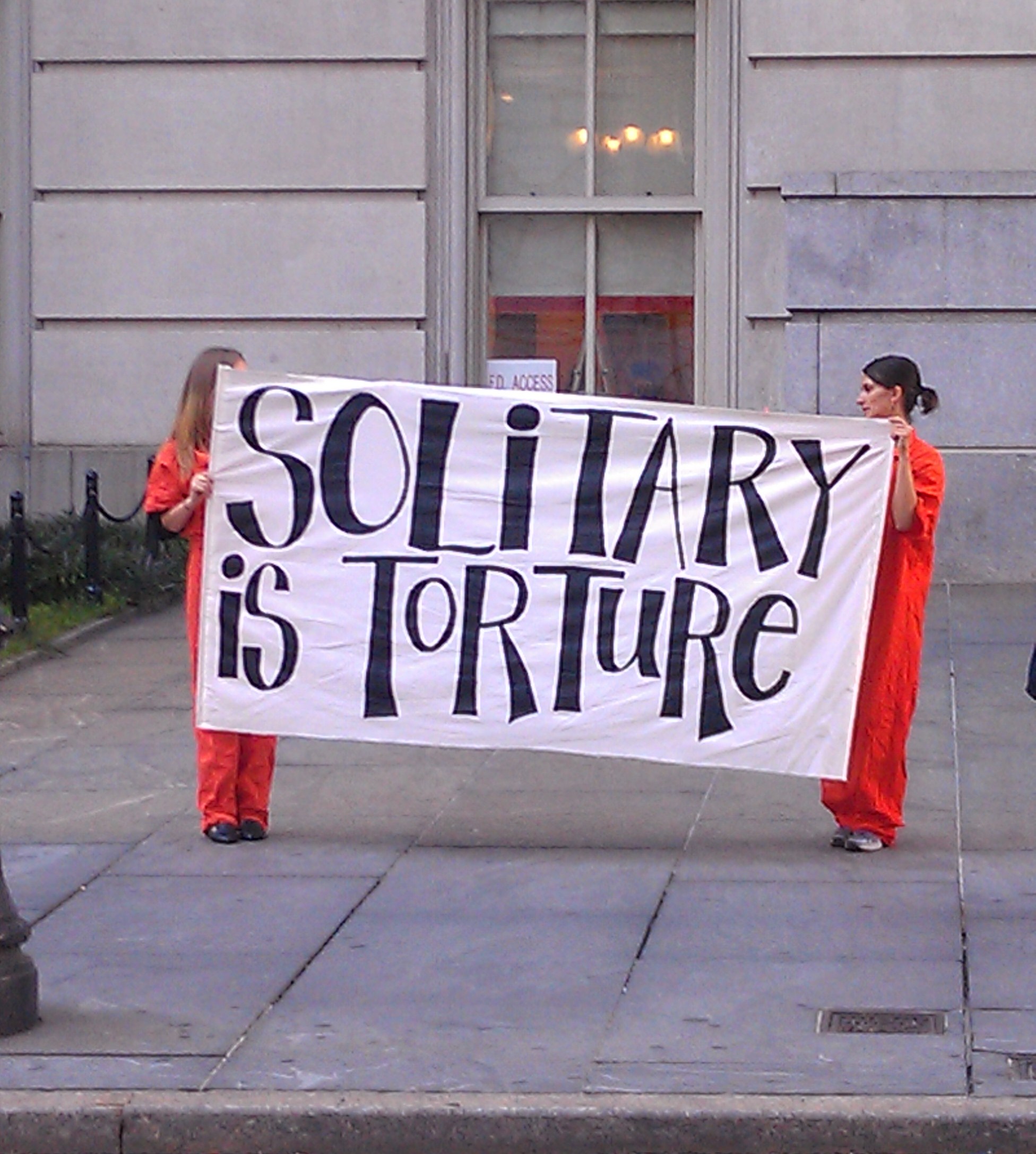
The United States built a `special’ hell for women, USP Hazelton


In 2012, under pressure led by Illinois Senator Dick Durbin, the US Bureau of Prisons began an internal audit of its `restrictive housing’ policies. `Restrictive housing’ means segregation and isolation. CNA Corporation was hired to do the study. At first, they were not going to include any women’s prisons, despite the fact that every Federal women’s prison has its own Special Housing Unit. Apparently, women just aren’t special enough.

The report was completed in December and made public this week. One women’s prison is included: USP Hazelton: “The USP Hazelton facility, which houses female SHU inmates, was included in the study in order to assess conditions in female restrictive housing. Currently, there are no female inmates in SMU or ADX status, largely because there is not a sufficient number to create specialized SMU or ADX female units.”

In government speak, SHU means Special Housing Unit; SMU means Special Management Unit; and ADX means Administrative Maximum. There’s one ADX unit, in Florence, Colorado.

Special Housing at some level is meant to be benign and protective: “Special Housing Units (SHUs) are housing units in Bureau institutions where inmates are securely separated from the general inmate population, and may be housed either alone or with other inmates. Special housing units help ensure the safety, security, and orderly operation of correctional facilities, and protect the public, by providing alternative housing assignments for inmates removed from the general population … Administrative detention status is an administrative status, which removes you from the general population when necessary to ensure the safety, security, and orderly operation of correctional facilities, or protect the public. Administrative detention status is nonpunitive, and can occur for a variety of reasons.”

It’s special and nonpunitive. It’s protective and for your own good. The variety of reasons includes awaiting classification or reclassification; waiting transfer; being under investigation or awaiting a hearing; awaiting return. Other reasons include danger or threats from other inmates and danger to oneself. Of course, it’s not that neat and clean.

There are three things you want to know about USP Hazelton.

First, “At USP Hazelton, 16 hours of psychiatry services are available per month for 600 female inmates. Given the traditionally high degree of expressed psychopathology in female incarcerated populations, this amount of dedicated psychiatry time is insufficient to meet the needs of the population. Understaffing in this area leads to potential under diagnosis, inadequate treatment, and delayed referral because the psychiatrist only has time to see the most severely mentally ill inmates.”

Second, “Only the USP Hazelton Secure Female Facility did not have an SHU lieutenant assigned to manage unit operations. At Hazelton, the shift or operations lieutenant supervised the SHU, in addition to his/her other duties, and on occasion an extra lieutenant was assigned to the unit to supervise operations … The staffing of SHUs is consistent throughout the Bureau of Prisons facilities assessed. With the exception of the female unit at USP Hazelton, each of the SHUs was managed by the lieutenant that was designated as the SHU lieutenant, responsible for management and oversight of the unit.”

Third, “In visiting the selected facilities, there was only one instance observed where a staff member was observed opening a cell door without having two officers present, in apparent violation of operational procedures. This was at the female facility at USP Hazelton and staffing levels in that SHU may have contributed to this violation, as there were few officers available to conduct the movements.”

Why is USP Hazelton so `special’ among the special housing units? Why is there no dedicated lieutenant? Why is there no recognition of the “traditionally high degree of psychopathology in female incarcerated populations”? Being marked as “special” in Federal prisons is bad for everyone, women, men, and especially children. Among the adults, women receive a special `special’ marking, through omission. What makes Hazelton `special’ is the lack of investment and concern. Having had mental health services in particular ravaged over the last decades, women enter prison to find further efficiencies carved out of their bodies and lives. The United States built a `special’ hell for women, and sadly USP Hazelton is only one of its many levels.


(Photo Credit: Franciso Quinones / Solitary Watch)

In Zimbabwe, women activists are not surprised by the abduction of Itai Dzamara

In Harare on Monday, Itai Dzamara – journalist, pro-democracy activist, leader of “Occupy Africa Unity Square”, and a real pain for Robert Mugabe – was kidnapped, in broad daylight. On Tuesday, Dzamara’s wife, Sheffra Dzamara, went to the High Court and filed an urgent habeas corpus. Today, the High Court ordered the State to “search” for Dzamara. Talk about the fox guarding the chickens.

Reporting on this incident, and reporting on Zimbabwe more generally, suggests that State-sponsored violence has significantly reduced since the dark days of the 2008 elections. Jestina Mukoko, National Director of the National Peace Project, and Beatrice Mtetwa, chairperson of the Zimbabwe Lawyers for Human Rights, would tell it differently. In 2008, Jestina Mukoko was abducted by State agents, and held and tortured for three months. Beatrice Mtetwa has also been a guest of the State, for having committed the crime of asking the whereabouts of one of her clients.

But that was then, and this is now. Right?

In an International Women’s Day celebration honoring Mbuya Felistas Chinyuku, a staunch anti-eviction women’s rights and human rights activist and organizer since 1991, Beatrice Mtetwa noted that in the past 24 months, 1390 local women human rights defenders had been arrested. The women activists’ crimes generally involved staging street protests or petitioning and litigating government with the aim of pressing for political, social and economic rights.

Beatrice Mtetwa explained, “When these women were arrested they were trying to assert their rights as women first and foremost and as citizens of Zimbabwe.” Jestina Mukoko added, “I do not know why the state thinks that we will be fighting against them. We do not intend to fight against the state but to remind them that we are people whose rights are being violated. But by just reminding them to recognize and respect people’s rights you will find yourself in jail.”

Beatrice Mtetwa and Jestina Mukoko made those remarks last Friday, three days before Itai Dzamara was kidnapped. Activists, and just plain folk, in Zimbabwe are worried and rattled by the abduction of Itai Dzamara, but they are not surprised. They have been struggling for the past two years with all varieties of disappearance, for the crime of being women and of being citizens. #BringItaiHome

(Image Credit: Twitter)

Indian rural women say NO! to the theft and devastation of their lands and lives


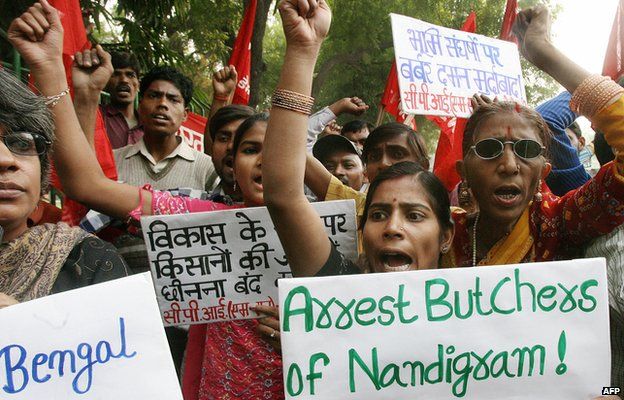
In India, last month, rural women shouted, “Enough is enough!” They marched, organized, and raised a ruckus about proposals to make corporate and State land “acquisition” easier and more “efficient.” They marched by the thousands to Delhi to express more than opposition. They went to articulate the value of their presence. And they promised that if no one in authority listened, they would return by the tens and hundreds of thousands.

In 2013, the Indian government passed a Land Acquisition Act that addressed consent, public purpose and urgency, and social impact. While the 2013 law had issues, it began a process of democratizing land acquisition. Local populations had to be consulted. The State was under stricter guidelines and controls concerning its capacity to declare a public need or urgency and thereby seize land. Social impact, such as mass dislocation, would have to be factored in. These provisions have complicated large scale land purchase, and so the new government has decided to prove its corporate creds by erasing over 65% of the national population. After all, farming communities are surely the source of India’s poverty, not “big capital [which] could get away with unconscionable waste, choke off all credit in the economy, externalise their costs on to society and flout regulation” and certainly not “the state [which] could fritter away vast land resources without any accountability.”

The new bill has been called anti-farmer, anti-Dalit, anti-poor, anti-women, and so Dalit women, tribal women, poor women, and women farmers united and went to Delhi. Kallan, from Uttar Pradesh, explained the women’s mobilization, “You see, men are scared of police. They flee at the first sign of trouble. We do not. Take us anywhere — to the police station, to the court anywhere, we will go… We will only go home when we get out patta (land documents).”

Sabubai, a tribal woman from Madhya Pradesh, agrees, “The farmers near our village sold off their land to the government, they wanted money and the land was to be used for a sugar factory. We are sharecroppers, we never owned the land. But we wrested it back from them. We have it now, but not the patta… we want the patta too.”

Baldiya Rana, an Adivasi from Assam, asked why the State is “so desperate to cease tribal cultivation close to forests, however encourage tree felling for firms”. Adivasis make up 8.6 percent of the Indian population, and 40 percent of those displaced by “improvement tasks.” Of those Adivasis who have been displaced, only 21 percent have been resettled.

Dalit farm laborer Hiranya Devi, from Uttar Pradesh, noted, “If solely the landowner will get a job and rehabilitation in trade, then the lots of like me will come and fill your cities. Anyway, that’s the place all of the street, electrical energy and water goes.”

Konsa Bai, a tribal woman from Madhya Pradesh, put it succinctly, “We have no land. Only big people have land in the village.”

Life for rural women has never been easy, anywhere in South Asia, and the everyday struggle for survival has always been hard. Where the food has been grown, hunger has always stalked women and children first. But recent years have been catastrophic. From 2001 to 2011, the number of women agricultural laborers increased 24 percent, while the total number of women farmers dropped 14 percent. Of nearly 98 million Indian women who have agricultural jobs, around 63% are agricultural laborers, dependent on the farms of others. Force women off their own land and then force them to return as laborers, in order to barely survive. It’s an old story and a very new one, and it’s part of the reason women marched to Delhi. They have seen the cost of `shining development’, and they know it targets women, viciously and violently.

Last month, thousands of women went to Delhi to say NO to the theft and devastation of their lands and lives. They went to say YES to their own dignity, to affirm the value of their presence and lives. That was last month. And next month … ?


(Photo Credit: BBC / AFP)

Tell the US to stop sentencing children to life without parole!


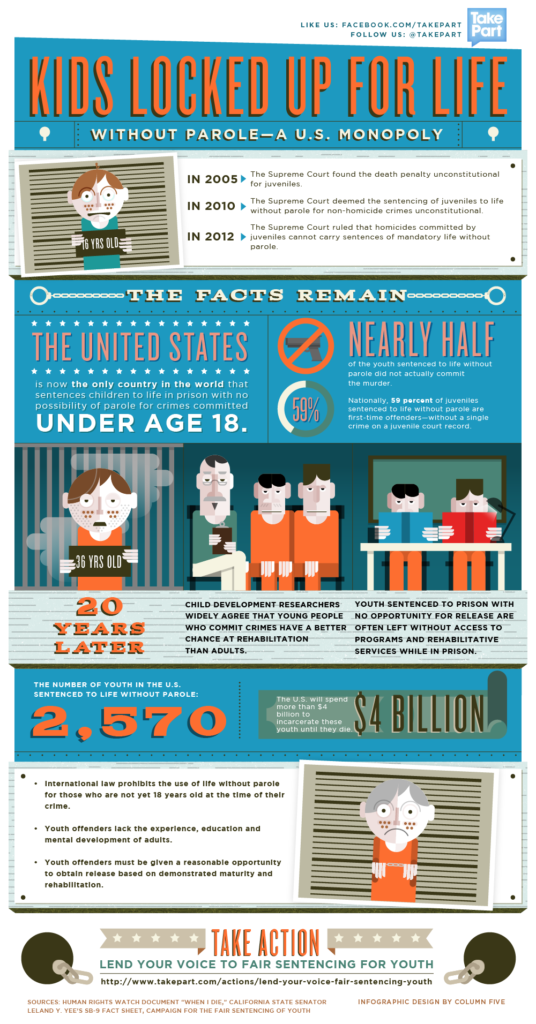
The United States stands alone in the world in sentencing children to life without the possibility of parole. Life without the possibility of parole is torture, but for children it’s a special hell. For girls, it’s worse. That’s the takeaway of this week’s report by Juan E. Méndez, the United Nations Special Rapporteur on torture and other cruel, inhuman or degrading treatment or punishment.

In his report, Juan Méndez “explores the international legal framework and standards protecting children deprived of their liberty from being subjected to torture or other ill-treatment and from experiencing developmentally harmful and torturous conditions of confinement. He also examines specific statutes and standards applying to prevent torture and ill-treatment of children deprived of liberty, and shortcomings in the practical implementation of legal standards.”

The report references girls’ need for access to gynecologists and education on women’s health; and their need for autonomous space, separated from boys as well as adults. The recommendations include respecting the heightened vulnerability of girls, as well as minority children, children living with disabilities, and migrant children. For migrant minority girls living with disabilities, the vulnerabilities are off the chart. In his last recommendation concerning treatment of children in detention, Méndez singles out girls, lesbian, gay, bisexual, transgender and intersex children, and children with disabilities.

The report notes, “Children in detention should be provided throughout the day with a full programme of education, sport, vocational training, recreation and other purposeful out-of-cell activities. This includes physical exercise for at least two hours every day in the open air, and preferably for a considerably longer time. Girls should under no circumstances receive less care, protection, assistance and training, including equal access to sport and recreation.”

And here is the heart, and heartlessness, of the matter: “Girls deprived of their liberty are at a heightened risk of sexual violence, sexual exploitation and underage pregnancies while in detention. The risk of sexual abuse is greater when male guards supervise girls in detention. Girls deprived of their liberty have different needs not only to those of adults but also of boys. Girls in detention are often not only children but also carers, either as mothers or as siblings, and have specific health, hygiene and sanitary needs. Across the globe, girls are rarely kept separately from women in pretrial and post-conviction settings. Similarly, the Special Rapporteur notes that lesbian, gay, bisexual, transgender and intersex children are at a heightened risk.”

Imagine that that daily “heightened risk” and intensified vulnerability form the visible, pre-ordained and immutable arc of your life. That is the policy practiced by the United States, alone in the world, and it’s designed for Black children. When it comes to girls, and particularly to Black girls, it’s designed for those whose vulnerability is already a matter of State practice. 80 percent of girls and nearly half of all children sentenced to life in prison without the possibility of parole have been physically abused. 77 percent of girls and 20 percent of all youth lifers said they have been sexually abused. This is the algebra of torture, cruelty, inhumanity, and degradation. Children sentenced to life without possibility of parole are the child soldiers of the United States. What exactly is the war being waged?

(Photo Credit: TakePart.com)

Tell Georgia not to kill Kelly Gissendaner!


Kelly Gissendaner at her 2011 graduation at Arrendale State Prison

In Georgia, Kelly Gissendaner was going to be the 16th woman to be executed in the United States since the death penalty was reinstated in 1973. Six women have been put to death in Texas. All the executions have occurred in Southern states. While California boasts the highest rate of death sentence for women, thus far none have been executed.

Kelly Gissendaner could have been the first woman executed in Georgia since 1945.

She was accused of killing her husband in 1997. She didn’t actually kill her husband; she asked her boyfriend at the time to do it. He was sentenced to life in prison with possibility of parole after 25 years. She was convicted of “malice murder” in 1998 and sentenced to death.

Both judge and media presented her as a greedy witch who had masterminded the murder. The plea bargain deal made with her boyfriend in exchange for his testimony against her did not bother too many people.

This case confirms that the death penalty carries the images of sin offerings.

Gissendaner’s first scheduled execution was postponed because of a winter storm on February 25th. The execution was rescheduled for Monday evening, and this time the executioner realized that the drug for the lethal injection was not going to work “quickly and properly” as it appeared cloudy. The recent agony of prisoners in Oklahoma after botched executions had brought international attention, shedding light on the brutality of the penal system of the United States. Nobody wanted to have more publicity added to this already disturbing judicial proceeding.

During the almost 17 years of waiting for a possible execution, Kelly Gissendaner went to school and completed a theology degree. More importantly, she changed her vision on life and expressed sincere remorse. She became a teacher who helped fellow inmates and was qualified as a role model by former wardens. Twenty-four people along with her three children begged for clemency to no avail. Her appeals were all denied. After the first attempt to kill her, more people took action to spare her life. Four hundred clergy sent letters. On February 27, the New York Times published an article, with moving testimony on her favor of a renowned theologian.

Meanwhile, in the spirit of an eye for an eye, the attorney for her husband’s family declared that the death sentence was appropriate for the crime. What she has done since is not worth considering.

These declarations and delays remind us of the demonic dimension of the death penalty; why not kill the condemned immediately if redemption is unattainable. If the vengeance in the death sentence includes that the victim of this revenge must dig her own grave year after year, it just confirms the impossibility of this sentence in a human society. Thus, her execution should be judged as malice murder.

Gender plays a particular role in this case. Kelly Gissendaner appeared as a monster because she transgressed the heterosexual role of the wife and the mother. The 16 women who have been executed since 1973 also transgressed this invisibly present boundary, making their crimes even more appealing for the execution of a death sentence.

The violent pulse of this case demonstrates that there is no equality in sentencing. All this works as a ritual that dehumanizes the condemned. It bans all emotions and allows every one that is involved in the death penalty process to ignore his or her own responsibility in the death of a human being, explains Denis Salas in The Will to Punish. The saga of the chronicle of Kelly Gissendaner’s sadistic delayed execution does not serve justice. It adds to the trivialization of populist moralistic biased judgments with no shame for putting to death a fellow woman.

The only way to remedy this cruel and barbarous punishment is to demand “pure and simple abolition of the death penalty.” as Victor Hugo argued in 1848. But first, Kelly Gissendaner must not be killed!


(Image Credit: United Methodist Church / Ann Borden)

Black women prisoners still haunt International Women’s Day

Around the world, women of color, Black women, Aboriginal women languish in solitary confinement. Many die there. Their numbers grow incrementally by the day. BobbyLee Worm, an Aboriginal woman prisoner in Canada, refused to become another abject statistic of prison morbidity and mortality.

In 2006, BobbyLee Worm, 19 years old, entered Edmonton Institution for Women. Shortly after, she was moved to Fraser Valley Institution. The Fraser Valley Institution described itself as “a multi-level facility for women … Programs focus on the particular needs of women offenders, including Aboriginal inmates and those with psychological problems or learning disabilities.”

One of these particular programs was called Management Protocol. Established in 2005, Management Protocol was “a special program for handling women prisoners who have been involved in a major violent incident or threat of incident while in the system.” By 2011 seven women prisoners had been on Management Protocol. All seven were Aboriginal women.

Management Protocol was indefinite and unregulated solitary confinement. Twenty- three hours a day for as long as the prison deemed `adequate’ and `necessary.’ How did one leave Management Protocol? One earned one’s way out. To this day, how one earned an exit visa remains a mystery.

BobbyLee Worm entered prison June 7, 2006. She was a first time offender, sentenced to six years, four months. She spent more than three and a half years in solitary confinement: 23 hours a day in a cell 10 by 8 feet, with no meaningful human contact. For months on end. She was 19 years old.

With the British Columbia Civil Liberties Association, or BCCLA, BobbyLee Worm sued the State for violation of her constitutional rights. Two days after the lawsuit was filed, BobbyLee Worm was removed from Management Protocol. Soon after, the Correctional Service of Canada, or CSC, announced it would shut down the Management Protocol program. In May 2013, BobbyLee Worm and the Canadian prison state settled the suit out of court. According to all reports, BobbyLee Worm was pleased with settlement.

This is a story of State investments and of women’s resistance and refusal. Who was BobbyLee Worm? According to her former attorney, “She was a teenage runaway living on the street, she was addicted to drugs, she was a survivor of serious childhood abuse and trauma and suffered from post-traumatic stress disorder and from depression. She had never had the opportunity to have any sort of trauma or abuse counselling, which she desperately needed. And the response of corrections was to subject BobbyLee to one of the harshest and most psychologically damaging punitive measures that they have available to them. And I think BobbyLee’s story is, sadly, not atypical. This happens to hundreds of prisoners across the country every day.”

This happens to hundreds of prisoners across the country every day, and in particular to Aboriginal women and girls.

What was the Management Protocol? For the CSC, it was a major commitment: “When the protocol was designed in 2003, experts advised the CSC that it was illegal. CSC leadership implemented it anyway. In 2008, the Office of the Correctional Investigator recommended that the program be rescinded, and CSC’s own review agreed that the protocol was dysfunctional. But it was only when the BCCLA filed suit that the CSC cancelled it … The law that allowed the management protocol remains on the books.”

The CSC wanted Management Protocol … badly. It wanted cages for young Aboriginal women, especially those desperately in need. Aboriginal women, Black women, women of color who live with that kind of desperate need are told they owe a debt to society, and prison is not enough. They must go into the hole, they must be tortured.

After the settlement was announced, BobbyLee Worm explained, “There were times when I lost all hope. Solitary confinement does one thing. It breaks a person’s will to live. Being locked up like that you feel like you’re losing your mind. The only contact with another human is through a food slot. Days turn into nights and into days and you don’t know if you’ll ever get out.” Debra Worm, BobbyLee’s mother, commented, “As a mother, that’s the worst feeling in the world to know your child is being broken apart but not being able to do anything to save her.”

The British Columbia Civil Liberties Association and the John Howard Society of Canada recently filed a lawsuit challenging the constitutionality of the laws governing solitary confinement. Sunday, March 8, 2015, is International Women’s Day. In 2011, Black women prisoners haunted International Women’s Day. In 2015, they still do. And next year?


(Image Credit: Erin Marie Konsmo, Media Arts Justice and Projects Coordinator, Native Youth Sexual Health Network)

The UK built a special hell for African women: Yarl’s Wood

Yarl’s Wood Immigration Removal Centre is as it has always been: notoriously rotten to the core. It’s a terrible idea horribly implemented in an architecture of abuse and atrocity. This has been more or less public knowledge for quite some time. Periodically, individual stories of pain, suffering, death emerged, and Yarl’s Wood would once again receive its fifteen minutes of infamy, and then recede into the cozy comforts of willed unconsciousness. Revelations this past week might change that tempo a bit. This week, we saw the fiber of Yarl’s Wood, and it’s designed to strangle African women.

On Monday, England’s Channel 4 broadcast Crying to Get Out, an undercover investigative report, one of the rare visual documents of life, and death, inside “secretive” Yarl’s Wood. While the report does have the first pictures from inside Yarl’s Wood, the aural record is far more telling. Listen to what the guards say in open conversation.

A manager explains `the situation’, “They’re animals. They’re beasties. They’re all animals. They’re caged animals. Right? Take a stick in with you and beat them up.” A guard generalizes, ”They’re all b*****ds. I don’t like any of them.” Another reflects on the rising incidence of self-harm, “They are all slashing their wrists apparently. Let them slash their wrists.” When a third hears that a woman attacked a guard, he replies, “Should’ve f**king headbutted the b****. Headbutt the b****. I’d beat her up.”

And who are “they”? And who is “she”? On the one hand, they’re women, women asylum seekers, pregnant women, and, now, women prisoners, for the crime of having sought haven. The film mentions a Chinese woman, a Sri Lankan woman, but “they” for whom the most severe violence is reserved are African women.

A guard describes the scene when women resist forced removal, “They take their clothes off, right [to resist forced removal]. Not normally Jamaicans. But it’s a very common thing with African ladies. They’re never slim and petite and pretty.”

Another guard explains, “Some of those women in there are horrible. They are really, really horrible. They’re evil. There’s a lot of them that are really nice. But some of them, these Black women, they’re f***king horrible,”

Something is indeed f***king horrible in the state of the United Kingdom: Yarl’s Wood, and the entire `immigrant detention enterprise.’ Serco has fired a couple guards and the Home Office has proposed using body cameras. That intentionally misses the point. Guards spoke their disgust and hatred openly because disgust and hatred of Black women aka African women are corporate and State policy.

Since Monday’s broadcast, Parliament received a damning cross party report on the use of immigrant detention in the United Kingdom; former prisoners of Yarl’s Wood have spoken out of the institutional reign of terror and atrocity; current prisoners are engaged in peaceful protest and perhaps a hunger strike; and Nigerian lesbian asylum seekers Aderonke Apata’s hearing began, during which she has been subjected to one racist homophobic Home Office claim after another. This is the State of Yarl’s Wood, and over its entrance there should be a sign that reads: “But some of them, these Black women, they’re f***king horrible.” Yarl’s Wood is meant to be a special hell for African women. Don’t fix it. Shut it down.


(Photo and video credit: Channel4.com / YouTube)

In France, sex and power go to trial, and DSK takes a walk

Last weekend in Lille, in northern France, a media sensitive trial ended. The trial came after 4 years of investigation by trial judges. Thirteen people faced charges of “aggravated procuring.” The accused were the usual suspects, pimps, cops, notables, businessmen, and Dominique Strauss Kahn aka DSK.

The trial is now finished; convictions and sentencing will be made public in June. While the pimp and his entourage will certainly be convicted, DSK left the court assured of being cleared, at least from the legal point of view.

The trial incriminated the managers of the Carlton Hotel in Lille who organized business reward sex orgies with the help of pimps, from Belgium, the local bourgeoisie and business men. They admitted that the raison d’être for these parties was DSK, knowing that it was a good way to create a friendly bond with this powerful man. DSK also opened his apartments to these orgies in Paris and in Washington when he was at the IMF.

The civil suit was composed of two former prostitutes, referred to as M and Jade. They sued for the violence they underwent, though the official charge was based on the orgies being paid for. Another former prostitute did not join the civil party although the same story happened to her. She was shipped to Washington in 2010 to please DSK. She was visibly scared and never joined the civil suit.

In France, prostitution is not forbidden but the notion of prostitution is legally blurred, and the status of the prostitute or sex worker is not legally well defined. Procuring is a crime (possible sentence up to five years) as is soliciting passively and actively (possible sentence up to 2 months). Having sex for money with a minor or a qualified “vulnerable” person, such as handicapped people, is forbidden. There is a notion of contract between the client and the prostitute that is tacitly accepted as long as the prostitute is not subordinated as the law says.

These shadowy laws have underserved the women. In Belgium, brothels are permitted. Since Lille is near Brussels, the prostitutes came from a brothel near Brussels run by one of the accused and his wife. The trial exposed the elusive character of the laws in France as well as the hypocritical situation in Belgium and how the accused took advantage of both legislations to plot these parties with minimum legal risks.

While DSK and his friends presented themselves as modern libertines with all the prerogatives that they should enjoy due to their social rank, the pimps were ready to take the brunt for their friend DSK. DSK claimed he had no idea that the women he mistreated were prostitutes. Nobody believed him, and the women said that they knew he knew.

Six prostitutes testified. The preliminary investigation established their degrading conditions of life in the brothel close to Brussels and used the term “carnage” to describe the type of sex that DSK and his friends would demand. The arrogance of DSK and his companions was exemplified by the words they used to describe their activities; they commonly talked about pleasure, pleasant détente, festive parties, and great massages. Their text messages, made public for the trial, alluded to the sex workers as livestock or equipment.

The women told a different story. They talked about their shameful work conditions and the violence that entailed suffering, pain and tears. Jade declared that there is no price that justifies imposing such suffering. She also reflected on how women enter this unwanted “job,” “The common point I observed among all of my companions in misfortune is that they all have been mistreated…. This body has been mistreated as a result we keep this stigma about ourselves…then we come to prostitute ourselves.” The notion of forceful mistreatment was at the center of their testimonies. All of them explained even if they were forced to accept these practices, they still accepted them, which made the case for rape legally feeble.

DSK’s lawyers asserted that their client was a victim of, voyeurism and moral lynching. In their closing arguments, they attacked those in the civil suit, accused them of being manipulated and of reinventing the facts. They trivialized the use of violent sex as part of the libertine life. One defense lawyers described the pain inflicted on his client. He even saw some tears!

At the end the prosecutor, who overtly opposed the work of the trial judges since the beginning, transformed his indictment of DSK into a speech for his defense, thanks to DSK’s large circle of influence.

After three weeks of trial, the Sofitel affair in New York became clearer to many and voices of support for Nafissatou Diallo, the Sofitel Maid who accused DSK of rape, grew louder.

The trial also shed light on the collusion between finance/power and sex.

In Sexus Economicus, the historian Yvonnick Denoel delineates the relationship among politics, business and prostitution/sex around the globalized world. He reveals the code of silence that accompanies financial manipulations of the profit driven market covers up the use of women as business and political contracts’ bonus. Their treatment and well being are the least of everyone’s concerns.

Meanwhile, some from DSK’s political party declared that they should erect a statue to Nafissatou Diallo for her strength and determination. Thanks to her, he did not become President, while she used his money to do good, opening a restaurant where she welcomes immigrants and workers.

From New York, Washington, Paris to Lille, the DSK saga magnifies the story of violence against women that epitomizes the power of patriarchal capitalism over women’s bodies.


(Image Credit: Benoît Peyrucq. AFP / Libération)

Virginia `pays’ for decades of forced sterilization of women


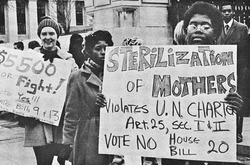
On Thursday, February 26, the Virginia legislature agreed to pay $25,000 in compensation to those who had suffered forced sterilization during the Commonwealth’s decades long adventure in eugenics. From 1924 to 1979, over 8000 people were involuntarily sterilized under the Virginia Eugenical Sterilization Act. It’s believed that 65,000 people nationwide were forcibly sterilized, and so, at over 12% of the total, Virginia holds pride of place. But there’s more. Virginia was the model for many states across the United States and for the German Nazi eugenics program. The line from Richmond to the Third Reich is direct.

More than a fifth of those sterilized in Virginia were African American, and more than two-thirds were women. Virginia’s longstanding war on Black women took many shapes, and the argument was always security and the well being of something called society. In 1927, the U.S. Supreme Court upheld Virginia’s sterilization program. In the words of Justice Oliver Wendell Holmes, “Three generations of imbeciles are enough.” By enough, he meant too much.

Virginia’s sterilization program sat comfortably at the intersection of gender, race, class, disability, and confinement. The overwhelming majority of those sterilized were “patients” of state institutions. They weren’t patients; they were prisoners.

In 1985, Virginia finally agreed to inform survivors of their sterilization and to provide them with counseling services. In 2002, then Governor Mark Warner formally apologized for Virginia’s shameful part in eugenics. In 2014, Delegate Patrick Hope, from Arlington County, began pushing for compensation, and that’s what was established yesterday. Yesterday, Del. Hope explained, “I think it’s a recognition when we do something wrong we need to fix it as a government. Now we can close this final chapter and healing can begin.”

Does healing begin this way? The compensation is a step in the right direction. At the same time, the survivors number only eleven. More to the point, what of the system of law, medicine, education, and State that supported the forced sterilization of over 5000 women, all in the name of preserving the health and well being of something called society? That healing has not begun, not while so many of their sisters, nieces, grand nieces, and the list goes on, languish in prisons and jails across the Commonwealth, and across the nation, today. The kind of healing of which Delegate Hope speaks and for which he yearns cannot be purchased. It is not for sale. It must emerge from sustained recognition of responsibility combined with recognition of the subjects of this history. Women. Black women. Black women living with disabilities. Poor Black women living with disabilities. That healing has yet to begin.


(Photo Credit: The Institute for Southern Studies)