I’ll leave you with a beautiful picture that was taken today

K…here it is…

I’m going to try to keep this as brief as I can, but I’ve been asked by several people about Central Booking today, so I’ll give you guys the shocking highlights. As much as I’d like to, I can’t describe the particulars of some of the more egregious arrests, due to attorney/client privilege issues, but I would like to describe the Civil Liberties violations, and the deplorable conditions which people have had to endure.

As many of you know, more than 250 people have been arrested since Monday here in Baltimore. Normally when you are arrested, you are given a copy of your charging documents and then you must see a commissioner within 24 hours for a bail determination (“prompt presentment”) and given a trial date. If you are not released after the commissioner hearing, you will be brought before a judge for a review of the bail set by the commissioner. None of this was happening, so we sent some lawyers to Central Booking yesterday to try to help. I heard, however, that only 2 commissioners showed up, and the correctional officers only brought about 9 people to be interviewed because the jail was on a mysterious “lock-down”.

Today we were divided into two groups. Some of the lawyers were assigned the task of actually doing judicial bail reviews for as many folks as they could get interviewed and docketed. I was assigned to the other group. We were the “habeas team”, and we were to interview folks that we felt were being illegally detained, so we could file writs of habeas corpus. Governor Hogan had issued an executive order, extending the time for prompt presentment to 47 hours. We believed that this order was invalid because the governor has no authority to alter the Maryland Rules. As a result, all people who were being detained for more than 24 hours without seeing a commissioner were being held illegally.

Knowing all of this, I was still not prepared for what I saw when I arrived. The small concrete booking cells were filled with hundreds of people, most with more than ten people per cell. Three of us were sent to the women’s side where there were up to 15 women per holding cell. Most of them had been there since Monday afternoon/evening. With the exception of 3 or 4 women, the women who weren’t there for Monday’s round-ups were there for freaking curfew violations. Many had not seen a doctor or received required medication. Many had not been able to reach a family member by phone. But here is the WORST thing. Not only had these women been held for two days and two nights without any sort of formal booking, BUT ALMOST NONE OF THEM HAD ACTUALLY BEEN CHARGED WITH ANYTHING. They were brought to CBIF via paddy wagons (most without seat belts, btw–a real shocker after all that’s happened), and taken to holding cells without ever being charged with an actual crime. No offense reports. No statements of probable cause. A few women had a vague idea what they might be charged with, some because of what they had actually been involved in, and some because of what the officer said, but quite a few had no idea why they were even there. Incidentally, I interviewed no one whose potential charges would have been more serious than petty theft, and most seemed to be disorderly conduct or failure to obey, charges which would usually result in an immediate recog/release.

The holding cells are approximately 10×10 (some slightly larger), with one open sink and toilet. The women were instructed that the water was “bad” and that they shouldn’t drink it. There are no beds–just a concrete cube. No blankets or pillows. The cells were designed to hold people for a few hours, not a few days. In the one cell, which housed 15 women, there wasn’t even enough room for them all to lay down at the same time. Three times a day, the guards brought each woman 4 slices of bread, a slice of american cheese and a small bag of cookies. They sometimes got juice, but water was scarce, as the CO’s had to wheel a water cooler through every so often (the regular water being “broken”.)

My fellow attorneys and I all separately heard the same sickening story over and over. None of the women really wanted to eat 4 slices of bread 3 times a day, so they were saving slices of bread TO USE AS PILLOWS. Let me say that again. THEY WERE ALL USING BREAD AS PILLOWS SO THAT THEY WOULDN’T HAVE TO LAY THEIR HEADS ON THE FILTHY CONCRETE FLOOR.

Interviewing these women was emotionally exhausting. Quite a few of them began crying–so happy to finally see someone who might know why they were there, or perhaps how they might get out of this Kafka-esque nightmare. These women came from all walks of life. We interviewed high school students, college students, people with graduate degrees, people with GED’s, single women, married women, mothers, the well-employed, the unemployed, black women and white women. Almost all of them had no record. Those that did had things like dui’s and very minor misdemeanors. Our group didn’t interview any of the men on the other side, but my colleagues reported very similar situations. On the men’s side there were journalists and activists, as well as highschool kids with no records, barely 18 years old.

As we were getting ready to leave, we heard that many of these folks might be released without charges, after being held for 2 days. When we returned to the office, our amazing “habeas fellow”, Zina Makar, single-handedly filed 82 habeas petitions. That is when we heard that 101 people were released without charges. I’d like to think that the amazing legal response to this injustice played a large part in their release, and I feel privileged to have been a part of it. They may be charged later, but I’m guessing most of them won’t based on how minor their alleged infractions are. There are still over a hundred folks in there that need to see a commissioner and/or a judge, but hopefully we have thinned the ranks a little, and we will keep fighting until everyone has received due process. (We are concerned about these folk’s potential bails, as we are hearing about bails in the hundreds of thousands of dollars for misdemeanor charges).

I’ll wrap this up by reminding everyone that all lives matter. We are all human beings. And we are Americans, and as such we are afforded protections under the law, the guilty and innocent alike. If one person is denied due process, we all suffer. If one person’s rights and freedoms are trampled on, it’s not only a reflection on all of us, but it puts our own liberty at risk. The moment we view some individuals as more important than others, we cheapen ourselves. At the very essence of our democracy is the right to question and stand up to authority. During these trying times, we should all keep that in mind.

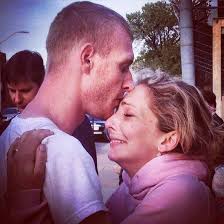
I’ll leave you with a beautiful picture that was taken today of one of the women who was released without charges. Her husband had been waiting outside CBIF trying to find something…ANYTHING out about when she might be charged or released. This was taken moments after she walked out the door…..

(Photo Credit: Marci Tarrant Johnson Facebook page)

If the people who died were White, the entire planet would be shaken


From my adoptive hometown of Baltimore the racialized surveillance of movement of people appears clear and loaded with violence and discrimination.

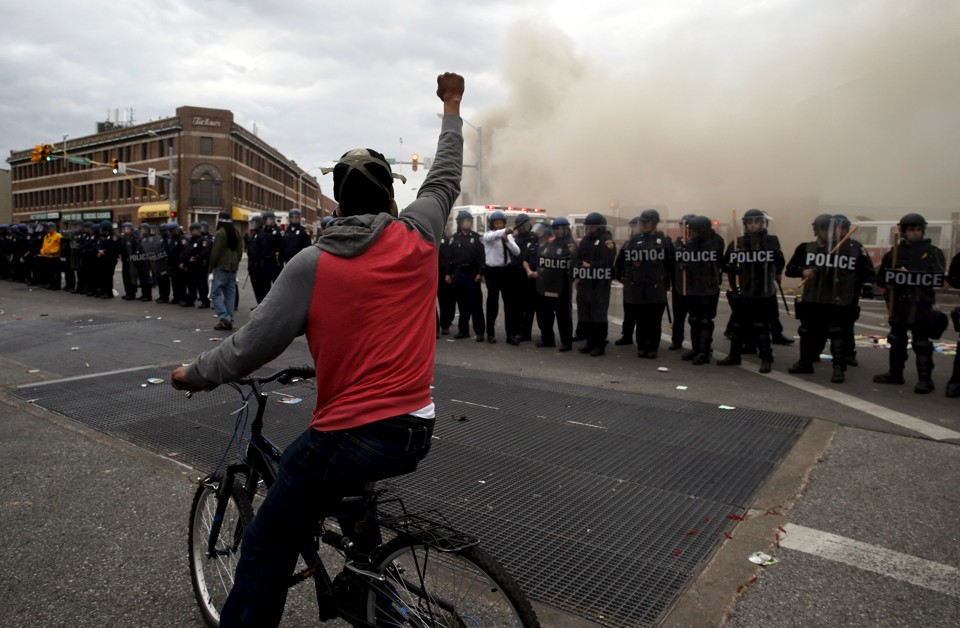
Monday was the funeral of Freddie Gray who died in police custody of unnatural causes, adding to the long list of people of color who died in police encounters. He was beaten up evidently. His fault was to run away from police for no other reason than not trusting them. The police chased him. The police do not need probable cause to arrest in high crime area. Baltimore is a high crime area all by itself and also a “Black city.” In this racially discriminatory and oppressive context, a young Black man does not want to be close to police. The latter is not there to protect him. The same is true for Black women. The city has paid over $ 5.7 million in settlement for the wrongdoing of the police since 2011. There is harassment, humiliation and constant scrutiny of movement for the African Americans in the street of Baltimore. Still, the police authorities accuse the poor and the destitute to be the threat, while the city is cutting social, public housing programs and school budget including financial support for organizations that provide support to the population while many actors with power just organize the demise of their community.

Worldwide, movement is not easy for the poor or the destitute. While the United States is the showroom of pure racism, the Mediterranean Sea is the theater of the policy of laissez-faire, let them die. As Senegalese author Fatou Diome declared, this racialized laissez-die has shaped the European Union’s dissuading policies against migration.

Since the beginning of 2015, over 39 000 people have attempted the crossing to Europe. 1776 have died just to escape the violence in Libya, Syria, Iraq or other battled countries. This means one death every two hours since the first of January. This is the highest rate ever recorded. According to the UN Commissioner of Refugees, only 10% of people running away from violence migrate to the EU but that’s enough to rekindle the conservative and nationalist spirit of this rich continent.

On April 19th, a rotten trawler with 700 migrants packed on board capsized. All 28 survivors had been on the upper level. As is often the case, women and children were locked up down in the hold. And so they all died.

This happened after 400 migrants died in the Sicily. These latest incidents shook the consciousness of some in Europe. In Italy the population came to the rescue helping the migrants in a solidarity spirit that should be the norm. But the policies of asylum don’t carry this humanistic solidarity spirit. They penalize populations coming from the South. The Dublin II Accord signed by 32 European States has stated that demand for asylum can only be filed in the first entry country. Today these countries are typically Greece, Italy, Spain and Malta.

At a recent summit EU Ministers of Foreign and Interior Affairs, Italian Prime Minister Matteo Renzi demanded that the rest of Europe participate in rescuing and receiving this flux of migrants.

After the drama of Lampedusa that left almost 280 dead, chanting “Never again”, the EU leaders eliminated the Italian program “Mare Nostrum” that ambitiously had the ability to search and rescue in international and European waters the migrants. Mare Nostrum was replaced by the “Triton” program which is not a search-and-rescue operation and operates only on European waters. It is also less expensive. As Paolo Gentiloni, the Italian Minister of Foreign Affairs noted, the UE, is the biggest economic power of our time, somehow can’t 3 million additional Euros per month to aid migrants.

Ten measures that resembled pious hope more than coherent actions were proposed. European leaders agreed to return most of the refugees to their war-torn countries, consenting to only 5 000 permits. These decisions are marked by the neoliberal austerity mindset that imposes discrimination and misery for those left out of the political and economic order.

The leaders also agreed to increase the funds for Triton within the program of surveillance of borders called Frontex. They also affirmed that they would fight the traffickers. As the socialist group of the European Parliament argued, these actions merely add another layer of military violence to areas already ravaged by conflict.

There is an obvious discrepancy between the dramas taking place in the Mediterranean waters and the streets of Baltimore or other US cities, and the application of the right to move freely or migrate to seek safer land, safer lives.

Fatou Diome put it clearly, “If the people who died were White, the entire planet would be shaken.” She added that the people who depart for survival already consider that their lives have no value and therefore are not afraid of losing it. The disaster has been already organized for them through imperialist wars and deprivation.

After the funeral, the riot in the streets of Baltimore shed light on the balance of power. Freddie Gray could not run away from arbitrary arrest and humiliation, and lost his life. The young rioters in Baltimore had a similar perception of their position. It is not enough to condemn violence, as Martin Luther King declared without “condemning the contingent intolerable conditions that exist in our society. These conditions are the things that cause individuals to feel that they have no other alternative than to engage in violent rebellions to get attention … Riot is the language of the unheard.”

These are large issues. Another type of dialogue and solidarity has to be formed if we are to restore a humanistic dialogue and discourse and free the movements of the oppressed.

(Portrait of Freddie Gray: Kim Sarabia / Colorlines)

You gave up the moral authority to declare a state of emergency decades ago

What qualifies as a State emergency, and who gets to call it? Not the State of Maryland and not the City of Baltimore. They lost that privilege decades ago.

After decades of publicly acknowledged police brutality directed specifically at Black and Brown skinned residents of the city, of spending millions of dollars to support violent extremists in the Baltimore City Police Department, neither the City of Baltimore nor the State of Maryland has the moral authority to declare a state of emergency. They wouldn’t know an emergency if it bit them.

Since 2011, Baltimore has invested $5.7 million in lawsuits dealing with police brutality. As Ta-Nehisi Coates noted, “The money paid out by the city to cover for the brutal acts of its police department would be enough to build “a state-of-the-art rec center or renovations at more than 30 playgrounds.” Instead, the money was used to cover for the brutal acts of the city’s police department and ensure they remained well beyond any semblance of justice.”

Coates grew up across the street from Mondawmin. Considerably earlier, I lived most of my pre-school life across the street from Mondawmin. We both understand the lie of peace and responsibility when they come from the mouths of State representatives. As Coates argues, “When nonviolence is preached as an attempt to evade the repercussions of political brutality, it betrays itself. When nonviolence begins halfway through the war with the aggressor calling time out, it exposes itself as a ruse. When nonviolence is preached by the representatives of the state, while the state doles out heaps of violence to its citizens, it reveals itself to be a con.”

What’s this war in Baltimore? Freddie Gray was killed while riding in a police van. Violence in police vans is so ordinary it has its own lexicon. There’s the “rough ride”, when the handcuffed and perhaps shackled prisoner is not seat belted, and so is thrown all over the van. This is also known as the “cowboy ride.” Then there’s “bringing them up front” where the driver slams unexpectedly on the brakes, throwing the prisoner against the cage behind the driver’s seat. This is also known as the “screen test”.

Last September, The Baltimore Sun ran a major investigation into the payouts, including the stories of horrible police violence against Black women: 87-year-old Venus Green; 26-year-old Starr Brown; 58-year-old Barbara Floyd. Between 2010 and 2014, 31 people died in `police in encounters’ in Baltimore. The culture of police brutality, Baltimore’s disgrace, has long been public knowledge. Did anyone in Annapolis or on the Baltimore City Council even contemplate stating that there is an emergency in Baltimore?

Individuals and agencies that have absolutely no moral authority to declare any kind of emergency are now in charge of declaring and maintaining a State of Emergency. None of this is a surprise. As John Angelos, Orioles team executive, noted early on, “My greater source of personal concern, outrage and sympathy … is focused rather upon the past four-decade period during which an American political elite have shipped middle class and working class jobs away from Baltimore and cities and towns around the U.S … plunged tens of millions of good, hard-working Americans into economic devastation, and then followed that action around the nation by diminishing every American’s civil rights protections in order to control an unfairly impoverished population living under an ever-declining standard of living and suffering at the butt end of an ever-more militarized and aggressive surveillance state.”

In his 1962 essay, “A Letter to My Nephew”, James Baldwin alluded to a slave spiritual, “You Got a Right”:

“You got a right, I got a right,
We all got a right to the tree of life.
Yes, tree of life.

The very time I thought I was lost,
The dungeon shook and the chain fell off.
You may hinder me here,
But you can’t hinder me there.
‘Cause God in the Heaven’s
Going to answer my prayer.”

We all got a right to the tree of life.


(Photo Credit: Jim Bourg / Reuters)

21 already (on South Africa’s Freedom Day)

21 already (on South Africa’s Freedom Day)
 
21 already
you are
getting there
rather quickly
(might it have been
far too soon)
 
was the enticement
of international sport
(rugby and cricket chiefly)
much too much to resist
 
21 already
were we readied
for the occasion
and the great beyond
 
What have you celebrated
have you always had cause
to celebrate and rejoice
(are you selective 
in your remembrances)
 
21 already
(this coming of age)
does it seem times
are tougher now
in our rebuilding phase
 
(will we be reconstructing
forever and a day)
 
There are folks hankering
for a return to apartheid
corporal punishment
the death penalty and
keeping women and children
(and the other) in their place
 
(and quite nearby dogs howl
as a neighbouring child 
gets a mother’s loud beating
and a shutting-up)
 
21 already
would you do it
all over again
(Photo Credit: http://constitutionallyspeaking.co.za)

In Kenya, Phyllis Omido is guilty of inciting justice


Phyllis Omido

Last week, Phyllis Omido, a community organizer in Mombasa, Kenya, received the Africa 2015 Goldman Environmental Prize for her work inciting justice. Phyllis Omido has been combating toxicity in all its forms: chemical, environmental, cultural, political, economic. She has struggled and organized to transform sites of toxic elements into spaces of collective health and well-being.

In 2009, an iron-smelting factory opened in the densely populated Owino Uhuru slum of Mombasa. Solar energy is big in Kenya, and growing quickly. To meet the increased demand for lead coming from the solar industry, smelting factories have popped up, recycling car batteries in smelters. It’s big business.

The smelting factory in Mombasa hired Phyllis Omido as a community liaison officer. Her job included conducting an environmental impact study. Somehow, despite all sorts of regulations, they had opened without any such study. Meanwhile, Omido’s two-and-a-half year old child began suffering a series of ailments: nausea, sleeplessness, high fever, and more. Tests finally showed that Omido’s son, King David, was suffering from lead poisoning, which he’d contracted from his mother’s breast milk.

Omido took her environmental impact study to her bosses, who immediately shut it down. She took it to the State, who immediately accused her of being a member of the opposition. They argued that she was clearly out to destroy the economy and crush the hopes of poor working people and communities. Omido had a long history of conducting professional environmental impact studies for other factories, and yet her hard data made less than no difference.

At first, Phyllis Omido campaigned for the factory to pay for her son’s medical care, which they did, once she agreed to sign non-disclosure agreements. But Phyllis Omido looked around and knew she couldn’t keep quiet. Too many lives were at stake.

And so Phyllis Omido organized. She organized a campaign to shut down the factory. After five years, that happened last year … sort of. When Phyllis Omido protested peacefully, she was charged with inciting violence. She was acquitted. When Phyllis Omido was physically and otherwise attacked, her response was to turn swords into ploughshares. She intensified and broadened the campaign. She founded The Center for Justice Governance & Environmental Action. She started taking on salt miners who are damaging Kenya’s coastal fisheries. She is testing the soil and air in a variety of nearby slum neighborhoods, and demanding action. She is suing the Kenyan government and its environmental agency, demanding that they pay compensation, clean up the local environment, and abide by the Constitutional mandate to provide a clean and safe environment for all.

Phyllis Omido has fused anecdotal, experiential evidence with hard, scientific data and created a powerful tool for the people, and especially the women, of the slums of Mombasa and beyond. She pursued what she could see. For example, on entering the plant, foreign managers donned protective gear and masks, but “the workers just worked. Sometimes they’d take a piece of rag and tie it around their noses but they didn’t have any protective gear. At that point when I was still there, they didn’t know that this [air] was poisonous. They were just protecting themselves from the smoke, the acid, the stench.” She pursued what she could not see: the paths of toxic elements, the lead contaminating the air, water, soil; the greed contaminating the State.

In January 2015, the State finally started testing the children of the slums of Mombasa. Thanks to Phyllis Omido and countless women slum dwellers like her, the quest for justice continues.


(Photo Credit: The Goldman Environmental Prize)

What happened to Natasha McKenna? The routine torture of cell extraction

In early February, Natasha McKenna was killed by six officers in the Fairfax County Jail, in northern Virginia near Washington, DC. McKenna was 37 years old. She was the mother of a 7-year-old daughter. She was living with schizophrenia. She was a diminutive woman, 5 feet 3 inches, 130 pounds. And she was Black.

She was killed during a so-called cell extraction, when six deputies tackled her and took care of business: “She was handcuffed behind her back, shackled around the legs, a hobble strap connected to both restraints, and a spit mask placed over her face.” Natasha McKenna continued to `resist’. An officer shot Natasha McKenna at least four times with a Taser, at point blank range: “Ms. McKenna … stopped breathing shortly thereafter, and her heart ceased beating. Although her heart was restarted, she died a few days later without regaining consciousness.”

Natasha McKenna was arrested by Fairfax County police on a warrant from Alexandria, for an incident that begged for help rather than punishment. Both Alexandria and Fairfax County police knew of Natasha McKenna’s mental illness history. Because Natasha McKenna was officially Alexandria’s prisoner, Fairfax couldn’t petition to have her placed in mental health care. Fairfax says it called Alexandria police three times, trying to have them pick up McKenna, but no one came. Now, Alexandria is “doing [its] own investigation on [its] practices on picking up inmates in other jurisdictions.” Alexandria, Fairfax County, and the local media are investigating, and Natasha McKenna is dead.

Hers was a violent death, as indicated by two black eyes, a badly bruised arm, and a finger that had to be amputated. But more than a violent death, Natasha McKenna’s death is just another typical day in the empire of cell extractions. Last year, San Diego faced street demonstrations and court proceedings for the routine violence meted out to juveniles during cell extractions. Earlier this month, a judge re-opened the case of Charles Jason Toll, who was killed in a cell extraction last year in Riverbend Maximum Security, in Tennessee. Last week, a judge dropped all charges against prisoner Louis Flack in the Knox County Jail, in Tennessee, in large part because of the beating he’d received during a so-called cell extraction.

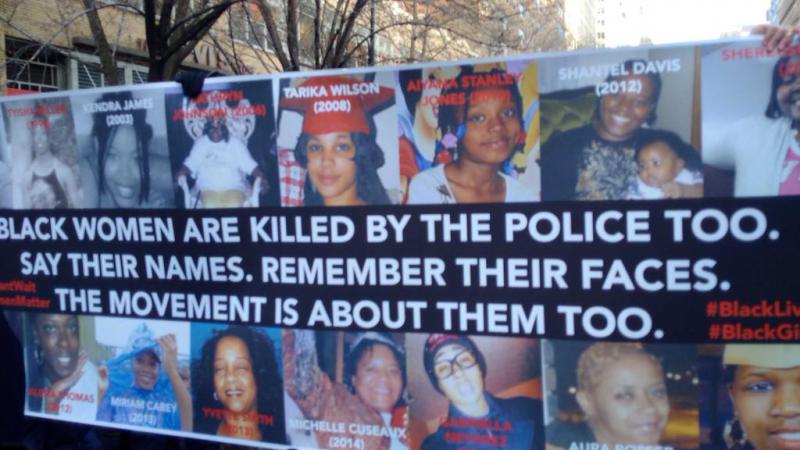
Natasha McKenna joins Aura Rosser, Kyera Singleton, Shae Ward, Shirley Beckley, Tanisha Anderson, Yvette Smith, Aiyana Stanley-Jones, Rekia Boyd, and a slew of other Black women killed by the State’s peacekeepers. Black women whose lives and violent deaths are covered in public and even more national silence.

These are the layers of silence: “Officials in Fairfax … have stonewalled and balked in Ms. McKenna’s case… The six sheriff’s deputies at the jail have been neither identified nor removed from regular duty… Sheriff Stacey A. Kincaid, who runs the county jail, has issued no new directives to her deputies regarding use of force, deployment of Tasers or procedures for cell extractions. She says a policy review is under way; there is no evidence of it… In Fairfax, where the state medical examiner has still not issued a cause of death for Ms. McKenna, the police investigation is frozen.”

It is time. It is way past time for the Justice Department to step in. It is time to break the silence surrounding the violence of cell extractions. How many more must die before we realize our part in the deaths? How many more must suffer excruciating pain before we realize our role in the commission of torture? How many more Black women must endure the assault on their bodies and persons by the State before we realize that we are that State?

What happened to Natasha McKenna? Absolutely nothing out of the ordinary. Just another day in the killing fields.


(Photo Credit: Legal Momentum)

For Nigeria and the World, an Anniversary and Much, Much More

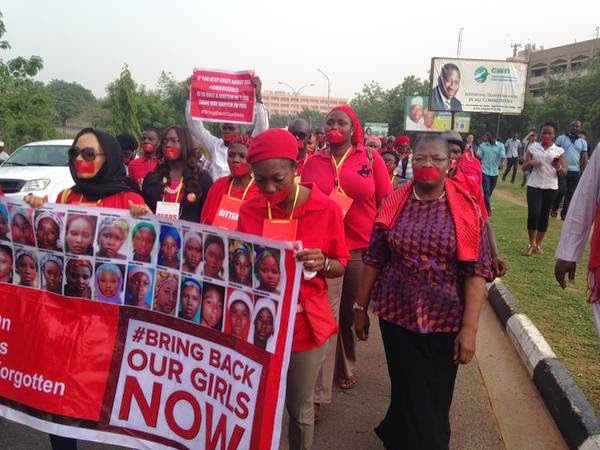
A year ago 276 high school girl students were kidnapped from Chibok boarding secondary school located in the state of Borno in the north east of Nigeria. One year later, clearly the national response and global response has been ineffective and disappointing since 219 girls are still missing.

The response from the former President Goodluck Jonathan was slow. Emmanuel Ogebe, a human rights lawyer, showed that the authorities’ apathy was obvious. He interviewed the population and the girls who escaped three months after the kidnapping, and reported that no police or other forms of inquiry had taken place.

Meanwhile, the insecurity is real and affects everyday life in Borno, straining means of subsistence and the region’s social balance. There is massive displacement of the population with 1.5 million forced out of their homes among whom 70% are women and children.

Since the beginning of 2014, over 2000 women and girls were killed in Nigeria.

Although the #BringBackOurGirls campaign got international attention with celebrities involved, a code of silence still sticks to the regular violence against women and youngsters in this part of the world.

While the killings in Paris were shocking and created the movements we know, the killing of 2000 people in Baga, Nigeria did not receive that same attention. BringBackOurGirls along with many activists have not given up. Malala Yousafzai, the Pakistani Nobel Peace Prize Winner who defends school education for girls, has declared, “In my opinion, Nigerian leaders and the international community have not done enough to help us.”

When women are taken hostages and utilized in a military way, whose patriarchal interest does it serve?

Should we question the lack of clear engagement of some leaders in the region of Lake Chad where important reserves of oil have been found? This oil reserve is shared by Niger, Nigeria and Chad.

Chad’s president, Idriss Deby Itno, has played a very obscure role, sometimes supporting efforts to control Boko Haram and sometimes retreating from the coalition. He also trapped the Nigerian president into a deal to get back the girls, last September, and then nothing happened. Boko Haram’s chief has been seen in armored vehicles made in Israel and used by the Chadian army. The French government has supported Deby, and French companies have also had important interests in the region. Nigerian leaders claim Chad is exploiting Nigerian oil using new drilling methods, while Nigeria is destabilized by Boko Haram’s assaults. The Chadian opposition organization, Mouvement du trois fevrier M3F, sees Deby as a pyromaniac fireman, spreading fire to better control oil exploitation in this area, thus expanding his political and economic control in the region, having already extended his stranglehold on the Central African Republic. Corporations from abroad enjoy a piece of the pie. Boko Haram’s thuggery is aided and abetted by this collusion by governments and corporate interests. And the victims are the school girls, who are still unaccounted for, and the terrorized population.

The questions surrounding the girls’ kidnapping and disappearance are a reminder that women’s lives are subjugated to the interest of a market system that knows no limits in using manipulation and spreading violence.

The exploitation of Nigeria’s oil reserves has a long history. Three decades ago, activists and writers tried to defend the precious Ogoni lands from being exploited by Shell Oil Company. The Nigerian government colluded with Shell Oil, which in turn was strongly supported by both the U.K. and the U.S. Nigeria tamped down the protests by executing the activists, despite international protests. Ken Saro-Wiwa, whose death, he himself predicts in his writing, clearly articulated and challenged the neoliberal corporate and political interests at the expense of the Ogonis. Today his words ring truer than ever as we see the brutal murder of women that mask the transnational neoliberal corporate and political greed to increase the oil fortunes of the one percent.

In this context, Boko Haram’s members maybe viewed as modern mercenaries. Their main targets are women, and to complete their grip on the populations they also target schools, with 900 schools burned in northern Nigeria and some 176 teachers killed. They seek to normalize violence and vulnerability. But resistance continues to be organized and women’s rights organizations have engaged in making these crimes visible. Resistance movements are not giving in. On March 14, one year after the abduction of the girls, a Global School March was organized worldwide. Women are demanding the newly elected Nigerian president Muhammadu Buhari who will start his mandate on May 29th to fulfill his promise and to step up the process to save these young women. The movement goes further and demands global protection of women and girls to teach and attend school and to enforce protection of rights. This is a global threat against women and against humanity, which is not poverty driven but driven by vested interests that impoverish and manipulate populations.

We cannot stop marching.

In Pramila Venkateswaran’s “When they Hang a Poet,” poet – activist Ken Saro-Wiwa protests neoliberal exploitation of the Ogonis, and is killed by the Nigerian government. But his words live on, and the protests continue. Try as they might, government and corporations will fail to snuff out the voices raised to preserve democracy free of violence 

When they Hang A Poet…
For Ken Saro-Wiwa

You spoke of a green earth—your dream
a filament of the earth’s desire.
You wrote of Africa pillaging
herself, a prostitute “choosing”
her destiny. I see your blood
in my quiet hands, in the hands
of my country, in the hands
of every human being caught
in the clamor of living,
in the hands of corporate souls
on whom desire sticks like sin;
in the hands of your land, your sentence
is as extraordinary as a poet’s nightmare.

They hanged Saro-wiwa: syllables shock the air
as leaves weep on the cold, cold dirt.
But your words spread like a rain-storm filling
decrepit croplands of the Ogoni.

(published in The Kerf, 1997)

(Photo Credit: bellanaija.com)

The World Bank is (still) bad for women, children, men, and all living creatures

The World Bank is still bad for women, children, men, and all living creatures. While not surprising news, it is the result of a mammoth research project carried on by the International Consortium of Investigative Journalists and their partners. Journalists pored through more than 6000 World Bank documents and interviewed past and current World Bank employees and government officials involved in World Bank funded projects. They found that, in the past decade, an investment of over 60 billion dollars directly fueled the loss of land and livelihood for 3.4 million slum dwellers, farmers, and villagers. That’s a pretty impressive rate of non-return, all in the name of modernization, villagization, electrification, and, of course, empowerment. Along with sowing displacement and devastation, the World Bank has also invested heavily in fossil-based fuels. All of this is in violation of its own rules.

Women are at the core of this narrative, and at every stage. There’s Gladys Chepkemoi and Paulina Sanyaga, indigenous Sengwer who lost their homes and houses, livestock and livelihoods, and almost lost their lives to a World Bank-financed forest conservation program in western Kenya’s Cherangani Hills. In 2013, Bimbo Omowole Osobe, a resident of Badia East, a slum in Lagos, lost nearly everything to a World Bank funded urban renewal zone. Osobe was one of thousands who suffered “involuntary resettlement” when Badia East was razed in no time flat. Today, she’s an organizes with Justice and Empowerment Initiatives, a group of slum dwellers fighting mass evictions. Aduma Omot lost everything in the villagization program in Ethiopia, a World Bank funded campaign that has displaced and demeaned untold Anuak women in the state of Gambella. In the highlands of Peru, Elvira Flores watched as her entire herd of sheep suddenly died, thanks to the cyanide that pours out of the World Bank funded Yanachocha Gold mine, the same mine that Maxima Acuña de Chaupe and her family have battled.

The people at ICIJ promise further reports from India, Honduras, and Kosovo. While the vast majority of the 3.4 million people physically or economically displaced by World Bank-backed projects live in Africa or Asia, no continent goes untouched. Here’s the tally of the evicted, in a mere decade: Asia: 2,897,872 people; Africa: 417,363 people; South America: 26,262 people; Europe: 5,524 people; Oceania: 2,483 people; North America: 855 people; and Island States: 90 people. The national leaders of the pack are, in descending order: Vietnam, China, India, Ethiopia, and Bangladesh. It’s one giant global round of hunger games, brought to you by the World Bank.

None of this is new. In 2011, Gender Action and Friends of the Earth reported on the gendered broken promises of the World Bank financed Chad-Cameroon Oil Pipeline and West African Gas Pipelines: “The pipelines increased women’s poverty and dependence on men; caused ecological degradation that destroyed women’s livelihoods; discriminated against women in employment and compensation; excluded women in consultation processes; and led to increased prostitution … Women in developing countries have paid too high a price.” The bill is too damn high.

In 2006, Gender Action and the CEE Bankwatch Network found that women suffered directly from World Bank funded oil pipeline projects in Azerbaijan, Georgia and Sakhalin: “Increased poverty, hindered access to subsistence resources, increased occurrence of still births, prostitution, HIV/AIDS and other diseases in local communities.”

There’s the impact on women of ignoring, or refusing to consider, unpaid care work in Malawi, Mali, Niger, and Rwanda, and the catastrophic impacts on women of World Bank funded austerity programs in Greece. And the list goes on.

So, what is to be done? Past experience suggests that the World Bank is too big to jail. How about beginning by challenging and changing the development paradigms and projects on the ground? No development that begins from outside. Absolutely no development that isn’t run by local women and other vulnerable sectors. While the World Bank refuses to forgive debts, globally women are forced to forgive the World Bank’s extraordinary debt each and every second of each and every day. This must end. Stop all mass evictions. Start listening to the women, all over the world, who say, “We need our voices heard.”


(Photo credit: El Pais / SERAC)

When Ethiopia `villagizes’, women suffer

The Oakland Institute released a major report today, We Say the Land is Not Yours: Breaking the Silence against Forced Displacement in Ethiopia. The report is comprised of oral testimony of individuals who have been violently displaced by the Ethiopian government’s ongoing villagization program. The Ethiopian government says it hopes to `resettle’ as many as 1.5 million people, all in the name of development … and direct foreign investment. Three years ago, Human Rights Watch released a major report, “Waiting Here for Death”: Forced Displacement and “Villagization” in Ethiopia’s Gambella Region.

Villagization is “the clustering of agropastoral and/or shifting cultivator populations into more permanent, sedentary settlements.” Families and communities that have lived on the land for centuries are “resettled” into “permanent” settlements. Settlements, bantustans, locations, encampments, prison colonies … you choose. What is clear in the miasma of scare quotes is that the years’ long campaign in “resettlement” benefits only foreign investors and their State clients.

In Gambella, in the westernmost part of Ethiopia, whole swaths of semi-nomadic, indigenous Nuer and Anuak people and communities have been targeted for “resettlement”, to “free” their land up. The Nuer and the Anuak have been moved, often at gunpoint and worse, to `new’ and `modern’ villages, where there’s little to no food, farmland, healthcare, or educational facilities. Ultimately, the plans are for 70,000 to be removed, out of a population of some 300,000. When Human Rights Watch reported on these forced removals, it was removed from the country. Likewise, the Ethiopian government has charged that the Oakland Institute is campaigning to perpetuate people’s poverty.

Where are the women in Gambella, and in villagization more generally? Everywhere and nowhere. In general, the news media ignores the gender implications of villagization and mass forced resettlement. The Oakland Institute has long argued that women and children have a particularly dire space in this program. Both Human Rights Watch and the Oakland Institute found that the new relocation sites, the “villages”, lacked schools, clinics, and running water, and so their infrastructure, in its lacks, targeted and condemned women to further hardships. Meanwhile, concentrating the land in the hands of a very few large-scale producers has meant the end of women dominated small hold farming, which means greater food insecurity, deeper and wider hunger, and impossibly greater amounts of unpaid and uncounted labor for women, as cash crops displace local food crops.

Today’s report does more than break the silence. It creates a space for voices, including women’s voices and stories. An eighty-year old refugee in Kenya tells a story: “A family I know was told that they had reached the final stage and were told to go back home. The wife refused. Her husband said that they should go to Uganda and try again for refugee status from another country. The wife was tired of moving and stayed. She has nothing. She sold her gold earrings to go back to the refugee camp. She tried to register with a new name, but the biometric gadget reflected her earlier record. They said she was trying to commit fraud and arrested her. She is now with us and has threatened to commit suicide if not granted the refugee status. The UNHCR decision [to not award refugee status] broke up the family. We try to watch over her.”

A woman refugee in Kenya tells her own story: “During the relocation, I was given a piece of land. I moved because I was forced. We had to build the tukul, our new home, ourselves. This does not mean we are content with it. According to our Anuak customs, we share everything. Our home country treats us as if we have no use, even though we were born and raised here. Our great-great-grandparents were there. We have suffered so much at the hands of the Ethiopian regime. After the villagization program, I was … sent for training. The main purpose of our training was to show us what the investors are doing and how they are cultivating our lands. We have seen only help for the investors. We were taken early morning and were brought back in the afternoon. Thirty minutes were given to eat lunch and we were not even provided water. We saw our lands worked by the others.

There are so many like me and whenever we speak, people don’t listen. The Ethiopian government uses us and our land. I’m not the only one. My brother and husband were killed by Ethiopian forces. When you move deep down in Gambella, life is hard. So we fled to Kenya for safety. I was in the camp 2 to 3 weeks ago, when 50 families seeking refuge were rejected. I don’t know what awaits us. We need help. We need our voices heard.”

At every step, the story of villagization is particularly a women’s story: “We need our voices heard.” The women are speaking. Who is listening?

(Photo Credit: Andreea Campeanu/ICIJ)

In Paris, a victory for migrant workers and for labor rights!

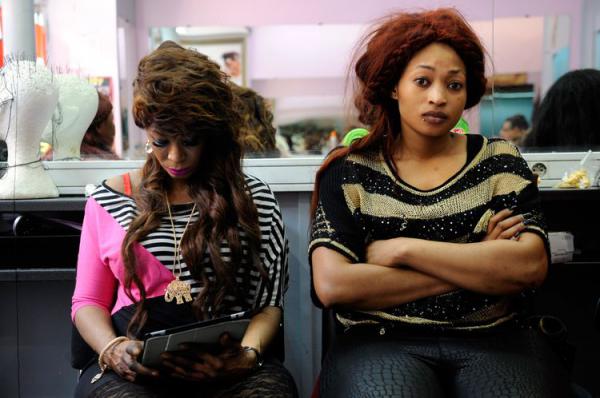
In Paris, this week 18 women and men, 14 of them undocumented immigrants, won an eight months battle for labor rights and human dignity. They are known as the workers of the “57” named after the address of the Afro Salon “New York fashion” 57 boulevard de Strasbourg in the heart of Paris.

They escaped their countries for various reasons. They are from Guinea, Ivory Coast, Guinea or China. Fatou left Ivory Coast because her life was threatened, she says that she wants to work and to pay her taxes to be part of the society. Alphonse from Burkina Faso had a visa to Turkey and then went to Greece where there was no work, and then came to Paris. He says that he had a lot of illusions, and then he saw how the bosses were merciless. His dream is to be finally happy. They each have a story rooted in intolerance and exploitation. They landed in Paris. Not all of them speak French. They all needed to work.

Many hair salons directed at migrant clients have settled in this district of Paris. Over time, a traffic involving the owners and managers targeted vulnerable and isolated migrants who needed work and dreamed about a safer more stable life. The managers recruited the workers of the 57 in the streets, enticing them with conditions of work and wages, which they never delivered. Instead, the workers had to work six days a week from 9AM to 11PM without interruption. The conditions were awful and harmful. The products they were asked to use contain carcinogenic agents, and they were used in rooms without ventilation increasing their toxicity. Their wages were extremely low from 300 to 400 Euros and irregularly paid.

Initially they had no work contracts. They first went on strike when they had not been paid in two months. Their bosses threatened to denounce them to the police, but they stood up for themselves. They reach out to the Union “CGT” for support after the managers and owners conveniently declared bankruptcy and disappeared, but not before shouting at them real threats against their lives. Their disappearance meant no possibility to regularize their immigration status.

As the general secretary of CGT Paris declared, this is modern slavery. They may not be physically shackled but the chains are now administrative and used by employers who exploit them. These chains are still heavy and violent. Still the techniques of slavery remained. The workers were separated according to language so they would not be able to communicate between each other.

But the workers responded with an extreme sense of solidarity. They endured threats. They disrupted the status quo with the authorities that allowed this worker trafficking to exist. Their courage and determination attracted attention. A group of film-makers made a little film to alert public opinion. Then, council members of the district and the deputy mayor of Paris multiplied the injunctions to the Minister of the Interior to obtain state protection, as required by law, for the workers. The union CGT pressed charges for human trafficking. Under French law, if an undocumented immigrant files an official complaint, the latter should receive a temporary residence permit. Regardless, the authorities were slow to move. While the workers were not going to be deported, their rights to work and to dignity were not restored. Artists mobilized and show their solidarity. Paris counselors of the leftist majority and the Mayor of Paris voted a text of support for the workers declaring that the non-protection of these employees will implicitly show support for these practices that imply exploitation of workers.

Finally, this week the Minister of the Interior regularized the 18 workers, providing then adequate documentation and the support of the state after eight months of hard struggle. Moreover, this victory is a good sign for many, especially those workers in this area who experience harsh conditions of life and work with abusive employers.

We should note that labor rights and laws to support them are being constantly questioned as human rights are again being defined according to origins and class. Their defense is crucial. At a time of merciless neoliberal control with climate and social destabilization, migration takes another dimension as asylum seekers are incarcerated or kept in unsafe situations threatening their lives. Cities like Paris should be involved in the protection of the most vulnerable residents and workers. Nothing is possible without strong solidarity between national, documented and undocumented humanity.

(Photo Credit: Africultures)