Lilian Oliva Bardales: “In prison when I haven’t committed any crime”

Lilian Yamileth Oliva Bardales, 19 years old, and her four-year-old son have been held in KarnesFamily Detention Center” since last October. She had applied for asylum, explaining that she had fled Honduras to escape an abusive ex-partner, six years older than she, who had beaten her regularly since she was 13. Her application was denied. Last Wednesday, she locked herself in a bathroom and cut her wrists. She was removed from the bathroom, held for four days under medical “supervision” during which she was denied access to her attorneys, and then, on Monday, suddenly moved from Karnes, presumably for deportation. From beginning to now, the treatment of Lilian Oliva Bardales has been a national disgrace.

Oliva Bardales left a note, the translation of which reads, in part: “I write this letter so you know how it feels to be in this damn place for 8 months. You don’t understand that people’s lives have no price and you cannot buy it with money. You don’t have a heart for anybody. You just lie and humiliate all of us who have come to this country … I do this because only God knows what I have suffered in my country. I come here so this country can help me but here you’ve been killing me little by little with punishment and lies in prison when I haven’t committed any crime. What hurts me the most is that I saw how my brother was killed and how it’s hurt my son and all the abuse that we suffered in my country. You don’t believe me you never wanted to give me my freedom. I do this because I would rather be dead than seeing my son fail along with me. Maybe you are not fathers or mothers to understand the reasons and the suffering that we live in this place together with our children. You would not like to be locked up in a place like this the way we are here suffering with our children. What I tell you is that nobody lives forever in this world one day we are all going to die and give an account to God. I do this because I don’t feel any life going back to my country. That’s why I waited so long so you could take a decision on my case but you have treated us worse than an animal …That’s why I do this because you were bad to me and my son. We did not deserve this. now you want to deport me after spending 8 months here.”

That’s “family detention”. It is the place where mercy dies a slow, tortured, mean, evil death:

The quality of mercy is not strained;
It droppeth as the gentle rain from heaven
Upon the place beneath. It is twice blest;
It blesseth him that gives and him that takes:
‘T is mightiest in the mightiest; it becomes
The throned monarch better than his crown:
His sceptre shows the force of temporal power,
The attribute to awe and majesty,
Wherein doth sit the dread and fear of kings;
But mercy is above this sceptred sway;
It is enthronèd in the hearts of kings,
It is an attribute to God himself;
And earthly power doth then show likest God’s
When mercy seasons justice.”

When mercy seasons justice. When degradation, abuse, torture and despair season the appeal for asylum … what then? Where are Lilian Oliva Bardales and her four-year-old son?


(Image Credit: McClatchydc.com)

Ameenah Gurib-Fakim is the first woman President of Mauritius!

Ameenah Gurib-Fakim, the new President of Mauritius

Last Friday, June 5, 2015, Ameenah Gurib-Fakim became the President of Mauritius. Gurib-Fakim is the first woman to hold that office. Maya Hanoomanjee, currently the Speaker of the National Assembly of Mauritius and the first woman to hold that post, described Gurib-Fakim’s ascension as an historic moment. Monique Ohsan-Bellepeau, the Vice-President of Mauritius and the first woman to hold that post, agreed.

Gurib-Fakim promises to break more than the gender barrier, although that would have been enough, and her life history suggests she’s not kidding. Gurib-Fakim is an internationally renowned biologist and chemist, with a Ph.D. in Organic Chemistry from the University of Exeter. She is currently Director of the Centre for Phytotherapy and Research and Professor of Organic Chemistry with an endowed chair at the University of Mauritius. From 2004 to 2010, she was Dean of the Faculty of Science and Pro Vice-Chancellor at the University of Mauritius. Ameenah Gurib-Fakim was the first woman professor at the University of Mauritius, where she was also the first woman Dean.

Gurib-Fakim is the leading scientist studying medicinal and aromatic plants and determining their health, nutritional and cosmetic uses. She’s all about respecting not only the local and indigenous flora but also those who care for the flora, more often than not women: “For a long time, people were suspicious of the `bad plants’ that I was studying for their medical properties. Some called me `witch’, and one night 20 years ago my lab was burned down.”

What do you call a feminist scientist witch? In Mauritius, you call her Madame President.

Since her nomination, Gurib-Fakim has been interviewed all over the place. In one interview, she talked of scientific diplomacy; bioparks and technology centers; the need for scientific data to be used as the basis for decisions in climate, agriculture and environmental policy; and her commitment to “reconcile scientific data with traditional practices”. Those traditional practices are women’s practices, largely.

In a separate interview, she answered the question of what her being a biologist brings to the Presidency: “I think not just as a biologist, but as a woman biologist. I’ve gone through the glass ceiling, and that’s an important message to send to young women and girls. Increasingly, young people are leaving the sciences, so I hope to be a role model to promote the learning of science, to make it interesting and sexy. I want to tell people, `Yes, it’s possible if you are a woman.’”

When asked about her entrance into government, Gurib-Fakim explained, “I did not choose politics but politics chose me.” Elsewhere, Gurib-Fakim noted that she was taken by surprise. Upon being inaugurated, Gurib-Fakim’s first statement was, “I feel great pride and humility. Those who reach the highest level of the State have no right to make mistakes. There’s great work ahead, especially as concerns women.”

Ameenah Gurib-Fakim may have been chosen by politics, but she’s been choosing all along, and, hopefully, will continue to do so.

(Photo Credit: AFP)

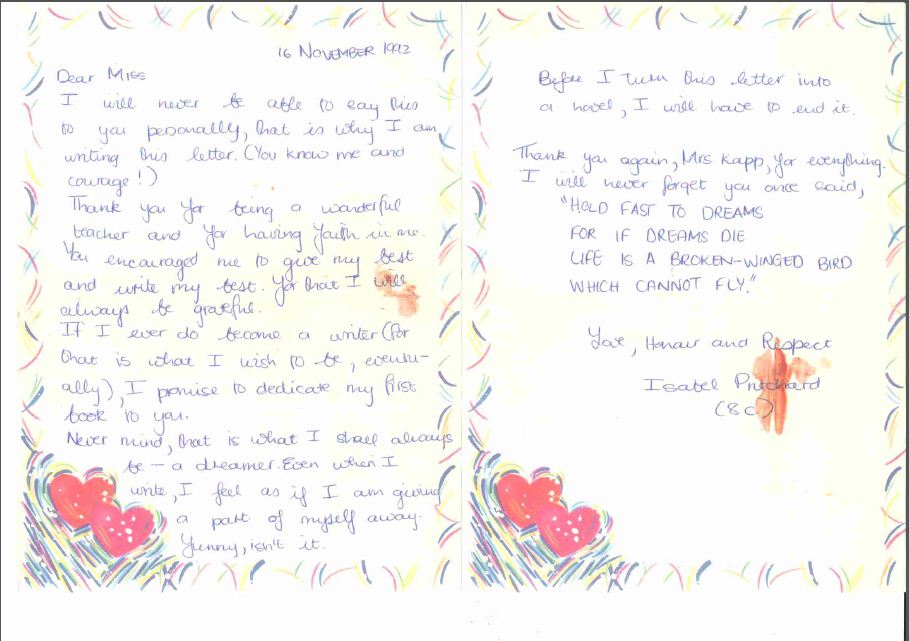
If I ever do (become a writer)

If I ever do (become a writer)
 
If I ever do become a writer
one Isabel Pritchard pens
a letter to her 8C teacher
at Oaklands High 1992
 
(thanking her for having 
faith in her promising 
to dedicate her first book to her)
 
Yet another bit of history
unearthed in our household
in between and betwixt Africa 
and Youth Months
 
If I ever do become a writer
for that is what I wish to be
a dreamer too she says
(sounds like teacher’s 
John Lennon influence)
 
When she writes she feels
as if she is giving a part
of herself away
 
(did she follow her passion 
her dream in some way 
educating and encouraging) 
 
She stops herself
(I will have to end it
says she dramatically)
before her letter turns
into a novel 
 
Ending with something 
her tea-drinkingly English
teacher quoted
 
Hold fast to dreams
for if dreams die
life is a broken-winged bird
which cannot fly
 
Did she stop herself
Did she hold fast and fly
 

A “Dear Miss” letter surfaces in the Kapp household, circa end-May into June 2015.

#SetHerFree: We want Yarl’s Wood to close, not just today, or tomorrow, but forever!


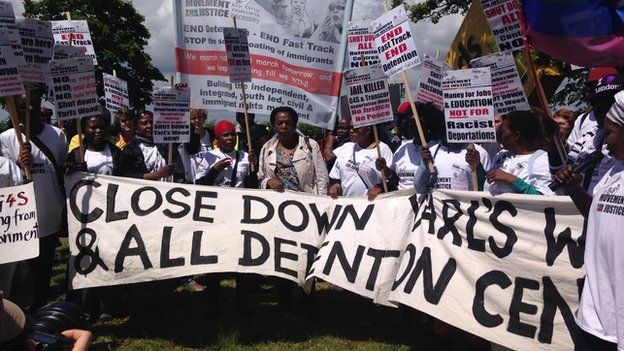
Hundreds of people showed up at Yarl’s Wood today, with one message. Shut it down now! Never open it again! Set her free! #SetHerFree. The hundreds included activists, organizers, advocates, and unusual suspects. Green Party and Conservative Party members showed up in support. Women chanted from one side of the fence surrounding the prison, and the women inside Yarl’s Wood responded, amplifying the demand to shut it down immediately and permanently. Lively protesters successfully pulled down parts of the outside perimeter fence, to the cheering of those inside as well as outside. Action unites.

The event was organized primarily by Women for Refugee Women, in coalition with other groups. Delighted at the numbers and energy of the turnout, Women for Refugee Women spokeswoman Sophie Radice commented, “The time was right for this protest because now people know what’s going on they want to take action. People come here to seek asylum and we lock them up like criminals. We will not stop campaigning until it is shut down … The atmosphere is defiant and it’s been a real show of force. We’ll carry on until the abomination that is Yarl’s Wood is shut down.”

When asked about the “problem with illegal immigration”, Shami Chakrabarti, director of the human rights organization Liberty, responded, “There is a problem in the world with turmoil and war and also for displaced people who need who need support and protection. But why should human rights abuses only be a justification for wars `over there’ and not refugee and human rights laws over here? … These brave women – some pregnant; some survivors of rape and torture; some suffering from mental or physical health problems – are indefinitely detained in a prison where abuse is endemic. Yarl’s Wood shames our great nation of immigrants – elsewhere criminal suspects detained without charge must be released after 14 days. Shut it down and set them free.”

As a local Conservative MP explained, 15 years ago, detention of asylum seekers was rare. Now “it’s the default.” It’s costly, ineffective, and inhumane, and that’s from a tough-on-immigration Conservative.

Yarl’s Wood is supposed to be the house of the dead, a factory that churns out packets of pain, suffering, and ultimately death. But the women of Yarl’s Wood have refused to lie down and die. They have rejected the special hell slotted for them. In 2010, at the age of 16, former Yarl’s Wood prisoner Meltem Avcil began campaigning to shut it down. In 2007, women asylum seekers banded together to take care of each other, help one another with anti-deportation campaigns, and to publicize the particulars of being a woman asylum seeker in Britain in 2007. They formed Women Asylum Seekers Together, WAST, as a women only safe space for those threatened every second of every day, women asylum seekers. Today, eight years later, they are all over the country.

Lydia Besong left Yarl’s Wood and wrote a play, How I Became an Asylum Seeker, which WAST took up and performed across the country. Nigerian lesbian feminist Aderonke Apata was dumped into Yarl’s Wood, or so they thought. She organized, founded Manchester MiSol, Manchester Migrant Solidarity, who hooked up with WAST, and today Yarl’s Wood was surrounded by chants, songs, and bodies pushing against the fence. Shut it down! Shut it down! Set her free!

Not long ago, WAST formed a choir, the Nightingales, who sing of women’s rights, women’s power, women’s dreams, and they begin, but it’s only a beginning, with this: “We want Yarl’s Wood to close, not just today, or tomorrow, but forever”. Sing it loud, sing it proud, shut it down, set her free, not just today, or tomorrow, but forever. Amen.


(Photo Credit 1: BBC)  (Photo Credit 2: Women for Refugee Women) (Video Credit: Channel 4 / YouTube)

A Tour of SCI Muncy: Always an elephant in the room

On March 10, 2015 I toured SCI Muncy along with seven members of a Pennsylvania non-profit. Of the seven, four of us visit Muncy on a regular basis. The day began with a meeting with Superintendent Robert Smith, Re-entry Coordinator and media spokesperson Troy Edwards, Assistant to Smith, Renee Shrimp, the health care administrator and a couple of Unit Managers and a couple of other people.

The meeting and conversation was lead by our questions and concerns. If we didn’t ask, nothing was freely offered. No one asked us about our work with the women. They didn’t seem to really care if we were there or not. This was my second meeting with Smith, when he was Acting Superintendent and he knows how hard it is for me to keep it together when wanting better care for the women and more involvement with their confinement. All of our needs were met, though there always seemed to be an elephant in the room. If we didn’t like what we heard or if we disagreed, that line of thought quietly evaporated. We all seemed to be on our best behavior.

There’s a lot at stake at times like this. How much pushing for the real truth can I do or objecting to policy without experiencing potential retaliation and my visits becoming denied? Questions and comments had to go nameless. Situations were described with just enough detail so as not to reveal the actual source. Occasionally names were mentioned, since the prisoner’s needs and situation were so obviously known to all. I hope that some of the concerns we raised made the staff realize that we are watching and we want to be part of the solution.

In the bathroom connected to this meeting room, I noticed many beautiful black and white photos mounted on board depicting woman at Muncy with their faces turned away from the camera involved in work: sewing, washing dishes, stuffing pillows with straw. I assumed they were taken before Muncy became part of the PA DOC in 1953. They were on the floor, fallen and stuck between the cabinet and the floor, gathering dust and scratches. I wanted to smuggle them out. On the windowsill was a large box of documents that belong to a current prisoner. I didn’t have time to go through them. But it seemed rather cold and careless to be dumped there.

After an hour and 45 minutes, I had talked and listened enough and needed to get moving. As I peeked on the tour itinerary that was in front of Smith, I asked him if we were touring the unit where Sharon Wiggins lived and died. It wasn’t on the schedule, but Superintendent Smith knows my devotion to Sharon and he agreed to take us there. It was our first stop and we went into Bethune Unit.

Bethune is neither a cottage nor a trailer/modular. It’s kind of a prefab gym. I immediately noticed all the various shades of over cleaned, dull surfaces of brown and beige: the flooring, walls, painted metal. It was all metal, vinyl, plastic materials. I immediately saw my friend Naomi Blount. We were not allowed to hug, but we managed some arm holding. She showed me her cell. This was the first cell in a woman’s prison that I have seen and entered. No doubt the cell had been personalized, but the condition of the “furniture” was shockingly awful. Rickety old metal that revealed several layers of multiple colored paint. The floor space between the bunk beds isn’t wide enough to do sit-ups. The mattress wasn’t as wide as the bed frame. It would tough to lay on one’s side without touching the wall and having a foot hang off the edge. The window was tiny. Only one seat at the table. A new plastic toilet seat. Oddly, the ceiling is a drop panel type.

The setting of Muncy is rural. During the summer the aroma of cow manure permeates. The rest of the year, it smells like creosote from a rail road tie processing company across the 405. The original residential “cottages” are almost a century old. To accommodate the increase in population, they added huge, attached trailers with low ceilings. It looks cheap and shoddy, because it is.

When the women sit on the top bunk bed, their heads are a couple of feet from the ceiling. There is no privacy. The newest housing is where the new arrivals are classified; it also holds punitive punishment, various mental health “treatment” units, young adult offenders and death row. The infirmary in another kind of warren. There, the psychiatric observation cells are located, medicine is distributed, dialysis is given and terminally ill women die. No one wants to recuperate in the infirmary. It is ugly, impersonal, poorly lit and brown-beige.

We had lunch in the officer’s dining room. The walls were adorned with unsigned prisoner-made art. As you finish your tray of food, you leave it on the table to be taken away by a prisoner employee. I thought that was rude on our part as visitors.

Unfortunately, we ran out of time and didn’t see the education building, library or chow hall. That will be another tour.


Keep food companies out of WHO policy-making!


The hours of women’s lives spent “grinding, chopping, and cooking,” as Rachel Laudan put it recently, add up to servitude for those like her mother who prepared “homecooked breakfast, dinner, and tea for eight to ten people three hundred and sixty-five days a year.”

But food companies solved that problem for us, right?  They made our lives easier. They squeezed the sweet syrup right out of the corn and baked it into our bread for us.  They went to the lab and found the chemicals that make food last longer on our shelves.  They even determined the precise combinations of salt, fat, and sugar that make food taste good, helping us keep our kids fed.  No more scurvy, no more rickets.  No more weeks upon weeks of potatoes and tea at every meal.  Instead:  variety! deliciousness! ease! availability!  Or in other words, “food products.”

There’s no doubt that industrial food has changed the ways of life of people around the world. Food companies’ solution to a previous problem, though, has created its own set of new problems. Poor working conditions, environmental degradation, and obesity are just a few.

And now, even though there is almost universal agreement that processed food is not good for the bodies that eat it or the bodies that produce it, food companies are doubling down. They don’t want to bow out gracefully, as in, “It’s been a nice run, y’all! Thanks for all the money!” Instead, they want more involvement in our foodways.

The kind of involvement they are vigorously pursuing right now are public-private partnerships. These partnerships are beneficial, food companies say, because they allow them to “work together” with the state toward their “common goals.” Public-private partnerships with food companies have been embraced in the United States in the form of associations like the Partnership for a Healthier America and the Alliance for a Healthier Generation. The United Nations, too, has declared that a spirit of cooperation with the private sector is good for everybody.

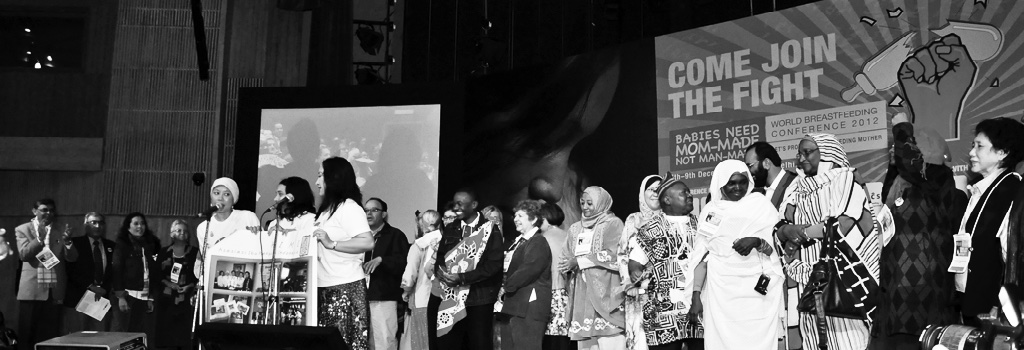
Now the World Health Organization (WHO) is debating a new Framework of Engagement with Non-State Actors (FENSA). In English, this means they’re trying to determine how much influence for-profit corporations should have in WHO policy-making. Organizations like the International Baby Food Action Network (IBFAN), along with nearly two dozen others, want a strict barrier between companies and the WHO. “Proposals for ‘multi-stakeholder partnerships,’” they say, “would designate junk food manufacturers as partners in the task of addressing obesity, heart disease and stroke.” They don’t want the fox guarding the hen house.

WHO member states should stand firm on FENSA, resisting corporate efforts to set their own terms and escape regulation. While industrial food may have made some women’s lives easier, it has exacerbated inequalities for those who produce it and resulted in high rates of life-threatening health conditions for those who have little choice but to consume it. More corporate involvement will result in less regulation, fewer safeguards, and an expansion of an industry that should be contained and fundamentally reformed.

To express your support for keeping food companies out of WHO policy-making, you can contact the IBFAN here.


(Photo Credit: IBFAN.org) (Video Credit: NPR / CBS / AP)

African women farmers reject the same old business as usual

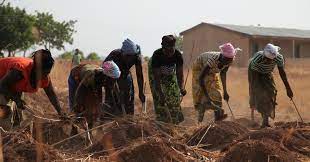
Members of the Rural Women’s Farmers Association of Ghana (RUWFAG) prepare a field for sowing.

The World Economic Forum is meeting this week in Cape Town, with much self-congratulation on “economic growth”, “poverty eradication”, and “women’s empowerment”, all brought by those who engineered a world economy based on growing inequality, galloping individual debt, expanding precarization of labor, and anything but the empowerment of women. Part of this circus maximus is the meeting, held largely behind closed doors, of the partners of the New Alliance for Food Security and Nutrition. Across Africa, women farmers see this “new alliance” as the same old same old, and they’re not buying it.

The New Alliance, cooked up by the G8 and the European Union in 2012, sports all the “right language”: transformation, growth, partnership, security, sustainability, sharing. But the New Alliance opens ever-larger amounts of land to corporate investors and multinational agro-corporations, because nothing says sustainable security like over-the-top investments, land grabs and the forced eviction of local populations. Women farmers’ organizations have decried the physical and cultural violence of this project. They have protested the Alliance’s refusal to consult, and they have shown the devastation this “new alliance” harvests from the destruction of women’s bodies and lives.

But what do women farmers know about food security or nutrition, and, in particular, what do African women farmers know? Once again, they must be saved from themselves.

The premise of the New Alliance is that “land titling” will fix everything. Here’s what’s actually happened. Malawi was induced to release about a million hectares, or 26 percent of the country’s arable land, to large-scale commercial farming. According to ActionAid, “Land titling can give small-scale food producers more security over their land, but in the current New Alliance-related processes, it appears to be a way to primarily help governments facilitate large-scale acquisitions of land. Secure land tenure does not necessarily require individual land ownership but can be achieved with clearly defined and sufficiently long-term use rights over land that is ultimately state property. The abolition of customary or communal tenure systems and their replacement with freehold title and the private land market has often led to extinguishing the land rights of the poor, notably women.”

Notably women. Yet again, the “new” produces wider and deeper vulnerability, especially for women, all in the name of security and sustainability. This new is not so new.

Malawi women farmers are not the only targets. Women farmers in Nigeria, Senegal, and Burkina Faso report the same, as do women farmers in Tanzania. As Tanzanian farmer Anza Ramadhani explained, “We never had a chance to influence the decisions concerning our land and future. There has been no transparency whatsoever. We don’t know if we will be resettled, where it will be or if we will be compensated. We don’t know how much the compensation will be or if it will be at all.”

In Ghana, women farmers are threatened with being forced to give up their control, and knowledge of seeds, by a new law, called the “Monsanto Law”, which would restrict, and even prohibit, storing and trading seeds. This law is a condition of New Alliance aid. The new is not at all new. As farmer Esther Boakye Yiadom explains, “My mother gave me some seeds to plant, and I’m also giving those seeds to my children to plant. So that is ongoing, every time we transfer to our children. And that is how all the women are doing. We don’t buy, we produce it ourselves.” Patricia Dianon, chair of the Rural Women Farmers Association of Ghana and traditional queen, agrees, “After harvesting, the women are able to store the seeds … They are able to dry it, tie it, and preserve it … So when the year comes, they bring these seeds to sow again.” Victoria Adongo, Program Director for the Peasant Farmer Association of Ghana, concurs, “Seed is where you grow your food from. So if you save the seed, then you grow food the following year. It’s very economical because you don’t have to go and buy seed. That is what we farmers have always done … We, the small holder farmers, want to have good lives. We want to be healthy. We have our seed systems that we like and are proud of. So we do not want multinational companies to come in and take over our seed systems.”

In the pursuit of profit, the New Alliance condemns women to “new” lives of increasing, intensifying and expanding vulnerability, hardship, and disposability. Across Africa, women farmers are saying NO! to the international delegation of liars and thieves. They are saying, “We don’t buy, we produce it ourselves. We want good lives. We want to be healthy.”


(Photo Credit: Global Justice Now / Common Dreams) (Video Credit: Global Justice Now / YouTube)

In Canada two Mexican women workers win a victory for women workers everywhere!

Since 1973, Canada has run the Temporary Foreign Worker Program, or TFWP. Initially designed to bring in `high-skilled’ and specialized workers, in 2002 it was revised in order to bring in “low-skilled” workers who now make up the overwhelming majority of TFWP workers. Eight years ago, two Mexican sisters took on the injustice of the TFWP and, last week, won a landmark victory for women workers everywhere.

In August 2007, two sisters, now known as O.P.T. and M.P.T., left Mexico to work in Canada under the Temporary Foreign Worker Program. They were employed by Presteve Foods Ltd, in Ontario, owned at the time by Jose Pratás. At the time Pratás was 74. O.P.T. is now 36 years old, and her sister is 30.

According to both sisters, Pratás immediately started making explicit sexual advances towards O.P.T. and then demanded sex. Whenever O.P.T offered resistance, Pratás would threaten to send her back to Mexico. This was no idle threat. Under the TFWP, “temporary workers” are attached to their employers. In the Spring of 2008, O.P.T. fled Presteve, moved to Windsor for a bit, and then returned to Mexico.

In the Spring of 2009, the CAW-Canada union, now called Unifor, filed a brief with the Human Rights Tribunal of Ontario, on behalf of 39 Thai and Mexican women workers employed at Presteve. Then things moved both quickly and slowly. Pratás was charged with 23 criminal charges of sexual assault and five counts of common assault, all involving women “temporary foreign workers”. In March 2010, Pratás pleaded guilty to one count of assault, and received a conditional sentence and some probation.

Ultimately, of the original 39 claimants, only O.P.T. and M.P.T. were left to challenge the power of Presteve Foods, Jose Pratás and the entire Temporary Food Works Program.

Last Wednesday, the Human Rights Tribunal of Ontario handed down its decision and awarded O.P.T. a record $165,000 as compensation for “injury to her dignity, feelings and self-respect”. The Tribunal also awarded M.P.T. $55,000. Pratás and Presteve Foods, now owned by Pratás’s son, must pay the two sisters $220,000 for having created a “sexually poisoned work environment”.

After the hearing, O.P.T. said, “I want to tell all women that are in a similar situation, that they should not be silent and that there is justice and they should not just accept mistreatment or humiliation. We must not stay silent. [As a migrant] one feels that she or he has to stay there [in the workplace] and there is nowhere to go or no one to talk to. Under the temporary foreign worker program, the boss has all the power – over your money, house, status, everything. They have you tied to their will. It has been 8 years to obtain justice but 8 years and justice is finally here today.

If we don’t do what they say, they have the power to deport. We are obligated to work. Not as people, but as slaves. We endure wage theft, verbal abuse, physical abuse, and our bodies are injured because of the stress of the work. They push and push us. How can you say that we are free when in practice we have no right to leave?

“But how can we leave, if we cannot work for another employer. They harm us, and then they send us home. There is racism underlying their treatment of us. How is this allowed in Canada? That happened to me eight years ago, and the system is still the same. Treat us with dignity. Not as animals. But as human beings who merit respect.

Even when we have been humiliated and mistreated, we have to hang on to our dignity. That is all we have.”

Canada created a system in which workers were tied, handcuffed, to their employers, in which workers were forced into almost complete dependence on employers. Employers then sought women workers, whom, by law, they are allowed to pay less for the same work as male workers in the program. Women in the caregivers’ program suffer the same violence.

O.P.T’s and M.P.T.’s victory is a victory for women workers across Canada and around the world, as they struggle with the violence of `national economic growth.’ We have to hang on to our dignity. That is all we have.


(Photo Credit: thestar.com)

From Connecticut to Oregon, women fight for domestic workers’ rights and power


Across the United States, women are organizing for domestic workers’ rights and power. According to the National Domestic Workers’ Alliance, in the next week, the Illinois Domestic Workers Bill of Rights will hit the Illinois State Senate; the Connecticut Domestic Workers’ Bill will go to the Connecticut House of Representatives; and the Oregon Domestic Workers’ Bill of Rights will arrive on the floor of the Oregon State House of Representatives. From sea to shining sea, domestic workers – maids, nannies, and home health care providers – are on the move and winning previously thought impossible battles. Women, overwhelming women of color and largely immigrant women, are transforming a subterranean network into an Overground Railroad of emancipation and enfranchisement. Connecticut, Illinois, and Oregon are stations on that system.

In so doing, women are re-writing history. While every labor victory rewrites history, these particular struggles involve not only State and Civil, or uncivil, Society disrespect and marginalization. They involve the words and texts of law. In Connecticut, for example, domestic workers’ struggle for dignity, rights, power, and better working conditions is aimed at re-writing the State definition of “employer.” Under Connecticut law, “employee” is defined as “any person employed by an employer but shall not include any individual employed by such individual’s parents, spouse or child; or in the domestic service of any person.” The Domestic Workers’ Bill of Rights eliminates the last clause: “or in the domestic service of any person.”

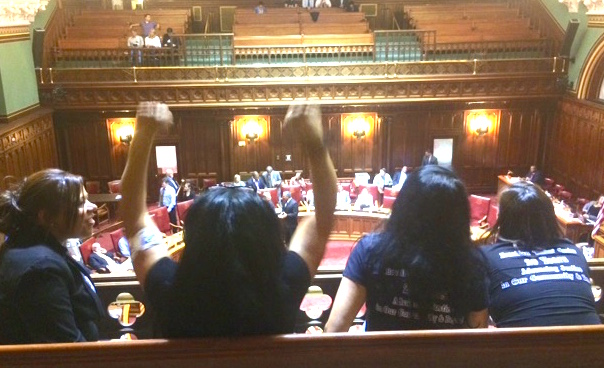
On Friday night, the Connecticut Senate passed the Domestic Workers’ Bill of Rights. Domestic workers – such as Natalicia Tracy, Iame Manucci, Maria Lima and Nina Siqueira – danced and shouted from the gallery, as the final vote was tallied. But they understand that this is the next step. Not only must the House of Representatives pass the Bill, but domestic workers must then militate further to be included in the State’s minimum wage law. That protection is not guaranteed under the Bill of Rights.

In Illinois and Oregon, it’s the same. Domestic workers are pushing to do much more thatn “come out of the shadows.” They have never been “shadow workers”. They have always been women workers on the move, and now the move has risen and expanded to the next stage.

The exclusion of domestic workers from labor law emerges from the explicitly racist foundations of slavery and Jim Crow. Domestic workers writing and promulgating Domestic Worker Bills of Rights participate in an ongoing Black and Brown Workers’ Liberation Movement. Within and beyond #BlackWomensLivesMatter and #SayHerName, domestic workers are pushing and expanding the terrain of emancipatory struggle. A luta continua! The struggle continues!

(Photo credit: Mark Pazniokas / Connecticut Mirror)

Nine Zimbabwean women say NO! and win a victory for women everywhere!


On March 17, 2014, police in a residential area of Harare arrested nine women – Chipo Nyamanhindi, Chipo Mwedziwendira, Lorraine Marapira, Beuty Kaseke, Tionesei Nyaude, Dorcas Linda, Selina Shoko, Memory Muchena and Colleter Chisedzi – for the `crime’ of being women out after dark. The arrest was part of Operation No to Robberies and Prostitution, which `swept’ the after-dusk streets of urban Zimbabwe clean of any scent of a woman by declaring that any woman out alone at night must be a sex worker. The nine women collectively said NO! NO to criminalization of women’s bodies and lives. NO to the trashing of the Constitution whenever women are involved. NO to the sexual and gender reign of terror. And yesterday Zimbabwe’s Constitutional Court agreed with the women, and stopped the prosecution. While the decision officially addresses only the case of these nine women, it has major implications for women across Zimbabwe, and, beyond that, is a major victory for women everywhere.

The women argued that the whole process – arbitrary arrest, detention, prosecution – violated their Constitutional rights. Though the police claimed the women were arrested for solicitation, no evidence was provided, other than standing on a street. They argued that police indiscriminately arresting women for the `crime’ of being out at night violated their right to freedom of movement. Finally, the women argued that the State never actually provided any material evidence of any actual solicitation, by deed or word. There was no there there, except for the women being there.

The Justices agreed, declaring that the police action amounted to a deprivation of liberty and a denial of the right of citizens to the protection of the law, as guaranteed by the Constitution of Zimbabwe.

Police harassment of women is nothing new. In the early 1980s, the State went into a moral panic about gains women had made with independence, and so, on October 1983, the State launched Operation Clean-Up, which captured women and girls in a single move. The ostensible target was `prostitution’. According to Zimbabwean feminist Shereen Essof, “Operation Clean-Up was dramatic enough to provoke a change in Zimbabwean women’s consciousness. It appeared that state patronage allowed little room for the advancement of women’s rights and with this gradual recognition a different kind of women’s organisation was born.”

In 2007, the State again clamped down, swept the streets, and hunted women for their political activism and for being women. This time, however, instead of searching `prostitutes’, the police went after “Tsvangirai’s whores.” (Morgan Tsvangirai was the leader of the opposition Movement for Democratic Change.”

For Zimbabwean feminist Everjoice Win, the structural abuse of women in Zimbabwe is the intersection of colonialism, patriarchy, and heterosexism. In response the Constitutional Court, Win tweeted, “So #ZRP [Zimbabwe Republic Police] had to be told not to arrest women under the pretext BLACK women on their own in cities after dark’re sex workers? Let us just name ‪#ZRP actions against black-single women in cities for what it is; policing women’ bodies & imposing outmoded moral values. Truth is #ZRP only targets BLACK younger women. This comes from colonial history, mindset, which saw all of us as `vectors of disease’. They say ‘Zim will never be a colony again’. Colonialist-hetero-sexism rules ‪#ZRP. Random arrests of black women=enforcing colonial rules.”

Zimbabwe Lawyers for Human Rights, who represented the nine women in court, noted, “The landmark ruling by the Constitutional Court is likely to be welcomed as a major reprieve by gender equality and human rights groups that for years have been seething with anger at the gender discrimination associated with the ZRP’s operations and help bring to an end the notorious police practice of indiscriminately rounding up women under the guise of clamping down on prostitution.”

Indiscriminately rounding up women under the guise of clamping down on prostitution is more than common police practice in every global city in the world. It’s part of State urban development policy. If you live in a global or just a big city, visit your local women’s jail and see who’s there, and find out why. You’ll see. And if you do, tell the women there about the Harare 9, about the victory that occurred this week in Zimbabwe and what it could mean for women everywhere. Tell them we are seething with anger and hope.


(Photo Credit: Research and Advocacy Unit)